- Market Value (2025): USD 115.3 Mn
- Estimated Value (2026): USD 426.2 Mn
- Forecast Value (2036): USD 129.9 Mn
- CAGR (2026-2036): 12.6%
What is the Carbon Nanorod Market forecast to be worth by 2036?
USD 129.9 million in 2026 to USD 426.2 million by 2036 at a 12.6% CAGR.
- Carbon nanorod demand came to USD 115.3 million in 2025, with automotive compounds and conductive electronic parts taking most of the volume.
- Revenue will reach USD 426.2 million by 2036, up from USD 129.9 million in 2026, as battery makers and vehicle suppliers move from trial lots to contract volumes.
- A 12.6% CAGR will carry the market from 2026 to 2036, since each new cell line or fuel system platform that qualifies a grade turns into a repeat order.
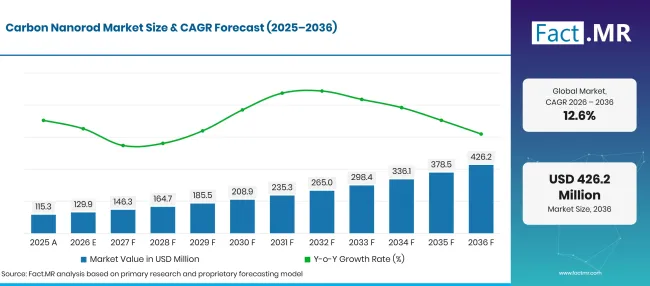
Factmr Carbon Nanorod Market Forecast Global | Source: Fact.MR
| Year | Basis | Market Value (USD million) |
|---|---|---|
| 2025 | Actual | 115.3 |
| 2026 | Estimate | 129.9 |
| 2036 | Forecast | 426.2 |
| CAGR 2026 to 2036 | Forecast period | 12.6% |
Source: Fact.MR analysis. Updated Oct 30, 2026
What are the defining numbers behind Carbon Nanorod Market growth?
The market will gain USD 296.4 million in new value between 2026 and 2036, drawn mostly from vehicle parts and battery electrodes.
- Demand Drivers in the Market
- Battery developers are testing carbon nanostructures in chemistries beyond lithium-ion. In December 2025, India’s Technology Development Board backed a NOPO Nanotechnologies feasibility study on adding single-walled carbon nanotubes to sodium-ion batteries [1]. Work of this kind gives single-walled grades an early route into grid storage cells.
- Cell makers are signing long-term supply deals for single-walled carbon. OCSiAl and Molicel announced a partnership in May 2025 under which OCSiAl supplies nanotubes for both the anode and the cathode of Molicel’s high-power cells [2]. A qualified supplier position on one cell often leads to orders for the next generation.
- Vehicle electrification raises the number of parts that must conduct current or shed static. The International Energy Agency reported that electric cars reached a 25% share of global car sales in 2025 [3]. Battery housings, sensor casings and fuel lines all need conductive plastics that stay light.
- Electronics makers want thinner parts that still move heat and dissipate charge. Rod-shaped carbon reaches a conductive network at low loading, so housings and trays keep their surface finish and strength.
- Ready-to-use masterbatches and pastes lower the barrier for new buyers. Compounders can now order pre-mixed grades instead of handling dry nanomaterial powder, which shortens qualification and reduces dust exposure on the plant floor.
- Key Segments Analyzed
- By Product Type: Single-Walled Carbon Nanorods will hold 56.4% share in 2026, as cell makers pay a premium for conductivity at a fraction of the loading needed with other carbons.
- By Application: Electronics will account for 34.1% share in 2026, reflecting steady use in antistatic packaging, shielding films and thermal pads.
- By End-User: Automotive will command 57.2% share in 2026, given that fuel systems, battery packs and painted plastic panels all call for conductive compounds.
- Analyst Opinion at Fact.MR
- Shambhu Nath Jha, Principal Consultant at Fact.MR, states, “Vehicle programs already buy carbon nanorods by the tonne, and battery work will add a second large outlet within this forecast period. The gap between a lab result and a qualified part is still dispersion, so suppliers that ship grades in a ready-mixed form will win more programs. Price per kilogram will count for less than conductivity per gram of additive.”
- Strategic Implications
- Nanorod producers should publish batch-level purity and wall-structure data, since automotive and cell buyers now ask for it before any trial order.
- Compounders should develop masterbatches matched to the resins used in fuel lines and battery housings, so vehicle suppliers can skip in-house mixing.
- Battery developers should run single-walled grades in pilot electrodes early, given that a late change of conductive additive restarts cell qualification.
- Electronics part makers should test nanorod-filled films and pads against their own heat and static targets before committing to a single grade.
The United Kingdom leads the five-country set at 15.4% CAGR, as public materials funding helps research move into production. Germany follows at 14.7% with a deep vehicle export base and a new microelectronics plan. Brazil reaches 12.6%, where battery storage plants open a fresh outlet. Japan grows at 10.5% from a strong nanocarbon research base. The United States trails at 9.1%, with battery manufacturing programs shaping demand after a cooler year for electric car sales.
How does the Carbon Nanorod Market break down by segment?
Single-Walled Carbon Nanorods will lead Product Type at 56.4%; Electronics will head Application at 34.1%; Automotive will top End-User at 57.2%.
Which Product Type leads?
Single-Walled Carbon Nanorods take 56.4% of 2026 revenue.
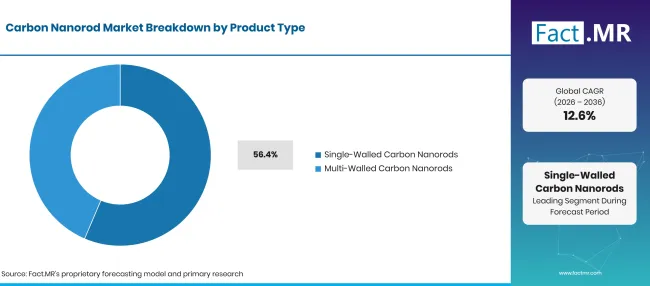
Carbon Nanorod Market Breakdown Product Type | Source: Fact.MR
| Product Type | Share (2026) |
|---|---|
| Single-Walled Carbon Nanorods (Leading segment) | 56.4% |
| Other segments combined | 43.6%* |
| Total | 100.0% |
Source: Fact.MR analysis. Updated Oct 30, 2026
Electrode engineers and film makers look for the lowest additive dose that still gives a continuous conductive path. Single-walled structures reach that point at minimal loadings, which leaves more room for active material in a cell. That advantage carries over to sodium-ion batteries, where conductivity in hard carbon anodes is a known weak spot. Multi-walled grades cost less per kilogram and are grown at larger scale, so they remain the default in plastics and rubber. They also blend well with chopped carbon fiber in structural composites that need some conductivity. Buyers often hold both types on their approved list and pick by part.
What supports Electronics within Application?
Electronics represents 34.1% of 2026 value.
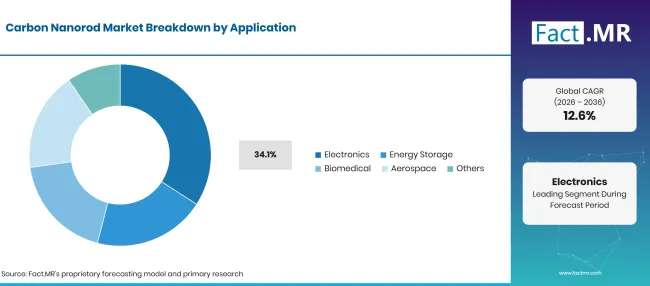
Carbon Nanorod Market Breakdown Application | Source: Fact.MR
| Application | Share (2026) |
|---|---|
| Electronics (Leading segment) | 34.1% |
| Other segments combined | 65.9%* |
| Total | 100.0% |
Source: Fact.MR analysis. Updated Oct 30, 2026
Chip handling, displays and sensors all need parts that resist static and spread heat in a small space. Nanorod-filled films and pads serve as thermal interface materials in dense modules, and conductive trays protect wafers in transit. The supply base for these parts is growing in Europe. A German government reply to parliament in October 2025 put employment in the Silicon Saxony microelectronics cluster at about 81,000 people [4]. Energy storage follows as the next application, built on conductive additives for electrodes and for supercapacitors. Biomedical use stays small and slow, owing to long safety testing for implants and drug carriers. Aerospace buyers test nanorod layers for lightning strike protection and de-icing, though qualification cycles there run for years.
How does End-User shape demand?
Automotive buyers account for 57.2% of 2026 sales.
| End-User | Share (2026) |
|---|---|
| Automotive (Leading segment) | 57.2% |
| Other segments combined | 42.8%* |
| Total | 100.0% |
Source: Fact.MR analysis. Updated Oct 30, 2026
Vehicle makers specify conductive plastics for fuel lines, connectors and painted body panels, and every platform is ordered in high volume. Electric drivetrains add battery housings and sensor shields to that list. The IEA also counted 441,000 electric trucks sold worldwide in 2025, more than double the previous year [3]. Heavy vehicles carry larger packs and need more shielded electronics per unit. Electronics makers form the second end-user group, followed by healthcare, aerospace and defense. Chip content per vehicle keeps rising, and automotive semiconductors need cooler and better-shielded packages. Defense buyers pay more per kilogram but order in small lots.
What is accelerating Carbon Nanorod Market adoption, and what is holding it back?
Electric vehicles, new battery chemistries and denser electronics are adding uses that need conductivity at low weight. High production cost, uneven batch quality and long part qualification still keep many buyers on carbon black.
Drivers Impact Analysis
| DRIVER | (~) % IMPACT ON CAGR | GEOGRAPHIC RELEVANCE | IMPACT TIMELINE |
|---|---|---|---|
| Conductive compounds for fuel systems, battery housings and vehicle electronics | +3.9% | Global | Medium term (2-4 years) |
| Single-walled additives in lithium-ion and sodium-ion electrodes | +2.8% | East Asia, North America, Western Europe | Long term (>= 4 years) |
| Antistatic and thermal parts for chip handling and dense electronics | +2.0% | East Asia, Western Europe | Medium term (2-4 years) |
| Ready-to-use masterbatches and pastes that shorten qualification | +1.4% | North America, East Asia | Medium term (2-4 years) |
Source: Fact.MR analysis. Updated Oct 30, 2026
Opportunity Impact Analysis
| OPPORTUNITY | (~) % IMPACT ON CAGR | GEOGRAPHIC RELEVANCE | IMPACT TIMELINE |
|---|---|---|---|
| Nanorod films and pads for semiconductor packaging heat control | +1.3% | East Asia, North America | Long term (>= 4 years) |
| Conductive additives for sodium-ion and grid storage cells | +1.1% | Global | Long term (>= 4 years) |
| Masterbatches for conductive automotive and industrial polymers | +0.8% | Western Europe, North America | Medium term (2-4 years) |
| Printed transparent conductive films for touch panels and solar electrodes | +0.4% | East Asia | Medium term (2-4 years) |
Source: Fact.MR analysis. Updated Oct 30, 2026
Restraints Impact Analysis
| RESTRAINT | (~) % IMPACT ON CAGR | GEOGRAPHIC RELEVANCE | IMPACT TIMELINE |
|---|---|---|---|
| High synthesis and purification cost for single-walled grades | -0.7% | Global | Short term (<= 2 years) |
| Batch-to-batch variation as producers scale output | -0.4% | Global | Medium term (2-4 years) |
| Long qualification cycles in vehicle, aerospace and medical parts | -0.3% | North America, Western Europe | Long term (>= 4 years) |
Source: Fact.MR analysis. Updated Oct 30, 2026
Which countries are scaling the Carbon Nanorod Market through 2036?
| Country | CAGR (2026 to 2036) |
|---|---|
| United Kingdom | 15.4% |
| Germany | 14.7% |
| Brazil | 12.6% |
| Japan | 10.5% |
| United States | 9.1% |
Source: Fact.MR analysis. Updated Oct 30, 2026
How is the United Kingdom scaling demand?
15.4% CAGR, driven by public funding that moves new materials from research into production.
In February 2026, the UK government announced an £80 million National Materials Innovation Programme to help British materials innovations reach market faster and keep production at home [5]. Vehicle demand adds a second pull. The Department for Transport reported that zero emission vehicles made 19.9% of new road-using registrations in 2025 [6]. University spinouts in nanocarbon can now find funded routes to pilot scale.
What supports Germany’s adoption?
14.7% CAGR, backed by a large electric car export base and a national microelectronics strategy.
German carmakers ship electric models across Europe and beyond, and each one carries conductive plastics in its battery and fuel systems. Destatis reported that battery-electric cars took 28.1% of German new car exports by quantity from January to July 2026, about 560,000 units [7]. In October 2025, the federal cabinet adopted a Microelectronics Strategy covering chip design, research transfer, skills and investment incentives [8].
How is Brazil developing demand?
12.6% CAGR, helped by new battery storage manufacturing and grid projects.
Brazil is building a domestic battery storage industry. In February 2026, the Brazilian Development Bank (BNDES) approved R$280 million for WEG’s energy storage plant in Itajaí, Santa Catarina [9]. The plant will produce up to 2 GWh of storage systems a year, or 400 units of 5 MWh [9]. Local cell and pack makers will need conductive additives as they scale, and Brazil’s large plastics industry offers a second outlet.
How does Japan perform?
10.5% CAGR, reflecting national research into nanotube processing for printed electronics and batteries.
Japan’s public laboratories are solving the dispersion problem that limits nanocarbon use. In January 2026, AIST reported an AI-guided process that disperses carbon nanotubes without ultrasonic treatment [10]. The resulting printed films reached 90% light transmittance with a sheet resistance of 35 ohms per square, which AIST described as the best printed result of its kind [10]. Touch panels, solar electrodes and battery materials are the named targets.
What is supporting the United States’ adoption?
9.1% CAGR, as federal battery manufacturing programs offset a slower pace in electric car sales.
In October 2026, the U.S. Department of Energy launched the Battery Manufacturing Accelerator, a consortium led by Pacific Northwest National Laboratory to move new battery technologies into U.S. production [11]. Electric car demand has cooled after federal tax credits expired. The U.S. Energy Information Administration reported that battery electric vehicles hit a record 12% of light-duty sales in September 2025, then fell to 6% in the third quarter of 2026 [12].
Who leads the Carbon Nanorod Market?
Three supplier groups compete for this market. Chemical majors such as Arkema and Cabot Corporation sell multi-walled grades alongside binders and conductive carbons, so they win when a buyer wants one partner for the whole electrode or compound. Arkema showed its Graphistrength nanotubes for conductive battery pastes at CIBF in May 2025 [13].
Volume specialists, Nanocyl and Hyperion Catalysis, compete on ready-to-use masterbatches and resin-specific concentrates for vehicle and electronics parts. Single-walled producers, OCSiAl, Thomas Swan and Raymor Industries, compete on purity and low loading. OCSiAl became an approved supplier to Molicel for high-power cells in May 2025 [2]. Cheap Tubes serves laboratories and pilot lines that buy small lots of many grades. From here to 2036, contracts will favor suppliers that hold dispersion quality steady across plants and can qualify new grades with vehicle and cell customers within a single program cycle.
Which companies are the key providers?
Key companies include Arkema S.A.; Cabot Corporation; OCSiAl; Nanocyl S.A.; Hyperion Catalysis International Inc.; Thomas Swan & Co. Ltd.; Raymor Industries Inc.; and Cheap Tubes Inc.
- Arkema S.A.
- Cabot Corporation
- OCSiAl
- Nanocyl S.A.
- Hyperion Catalysis International Inc.
- Thomas Swan & Co. Ltd.
- Raymor Industries Inc.
- Cheap Tubes Inc.
What is the report’s scope and coverage?
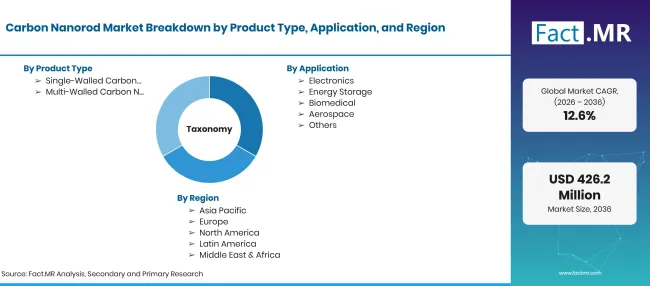
Carbon Nanorod Market Taxonomy | Source: Fact.MR
| Attribute | Details |
|---|---|
| Quantitative Units | USD million |
| Market Definition | Rod-shaped tubular carbon nanostructures with single or multiple graphitic walls, sold as powders, masterbatches or pastes for conductive, thermal and reinforcing uses. Revenue is counted at the material level. |
| Product Type | Single-Walled Carbon Nanorods; Multi-Walled Carbon Nanorods |
| Application | Electronics; Energy Storage; Biomedical; Aerospace; Others |
| End-User | Electronics; Automotive; Healthcare; Aerospace & Defense; Others |
| Regions Covered | North America; Latin America; Western Europe; Eastern Europe; East Asia; South Asia & Pacific; Middle East & Africa |
| Countries Covered | United Kingdom; Germany; Brazil; Japan; United States |
| Companies Profiled | Arkema S.A.; Cabot Corporation; OCSiAl; Nanocyl S.A.; Hyperion Catalysis International Inc.; Thomas Swan & Co. Ltd.; Raymor Industries Inc.; Cheap Tubes Inc. |
| Forecast Period | 2026 to 2036 |
| Approach | Hybrid top-down and bottom-up model built on producer capacity by wall type, additive loading per vehicle part and per GWh of cells, electronics part volumes and grade pricing by purity. |
Source: Fact.MR analysis. Updated Oct 30, 2026
Bibliography
- [1] Technology Development Board, Department of Science and Technology, Government of India. (2025, December 17). TDB-DST Supports M/s NOPO Nanotechnologies India Pvt. Ltd., Bengaluru for Advanced Sodium-Ion Battery Technology under I4F Call.
- [2] OCSiAl. (2025, May 7). OCSiAl and Molicel Announce Long-Term Partnership to Enhance Ultrahigh-Power Cells with Single Wall Carbon Nanotubes.
- [3] International Energy Agency. (2026, May 20). Global EV Outlook 2026: Launch Webinar Slides.
- [4] Deutscher Bundestag. (2025, October 28). Bedeutung der Halbleiterindustrie für Deutschlands wirtschaftliche und sicherheitspolitische Souveränität (Drucksache 21/2446) [Importance of the semiconductor industry for Germany’s economic and security sovereignty].
- [5] Department for Science, Innovation and Technology. (2026, February 19). British research expertise to deliver faster cancer diagnosis and cleaner energy.
- [6] Department for Transport. (2026, April 29). Vehicle licensing statistics, United Kingdom: 2025.
- [7] Statistisches Bundesamt (Destatis). (2026, September 21). Exporte von neuen Pkw in den ersten sieben Monaten 2026 um 4,0 % zum Vorjahreszeitraum gesunken [New car exports in the first seven months of 2026 down 4.0% on the prior-year period].
- [8] Bundesministerium für Wirtschaft und Energie. (2025, October 15). Bundeskabinett beschließt Mikroelektronik-Strategie [Federal cabinet adopts Microelectronics Strategy].
- [9] Banco Nacional de Desenvolvimento Econômico e Social (BNDES). (2026, February 4). Com R$ 280 mi, BNDES apoia construção da maior e mais moderna fábrica de sistemas de armazenagem de energia elétrica do Brasil [With R$280 million, BNDES backs construction of a new electricity storage systems plant in Brazil].
- [10] National Institute of Advanced Industrial Science and Technology (AIST). (2026, January 21). AI[AI-guided optimization of carbon nanotube dispersion processes].
- [11] U.S. Department of Energy. (2026, October 28). DOE Launches Battery Manufacturing Accelerator to Strengthen U.S. Competitiveness.
- [12] U.S. Energy Information Administration. (2026, October 19). Hybrid sales rise while battery electric sales remain lower after tax credit expiration.
- [13] Arkema. (2025, May 15). Arkema launches one-stop cutting-edge Battery Material Solutions at CIBF 2025.
This Report Answers
- How much carbon nanorods will be worth in 2026 and 2036, and what pace links the two years.
- Why single-walled grades hold the product lead while multi-walled grades keep the plastics and rubber trade.
- Where vehicle parts, electronics and battery electrodes each draw on nanorod supply.
- Which policy and industry signals separate the United Kingdom, Germany, Brazil, Japan and the United States.
- Which supplier groups win on scale, ready-mixed formats or purity, and what will decide future contracts.
What does the Carbon Nanorod Market cover?
This study tracks single-walled and multi-walled carbon nanorods sold to industrial buyers. Material is counted whether it ships as dry powder, as a polymer masterbatch or as a water or solvent paste.
Demand is followed across electronics, energy storage, biomedical, aerospace and other applications, and across automotive, electronics, healthcare, aerospace and defense buyers. Value is taken at the price the producer or formulator charges, before the material enters a finished part.
What is included in the scope?
Conductive additives sold to cell makers are in scope, along with grades for MEMS sensors and flexible electronics. Masterbatches and concentrates are counted at the value of the nanorod-bearing product.
Research-grade material sold to universities and pilot lines is included. So are hybrid additives that pair nanorods with graphene or carbon black, where the nanorods carry the conductive function.
What is excluded from the scope?
Finished batteries, vehicle parts, electronic devices and aerospace structures are left out. Only the nanorod material inside them is valued.
Carbon black, graphite and graphene sold without nanorods are not counted. Synthesis reactors, mixing equipment and contract testing services are also outside the study.
How Was the Analysis Built?
The analysis draws on 120+ sources, 35+ company portfolios, 25+ countries, and more than 20 industry interviews.
- Primary Research: Primary research includes discussions with manufacturers, service providers, technology developers, distributors, end users, and subject-matter experts. These conversations examine purchasing priorities, product adoption, operational challenges, approval requirements, competitive positioning, and the factors that influence wider market acceptance.
- Desk Research: Desk research covers government statistics, regulatory publications, company filings, trade data, technical studies, industry associations, standards, public policy, and other authoritative sources. Every source used in the analysis is documented in the bibliography.
- Market Sizing and Forecasting: Market estimates combine historical performance, demand indicators, pricing and volume trends, segment shares, company participation, country-level growth, adoption patterns, investment activity, and barriers to market expansion.
- Data Validation and Update Cycle: Findings are validated by comparing primary interviews with public data, company activity, regulatory changes, trade patterns, and industry developments. Regular updates review new product launches, capacity changes, partnerships, approvals, and shifts in commercial adoption.
Segmentation
How is the market segmented?
-
By Product Type
- Single-Walled Carbon Nanorods
- Multi-Walled Carbon Nanorods
-
By Application
- Electronics
- Energy Storage
- Biomedical
- Aerospace
- Others
-
By End-User
- Electronics
- Automotive
- Healthcare
- Aerospace & Defense
- Others
-
By Region
- North America
- Latin America
- Western Europe
- Eastern Europe
- East Asia
- South Asia & Pacific
- Middle East & Africa
Frequently Asked Questions
How big is the carbon nanorod market in 2026?
What is the CAGR of the carbon nanorod market from 2026 to 2036?
Which product type leads the carbon nanorod market?
Which application leads the carbon nanorod market?
Which end-user leads the carbon nanorod market?
Which country will grow the most in the carbon nanorod market?
Who are the main companies in the carbon nanorod market?
Who worked on this report


Preview the report firsthand - request a free sample
Free SampleGet the brochure for pricing and purchase details
Download PDF