Carbon-Negative Fabrics Market (2026 - 2036)
Carbon-negative fabrics market is segmented by Fabric Type (Hemp-based Fabrics, Carbon-capture-derived Synthetic Fabrics, Algae-based Fabrics, Regenerative Natural Fiber Fabrics, Others), Application (Apparel, Footwear and Accessories, Home Textiles, Industrial and Technical Textiles, Others), End Use (Fashion Brands, Outdoor and Performance, Home Furnishings, Automotive and Mobility Interiors, Others), and Region. Forecast for 2026 to 2036.
Core Findings
Carbon-Negative Fabrics Market Forecast and Outlook By Fact.MR
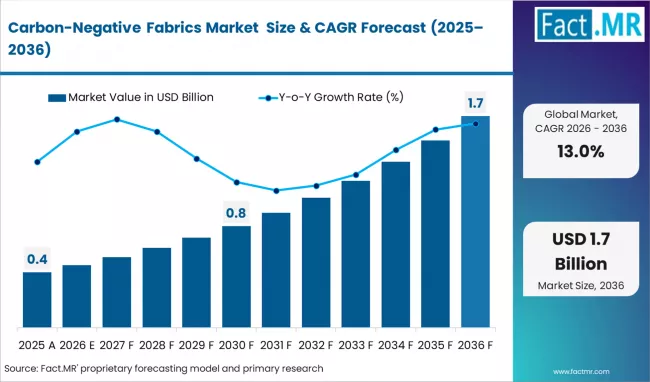
Valued at USD 0.4 billion in 2025, the carbon-negative fabrics market is forecast to reach USD 0.5 billion in 2026 and USD 1.7 billion by 2036, posting a CAGR of 13.0% over the forecast period. Hemp-based Fabrics is projected to lead fabric type at 29.8% share in 2026. Apparel is set to dominate applications at 47.3%, with Fashion Brands commanding the largest end use position at 44.6% in 2026. The commercial logic here is straightforward; fashion brands have exhausted the marketing value of recycled polyester and recycled cotton, and their sustainability teams are now being pushed to find materials that do not just do less harm but actively do good. Carbon-negative fabrics sit at that frontier, and the race is on to prove they can also survive a wash cycle, hold a dye, and move through a production line.
Key Drivers
- Decarbonization Pressure: Fashion and textile brands are pushing beyond recycled content into materials that can materially shift product-level carbon claims.
- Materials Innovation: Carbon-capture chemistry, algae-derived inputs, and regenerative fiber systems are widening the range of textiles that can compete on both climate narrative and functional performance.
- Premium Pull: Early demand is strongest where high-margin fashion, footwear, and performance brands can absorb higher material costs and differentiate through supply-chain climate stories.
Key Segments Analyzed in the Report
- Fabric Type: Hemp-Based Fabrics, Carbon-Capture-Derived Synthetic Fabrics, Algae-Based Fabrics, Regenerative Natural Fiber Fabrics, And Others
- Application: Apparel, Footwear And Accessories, Home Textiles, Industrial And Technical Textiles, And Others
- End Use: Fashion Brands, Outdoor And Performance, Home Furnishings, Automotive And Mobility Interiors, And Others
- Region: North America, Latin America, Europe, Asia Pacific, And Middle East & Africa
Analyst Opinion
Shambhu Nath Jha, Principal Consultant, Fact.MR says the carbon-negative fabrics market will not be decided by climate proclamations. It will be decided by which materials can prove spinnability, dyeability, hand-feel, and scalable sourcing while still carrying a defensible carbon removal story. The brands betting early on these materials are making a calculated wager: that being first to credible carbon-negative textile claims will matter when buyers start asking harder questions about scope 3 emissions across their supply chains.
Carbon-Negative Fabrics Market Definition
The carbon-negative fabrics market covers textile materials positioned to deliver net-negative or strongly carbon-sequestering life-cycle profiles through regenerative agriculture, carbon-capture-derived feedstocks, algae-based inputs, or other pathways that lock atmospheric or biogenic carbon into fabric value chains.
Carbon-Negative Fabrics Market Inclusions
- Revenue from fabrics and textile materials marketed for carbon-negative, carbon-sequestering, or equivalent net-removal claims in commercial textile applications.
- Fabric sales across apparel, footwear, home textiles, technical textiles, and adjacent premium material uses.
- Demand across North America, Latin America, Europe, Asia Pacific, and the Middle East & Africa.
Carbon-Negative Fabrics Market Exclusions
- Generic recycled or bio-based fabrics that do not carry a carbon-negative or equivalent removal-centered market proposition.
- Carbon accounting software, consulting services, or offset credits sold outside the textile material transaction.
- Finished garment revenue where the fabric itself is not the primary value basis under study.
Carbon-Negative Fabrics Market Research Methodology
This study evaluates the carbon-negative fabrics market across fabric type, application, end use, and region, using 2025 as the base year and 2026 to 2036 as the forecast period. Market value is expressed in USD billion. Evidence inputs include textile decarbonization roadmaps, biogenic carbon accounting guidance, renewable carbon textile initiatives, and first-party innovation disclosures from Rubi Laboratories, LanzaTech, Newlight Technologies, Living Ink Technologies, and textile innovation platforms. Triangulation aligns early commercialization volumes, premium textile adoption rates, brand pilot conversion, and cost-reduction trajectories to derive segment and regional estimates.
Key Drivers, Restraints, and Trends in Carbon-Negative Fabrics Market
Drivers
Demand for carbon-negative fabrics is forming because recycled content alone is insufficient for brands chasing deeper climate commitments. Material teams are seeking fibers and coatings that can help lower or even reverse cradle-to-gate emissions while still functioning within existing textile and fashion supply chains. That gives premium fabrics with a credible removal story a clear commercial opening.
Restraints
The category still faces a proof challenge. Many materials can present a compelling concept note or pilot collection, but fewer can demonstrate reliable scale, stable quality, and defensible accounting across sourcing, processing, and end-of-life assumptions. The market remains sensitive to certification standards and buyer skepticism around climate overclaiming.
Trends
Commercial momentum is concentrating around two routes: regenerative and low-input natural fibers that store more carbon in landscapes and soils, and synthetic or hybrid materials derived from captured carbon or algae-based feedstocks. Over time, winning products are likely to be those that combine strong textile performance with carbon accounting capable of surviving procurement scrutiny.
Segmental Analysis
Carbon-Negative Fabrics Market Analysis by Fabric Type
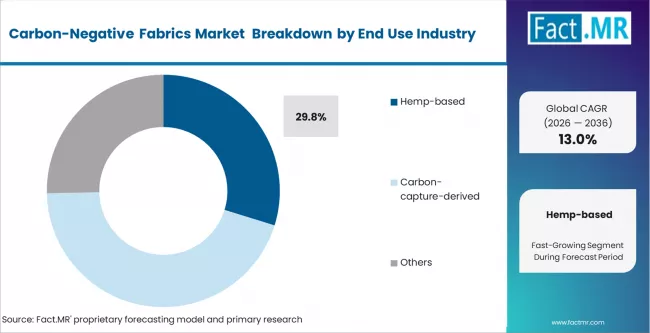
The Hemp-based Fabrics segment is expected to lead the fabric type category with a 29.8% share in 2026. Hemp-based fabrics lead because they already have an established commercial textile base, a strong sustainability narrative, and a more credible near-term scale profile than several lab-stage carbon-capture routes. Buyers can source hemp today while positioning it within lower-impact and carbon-sequestering product stories.
Carbon-Negative Fabrics Market Analysis by Application
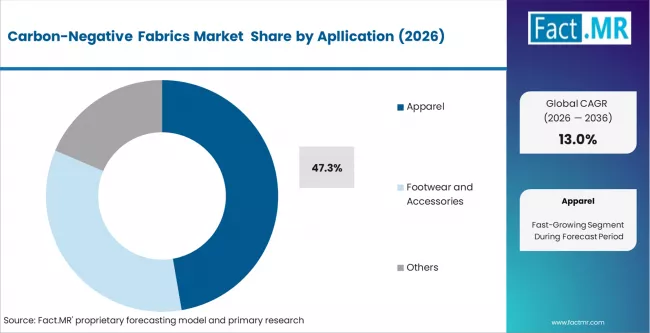
The Apparel segment is expected to lead the application category with a 47.3% share in 2026. Apparel leads because fashion is the first sector willing to trial new fabrics for brand differentiation, climate storytelling, and premium capsule launches. It also offers shorter product cycles and greater flexibility than home textiles or industrial applications when materials are still in early commercialization.
Competitive Aligners for Market Players
Competing in carbon-negative fabrics requires a company to simultaneously win on two very different fronts. The first is the science front: LCA data must be bulletproof, carbon accounting methodology must survive procurement and NGO scrutiny, and the removal claim must hold across the full supply chain including processing and finishing. The second is the textile performance front: yarn processability, dye uptake, tensile strength, wash durability, and hand-feel must all pass the same bar that any other commercial fabric would face. Failing on either front disqualifies the material from serious brand consideration.
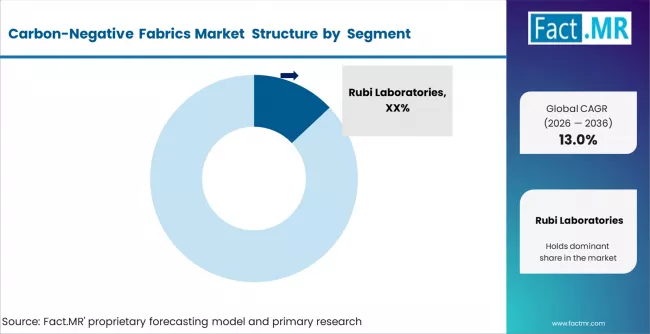
The early competitive leaders are not necessarily the companies with the strongest carbon story. They are the ones who figured out how to build supply chains around their material before demand arrived. Rubi Laboratories, Spinnova, and AlgiKnit are all examples of innovators who have moved from lab-bench proofs to brand partnerships specifically because they invested in textile process compatibility, not just feedstock novelty. That sequencing matters enormously. A material that cannot be processed at a conventional mill is effectively not a commercial textile yet.
For fashion brands evaluating entry into this space, the strategic calculus is about positioning and timing. First-mover capsule collections carry press value now. But the durable competitive advantage will accrue to brands that co-develop materials with suppliers early enough to lock in preferred-supplier relationships, custom LCA methodologies, and exclusive material narratives before the category becomes crowded. The window for that kind of structural differentiation is narrowing as more players enter.
Key Players in Carbon-Negative Fabrics Market
- Rubi Laboratories
- LanzaTech
- Newlight Technologies
- Living Ink Technologies
- PANGAIA
- On
- Spiber
- Nanollose
- AlgiKnit
- Spinnova
Strategic Outlook by Fact.MR on Carbon-Negative Fabrics Market
Fact.MR expects carbon-negative fabrics to remain premium-led in the near term, with meaningful scale emerging only where material performance, climate accounting, and brand storytelling stay aligned across the supply chain. The strongest long-run position will belong to suppliers that move from innovation showcase to reliable textile platform with auditable carbon data and practical processing compatibility. Scale will arrive, but it will arrive for the players who solved the textile problem first, not the carbon story first.
Scope of the Report
| Metric | Value |
|---|---|
| Market Value | USD 0.4 billion in 2025 to USD 1.7 billion by 2036 |
| CAGR | 13.0% from 2026 to 2036 |
| Base Year | 2025 |
| Forecast Period | 2026 to 2036 |
| Fabric Type Segmentation | Hemp-based Fabrics, Carbon-capture-derived Synthetic Fabrics, Algae-based Fabrics, Regenerative Natural Fiber Fabrics, Others |
| Application Segmentation | Apparel, Footwear and Accessories, Home Textiles, Industrial and Technical Textiles, Others |
| End Use Segmentation | Fashion Brands, Outdoor and Performance, Home Furnishings, Automotive and Mobility Interiors, Others |
| Regional Coverage | North America, Latin America, Europe, Asia Pacific, and Middle East & Africa |
Bibliography
- Textile Exchange. 2024. The Future of Synthetics.
- Textile Exchange. 2024. Biogenic Carbon: Guideline on the Consideration of Biogenic Carbon Emissions and Removals in Carbon Footprint Calculations.
- Fashion for Good. 2021. Fashion for Good Launches the Renewable Carbon Textiles Project.
- Textile Exchange. 2024. Using Carbon Capture to Replace Fossil-Based Polyester Feedstocks with LanzaTech and On.
- Fashion for Good. 2022. Fashion for Good Selects Eight Innovators for 2022 Global Innovation Programme.
Table of Content
- Executive Summary
- Global Market Outlook
- Demand to side Trends
- Supply to side Trends
- Technology Roadmap Analysis
- Analysis and Recommendations
- Market Overview
- Market Coverage / Taxonomy
- Market Definition / Scope / Limitations
- Research Methodology
- Chapter Orientation
- Analytical Lens and Working Hypotheses
- Market Structure, Signals, and Trend Drivers
- Benchmarking and Cross-market Comparability
- Market Sizing, Forecasting, and Opportunity Mapping
- Research Design and Evidence Framework
- Desk Research Programme (Secondary Evidence)
- Company Annual and Sustainability Reports
- Peer-reviewed Journals and Academic Literature
- Corporate Websites, Product Literature, and Technical Notes
- Earnings Decks and Investor Briefings
- Statutory Filings and Regulatory Disclosures
- Technical White Papers and Standards Notes
- Trade Journals, Industry Magazines, and Analyst Briefs
- Conference Proceedings, Webinars, and Seminar Materials
- Government Statistics Portals and Public Data Releases
- Press Releases and Reputable Media Coverage
- Specialist Newsletters and Curated Briefings
- Sector Databases and Reference Repositories
- Fact.MR Internal Proprietary Databases and Historical Market Datasets
- Subscription Datasets and Paid Sources
- Social Channels, Communities, and Digital Listening Inputs
- Additional Desk Sources
- Expert Input and Fieldwork (Primary Evidence)
- Primary Modes
- Qualitative Interviews and Expert Elicitation
- Quantitative Surveys and Structured Data Capture
- Blended Approach
- Why Primary Evidence is Used
- Field Techniques
- Interviews
- Surveys
- Focus Groups
- Observational and In-context Research
- Social and Community Interactions
- Stakeholder Universe Engaged
- C-suite Leaders
- Board Members
- Presidents and Vice Presidents
- R&D and Innovation Heads
- Technical Specialists
- Domain Subject-matter Experts
- Scientists
- Physicians and Other Healthcare Professionals
- Governance, Ethics, and Data Stewardship
- Research Ethics
- Data Integrity and Handling
- Primary Modes
- Tooling, Models, and Reference Databases
- Desk Research Programme (Secondary Evidence)
- Data Engineering and Model Build
- Data Acquisition and Ingestion
- Cleaning, Normalisation, and Verification
- Synthesis, Triangulation, and Analysis
- Quality Assurance and Audit Trail
- Market Background
- Market Dynamics
- Drivers
- Restraints
- Opportunity
- Trends
- Scenario Forecast
- Demand in Optimistic Scenario
- Demand in Likely Scenario
- Demand in Conservative Scenario
- Opportunity Map Analysis
- Product Life Cycle Analysis
- Supply Chain Analysis
- Investment Feasibility Matrix
- Value Chain Analysis
- PESTLE and Porter’s Analysis
- Regulatory Landscape
- Regional Parent Market Outlook
- Production and Consumption Statistics
- Import and Export Statistics
- Market Dynamics
- Global Market Analysis 2021 to 2025 and Forecast, 2026 to 2036
- Historical Market Size Value (USD Million) Analysis, 2021 to 2025
- Current and Future Market Size Value (USD Million) Projections, 2026 to 2036
- Y to o to Y Growth Trend Analysis
- Absolute $ Opportunity Analysis
- Global Market Pricing Analysis 2021 to 2025 and Forecast 2026 to 2036
- Global Market Analysis 2021 to 2025 and Forecast 2026 to 2036, By Apllication
- Introduction / Key Findings
- Historical Market Size Value (USD Million) Analysis By Apllication, 2021 to 2025
- Current and Future Market Size Value (USD Million) Analysis and Forecast By Apllication, 2026 to 2036
- Apparel
- Footwear and Accessories
- Others
- Apparel
- Y to o to Y Growth Trend Analysis By Apllication, 2021 to 2025
- Absolute $ Opportunity Analysis By Apllication, 2026 to 2036
- Global Market Analysis 2021 to 2025 and Forecast 2026 to 2036, By Fabric Type
- Introduction / Key Findings
- Historical Market Size Value (USD Million) Analysis By Fabric Type, 2021 to 2025
- Current and Future Market Size Value (USD Million) Analysis and Forecast By Fabric Type, 2026 to 2036
- Hemp-based
- Carbon-capture-derived
- Others
- Hemp-based
- Y to o to Y Growth Trend Analysis By Fabric Type, 2021 to 2025
- Absolute $ Opportunity Analysis By Fabric Type, 2026 to 2036
- Global Market Analysis 2021 to 2025 and Forecast 2026 to 2036, By End Use
- Introduction / Key Findings
- Historical Market Size Value (USD Million) Analysis By End Use, 2021 to 2025
- Current and Future Market Size Value (USD Million) Analysis and Forecast By End Use, 2026 to 2036
- Fashion Brands
- Outdoor and Performance
- Others
- Fashion Brands
- Y to o to Y Growth Trend Analysis By End Use, 2021 to 2025
- Absolute $ Opportunity Analysis By End Use, 2026 to 2036
- Global Market Analysis 2021 to 2025 and Forecast 2026 to 2036, By Region
- Introduction
- Historical Market Size Value (USD Million) Analysis By Region, 2021 to 2025
- Current Market Size Value (USD Million) Analysis and Forecast By Region, 2026 to 2036
- North America
- Latin America
- Western Europe
- Eastern Europe
- East Asia
- South Asia and Pacific
- Middle East & Africa
- Market Attractiveness Analysis By Region
- North America Market Analysis 2021 to 2025 and Forecast 2026 to 2036, By Country
- Historical Market Size Value (USD Million) Trend Analysis By Market Taxonomy, 2021 to 2025
- Market Size Value (USD Million) Forecast By Market Taxonomy, 2026 to 2036
- By Country
- USA
- Canada
- Mexico
- By Apllication
- By Fabric Type
- By End Use
- By Country
- Market Attractiveness Analysis
- By Country
- By Apllication
- By Fabric Type
- By End Use
- Key Takeaways
- Latin America Market Analysis 2021 to 2025 and Forecast 2026 to 2036, By Country
- Historical Market Size Value (USD Million) Trend Analysis By Market Taxonomy, 2021 to 2025
- Market Size Value (USD Million) Forecast By Market Taxonomy, 2026 to 2036
- By Country
- Brazil
- Chile
- Rest of Latin America
- By Apllication
- By Fabric Type
- By End Use
- By Country
- Market Attractiveness Analysis
- By Country
- By Apllication
- By Fabric Type
- By End Use
- Key Takeaways
- Western Europe Market Analysis 2021 to 2025 and Forecast 2026 to 2036, By Country
- Historical Market Size Value (USD Million) Trend Analysis By Market Taxonomy, 2021 to 2025
- Market Size Value (USD Million) Forecast By Market Taxonomy, 2026 to 2036
- By Country
- Germany
- UK
- Italy
- Spain
- France
- Nordic
- BENELUX
- Rest of Western Europe
- By Apllication
- By Fabric Type
- By End Use
- By Country
- Market Attractiveness Analysis
- By Country
- By Apllication
- By Fabric Type
- By End Use
- Key Takeaways
- Eastern Europe Market Analysis 2021 to 2025 and Forecast 2026 to 2036, By Country
- Historical Market Size Value (USD Million) Trend Analysis By Market Taxonomy, 2021 to 2025
- Market Size Value (USD Million) Forecast By Market Taxonomy, 2026 to 2036
- By Country
- Russia
- Poland
- Hungary
- Balkan & Baltic
- Rest of Eastern Europe
- By Apllication
- By Fabric Type
- By End Use
- By Country
- Market Attractiveness Analysis
- By Country
- By Apllication
- By Fabric Type
- By End Use
- Key Takeaways
- East Asia Market Analysis 2021 to 2025 and Forecast 2026 to 2036, By Country
- Historical Market Size Value (USD Million) Trend Analysis By Market Taxonomy, 2021 to 2025
- Market Size Value (USD Million) Forecast By Market Taxonomy, 2026 to 2036
- By Country
- China
- Japan
- South Korea
- By Apllication
- By Fabric Type
- By End Use
- By Country
- Market Attractiveness Analysis
- By Country
- By Apllication
- By Fabric Type
- By End Use
- Key Takeaways
- South Asia and Pacific Market Analysis 2021 to 2025 and Forecast 2026 to 2036, By Country
- Historical Market Size Value (USD Million) Trend Analysis By Market Taxonomy, 2021 to 2025
- Market Size Value (USD Million) Forecast By Market Taxonomy, 2026 to 2036
- By Country
- India
- ASEAN
- Australia & New Zealand
- Rest of South Asia and Pacific
- By Apllication
- By Fabric Type
- By End Use
- By Country
- Market Attractiveness Analysis
- By Country
- By Apllication
- By Fabric Type
- By End Use
- Key Takeaways
- Middle East & Africa Market Analysis 2021 to 2025 and Forecast 2026 to 2036, By Country
- Historical Market Size Value (USD Million) Trend Analysis By Market Taxonomy, 2021 to 2025
- Market Size Value (USD Million) Forecast By Market Taxonomy, 2026 to 2036
- By Country
- Kingdom of Saudi Arabia
- Other GCC Countries
- Turkiye
- South Africa
- Other African Union
- Rest of Middle East & Africa
- By Apllication
- By Fabric Type
- By End Use
- By Country
- Market Attractiveness Analysis
- By Country
- By Apllication
- By Fabric Type
- By End Use
- Key Takeaways
- Key Countries Market Analysis
- USA
- Pricing Analysis
- Market Share Analysis, 2025
- By Apllication
- By Fabric Type
- By End Use
- Canada
- Pricing Analysis
- Market Share Analysis, 2025
- By Apllication
- By Fabric Type
- By End Use
- Mexico
- Pricing Analysis
- Market Share Analysis, 2025
- By Apllication
- By Fabric Type
- By End Use
- Brazil
- Pricing Analysis
- Market Share Analysis, 2025
- By Apllication
- By Fabric Type
- By End Use
- Chile
- Pricing Analysis
- Market Share Analysis, 2025
- By Apllication
- By Fabric Type
- By End Use
- Germany
- Pricing Analysis
- Market Share Analysis, 2025
- By Apllication
- By Fabric Type
- By End Use
- UK
- Pricing Analysis
- Market Share Analysis, 2025
- By Apllication
- By Fabric Type
- By End Use
- Italy
- Pricing Analysis
- Market Share Analysis, 2025
- By Apllication
- By Fabric Type
- By End Use
- Spain
- Pricing Analysis
- Market Share Analysis, 2025
- By Apllication
- By Fabric Type
- By End Use
- France
- Pricing Analysis
- Market Share Analysis, 2025
- By Apllication
- By Fabric Type
- By End Use
- India
- Pricing Analysis
- Market Share Analysis, 2025
- By Apllication
- By Fabric Type
- By End Use
- ASEAN
- Pricing Analysis
- Market Share Analysis, 2025
- By Apllication
- By Fabric Type
- By End Use
- Australia & New Zealand
- Pricing Analysis
- Market Share Analysis, 2025
- By Apllication
- By Fabric Type
- By End Use
- China
- Pricing Analysis
- Market Share Analysis, 2025
- By Apllication
- By Fabric Type
- By End Use
- Japan
- Pricing Analysis
- Market Share Analysis, 2025
- By Apllication
- By Fabric Type
- By End Use
- South Korea
- Pricing Analysis
- Market Share Analysis, 2025
- By Apllication
- By Fabric Type
- By End Use
- Russia
- Pricing Analysis
- Market Share Analysis, 2025
- By Apllication
- By Fabric Type
- By End Use
- Poland
- Pricing Analysis
- Market Share Analysis, 2025
- By Apllication
- By Fabric Type
- By End Use
- Hungary
- Pricing Analysis
- Market Share Analysis, 2025
- By Apllication
- By Fabric Type
- By End Use
- Kingdom of Saudi Arabia
- Pricing Analysis
- Market Share Analysis, 2025
- By Apllication
- By Fabric Type
- By End Use
- Turkiye
- Pricing Analysis
- Market Share Analysis, 2025
- By Apllication
- By Fabric Type
- By End Use
- South Africa
- Pricing Analysis
- Market Share Analysis, 2025
- By Apllication
- By Fabric Type
- By End Use
- USA
- Market Structure Analysis
- Competition Dashboard
- Competition Benchmarking
- Market Share Analysis of Top Players
- By Regional
- By Apllication
- By Fabric Type
- By End Use
- Competition Analysis
- Competition Deep Dive
- Rubi Laboratories
- Overview
- Product Portfolio
- Profitability by Market Segments (Product/Age /Sales Channel/Region)
- Sales Footprint
- Strategy Overview
- Marketing Strategy
- Product Strategy
- Channel Strategy
- LanzaTech
- Newlight Technologies
- Living Ink Technologies
- PANGAIA
- On
- Spiber
- Rubi Laboratories
- Competition Deep Dive
- Assumptions & Acronyms Used
List Of Table
- Table 1: Global Market Value (USD Million) Forecast by Region, 2021 to 2036
- Table 2: Global Market Value (USD Million) Forecast by Apllication, 2021 to 2036
- Table 3: Global Market Value (USD Million) Forecast by Fabric Type, 2021 to 2036
- Table 4: Global Market Value (USD Million) Forecast by End Use, 2021 to 2036
- Table 5: North America Market Value (USD Million) Forecast by Country, 2021 to 2036
- Table 6: North America Market Value (USD Million) Forecast by Apllication, 2021 to 2036
- Table 7: North America Market Value (USD Million) Forecast by Fabric Type, 2021 to 2036
- Table 8: North America Market Value (USD Million) Forecast by End Use, 2021 to 2036
- Table 9: Latin America Market Value (USD Million) Forecast by Country, 2021 to 2036
- Table 10: Latin America Market Value (USD Million) Forecast by Apllication, 2021 to 2036
- Table 11: Latin America Market Value (USD Million) Forecast by Fabric Type, 2021 to 2036
- Table 12: Latin America Market Value (USD Million) Forecast by End Use, 2021 to 2036
- Table 13: Western Europe Market Value (USD Million) Forecast by Country, 2021 to 2036
- Table 14: Western Europe Market Value (USD Million) Forecast by Apllication, 2021 to 2036
- Table 15: Western Europe Market Value (USD Million) Forecast by Fabric Type, 2021 to 2036
- Table 16: Western Europe Market Value (USD Million) Forecast by End Use, 2021 to 2036
- Table 17: Eastern Europe Market Value (USD Million) Forecast by Country, 2021 to 2036
- Table 18: Eastern Europe Market Value (USD Million) Forecast by Apllication, 2021 to 2036
- Table 19: Eastern Europe Market Value (USD Million) Forecast by Fabric Type, 2021 to 2036
- Table 20: Eastern Europe Market Value (USD Million) Forecast by End Use, 2021 to 2036
- Table 21: East Asia Market Value (USD Million) Forecast by Country, 2021 to 2036
- Table 22: East Asia Market Value (USD Million) Forecast by Apllication, 2021 to 2036
- Table 23: East Asia Market Value (USD Million) Forecast by Fabric Type, 2021 to 2036
- Table 24: East Asia Market Value (USD Million) Forecast by End Use, 2021 to 2036
- Table 25: South Asia and Pacific Market Value (USD Million) Forecast by Country, 2021 to 2036
- Table 26: South Asia and Pacific Market Value (USD Million) Forecast by Apllication, 2021 to 2036
- Table 27: South Asia and Pacific Market Value (USD Million) Forecast by Fabric Type, 2021 to 2036
- Table 28: South Asia and Pacific Market Value (USD Million) Forecast by End Use, 2021 to 2036
- Table 29: Middle East & Africa Market Value (USD Million) Forecast by Country, 2021 to 2036
- Table 30: Middle East & Africa Market Value (USD Million) Forecast by Apllication, 2021 to 2036
- Table 31: Middle East & Africa Market Value (USD Million) Forecast by Fabric Type, 2021 to 2036
- Table 32: Middle East & Africa Market Value (USD Million) Forecast by End Use, 2021 to 2036
List Of Figures
- Figure 1: Global Market Pricing Analysis
- Figure 2: Global Market Value (USD Million) Forecast 2021 to 2036
- Figure 3: Global Market Value Share and BPS Analysis by Apllication, 2026 and 2036
- Figure 4: Global Market Y-o-Y Growth Comparison by Apllication, 2026 to 2036
- Figure 5: Global Market Attractiveness Analysis by Apllication
- Figure 6: Global Market Value Share and BPS Analysis by Fabric Type, 2026 and 2036
- Figure 7: Global Market Y-o-Y Growth Comparison by Fabric Type, 2026 to 2036
- Figure 8: Global Market Attractiveness Analysis by Fabric Type
- Figure 9: Global Market Value Share and BPS Analysis by End Use, 2026 and 2036
- Figure 10: Global Market Y-o-Y Growth Comparison by End Use, 2026 to 2036
- Figure 11: Global Market Attractiveness Analysis by End Use
- Figure 12: Global Market Value (USD Million) Share and BPS Analysis by Region, 2026 and 2036
- Figure 13: Global Market Y-o-Y Growth Comparison by Region, 2026 to 2036
- Figure 14: Global Market Attractiveness Analysis by Region
- Figure 15: North America Market Incremental Dollar Opportunity, 2026 to 2036
- Figure 16: Latin America Market Incremental Dollar Opportunity, 2026 to 2036
- Figure 17: Western Europe Market Incremental Dollar Opportunity, 2026 to 2036
- Figure 18: Eastern Europe Market Incremental Dollar Opportunity, 2026 to 2036
- Figure 19: East Asia Market Incremental Dollar Opportunity, 2026 to 2036
- Figure 20: South Asia and Pacific Market Incremental Dollar Opportunity, 2026 to 2036
- Figure 21: Middle East & Africa Market Incremental Dollar Opportunity, 2026 to 2036
- Figure 22: North America Market Value Share and BPS Analysis by Country, 2026 and 2036
- Figure 23: North America Market Value Share and BPS Analysis by Apllication, 2026 and 2036
- Figure 24: North America Market Y-o-Y Growth Comparison by Apllication, 2026 to 2036
- Figure 25: North America Market Attractiveness Analysis by Apllication
- Figure 26: North America Market Value Share and BPS Analysis by Fabric Type, 2026 and 2036
- Figure 27: North America Market Y-o-Y Growth Comparison by Fabric Type, 2026 to 2036
- Figure 28: North America Market Attractiveness Analysis by Fabric Type
- Figure 29: North America Market Value Share and BPS Analysis by End Use, 2026 and 2036
- Figure 30: North America Market Y-o-Y Growth Comparison by End Use, 2026 to 2036
- Figure 31: North America Market Attractiveness Analysis by End Use
- Figure 32: Latin America Market Value Share and BPS Analysis by Country, 2026 and 2036
- Figure 33: Latin America Market Value Share and BPS Analysis by Apllication, 2026 and 2036
- Figure 34: Latin America Market Y-o-Y Growth Comparison by Apllication, 2026 to 2036
- Figure 35: Latin America Market Attractiveness Analysis by Apllication
- Figure 36: Latin America Market Value Share and BPS Analysis by Fabric Type, 2026 and 2036
- Figure 37: Latin America Market Y-o-Y Growth Comparison by Fabric Type, 2026 to 2036
- Figure 38: Latin America Market Attractiveness Analysis by Fabric Type
- Figure 39: Latin America Market Value Share and BPS Analysis by End Use, 2026 and 2036
- Figure 40: Latin America Market Y-o-Y Growth Comparison by End Use, 2026 to 2036
- Figure 41: Latin America Market Attractiveness Analysis by End Use
- Figure 42: Western Europe Market Value Share and BPS Analysis by Country, 2026 and 2036
- Figure 43: Western Europe Market Value Share and BPS Analysis by Apllication, 2026 and 2036
- Figure 44: Western Europe Market Y-o-Y Growth Comparison by Apllication, 2026 to 2036
- Figure 45: Western Europe Market Attractiveness Analysis by Apllication
- Figure 46: Western Europe Market Value Share and BPS Analysis by Fabric Type, 2026 and 2036
- Figure 47: Western Europe Market Y-o-Y Growth Comparison by Fabric Type, 2026 to 2036
- Figure 48: Western Europe Market Attractiveness Analysis by Fabric Type
- Figure 49: Western Europe Market Value Share and BPS Analysis by End Use, 2026 and 2036
- Figure 50: Western Europe Market Y-o-Y Growth Comparison by End Use, 2026 to 2036
- Figure 51: Western Europe Market Attractiveness Analysis by End Use
- Figure 52: Eastern Europe Market Value Share and BPS Analysis by Country, 2026 and 2036
- Figure 53: Eastern Europe Market Value Share and BPS Analysis by Apllication, 2026 and 2036
- Figure 54: Eastern Europe Market Y-o-Y Growth Comparison by Apllication, 2026 to 2036
- Figure 55: Eastern Europe Market Attractiveness Analysis by Apllication
- Figure 56: Eastern Europe Market Value Share and BPS Analysis by Fabric Type, 2026 and 2036
- Figure 57: Eastern Europe Market Y-o-Y Growth Comparison by Fabric Type, 2026 to 2036
- Figure 58: Eastern Europe Market Attractiveness Analysis by Fabric Type
- Figure 59: Eastern Europe Market Value Share and BPS Analysis by End Use, 2026 and 2036
- Figure 60: Eastern Europe Market Y-o-Y Growth Comparison by End Use, 2026 to 2036
- Figure 61: Eastern Europe Market Attractiveness Analysis by End Use
- Figure 62: East Asia Market Value Share and BPS Analysis by Country, 2026 and 2036
- Figure 63: East Asia Market Value Share and BPS Analysis by Apllication, 2026 and 2036
- Figure 64: East Asia Market Y-o-Y Growth Comparison by Apllication, 2026 to 2036
- Figure 65: East Asia Market Attractiveness Analysis by Apllication
- Figure 66: East Asia Market Value Share and BPS Analysis by Fabric Type, 2026 and 2036
- Figure 67: East Asia Market Y-o-Y Growth Comparison by Fabric Type, 2026 to 2036
- Figure 68: East Asia Market Attractiveness Analysis by Fabric Type
- Figure 69: East Asia Market Value Share and BPS Analysis by End Use, 2026 and 2036
- Figure 70: East Asia Market Y-o-Y Growth Comparison by End Use, 2026 to 2036
- Figure 71: East Asia Market Attractiveness Analysis by End Use
- Figure 72: South Asia and Pacific Market Value Share and BPS Analysis by Country, 2026 and 2036
- Figure 73: South Asia and Pacific Market Value Share and BPS Analysis by Apllication, 2026 and 2036
- Figure 74: South Asia and Pacific Market Y-o-Y Growth Comparison by Apllication, 2026 to 2036
- Figure 75: South Asia and Pacific Market Attractiveness Analysis by Apllication
- Figure 76: South Asia and Pacific Market Value Share and BPS Analysis by Fabric Type, 2026 and 2036
- Figure 77: South Asia and Pacific Market Y-o-Y Growth Comparison by Fabric Type, 2026 to 2036
- Figure 78: South Asia and Pacific Market Attractiveness Analysis by Fabric Type
- Figure 79: South Asia and Pacific Market Value Share and BPS Analysis by End Use, 2026 and 2036
- Figure 80: South Asia and Pacific Market Y-o-Y Growth Comparison by End Use, 2026 to 2036
- Figure 81: South Asia and Pacific Market Attractiveness Analysis by End Use
- Figure 82: Middle East & Africa Market Value Share and BPS Analysis by Country, 2026 and 2036
- Figure 83: Middle East & Africa Market Value Share and BPS Analysis by Apllication, 2026 and 2036
- Figure 84: Middle East & Africa Market Y-o-Y Growth Comparison by Apllication, 2026 to 2036
- Figure 85: Middle East & Africa Market Attractiveness Analysis by Apllication
- Figure 86: Middle East & Africa Market Value Share and BPS Analysis by Fabric Type, 2026 and 2036
- Figure 87: Middle East & Africa Market Y-o-Y Growth Comparison by Fabric Type, 2026 to 2036
- Figure 88: Middle East & Africa Market Attractiveness Analysis by Fabric Type
- Figure 89: Middle East & Africa Market Value Share and BPS Analysis by End Use, 2026 and 2036
- Figure 90: Middle East & Africa Market Y-o-Y Growth Comparison by End Use, 2026 to 2036
- Figure 91: Middle East & Africa Market Attractiveness Analysis by End Use
- Figure 92: Global Market - Tier Structure Analysis
- Figure 93: Global Market - Company Share Analysis
- FAQs -
What is the projected size of the Carbon-Negative Fabrics Market by 2036?
The carbon-negative fabrics market is projected to reach USD 1.7 billion by 2036.
What is the CAGR of the Carbon-Negative Fabrics Market from 2026 to 2036?
The carbon-negative fabrics market is projected to expand at a CAGR of 13.0% from 2026 to 2036.
Which fabric type segment leads the Carbon-Negative Fabrics Market?
The Hemp-based Fabrics segment leads the carbon-negative fabrics market with a 29.8% share in 2026.
Which application segment dominates the Carbon-Negative Fabrics Market?
The Apparel segment holds the leading position in the carbon-negative fabrics market with a 47.3% share in 2026.
Which end use segment leads the Carbon-Negative Fabrics Market?
The Fashion Brands segment is expected to account for the largest share of the carbon-negative fabrics market at 44.6% in 2026.
Who are the key companies in the Carbon-Negative Fabrics Market?
Key companies active in the carbon-negative fabrics market include Rubi Laboratories, LanzaTech, Newlight Technologies, Living Ink Technologies, PANGAIA, On, and other specialized participants.
What is driving demand in the Carbon-Negative Fabrics Market?
Demand in the carbon-negative fabrics market is being driven by premium fashion decarbonization, regenerative fiber adoption, and early commercialization of carbon-capture and algae-derived textile inputs.