- Base Value(2025): 1.1 Bn
- Estimated Value(2026): 1.1 Bn
- Forecast Value (2036): 1.9 Bn
- CAGR (2026 - 2036): 5.5%
Carbon Steel Market Analysis and Forecast by Fact.MR
- The global carbon steel market is estimated at USD 1.11 trillion in 2026 and is forecast to expand at a CAGR of 5.5% to reach USD 1.89 trillion by 2036.
- Carbon steel encompasses flat and long steel products manufactured through basic oxygen furnace (BOF) and electric arc furnace (EAF) processes across low, medium, and high carbon grades.
- The market is driven by construction sector demand in emerging economies, automotive lightweighting and electrification trends, infrastructure modernization programs, energy transition requirements including wind towers and solar structures, and the accelerating shift toward EAF-based production using recycled steel.
- Decarbonization initiatives are reshaping production economics, with EAF capacity additions and renewable energy integration creating structural shifts in cost competitiveness across major producing regions.
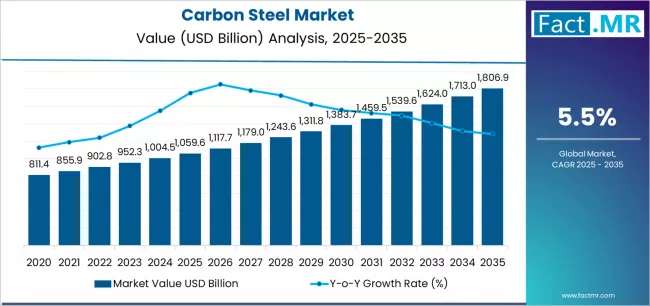
Carbon Steel Market Value Analysis | Source: Fact.MR
Summary of the Carbon Steel Market
- Market Snapshot
- In 2025, the global Carbon Steel Market was valued at approximately USD 1.05 trillion.
- The market is estimated to reach USD 1.11 trillion in 2026 and is projected to attain USD 1.89 trillion by 2036.
- The carbon steel market is likely to expand at a CAGR of 5.5% during the forecast period.
- The market is anticipated to create an absolute dollar opportunity of USD 0.78 trillion between 2026 and 2036.
- Low carbon steel (mild steel) accounts for 60% of carbon content share in 2026.
- India (6.8%) and China (6.6%) are the key growth markets during the forecast period.
- Demand and Growth Drivers
- Construction sector expansion across India, China, Southeast Asia, the Middle East, and Africa is driving demand for flat and long carbon steel products used in structural frameworks, reinforcement, and building envelopes.
- Automotive industry evolution, including vehicle lightweighting, electric vehicle platform development, and advanced high-strength steel adoption, is reshaping carbon steel specification and procurement patterns.
- Infrastructure modernization programs including bridges, railways, roads, and utility networks are generating sustained demand for structural sections, plates, and reinforcement bar across both developed and emerging markets.
- Energy transition requirements, including wind tower fabrication, solar mounting structures, and grid infrastructure expansion, are creating new demand categories for carbon steel across renewable energy supply chains.
- The accelerating shift from BOF to EAF steelmaking, driven by decarbonization targets and recycled steel availability, is restructuring production economics and regional competitiveness.
- Product and Segment View
- Flat carbon steel accounts for 55% of the product type segment in 2026, driven by broad demand for hot rolled coils, cold rolled sheets, and coated steel across construction, automotive, appliance, and energy applications.
- Low carbon steel (mild steel) holds 60% of the carbon content segment in 2026, reflecting its dominant use in construction, general engineering, and automotive body applications where formability and weldability are primary requirements.
- Basic oxygen furnace (BOF) accounts for 65% of the manufacturing process segment in 2026, sustained by integrated steel plants serving large-scale production, though EAF share is growing through recycled steel-based production.
- Key segmentation includes:
- Product Type: Flat carbon steel (hot rolled, cold rolled, coated), Long carbon steel (bars, structural, rails)
- Carbon Content: Low carbon steel (mild steel), Medium carbon steel, High carbon steel
- Manufacturing Process: Basic oxygen furnace (BOF), Electric arc furnace (EAF), Other processes
- Form: Sheets and strips, Plates, Bars and rods, Structural sections
- Application: Construction, Automotive, Machinery and equipment, Energy, Consumer goods
- These systems enable:
- Structural and reinforcement solutions for construction, infrastructure, and industrial applications across all major economies
- Formable, weldable, and cost-effective material platforms for automotive body, chassis, and component manufacturing
- Fabrication-ready flat and long products for energy infrastructure including wind towers, solar structures, and grid equipment
- Geography and Competitive Outlook
- Asia Pacific dominates the market through China and India, driven by construction sector growth, infrastructure investment, automotive production, and expanding EAF steelmaking capacity.
- North America sustains demand through the USA, supported by infrastructure modernization, automotive production, EAF capacity expansion, and trade policy measures including CBAM and tariff protections.
- Europe maintains steady demand through Germany and the UK, driven by automotive steel specification, green steel initiatives, EAF transition investment, and energy infrastructure requirements.
- India (6.8%) and China (6.6%) lead growth, while Brazil (6.2%), the USA (5.8%), Germany (5.6%), the UK (5.3%), Japan (4.9%), and Mexico (4.5%) sustain demand across construction, automotive, and industrial applications.
- Some of the major players include Arcelor Mittal, Nippon Steel Corporation, POSCO Holdings Inc., Baosteel Group Corporation, and JFE Steel Corporation.
- Analyst Opinion
- Shambhu Nath Jha, Principal Consultant at Fact.MR, says 'The carbon steel market is undergoing its most significant structural transformation in decades, driven by the simultaneous convergence of decarbonization mandates, trade policy recalibration, and energy transition demand. ArcelorMittal's announcement of a EUR 1.3 billion EAF investment at Dunkirk, combined with the EU's CBAM and tariff rate quota implementation expected from July 2026, signals a fundamental reshaping of European steel economics. Companies investing in EAF capacity, renewable energy integration, and low-carbon steel certification are positioning for premium pricing and specification advantages, while producers dependent on conventional BOF without decarbonization roadmaps face growing regulatory and market access risks.'
Key Growth Drivers, Constraints, and Opportunities
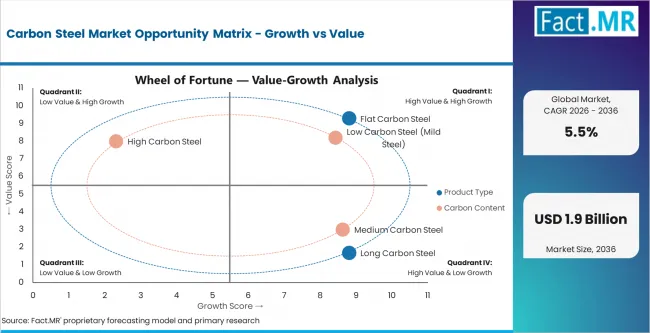
Carbon Steel Market Opportunity Matrix Growth Vs Value | Source: Fact.MR
Key Factors Driving Growth
- Construction sector expansion in India, China, Southeast Asia, and the Middle East generates sustained demand for structural steel, reinforcement bar, and flat products for building envelopes.
- Energy transition infrastructure requirements, including wind towers, solar mounting, and grid expansion, create new demand categories for carbon steel across renewable supply chains.
- EAF capacity expansion driven by decarbonization targets and recycled steel availability is restructuring production economics and enabling lower-emission steel supply.
Key Market Constraints
- Overcapacity in Chinese steel production creates persistent downward pricing pressure on global carbon steel markets, compressing margins for producers in other regions.
- Volatile raw material costs for iron ore, coking coal, and scrap steel create procurement uncertainty and margin volatility for both BOF and EAF producers.
- Trade policy uncertainty, including tariff changes, anti-dumping measures, and CBAM implementation timelines, creates market access and pricing risks for export-oriented producers.
Key Opportunity Areas
- Green steel certification and low-carbon steel premiums are creating differentiation opportunities for producers investing in EAF, hydrogen-based reduction, and renewable energy integration.
- Automotive advanced high-strength steel (AHSS) development is creating premium product segments where material performance commands higher pricing and specification lock-in.
- Infrastructure modernization programs in the USA, EU, and India are generating multi-year demand pipelines for structural sections, plates, and reinforcement products.
Segment-wise Analysis of the Carbon Steel Market
- Flat carbon steel holds 55% of the product type segment in 2026, driven by broad demand across construction, automotive, appliance, and energy applications.
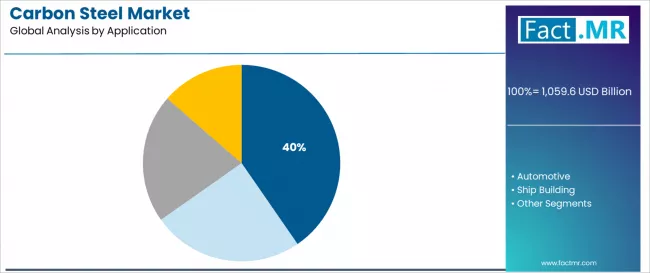
- Construction accounts for 40% of the application segment in 2026, reflecting the dominance of building and infrastructure demand as the primary driver of carbon steel consumption.
- Sheets and strips account for 40% of the form segment, sustained by automotive, appliance, packaging, and general manufacturing applications.
The carbon steel market is segmented by product type, carbon content, manufacturing process, form, application, and region. Flat carbon steel leads by product type. Low carbon steel dominates by carbon content. BOF leads by manufacturing process, and construction leads by application.
Which Product Type Segment Dominates the Carbon Steel Market?
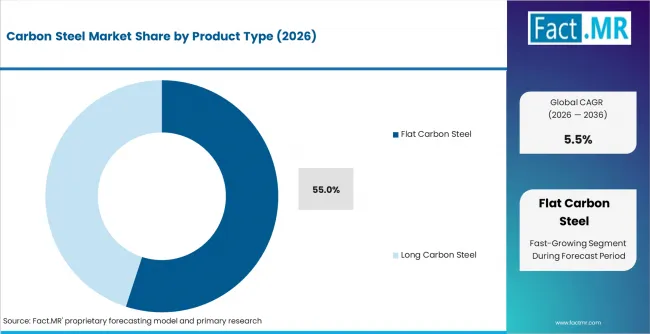
Carbon Steel Market Analysis By Product Type | Source: Fact.MR
Flat carbon steel accounts for 55% of the product type segment in 2026. Hot rolled coils, cold rolled sheets, and coated steel (galvanized, galvalume) serve the broadest range of applications across construction, automotive, appliance, packaging, and energy sectors. Flat steel's versatility in forming, coating, and finishing makes it the primary product category for value-added steel applications.
Long carbon steel, including rebars, wire rods, structural beams, and rails, serves construction reinforcement, infrastructure, and industrial applications. Long products are growing through infrastructure modernization programs and railway expansion, though flat products maintain the larger share due to automotive and consumer goods demand.
Which Manufacturing Process Segment Dominates the Carbon Steel Market?
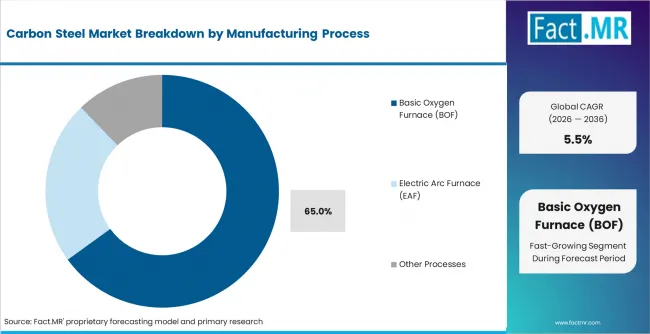
Carbon Steel Market Analysis By Manufacturing Process | Source: Fact.MR
Basic oxygen furnace (BOF) accounts for 65% of the manufacturing process segment in 2026. Integrated BOF steel plants continue to produce the majority of global carbon steel output, particularly in China, Japan, and South Korea where large-scale blast furnace operations serve construction and export markets.
Electric arc furnace (EAF) is the fastest-growing process segment, driven by decarbonization mandates, recycled steel availability, and lower capital intensity for new capacity additions. ArcelorMittal's EUR 1.3 billion Dunkirk EAF investment and the ramp-up of the Calvert, Alabama EAF mill exemplify the industry's structural shift toward scrap-based production.
Which Application Segment Dominates the Carbon Steel Market?
Carbon Steel Market Analysis By Application | Source: Fact.MR
Construction accounts for 40% of the application segment in 2026. Residential, commercial, and infrastructure construction consumes the largest share of both flat and long carbon steel products. Structural frameworks, reinforcement bar, roofing sheets, and building envelope materials represent the core demand drivers in this segment.
Automotive is the second-largest application, with evolving demand for advanced high-strength steel, ultra-high-strength steel, and coated products supporting vehicle lightweighting and electric vehicle platform development. Energy applications are the fastest-growing segment through wind tower fabrication, solar structures, and grid infrastructure.
Which Product Trend is Shaping the Next Phase of Growth in the Carbon Steel Market?
The transition from BOF to EAF production with integrated renewable energy is the defining trend reshaping the carbon steel market. ArcelorMittal announced a EUR 1.3 billion investment in a 2 million tonne EAF at Dunkirk, France in February 2026, expected to reduce the site's emissions by approximately 25%. The company reported 5.4 million tonnes of additional EAF capacity across its global operations, with new EAFs at Sestao and Gijon in Spain already operational and the Calvert, Alabama mill ramping up in North America.
This EAF transition is being supported by renewable energy integration. ArcelorMittal has commissioned 1.9 GW of solar, wind, and hybrid capacity across India, Brazil, and Argentina, with a further 1.4 GW under development for commissioning by 2028. The EU's Carbon Border Adjustment Mechanism (CBAM) and the new tariff rate quota (TRQ) expected from July 2026 are creating policy frameworks that improve the economics of domestic low-carbon steel production. Producers that combine EAF capacity with renewable energy access and green steel certification are positioning for premium pricing in markets where carbon-adjusted import costs reshape competitive dynamics.
Regional Outlook Across Key Markets
.webp "Top Country Growth Comparison Carbon Steel Market Cagr (2026 2036)")
Top Country Growth Comparison Carbon Steel Market Cagr (2026 2036) | Source: Fact.MR
- India leads growth at 6.8%, driven by construction sector expansion, infrastructure modernization, automotive production growth, and capacity additions by domestic and joint venture producers.
- China follows at 6.6%, supported by the world's largest production base, domestic construction demand, EAF transition initiatives, and renewable energy infrastructure requirements.
- The USA grows at 5.8%, driven by infrastructure investment, EAF capacity expansion, trade policy support through tariffs and CBAM alignment, and automotive sector demand.
- Europe sustains growth through Germany (5.6%) and the UK (5.3%), supported by CBAM implementation, EAF transition investment, automotive steel specification, and green steel premiums.
| Country | CAGR (%) |
|---|---|
| India | 6.8% |
| China | 6.6% |
| Brazil | 6.2% |
| USA | 5.8% |
| Germany | 5.6% |
| UK | 5.3% |
| Japan | 4.9% |
| Mexico | 4.5% |
Source: Fact.MR analysis. Updated May 25, 2026
Source: Fact MR (FMR) analysis, based on proprietary forecasting model and primary research.
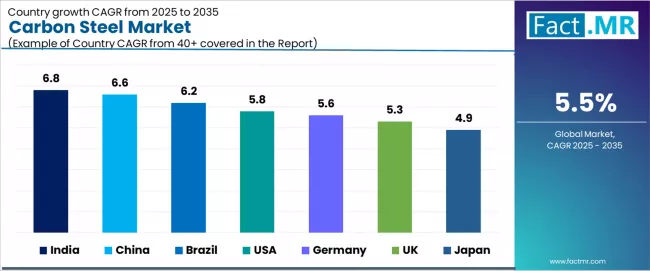
Carbon Steel Market Cagr Analysis By Country | Source: Fact.MR
Market Outlook for Carbon Steel in India
The India carbon steel market is projected to grow at a CAGR of 6.8% through 2036. Demand is driven by construction expansion, infrastructure modernization, automotive production growth, and capacity additions through domestic investment and the AMNS India joint venture expansion to 15 Mtpa.
- Construction sector drives the largest share of flat and long product demand.
- Infrastructure modernization creates multi-year procurement pipelines.
- AMNS India expansion to 15 Mtpa strengthens domestic production capacity.
Carbon Steel Demand Trends in China
The China carbon steel market is projected to grow at a CAGR of 6.6% through 2036. Growth is supported by the world's largest production base, domestic construction demand, EAF transition initiatives, and energy infrastructure fabrication requirements.
- Domestic construction remains the primary demand driver for flat and long products.
- EAF transition initiatives reshape production economics and carbon intensity.
- Renewable energy infrastructure creates demand for wind tower and solar steel.
United States Carbon Steel Market Growth Assessment
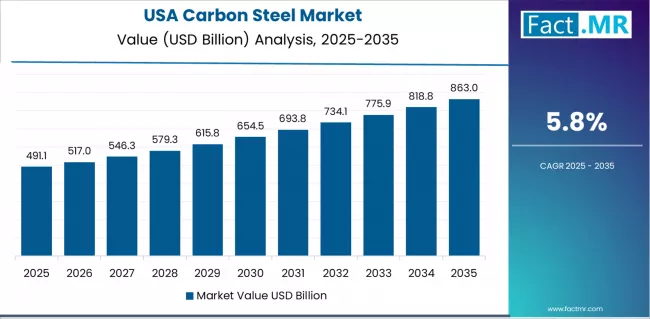
Carbon Steel Market Country Value Analysis | Source: Fact.MR
The U.S. carbon steel market is projected to grow at a CAGR of 5.8% through 2036. Demand is driven by infrastructure investment, EAF capacity expansion at facilities like Calvert, trade protections, and automotive sector requirements.
- Infrastructure investment sustains multi-year structural and reinforcement steel demand.
- EAF capacity expansion at Calvert and other facilities increases domestic supply.
- Trade policies including tariffs and CBAM alignment support domestic pricing.
Germany Carbon Steel Market Demand Analysis
The Germany carbon steel market is projected to grow at a CAGR of 5.6% through 2036. Demand is shaped by automotive steel specification, CBAM implementation, EAF transition investment, and energy infrastructure requirements.
- Automotive sector drives demand for advanced high-strength steel grades.
- CBAM implementation supports domestic production competitiveness against imports.
- EAF transition investment positions Germany for low-carbon steel supply.
Brazil Carbon Steel Market Opportunity Outlook
The Brazil carbon steel market is projected to grow at a CAGR of 6.2% through 2036. Demand is supported by construction activity, infrastructure development, agricultural equipment, and growing EAF capacity with renewable energy integration.
- Construction activity drives demand for structural and reinforcement products.
- Infrastructure development creates procurement pipelines for long products.
- Renewable energy integration at steel plants improves production competitiveness.
Competitive Benchmarking and Company Positioning
Carbon Steel Market Analysis By Company | Source: Fact.MR
Carbon Steel Market Analysis By Company
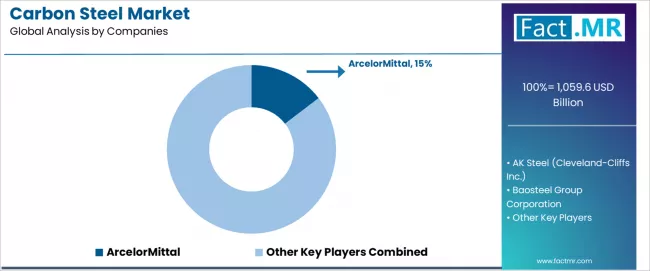
- ArcelorMittal holds approximately 15% market share through global production scale, diversified geographic presence, and leadership in EAF transition and renewable energy integration.
- Nippon Steel Corporation, POSCO Holdings Inc., and Baosteel Group Corporation compete through technology leadership, product quality, and strong positions in automotive and premium flat steel segments.
- Production scale, product mix quality, decarbonization roadmap credibility, and geographic diversification are the primary competitive differentiators.
The competitive landscape is moderately consolidated at the global level but highly fragmented regionally. ArcelorMittal leads with approximately 15% market share, producing 55.6 million tonnes of crude steel and generating USD 61.4 billion in revenue in 2025. The company's competitive position is built on global scale, diversified market exposure, and leading investment in EAF transition with 5.4 million tonnes of new capacity.
Nippon Steel Corporation and JFE Steel Corporation maintain strong positions through technology leadership in automotive steel grades and advanced high-strength products. POSCO Holdings leads in coated steel and automotive applications, while Baosteel Group and HBIS Group represent China's production scale advantage.
AK Steel (Cleveland-Cliffs Inc.), NLMK Group, Evraz plc, and U.S. Steel compete through regional focus, specific product specialization, and infrastructure-grade production capabilities. U.S. Steel's position is evolving through ongoing strategic developments in the North American market.
Strategic priorities include accelerating EAF capacity additions, securing renewable energy for production sites, developing green steel certification, expanding automotive AHSS capabilities, and navigating evolving trade policy landscapes.
Key Companies in the Carbon Steel Market
- ArcelorMittal, Nippon Steel Corporation, and POSCO Holdings Inc. are the leading global players, supported by production scale, technology leadership, and diversified market presence.
- Baosteel Group Corporation, HBIS Group, and JFE Steel Corporation hold dominant positions in their respective regional markets with strong automotive and construction sector supply.
- AK Steel (Cleveland-Cliffs Inc.), NLMK Group, Evraz plc, and U.S. Steel compete through North American and European market focus, product specialization, and infrastructure-grade capabilities.
Recent Industry Developments
- ArcelorMittal - Strategic Investment / EUR 1.3 Billion Dunkirk EAF (February 2026)
- ArcelorMittal announced a EUR 1.3 billion investment in a 2 million tonne electric arc furnace at Dunkirk, France, supported by French government funding and competitive low-carbon power. Commissioning is targeted for 2029, with the project expected to cut site emissions by approximately 25%.
- ArcelorMittal - Capacity Expansion / Calvert EAF Ramp-Up and Gijon Start-Up (2025-2026)
- ArcelorMittal ramped up its Calvert, Alabama EAF mill and started the 1 Mt Gijon EAF for long products in Spain, adding to the company's growing EAF production base. North American output increased 18.3% quarter-on-quarter in Q1 2026.
- AMNS India - Greenfield Announcement / Rajayyapeta Integrated Steel Plant (March 2026)
- AMNS India, the ArcelorMittal-Nippon Steel joint venture, announced plans to construct a greenfield integrated steel plant in Rajayyapeta, Andhra Pradesh, with Phase 1 capacity of 8.2 Mtpa, strengthening production capacity to serve India's growing construction and infrastructure demand.
Leading Companies Shaping the Carbon Steel Market
- ArcelorMittal
- AK Steel (Cleveland-Cliffs Inc.)
- Baosteel Group Corporation
- HBIS Group Co., Ltd.
- JFE Steel Corporation
- Nippon Steel Corporation
- POSCO Holdings Inc.
- NLMK Group
- Evraz plc
- U.S. Steel
Sources and Research References
- ArcelorMittal. Q1 2026 financial results, Dunkirk EAF investment, and 2025 Sustainability Report.
- AMNS India. Rajayyapeta greenfield steel plant announcement.
- World Steel Association. Global crude steel production and capacity utilization data.
- Construction industry output databases, automotive production statistics, and trade policy documentation.
- Primary interviews with steel producers, distributors, automotive OEMs, construction firms, and trade analysts.
This bibliography is provided for reader reference and is not exhaustive. The full report contains the complete reference list and detailed citations.
Key Questions This Report Addresses
- What is the current and future size of the Carbon Steel market?
- How fast is the market expected to grow between 2026 and 2036?
- Which product type leads in 2026?
- Which application holds highest share?
- What drives demand globally?
- How is the EAF transition influencing the market?
- Why is India the fastest-growing market?
- How are CBAM and trade policies reshaping competitiveness?
- Which countries show fastest growth?
- Who are the key companies?
- How does Fact.MR validate the forecast?
Carbon Steel Market Definition
The carbon steel market covers flat and long steel products manufactured through BOF and EAF processes across low, medium, and high carbon grades for construction, automotive, machinery, energy, and consumer goods applications globally.
Carbon Steel Market Inclusions
- The scope covers global and regional market size and forecasts for 2026 to 2036 across product type, carbon content, manufacturing process, form, application, and region.
- It includes analysis of construction output, automotive production, infrastructure investment, and energy transition requirements influencing carbon steel demand.
- The report covers pricing and cost analysis across flat and long product categories, including raw material costs, production economics, and trade policy impacts.
- It covers technology trends, market drivers and constraints, and the competitive landscape including production capacity, technology roadmaps, and decarbonization strategies of leading producers.
Carbon Steel Market Exclusions
- The scope excludes stainless steel, alloy steel, and specialty steel products not classified as carbon steel.
- It excludes iron ore, coking coal, and steelmaking raw materials sold separately from finished carbon steel products.
- The report excludes steelmaking equipment, rolling mill machinery, and production technology sold independently.
- It also excludes scrap metal trading, steel recycling services, and secondary processing not directly tied to primary carbon steel production.
Carbon Steel Market Research Methodology
- The methodology combines secondary research, primary interviews, and forecast modelling.
- It draws on 100+ secondary sources and benchmarks 30+ producer capacity and production data.
- Market sizing covers 30+ countries through a demand-side model, supported by top-down validation.
- Key inputs include construction output forecasts, automotive production volumes, infrastructure investment programs, energy transition capacity targets, and trade policy analysis.
- The model cross-checks demand with production capacity, raw material pricing, trade flow data, and capacity utilization rates.
- Primary validation includes 25+ interviews across steel producers, distributors, automotive OEMs, construction firms, and trade analysts.
- Final estimates go through production-capacity checks, trade-flow analysis, and sensitivity testing.
Segmentation
Scope of Analysis
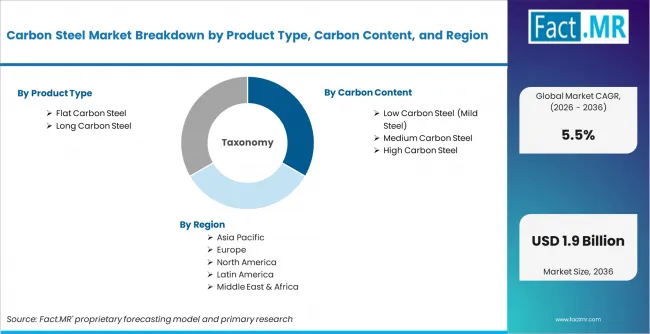
Carbon Steel Market Breakdown By Product Type, Carbon Content, And Region | Source: Fact.MR
| Parameter | Details |
|---|---|
| Quantitative Units | USD 1.11 trillion to USD 1.89 trillion, at a CAGR of 5.5% |
| Market Definition | The carbon steel market covers flat and long steel products manufactured through BOF and EAF processes across low, medium, and high carbon grades for construction, automotive, machinery, energy, and consumer goods applications. |
| Regions Covered | North America, Latin America, Europe, East Asia, South Asia and Pacific, Middle East and Africa |
| Countries Covered | India, China, Brazil, USA, Germany, UK, Japan, Mexico, 30 plus countries |
| Key Companies | ArcelorMittal, AK Steel (Cleveland-Cliffs), Baosteel, HBIS, JFE Steel, Nippon Steel, POSCO, NLMK, Evraz, U.S. Steel |
| Forecast Period | 2026 to 2036 |
| Approach | Hybrid demand-side and top-down methodology built on construction output, automotive production, infrastructure investment, trade flow analysis, and primary interviews across producers, distributors, and end users |
Source: Fact.MR analysis. Updated May 25, 2026
Carbon Steel Market Segmentation
-
Carbon Steel Market Segmented by Product Type:
- Flat Carbon Steel
- Hot Rolled Steel
- Hot Rolled Coils (HRC)
- Hot Rolled Sheets
- Cold Rolled Steel
- Cold Rolled Coils (CRC)
- Cold Rolled Sheets
- Coated Steel
- Galvanized Steel
- Galvalume Steel
- Hot Rolled Steel
- Long Carbon Steel
- Bars and Rods
- Rebars
- Wire Rods
- Structural Steel
- Beams
- Channels
- Rails
- Rail Tracks
- Crane Rails
- Bars and Rods
- Flat Carbon Steel
-
Carbon Steel Market Segmented by Carbon Content:
- Low Carbon Steel (Mild Steel)
- Below 0.25% Carbon
- High Ductility
- Easy Formability
- 0.25–0.30% Carbon
- Structural Applications
- General Engineering
- Below 0.25% Carbon
- Medium Carbon Steel
- 0.30–0.60% Carbon
- Automotive Components
- Machinery Parts
- Heat-treated Medium Carbon
- Improved Strength
- Wear Resistance
- 0.30–0.60% Carbon
- High Carbon Steel
- 0.60–1.0% Carbon
- Cutting Tools
- Springs
- Above 1.0% Carbon
- High Hardness
- Specialty Applications
- 0.60–1.0% Carbon
- Low Carbon Steel (Mild Steel)
-
Carbon Steel Market Segmented by Manufacturing Process:
- Basic Oxygen Furnace (BOF)
- Primary Steelmaking
- Large-scale Production
- Integrated Steel Plants
- Secondary Refining
- Quality Enhancement
- Impurity Removal
- Primary Steelmaking
- Electric Arc Furnace (EAF)
- Scrap-based Production
- Recycled Steel
- Energy Efficient
- Direct Reduced Iron (DRI)
- Sponge Iron Use
- Lower Emissions
- Scrap-based Production
- Other Processes
- Open Hearth Furnace
- Legacy Systems
- Limited Use
- Induction Furnace
- Small-scale Production
- Specialty Steel
- Open Hearth Furnace
- Basic Oxygen Furnace (BOF)
-
Carbon Steel Market Segmented by Form:
- Sheets and Strips
- Thin Sheets
- Automotive Panels
- Appliances
- Strips
- Pipes and Tubes
- Packaging
- Thin Sheets
- Plates
- Heavy Plates
- Shipbuilding
- Pressure Vessels
- Light Plates
- Construction
- Fabrication
- Heavy Plates
- Bars and Rods
- Round Bars
- Engineering Components
- Machining
- Wire Rods
- Fasteners
- Springs
- Round Bars
- Structural Sections
- I-beams
- Construction
- Infrastructure
- Angles and Channels
- Support Structures
- Frames
- I-beams
- Sheets and Strips
-
Carbon Steel Market Segmented by Application:
- Construction
- Buildings
- Residential
- Commercial
- Infrastructure
- Bridges
- Roads
- Buildings
- Automotive
- Vehicle Body
- Passenger Cars
- Commercial Vehicles
- Components
- Chassis
- Engine Parts
- Vehicle Body
- Machinery and Equipment
- Industrial Machinery
- Heavy Equipment
- Manufacturing Tools
- Agricultural Equipment
- Tractors
- Harvesters
- Industrial Machinery
- Energy
- Oil and Gas
- Pipelines
- Drilling Equipment
- Power Generation
- Thermal Plants
- Wind Towers
- Oil and Gas
- Consumer Goods
- Appliances
- Refrigerators
- Washing Machines
- Packaging
- Cans
- Containers
- Appliances
- Construction
-
Carbon Steel Market by Region:
- North America
- USA
- Canada
- Mexico
- Latin America
- Brazil
- Chile
- Rest of Latin America
- Western Europe
- Germany
- UK
- Italy
- Spain
- France
- Nordic
- BENELUX
- Rest of Western Europe
- Eastern Europe
- Russia
- Poland
- Hungary
- Balkan & Baltic
- Rest of Eastern Europe
- East Asia
- China
- Japan
- South Korea
- South Asia and Pacific
- India
- ASEAN
- Australia & New Zealand
- Rest of South Asia and Pacific
- Middle East & Africa
- Kingdom of Saudi Arabia
- Other GCC Countries
- Turkiye
- South Africa
- Other African Union
- Rest of Middle East & Africa
- North America
Frequently Asked Questions
What will be the size of the Pneumatic Components Market in 2036?
How much will the Pneumatic Components Market grow between 2026 and 2036?
What are the key product types in the Pneumatic Components Market?
Which application holds the highest share in the Pneumatic Components Market in 2026?
Which are the fastest-growing countries in the Pneumatic Components Market?
Which are the fastest-growing countries?
Who worked on this report


Preview the report firsthand - request a free sample
Free SampleGet the brochure for pricing and purchase details
Download PDF