
- Market Value (2025): USD 22.0 Mn
- Estimated Value (2026): USD 23.2 Mn
- Forecast Value (2036): USD 41.6 Mn
- CAGR (2026-2036): 6.0%
Carthamin Market Forecast and Outlook 2026 to 2036
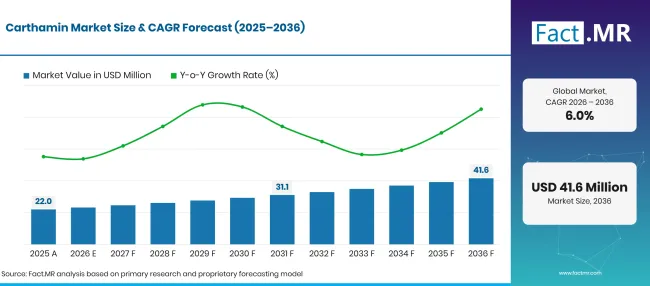
The carthamin market is anticipated to grow from USD 23.2 million in 2026 to USD 41.6 million by 2036, registering a CAGR of 6.0% over the ten-year period. Demand is supported by growing interest in safflower-derived red pigments for natural food coloring, cosmetic formulations and textile dyeing applications.
Sales of carthamin are gaining attention as textile dyers, pigment manufacturers and specialty formulators explore safflower-derived red colorants. Producers are examining extraction methods that improve pigment recovery while preserving color quality. In July 2025, researchers at Vasantrao Naik Marathwada Krishi Vidyapeeth in India published findings on safflower pigment extraction and characterization across different flower genotypes. Their work examined the concentration of red carthamin and yellow pigments separately, identifying varieties with higher pigment yields.
Key Takeaways from Carthamin Market
- Carthamin Market Value (2025): USD 22.0 million
- Carthamin Market Value (2026): USD 23.2 million
- Carthamin Market Forecast Value (2036): USD 41.6 million
- Carthamin Market Forecast CAGR (2026-2036): 6.0%
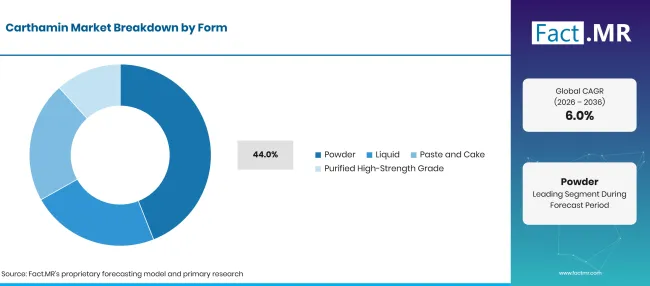
- Leading Form: Powder (44.0%)
- Key Market Participants: Organic Herb, Shaanxi NHK Technology, Xi'an PuroNature Biotechnology, Anrui Biotech, IMAHERB Biotech, Bioway (Xi'an) Organic Ingredients Co., Ltd., Creative Enzymes, Xi'an HuaRui Bio-Engineering Co., Ltd.
- Key Growth Countries: India, China, South Korea, United States, France
In July 2025, a published study examining 30 safflower genotypes reported red pigment concentrations ranging from 2.2 to 4.3 mg/ml in the tested extracts. These differences highlight the importance of flower variety and pigment recovery when producing safflower-derived red colorants. The study distinguishes red carthamin from yellow safflower pigments, which have different chemical properties.
Carthamin Market
| Metric | Value |
|---|---|
| Estimated Value in (2026) | USD 23.2 million |
| Forecast Value in (2036) | USD 41.6 million |
| Forecast CAGR (2026 to 2036) | 6.0% |
Source: Fact.MR analysis. Updated Nov 27, 2026
Carthamin Market Forecast Global | Source: Fact.MR
Category
| Category | Segments |
|---|---|
| Form | Powder, Liquid, Paste and cake, Purified high-strength grade |
| Application | Food and beverages, Cosmetics and personal care, Textile and craft dyeing, Pharmaceutical and nutraceutical, Artists' pigments and inks |
| Grade | Food grade, Cosmetic grade, Technical grade, Reagent and analytical grade |
| Sales Channel | Direct to manufacturers, Distributors, Online and specialty retail, Contract and tolling supply |
| Region | India; China; South Korea; United States; France |
Source: Fact.MR analysis. Updated Nov 27, 2026
Segmental Analysis
What makes powder the leading form segment in the Carthamin Market?
Carthamin Market Breakdown Form | Source: Fact.MR
Powdered carthamin accounts for 44.0% of market revenue in 2026, approximately USD 10.2 million. Its dry format supports convenient storage, transportation and measured incorporation into suitable pigment formulations. Powdered safflower red preparations can contain carriers such as dextrin. Textile dyers and specialty pigment manufacturers consider color concentration, moisture protection and stability when selecting powdered materials.
Which factors support food and beverages as the largest application segment in the Carthamin Market?
Carthamin Market Breakdown Application | Source: Fact.MR
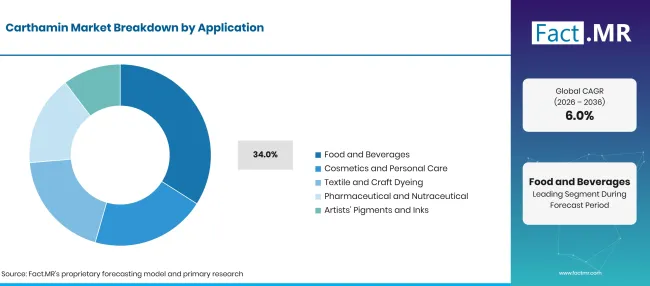
Food and beverage applications represent 34.0% of carthamin revenue in 2026, equivalent to approximately USD 7.9 million. Interest in botanical colorants creates opportunities for safflower-derived ingredients, subject to product identity and regulatory requirements. Food applications depend on authorization of the specific red pigment rather than approval of unrelated safflower yellow extracts.
What makes food grade the leading grade segment in the Carthamin Market?
Carthamin Market Breakdown Grade | Source: Fact.MR
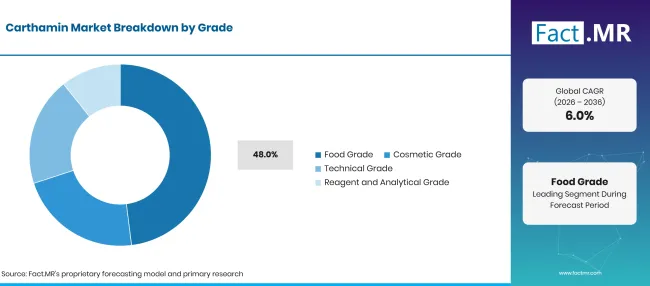
Food-grade carthamin contributes approximately USD 11.1 million in 2026, representing 48.0% of market revenue. Manufacturers assess pigment purity, composition and processing conditions when sourcing botanical coloring ingredients. Carthamin differs chemically from safflower yellow pigments, making precise ingredient identification essential. Food-grade specifications support quality assessment, while commercial use remains subject to applicable color additive regulations.
Which factors support direct to manufacturers as the largest sales channel segment in the Carthamin Market?
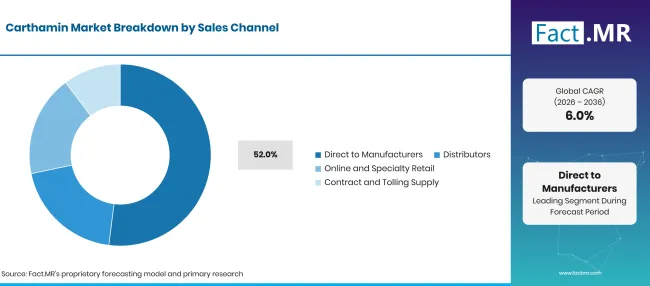
Carthamin Market Breakdown Sales Channel | Source: Fact.MR
Direct sales to manufacturers generate approximately USD 12.1 million in 2026, accounting for 52.0% of market revenue. Buyers sourcing carthamin for textile dyes and specialty pigments can specify concentration, purity and delivery format. Direct supplier relationships also support discussions about batch consistency, processing requirements and suitable storage conditions, helping manufacturers maintain predictable formulation quality.
Carthamin Market-Drivers, Restraints & Trends
Drivers
Interest in plant-derived red pigments supports carthamin applications in textile dyeing, traditional crafts and specialty color formulations. Research into safflower pigment extraction is helping identify suitable flower varieties and processing conditions. Food and cosmetic applications also offer opportunities where regulatory requirements permit.
Restraints
Carthamin's sensitivity to light creates challenges for maintaining consistent color during storage and application. Limited red pigment content in safflower petals can increase extraction costs. Manufacturers must also address pigment stability, processing efficiency and regulatory permissions before expanding into food applications.
Trend
Plant-Derived Colorants: Research into safflower genotype and sowing time examines how cultivation conditions affect the accumulation of red and yellow pigments. A January 2026 study distinguished carthamin, the principal red pigment, from water-soluble yellow dyes.
Trend
Natural Cosmetics: Cosmetic formulators are examining plant-derived pigments for specialty color applications, creating opportunities for safflower-based ingredients. Carthamin offers a botanical red pigment, although its light sensitivity requires careful formulation. Suppliers must assess color stability, ingredient purity and applicable cosmetic regulations before commercial use.
Carthamin Market Analysis by Key Country
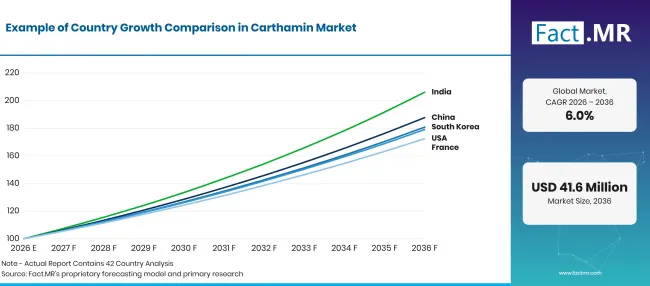
Carthamin Market Growth Index | Source: Fact.MR
| Country | CAGR (2026-2036) |
|---|---|
| India | 7.5% |
| China | 6.5% |
| South Korea | 6.1% |
| United States | 6.0% |
| France | 5.6% |
Source: Fact.MR analysis.
Why is India the fastest-growing market for carthamin?
Demand for carthamin in India is anticipated to increase at a 7.5% CAGR over the forecast period.
Safflower cultivation and traditional textile dyeing provide opportunities for red pigment extraction. In January 2026, India's Ministry of Agriculture reported that safflower sowing had reached 0.64 lakh hectares as of January 23 during the ongoing rabi season. Pigment manufacturers can explore safflower petals as a source of carthamin for specialty dyes.
What is driving carthamin demand in China?
Sales of carthamin in China are anticipated to expand at a 6.5% CAGR over the next decade.
Research into safflower pigments provides opportunities for improved extraction and purification techniques. A 2025 study involving Chinese researchers examined ultrasound-assisted extraction of red and yellow safflower pigments using natural deep eutectic solvents. The findings highlighted differences in pigment separation and storage stability. Producers developing carthamin ingredients can apply such research to improve recovery, maintain color quality and serve specialized dye applications.
What is shaping carthamin demand in South Korea?
Cosmetic ingredient research provides a potential application for safflower-derived pigments in South Korea, where carthamin sales are anticipated to rise at a 6.1% CAGR by 2036.
A 2025 study published in the Journal of the Society of Cosmetic Scientists of Korea examined a botanical complex containing safflower alongside other flower extracts. Cosmetic manufacturers considering red safflower pigments must separately assess their stability, composition and suitability under applicable ingredient regulations.
How is demand for carthamin developing in the United States?
Demand for carthamin in the United States is anticipated to grow at a 6.0% CAGR during the forecast period.
Regulatory developments concerning botanical colorants are influencing ingredient evaluation. Carthamin food applications depend on the regulatory status of the red pigment. A petition concerning safflower yellow does not establish authorization for carthamin.
Why is growth slower for carthamin in France?
Sales of carthamin in France are anticipated to increase at a 5.6% CAGR through 2036.
Textile heritage research offers a specialized application for identifying safflower-derived red pigments. A September 2026 study examining an eighteenth-century French garment identified carthamin as an important marker of safflower dye. Commercial opportunities also depend on formulation stability and regulatory suitability, particularly for manufacturers considering cosmetic or food coloring applications.
Competitive Landscape for Carthamin Market
Carthamin suppliers compete in a specialized pigment market where extraction efficiency, red color concentration and stability influence commercial value. Anrui Biotech lists safflower red containing carthamin for business customers.
Recent research is creating opportunities to improve carthamin recovery. A 2025 study examined ultrasound-assisted extraction of red and yellow safflower pigments using natural deep eutectic solvents. Suppliers developing red pigment products must consider extraction yield, light sensitivity and batch consistency. Buyers also assess purity, intended applications and applicable regulations, particularly for food and cosmetic formulations.
Recent Developments
- In January 2026, researchers published a study assessing how safflower genotype and sowing time affect red and yellow pigment accumulation. The findings provide a basis for selecting plant material for natural dye extraction.
Key Players in Carthamin Market
Key companies operating in the market include Organic Herb, Shaanxi NHK Technology, Xi'an PuroNature Biotechnology, Anrui Biotech, IMAHERB Biotech, Bioway (Xi'an) Organic Ingredients Co., Ltd., Creative Enzymes, and Xi'an HuaRui Bio-Engineering Co., Ltd.
- Organic Herb
- Shaanxi NHK Technology
- Xi'an PuroNature Biotechnology
- Anrui Biotech
- IMAHERB Biotech
- Bioway (Xi'an) Organic Ingredients Co., Ltd.
- Creative Enzymes
- Xi'an HuaRui Bio-Engineering Co., Ltd.
Bibliography
- Cafaro, V., Patanè, C., Panebianco, V., Calcagno, S., Caruso, P., & Testa, G. (2025). Safflower petal composition: Impact of sowing time and plant density on proximate, antioxidants, and colorants. Frontiers in Plant Science, 16, 1711580.
- Clemente, C., Tavarini, S., Antoni, S., Zublena, S., Angelini, L. G., & Degano, I. (2026). Natural dyes and antioxidant compounds from safflower (Carthamus tinctorius L.) florets: The effects of genotype and sowing time. Plants, 15(2), 282.
- Jadhav, P. V., Bhalerao, S., Ghuge, S. B., & Thorat, G. P. (2025). Comparative analysis and characterization of yellow and red pigment in safflower (Carthamus tinctorius L.). Plant Cell Biotechnology and Molecular Biology, 26(7–8), 310–321.
- Mieites Alonso, M. G., & Basso, E. (2026). Revealing Parelle d’Auvergne: LC-MS characterization of dyes in a robe à la circassienne. Heritage, 9(9), 353.
- Mieites Alonso, M. G., Leona, M., & Shibayama, N. (2025). From Edo to Shōwa: Study on the transition from natural to synthetic dyes in kimono from the 19th to the 20th century. npj Heritage Science, 13, 538.
- Özpeynirci, A., & Nizamlioğlu, N. M. (2026). Safflower flower extracted carthamidin color pigment purification by adsorption chromatography and investigation of its use as a coloring agent in some foods. Microchemical Journal, 220, 116265.
- Pan, Y.-L., & Ishii, M. (2026). A comparative study of silk dyed with traditional fermented safflower cake or dried safflower petals. Journal of the Institute of Conservation, 49(2), 117–138.
- Press Information Bureau, Government of India. (2026, January 28). Progress of area coverage under Rabi crops as on 23rd January 2026. Ministry of Agriculture & Farmers Welfare. P
- Uskutoğlu, T. (2025). Variation in HSYA and carthamin contents across developmental stages of flowers and different petal colours in safflower (Carthamus tinctorius L.): Relationship with CIELAB colour space parameters. Annals of Applied Biology, 187(3), 398–407.
- U.S. Food and Drug Administration. (2026, August 19). GNT USA, LLC.; Filing of color additive petition (91 FR 53545). Federal Register.
Segmentation
Scope of Report
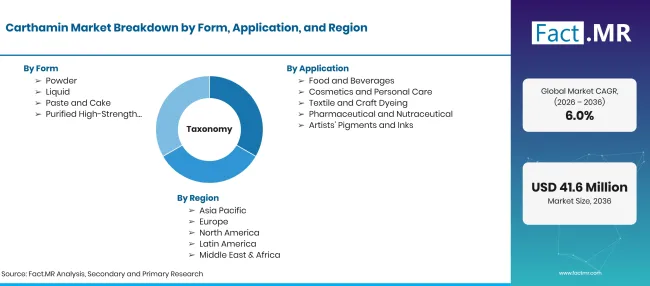
Carthamin Market Taxonomy | Source: Fact.MR
| Items | Values |
|---|---|
| Quantitative Units (2026) | USD 23.2 Million |
| Form | Powder, Liquid, Paste and cake, Purified high-strength grade |
| Application | Food and beverages, Cosmetics and personal care, Textile and craft dyeing, Pharmaceutical and nutraceutical, Artists' pigments and inks |
| Grade | Food grade, Cosmetic grade, Technical grade, Reagent and analytical grade |
| Sales Channel | Direct to manufacturers, Distributors, Online and specialty retail, Contract and tolling supply |
| Regions Covered | North America, Latin America, Europe, Asia Pacific, Middle East & Africa |
| Countries Covered | India, China, South Korea, United States, France, and other countries |
| Key Companies Profiled | Organic Herb, Shaanxi NHK Technology, Xi'an PuroNature Biotechnology, Anrui Biotech, IMAHERB Biotech, Bioway (Xi'an) Organic Ingredients Co., Ltd., Creative Enzymes, Xi'an HuaRui Bio-Engineering Co., Ltd. |
| Additional Attributes | Dollar revenue in the Carthamin Market is segmented by form, application, grade and sales channel and region. |
Source: Fact.MR analysis. Updated Nov 27, 2026
Carthamin Market by Segments
-
Form
- Powder
- Liquid
- Paste and cake
- Purified high-strength grade
-
Application
- Food and beverages
- Cosmetics and personal care
- Textile and craft dyeing
- Pharmaceutical and nutraceutical
- Artists' pigments and inks
-
Grade
- Food grade
- Cosmetic grade
- Technical grade
- Reagent and analytical grade
-
Sales Channel
- Direct to manufacturers
- Distributors
- Online and specialty retail
- Contract and tolling supply
-
Region:
- North America
- United States
- Canada
- Mexico
- Europe
- Germany
- United Kingdom
- France
- Italy
- Spain
- Rest of Europe
- Asia Pacific
- China
- India
- Japan
- South Korea
- Australia and New Zealand
- Rest of Asia Pacific
- Latin America
- Brazil
- Argentina
- Rest of Latin America
- Middle East & Africa
- GCC Countries
- South Africa
- Rest of Middle East & Africa
- North America
Table of Contents
Key Takeaways
- Market Size and CAGR
- Top Growth Driver
- Fastest Growing Segment
- Leading Region
- Key Companies
- Emerging Opportunities

