
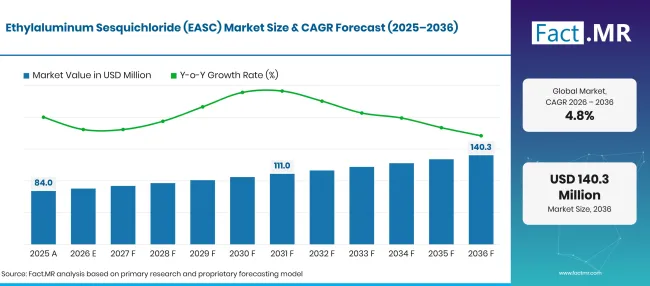
- Market Value (2025): USD 84.0 Mn
- Estimated Value (2026): USD 87.8 Mn
- Forecast Value (2036): USD 140.3 Mn
- CAGR (2026-2036): 4.8%
Ethylaluminum Sesquichloride (EASC) Market Forecast and Outlook 2026 to 2036
According to the Fact.MR analysis, the ethylaluminum sesquichloride (EASC) market surpassed a value of USD 84.0 million in 2025 and is projected to grow from USD 87.8 million in 2026 to USD 140.3 million by 2036. Demand for ethylaluminum sesquichloride is likely to grow at a CAGR of 4.8% over the forecast period.
Demand for ethylaluminum sesquichloride (EASC) is supported by its use as a catalyst component in the production of EPDM and polybutadiene rubber and polyolefins, and by smaller uses in fine chemicals. The key players are offering neat liquid and diluted heptane and hexane solutions in steel cylinders, drums and bulk containers designed for this pyrophoric material.
Key Takeaways from the Ethylaluminum Sesquichloride (EASC) Market
- Ethylaluminum Sesquichloride (EASC) Market Value (2025): USD 84.0 million
- Ethylaluminum Sesquichloride (EASC) Market Value (2026): USD 87.8 million
- Ethylaluminum Sesquichloride (EASC) Market Forecast Value (2036): USD 140.3 million
- Ethylaluminum Sesquichloride (EASC) Market Forecast CAGR (2026-2036): 4.8%
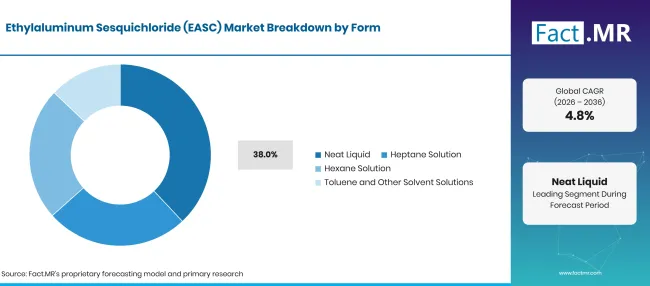
- Leading Form: Neat liquid (38.0%)
- Key Market Participants: Nouryon, Albemarle, Tosoh Finechem, Nippon Aluminum Alkyls
- Key Growth Countries: India, China, South Korea, Japan, United States
Demand for Ethylaluminum Sesquichloride (EASC) is expected to remain supported by its role as a cocatalyst in Ziegler-Natta polymerization, particularly in the production of EPDM synthetic rubber and polyolefins. EPDM is widely used in automotive tires, seals, hoses and other components, while polyethylene and polypropylene serve packaging, automotive and industrial applications. The Gujarat State Environment Impact Assessment Authority identifies EASC as a catalyst used in EPDM rubber and polyolefin manufacturing, reinforcing its importance in polymer production. However, EASC's pyrophoric nature and violent reaction with water require inert-gas handling, specialized storage and controlled transportation. These safety requirements increase operating complexity and limit participation among manufacturers with appropriate chemical-handling capabilities.
Ethylaluminum Sesquichloride (EASC) Market
| Metric | Value |
|---|---|
| Estimated Value in (2026) | USD 87.8 million |
| Forecast Value in (2036) | USD 140.3 million |
| Forecast CAGR (2026 to 2036) | 4.8% |
Source: Fact.MR analysis.
Ethylaluminum Sesquichloride Easc Market Forecast Global | Source: Fact.MR
Category
| Category | Segments |
|---|---|
| Form | Neat liquid, Heptane solution, Hexane solution, Toluene and other solvent solutions |
| Application | EPDM and polybutadiene rubber catalysts, Ziegler-Natta polyolefin catalysts, Fine chemicals and pharmaceuticals, Alkylation and metallurgy uses |
| Packaging | Steel cylinders, ISO tanks and bulk containers, Drums, Small lab and pilot packs |
| End-Use Industry | Tyre and rubber goods, Plastics and polyolefins, Pharmaceuticals and agrochemicals, Specialty chemicals |
| Region | India; China; South Korea; Japan; United States |
Source: Fact.MR analysis.
Ethylaluminum Sesquichloride (EASC) Market Analysis by Key Country
Ethylaluminum Sesquichloride Easc Market Growth Index | Source: Fact.MR
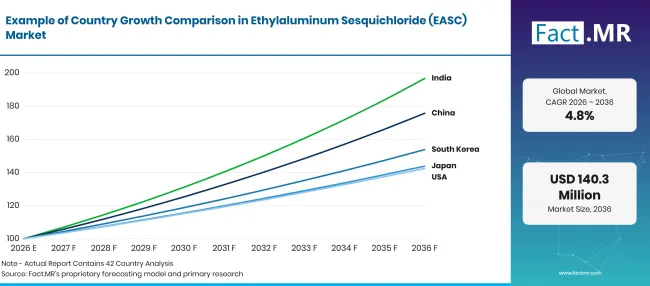
| Country | CAGR (2026-2036) |
|---|---|
| India | 7.0% |
| China | 5.8% |
| South Korea | 4.4% |
| Japan | 3.7% |
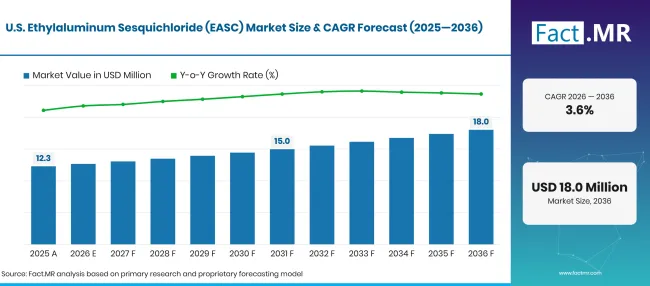
| United States | 3.6% |
Source: Fact.MR analysis.
What is accelerating ethylaluminum sesquichloride demand and sales in India?
Demand for ethylaluminum sesquichloride in India is projected to increase at a 7.0% CAGR through 2036, the fastest among the five countries.
Expanding synthetic rubber and polyolefin production is creating opportunities for organoaluminum catalyst manufacturers. According to the Department of Chemicals and Petrochemicals, Government of India, synthetic rubber production reached 411,300 tonnes in FY 2024-25, compared with 394,700 tonnes in FY 2023-24. The government's 2025 petrochemical outlook also projects polymer production of 13.37 million tonnes in FY 2025-26. These production requirements support procurement of polymerization catalysts and co-catalysts, strengthening potential EASC sales.
Which industrial production trends are strengthening EASC sales in China?
Demand for ethylaluminum sesquichloride in China is forecast to grow at a 5.8% CAGR through 2036, above the global rate of 4.8%.
Extensive polymer manufacturing and industrial chemical production create a substantial application base for catalyst components. China's National Bureau of Statistics reported that ethylene production reached 41.508 million tonnes in 2025, increasing 6.4% year over year. The country's manufacturing scale supports demand for polymerization technologies used in plastics and synthetic materials. Continued investment in petrochemical production and downstream processing is expected to sustain procurement of organoaluminum co-catalysts, supporting supplier sales over the forecast period.
How are South Korea's synthetic rubber and specialty chemical industries influencing EASC adoption?
Demand for ethylaluminum sesquichloride in South Korea is expected to rise at a 4.4% CAGR through 2036, slightly below the global rate of 4.8%.
Established synthetic rubber manufacturing and specialty chemical production provide a stable customer base for catalyst manufacturers. South Korea's official KOSIS statistical system, updated on November 24, 2026, maintains government-approved industrial production statistics covering manufacturing and chemical industries. These industrial statistics provide an important measure of the country's manufacturing activity. Continued requirements for polymerization catalysts in rubber and plastics production are expected to support recurring EASC purchases, although mature industrial capacity moderates incremental sales growth.
What is sustaining specialty catalyst demand and sales in Japan?
Demand for ethylaluminum sesquichloride in Japan is projected to increase at a 3.7% CAGR through 2036, below the global rate of 4.8%.
Established specialty chemical manufacturing and synthetic rubber production support a replacement-oriented market for catalyst components. Japan's Ministry of Economy, Trade and Industry published its 2025 annual-adjusted manufacturing production statistics in March 2026, covering chemical products, petrochemicals, catalysts, rubber and plastic products. Its 2026 production survey also tracks monthly chemical and rubber manufacturing activity. These official reporting programmes demonstrate the scale of industrial monitoring and provide indicators for procurement activity. Mature manufacturing capacity and selective investment are likely to moderate new EASC sales.
Which factors are shaping ethylaluminum sesquichloride purchasing in the United States?
Demand for ethylaluminum sesquichloride in the United States is forecast to grow at a 3.6% CAGR through 2036, the slowest among the five countries.
Ethylaluminum Sesquichloride Easc Market Forecast Usa | Source: Fact.MR
Established polymer manufacturing and relatively mature chemical production constrain incremental expansion, while industrial buyers continue purchasing catalyst components for specialized applications. The US Census Bureau's 2024 Annual Integrated Economic Survey, released in September 2026, reported rubber product manufacturing revenue of USD 47.33 billion, with annual payroll of USD 9.06 billion. This substantial downstream manufacturing base supports continued requirements for synthetic rubber and polymer inputs. However, stringent chemical handling, storage and transportation requirements influence purchasing decisions and supplier selection.
Competitive Landscape for Ethylaluminum Sesquichloride (EASC) Market
The ethylaluminum sesquichloride (EASC) market is moderately concentrated, with Nouryon, Albemarle, Tosoh Finechem and Nippon Aluminum Alkyls together hold about 46% of 2026 revenue, based on Fact.MR estimates. Competition centers on product purity, safe packaging and transport, reliability of supply and technical support to catalyst users. A small number of specialty organometallic producers lead, and customers often qualify them through long approvals.
Recent Developments
- In October, 2025, Mitsui Chemicals acquired 100% of Nippon Aluminum Alkyls (NAA) from Ketjen Netherlands Holdings, making the Japanese organometallic manufacturer a wholly owned subsidiary. NAA manufactures and sells aluminium alkyl compounds used in polyolefin catalysts, synthetic rubber production and other specialty chemical applications. The acquisition enables Mitsui Chemicals to allocate resources more directly towards catalysts and cocatalysts for polyolefins and synthetic rubber, while strengthening its control over organometallic manufacturing and supply. Since NAA's product portfolio explicitly includes ethylaluminum sesquichloride, this transaction represents a directly relevant ownership development for the EASC market.
- In November 2025, Nippon Aluminum Alkyls announced a price revision covering all grades of its aluminium alkyl products, explicitly including ethylaluminum sesquichloride (EASC). The company cited increases in raw-material, packaging, logistics and manufacturing-equipment maintenance costs. The announced adjustment was JPY 150 per kg, effective for deliveries from January 1, 2026. The revision reflects changing production and distribution economics for EASC and other organoaluminum compounds. It is a relevant commercial development because it directly identifies EASC within the affected product portfolio.
- In October 2025, Nouryon completed a metal-alkyl production capacity expansion at its Jiaxing facility in China, ultimately doubling its production capability for triethylaluminum (TEAL), an important cocatalyst used in polyethylene and polypropylene manufacturing. The investment also included infrastructure upgrades, additional blending and cylinder-transfilling capabilities, and advanced emission-control systems. The company further announced plans for MMAO production in China from 2027 and an organic peroxides innovation centre in Tianjin in 2026. Although the capacity increase concerns TEAL rather than EASC, it demonstrates investment in the broader metal-alkyl supply chain serving polymer manufacturers.
- In October, 2026, Gulbrandsen announced the commercial launch of HYPORE, a portfolio of advanced silica supports and silica-supported chromium catalyst precursors for polyethylene catalyst systems. The launch extends the company's activities across the polyolefin catalyst value chain beyond its established metal-alkyl business. The products are manufactured at commercial scale and target polyethylene producers, catalyst manufacturers and process-technology companies. The development demonstrates Gulbrandsen's continued investment in catalyst-related materials and its expansion into additional polymer production inputs.
- In March 2026, Albemarle completed the sale of a controlling stake in Ketjen to KPS Capital Partners, retaining a minority interest in the company. The transaction transferred operational control of Ketjen's refining catalyst solutions business to KPS, while Albemarle retained full ownership of Ketjen's Performance Catalyst Solutions business. This development is relevant to the wider organometallic and catalyst supplier landscape because Ketjen was previously a shareholder in Nippon Aluminum Alkyls before Mitsui Chemicals acquired the remaining shares in October 2025.
Segmental Analysis
What is driving demand for neat liquid EASC?
Ethylaluminum Sesquichloride Easc Market Breakdown Form | Source: Fact.MR
Demand for neat liquid EASC is supported by polymer manufacturers that require concentrated organoaluminum catalysts for industrial production. The neat liquid segment accounts for 38.0% of market revenue in 2026, about USD 33.4 million. India's Department of Chemicals and Petrochemicals reported production of 27.322 million tonnes of major chemicals and petrochemicals during April to September 2025, according to its Annual Report 2025–26. Organic chemicals represented 15.7% of major chemical production in FY 2024–25. Expanding chemical manufacturing activity creates opportunities for catalyst manufacturers serving polymer producers with dedicated chemical-handling infrastructure.
Which factors are increasing demand for EPDM and polybutadiene rubber catalysts?
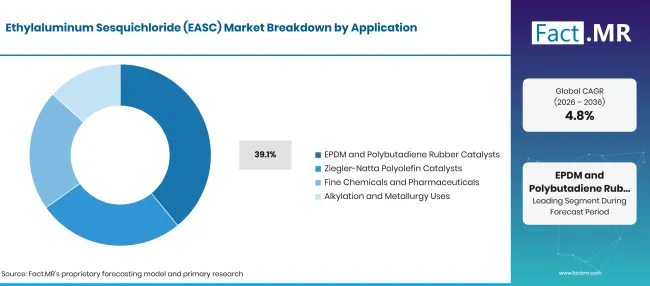
Ethylaluminum Sesquichloride Easc Market Breakdown Application | Source: Fact.MR
Demand for EPDM and polybutadiene rubber catalysts is closely linked to tyre manufacturing and industrial rubber production. This application segment accounts for 39.1% of EASC market revenue in 2026, about USD 34.3 million. According to the Department for Promotion of Industry and Internal Trade's 2025–26 Annual Report, India's tyre production reached approximately 223.33 million units in FY 2024–25, while tyre exports were valued at INR 27,300.69 crore in 2025. Rising domestic manufacturing and export activity support demand for synthetic rubber production, creating opportunities for EASC manufacturers serving rubber catalyst manufacturers.
How are chemical safety requirements shaping demand for steel-cylinder packaging?
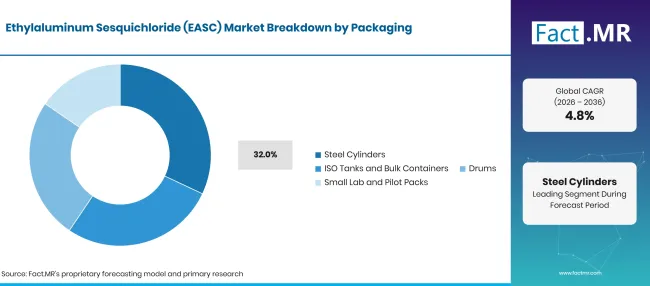
Ethylaluminum Sesquichloride Easc Market Breakdown Packaging | Source: Fact.MR
Demand for steel-cylinder packaging is supported by the need to protect reactive organoaluminum compounds from moisture and air during storage and transportation. This packaging segment accounts for 32.0% of EASC market revenue in 2026, about USD 28.1 million. India's Petroleum and Explosives Safety Organisation oversees safety requirements covering the manufacture, storage, transportation and handling of regulated hazardous substances. Its cylinder-related requirements address secure transportation, protection against physical damage and inspection procedures. These safety considerations reinforce the importance of suitable packaging and controlled logistics for hazardous chemical manufacturers.
What is supporting sales of EASC to tyre and rubber goods manufacturers?
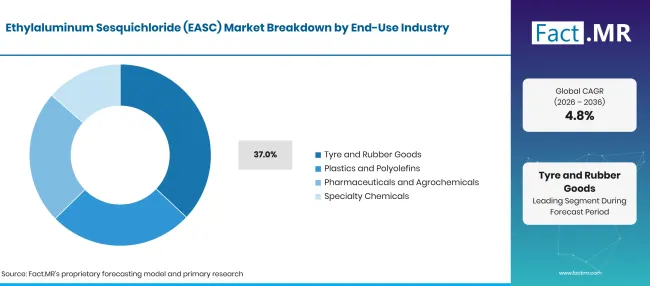
Ethylaluminum Sesquichloride Easc Market Breakdown End Use Industry | Source: Fact.MR
Sales of EASC to tyre and rubber goods manufacturers are driven by India's substantial tyre production and export base. This end-use segment accounts for 37.0% of EASC market revenue in 2026, about USD 32.5 million. The Department for Promotion of Industry and Internal Trade reported that nearly 100% of India's domestic tyre demand was met through local production, with approximately 20% of total tyre production exported during FY 2024–25. The industry recorded an estimated annual turnover of INR 1 lakh crore in the same financial year. This established manufacturing base supports demand for synthetic rubber and associated catalyst systems.
Ethylaluminum Sesquichloride (EASC) Market-Drivers, Restraints & Trends
Drivers: Expanding Synthetic Rubber and Polymer Production
Demand for ethylaluminum sesquichloride is supported by expanding synthetic rubber and polyolefin manufacturing, where organoaluminum compounds serve as important catalyst components in selected polymerization processes. India's Rubber Board reported that synthetic rubber consumption increased by 5.5% to 753,000 tonnes during April 2025 to January 2026, while domestic production rose by 3.0% to 495,000 tonnes. Additionally, the Department of Chemicals and Petrochemicals recorded EPDM production of 68,403 tonnes and polybutadiene rubber production of 152,166 tonnes in FY 2024–25. These production and consumption trends indicate a substantial downstream industrial base supporting demand for polymerization catalysts, including EASC.
Restraints: Hazardous Material Handling and Alternative Catalyst Systems
Sales are constrained by the hazardous nature of the material, which requires special packaging and transport, by the concentration of supply in a few producers and by shifts to other catalyst systems in some plants. Demand for ethylaluminum sesquichloride is constrained by its hazardous handling requirements, specialized packaging needs and transportation risks. The Bureau of Indian Standards' IS 1446:2024 classifies dangerous goods according to their hazard characteristics, while IS 18149:2023 establishes requirements for packaging, labelling, documentation, handling and transportation. Compliance with these requirements can increase logistics costs and operational complexity for EASC manufacturers and downstream users. Additionally, the availability of alternative catalyst systems can limit adoption where polymer manufacturers prioritize process compatibility, operating costs and catalyst performance.
Opportunity: Safe-Handling Solutions
Suppliers are offering diluted solutions and engineered packaging to reduce handling risk for customers. Opportunities are emerging for EASC manufacturers offering engineered packaging, controlled dilution formats and specialized delivery systems that simplify material transfer and reduce exposure risks. India's IS 18149:2023 guidelines establish a framework covering dangerous-goods classification, packaging, labelling, handling and emergency procedures during transportation. These requirements create opportunities for manufacturers to differentiate through compatible containers, secure transfer connections, improved handling instructions and technical support for customer facilities. Such solutions can help polymer manufacturers improve chemical-handling procedures while maintaining catalyst quality and process consistency.
Trend: Specialty Rubber Growth
Demand for EPDM for vehicles, construction and electric-vehicle components supports catalyst consumption. Demand for EASC is benefiting from the expansion of downstream polymer and specialty-rubber applications in automotive manufacturing. India's passenger vehicle production increased from 4.902 million units in FY 2023–24 to 5.061 million units in FY 2024–25, according to figures reported by the Ministry of Heavy Industries in February 2026. At the same time, EPDM production reached 68,403 tonnes in FY 2024–25, reflecting growth in domestic production of an important specialty elastomer. These developments support the broader opportunity for catalyst consumption in rubber applications associated with automotive sealing systems, weatherstripping, hoses and other industrial components.
Key Players in Ethylaluminum Sesquichloride (EASC) Market
Key companies operating in the market include Albemarle Corporation, Gulbrandsen, LANXESS, Mitsui Chemicals (Nippon Aluminum Alkyls), Nouryon, and Tosoh Finechem Corporation.
- Albemarle Corporation
- Gulbrandsen
- LANXESS
- Mitsui Chemicals (Nippon Aluminum Alkyls)
- Nouryon
- Tosoh Finechem Corporation
Bibliography
- Bureau of Indian Standards. (2025). Compendium of Indian Standards: Dangerous goods classification and transportation [PDF].
- Department for Promotion of Industry and Internal Trade. (2026). Annual report 2025–26: Tyres and tubes industry [PDF].
- Department of Chemicals and Petrochemicals. (2026). Annual report 2025–26 [PDF].
- NITI Aayog. (2026, January). Enhancing circular economy of waste tyres in India [PDF].
- Petroleum and Explosives Safety Organisation. (n.d.). Citizen charter.
- Petroleum and Explosives Safety Organisation. (2026). Gas cylinders (amendment) rules, 2026.
- Rubber Board. (n.d.). Synthetic rubber production and consumption statistics [PDF].
Segmentation
Scope of Report
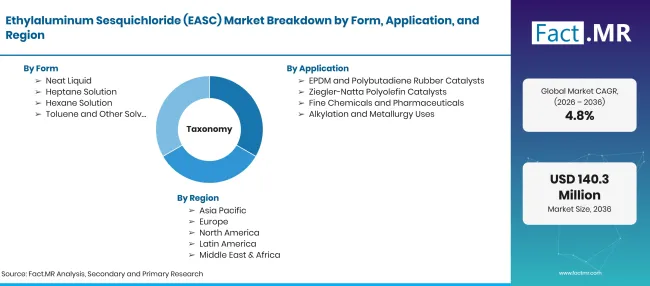
Ethylaluminum Sesquichloride Easc Market Taxonomy | Source: Fact.MR
| Items | Values |
|---|---|
| Quantitative Units (2026) | USD 87.8 Million |
| Form | Neat liquid, Heptane solution, Hexane solution, Toluene and other solvent solutions |
| Application | EPDM and polybutadiene rubber catalysts, Ziegler-Natta polyolefin catalysts, Fine chemicals and pharmaceuticals, Alkylation and metallurgy uses |
| Packaging | Steel cylinders, ISO tanks and bulk containers, Drums, Small lab and pilot packs |
| End-Use Industry | Tyre and rubber goods, Plastics and polyolefins, Pharmaceuticals and agrochemicals, Specialty chemicals |
| Regions Covered | North America, Latin America, Europe, Asia Pacific, Middle East & Africa |
| Countries Covered | India, China, South Korea, Japan, United States, and other countries |
| Key Companies Profiled | • Albemarle Corporation • Gulbrandsen • LANXESS • Mitsui Chemicals (Nippon Aluminum Alkyls) • Nouryon • Tosoh Finechem Corporation |
| Additional Attributes | Dollar revenue in the Ethylaluminum Sesquichloride (EASC) Market is segmented by form, application, packaging and end-use industry and region. |
Source: Fact.MR analysis.
Ethylaluminum Sesquichloride (EASC) Market by Segments
-
Form
- Neat liquid
- Heptane solution
- Hexane solution
- Toluene and other solvent solutions
-
Application
- EPDM and polybutadiene rubber catalysts
- Ziegler-Natta polyolefin catalysts
- Fine chemicals and pharmaceuticals
- Alkylation and metallurgy uses
-
Packaging
- Steel cylinders
- ISO tanks and bulk containers
- Drums
- Small lab and pilot packs
-
End-Use Industry
- Tyre and rubber goods
- Plastics and polyolefins
- Pharmaceuticals and agrochemicals
- Specialty chemicals
-
Region:
- North America
- United States
- Canada
- Mexico
- Europe
- Germany
- United Kingdom
- France
- Italy
- Spain
- Rest of Europe
- Asia Pacific
- China
- India
- Japan
- South Korea
- Australia and New Zealand
- Rest of Asia Pacific
- Latin America
- Brazil
- Argentina
- Rest of Latin America
- Middle East & Africa
- GCC Countries
- South Africa
- Rest of Middle East & Africa
- North America
Table of Contents
Key Takeaways
- Market Size and CAGR
- Top Growth Driver
- Fastest Growing Segment
- Leading Region
- Key Companies
- Emerging Opportunities

