
- Market Value (2025): USD 17.0 Bn
- Estimated Value (2026): USD 17.90 Bn
- Forecast Value (2036): USD 30.2 Bn
- CAGR (2026-2036): 5.4%
Specialty Lubricants Market Forecast and Outlook 2026 to 2036
The specialty lubricant market is anticipated to grow from USD 17.90 billion in 2026 to USD 30.2 billion by 2036, registering a CAGR of 5.4% over the ten-year period. Demand is supported by the use of high-performance lubricants in industrial machinery, automotive components and equipment operating under extreme temperatures and heavy loads.
Interest in specialty lubricants reflects how industrial, automotive, mining and energy users need greases and fluids that perform at extreme temperatures, loads and speeds, and last longer between changes. Suppliers are offering greases, synthetic industrial fluids, compressor and refrigeration oils and high-performance products on mineral, PAO and ester bases.
Key Takeaways from Specialty Lubricants Market
- Sales of specialty lubricants stood at USD 17.0 billion in 2025
- Specialty Lubricants Market Value (2026): USD 17.90 billion
- Specialty Lubricants Market Forecast Value (2036): USD 30.2 billion
- Specialty Lubricants Market Forecast CAGR (2026-2036): 5.4%
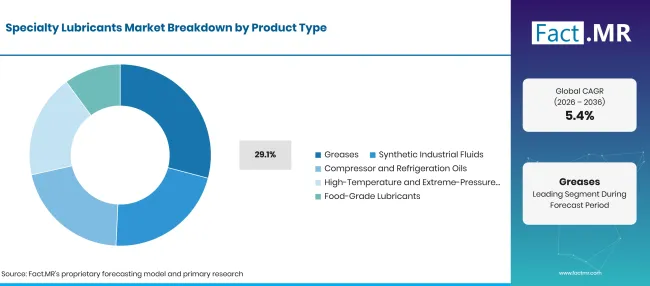
- Leading Product Type: Greases (29.1%)
- Key Market Participants: Shell, ExxonMobil, TotalEnergies, Chevron, Castrol (Stonepeak 65%; bp 35%)
- Key Growth Countries: India, China, Brazil, South Korea, United States
On November 11, 2025, Shell announced that its EV-Plus Thermal Fluid had successfully cooled the battery, electric motor and power electronics of a battery electric vehicle using a single-fluid cooling circuit. Testing conducted with HORIBA MIRA demonstrated the fluid's ability to manage heat across the powertrain under different operating conditions. Electric vehicle manufacturers are exploring specialized thermal fluids to improve battery cooling, simplify powertrain architecture and support faster charging. Shell's development illustrates how lubricant suppliers are extending their product portfolios into advanced electric vehicle thermal management.
Specialty Lubricants Market
| Metric | Value |
|---|---|
| Estimated Value in (2026) | USD 17.0 billion |
| Forecast Value in (2036) | USD 30.2 billion |
| Forecast CAGR (2026 to 2036) | 5.4% |
Source: Fact.MR analysis.
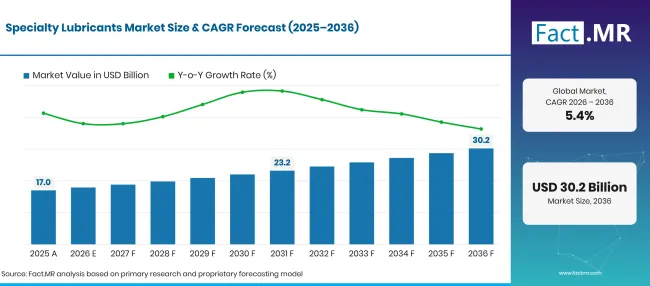
Specialty Lubricants Market Forecast Global | Source: Fact.MR
Category
| Category | Segments |
|---|---|
| Product Type | Greases, Synthetic industrial fluids, Compressor and refrigeration oils, High-temperature and extreme-pressure lubricants, Food-grade lubricants |
| Base Oil | Mineral and group III based, Polyalphaolefin based, Ester based, Silicone and fluorinated, Polyalkylene glycol based |
| End Use | Industrial manufacturing, Automotive, Mining and construction, Power generation and wind, Aerospace and defence |
| Form | Liquid oils and fluids, Greases, Solid film and paste lubricants, Sprays and aerosols |
| Region | India; China; Brazil; South Korea; United States |
Source: Fact.MR analysis.
Segmental Analysis
What explains the leading product type share of greases in the Specialty Lubricants Market?
Specialty Lubricants Market Breakdown Product Type | Source: Fact.MR
Greases hold a 29.1% revenue share in 2026, with sales of approximately USD 5.21 billion. Their use in industrial bearings, gears and automotive joints reflects the need for lubrication that remains in place under demanding operating conditions. Shell offers Gadus greases for high-temperature, heavy-load and extended-service applications, supporting purchases of specialized formulations.
What explains the leading base oil share of mineral and group III based in the Specialty Lubricants Market?
Specialty Lubricants Market Breakdown Base Oil | Source: Fact.MR
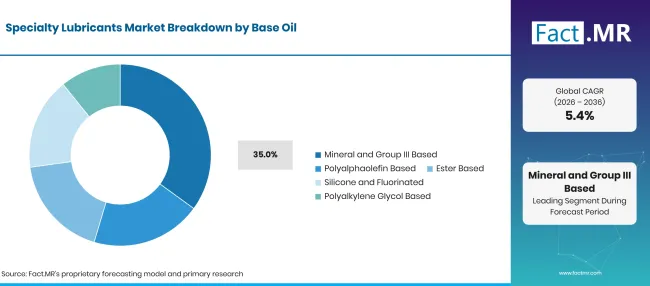
Mineral and Group III base oils generate approximately USD 6.26 billion in 2026, securing 35.0% of specialty lubricant revenue. Their balance of cost and performance suits industrial equipment requiring reliable lubrication under normal operating conditions. ExxonMobil supplies different base stock grades, while PAO and ester formulations address applications involving demanding temperatures and longer service intervals.
What explains the leading end use share of industrial manufacturing in the Specialty Lubricants Market?
Specialty Lubricants Market Breakdown End Use | Source: Fact.MR
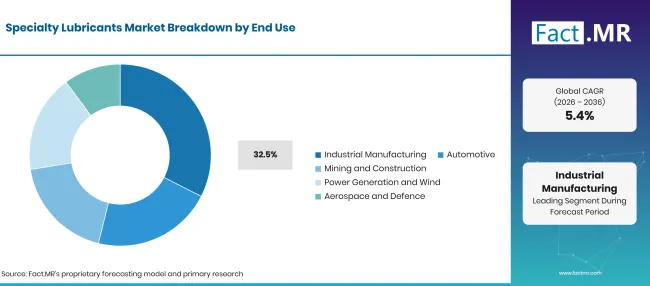
Industrial manufacturing contributes 32.5% of market revenue in 2026, approximately USD 5.82 billion. Production facilities require specialty lubricants for compressors, gearboxes, hydraulic systems and processing machinery operating continuously. TotalEnergies supplies industrial oils for equipment exposed to demanding operating conditions. Scheduled maintenance, equipment protection and efforts to reduce production interruptions influence lubricant selection across manufacturing facilities.
What explains the leading form share of liquid oils and fluids in the Specialty Lubricants Market?
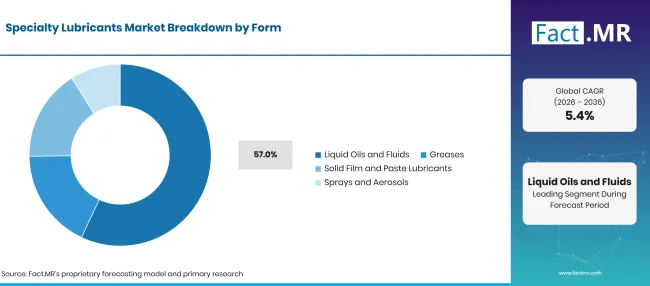
Specialty Lubricants Market Breakdown Form | Source: Fact.MR
The liquid oils and fluids segment leads with 57.0% of revenue in 2026, approximately USD 10.20 billion. Hydraulic equipment, industrial compressors and enclosed gear systems rely on circulating lubricants to reduce friction, transfer heat and protect moving components. Their application across multiple machinery systems supports substantial consumption, while greases serve equipment requiring retained lubrication.
Specialty Lubricants Market- Drivers, Restraints and Trends
Drivers
Industrial machinery operating under high temperatures, heavy loads and continuous production cycles requires specialized lubrication to reduce friction and equipment wear. Manufacturers are developing high-performance greases and synthetic fluids that extend service intervals, improve machinery efficiency and support reliable operations across demanding industrial applications.
Restraints
Extended oil drain intervals reduce replacement volumes, while growing electric vehicle use changes requirements for conventional engine lubricants. Fluctuations in base oil and additive prices create additional cost pressures for manufacturers. Industrial buyers also assess higher-priced specialty formulations against conventional alternatives.
Trend
Electric Vehicle Thermal Fluids: In November 2025, Shell demonstrated its EV-Plus Thermal Fluid for cooling batteries, electric motors and power electronics through a single circuit. Such innovations are expanding lubricant applications into electric vehicle thermal management, where efficient cooling supports battery performance and simplified powertrain designs.
Trend: Bio-Based and Food-Grade Products
Food processors and marine operators are selecting specialized lubricants suited to hygiene and environmental requirements. NSF H1 registration addresses incidental food contact, while ExxonMobil offers environmentally acceptable marine lubricants. These applications encourage suppliers to develop formulations combining equipment protection with application-specific safety requirements.
Specialty Lubricants Market Analysis by Key Country
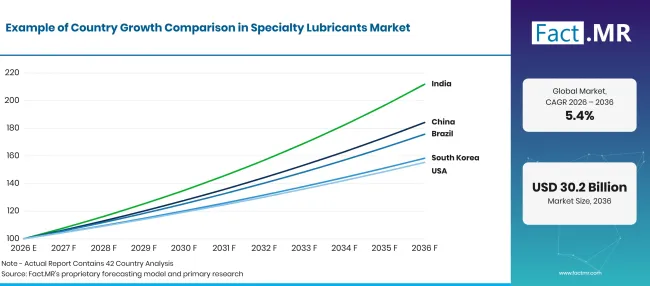
Specialty Lubricants Market Growth Index | Source: Fact.MR
| Country | CAGR (2026-2036) |
|---|---|
| India | 7.8% |
| China | 6.3% |
| Brazil | 5.8% |
| South Korea | 4.7% |
| United States | 4.5% |
Source: Fact.MR analysis.
Why is India the fastest-growing market for specialty lubricants?
Sales of specialty lubricants in India are forecast to increase at a 7.8% CAGR over the next decade, the highest among the five countries.
Manufacturing expansion, infrastructure development and growing vehicle fleets support purchases of industrial greases and synthetic fluids. India's Ministry of Statistics and Programme Implementation reported that registered manufacturing output increased by 7.81% in FY 2024–2025. Machinery operators require lubricants suited to heavy loads, continuous operation and elevated temperatures.
How is demand for specialty lubricants developing in China?
Demand for specialty lubricants in China is anticipated to expand at a 6.3% CAGR over the forecast period, exceeding the global rate of 5.4%.
Industrial equipment manufacturing and automotive production create requirements for high-performance greases, compressor oils and specialized fluids. China's National Bureau of Statistics recorded an 8.0% increase in general-purpose machinery manufacturing output during 2025. Equipment manufacturers and factory operators increasingly require lubrication suited to precision components, automated production lines and extended operating cycles.
What is driving specialty lubricants demand in Brazil?
Sales of specialty lubricants in Brazil are estimated to grow at a 5.8% CAGR by 2036, above the global average of 5.4%.
Agricultural machinery, mining equipment and industrial processing facilities rely on greases and fluids suited to demanding operating environments. Brazil's Institute of Geography and Statistics reported that mining and quarrying activity expanded by 8.6% in 2025. Heavy equipment used in mineral extraction requires lubrication for bearings, hydraulic systems and gears.
What is shaping specialty lubricants demand in South Korea?
Demand for specialty lubricants in South Korea is projected to rise at a 4.7% CAGR over the ten-year outlook, compared with the global rate of 5.4%.
Shipbuilding, automotive manufacturing and electronics production require lubricants suited to precision machinery and demanding operating conditions. South Korea's Ministry of Trade, Industry and Resources reported automotive production of 4.1 million vehicles in 2025. Manufacturing facilities use specialized greases and industrial fluids to protect production equipment, while shipyards require formulations suited to marine environments, mechanical loads and continuous maintenance operations.
Why is growth slower for specialty lubricants in the United States?
Sales of specialty lubricants in the United States are forecast to advance at a 4.5% CAGR by 2036, below the global rate of 5.4%.
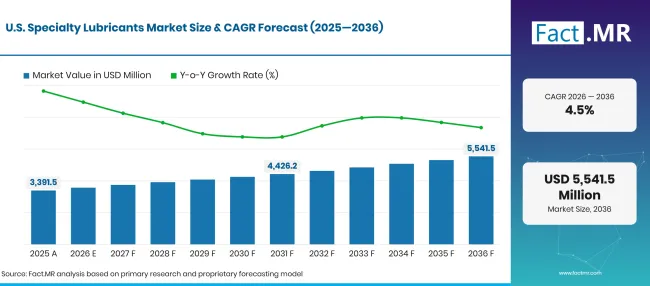
Specialty Lubricants Market Forecast Usa | Source: Fact.MR
Established manufacturing facilities, energy operations and industrial maintenance activities sustain purchases of high-performance oils and greases. The Federal Reserve reported manufacturing capacity utilization of approximately 76.0% in October 2026. Industrial buyers place considerable importance on equipment compatibility, lubricant service life and operating efficiency.
Competitive Landscape for Specialty Lubricants Market
Specialty lubricant manufacturers differentiate their offerings through formulation expertise, equipment manufacturer approvals and technical service capabilities. Shell markets Gadus greases and Tellus hydraulic fluids, while ExxonMobil supplies Mobil SHC synthetic lubricants for demanding industrial applications. TotalEnergies provides specialized industrial oils alongside maintenance support, and Chevron competes through its ISOCLEAN certified lubricant portfolio.
Ownership changes are also influencing competition. On November 2, 2026, Stonepeak completed its acquisition of a 65% controlling stake in Castrol, with bp retaining 35%. Suppliers offering application-specific formulations, dependable distribution and technical assistance remain well positioned among industrial customers.
Recent Developments
- In September 2026, TotalEnergies launched Aurelia FE, a lubricant for medium-speed marine engines. The oil helps ships use less fuel, improves engine efficiency, and supports lower operating costs for shipping companies.
- In March 2025, Castrol launched Cyltech 70f, 100f, and 140f lubricants for large marine engines. The oils help protect engine parts from wear, reduce harmful deposits, and maintain performance during shipping operations.
Key Players in Specialty Lubricants Market
Key companies operating in the Specialty Lubricants Market include Shell, ExxonMobil, TotalEnergies, Chevron, and Castrol.
- Shell
- ExxonMobil
- TotalEnergies
- Chevron
- Castrol
Bibliography
- Castrol. (2025, March 24). Castrol launches new Cyltech range.
- Castrol. (2026, September 29). Castrol launches Castrol CORE.
- Federal Reserve Board. (2026, November 17). Industrial production and capacity utilization – G.17.
- Instituto Brasileiro de Geografia e Estatística. (2026, April 2). Industrial production advances 0.9% in February.
- Ministry of Statistics and Programme Implementation, Government of India. (2026, November 4). Annual Survey of Industries 2024–25: Summary results of factory sector.
- National Bureau of Statistics of China. (2026, November 17). Industrial production operation in October 2026.
- National Bureau of Statistics of China. (2026, February 28). Statistical communiqué of the People’s Republic of China on the 2025 national economic and social development.
- Shell. (2025, November 11). Shell’s thermal fluid successfully cools all electrical components in an entire BEV power train using a single-circuit, single-fluid design innovation.
- Stonepeak. (2026, November 2). Stonepeak acquires 65% stake in Castrol.
- TotalEnergies Lubmarine. (2026, September 7). TotalEnergies Lubmarine launches Aurelia FE, an innovative fuel economy lubricant for 4-stroke medium speed marine engines.
Segmentation
Scope of Report
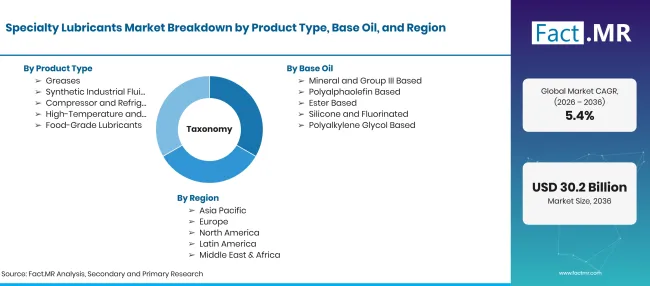
Specialty Lubricants Market Taxonomy | Source: Fact.MR
| Items | Values |
|---|---|
| Quantitative Units (2026) | USD 17.90 Billion |
| Product Type | Greases, Synthetic industrial fluids, Compressor and refrigeration oils, High-temperature and extreme-pressure lubricants, Food-grade lubricants |
| Base Oil | Mineral and group III based, Polyalphaolefin based, Ester based, Silicone and fluorinated, Polyalkylene glycol based |
| End Use | Industrial manufacturing, Automotive, Mining and construction, Power generation and wind, Aerospace and defence |
| Form | Liquid oils and fluids, Greases, Solid film and paste lubricants, Sprays and aerosols |
| Regions Covered | North America, Latin America, Europe, Asia Pacific, Middle East & Africa |
| Countries Covered | India, China, Brazil, South Korea, United States, and other countries |
| Key Companies Profiled | Shell, ExxonMobil, TotalEnergies, Chevron, Castrol (Stonepeak 65%; bp 35%) |
| Additional Attributes | Dollar revenue in the Specialty Lubricants Market is segmented by product type, base oil, end use and form and region. |
Source: Fact.MR analysis.
Specialty Lubricants Market by Segments
-
Product Type
- Greases
- Synthetic industrial fluids
- Compressor and refrigeration oils
- High-temperature and extreme-pressure lubricants
- Food-grade lubricants
-
Base Oil
- Mineral and group III based
- Polyalphaolefin based
- Ester based
- Silicone and fluorinated
- Polyalkylene glycol based
-
End Use
- Industrial manufacturing
- Automotive
- Mining and construction
- Power generation and wind
- Aerospace and defence
-
Form
- Liquid oils and fluids
- Greases
- Solid film and paste lubricants
- Sprays and aerosols
-
Region:
- North America
- United States
- Canada
- Mexico
- Europe
- Germany
- United Kingdom
- France
- Italy
- Spain
- Rest of Europe
- Asia Pacific
- China
- India
- Japan
- South Korea
- Australia and New Zealand
- Rest of Asia Pacific
- Latin America
- Brazil
- Argentina
- Rest of Latin America
- Middle East & Africa
- GCC Countries
- South Africa
- Rest of Middle East & Africa
- North America
Table of Contents
Key Takeaways
- Market Size and CAGR
- Top Growth Driver
- Fastest Growing Segment
- Leading Region
- Key Companies
- Emerging Opportunities

