- Market Value (2025): USD 4.0 Bn
- Estimated Value (2026): USD 4.2 Bn
- Forecast Value (2036): USD 7.1 Bn
- CAGR (2026-2036): 5.4%
What is the Cat Collar Market forecast to be worth by 2036?
USD 4.2 billion to USD 7.1 billion by 2036 at a 5.4% CAGR.
- The cat collar market reached USD 4.0 billion in 2025.
- Demand is projected to increase from USD 4.2 billion in 2026 to USD 7.1 billion by 2036.
- The market is forecast to expand at a 5.4% CAGR from 2026 to 2036.
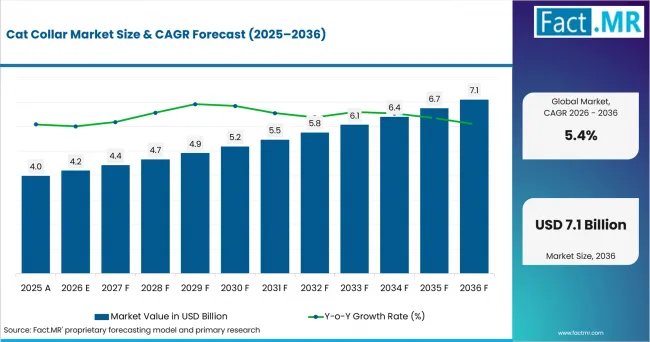
Cat Collar Market Value Analysis | Source: Fact.MR
What are the defining numbers behind Cat Collar Market growth?
An absolute opportunity of USD 2.9 billion is expected between 2026 and 2036.
- Demand Drivers in the Market
- The installed base of pet cats is expanding in several major consumer markets. The American Pet Products Association reported 53 million U.S. households with a cat in 2025, equal to 39% of households and 5% above the previous year. Each new cat-owning household creates an initial requirement for identification and safety accessories, while existing owners replace collars as pets grow, products wear or use cases change.
- Collar ownership itself is increasing. APPA reported that 27% of U.S. cat owners owned a non-flea collar in 2024, with ownership of this accessory up 50% from 2018. This indicates that collar demand can expand through wider accessory penetration even when the underlying cat population changes more slowly.
- Identification remains a practical purchase trigger. In England, owned cats must be microchipped and registered by 20 weeks of age. A microchip provides permanent machine-readable identification, while a visible collar can carry immediate contact information and can signal that a roaming cat has an owner. This supports personalized ID and tag-holder collars as complementary identification products.
- Connected functions are increasing the value that can be built into a collar. Tractive currently combines live location, virtual fences and health monitoring with an integrated safety collar for cats. This links the category with the broader pet wearables segment and gives owners a reason to trade up from passive identification products to connected devices.
- Safety guidance is shaping collar design. Cats Protection recommends quick-release or snap-opening collars and warns that elasticated or poorly fitted collars can trap a cat. As awareness of fit and snagging risk increases, owners are more likely to replace basic collars with breakaway mechanisms, reflective elements and lighter designs.
- Parasite prevention sustains a separate use case. The U.S. Environmental Protection Agency lists collars among flea and tick control formats and requires species-specific use according to label directions. This keeps flea and tick collars commercially relevant while placing greater emphasis on product safety, labeling and post-market monitoring.
- Key Segments Analyzed
- Identification Cat Collars account for 43.8% of Product in 2026, supported by their low-friction role in visible owner identification and contact information.
- Pet Identification represents 68.7% of Application in 2026 because identification remains relevant to both indoor cats that may escape and cats that regularly go outdoors.
- Individual Pet Owners account for 57.4% of End Use in 2026 as most collar purchasing decisions are made at household level and recur with replacement or new-pet adoption.
- Smart Connectivity Technology holds 34.5% of Technology in 2026 because location tracking and app-linked monitoring add new functions to the collar without replacing basic identification use.
- Synthetic Collar Systems account for 73.2% of Formulation in 2026 because nylon and polyester configurations support lightweight construction, washability and compatibility with safety-release hardware.
- Pet Specialty Stores represent 61.9% of Distribution Channel in 2026 because fit, breakaway design and species-specific product selection often benefit from a dedicated pet retail environment.
- Analyst Opinion at Fact.MR
- Shambhu Nath Jha, Principal Consultant at Fact.MR, states, “Cat collar demand is moving beyond a basic identification strap toward a combination of visible ID, breakaway safety and connected tracking. Affordable identification collars will continue to serve the broad customer base, while lightweight smart features can raise value per purchase. Retail fit guidance and clear species-specific instructions will remain important as the market expands from USD 4.2 billion in 2026 to USD 7.1 billion by 2036.”
- Strategic Implications
- Identification-collar suppliers should make personalization and tag attachment simple. Buyers should be able to add a name or contact detail without adding excessive weight to the collar.
- Retailers can merchandise collars with adjacent pet accessories while keeping cat-specific fit and breakaway guidance visible at the point of purchase. This can improve selection without relying on broad lifestyle claims.
- Smart-collar suppliers should reduce device weight, make charging requirements clear and integrate the safety-release mechanism with the electronics. Subscription terms also need to be transparent because recurring service cost affects the total ownership decision.
- Manufacturers that share materials, buckles and production lines with broader pet collars can spread development cost, but cat products still require species-specific sizing and lower weight.
How does the Cat Collar Market break down by segment?
The market is segmented by Product, Application, End Use, Technology, Formulation and Distribution Channel.
Why do Identification Cat Collars lead Product?
Identification Cat Collars are projected to account for a 43.8% share in 2026.
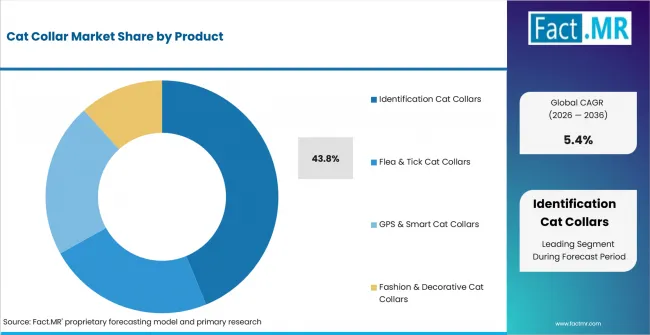
Cat Collar Market Analysis By Product | Source: Fact.MR
Identification collars lead because they solve a common requirement with minimal setup. Personalized ID collars and tag-holder collars can display contact information immediately, do not require charging and can be used by owners across a wide range of budgets. They also remain useful when a cat is already microchipped because a finder can read a tag before a scanner is available.
APPA reported that 27% of U.S. cat owners owned a non-flea collar in 2024. The category had increased materially since 2018, indicating that visible identification and everyday accessory use are becoming more common within cat-owning households.
Why does Pet Identification lead Application?
Pet Identification is projected to account for a 68.7% share in 2026.
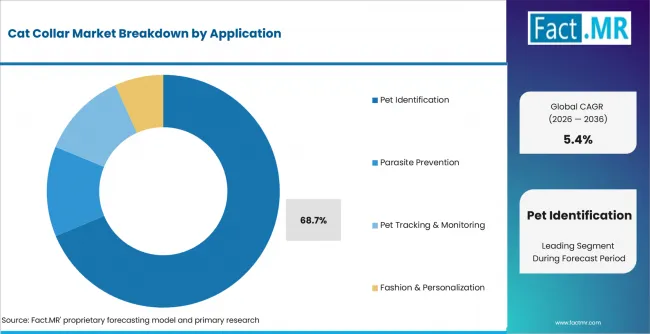
Cat Collar Market Analysis By Application | Source: Fact.MR
Pet Identification leads because the use case extends across basic and connected collars. A low-cost collar may carry a printed name or tag, while a smart collar can combine identity with location data. This broadens the addressable user base beyond owners seeking a single premium function.
The UK identification framework reinforces the importance of permanent identification. In England, cats must be microchipped and registered by 20 weeks. Collars are not a substitute for that requirement, but visible identification can shorten the first step in reuniting a roaming cat with its owner when the collar remains safely attached.
Why do Individual Pet Owners lead End Use?
Individual Pet Owners are projected to account for a 57.4% share in 2026.
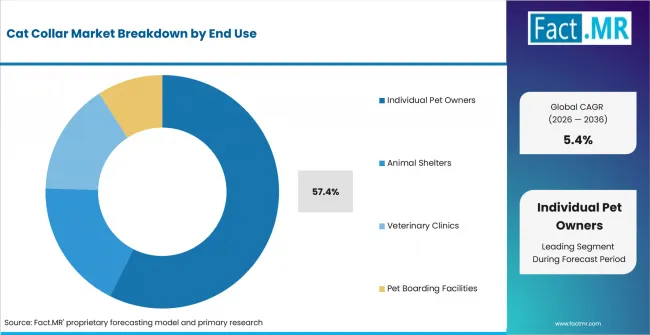
Cat Collar Market Analysis By End Use | Source: Fact.MR
Individual owners lead because collar choice is usually a household purchase rather than an institutional procurement decision. Owners select size, material, buckle type and appearance for one or a few cats and replace the product after wear, loss or a change in the cat’s size or routine.
The household base is substantial in several key countries. Germany had 15.7 million cats in 2025, while APPA reported 53 million U.S. cat-owning households. This creates recurring consumer demand that is larger in purchasing frequency than shelter or clinic procurement, even though institutions remain important for identification and temporary care.
Why does Smart Connectivity Technology lead Technology?
Smart Connectivity Technology is projected to account for a 34.5% share in 2026.
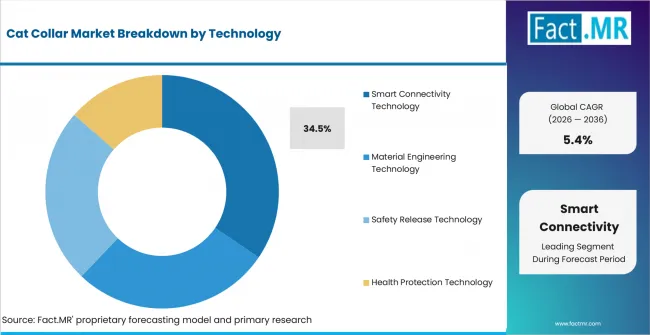
Cat Collar Market Analysis By Technology | Source: Fact.MR
Smart connectivity leads the technology category because it adds services that a passive collar cannot provide. GPS or radio-based location systems can help owners recover a roaming cat, while app-linked devices can add activity or health monitoring. The value is strongest for outdoor cats and for owners who want location history or escape alerts.
Tractive’s current cat tracker combines GPS, virtual fences and activity or sleep monitoring with an integrated safety collar. This illustrates how GPS trackers can be designed specifically around feline weight and breakaway requirements. Battery life and recurring subscription cost still limit adoption relative to passive collars, which keeps the technology segment below a majority share.
Why do Synthetic Collar Systems lead Formulation?
Synthetic Collar Systems are projected to account for a 73.2% share in 2026.
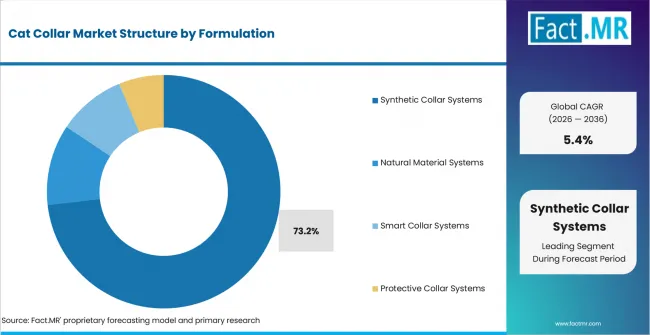
Cat Collar Market Analysis By Formulation | Source: Fact.MR
Synthetic systems lead because nylon and polyester can be produced in thin, flexible constructions that suit small neck sizes while supporting adjustable sliders, reflective stitching and quick-release buckles. They can also be washed after outdoor use and produced in a wide range of colors without requiring the care associated with leather.
For cat owners, material choice is closely linked to fit and safety. Cats Protection advises owners to use well-fitted quick-release collars and to avoid designs that can trap the jaw or a leg. Synthetic webbing is well suited to these lightweight breakaway configurations, which supports its broad use across everyday identification products.
Why do Pet Specialty Stores lead Distribution Channel?
Pet Specialty Stores are projected to account for a 61.9% share in 2026.
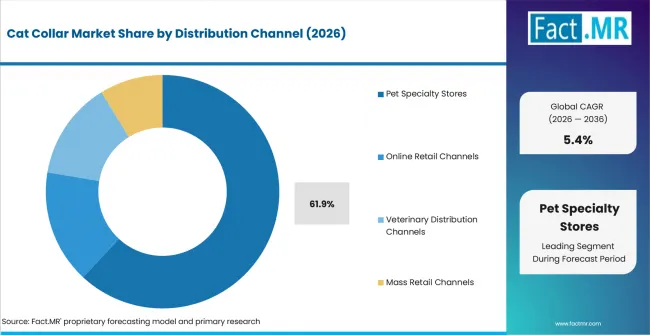
Cat Collar Market Analysis By Distribution Channel | Source: Fact.MR
Pet specialty stores lead because cat collars require more selection support than their low unit value might suggest. Owners need to compare neck size, buckle release and tag placement, while flea and tick collars require attention to species and label instructions. Smart collars add questions around device weight, connectivity and charging.
Dedicated stores can therefore combine product assortment with practical fit guidance. Collars can also be cross-sold alongside pet grooming and routine care products, which supports repeat store visits. Online channels continue to grow, but specialty stores retain an advantage when owners want to handle the collar or confirm fit before purchase.
What is accelerating Cat Collar Market adoption, and what is holding it back?
Adoption is being supported by a growing cat-owning household base, wider use of visible identification, safety-release design, parasite-control applications and connected tracking. Growth is constrained by collar-safety concerns, microchips substituting for some identification needs, premium smart-collar ownership costs and regulatory scrutiny of pesticide-based collars.
Drivers Impact Analysis
| Factor | (~) % Impact on CAGR | Geographic Relevance | Impact Timeline |
|---|---|---|---|
| Growth in cat-owning households and multi-cat homes | +1.1% | Germany; Brazil; USA; UK; Japan | Short term (<= 2 years) |
| Visible identification and lost-pet recovery use | +0.8% | Germany; USA; UK | Short term (<= 2 years) |
| Breakaway and reflective safety upgrades | +0.6% | Germany; USA; UK; Japan | Medium term (2-4 years) |
| Smart tracking and connected monitoring | +0.5% | Germany; USA; Japan | Medium term (2-4 years) |
| Flea and tick prevention through collar formats | +0.3% | Global | Long term (>= 4 years) |
Source: Fact.MR analysis. Updated Aug 25, 2026
Opportunity Impact Analysis
| Factor | (~) % Impact on CAGR | Geographic Relevance | Impact Timeline |
|---|---|---|---|
| Lightweight GPS and health-monitoring collars | +0.6% | Germany; USA; Japan | Medium term (2-4 years) |
| Personalized identification and tag integration | +0.5% | Global | Medium term (2-4 years) |
| Specialty retail and fit-guidance expansion | +0.4% | Brazil; Germany; USA; UK | Medium term (2-4 years) |
| Reflective and safety-release product upgrades | +0.3% | Global | Long term (>= 4 years) |
Source: Fact.MR analysis. Updated Aug 25, 2026
Restraints Impact Analysis
| Factor | (~) % Impact on CAGR | Geographic Relevance | Impact Timeline |
|---|---|---|---|
| Snagging and poor-fit safety concerns | -0.7% | Global | Short term (<= 2 years) |
| Microchip substitution for some identification needs | -0.5% | UK; Germany; USA | Medium term (2-4 years) |
| Smart-collar device and subscription cost | -0.4% | Germany; USA; Japan | Medium term (2-4 years) |
| Regulatory scrutiny of flea and tick collars | -0.3% | USA; Europe | Long term (>= 4 years) |
Source: Fact.MR analysis. Updated Aug 25, 2026
Which countries are scaling the Cat Collar Market through 2036?
- Germany: ZZF and IVH recorded 15.7 million cats in German households in 2025, with cats present in 24% of households. This installed base supports recurring purchases of ID collars, safety-release products and connected trackers, particularly where cats move outdoors.
- Brazil: ABEMPET reports an average of 1.8 pets per residence in Brazil. A broad pet-owning household base supports demand for everyday accessories, while the country’s specialized pet retail network gives collar brands a dedicated route to consumers.
- USA: APPA reported 53 million cat-owning households in 2025 and a 5% year-over-year increase in cat ownership. The same organization reported strong growth in non-flea collar ownership, supporting both basic replacement demand and higher-value safety or connected products.
- UK: PDSA estimated 10.5 million pet cats in the UK in 2025. Mandatory microchipping in England keeps identification visible in owner decision-making, while animal-welfare guidance favors quick-release collars for cats that wear them.
- Japan: The Pet Food Association of Japan estimated about 8.847 million cats in 2025. The population was broadly stable, so market growth is more likely to come from replacement, material upgrades and connected features than from rapid expansion in cat numbers.
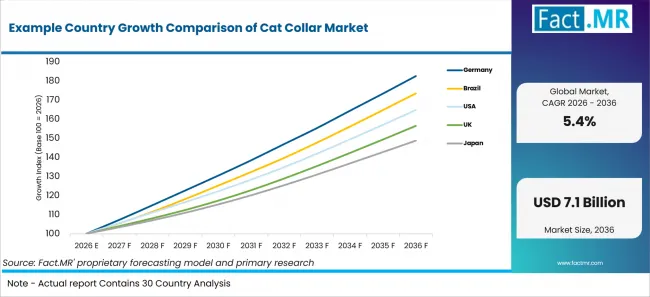
Example Country Growth Comparison Of Cat Collar Market | Source: Fact.MR
Country CAGR (2026-2036)
| Country | CAGR, 2026-2036 |
|---|---|
| Germany | 6.2% |
| Brazil | 5.7% |
| USA | 5.1% |
| UK | 4.6% |
| Japan | 4.1% |
Source: Fact.MR analysis. Updated Aug 25, 2026
What is driving Germany’s growth through 2036?
Germany is forecast to expand at a 6.2% CAGR from 2026 to 2036.
Germany combines a large cat population with a meaningful multi-cat household base. ZZF and IVH reported that 43% of cat-owning households had two or more cats in 2025. Multi-cat ownership increases the number of collars potentially purchased per home and can create separate needs for identification, reflective safety or location tracking across individual cats.
The country also has an established pet specialty retail environment. That favors products where the owner wants to compare fit and buckle release before purchase, while connected collars can be positioned to owners of roaming cats who place greater value on location information.
What is driving Brazil’s growth through 2036?
Brazil is forecast to expand at a 5.7% CAGR from 2026 to 2036.
Brazil’s pet economy supports a broad accessory customer base. ABEMPET reports 1.8 pets per residence on a statistical basis and noted continued category diversification in 2025. For cat collars, this supports demand across basic ID, decorative and protective formats rather than relying on one premium technology niche.
Distribution is also favorable to dedicated pet retail. ABEMPET reported that specialized pet shops represented 37.3% of online pet-sector turnover in 2025. This gives collar suppliers a channel that can combine digital reach with category-specific merchandising and sizing guidance.
What is driving the USA’s growth through 2036?
The USA is forecast to expand at a 5.1% CAGR from 2026 to 2036.
APPA reported 53 million U.S. households with a cat in 2025, and products remained an important part of cat-owner spending. This household scale creates a recurring base for collars purchased when a cat is adopted or when an existing collar is lost, worn or replaced with a safer design.
Collar penetration is also rising. APPA reported that 27% of cat owners owned a non-flea collar in 2024, 50% above the 2018 level. That supports growth through greater accessory adoption per owner. Smart tracking adds a higher-value layer, while EPA oversight keeps flea and tick collars tied to species-specific safety and label compliance.
What is driving the UK’s growth through 2036?
The UK is forecast to expand at a 4.6% CAGR from 2026 to 2036.
PDSA estimated 10.5 million pet cats in the UK in 2025. This creates a stable replacement market across identification and safety collars, with outdoor access increasing the relevance of visible ID and reflective features for some owners.
In England, owned cats must be microchipped by 20 weeks and registered in an approved database. This sets a formal identification baseline. For owners who also use a collar, welfare guidance from Cats Protection directs purchasing toward quick-release or snap-opening designs and correct fit, supporting safety-led product replacement rather than indiscriminate collar use.
What is driving Japan’s growth through 2036?
Japan is forecast to expand at a 4.1% CAGR from 2026 to 2036.
The Pet Food Association of Japan estimated about 8.847 million cats in 2025 and described the population as broadly flat over roughly the past decade. This means collar growth is less dependent on a rapid increase in cat numbers and more dependent on replacement cycles and higher-value functionality.
The association also noted that multi-cat household patterns have remained meaningful. For suppliers, this favors lightweight products that can be used continuously and connected systems that justify a higher spend through location or monitoring functions without adding excessive bulk to the cat’s neck.
Who Leads the Cat Collar Market?
Tractive GmbH leads the Cat Collar Market.
Tractive competes through a current cat-specific tracking portfolio. Its CAT 6 Mini integrates the tracker into a safety collar and combines live GPS, virtual fences, location history and activity or health monitoring. Cat-specific weight limits and a release mechanism are important because connected electronics add bulk that conventional collars do not carry.
Eureka Technology Partners LLC provides a different tracking architecture through Marco Polo. The system uses a self-contained radio link rather than cellular or GPS service, attaches a lightweight tag to the collar and is positioned for pet recovery without a monthly service fee. This gives the company a clear alternative for owners who prioritize battery life or coverage outside cellular networks.
Acorn Pet Products currently focuses on recovery and calming products for cats and dogs. Its current collar products are primarily post-surgical recovery formats, which fall outside the Cat Collar Market definition used here. PetAZ and QBLEEV participate through pet accessory products, while SCOLLAR Inc. and LINK AKC are associated with earlier smart-collar concepts whose current retail presence is limited.
KYON AG currently operates as a veterinary orthopedics company and directs U.S. sales through Movora. Its current product portfolio does not list cat collars, so current commercial activity is centered outside the cat-collar category.
Supplier selection is shaped by collar weight, fit and safety release. Identification visibility and tracking accuracy matter for different use cases. Flea and tick products also require species-specific compliance, while smart products add battery and connectivity requirements. These factors allow low-cost passive collars and higher-value connected systems to coexist within the same market.
Which companies are the key providers?
Key companies profiled include Tractive GmbH; Acorn Pet Products; PetAZ; QBLEEV; SCOLLAR Inc.; Eureka Technology Partners LLC; LINK AKC; and KYON AG.
- Tractive GmbH
- Acorn Pet Products
- PetAZ
- QBLEEV
- SCOLLAR Inc.
- Eureka Technology Partners LLC
- LINK AKC
- KYON AG
Bibliography
- American Pet Products Association. (2026). U.S. Pet Industry Reaches $158 Billion in 2025, Poised for Continued Growth in 2026. American Pet Products Association.
- American Pet Products Association. (2025). The American Pet Products Association Releases 2025 Dog & Cat Report, Revealing a New Era of Pet Ownership. American Pet Products Association.
- ZZF and IVH. (2026). Heimtiere in Deutschland: Heimtierpopulation in Deutschland 2025. Zentralverband Zoologischer Fachbetriebe Deutschlands and Industrieverband Heimtierbedarf.
- PDSA. (2025). UK Pet Populations of Dogs, Cats and Rabbits. PDSA Animal Wellbeing Report.
- Department for Environment, Food & Rural Affairs. (2024). Cat Microchipping Now Mandatory. UK Government.
- Cats Protection. (2026). Choosing a Cat Collar. Cats Protection.
- U.S. Environmental Protection Agency. (2026). EPA Evaluation and Regulation of Pet Collar Products. U.S. Environmental Protection Agency.
- U.S. Environmental Protection Agency. (2026). Controlling Fleas and Ticks on Your Pet. U.S. Environmental Protection Agency.
- Pet Food Association of Japan. (2025). Nationwide Dog and Cat Ownership Survey 2025. Pet Food Association of Japan.
- ABEMPET. (2026). Mercado Pet em Números: Acompanhe os Dados do Setor. Associação Brasileira das Empresas do Setor de Animais de Estimação.
- ABEMPET. (2025). No Digital, o Varejo Especializado Mantém a Liderança. Associação Brasileira das Empresas do Setor de Animais de Estimação.
- Tractive GmbH. (2026). Smart Cat Tracker. Tractive GmbH.
- Eureka Technology Partners, LLC. (2026). Marco Polo Pet Monitoring, Tracking and Recovery System. Eureka Technology Partners, LLC.
- Acorn Pet Products. (2026). Recovery & Calming for Cats & Dogs. Acorn Pet Products.
- KYON AG. (2026). Veterinary Orthopedic Solutions and Company Information. KYON AG.
This Report Answers
- How identification, parasite prevention, smart tracking and decorative use shape cat-collar demand.
- Why buyer priorities differ across basic identification products, connected collars and protective formats.
- How safety-release design and species-specific product guidance influence purchase decisions.
- Which country conditions support replacement demand, channel expansion or technology upgrades.
- How current providers differ by passive accessories, tracking architecture and adjacent pet-care portfolios.
What does the Cat Collar Market cover?
The Cat Collar Market covers collars designed and sold specifically for cats for identification, parasite prevention, tracking or monitoring, fashion and related safety functions. Revenue includes complete collar products and collar-integrated systems sold through the included distribution channels.
The market is organized by Product, Application, End Use, Technology, Formulation and Distribution Channel. A product is included when the collar itself is a commercial part of the cat-care offering, including smart collars where tracking or monitoring hardware is integrated with or sold for use on the collar.
What is included in the scope?
The scope includes identification cat collars, flea and tick cat collars, GPS or smart cat collars and fashion or decorative cat collars. It includes products used for pet identification, parasite prevention, tracking or monitoring and personalization.
End users include individual pet owners, animal shelters, veterinary clinics and pet boarding facilities. Technology coverage includes smart connectivity, material engineering, safety-release systems and health-protection technology. Formulation covers synthetic, natural, smart and protective collar systems. Sales through pet specialty stores, online retail, veterinary distribution and mass retail are included.
What is excluded from the scope?
The scope excludes dog-only collars and collars designed only for livestock or other animals. Harnesses, leashes and standalone ID tags are excluded when sold without a collar. Standalone microchips and microchip registration services are also outside the market.
Post-surgical Elizabethan collars, inflatable recovery cones and neck-support devices are excluded because they fall outside the Product categories covered by the market. Standalone GPS devices are excluded when they are not sold as part of, or specifically for attachment to, a cat collar system. Veterinary flea and tick medicines delivered through formats other than collars are outside the market.
How Was the Analysis Built?
The analysis combines structured demand modelling with primary interviews and secondary research focused on cat ownership, collar penetration, replacement behavior and product mix.
- Primary Research: Interviews cover cat-collar manufacturers, pet accessory brands, smart-tracker developers, specialty pet retailers, veterinary distributors, animal shelters and pet owners. Discussions examine fit, replacement frequency, channel choice, safety requirements and willingness to pay for connected features.
- Desk Research: The review uses pet-ownership surveys, animal-welfare guidance, government identification rules, pesticide regulation, company product documentation and pet-retail information.
- Market Sizing and Forecasting: Sizing variables include cat population and household ownership, collar penetration, replacement intervals, average selling prices, product mix, smart-collar adoption, parasite-prevention use and distribution-channel mix. Country forecasts also consider local pet ownership and retail structure.
- Data Validation and Update Cycle: Findings are cross-checked against public pet-population data, current product portfolios and channel evidence. Updates account for changes in ownership patterns, tracking technology, safety guidance, flea and tick regulation and provider activity.
Segmentation
What is the report's scope and coverage?
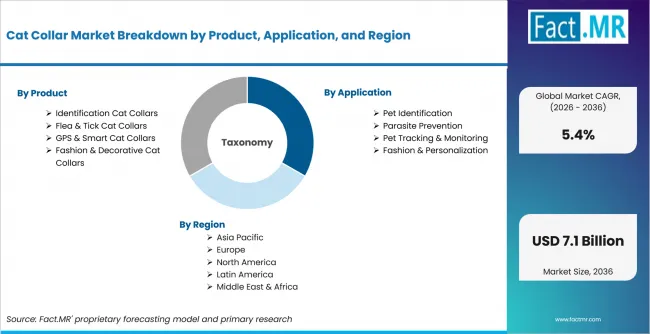
Cat Collar Market Breakdown By Product, Application, And Region | Source: Fact.MR
| Attribute | Details |
|---|---|
| Quantitative Units | USD billion |
| Market Definition | Cat collars sold for identification, parasite prevention, connected tracking, fashion and related safety functions within the stated taxonomy |
| Segments Covered | Product; Application; End Use; Technology; Formulation; Distribution Channel |
| Regions Covered | North America; Latin America; Europe; East Asia; South Asia and Pacific; Middle East and Africa |
| Countries Covered | Germany; Brazil; USA; UK; Japan |
| Key Companies Profiled | Tractive GmbH; Acorn Pet Products; PetAZ; QBLEEV; SCOLLAR Inc.; Eureka Technology Partners LLC; LINK AKC; KYON AG |
| Forecast Period | 2026 to 2036 |
| Base Year | 2026 |
| Market Value, 2026 | USD 4.2 billion |
| Market Value, 2036 | USD 7.1 billion |
| CAGR, 2026-2036 | 5.4% |
| Absolute Opportunity | USD 2.9 billion |
| Approach | Hybrid top-down and bottom-up approach using cat ownership, collar penetration, replacement cycles, average selling prices, product mix, channel mix and country-level demand factors |
Source: Fact.MR analysis. Updated Aug 25, 2026
How is the market segmented?
-
By Product:
- Identification Cat Collars
- Personalized ID Collars
- Tag Holder Collars
- Flea & Tick Cat Collars
- Chemical Protection Collars
- Natural Protection Collars
- GPS & Smart Cat Collars
- Real Time Tracking Collars
- Activity Monitoring Collars
- Fashion & Decorative Cat Collars
- Premium Fashion Collars
- Seasonal Decorative Collars
- Identification Cat Collars
-
By Application:
- Pet Identification
- Home Pet Identification
- Outdoor Pet Identification
- Parasite Prevention
- Flea Prevention Applications
- Tick Prevention Applications
- Pet Tracking & Monitoring
- Location Tracking Applications
- Health Monitoring Applications
- Fashion & Personalization
- Lifestyle Applications
- Event Applications
- Pet Identification
-
By End Use:
- Individual Pet Owners
- Indoor Cat Owners
- Outdoor Cat Owners
- Animal Shelters
- Rescue Shelters
- Municipal Shelters
- Veterinary Clinics
- General Veterinary Clinics
- Specialty Veterinary Centers
- Pet Boarding Facilities
- Pet Hotels
- Day Care Facilities
- Individual Pet Owners
-
By Technology:
- Smart Connectivity Technology
- GPS Tracking Technology
- Wireless Connectivity Technology
- Material Engineering Technology
- Synthetic Material Systems
- Natural Material Systems
- Safety Release Technology
- Breakaway Mechanisms
- Reflective Safety Systems
- Health Protection Technology
- Parasite Control Technology
- Monitoring Technology
- Smart Connectivity Technology
-
By Formulation:
- Synthetic Collar Systems
- Nylon Based Systems
- Polyester Based Systems
- Natural Material Systems
- Leather Based Systems
- Cotton Based Systems
- Smart Collar Systems
- Tracking Integrated Systems
- Monitoring Integrated Systems
- Protective Collar Systems
- Parasite Protection Systems
- Safety Protection Systems
- Synthetic Collar Systems
-
By Distribution Channel:
- Pet Specialty Stores
- Independent Pet Stores
- Chain Pet Stores
- Online Retail Channels
- E-Commerce Platforms
- Brand Owned Websites
- Veterinary Distribution Channels
- Clinic Based Sales
- Hospital Based Sales
- Mass Retail Channels
- Supermarket Retailing
- Department Store Retailing
- Pet Specialty Stores
Frequently Asked Questions
What is the Cat Collar Market value in 2026?
At what CAGR is the market projected to grow?
What is the projected market value by 2036?
Which Product leads the market?
Which Application leads the market?
Which End Use leads the market?
Which Technology leads the market?
Which Formulation leads the market?
Which Distribution Channel leads the market?
Which country leads the listed CAGR table?
Which company leads the Cat Collar Market?
What is the primary driver in this market?
What is the main restraint?
Which companies are included in the market?
Who worked on this report


Preview the report firsthand - request a free sample
Free SampleGet the brochure for pricing and purchase details
Download PDF