- Market Value (2025): USD 267.7 Mn
- Estimated Value (2026): USD 278.8 Mn
- Forecast Value (2036): USD 418.7 Mn
- CAGR (2026-2036): 4.1%
What is the Cationic Fatliquor Market forecast to be worth by 2036?
USD 278.8 million in 2026 to USD 418.7 million by 2036 at a 4.1% CAGR.
- As per Fact.MR analysis, the cationic fatliquor market was valued at USD 267.7 million in 2025.
- Demand will grow from USD 278.8 million in 2026 to USD 418.7 million by 2036.
- The forecast records a 4.1% CAGR from 2026 to 2036 as leather processors seek fatliquoring formulations that deliver consistent softness and compatibility with downstream processing.
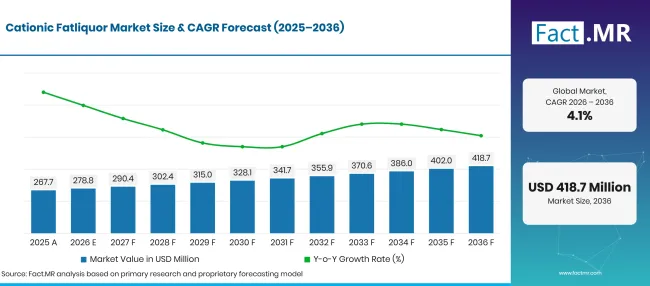
Cationic Fatliquor Market Forecast Global | Source: Fact.MR
| Year | Basis | Market Value (USD million) |
|---|---|---|
| 2025 | Actual | 267.8 |
| 2026 | Estimate | 278.8 |
| 2036 | Forecast | 418.7 |
| CAGR 2026 to 2036 | Forecast period | 4.1% |
Source: Fact.MR analysis. Updated Oct 30, 2026
What are the defining numbers behind Cationic Fatliquor Market growth?
USD 139.9 million absolute opportunity between 2026 and 2036.
- Demand Drivers in the Market
- Growth in leather and footwear manufacturing has driven the growth of the market. India’s leather and footwear exports reached USD 4.75 billion in FY 2025–26, according to the Press Information Bureau. The figure illustrates the scale of the downstream industry; leather processors use suitable fatliquors to meet softness and finishing requirements [1]. [1]
- Increasing focus on value-added leather products has increased demand for the cationic fatliquor. NITI Aayog’s Trade Watch report records global leather and footwear exports of approximately USD 297.7 billion in 2024 and Indian exports of USD 5.5 billion in its detailed trade-category analysis. These figures provide downstream industry context for leather-processing chemicals used in finishing operations [2]. [2]
- Government support for leather-sector expansion has supported the market growth. In July 2026, India’s Ministry of Commerce and Industry called on the leather and footwear industry to target USD 15 billion in exports over the following five to six years. Efforts to expand production capacity and strengthen product quality could support the use of specialized leather-processing formulations, including cationic fatliquors [3].
- Key Segments Analyzed
- By Product Type: Synthetic fatliquors will account for 64.3% of the market in 2026, reflecting their role in formulation development and process-specific leather treatment.
- By Application: Automotive Leather hold prominent share of 32.4% in 2026, driven by demand for leather used in vehicle interiors and seating.
- By Process: Drum Dyeing leads with 54.2% of the market in 2026, supported by the importance of drum-based processing in leather treatment.
- By End-User: Automotive will represent for 36.8% of the market in 2026, reflecting the requirements of automotive leather suppliers and component manufacturers.
- Analyst Opinion at Fact.MR
- Shambhu Nath Jha, Principal Consultant at Fact.MR, states, “Cationic fatliquors can help leather processors achieve specific softness and handle requirements when formulations are matched to the leather type and processing conditions. Suppliers that provide consistent product performance and practical technical support can strengthen their position with leather manufacturers.”
- Strategic Implications
- Manufacturers should provide clear technical information on compatibility, recommended dosage, and processing conditions for different leather types.
- Leather processors need to evaluate softness, fullness, flexibility, and finishing compatibility when comparing cationic fatliquor formulations.
- Chemical suppliers should support customers with formulation trials that assess performance across the intended tanning, dyeing, and finishing sequence.
- Automotive and furniture leather suppliers must prioritize consistent quality and compliance with applicable end-product specifications.
Germany is set to record a 5.0% CAGR through 2036. The USA is projected to post 4.4%, followed by Brazil at 3.7%. The UK is estimated to advance at 3.4%, while Japan is forecast to record a 3.1% CAGR.
How does the Cationic Fatliquor Market break down by segment?
Fact.MR finds that Synthetic Leads Product Type at 64.3%; Automotive Leather Leads Application at 32.4%; Drum Dyeing Leads Process at 54.2%; Automotive leads End-User at 36.8%.
Which Product Type dominates?
Synthetic is set to hold a 64.3% share in 2026.
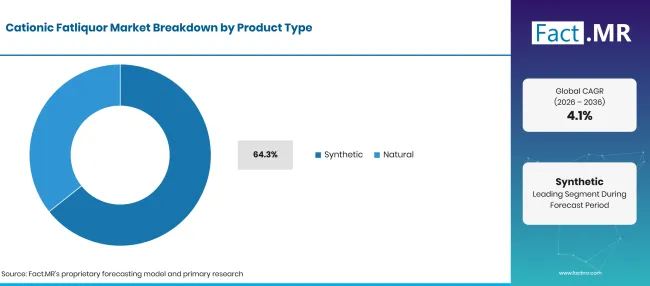
Cationic Fatliquor Market Breakdown Product Type | Source: Fact.MR
| Product Type | Share (2026) |
|---|---|
| Synthetic (Leading segment) | 64.3% |
| Other segments combined | 35.7%* |
| Total | 100.0% |
Source: Fact.MR analysis. Updated Oct 30, 2026
Synthetic fatliquors are used in leather processing formulations designed to deliver specific softness and lubrication while improving handling characteristics. Their composition can be tailored to suit different leather types and manufacturing requirements. Natural fatliquors remain relevant when processors seek particular material properties or formulation characteristics. The choice between synthetic and natural products depends on performance and compatibility alongside cost and the required properties of the finished leather.
What leads the Application segment?
Automotive Leather is set to represent a 32.4% share in 2026.
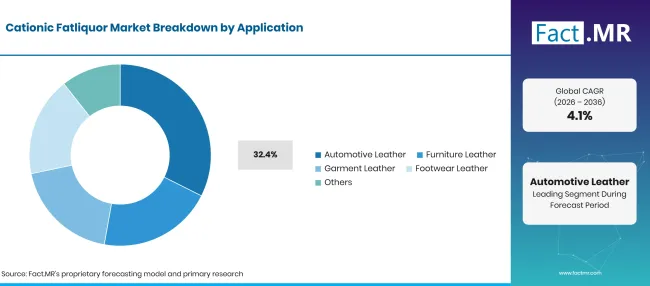
Cationic Fatliquor Market Breakdown Application | Source: Fact.MR
| Application | Share (2026) |
|---|---|
| Automotive Leather (Leading segment) | 32.4% |
| Other segments combined | 67.6%* |
| Total | 100.0% |
Source: Fact.MR analysis. Updated Oct 30, 2026
Automotive leather applications require suitable softness and flexibility while maintaining a consistent appearance across seats and interior trim. Fatliquoring treatments improve the physical feel of leather and influence its handling during subsequent finishing operations. Furniture and garment leather have distinct performance requirements, while footwear and other leather applications require properties suited to their design and intended use.
How does Process shape demand?
Drum Dyeing is likely to account for a 54.2% share in 2026.
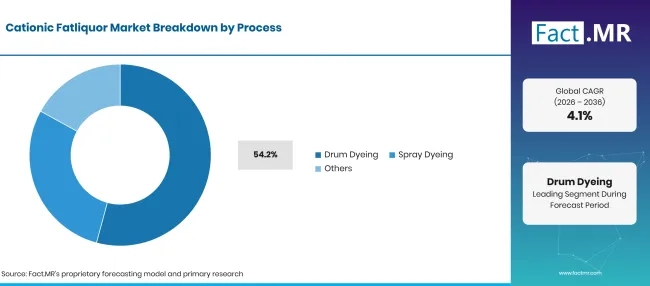
Cationic Fatliquor Market Breakdown Process | Source: Fact.MR
| Process | Share (2026) |
|---|---|
| Drum Dyeing (Leading segment) | 54.2% |
| Other segments combined | 45.8%* |
| Total | 100.0% |
Source: Fact.MR analysis. Updated Oct 30, 2026
Drum-based leather processing allows hides and skins to undergo treatment with chemicals under controlled operating conditions. Fatliquor selection depends on penetration, distribution, compatibility with other processing chemicals, and the desired leather characteristics. Spray-based application and other processes serve different finishing or treatment requirements depending on the production setup.
How does End-User shape demand?
Automotive leads with 36.8% share in 2026.
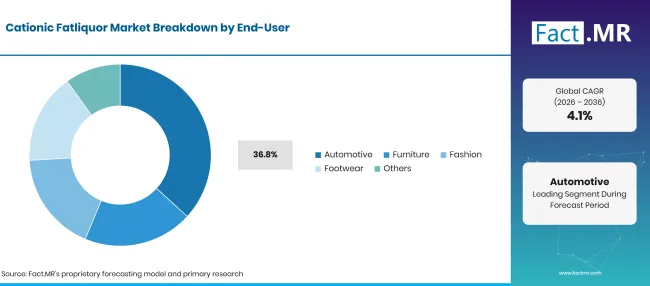
Cationic Fatliquor Market Breakdown End User | Source: Fact.MR
| End-User | Share (2026) |
|---|---|
| Automotive (Leading segment) | 36.8% |
| Other segments combined | 63.2%* |
| Total | 100.0% |
Source: Fact.MR analysis. Updated Oct 30, 2026
Automotive suppliers require leather materials with consistent physical properties and appearance across production batches. Fatliquoring chemicals help achieve the softness and flexibility needed for vehicle seating and interiors. Furniture manufacturers and fashion brands also contribute to demand, while footwear companies require formulations suited to their specific durability and processing needs.
What is accelerating Cationic Fatliquor Market adoption, and what is holding it back?
Demand for consistent leather softness and application-specific processing supports market adoption. However, high formulation costs and chemical compatibility issues can constrain growth alongside challenges in maintaining production consistency.
Drivers Impact Analysis
| DRIVER | (~) % IMPACT ON CAGR | Geographic relevance | Impact timeline |
|---|---|---|---|
| Demand for automotive upholstery leather | +0.9% | Europe, Asia | Medium term (2–4 years) |
| Requirements for consistent leather softness | +0.7% | Global | Short term (≤ 2 years) |
| Growth in premium furniture and footwear applications | +0.6% | Global | Medium term (2–4 years) |
| Need for reliable leather processing performance | +0.5% | Global | Short term (≤ 2 years) |
| Technical support from leather chemical suppliers | +0.4% | Global | Medium term (2–4 years) |
Source: Fact.MR analysis. Updated Oct 30, 2026
Opportunity Impact Analysis
| OPPORTUNITY | (~) % IMPACT ON CAGR | Geographic relevance | Impact timeline |
|---|---|---|---|
| Application-specific fatliquor formulations | +0.7% | Global | Medium term (2–4 years) |
| Improved compatibility with leather processing chemicals | +0.6% | Europe, Asia | Medium term (2–4 years) |
| Formulations for consistent automotive leather quality | +0.5% | Europe, Americas, Asia | Long term (≥ 4 years) |
| Technical assistance for smaller leather processors | +0.4% | Asia, Latin America | Short term (≤ 2 years) |
Source: Fact.MR analysis. Updated Oct 30, 2026
Restraints Impact Analysis
| RESTRAINT | (~) % IMPACT ON CAGR | Geographic relevance | Impact timeline |
|---|---|---|---|
| Fluctuating chemical input costs | -0.7% | Global | Short term (≤ 2 years) |
| Compatibility issues with other processing chemicals | -0.6% | Global | Short term (≤ 2 years) |
| Variation in leather quality and processing conditions | -0.5% | Global | Medium term (2–4 years) |
| Price competition among chemical suppliers | -0.4% | Global | Medium term (2–4 years) |
Source: Fact.MR analysis. Updated Oct 30, 2026
Which countries are scaling the Cationic Fatliquor Market through 2036?
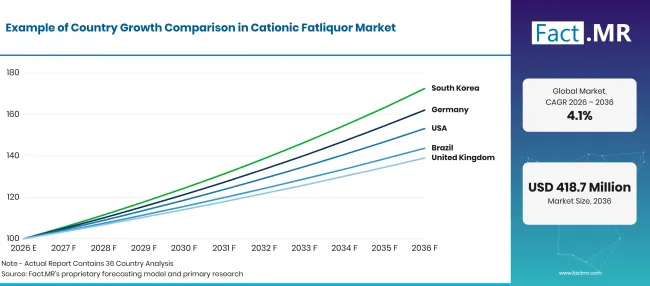
Cationic Fatliquor Market Growth Index | Source: Fact.MR
| Country | CAGR (2026–2036) |
|---|---|
| Germany | 5.0% |
| USA | 4.4% |
| Brazil | 3.7% |
| UK | 3.4% |
| Japan | 3.1% |
Source: Fact.MR analysis. Updated Oct 30, 2026
What supports Germany adoption?
5.0% CAGR, supported by demand for specialized leather chemicals and automotive interior materials.
Germany's automotive supply chain creates demand for leather and other interior materials that must meet specified quality and performance requirements. Leather chemical suppliers can serve processors by offering fatliquoring formulations suited to different leather grades and finishing processes. Demand depends on the use of leather in vehicle interiors and other premium leather applications.
How is the USA developing cationic fatliquor adoption?
4.4% CAGR, shaped by demand for automotive upholstery and furniture leather.
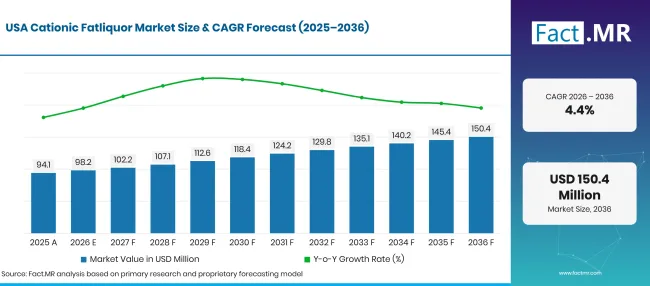
Cationic Fatliquor Market Forecast Usa | Source: Fact.MR
The US market is linked to leather used in vehicle interiors, upholstered furniture, footwear, and other finished goods. Processors require fatliquoring agents that deliver suitable softness and flexibility without compromising downstream finishing. Technical support and consistent chemical performance can help suppliers serve leather processors and their customers.
What supports Brazil adoption?
3.7% CAGR, led by leather processing and footwear and upholstery applications.
Brazil has an established leather and footwear manufacturing base. Fatliquoring chemicals are used during leather processing to improve handle and flexibility, with formulation needs varying by leather type and finished application. Suppliers can compete through reliable product availability, cost-effective formulations, and technical guidance for industrial users.
How is the United Kingdom building adoption?
3.4% CAGR, backed by specialized leather goods and upholstery requirements.
UK demand is associated with leather used in automotive interiors, furniture, footwear, and fashion products. According to the UK Government’s 2025 vehicle licensing statistics, 2.617 million new vehicles were registered in the UK in 2025, including 2.071 million cars. These figures illustrate the scale of the UK vehicle market. Automotive leather is a potential downstream application for appropriate leather-processing chemicals, depending on the interior materials selected by manufacturers. Cationic fatliquors can support the required softness and handling characteristics of leather used in these applications [4]. Leather and related-product exports provide an additional measure of activity in the UK leather supply chain. A comparable first-half growth estimate requires verification against the underlying ONS time-series tables. [4][5][4][5]
What supports Japan adoption?
3.1% CAGR, driven by demand for consistent leather quality in automotive and consumer applications.
Japan's automotive and manufacturing sectors prioritize product quality and consistency. Leather processors supplying automotive interiors and premium consumer goods require chemicals that deliver reliable softness and predictable processing performance. Suppliers can strengthen their market position through consistent formulations and technical documentation while providing support tailored to specific production requirements.
Who leads the Cationic Fatliquor Market?
Fact.MR profiles Silvateam S.p.A.; Muno; Quimser S.A.; Poplon Chemie; Sterling Organics & Chemicals, Zsivira Chemie Merk Pvt. Ltd. across the leather chemicals value chain.
Quimser S.A. lists SEROIL SC-B, a cationic polymer-fat formulation, in its official fatliquor catalog. Muno, Zsivira Chemie Merk, and Poplon Chemie are also identified among leather-chemical suppliers, although their current dedicated cationic fatliquor products require separate confirmation.
Silvateam S.p.A. is associated with tannins and other specialty ingredients for leather processing. Sterling Organics & Chemicals supplies leather auxiliaries, including fatliquoring products. However, the presence of a broader leather chemicals portfolio does not independently establish that every company offers a dedicated cationic fatliquor product.
Competition depends on formulation performance, compatibility with other leather chemicals, processing consistency, technical support, and compliance with customer requirements. Suppliers that demonstrate reliable results across specific leather types can strengthen their position with tanneries and leather processors.
Which companies are the key providers?
Companies assessed across cationic fatliquors and related leather-processing chemicals include Silvateam S.p.A., Muno, Quimser S.A., Poplon Chemie, Sterling Organics & Chemicals, and Zsivira Chemie Merk Pvt. Ltd. Quimser has a documented cationic fatliquor product; the other suppliers require product-specific confirmation.
- Silvateam S.p.A.
- Muno
- Quimser S.A.
- Poplon Chemie
- Sterling Organics & Chemicals
- Zsivira Chemie Merk Pvt. Ltd.
Bibliography
- [1] Press Information Bureau. (2026, June 8). 12 years of transformative growth: Leather, footwear and accessories sector emerges as a premier driver of employment and exports. Government of India.
- [2] NITI Aayog. (2025, October 6). Trade Watch- Quarterly (January - March [Q4] FY25. Government of India.
- [3] Press Information Bureau. (2026, July 6). Union Minister of Commerce and Industry Shri Piyush Goyal calls upon leather and footwear industry to target at least USD 15 billion in exports in next five to six years. Ministry of Commerce and Industry, Government of India.
- [4] Department for Transport. (2026, April 29). Vehicle licensing statistics, United Kingdom: 2025.
- [5] Office for National Statistics. (2026, September 11). UKProdTO: 15 - Manufacture of leather and related products EXPORT (£m).
This Report Answers
- The report describes how cationic fatliquors support leather softness, flexibility, and processing requirements.
- Product-type analysis compares synthetic and natural fatliquoring agents.
- Application analysis examines automotive, furniture, garment, footwear, and other leather products.
- Process analysis distinguishes drum dyeing from spray dyeing and other processing methods.
- Country analysis discusses Germany, the USA, Brazil, the UK, and Japan alongside the growth.
- The competitive overview profiles six companies involved in leather chemicals or related processing ingredients.
What does the Cationic Fatliquor Market cover?
The market covers cationic fatliquoring agents used during leather processing to influence softness, flexibility, surface feel, and other physical characteristics. These products are selected according to the type of leather, the desired finished properties, and their compatibility with other chemicals used during tanning, dyeing, and finishing.
What is included in the scope?
Included products are cationic fatliquors intended for leather treatment. Applications include leather used in automotive interiors, furniture, garments, footwear, and other finished goods. The analysis distinguishes synthetic and natural product categories and the specified processing methods.
What is excluded from the scope?
The analysis excludes general tanning chemicals, dyes, finishing agents, and other leather auxiliaries when they are not sold as cationic fatliquoring agents. Finished leather goods, footwear, automotive seats, furniture, and leather-processing equipment are also excluded from the chemical product revenue boundary.
How Was the Analysis Built?
The analysis draws on 120+ sources, 35+ company portfolios, 25+ countries, and more than 20 industry interviews.
- Primary Research: Primary research includes discussions with manufacturers, service providers, technology developers, distributors, end users, and subject-matter experts. These conversations examine purchasing priorities, product adoption, operational challenges, approval requirements, competitive positioning, and the factors that influence wider market acceptance.
- Desk Research: Desk research covers government statistics, regulatory publications, company filings, trade data, technical studies, industry associations, standards, public policy, and other authoritative sources. Every source used in the analysis is documented in the bibliography.
- Market Sizing and Forecasting: Market estimates combine historical performance, demand indicators, pricing and volume trends, segment shares, company participation, country-level growth, adoption patterns, investment activity, and barriers to market expansion.
- Data Validation and Update Cycle: Findings are validated by comparing primary interviews with public data, company activity, regulatory changes, trade patterns, and industry developments. Regular updates review new product launches, capacity changes, partnerships, approvals, and shifts in commercial adoption.
Segmentation
What is the report's scope and coverage?
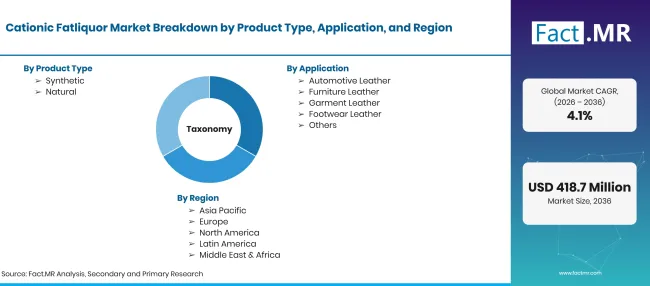
Cationic Fatliquor Market Taxonomy | Source: Fact.MR
| Attribute | Details |
|---|---|
| Quantitative Units | USD million in 2026 to USD million by 2036, at CAGR |
| Market Definition | The cationic fatliquor market comprises positively charged fatliquoring agents used in leather processing to lubricate leather fibres and improve softness and flexibility. These formulations enhance handling characteristics and surface feel while supporting specific finishing requirements across different leather types and applications. |
| Product Type | Synthetic; Natural |
| Application | Automotive Leather; Furniture Leather; Garment Leather; Footwear Leather; Others |
| Process | Drum Dyeing; Spray Dyeing; Others |
| End-User | Automotive; Furniture; Fashion; Footwear; Others |
| Regions Covered | North America; Latin America; Western Europe; Eastern Europe; East Asia; South Asia & Pacific; Middle East & Africa |
| Countries Covered | Germany; USA; Brazil; UK; Japan |
| Companies Profiled | Silvateam S.p.A.; Muno; Quimser S.A.; Poplon Chemie; Sterling Organics & Chemicals, Zsivira Chemie Merk Pvt. Ltd. |
| Forecast Period | 2026 to 2036 |
| Approach | Market segmentation and forecast analysis supported by company product information and leather-processing industry indicators |
Source: Fact.MR analysis. Updated Oct 30, 2026
How is the market segmented?
-
By Product Type
- Synthetic
- Natural
-
By Application
- Automotive Leather
- Furniture Leather
- Garment Leather
- Footwear Leather
- Others
-
By Process
- Drum Dyeing
- Spray Dyeing
- Others
-
By End-User
- Automotive
- Furniture
- Fashion
- Footwear
- Others
-
By Region
- North America
- Latin America
- Western Europe
- Eastern Europe
- East Asia
- South Asia & Pacific
- Middle East & Africa
Frequently Asked Questions
How big is the Cationic Fatliquor Market in 2026?
What is the CAGR from 2026 to 2036?
Which product type has the largest share?
Which process has the largest share?
Which companies are covered?
Who worked on this report


Preview the report firsthand - request a free sample
Free SampleGet the brochure for pricing and purchase details
Download PDF