- Market Value (2025): USD 16.2 Bn
- Estimated Value (2026): USD 16.9 Bn
- Forecast Value (2036): USD 26.8 Bn
- CAGR (2026-2036): 4.7%
What is the Rayon Market forecast to be worth by 2036?
USD 16.9 billion in 2026 to USD 26.8 billion by 2036 at a 4.7% CAGR.
- In 2025, the rayon market was worth USD 16.2 billion, with woven and knitted garment fabric taking the bulk of fibre shipments.
- Revenue will move from USD 16.9 billion in 2026 to USD 26.8 billion by 2036 as spinners add modal and lyocell lines alongside standard viscose.
- A 4.7% CAGR will hold from 2026 to 2036, since fashion brands keep swapping part of their polyester volume for cellulose blends.
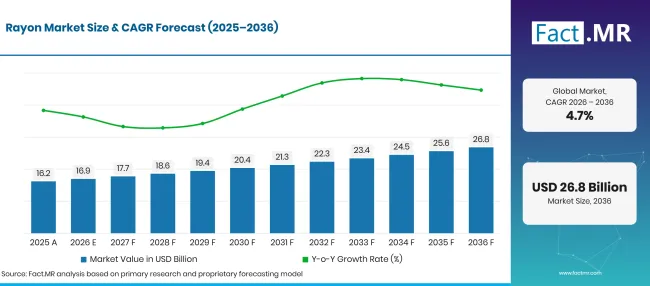
Rayon Market Forecast Global | Source: Fact.MR
| Year | Basis | Market Value (USD billion) |
|---|---|---|
| 2025 | Actual | 16.2 |
| 2026 | Estimate | 16.9 |
| 2036 | Forecast | 26.8 |
| CAGR 2026 to 2036 | Forecast period | 4.7% |
Source: Fact.MR analysis. Updated Oct 30, 2026
What are the defining numbers behind Rayon Market growth?
The 2026 to 2036 period adds USD 9.9 billion in new value, led by apparel fabric and specialty cellulose grades.
- Demand Drivers in the Market
- Garment makers buy rayon for dresses, blouses, shirts and linings because it drapes like silk and breathes like cotton. Fast collection changes at value and mid-price brands keep spinning mills running close to full order books.
- Indian policy has eased fibre access for mills. On 18 November 2025, India’s Ministry of Textiles rescinded the Quality Control Order requirement for viscose staple fibre with immediate effect, citing raw material supply constraints and high costs for MSMEs and exporters [1]. Spinners in India can now import specialty grades without separate certification.
- Home textile producers use rayon in bed linen, curtains and upholstery blends. Its moisture uptake and dye depth suit printed furnishing fabrics, which widens fibre demand beyond clothing.
- Textile waste recovery opens a cellulose feedstock route. India manages about 7.8 million tonnes of textile waste each year, and more than 70% of it is recovered for recycling, upcycling, downcycling or reuse, according to a July 2026 government paper [2]. Cotton-rich waste can be pulped and spun back into viscose.
- Hygiene and wipes makers want plant-based fibres that break down after use. Viscose and lyocell staple replace polypropylene in many spunlace wipes and absorbent products.
- Key Segments Analyzed
- By Type: Viscose Rayon will hold 58.5% share in 2026, as most spinning mills run it on existing ring and air-jet lines at a lower cost than modal or lyocell.
- By Application: Apparel will account for 49.3% share in 2026, given that dresses, shirts and linings use rayon for drape and colour depth.
- By End-User: Textile Industry will capture 62.4% share in 2026 through steady staple and filament purchases by yarn spinners and fabric weavers.
- Analyst Opinion at Fact.MR
- Shambhu Nath Jha, Principal Consultant at Fact.MR, states, “Rayon earns its place on the cutting table because it gives a cotton-like feel with silk-like drape at a price brands can carry in volume. Producers who control pulp supply and recover their process chemicals will set the cost floor for viscose. Lyocell and modal will add value, but viscose staple will still decide how much fibre mills buy each season.”
- Strategic Implications
- Fibre producers should lock in dissolving pulp contracts with audited forest sources, given that pulp is the main cost item and brands now check where it comes from.
- Spinning mills should run trials on lyocell and modal blends before buyers ask for them, since process settings for split control and dyeing differ from standard viscose.
- Apparel brands should map fibre origin down to the pulp mill to meet extended producer responsibility rules in Europe.
- Nonwoven converters should qualify viscose and lyocell staple for wipes and hygiene products, where retailers want plastic-free claims on pack.
Germany will lead the group at 5.6% CAGR as EU producer responsibility rules push brands toward traceable cellulose fibres. Brazil follows at 5.2% with a growing apparel trade that draws in imported fabric. The United Kingdom will advance at 4.4% as tighter textile waste guidance reshapes sourcing. In the United States, a 4.0% pace reflects heavy reliance on imported man-made fibre clothing. Japan rounds out the list at 3.7%, where clothing supply volumes are large but slow to change.
How does the Rayon Market break down by segment?
Viscose Rayon will lead Type at 58.5%; Apparel will top Application at 49.3%; Textile Industry will head End-User at 62.4%.
Which Type leads?
Viscose Rayon takes 58.5% of 2026 sales.
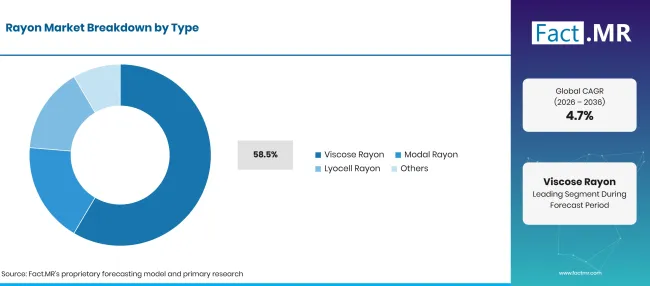
Rayon Market Breakdown Type | Source: Fact.MR
| Type | Share (2026) |
|---|---|
| Viscose Rayon (Leading segment) | 58.5% |
| Other segments combined | 41.5%* |
| Total | 100.0% |
Source: Fact.MR analysis. Updated Oct 30, 2026
Spinners have run viscose staple for decades, so machine settings, dye recipes and finishing steps are well known on mill floors. The fibre takes reactive dyes evenly and gives a smooth face to challis, crepe and lining fabrics. Its unit cost stays below modal and lyocell, which keeps it in mass-market collections. Lyocell uses a closed-loop solvent process and gives higher wet strength, so it suits denim, workwear and towels; Fact.MR tracks this grade in its lyocell fiber study. In July 2026, Asia Pacific Rayon held a lyocell fabric processing masterclass in Bandung and Solo, drawing over 125 participants from more than 50 knitted and woven fabric manufacturers [3]. Modal fills the gap with a softer hand for underwear and knit tops.
What supports Apparel within Application?
Apparel holds 49.3% of 2026 revenue.
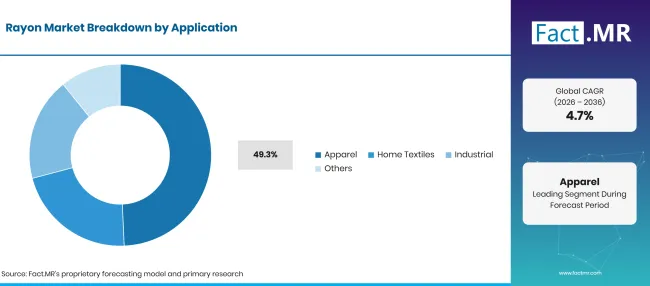
Rayon Market Breakdown Application | Source: Fact.MR
| Application | Share (2026) |
|---|---|
| Apparel (Leading segment) | 49.3% |
| Other segments combined | 50.7%* |
| Total | 100.0% |
Source: Fact.MR analysis. Updated Oct 30, 2026
Womenswear designers choose rayon when a garment needs to fall and move with the body. Blouses, maxi dresses, kurtas and shirt linings all use it, often blended with cotton or elastane for shape. Branded apparel labels refresh rayon prints each season, which keeps reorders flowing to fabric mills. Premium fashion is testing wood-based fibres in new ways. Asia Pacific Rayon partnered with Indonesian designer Toton Januar on a 2027 collection of 10 looks made from viscose and lyocell fabrics, announced in July 2026 [4]. Home textiles and industrial uses such as tyre cord and medical fabrics form the remaining application demand.
How does End-User shape demand?
Textile Industry buyers represent 62.4% of 2026 purchases.
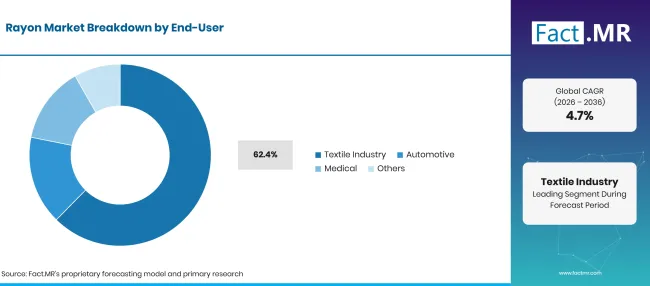
Rayon Market Breakdown End User | Source: Fact.MR
| End-User | Share (2026) |
|---|---|
| Textile Industry (Leading segment) | 62.4% |
| Other segments combined | 37.6%* |
| Total | 100.0% |
Source: Fact.MR analysis. Updated Oct 30, 2026
Yarn spinners and fabric weavers place most rayon orders. They judge each lot on fibre length, denier evenness and whiteness, then run it through scouring and dyeing with textile chemicals matched to cellulose. Price swings in pulp pass quickly into their yarn quotes. Medical and hygiene buyers need absorbent, low-lint fibres for gauze, pads and wipes sold in the tissue and hygiene products channel. Lenzing reported that it and Edgewell brought VEOCEL lyocell hygiene products to the North American market for the first time during 2025 [5]. Automotive buyers use rayon in headliners and coated textiles for interiors.
What is accelerating Rayon Market adoption, and what is holding it back?
Apparel volume, cellulose blends in home textiles and plastic-free wipes will keep fibre demand moving through 2036. Pulp price swings, competition from cheaper polyester and cotton, and scrutiny of chemical recovery at viscose plants will limit how fast new capacity fills.
Drivers Impact Analysis
| DRIVER | (~) % IMPACT ON CAGR | GEOGRAPHIC RELEVANCE | IMPACT TIMELINE |
|---|---|---|---|
| Steady use of rayon in dresses, shirts and linings | +1.5% | Global | Short term (<= 2 years) |
| Brand shift from polyester toward cellulose blends | +1.0% | Western Europe, North America, East Asia | Medium term (2-4 years) |
| Wider use of lyocell and modal in denim, knits and towels | +0.8% | Western Europe, East Asia, South Asia & Pacific | Medium term (2-4 years) |
| Plastic-free wipes and hygiene products using viscose staple | +0.6% | North America, Western Europe | Long term (>= 4 years) |
Source: Fact.MR analysis. Updated Oct 30, 2026
Opportunity Impact Analysis
| OPPORTUNITY | (~) % IMPACT ON CAGR | GEOGRAPHIC RELEVANCE | IMPACT TIMELINE |
|---|---|---|---|
| Recycled-content viscose made from cotton-rich textile waste | +0.8% | Western Europe, South Asia & Pacific | Medium term (2-4 years) |
| Lyocell filament and fill grades for premium apparel | +0.6% | East Asia, Western Europe | Medium term (2-4 years) |
| Traceable pulp sourcing for EU producer responsibility rules | +0.5% | Western Europe | Long term (>= 4 years) |
| Spunlace viscose for flushable and biodegradable wipes | +0.4% | North America, East Asia | Short term (<= 2 years) |
Source: Fact.MR analysis. Updated Oct 30, 2026
Restraints Impact Analysis
| RESTRAINT | (~) % IMPACT ON CAGR | GEOGRAPHIC RELEVANCE | IMPACT TIMELINE |
|---|---|---|---|
| Price competition from polyester and cotton staple | -0.6% | Global | Short term (<= 2 years) |
| Swings in dissolving pulp, caustic soda and energy costs | -0.4% | Global | Short term (<= 2 years) |
| Scrutiny of carbon disulphide emissions at viscose plants | -0.3% | East Asia, South Asia & Pacific | Medium term (2-4 years) |
| Low fibre-to-fibre recycling rates for blended fabrics | -0.2% | Global | Long term (>= 4 years) |
Source: Fact.MR analysis. Updated Oct 30, 2026
Which countries are scaling the Rayon Market through 2036?
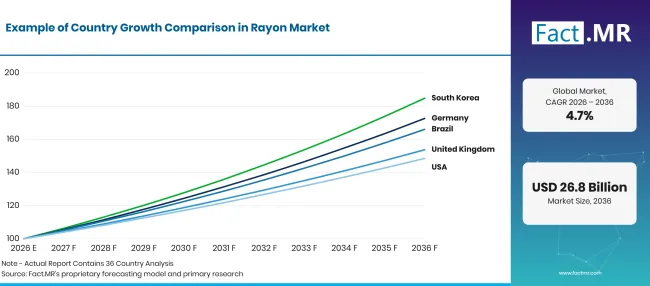
Factmr Rayon Market Growth Index | Source: Fact.MR
| Country | CAGR (2026 to 2036) |
|---|---|
| Germany | 5.6% |
| Brazil | 5.2% |
| United Kingdom | 4.4% |
| United States | 4.0% |
| Japan | 3.7% |
Source: Fact.MR analysis. Updated Oct 30, 2026
What supports Germany’s adoption?
5.6% CAGR, driven by EU producer responsibility rules that reward traceable cellulose fibres.
German fashion and home textile brands face new duties under Directive (EU) 2025/1892, which entered into force on 16 October 2025 [6]. The directive requires Member States to set up extended producer responsibility schemes for textiles by 17 April 2028 [6]. Brands will pay fees linked to product design, so fibres that can be recycled or traced back to certified forests gain favour with German buyers.
How is Brazil developing demand?
5.2% CAGR, backed by rising apparel imports and a large domestic garment base.
Brazil bought USD 2.35 billion of apparel abroad in 2025 against exports of USD 206.0 million, according to a December 2025 sector study by Banco do Nordeste [7]. China supplied 51.5% of those imports [7]. Domestic garment makers in Santa Catarina and São Paulo answer with viscose prints and blends that compete on price and speed to shelf.
How is the United Kingdom scaling demand?
4.4% CAGR, helped by stricter sorting rules for used textiles.
Guidance issued by the Environment Agency in June 2026 states that textiles count as non-waste only when they are suitable for direct reuse, and that waste textiles for export are usually classed under Basel code B3030 [8]. Collectors must sort, remove contamination and meet a set specification before shipping. Cleaner sorted streams make it easier for UK brands to test recycled cellulose fibres in new ranges.
What is supporting the United States’ adoption?
4.0% CAGR, reflecting heavy reliance on imported man-made fibre apparel.
American shoppers buy most rayon as imported garments. The Office of Textiles and Apparel reported that total U.S. textile and apparel imports rose 27.9% in January 2025 from January 2024, while apparel imports grew 18.5% [9]. Man-made fibre apparel imports increased 16.0% over the same comparison [9]. Retailers source viscose dresses and tops mainly from Asian cut-and-sew partners.
How does Japan perform?
3.7% CAGR, as a mature clothing market adds volume slowly.
Japan’s Ministry of the Environment put domestic new clothing supply at about 821,000 tonnes in its 2025 material flow study, published in March 2026 [10]. Of clothing released by households, about 35% was reused and 7% recycled [10]. Japanese spinners focus on fine-denier and specialty cellulose fibres for innerwear and premium shirting.
Who leads the Rayon Market?
Integrated pulp-to-fibre groups form the first tier. Grasim Industries Limited (Birla Cellulose) and Thai Rayon run viscose and modal plants, while Lenzing AG pushes branded specialty fibres; its 2025 report cites a new VEOCEL lyocell generation for wipes [5]. Sateri and Asia Pacific Rayon share pulp access within one group, and APR received Indonesia’s Green Industry Award 2025 from the Ministry of Industry [11]. These producers compete on feedstock control, chemical recovery and brand-facing certification.
A second tier of Chinese producers, Tangshan Sanyou Group, Zhejiang Fulida Co., Ltd., Jilin Chemical Fiber Group Co., Ltd. and Xinxiang Chemical Fiber Co., Ltd. (Bailu), wins on scale and lead time for staple and filament yarn. APR’s 2026 lyocell masterclass for Indonesian mills shows how producers now train customers to use newer grades [3]. Through 2036, pulp traceability and recycled-content offers will separate the price leaders from the specialty sellers.
Which companies are the key providers?
Key companies include Grasim Industries Limited (Birla Cellulose); Lenzing AG; Sateri; Asia Pacific Rayon; Thai Rayon Public Company Limited; Tangshan Sanyou Group; Zhejiang Fulida Co., Ltd.; Jilin Chemical Fiber Group Co., Ltd.; and Xinxiang Chemical Fiber Co., Ltd. (Bailu).
- Grasim Industries Limited (Birla Cellulose)
- Lenzing AG
- Sateri
- Asia Pacific Rayon
- Thai Rayon Public Company Limited
- Tangshan Sanyou Group
- Zhejiang Fulida Co., Ltd.
- Jilin Chemical Fiber Group Co., Ltd.
- Xinxiang Chemical Fiber Co., Ltd. (Bailu)
What is the report’s scope and coverage?
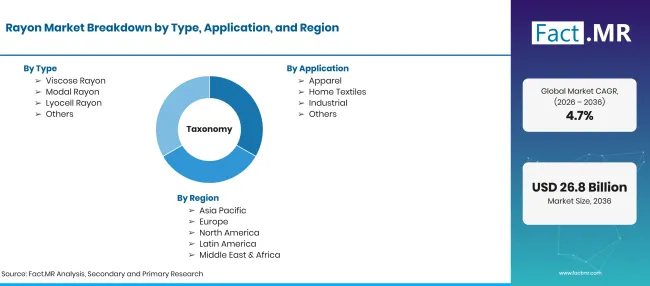
Rayon Market Taxonomy | Source: Fact.MR
| Attribute | Details |
|---|---|
| Quantitative Units | USD billion |
| Market Definition | Regenerated cellulose fibres sold as staple fibre and filament yarn, including viscose, modal and lyocell. Revenue is counted at the fibre level, before spinning into yarn or conversion into fabric. |
| Type | Viscose Rayon; Modal Rayon; Lyocell Rayon; Others |
| Application | Apparel; Home Textiles; Industrial; Others |
| End-User | Textile Industry; Automotive; Medical; Others |
| Regions Covered | North America; Latin America; Western Europe; Eastern Europe; East Asia; South Asia & Pacific; Middle East & Africa |
| Countries Covered | Germany; Brazil; United Kingdom; United States; Japan |
| Companies Profiled | Grasim Industries Limited (Birla Cellulose); Lenzing AG; Sateri; Asia Pacific Rayon; Thai Rayon Public Company Limited; Tangshan Sanyou Group; Zhejiang Fulida Co., Ltd.; Jilin Chemical Fiber Group Co., Ltd.; Xinxiang Chemical Fiber Co., Ltd. (Bailu) |
| Forecast Period | 2026 to 2036 |
| Approach | Hybrid top-down and bottom-up approach using dissolving pulp supply, staple and filament capacity, garment and home textile output, fibre price trends by grade and producer portfolio review. |
Source: Fact.MR analysis. Updated Oct 30, 2026
Bibliography
- [1] Ministry of Textiles, Government of India. (2025, November 18). Central Government has rescinded the Quality Control Order (QCO) requirement for Viscose Staple Fibre (VSF) with immediate effect.
- [2] Press Information Bureau, Government of India. (2026, July 12). Weaving Sustainability into India’s Textile Future.
- [3] Asia Pacific Rayon. (2026, July 3). APR Accelerates Lyocell Adoption in Indonesia with Fabric Processing Masterclass.
- [4] Asia Pacific Rayon. (2026, July 30). Asia Pacific Rayon and TOTON Showcase the Creative Potential of Viscose and Lyocell in Contemporary Fashion.
- [5] Lenzing AG. (2026, March 19). Lead Transformation, Generate Impact: Lenzing Presents Its 2025 Annual and Sustainability Report.
- [6] European Parliament and Council of the European Union. (2025, September 10). Directive (EU) 2025/1892 of the European Parliament and of the Council of 10 September 2025 amending Directive 2008/98/EC on waste.
- [7] Banco do Nordeste do Brasil, ETENE. (2025, December). Caderno Setorial ETENE: Vestuário, Ano 10, Nº 419 [Sector Notebook: Apparel].
- [8] Environment Agency. (2026, June 3). Importing and exporting waste and non-waste textiles.
- [9] U.S. Department of Commerce, Office of Textiles and Apparel. (2025, March 6). January 2025 Trade Data Release.
- [10] Ministry of the Environment, Japan. (2026, March).[FY2025 survey on promoting circular fashion: 2025 clothing material flow].
- [11] Asia Pacific Rayon. (2026, September 3). APR Releases 2025 Sustainability Report: Growing Value, Sustaining Progress
This Report Answers
- How much rayon revenue comes from each type, application and end-user group in 2026?
- Why do mills still favour viscose, and where do modal and lyocell win orders?
- Germany, Brazil, the United Kingdom, the United States and Japan are compared on import reliance, waste rules and garment demand.
- Fibre producers are grouped by pulp access, product range and certification strength.
- Pulp costs, polyester competition and recycling limits are traced to show where growth slows.
What does the Rayon Market cover?
Viscose, modal and lyocell fibres made by dissolving wood or other cellulose pulp and spinning it back into fibre form are counted in this study. Both staple fibre for spun yarn and continuous filament yarn are included.
Demand is tracked across apparel, home textiles, industrial products and other uses. Values reflect sales by fibre producers to spinners, weavers, nonwoven converters and other direct buyers.
What is included in the scope?
Fibre made from dissolving pulp of wood, bamboo or cotton linter origin is in scope, as are recycled-content viscose and lyocell grades that blend pulped textile waste with virgin pulp. Spun-dyed and specialty grades count at their fibre selling price.
Rayon staple sold to nonwoven converters for wipes, hygiene and medical products is included. Filament yarn sold for tyre cord, linings and embroidery thread falls within the boundary as well.
What is excluded from the scope?
Dissolving pulp sold on its own, before spinning, is left out. Cotton, polyester, nylon and other non-cellulosic fibres are not valued, even when blended with rayon in the same yarn.
Finished garments, home furnishings and car interiors count only through the rayon fibre they contain. Cellophane film, cellulose acetate tow and textile recycling services are outside the valuation.
How Was the Analysis Built?
The analysis draws on 120+ sources, 35+ company portfolios, 25+ countries, and more than 20 industry interviews.
- Primary Research: Primary research includes discussions with manufacturers, service providers, technology developers, distributors, end users, and subject-matter experts. These conversations examine purchasing priorities, product adoption, operational challenges, approval requirements, competitive positioning, and the factors that influence wider market acceptance.
- Desk Research: Desk research covers government statistics, regulatory publications, company filings, trade data, technical studies, industry associations, standards, public policy, and other authoritative sources. Every source used in the analysis is documented in the bibliography.
- Market Sizing and Forecasting: Market estimates combine historical performance, demand indicators, pricing and volume trends, segment shares, company participation, country-level growth, adoption patterns, investment activity, and barriers to market expansion.
- Data Validation and Update Cycle: Findings are validated by comparing primary interviews with public data, company activity, regulatory changes, trade patterns, and industry developments. Regular updates review new product launches, capacity changes, partnerships, approvals, and shifts in commercial adoption.
Segmentation
How is the market segmented?
-
By Type
- Viscose Rayon
- Modal Rayon
- Lyocell Rayon
- Others
-
By Application
- Apparel
- Home Textiles
- Industrial
- Others
-
By End-User
- Textile Industry
- Automotive
- Medical
- Others
-
By Region
- North America
- Latin America
- Western Europe
- Eastern Europe
- East Asia
- South Asia & Pacific
- Middle East & Africa
Frequently Asked Questions
How big is the rayon market in 2026?
What is the CAGR of the rayon market from 2026 to 2036?
Which type leads the rayon market?
Which application leads the rayon market?
Which end-user leads the rayon market?
Which country will grow the most in the rayon market?
Who are the main companies in the rayon market?
Who worked on this report


Preview the report firsthand - request a free sample
Free SampleGet the brochure for pricing and purchase details
Download PDF