- Market Value (2025): USD 119.5 Mn
- Estimated Value (2026): USD 125.7 Mn
- Forecast Value (2036): USD 208.5 Mn
- CAGR (2026-2036): 5.2%
What is the Acid Mist Suppressant Market forecast to be worth by 2036?
USD 125.7 million in 2026 to USD 208.5 million by 2036, at a 5.2% CAGR.
- As per Fact.MR analysis, the Acid Mist Suppressant Market was valued at USD 119.5 million in 2025.
- Demand will grow from USD 125.7 million in 2026 to USD 208.5 million by 2036.
- The market is projected to record a 5.2% CAGR from 2026 to 2036, supported by industrial efforts to reduce acid mist emissions and improve worker protection.
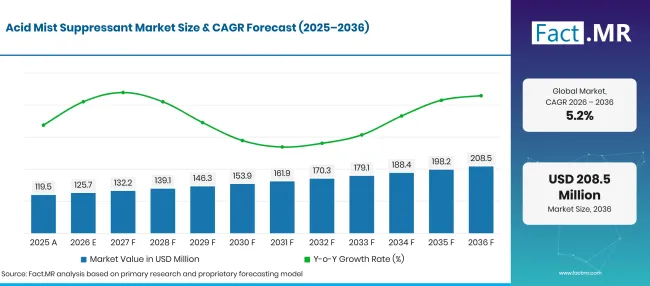
Acid Mist Suppressant Market Forecast Global | Source: Fact.MR
| Year | Basis | Market Value (USD million) |
|---|---|---|
| 2025 | Actual | 119.5 |
| 2026 | Estimate | 125.7 |
| 2036 | Forecast | 208.5 |
| CAGR 2026 to 2036 | Forecast period | 5.2% |
Source: Fact.MR analysis. Updated Oct 30, 2026
What are the defining numbers behind Acid Mist Suppressant Market growth?
USD 82.8 million in absolute opportunity between 2026 and 2036.
- Demand Drivers in the Market
- Stringent environmental and workplace safety regulations drive the growth of the market. Increasing enforcement of occupational health and environmental regulations is driving demand for acid mist suppressants to minimize hazardous aerosol emissions and reduce worker exposure in electroplating and chemical processing facilities.
- Expansion of electroplating and metal finishing industries supports demand for acid mist suppressants. Corrosion-resistant and decorative coatings used in automotive, electronics, and industrial manufacturing require surface-treatment processes, including certain chromium plating operations, where mist-control formulations can help manage airborne acid droplets.
- Increasing Steel Pickling and Industrial Processing Activities Rising demand for processed steel and high-quality metal surfaces is boosting the use of acid-based pickling and cleaning operations, creating opportunities for acid mist suppressants to improve workplace safety and control airborne acid emissions.
- The OECD Steel Outlook 2026 projects global steel production at approximately 1,869 million tonnes in 2026, up 1.0% from 2025. India’s production is projected to increase from 164.4 million tonnes in 2025 to 174.9 million tonnes in 2026, representing 6.4% growth. These figures provide context for metal processing, where certain acid-based treatment operations require mist-control measures [7]. [7]
- Key Segments Analyzed
- By Product Type: Foam-Based products account for 62.4% of the market. Their use depends on whether a foam layer is compatible with the operating process.
- By Application: Electroplating leads with 38.2% in 2026. Acid mist suppression is relevant to plating operations where acidic electrolytes can generate airborne droplets.
- By End-User Industry: Automotive holds prominent share of 32.8% in 2026. Metal finishing requirements for vehicle components can support demand for process chemicals used in suitable surface-treatment operations.
- Analyst Opinion at Fact.MR
- Shambhu Nath Jha, Principal Consultant at Fact.MR, states, “The Acid Mist Suppressant Market is shaped by the need to control airborne acid droplets without disrupting industrial production. Product developers must demonstrate effective mist reduction while maintaining compatibility with process chemistry. Shifts toward alternative suppressant formulations may create opportunities for suppliers, although buyers still need evidence of performance under actual operating conditions.”
- Strategic Implications
- Manufacturers need to document suppressant performance under representative process conditions and provide clear compatibility guidance.
- Industrial operators should assess suppressant use alongside ventilation and other workplace exposure controls.
- Distributors can help customers select products suited to their acid concentration and operating conditions.
- Purchasing teams must evaluate total operating cost alongside mist reduction performance and process stability.
Germany is forecast to record a 4.0% CAGR through 2036. Brazil is projected to grow at 5.5%, followed by the USA at 6.7%. The UK is expected to advance at 4.7%, while Japan is forecast to grow at 5.1%.
How does the Acid Mist Suppressant Market break down by segment?
Fact.MR identifies Foam-Based products at 62.4%, Electroplating at 38.2% and Automotive at 32.8% in 2026.
Which Product Type accounts for the largest share?
Foam-Based products are set to account for 62.4% share in 2026.
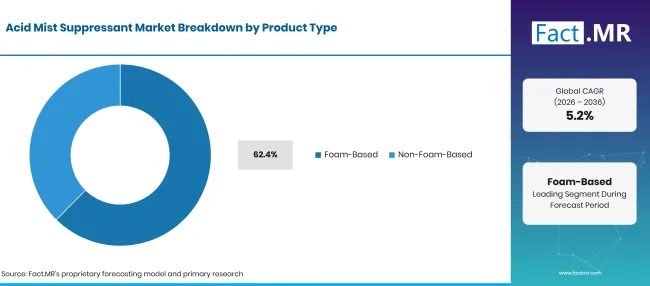
Acid Mist Suppressant Market Breakdown Product Type | Source: Fact.MR
| Product Type | Share (2026) |
|---|---|
| Foam-Based (Leading segment) | 62.4% |
| Other segments combined | 37.6%* |
| Total | 100.0% |
Source: Fact.MR analysis. Updated Oct 30, 2026
Foam-Based suppressants are used where a surface foam layer helps reduce the release of airborne acid droplets. Their suitability depends on the process and whether foam formation affects production or downstream operations. Non-Foam-Based products offer an alternative where operators need to suppress mist without relying on a stable foam blanket.
What leads the Application segment?
Electroplating is set to represent 38.2% share in 2026.
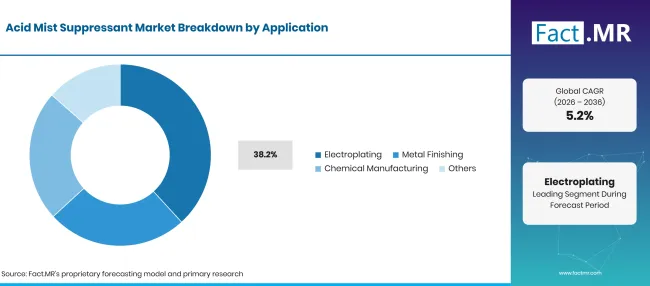
Acid Mist Suppressant Market Breakdown Application | Source: Fact.MR
| Application | Share (2026) |
|---|---|
| Electroplating (Leading segment) | 38.2% |
| Other segments combined | 61.8%* |
| Total | 100.0% |
Source: Fact.MR analysis. Updated Oct 30, 2026
Electroplating processes use electrical current to deposit a metal coating onto a surface. Acid mist can form when gas bubbles burst at the electrolyte surface or during certain handling activities. Suppressants can help reduce mist generation, while ventilation and other exposure controls remain important for workplace safety.
How does End-User Industry shape demand?
Automotive is set to capture 32.8% share in 2026.
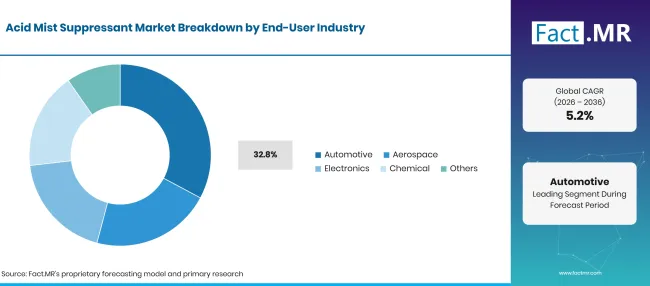
Acid Mist Suppressant Market Breakdown End User Industry | Source: Fact.MR
| End-User Industry | Share (2026) |
|---|---|
| Automotive (Leading segment) | 32.8% |
| Other segments combined | 67.2%* |
| Total | 100.0% |
Source: Fact.MR analysis. Updated Oct 30, 2026
Automotive manufacturing uses metal finishing for components that require suitable surface properties. Acid mist suppressant demand can arise where relevant production processes involve acidic baths. Aerospace and electronics applications may have different process specifications, while chemical manufacturers evaluate products according to their specific acid-handling operations.
What is accelerating Acid Mist Suppressant Market adoption, and what is holding it back?
Stringent industrial emission controls and growing demand for safer acid-handling operations support market adoption, while formulation costs and application-specific performance challenges limit wider uptake.
Drivers Impact Analysis
| DRIVER | (~) % IMPACT ON CAGR | GEOGRAPHIC RELEVANCE | IMPACT TIMELINE |
|---|---|---|---|
| Stricter industrial emission control requirements | +1.0% | Europe, Asia | Medium term (2–4 years) |
| Growing demand from metal finishing and electroplating | +0.9% | Global | Short term (≤ 2 years) |
| Expansion of acid-based industrial processing | +0.7% | Asia, Americas | Medium term (2–4 years) |
| Increased focus on worker safety and workplace air quality | +0.5% | Global | Short term (≤ 2 years) |
| Adoption of specialized surface treatment chemicals | +0.4% | Europe, Asia | Long term (≥ 4 years) |
Source: Fact.MR analysis. Updated Oct 30, 2026
Opportunity Impact Analysis
| OPPORTUNITY | (~) % IMPACT ON CAGR | GEOGRAPHIC RELEVANCE | IMPACT TIMELINE |
|---|---|---|---|
| Development of PFAS-free mist suppressant formulations | +0.8% | Europe, Americas | Medium term (2–4 years) |
| Formulations compatible with diverse acid bath conditions | +0.6% | Global | Medium term (2–4 years) |
| Growing demand from electroplating and metal finishing facilities | +0.5% | Asia, Americas | Long term (≥ 4 years) |
| Improved product performance and chemical concentration labeling | +0.4% | Global | Short term (≤ 2 years) |
Source: Fact.MR analysis. Updated Oct 30, 2026
Restraints Impact Analysis
| RESTRAINT | (~) % IMPACT ON CAGR | GEOGRAPHIC RELEVANCE | IMPACT TIMELINE |
|---|---|---|---|
| High formulation and treatment costs | -0.8% | Global | Short term (≤ 2 years) |
| Compatibility issues with plating bath chemistry | -0.6% | Global | Medium term (2–4 years) |
| Regulatory restrictions on certain suppressant chemistries | -0.5% | Europe, Americas | Short term (≤ 2 years) |
| Limited technical expertise and application-specific validation | -0.4% | Asia, emerging markets | Medium term (2–4 years) |
Source: Fact.MR analysis. Updated Oct 30, 2026
Which countries are scaling the Acid Mist Suppressant Market through 2036?
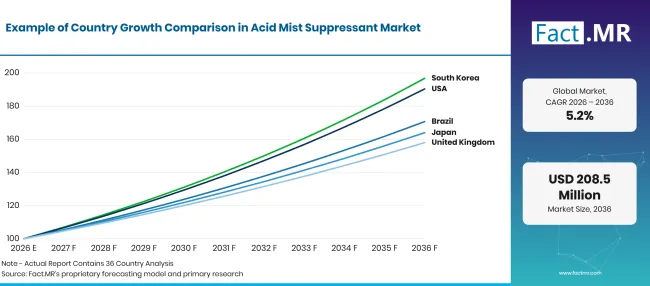
Acid Mist Suppressant Market Growth Index | Source: Fact.MR
| Country | CAGR (2026–2036) |
|---|---|
| Germany | 4.0% |
| Brazil | 5.5% |
| USA | 6.7% |
| UK | 4.7% |
| Japan | 5.1% |
Source: Fact.MR analysis. Updated Oct 30, 2026
What supports Germany adoption?
4.0% CAGR, driven by stringent environmental regulations.
Germany’s acid mist suppressants market is driven by stringent environmental regulations, occupational safety requirements, and demand from electroplating, metal finishing, and automotive component manufacturing. Directive (EU) 2024/1785 required EU Member States, including Germany, to adopt national implementing provisions by July 1, 2026. The revised framework supports continued attention to applicable industrial pollution controls. Additionally, manufacturers are exploring fluorine-free alternatives to improve environmental performance and comply with evolving chemical restrictions [1]. [1]
How is Brazil developing acid mist suppressant adoption?
5.5% CAGR, shaped by expanding automotive manufacturing.
Brazil's metal processing and mining-related activities provide potential demand channels for acid mist suppression products. Copper electrowinning applications require control of sulfuric acid mist released during processing. Suppliers can address this demand through products designed for the relevant electrolyte conditions.
What supports United States adoption?
6.7% CAGR, supported by stringent air pollution control standards, occupational safety requirements.
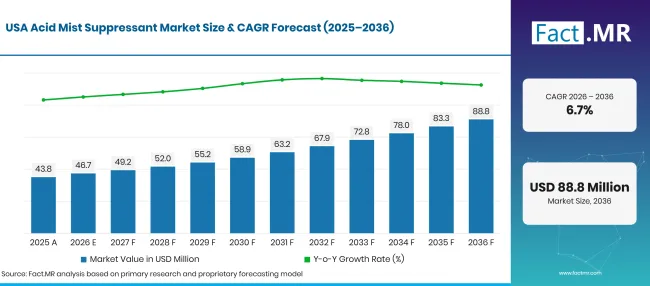
Acid Mist Suppressant Market Forecast Usa | Source: Fact.MR
The U.S. market is shaped by exposure-control requirements across electroplating and related industrial processes. Facilities evaluate ventilation, containment, and other suitable controls according to operating conditions, worker exposure levels, and applicable safety requirements when planning equipment upgrades.
How is the United Kingdom building adoption?
4.7% CAGR, driven by increasing demand from electroplating and metal finishing facilities.
The United Kingdom acid mist suppressants market presents growth opportunities through the development of environmentally safer formulations, increasing demand from electroplating and metal finishing facilities, and stronger emphasis on industrial air quality and worker protection. UK government publications addressing the chemicals industry and advanced manufacturing provide a broader policy context for industrial chemical suppliers. Commercial demand for acid mist suppressants depends on facilities carrying out applicable metal-finishing and acid-treatment processes. Partnerships with specialty chemical distributors and customized formulations for metal treatment processes can further support market penetration [2] [3]. [2][3]
What supports Japan adoption?
5.1% CAGR, owing to advanced electronics manufacturing.
Japan's manufacturing base provides potential demand for chemicals used in metal treatment and surface finishing. Electronics and automotive production may require specialized finishing processes, depending on component specifications. Suppressant adoption depends on process compatibility and the ability to reduce acid mist without affecting product quality.
Japan's automotive and electronics manufacturing sectors include applications involving metal finishing and surface treatment. Acid mist suppressant demand depends on the use of acid-based baths, process compatibility, and applicable workplace exposure controls. Suppliers can serve these applications through formulations designed for specific electrolyte chemistry and operating conditions. [4][5]
Who leads the Acid Mist Suppressant Market?
Fact.MR finds that BASF SE, Syensqo, SafetyMin, Tianjin Chemshi Technology Co., Ltd., and Electrochemical Products, Inc. (EPi), alongside Innospec Inc. and A. S. Harrison & Co. Pty Limited, are relevant companies to assess across the acid mist suppression value chain.
BASF SE and Syensqo have documented product offerings for acid mist suppression in copper electrowinning. SafetyMin and Tianjin Chemshi Technology Co., Ltd. are relevant to investigate for specialized mist suppressant formulations. Electrochemical Products, Inc. (EPi) supplies products for acid mist control in chromium plating. Innospec Inc. and A. S. Harrison & Co. Pty Limited should be evaluated for specific product offerings and distribution activities before classifying them as direct manufacturers. In July 2026, Tianjin Chemshi Technology Co., Ltd., announced its NF-100 acid mist suppressant for copper electrowinning and acid-cleaning applications. The manufacturer describes the product as a formulation for industrial acid mist control. Application suitability and performance require assessment against product specifications and operating conditions [6]. [6]
Commercial competition depends on suppressant chemistry, application compatibility, and demonstrated mist reduction. Industrial users need products suited to their specific acid bath conditions. Formulators need reliable performance data and regulatory documentation. Buyers also consider chemical handling requirements, supplier availability, and compatibility with existing plating or electrowinning processes.
Which companies are the key providers?
Companies assessed across acid mist suppression products and related industrial chemicals include BASF SE, Syensqo, SafetyMin, Tianjin Chemshi Technology Co., Ltd., Electrochemical Products, Inc. (EPi), Innospec Inc., and A. S. Harrison & Co. Pty Limited. Direct product participation requires verification for each supplier.
- BASF SE
- Syensqo
- SafetyMin
- Tianjin Chemshi Technology Co., Ltd.
- Electrochemical Products, Inc. (EPi)
- Innospec Inc.
- A. S. Harrison & Co Pty Limited
Bibliography
- [1] Umweltbundesamt. (2024, August 1). Industrieemissionsrichtlinie.
- [2] Department for Business and Trade. (n.d.). Chemicals. Business.gov.uk.
- [3] Council for Science and Technology. (2026, August 25). Achieving stability and growth in the UK chemical sector.
- [4] Ministry of the Environment, Government of Japan. (2026, June 29). Release of report on the market size and employment size of the environmental industry.
- [5] Syntax Partners, Inc. (2026, October 16). Japan plating and surface treatment M&A: Succession platforms, process insourcing and foreign capital in plating chemicals.
- [6] Tianjin Chemshi Technology Co., Ltd. (2026, July 22). Maximizing efficiency and safety with advanced acid mist suppressants: The ultimate guide for metallurgy and electroplating.
- [7] OECD. (2026, June 4). OECD Steel Outlook 2026. OECD Publishing.
This Report Answers
- The report describes the use of acid mist suppressants in industrial processes.
- Segment analysis compares Foam-Based and Non-Foam-Based products.
- Application analysis covers electroplating and other stated industrial uses.
- End-user analysis compares the automotive sector with other specified industries.
- Country analysis reviews the growth forecasts for Germany, Brazil, the USA, the UK and Japan.
- The competitive overview identifies companies with documented acid mist suppressant products.
What does the Acid Mist Suppressant Market cover?
The market covers chemical formulations designed to reduce acid mist formation during industrial processing. These products can be used in relevant electroplating operations and in selected metal treatment or electrowinning processes. Product performance depends on the acid system and operating conditions.
What is included in the scope?
Included products are specialty chemical suppressants sold for reducing acid mist formation. The scope covers foam-based and non-foam-based formulations used in the stated applications and end-user industries.
What is excluded from the scope?
The scope excludes general ventilation equipment and mist collection systems sold independently of suppressant chemicals. General surfactants without a documented acid mist suppression application are also excluded. Other industrial chemicals are not included unless they are specifically marketed for acid mist control.
How Was the Analysis Built?
The analysis draws on 120+ sources, 35+ company portfolios, 25+ countries, and more than 20 industry interviews.
- Primary Research: Primary research includes discussions with manufacturers, service providers, technology developers, distributors, end users, and subject-matter experts. These conversations examine purchasing priorities, product adoption, operational challenges, approval requirements, competitive positioning, and the factors that influence wider market acceptance.
- Desk Research: Desk research covers government statistics, regulatory publications, company filings, trade data, technical studies, industry associations, standards, public policy, and other authoritative sources. Every source used in the analysis is documented in the bibliography.
- Market Sizing and Forecasting: Market estimates combine historical performance, demand indicators, pricing and volume trends, segment shares, company participation, country-level growth, adoption patterns, investment activity, and barriers to market expansion.
- Data Validation and Update Cycle: Findings are validated by comparing primary interviews with public data, company activity, regulatory changes, trade patterns, and industry developments. Regular updates review new product launches, capacity changes, partnerships, approvals, and shifts in commercial adoption.
Segmentation
What is the report’s scope and coverage?
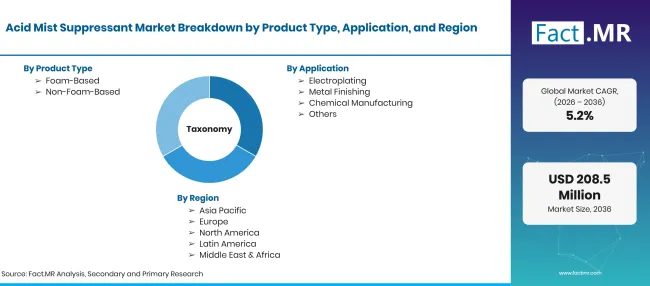
Acid Mist Suppressant Market Taxonomy | Source: Fact.MR
| Attribute | Details |
|---|---|
| Quantitative units | USD million in 2026 to USD million by 2036, at CAGR |
| Market definition | The acid mist suppressants market comprises specialty chemical formulations designed to reduce the formation and release of acid mist during industrial operations such as electroplating, metal finishing and copper electrowinning. |
| Product Type | Foam-Based; Non-Foam-Based |
| Application | Electroplating; Metal Finishing; Chemical Manufacturing; Others |
| End-User Industry | Automotive; Aerospace; Electronics; Chemical; Others |
| Countries covered | Germany; Brazil; USA; UK; Japan |
| Companies profiled | BASF SE; Syensqo; SafetyMin; Tianjin Chemshi Technology Co., Ltd.; Electrochemical Products, Inc. (EPi) ; Innospec Inc.; A. S. Harrison & Co Pty Limited |
| Forecast period | 2026 to 2036 |
| Approach | Segment-based forecast using the market values and shares, supported by product and occupational-safety documentation |
Source: Fact.MR analysis. Updated Oct 30, 2026
How is the market segmented?
-
By Product Type
- Foam-Based
- Non-Foam-Based
-
By Application
- Electroplating
- Metal Finishing
- Chemical Manufacturing
- Others
-
By End-User Industry
- Automotive
- Aerospace
- Electronics
- Chemical
- Others
-
By Country
- Germany
- Brazil
- USA
- UK
- Japan
Frequently Asked Questions
How big is the Acid Mist Suppressant Market in 2026?
What is the CAGR from 2026 to 2036?
Which product type has the largest share?
Which application has the largest share?
Which companies are covered?
Who worked on this report


Preview the report firsthand - request a free sample
Free SampleGet the brochure for pricing and purchase details
Download PDF