Cattle Gastrointestinal Infection Treatment Market
Cattle Gastrointestinal Infection Treatment Market Size and Share Forecast Outlook 2026 to 2036
Cattle gastrointestinal infection treatment market is projected to grow from USD 2.2 billion in 2026 to USD 4.1 billion by 2036, at a CAGR of 6.5%. Antibiotics will dominate with a 36.1% market share, while bacterial gi infections will lead the application segment with a 39.9% share.
Cattle Gastrointestinal Infection Treatment Market Forecast and Outlook 2026 to 2036
The global cattle gastrointestinal infection treatment market is projected to grow from USD 2.18 billion in 2026 to USD 4.07 billion by 2036, progressing at a CAGR of 6.5%. This growth is occurring within a landscape fundamentally reshaped by the twin pressures of antimicrobial resistance concerns and the intensification of global cattle production.
Key Takeaways from the Cattle Gastrointestinal Infection Treatment Market
- Market Value for 2026: USD 2.18 Billion
- Market Value for 2036: USD 4.07 Billion
- Forecast CAGR 2026 to 2036: 6.5%
- Leading Product Segment (2026): Antibiotics (36.1%)
- Leading Application Segment (2026): Bacterial GI Infections (39.9%)
- Leading End-User Segment (2026): Large Dairy Farms (41.8%)
- Key Growth Countries: India (8.1% CAGR), China (7.9% CAGR), Brazil (7.6% CAGR), USA (6.6% CAGR), Germany (6.4% CAGR), UK (6.4% CAGR), France (6.3% CAGR)
- Key Players in the Market: Zoetis Inc., MSD Animal Health, Elanco Animal Health, Boehringer Ingelheim Animal Health, Ceva Santé Animale
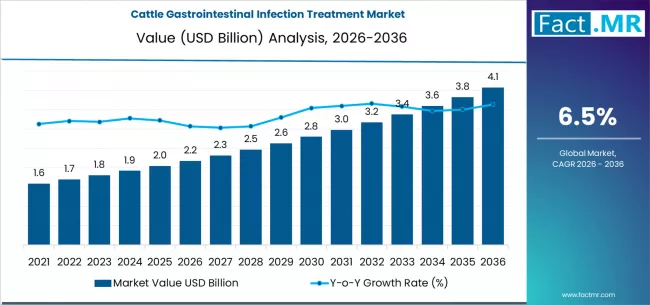
While bacterial infections drive significant treatment demand, the market is progressively pivoting from reliance on traditional antibiotics toward integrated parasite control and gut health management. This evolution reflects a broader trend in veterinary medicine towards sustainable herd health.
Key developments include the rapid incorporation of diagnostics and a shift in product mix. The use of rapid on-farm diagnostic tests to identify specific pathogens is becoming more common, enabling targeted therapy and supporting antibiotic stewardship.
There is robust growth in the probiotics and feed additives segment, as producers seek to bolster innate immunity and prevent infections before they occur. This trend is reinforced by stringent regulations on antibiotic use in livestock, particularly in Europe and North America, compelling the industry to innovate.
Metric
| Metric | Value |
|---|---|
| Market Value (2026) | USD 2.18 Billion |
| Market Forecast Value (2036) | USD 4.07 Billion |
| Forecast CAGR 2026 to 2036 | 6.5% |
Category
| Category | Segments |
|---|---|
| Product | Antibiotics, Antiparasitics, Probiotics & Feed Additives, Supportive Therapies |
| Application | Bacterial GI Infections, Parasitic Infections, Mixed Infections |
| End User | Large Dairy Farms, Veterinary Hospitals, Agro-Vet Distributors |
| Region | North America, Latin America, Western Europe, Eastern Europe, East Asia, South Asia & Pacific, Middle East & Africa |
Segmental Analysis
By Product, Which Segment is Undergoing the Most Significant Strategic Transformation?
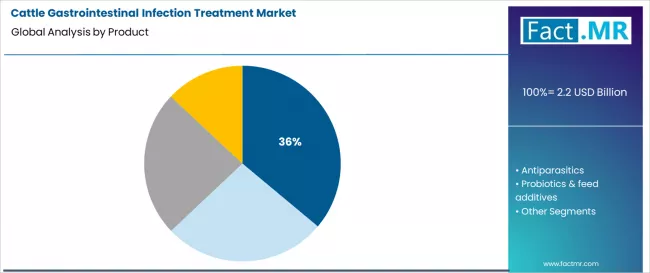
Antibiotics currently command a leading 36.1% share, but this segment is at a strategic crossroads. While remaining essential for treating acute bacterial infections like salmonellosis and clostridial enteritis, its growth is tempered by stringent regulatory oversight and resistance concerns.
The segment's future is shifting toward precision use guided by diagnostics and the development of novel classes with lower resistance potential, rather than volume-based growth.
By Application, Which Persistent Condition Drives Core Therapeutic Demand?
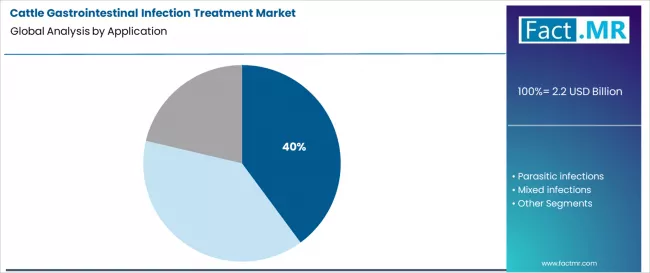
Bacterial gastrointestinal infections constitute the primary application segment at 39.9%. Diseases such as calf scours caused by E. coli, salmonella, and clostridium, represent a major cause of mortality and morbidity, especially in young stock.
The high economic impact of lost growth, treatment costs, and death in valuable calves ensures consistent demand for effective therapeutic interventions, solidifying this application as the market's volume core.
By End User, Which Group is the Primary Driver for Protocol-Based Treatment Plans?
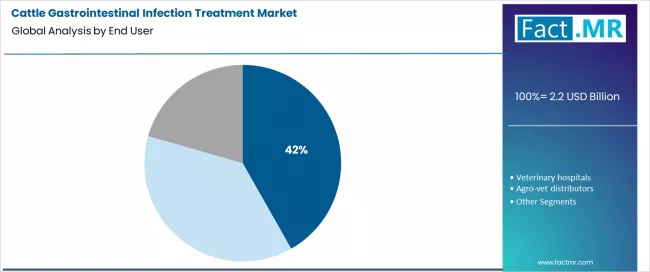
Large dairy farms form the leading end-user segment at 41.8%. These operations have the scale to employ dedicated veterinary consultants and implement standardized health protocols.
Their management of high-density calf-rearing units makes them major purchasers of both therapeutic and preventative products. They increasingly demand integrated solutions that combine antibiotics, antiparasitics, and nutritional supports within vet-supervised health programs.
What are the Principal Drivers, Constraints, and Evolving Dynamics of this Market?
The principal driver for the cattle gastrointestinal infection treatment market is the high economic loss associated with calf mortality and reduced growth rates due to GI diseases, creating a strong incentive for effective treatment.
A major constraint is the global push for antibiotic reduction in livestock, which limits the growth trajectory of the largest product segment and pressures profitability. A significant opportunity lies in the expansion of preventative health through advanced probiotics, prebiotics, and vaccines that reduce the incidence of infection, creating a growing alternative revenue stream.
The dominant trend is the integration of rapid point-of-care diagnostics with treatment decisions, enabling more targeted and responsible antimicrobial use while improving clinical outcomes and supporting regulatory compliance.
Analysis of the Cattle Gastrointestinal Infection Treatment Market by Key Countries
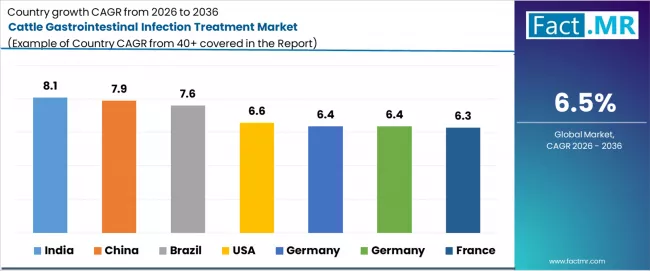
| Country | CAGR 2026 to 2036 |
|---|---|
| India | 8.1% |
| China | 7.9% |
| Brazil | 7.6% |
| USA | 6.6% |
| Germany | 6.4% |
| UK | 6.4% |
| France | 6.3% |
How is the USA's Market Balancing Therapeutic Efficacy with Stringent Antibiotic Stewardship?
The USA’s 6.6% CAGR operates under the Veterinary Feed Directive (VFD) and heightened consumer scrutiny. Growth in the cattle gastrointestinal infection treatment market is characterized by a shift toward prescription-only antibiotics and increased investment in diagnostic testing to ensure appropriate use. This drives demand for newer, more targeted antimicrobials and a parallel surge in preventative probiotic and vaccine adoption within large feedlot and dairy systems.
Does Brazil's Extensive Beef Production System Dictate a Focus on Parasitic Control?
The vast grazing-based beef cattle population heavily influences Brazil’s 7.6% CAGR. The cattle gastrointestinal infection treatment market here prioritizes broad-spectrum antiparasitics to control nematode and coccidial infections that thrive in pasture settings.
While antibiotics are used, the application focus and growth are disproportionately weighted toward managing parasitic gastroenteritis, which represents the dominant health challenge in this production model.
Is China's Intensive Beef and Dairy Rearing Model Creating a High-Density Disease Environment?
China’s 7.9% CAGR is fueled by the rapid growth of its confined animal feeding operations (for both dairy and beef. The high stocking densities in these systems create ideal conditions for the rapid spread of bacterial and mixed GI infections.
This drives robust demand for therapeutic antibiotics and feed-additive-based preventative solutions, with the market closely linked to the scale-up of modern, intensive production facilities.
Will India's Market Growth be Defined by Smallholder Challenges and Evolving Parasite Resistance?
Its enormous bovine population and increasing awareness of productivity losses drive India’s leading 8.1% CAGR from GI disease. The cattle gastrointestinal infection treatment market faces unique challenges: treating infections in small, scattered herds and growing resistance to older classes of dewormers. Growth is finding a path through the agro-vet distributor channel, with increasing uptake of combination antiparasitics and affordable antibiotic therapies.
Are Germany's Strict Regulations Successfully Decoupling Market Growth from Antibiotic Volume?
Germany’s 6.4% CAGR reflects a market where strict antibiotic usage monitoring and reduction targets are in place. Growth in the cattle gastrointestinal infection treatment market is increasingly derived from non-antibiotic products. Advanced supportive therapies for electrolyte and acid-base balance, alongside sophisticated parasite control programs and immune-modulating feed additives, are capturing market share, demonstrating a model of value growth without increased antimicrobial use.
Does France's Emphasis on Grass-Fed and Label-Rouge Systems Require Specific Treatment Approaches?
France’s 6.3% CAGR is influenced by its significant pasture-based and quality-label production systems. Parasitic infections remain a primary concern. The cattle gastrointestinal infection treatment market emphasizes targeted, selective deworming strategies to maintain parasite refugia and prevent resistance, alongside the use of natural preventive supplements, aligning with the holistic management practices valued in these production schemes.
Is the UK's Market Trajectory Focused on High-Value Calf Health and Diagnostic-Led Therapy?
The UK’s 6.4% CAGR is strongly oriented toward its intensive dairy calf-rearing sector. The high value of dairy replacements makes effective GI infection treatment critical.
The market is characterized by a strong focus on rapid diagnostics for neonatal calf diarrhea and a growing preference for oral rehydration and probiotic supportive therapies as first-line interventions, reserving antibiotics for confirmed bacterial cases.
Competitive Landscape of the Cattle Gastrointestinal Infection Treatment Market
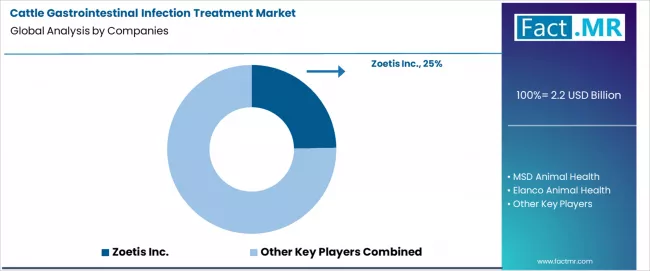
Global animal health giants with broad pharmaceutical portfolios dominate the competitive landscape. These companies compete by offering a range of solutions across the antibiotic, antiparasitic, and nutritional spectrum.
Their strength lies in extensive R&D capabilities for novel molecules and established relationships with large veterinary practices and integrated farming operations. Success depends on navigating regulatory pathways for new antimicrobials while expanding portfolios of preventative health products.
Competition is intensifying in the probiotics and feed additive segment, where specialized life science companies and agribusiness firms are active. Key strategies include developing combination products that address multiple pathogens, creating novel delivery mechanisms for pastures, and providing data-driven herd health consultancy services that bundle diagnostics with treatment recommendations. Partnerships with diagnostic companies are becoming crucial to offer complete, stewardship-compliant solutions.
Key Players in the Cattle Gastrointestinal Infection Treatment Market
- Zoetis Inc.
- MSD Animal Health
- Elanco Animal Health
- Boehringer Ingelheim Animal Health
- Ceva Santé Animale
- Others
Scope of Report
| Items | Metrics |
|---|---|
| Quantitative Units | USD Billion |
| Product | Antibiotics, Antiparasitics, Probiotics & Feed Additives, Supportive Therapies |
| Application | Bacterial GI Infections, Parasitic Infections, Mixed Infections |
| End User | Large Dairy Farms, Veterinary Hospitals, Agro-Vet Distributors |
| Key Countries | India, China, Brazil, USA, Germany, France, UK |
| Key Companies | Zoetis, MSD Animal Health, Elanco, Boehringer Ingelheim, Ceva, Others |
| Additional Analysis | Analysis of antibiotic resistance patterns in key cattle pathogens; economic burden of GI infections across different production systems; impact of weather and climate on parasitic infection prevalence; comparison of treatment protocols in conventional vs. organic farming. |
Market by Segments
-
Product :
- Antibiotics
- Antiparasitics
- Probiotics & Feed Additives
- Supportive Therapies
-
Application :
- Bacterial GI Infections
- Parasitic Infections
- Mixed Infections
-
End User :
- Large Dairy Farms
- Veterinary Hospitals
- Agro-Vet Distributors
-
Region :
-
North America
- USA
- Canada
-
Latin America
- Brazil
- Mexico
- Argentina
- Rest of Latin America
-
Western Europe
- Germany
- France
- UK
- Italy
- Spain
- BENELUX
- Rest of Western Europe
-
Eastern Europe
- Russia
- Poland
- Czech Republic
- Rest of Eastern Europe
-
East Asia
- China
- Japan
- South Korea
- Rest of East Asia
-
South Asia & Pacific
- India
- ASEAN
- Australia
- Rest of South Asia & Pacific
-
MEA
- GCC Countries
- South Africa
- Turkiye
- Rest of MEA
-
Bibliography
- American Association of Bovine Practitioners (AABP). (2025). Clinical Guidelines for the Diagnosis and Management of Gastrointestinal Infections in Cattle.
- European Medicines Agency (EMA). (2024). CVMP Strategy on Antimicrobials 2026-2030: Impact on Veterinary Gastroenteric Products.
- World Organisation for Animal Health (WOAH). (2024). Terrestrial Animal Health Code: Chapter on Antimicrobial Resistance and Prudent Use.
- Journal of Dairy Science. (2025). Special Issue: Advances in Prevention and Control of Neonatal Calf Diarrhea.
Table of Content
- Executive Summary
- Global Market Outlook
- Demand to side Trends
- Supply to side Trends
- Technology Roadmap Analysis
- Analysis and Recommendations
- Market Overview
- Market Coverage / Taxonomy
- Market Definition / Scope / Limitations
- Market Background
- Market Dynamics
- Drivers
- Restraints
- Opportunity
- Trends
- Scenario Forecast
- Demand in Optimistic Scenario
- Demand in Likely Scenario
- Demand in Conservative Scenario
- Opportunity Map Analysis
- Product Life Cycle Analysis
- Supply Chain Analysis
- Investment Feasibility Matrix
- Value Chain Analysis
- PESTLE and Porter’s Analysis
- Regulatory Landscape
- Regional Parent Market Outlook
- Production and Consumption Statistics
- Import and Export Statistics
- Market Dynamics
- Global Market Analysis 2021 to 2025 and Forecast, 2026 to 2036
- Historical Market Size Value (USD Million) Analysis, 2021 to 2025
- Current and Future Market Size Value (USD Million) Projections, 2026 to 2036
- Y to o to Y Growth Trend Analysis
- Absolute $ Opportunity Analysis
- Global Market Pricing Analysis 2021 to 2025 and Forecast 2026 to 2036
- Global Market Analysis 2021 to 2025 and Forecast 2026 to 2036, By Product
- Introduction / Key Findings
- Historical Market Size Value (USD Million) Analysis By Product, 2021 to 2025
- Current and Future Market Size Value (USD Million) Analysis and Forecast By Product, 2026 to 2036
- Antibiotics
- Antiparasitics
- Probiotics & feed additives
- Supportive therapies
- Antibiotics
- Y to o to Y Growth Trend Analysis By Product, 2021 to 2025
- Absolute $ Opportunity Analysis By Product, 2026 to 2036
- Global Market Analysis 2021 to 2025 and Forecast 2026 to 2036, By Application
- Introduction / Key Findings
- Historical Market Size Value (USD Million) Analysis By Application, 2021 to 2025
- Current and Future Market Size Value (USD Million) Analysis and Forecast By Application, 2026 to 2036
- Bacterial GI infections
- Parasitic infections
- Mixed infections
- Bacterial GI infections
- Y to o to Y Growth Trend Analysis By Application, 2021 to 2025
- Absolute $ Opportunity Analysis By Application, 2026 to 2036
- Global Market Analysis 2021 to 2025 and Forecast 2026 to 2036, By End User
- Introduction / Key Findings
- Historical Market Size Value (USD Million) Analysis By End User, 2021 to 2025
- Current and Future Market Size Value (USD Million) Analysis and Forecast By End User, 2026 to 2036
- Large dairy farms
- Veterinary hospitals
- Agro-vet distributors
- Large dairy farms
- Y to o to Y Growth Trend Analysis By End User, 2021 to 2025
- Absolute $ Opportunity Analysis By End User, 2026 to 2036
- Global Market Analysis 2021 to 2025 and Forecast 2026 to 2036, By Region
- Introduction
- Historical Market Size Value (USD Million) Analysis By Region, 2021 to 2025
- Current Market Size Value (USD Million) Analysis and Forecast By Region, 2026 to 2036
- North America
- Latin America
- Western Europe
- Eastern Europe
- East Asia
- South Asia and Pacific
- Middle East & Africa
- Market Attractiveness Analysis By Region
- North America Market Analysis 2021 to 2025 and Forecast 2026 to 2036, By Country
- Historical Market Size Value (USD Million) Trend Analysis By Market Taxonomy, 2021 to 2025
- Market Size Value (USD Million) Forecast By Market Taxonomy, 2026 to 2036
- By Country
- USA
- Canada
- Mexico
- By Product
- By Application
- By End User
- By Country
- Market Attractiveness Analysis
- By Country
- By Product
- By Application
- By End User
- Key Takeaways
- Latin America Market Analysis 2021 to 2025 and Forecast 2026 to 2036, By Country
- Historical Market Size Value (USD Million) Trend Analysis By Market Taxonomy, 2021 to 2025
- Market Size Value (USD Million) Forecast By Market Taxonomy, 2026 to 2036
- By Country
- Brazil
- Chile
- Rest of Latin America
- By Product
- By Application
- By End User
- By Country
- Market Attractiveness Analysis
- By Country
- By Product
- By Application
- By End User
- Key Takeaways
- Western Europe Market Analysis 2021 to 2025 and Forecast 2026 to 2036, By Country
- Historical Market Size Value (USD Million) Trend Analysis By Market Taxonomy, 2021 to 2025
- Market Size Value (USD Million) Forecast By Market Taxonomy, 2026 to 2036
- By Country
- Germany
- UK
- Italy
- Spain
- France
- Nordic
- BENELUX
- Rest of Western Europe
- By Product
- By Application
- By End User
- By Country
- Market Attractiveness Analysis
- By Country
- By Product
- By Application
- By End User
- Key Takeaways
- Eastern Europe Market Analysis 2021 to 2025 and Forecast 2026 to 2036, By Country
- Historical Market Size Value (USD Million) Trend Analysis By Market Taxonomy, 2021 to 2025
- Market Size Value (USD Million) Forecast By Market Taxonomy, 2026 to 2036
- By Country
- Russia
- Poland
- Hungary
- Balkan & Baltic
- Rest of Eastern Europe
- By Product
- By Application
- By End User
- By Country
- Market Attractiveness Analysis
- By Country
- By Product
- By Application
- By End User
- Key Takeaways
- East Asia Market Analysis 2021 to 2025 and Forecast 2026 to 2036, By Country
- Historical Market Size Value (USD Million) Trend Analysis By Market Taxonomy, 2021 to 2025
- Market Size Value (USD Million) Forecast By Market Taxonomy, 2026 to 2036
- By Country
- China
- Japan
- South Korea
- By Product
- By Application
- By End User
- By Country
- Market Attractiveness Analysis
- By Country
- By Product
- By Application
- By End User
- Key Takeaways
- South Asia and Pacific Market Analysis 2021 to 2025 and Forecast 2026 to 2036, By Country
- Historical Market Size Value (USD Million) Trend Analysis By Market Taxonomy, 2021 to 2025
- Market Size Value (USD Million) Forecast By Market Taxonomy, 2026 to 2036
- By Country
- India
- ASEAN
- Australia & New Zealand
- Rest of South Asia and Pacific
- By Product
- By Application
- By End User
- By Country
- Market Attractiveness Analysis
- By Country
- By Product
- By Application
- By End User
- Key Takeaways
- Middle East & Africa Market Analysis 2021 to 2025 and Forecast 2026 to 2036, By Country
- Historical Market Size Value (USD Million) Trend Analysis By Market Taxonomy, 2021 to 2025
- Market Size Value (USD Million) Forecast By Market Taxonomy, 2026 to 2036
- By Country
- Kingdom of Saudi Arabia
- Other GCC Countries
- Turkiye
- South Africa
- Other African Union
- Rest of Middle East & Africa
- By Product
- By Application
- By End User
- By Country
- Market Attractiveness Analysis
- By Country
- By Product
- By Application
- By End User
- Key Takeaways
- Key Countries Market Analysis
- USA
- Pricing Analysis
- Market Share Analysis, 2025
- By Product
- By Application
- By End User
- Canada
- Pricing Analysis
- Market Share Analysis, 2025
- By Product
- By Application
- By End User
- Mexico
- Pricing Analysis
- Market Share Analysis, 2025
- By Product
- By Application
- By End User
- Brazil
- Pricing Analysis
- Market Share Analysis, 2025
- By Product
- By Application
- By End User
- Chile
- Pricing Analysis
- Market Share Analysis, 2025
- By Product
- By Application
- By End User
- Germany
- Pricing Analysis
- Market Share Analysis, 2025
- By Product
- By Application
- By End User
- UK
- Pricing Analysis
- Market Share Analysis, 2025
- By Product
- By Application
- By End User
- Italy
- Pricing Analysis
- Market Share Analysis, 2025
- By Product
- By Application
- By End User
- Spain
- Pricing Analysis
- Market Share Analysis, 2025
- By Product
- By Application
- By End User
- France
- Pricing Analysis
- Market Share Analysis, 2025
- By Product
- By Application
- By End User
- India
- Pricing Analysis
- Market Share Analysis, 2025
- By Product
- By Application
- By End User
- ASEAN
- Pricing Analysis
- Market Share Analysis, 2025
- By Product
- By Application
- By End User
- Australia & New Zealand
- Pricing Analysis
- Market Share Analysis, 2025
- By Product
- By Application
- By End User
- China
- Pricing Analysis
- Market Share Analysis, 2025
- By Product
- By Application
- By End User
- Japan
- Pricing Analysis
- Market Share Analysis, 2025
- By Product
- By Application
- By End User
- South Korea
- Pricing Analysis
- Market Share Analysis, 2025
- By Product
- By Application
- By End User
- Russia
- Pricing Analysis
- Market Share Analysis, 2025
- By Product
- By Application
- By End User
- Poland
- Pricing Analysis
- Market Share Analysis, 2025
- By Product
- By Application
- By End User
- Hungary
- Pricing Analysis
- Market Share Analysis, 2025
- By Product
- By Application
- By End User
- Kingdom of Saudi Arabia
- Pricing Analysis
- Market Share Analysis, 2025
- By Product
- By Application
- By End User
- Turkiye
- Pricing Analysis
- Market Share Analysis, 2025
- By Product
- By Application
- By End User
- South Africa
- Pricing Analysis
- Market Share Analysis, 2025
- By Product
- By Application
- By End User
- USA
- Market Structure Analysis
- Competition Dashboard
- Competition Benchmarking
- Market Share Analysis of Top Players
- By Regional
- By Product
- By Application
- By End User
- Competition Analysis
- Competition Deep Dive
- Zoetis Inc.
- Overview
- Product Portfolio
- Profitability by Market Segments (Product/Age /Sales Channel/Region)
- Sales Footprint
- Strategy Overview
- Marketing Strategy
- Product Strategy
- Channel Strategy
- MSD Animal Health
- Elanco Animal Health
- Boehringer Ingelheim Animal Health
- Ceva Santé Animale
- Others
- Zoetis Inc.
- Competition Deep Dive
- Assumptions & Acronyms Used
- Research Methodology
List Of Table
- Table 1: Global Market Value (USD Million) Forecast by Region, 2021 to 2036
- Table 2: Global Market Value (USD Million) Forecast by Product, 2021 to 2036
- Table 3: Global Market Value (USD Million) Forecast by Application, 2021 to 2036
- Table 4: Global Market Value (USD Million) Forecast by End User, 2021 to 2036
- Table 5: North America Market Value (USD Million) Forecast by Country, 2021 to 2036
- Table 6: North America Market Value (USD Million) Forecast by Product, 2021 to 2036
- Table 7: North America Market Value (USD Million) Forecast by Application, 2021 to 2036
- Table 8: North America Market Value (USD Million) Forecast by End User, 2021 to 2036
- Table 9: Latin America Market Value (USD Million) Forecast by Country, 2021 to 2036
- Table 10: Latin America Market Value (USD Million) Forecast by Product, 2021 to 2036
- Table 11: Latin America Market Value (USD Million) Forecast by Application, 2021 to 2036
- Table 12: Latin America Market Value (USD Million) Forecast by End User, 2021 to 2036
- Table 13: Western Europe Market Value (USD Million) Forecast by Country, 2021 to 2036
- Table 14: Western Europe Market Value (USD Million) Forecast by Product, 2021 to 2036
- Table 15: Western Europe Market Value (USD Million) Forecast by Application, 2021 to 2036
- Table 16: Western Europe Market Value (USD Million) Forecast by End User, 2021 to 2036
- Table 17: Eastern Europe Market Value (USD Million) Forecast by Country, 2021 to 2036
- Table 18: Eastern Europe Market Value (USD Million) Forecast by Product, 2021 to 2036
- Table 19: Eastern Europe Market Value (USD Million) Forecast by Application, 2021 to 2036
- Table 20: Eastern Europe Market Value (USD Million) Forecast by End User, 2021 to 2036
- Table 21: East Asia Market Value (USD Million) Forecast by Country, 2021 to 2036
- Table 22: East Asia Market Value (USD Million) Forecast by Product, 2021 to 2036
- Table 23: East Asia Market Value (USD Million) Forecast by Application, 2021 to 2036
- Table 24: East Asia Market Value (USD Million) Forecast by End User, 2021 to 2036
- Table 25: South Asia and Pacific Market Value (USD Million) Forecast by Country, 2021 to 2036
- Table 26: South Asia and Pacific Market Value (USD Million) Forecast by Product, 2021 to 2036
- Table 27: South Asia and Pacific Market Value (USD Million) Forecast by Application, 2021 to 2036
- Table 28: South Asia and Pacific Market Value (USD Million) Forecast by End User, 2021 to 2036
- Table 29: Middle East & Africa Market Value (USD Million) Forecast by Country, 2021 to 2036
- Table 30: Middle East & Africa Market Value (USD Million) Forecast by Product, 2021 to 2036
- Table 31: Middle East & Africa Market Value (USD Million) Forecast by Application, 2021 to 2036
- Table 32: Middle East & Africa Market Value (USD Million) Forecast by End User, 2021 to 2036
List Of Figures
- Figure 1: Global Market Pricing Analysis
- Figure 2: Global Market Value (USD Million) Forecast 2021 to 2036
- Figure 3: Global Market Value Share and BPS Analysis by Product, 2026 and 2036
- Figure 4: Global Market Y to o to Y Growth Comparison by Product, 2026 to 2036
- Figure 5: Global Market Attractiveness Analysis by Product
- Figure 6: Global Market Value Share and BPS Analysis by Application, 2026 and 2036
- Figure 7: Global Market Y to o to Y Growth Comparison by Application, 2026 to 2036
- Figure 8: Global Market Attractiveness Analysis by Application
- Figure 9: Global Market Value Share and BPS Analysis by End User, 2026 and 2036
- Figure 10: Global Market Y to o to Y Growth Comparison by End User, 2026 to 2036
- Figure 11: Global Market Attractiveness Analysis by End User
- Figure 12: Global Market Value (USD Million) Share and BPS Analysis by Region, 2026 and 2036
- Figure 13: Global Market Y to o to Y Growth Comparison by Region, 2026 to 2036
- Figure 14: Global Market Attractiveness Analysis by Region
- Figure 15: North America Market Incremental Dollar Opportunity, 2026 to 2036
- Figure 16: Latin America Market Incremental Dollar Opportunity, 2026 to 2036
- Figure 17: Western Europe Market Incremental Dollar Opportunity, 2026 to 2036
- Figure 18: Eastern Europe Market Incremental Dollar Opportunity, 2026 to 2036
- Figure 19: East Asia Market Incremental Dollar Opportunity, 2026 to 2036
- Figure 20: South Asia and Pacific Market Incremental Dollar Opportunity, 2026 to 2036
- Figure 21: Middle East & Africa Market Incremental Dollar Opportunity, 2026 to 2036
- Figure 22: North America Market Value Share and BPS Analysis by Country, 2026 and 2036
- Figure 23: North America Market Value Share and BPS Analysis by Product, 2026 and 2036
- Figure 24: North America Market Y to o to Y Growth Comparison by Product, 2026 to 2036
- Figure 25: North America Market Attractiveness Analysis by Product
- Figure 26: North America Market Value Share and BPS Analysis by Application, 2026 and 2036
- Figure 27: North America Market Y to o to Y Growth Comparison by Application, 2026 to 2036
- Figure 28: North America Market Attractiveness Analysis by Application
- Figure 29: North America Market Value Share and BPS Analysis by End User, 2026 and 2036
- Figure 30: North America Market Y to o to Y Growth Comparison by End User, 2026 to 2036
- Figure 31: North America Market Attractiveness Analysis by End User
- Figure 32: Latin America Market Value Share and BPS Analysis by Country, 2026 and 2036
- Figure 33: Latin America Market Value Share and BPS Analysis by Product, 2026 and 2036
- Figure 34: Latin America Market Y to o to Y Growth Comparison by Product, 2026 to 2036
- Figure 35: Latin America Market Attractiveness Analysis by Product
- Figure 36: Latin America Market Value Share and BPS Analysis by Application, 2026 and 2036
- Figure 37: Latin America Market Y to o to Y Growth Comparison by Application, 2026 to 2036
- Figure 38: Latin America Market Attractiveness Analysis by Application
- Figure 39: Latin America Market Value Share and BPS Analysis by End User, 2026 and 2036
- Figure 40: Latin America Market Y to o to Y Growth Comparison by End User, 2026 to 2036
- Figure 41: Latin America Market Attractiveness Analysis by End User
- Figure 42: Western Europe Market Value Share and BPS Analysis by Country, 2026 and 2036
- Figure 43: Western Europe Market Value Share and BPS Analysis by Product, 2026 and 2036
- Figure 44: Western Europe Market Y to o to Y Growth Comparison by Product, 2026 to 2036
- Figure 45: Western Europe Market Attractiveness Analysis by Product
- Figure 46: Western Europe Market Value Share and BPS Analysis by Application, 2026 and 2036
- Figure 47: Western Europe Market Y to o to Y Growth Comparison by Application, 2026 to 2036
- Figure 48: Western Europe Market Attractiveness Analysis by Application
- Figure 49: Western Europe Market Value Share and BPS Analysis by End User, 2026 and 2036
- Figure 50: Western Europe Market Y to o to Y Growth Comparison by End User, 2026 to 2036
- Figure 51: Western Europe Market Attractiveness Analysis by End User
- Figure 52: Eastern Europe Market Value Share and BPS Analysis by Country, 2026 and 2036
- Figure 53: Eastern Europe Market Value Share and BPS Analysis by Product, 2026 and 2036
- Figure 54: Eastern Europe Market Y to o to Y Growth Comparison by Product, 2026 to 2036
- Figure 55: Eastern Europe Market Attractiveness Analysis by Product
- Figure 56: Eastern Europe Market Value Share and BPS Analysis by Application, 2026 and 2036
- Figure 57: Eastern Europe Market Y to o to Y Growth Comparison by Application, 2026 to 2036
- Figure 58: Eastern Europe Market Attractiveness Analysis by Application
- Figure 59: Eastern Europe Market Value Share and BPS Analysis by End User, 2026 and 2036
- Figure 60: Eastern Europe Market Y to o to Y Growth Comparison by End User, 2026 to 2036
- Figure 61: Eastern Europe Market Attractiveness Analysis by End User
- Figure 62: East Asia Market Value Share and BPS Analysis by Country, 2026 and 2036
- Figure 63: East Asia Market Value Share and BPS Analysis by Product, 2026 and 2036
- Figure 64: East Asia Market Y to o to Y Growth Comparison by Product, 2026 to 2036
- Figure 65: East Asia Market Attractiveness Analysis by Product
- Figure 66: East Asia Market Value Share and BPS Analysis by Application, 2026 and 2036
- Figure 67: East Asia Market Y to o to Y Growth Comparison by Application, 2026 to 2036
- Figure 68: East Asia Market Attractiveness Analysis by Application
- Figure 69: East Asia Market Value Share and BPS Analysis by End User, 2026 and 2036
- Figure 70: East Asia Market Y to o to Y Growth Comparison by End User, 2026 to 2036
- Figure 71: East Asia Market Attractiveness Analysis by End User
- Figure 72: South Asia and Pacific Market Value Share and BPS Analysis by Country, 2026 and 2036
- Figure 73: South Asia and Pacific Market Value Share and BPS Analysis by Product, 2026 and 2036
- Figure 74: South Asia and Pacific Market Y to o to Y Growth Comparison by Product, 2026 to 2036
- Figure 75: South Asia and Pacific Market Attractiveness Analysis by Product
- Figure 76: South Asia and Pacific Market Value Share and BPS Analysis by Application, 2026 and 2036
- Figure 77: South Asia and Pacific Market Y to o to Y Growth Comparison by Application, 2026 to 2036
- Figure 78: South Asia and Pacific Market Attractiveness Analysis by Application
- Figure 79: South Asia and Pacific Market Value Share and BPS Analysis by End User, 2026 and 2036
- Figure 80: South Asia and Pacific Market Y to o to Y Growth Comparison by End User, 2026 to 2036
- Figure 81: South Asia and Pacific Market Attractiveness Analysis by End User
- Figure 82: Middle East & Africa Market Value Share and BPS Analysis by Country, 2026 and 2036
- Figure 83: Middle East & Africa Market Value Share and BPS Analysis by Product, 2026 and 2036
- Figure 84: Middle East & Africa Market Y to o to Y Growth Comparison by Product, 2026 to 2036
- Figure 85: Middle East & Africa Market Attractiveness Analysis by Product
- Figure 86: Middle East & Africa Market Value Share and BPS Analysis by Application, 2026 and 2036
- Figure 87: Middle East & Africa Market Y to o to Y Growth Comparison by Application, 2026 to 2036
- Figure 88: Middle East & Africa Market Attractiveness Analysis by Application
- Figure 89: Middle East & Africa Market Value Share and BPS Analysis by End User, 2026 and 2036
- Figure 90: Middle East & Africa Market Y to o to Y Growth Comparison by End User, 2026 to 2036
- Figure 91: Middle East & Africa Market Attractiveness Analysis by End User
- Figure 92: Global Market - Tier Structure Analysis
- Figure 93: Global Market - Company Share Analysis
- FAQs -
How big is the cattle gastrointestinal infection treatment market in 2026?
The global cattle gastrointestinal infection treatment market is estimated to be valued at USD 2.2 billion in 2026.
What will be the size of cattle gastrointestinal infection treatment market in 2036?
The market size for the cattle gastrointestinal infection treatment market is projected to reach USD 4.1 billion by 2036.
How much will be the cattle gastrointestinal infection treatment market growth between 2026 and 2036?
The cattle gastrointestinal infection treatment market is expected to grow at a 6.5% CAGR between 2026 and 2036.
What are the key product types in the cattle gastrointestinal infection treatment market?
The key product types in cattle gastrointestinal infection treatment market are antibiotics, antiparasitics, probiotics & feed additives and supportive therapies.
Which application segment to contribute significant share in the cattle gastrointestinal infection treatment market in 2026?
In terms of application, bacterial gi infections segment to command 39.9% share in the cattle gastrointestinal infection treatment market in 2026.