- Market Value (2025): USD 1.23 Bn
- Estimated Value (2026): USD 1.33 Bn
- Forecast Value (2036): USD 2.8 Bn
- CAGR (2026-2036): 7.7%
What is the cDNA and oDNA Microchips Market forecast to be worth by 2036?
USD 1.3 billion in 2026 to USD 2.8 billion by 2036, at a 7.7% CAGR.
- According to Fact.MR analysis, the cDNA and oDNA microchips market reached USD 1.23 billion in 2025.
- Sales are projected to increase from USD 1.33 billion in 2026 to USD 2.8 billion by 2036.
- As per Fact.MR analysis, the market is forecast to record a 7.7% CAGR during 2026 to 2036 as laboratories buy arrays for gene expression and genotyping studies.
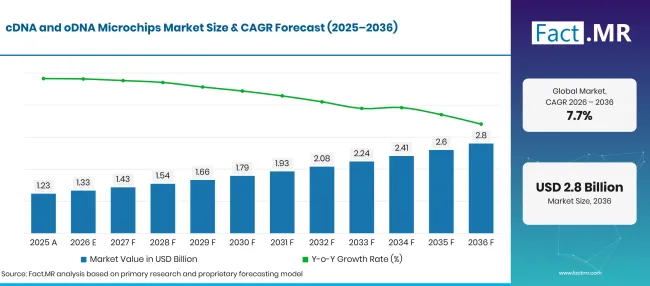
Factmr Cdna And Odna Microchips Market Forecast Global | Source: Fact.MR
| Year | Basis | Market Value (USD billion) |
|---|---|---|
| 2025 | Historical estimate | 1.23 |
| 2026 | Estimate | 1.33 |
| 2036 | Forecast | 2.8 |
| CAGR 2026 to 2036 | Forecast period | 7.7% |
Source: Fact.MR analysis. Updated Oct 19, 2026
What are the defining numbers behind cDNA and oDNA Microchips Market growth?
Fact.MR record USD 1.5 billion absolute opportunity by 2036, with cDNA Microchips and Gene Expression as major purchasing categories.
- Demand Drivers in the Market
- Research teams use cDNA microchips to compare known gene transcripts across matched samples. A 2025 study published in Scientific Reports compared microarray and RNA sequencing results in a concentration-response experiment [7].
- Genotyping researchers select oligonucleotide arrays when thousands of known genetic positions must be examined in a repeatable workflow. Buying decisions reflect sample throughput and whether the platform supports the required variant coverage.
- Pharmaceutical research teams use expression profiling to examine how cells respond to candidate compounds. Repeated experiments favor platforms with stable probe designs and dependable software for reviewing changes between treatment groups.
- Key Segments Analyzed
- By Product Type: cDNA Microchips hold 54.7% share in 2026 because they support expression comparisons across prepared biological samples.
- By Application: Gene Expression represents 42.5% share in 2026 as researchers compare transcription patterns across study groups.
- By End-User: Research Laboratories account for 42.3% share in 2026 owing to their repeated use of microarrays in experimental programmes.
- Analyst Opinion at Fact.MR
- Shambhu Nath Jha, Principal Consultant at Fact.MR, states, “Laboratories choose microarrays for specific research questions rather than for every genetic study. A defined panel can support repeated gene-expression tests, while projects exploring unfamiliar sequences may call for another method.”
- Strategic Implications
- Microchip suppliers should document each probe set and the sample types it supports. The National Human Genome Research Institute explains that microarrays use known DNA fragments attached to a solid surface to detect complementary sequences in prepared samples [8].
- Research laboratories should compare total workflow cost, including extraction and data review, before choosing a platform.
- Distributors should maintain suitable storage conditions and accurate consumable records so laboratories receive compatible array materials.
- Software providers should make quality checks and result comparison straightforward for teams running repeated expression studies. Related gene expression workflows also rely on reproducible data handling.
Germany is forecast to grow at an 8.5% CAGR through 2036, supported by its strong laboratory research base and use of specialized assays. Brazil is expected to expand at 7.8%, followed by the United States at 7.0%. The United Kingdom stands at 6.3%, while Japan records 5.6% amid differing laboratory spending and workflow needs.
How does the cDNA and oDNA Microchips Market break down by segment?
cDNA Microchips account for 54.7%; Gene Expression leads with 42.5% share in 2026.
Which Product Type holds the larger share?
cDNA Microchips hold 54.7% share in 2026.
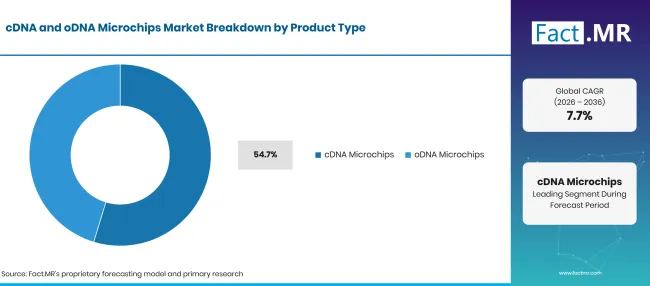
Factmr Cdna And Odna Microchips Market Breakdown Product Type | Source: Fact.MR
| Product Type | Share (2026) |
|---|---|
| cDNA Microchips (Leading segment) | 54.7% |
| Other segments combined | 45.3% |
| Total | 100.0% |
Source: Fact.MR analysis. Updated Oct 19, 2026
cDNA microchips use complementary DNA probes to compare gene activity across biological samples. Researchers select each probe set according to the transcripts they need to examine, while repeated studies also require consistent sample handling and reliable checks on signal quality. Related DNA and RNA sample preparation workflows influence chip selection because suitable sample quality is required before hybridization.
What leads the Application segment?
Gene Expression accounts for 42.5% share in 2026.
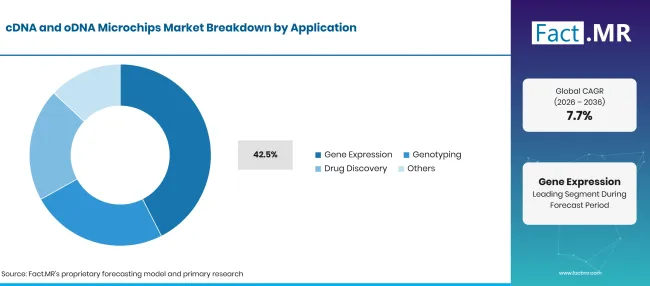
Factmr Cdna And Odna Microchips Market Breakdown Application | Source: Fact.MR
| Application | Share (2026) |
|---|---|
| Gene Expression (Leading segment) | 42.5% |
| Other segments combined | 57.5% |
| Total | 100.0% |
Source: Fact.MR analysis. Updated Oct 19, 2026
Gene expression analysis is forecast to account for 42.5% of applications in 2026. These arrays help researchers compare known transcripts across samples collected under different study conditions. A fixed probe design makes the test useful when teams plan repeated measurements and need comparable output files. Genotyping arrays are used to inspect selected DNA variants, while drug discovery studies can apply expression profiles to assess cellular responses.
How does End-User purchasing shape sales?
Research Laboratories represent 42.3% share in 2026.
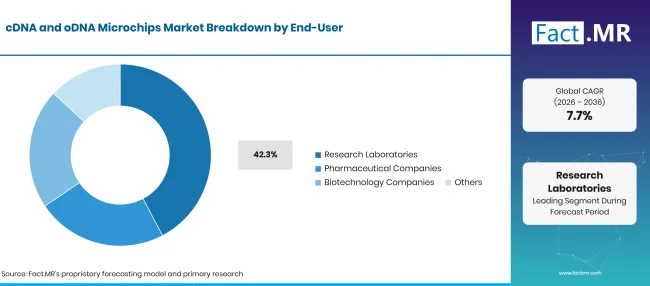
Factmr Cdna And Odna Microchips Market Breakdown End User | Source: Fact.MR
| End-User | Share (2026) |
|---|---|
| Research Laboratories (Leading segment) | 42.3% |
| Other segments combined | 57.7% |
| Total | 100.0% |
Source: Fact.MR analysis. Updated Oct 19, 2026
Research laboratories are forecast to represent 42.3% share in 2026. Academic teams use expression arrays when known probes provide the information needed for a particular experiment. Pharmaceutical Companies select assays for defined research stages, including studies of cellular responses to candidate compounds.
What is accelerating cDNA and oDNA Microchips Market adoption, and what is holding it back?
Repeatable gene expression studies support array purchases, while competing methods and validation costs limit some installations.
Drivers Impact Analysis
| DRIVER | (~) % IMPACT ON CAGR | GEOGRAPHIC RELEVANCE | IMPACT TIMELINE |
|---|---|---|---|
| Repeat expression studies | +1.0% | Global | Medium term (2–4 years) |
| Existing assay protocols | +0.8% | United States, Europe | Short term (<= 2 years) |
| Genotyping project needs | +0.7% | Global | Medium term (2–4 years) |
| Laboratory workflow fit | +0.5% | Global | Medium term (2–4 years) |
| Array data comparability | +0.4% | Japan, Europe | Long term (>= 4 years) |
Source: Fact.MR analysis. Updated Oct 19, 2026
Opportunity Impact Analysis
| OPPORTUNITY | (~) % IMPACT ON CAGR | GEOGRAPHIC RELEVANCE | IMPACT TIMELINE |
|---|---|---|---|
| High-throughput sample runs | +0.8% | Global | Medium term (2–4 years) |
| Focused biomarker studies | +0.6% | North America, Europe | Medium term (2–4 years) |
| Assay support services | +0.5% | Global | Short term (<= 2 years) |
| Reference data comparability | +0.4% | Global | Long term (>= 4 years) |
Source: Fact.MR analysis. Updated Oct 19, 2026
Restraints Impact Analysis
| RESTRAINT | (~) % IMPACT ON CAGR | GEOGRAPHIC RELEVANCE | IMPACT TIMELINE |
|---|---|---|---|
| Sequencing substitution | -0.8% | Global | Medium term (2–4 years) |
| Sample quality requirements | -0.6% | Global | Short term (<= 2 years) |
| Platform validation expense | -0.5% | Global | Medium term (2–4 years) |
| Limited panel flexibility | -0.4% | Global | Long term (>= 4 years) |
Source: Fact.MR analysis. Updated Oct 19, 2026
Which countries are scaling the cDNA and oDNA Microchips Market through 2036?
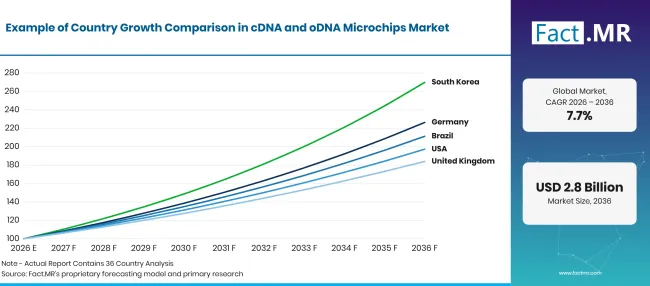
Factmr Cdna And Odna Microchips Market Growth Index | Source: Fact.MR
| Country | CAGR (2026–2036) |
|---|---|
| Germany | 8.5% |
| Brazil | 7.8% |
| United States | 7.0% |
| United Kingdom | 6.3% |
| Japan | 5.6% |
Source: Fact.MR analysis. Updated Oct 19, 2026
Why is Germany expanding cDNA and oDNA microchip research?
8.5% CAGR, associated with laboratory research and repeatable molecular assays.
Germany’s academic laboratories and life sciences teams consider reproducibility when comparing cDNA arrays with synthetic oligonucleotide chips. In March 2026, Destatis reported that German research and development expenditure reached EUR 137.1 billion for 2024 [3]. Research budgets cover many technologies, so individual laboratories still select microchips according to probe design and the experiments they plan to repeat.
How is Brazil developing cDNA and oDNA microchip use?
7.8% CAGR, shaped by project funding and access to specialist laboratory services.
Brazilian university researchers may use fixed-probe microchips when a study needs comparable gene expression measurements across selected samples. Facilities with trained laboratory staff can offer this service to research groups that use the equipment occasionally.
What supports the United States outlook?
7.0% CAGR, linked to established molecular research workflows.
United States research laboratories use defined gene expression arrays when stable probe coverage is useful across repeated experiments. In March 2026, the National Institutes of Health reported USD 35.3 billion in extramural biomedical research grants awarded during fiscal 2025 [4]. That funding covers many types of biomedical research and indicates the scale of the broader research environment.
How is the United Kingdom using expression microchips?
6.3% CAGR, tied to the life sciences research base.
United Kingdom life sciences laboratories compare molecular assay performance and analysis support before selecting a new chip design. In October 2025, the Office for Life Sciences reported 6,170 businesses across the wider UK life sciences sector during 2023–2024 [5]. Those businesses span a broad range of activities and do not all use microarrays.
Why does Japan retain a role in expression microarrays?
5.6% CAGR, supported by established laboratory practices.
Japanese laboratories tend to compare assay consistency with the level of technical support available for established genetic research methods. In January 2026, the Statistics Bureau of Japan reported that national research and development spending reached JPY 23.79 trillion in fiscal 2024 [6]. The total describes the wider research system and includes many disciplines.
Who leads the cDNA and oDNA Microchips Market?
Thermo Fisher Scientific offers Applied Biosystems GeneChip and Axiom array products for research applications, while Agilent Technologies supplies gene expression microarrays.
Illumina participates in genomic analysis through array-based genotyping products. The companies serve different laboratory needs, with assay coverage and compatible processing equipment shaping platform selection. Competition for cDNA and oDNA microchips is expected to depend on validated probe content and continued support for repeat studies. [1][2]
Which companies are the key providers?
Key companies include Thermo Fisher Scientific (including Affymetrix and GeneChip heritage); Agilent Technologies; Illumina Inc.; Arrayit Corporation; Phalanx Biotech Group; Microarrays Inc.
- Thermo Fisher Scientific (including Affymetrix and GeneChip heritage)
- Agilent Technologies
- Illumina Inc.
- Arrayit Corporation
- Phalanx Biotech Group
- Microarrays Inc.
Bibliography
- [1] Thermo Fisher Scientific. (n.d.). Axiom™ PangenomiX Array Kit. Retrieved October 15, 2026, from
- [2] Agilent Technologies. (n.d.). Gene Expression Microarray Platform. Retrieved October 15, 2026, from
- [3] Statistisches Bundesamt (Destatis). (2026, March 27). 3.8% more expenditure on research and development in 2024.
- [4] National Institutes of Health. (2026, March 12). Fiscal Year 2025 By the Numbers: Extramural Grant Investments in Research.
- [5] Office for Life Sciences. (2025, October 2). Bioscience and health technology sector statistics 2023 to 2024. GOV.UK.
- [6] Statistics Bureau of Japan. (2026, January 28). News Bulletin No. 375: Results of the Survey of Research and Development were released.
- [7] Gao, X., Yourick, M. R., Campasino, K., Zhao, Y., Sepehr, E., Vaught, C., Sprando, R. L., & Yourick, J. J. (2025). An updated comparison of microarray and RNA-seq for concentration response transcriptomic study:
- [8] National Human Genome Research Institute. (2026, October 15). Microarray technology.
This Report Answers
- The report compares cDNA and oligonucleotide microchip designs used in targeted biological studies.
- Application analysis explains why gene expression holds the stated 2026 share.
- The country comparison covers Germany, Brazil, the United States, the United Kingdom and Japan.
- Competitive analysis distinguishes direct microarray platforms from adjacent laboratory suppliers.
- End-user analysis compares research laboratory needs with pharmaceutical and biotechnology applications.
What does the cDNA and oDNA Microchips Market cover?
The market covers chips carrying complementary DNA or designed oligonucleotide probes used to detect selected biological sequences. It includes research applications in expression profiling and genotyping. Array materials and matching assay workflows sit within the market boundary when sold for these stated purposes.
What is included in the scope?
Included sales concern cDNA and oDNA microchips used by research laboratories and commercial life sciences organizations.
The scope covers chips applied to gene expression comparisons and selected genotyping projects. Research activities that use compatible arrays for compound-response analysis are included under drug discovery. Purchases are assessed by the product form and its actual use rather than the broader equipment portfolio of the laboratory supplier.
What is excluded from the scope?
The scope excludes general-purpose sequencing services and instruments when they are not part of a microchip assay sale.
Extraction reagents sold on their own do not count as DNA microchips. Clinical diagnostic tests without the stated array format are also outside the covered product categories, even where the same manufacturer supplies both kinds of technology.
How Was the Analysis Built?
The analysis draws on 120+ sources, 35+ company portfolios, 25+ countries, and more than 20 industry interviews.
- Primary Research: Primary research includes discussions with manufacturers, service providers, technology developers, distributors, end users, and subject-matter experts. These conversations examine purchasing priorities, product adoption, operational challenges, approval requirements, competitive positioning, and the factors that influence wider market acceptance.
- Desk Research: Desk research covers government statistics, regulatory publications, company filings, trade data, technical studies, industry associations, standards, public policy, and other authoritative sources. Every source used in the analysis is documented in the bibliography.
- Market Sizing and Forecasting: Market estimates combine historical performance, demand indicators, pricing and volume trends, segment shares, company participation, country-level growth, adoption patterns, investment activity, and barriers to market expansion.
- Data Validation and Update Cycle: Findings are validated by comparing primary interviews with public data, company activity, regulatory changes, trade patterns, and industry developments. Regular updates review new product launches, capacity changes, partnerships, approvals, and shifts in commercial adoption.
Segmentation
What is the report’s scope and coverage?
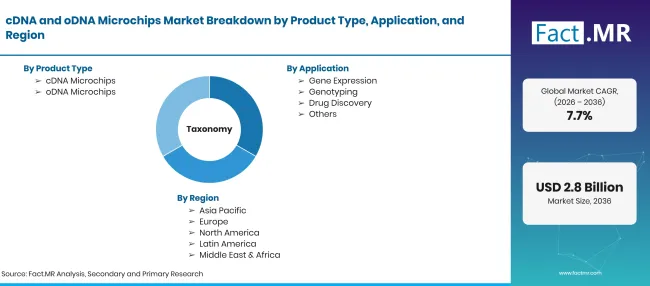
Factmr Cdna And Odna Microchips Market Taxonomy | Source: Fact.MR
| Attribute | Details |
|---|---|
| Quantitative Units | USD billion |
| Market Definition | Complementary DNA and oligonucleotide DNA microchips used in gene expression and related genotyping research. |
| Product Type | cDNA Microchips; oDNA Microchips |
| Application | Gene Expression; Genotyping; Drug Discovery; Others |
| End-User | Research Laboratories; Pharmaceutical Companies; Biotechnology Companies; Others |
| Regions Covered | North America; Latin America; Western Europe; Eastern Europe; East Asia; South Asia & Pacific; Middle East & Africa |
| Countries Covered | Germany; Brazil; United States; United Kingdom; Japan |
| Companies Profiled | Thermo Fisher Scientific (including Affymetrix and GeneChip heritage); Agilent Technologies; Illumina Inc.; Arrayit Corporation; Phalanx Biotech Group; Microarrays Inc. |
| Forecast Period | 2026 to 2036 |
| Approach | Comparison of array applications, research uses, company products and official research-sector indicators |
Source: Fact.MR analysis. Updated Oct 19, 2026
How is the market segmented?
-
By Product Type:
- cDNA Microchips
- oDNA Microchips
-
By Application:
- Gene Expression
- Genotyping
- Drug Discovery
- Others
-
By End-User:
- Research Laboratories
- Pharmaceutical Companies
- Biotechnology Companies
- Others
-
By Region:
- North America
- Latin America
- Western Europe
- Eastern Europe
- East Asia
- South Asia & Pacific
- Middle East & Africa
Frequently Asked Questions
How big is the cDNA and oDNA Microchips Market in 2026?
What is the CAGR of the cDNA and oDNA Microchips Market from 2026 to 2036?
Which product type leads the cDNA and oDNA Microchips Market?
Which application leads the cDNA and oDNA Microchips Market?
Who are the leading companies in the cDNA and oDNA Microchips Market?
Who worked on this report


Preview the report firsthand - request a free sample
Free SampleGet the brochure for pricing and purchase details
Download PDF