- Market Value (2025): USD 264.2 Mn
- Estimated Value (2026): USD 295.0 Mn
- Forecast Value (2036): USD 887.2 Mn
- CAGR (2026-2036): 11.6%
What is the Cellulose-Based Food Whiteners Market forecast to be worth by 2036?
USD 295.0 million in 2026 to USD 887.2 million by 2036, at 11.6% CAGR.
- The Cellulose-Based Food Whiteners Market was valued at USD 264.2 million in 2025.
- Demand is projected to increase from USD 295.0 million in 2026 to USD 887.2 million by 2036.
- The market is forecast to record 11.6% CAGR from 2026 to 2036. Food formulators are expected to qualify opacity systems across bakery and confectionery as well as dairy alternatives and powdered products.
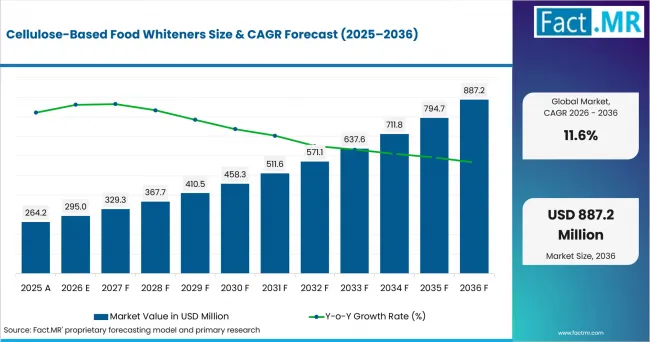
Cellulose Based Food Whiteners Value Analysis | Source: Fact.MR
What are the defining numbers behind Cellulose-Based Food Whiteners Market growth?
USD 592.2 million absolute opportunity by 2036; engineered cellulose light scatterers and TiO2 replacement positioning lead the opportunity alongside bakery icing applications.
- Demand Drivers in the Market
- Bakery formulators need white systems that remain visually consistent after mixing and baking. Drying performance gives heat-stable cellulose particles a clear formulation role.
- Confectionery coating teams need opacity at workable dosage levels because whitening agents affect shell build, surface finish and the number of coating passes needed.
- Beverage powder developers need dispersible whitening systems that maintain a uniform appearance after reconstitution. Particle behavior is therefore assessed together with brightness.
- Nutraceutical coating developers need mineral-free or lower-mineral options where label strategy and tablet appearance are evaluated together during product development.
- Key Segments Analyzed
- By Whitening Platform: Engineered cellulose light scatterer is expected to account for 49.0% share in 2026. Structural light scattering provides opacity through controlled cellulose architecture.
- By Application: Bakery icing is projected to represent 36.0% share in 2026 because white bases are used to create contrast and a consistent surface for colored decorations.
- By Performance: Opacity / brightness is anticipated to hold 43.0% share in 2026, reflecting the need to match the visual function that conventional white pigments provide.
- By Product Position: TiO2 replacement is estimated to capture 49.0% share in 2026 owing to reformulation work where manufacturers compare visual performance, dosage and process stability.
- Analyst Opinion at Fact.MR
- Shambhu Nath Jha, Principal Consultant at Fact.MR, states, “Cellulose-based food whiteners are moving from simple color replacement toward application-specific opacity systems. Formulators are evaluating brightness alongside dosage, heat and pH stability, sensory neutrality and texture because a substitute must perform inside the finished food matrix. Engineered cellulose platforms are positioned well where suppliers can combine reliable light scattering with practical application support across bakery, confectionery, beverages and ingestible coatings.”
- Strategic Implications
- Ingredient developers should publish application-specific dosage and stability data so formulation teams can compare cellulose systems against established whitening benchmarks.
- Food brands should test whiteners in the actual finished matrix because pH, water activity and processing temperature can change the visual result.
- Distributors should separate direct cellulose technologies from starch and mineral alternatives so customers understand ingredient composition before qualification work begins.
- Quality teams should build color measurement, sensory checks and shelf-life observation into substitution trials before a whitening system is approved for commercial scale.
The Netherlands is forecast to record 12.3% CAGR through 2036. Its cocoa and food-export base supports specialty ingredient qualification. The UK is projected to post 11.7% as manufacturers work across bakery, confectionery and prepared-food categories. The USA is anticipated to reach 11.0% amid a large food-manufacturing base and active color-additive reformulation. Germany is estimated at 10.7%, while France is forecast at 8.6% as food processors balance reformulation with cost and performance requirements.
How does the Cellulose-Based Food Whiteners Market break down by segment?
Engineered cellulose light scatterer leads Whitening Platform at 49.0%; TiO2 replacement leads Product Position at 49.0%.
Which Whitening Platform dominates?
Engineered cellulose light scatterer is expected to hold 49.0% share in 2026.
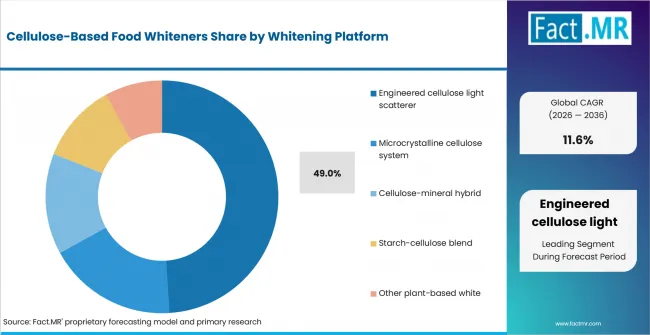
Cellulose Based Food Whiteners Analysis By Whitening Platform | Source: Fact.MR
Engineered cellulose light scatterers are expected to lead because controlled cellulose structures can create a white appearance by scattering visible light. Microcrystalline cellulose systems offer a familiar food-ingredient route where texture and opacity functions overlap. Cellulose-mineral hybrids address formulas that accept a mixed composition, while starch-cellulose blends provide another route to build whiteness. Other plant-based white systems remain relevant where application rules differ. Seprify describes its food-grade white pigment as a cellulose-based material designed for high opacity and neutral sensory performance.
What leads the Application segment?
Bakery icing is projected to account for 36.0% share in 2026.
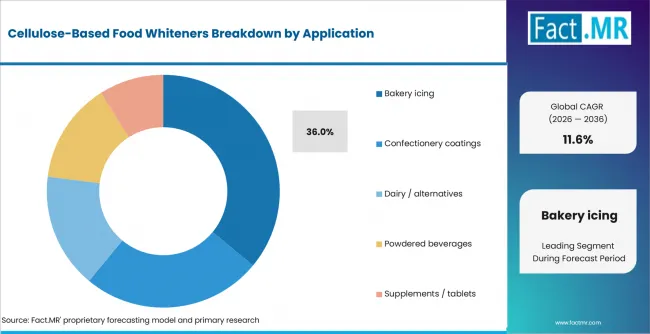
Cellulose Based Food Whiteners Analysis By Application | Source: Fact.MR
Bakery icing is projected to lead because a bright white base supports both standalone white decoration and subsequent color application. Confectionery coatings require similar opacity but place extra weight on drying and surface smoothness. Dairy and alternatives introduce pH and dispersion requirements. Powdered beverages need rapid reconstitution with a uniform appearance. Supplements and tablets require even coating coverage. Seprify reported on July 25 2025 that its cellulose white pigment is designed for baked goods and confections. The same platform is positioned for sauces and coffee creamers.
How does Performance shape demand?
Opacity / brightness is anticipated to represent 43.0% share in 2026.
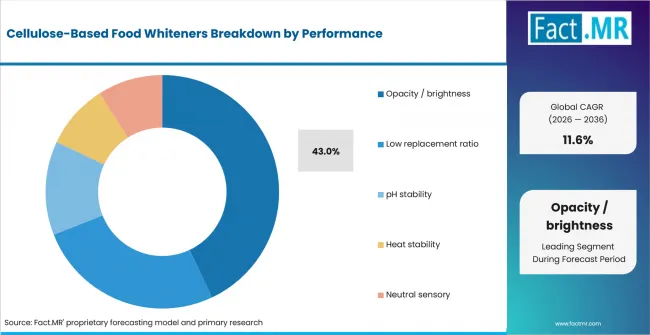
Cellulose Based Food Whiteners Analysis By Performance | Source: Fact.MR
Opacity and brightness are anticipated to lead because a replacement must first perform the visible function for which a white pigment is selected. Low replacement ratio matters to formulators because high dosage can alter solids loading and texture. pH stability is relevant in acidic beverages and dairy-style systems. Heat stability supports bakery and processed applications, while neutral sensory behavior limits unwanted flavor or odor changes.
What supports TiO2 replacement within Product Position?
TiO2 replacement is estimated to hold 49.0% share in 2026.
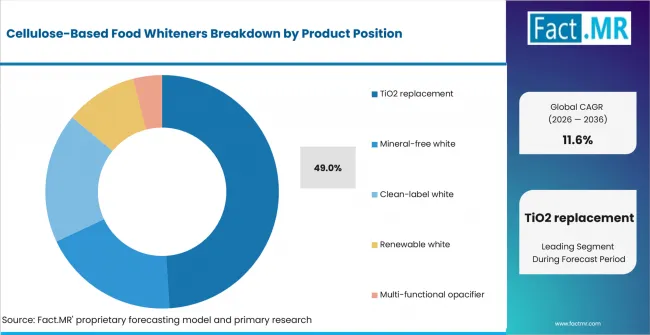
Cellulose Based Food Whiteners Analysis By Product Position | Source: Fact.MR
TiO2 replacement is estimated to lead because formulators already understand the target appearance and can benchmark substitutes against an established white standard. Mineral-free white positioning serves brands seeking a plant-based ingredient story. Clean-label white and renewable white propositions add label and sourcing considerations. Multi-functional opacifiers compete when one ingredient can also affect texture or process behavior.
What is accelerating Cellulose-Based Food Whiteners Market adoption, and what is holding it back?
Demand is expected to rise through TiO2-replacement reformulation, opacity requirements and plant-based positioning. Growth may be limited by dosage effects, application-specific stability requirements and competition from mineral and starch-based whitening alternatives.
Drivers Impact Analysis
| DRIVER | (~) % IMPACT ON CAGR | GEOGRAPHIC RELEVANCE | IMPACT TIMELINE |
|---|---|---|---|
| Food reformulation toward alternative white systems | +1.8% | North America, Europe | Short term (<= 2 years) |
| Opacity requirements in bakery and confectionery | +1.4% | Global | Short term (<= 2 years) |
| Plant-based and mineral-free positioning | +1.0% | Europe, North America | Medium term (2-4 years) |
| Application expansion into beverages and tablets | +0.8% | Global | Medium term (2-4 years) |
Opportunity Impact Analysis
| OPPORTUNITY | (~) % IMPACT ON CAGR | GEOGRAPHIC RELEVANCE | IMPACT TIMELINE |
|---|---|---|---|
| Lower-dose cellulose systems with stronger light scattering | +1.2% | Global | Medium term (2-4 years) |
| Turnkey blends for difficult pH and heat conditions | +0.9% | Europe, North America | Medium term (2-4 years) |
| Nutraceutical tablet-coating partnerships | +0.7% | Europe, North America | Short term (<= 2 years) |
Restraints Impact Analysis
| RESTRAINT | (~) % IMPACT ON CAGR | GEOGRAPHIC RELEVANCE | IMPACT TIMELINE |
|---|---|---|---|
| Higher dosage or texture effects in substitute systems | -0.7% | Global | Short term (<= 2 years) |
| Application-specific stability requirements | -0.5% | Global | Medium term (2-4 years) |
| Competition from mineral and starch alternatives | -0.4% | North America, Europe | Long term (>= 4 years) |
Which countries are scaling the Cellulose-Based Food Whiteners Market through 2036?
- The displayed country comparison spans 3.7 percentage points across the 2026 to 2036 forecast period.
- The Netherlands remains 0.6 percentage point above the UK as cocoa and food-export activity supports specialty ingredient qualification.
- The UK remains 0.7 percentage point above the USA as bakery and confectionery manufacturers continue reformulation work.
- The USA remains 0.3 percentage point above Germany as large-scale food manufacturing supports a broad application base.
- Germany remains 2.1 percentage points above France as confectionery production and processed-food activity support formulation demand.
- France closes the displayed range as agri-food manufacturers balance appearance requirements with application performance.
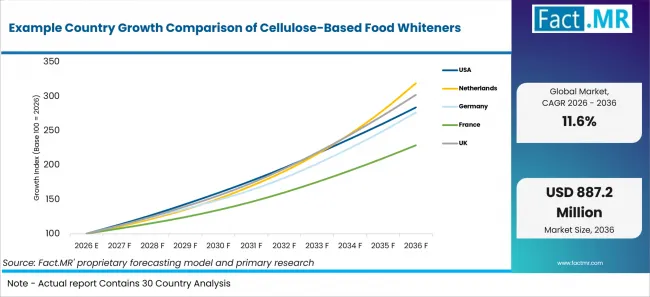
Example Country Growth Comparison Of Cellulose Based Food Whiteners | Source: Fact.MR
Comparable CAGRs create different entry conditions because food-manufacturing scale, application mix and ingredient rules vary by country. Full report coverage includes North America and Latin America. It also includes Western Europe and Eastern Europe. East Asia, South Asia & Pacific and Middle East & Africa complete the coverage.
| Country | CAGR (2026-2036) |
|---|---|
| Netherlands | 12.3% |
| UK | 11.7% |
| USA | 11.0% |
| Germany | 10.7% |
| France | 8.6% |
What is powering the Netherlands outlook?
12.3% CAGR through 2036, supported by cocoa processing and export-oriented food activity.
The Netherlands combines a major cocoa trade base with food manufacturers serving several European markets. Statistics Netherlands reported on April 3, 2026 that Dutch cocoa-product exports reached EUR 12.4 billion in 2025. That scale supports ingredient trials in confectionery and coating applications where white contrast is commercially visible. The Netherlands is forecast to record 12.3% CAGR through 2036 as cellulose suppliers target application support around these manufacturing networks.
How is the UK scaling market demand?
11.7% CAGR through 2036, led by food manufacturing and bakery-confectionery reformulation.
UK food manufacturers give whitening suppliers a broad application base across bakery and confectionery. The Office for National Statistics reported on July 24, 2026 that the manufacture of food represented 22.9% of total UK manufacturers’ sales in 2025. Formulators are expected to value application data that links opacity with texture and process stability. The UK is projected to record 11.7% CAGR through 2036 as cellulose systems move through product-specific qualification.
What supports USA adoption?
11.0% CAGR through 2036, backed by large-scale food manufacturing and white-color reformulation.
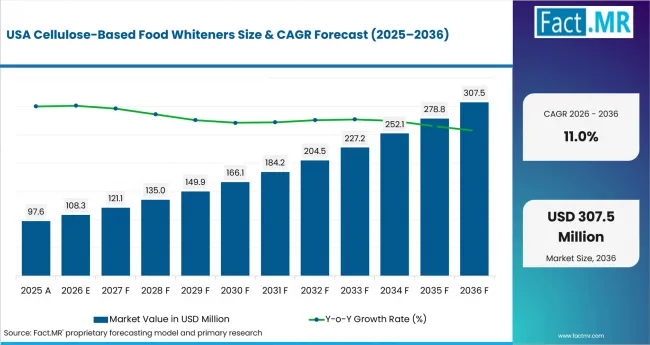
Cellulose Based Food Whiteners Country Value Analysis | Source: Fact.MR
The USA offers a broad food-manufacturing base for bakery, confectionery and powdered-product applications. The U.S. Census Bureau reported on September 3, 2026 that Food Manufacturing (NAICS 311) generated an estimated USD 1,054.3 billion in value of shipments in 2024. That industrial scale creates many finished-product matrices where whiteness and opacity are measured during reformulation. The USA is anticipated to record 11.0% CAGR through 2036 as cellulose platforms compete for qualified TiO2-replacement projects.
What underpins Germany growth?
10.7% CAGR through 2036, driven by confectionery production and processed-food formulation activity.
Germany provides a sizeable confectionery base where coating appearance and opacity remain measurable formulation criteria. Destatis reported on December 2, 2025 that Germany produced nearly 1.07 million tonnes of cocoa-containing chocolate products in 2024. Cellulose whiteners are expected to gain attention where suppliers can document dosage and heat stability in finished products. Germany is estimated to record 10.7% CAGR through 2036 as qualification focuses on repeatable application performance.
How does France perform?
8.6% CAGR through 2036, shaped by a broad agri-food manufacturing base and selective reformulation.
France combines bakery and dairy activity with a broad processed-food manufacturing base. Agreste reported on December 17, 2025 that French agri-food industries marketed EUR 162 billion of food and beverage products in 2024. Formulators are expected to compare cellulose options on opacity and sensory neutrality before changing established recipes. France is forecast to record 8.6% CAGR through 2036 as adoption concentrates on applications where the formulation trade-off is clear.
Who leads the Cellulose-Based Food Whiteners Market?
Seprify and Oterra provide direct cellulose-based white commercialization. JRS extends tablet-coating reach while IFF, Roquette and Accent Microcell represent adjacent whitening alternatives.
Seprify provides direct cellulose-based whitening technology through its SilvaAlba™ white-pigment platform. Oterra contributes established food-color application expertise and commercial reach through its partnership with Seprify to market cellulose-based white color for food and beverage applications.
Competitive differentiation across these technologies includes opacity, required dosage, processing stability and performance in the intended finished-product application.
Which companies are the key providers?
Key companies include Seprify; Oterra; JRS; IFF; Roquette; and Accent Microcell.
- Seprify
- Oterra
- JRS
- IFF
- Roquette
- Accent Microcell
Bibliography
- Statistics Netherlands. (2026, April 3). The Netherlands is the world’s leading exporter of cocoa products.
- Office for National Statistics. (2026, July 24). UK manufacturers’ sales by product: 2025.
- U.S. Census Bureau. (2026, September 3). Census Bureau releases new Annual Integrated Economic Survey data.
- Statistisches Bundesamt (Destatis). (2025, December 2). 12,8 Kilo Schokolade pro Kopf wurden 2024 produziert [12.8 kilos of chocolate per capita were produced in 2024].
- Renaud, A. (2025, December 17). Productions commercialisées des industries agroalimentaires 2024 : léger recul des ventes mais un niveau toujours élevé. Agreste.
- U.S. Food and Drug Administration. (2025, May 9). FDA approves three food colors from natural sources.
- Seprify. (2025, November 11). Oterra signs partnership with Seprify to bring natural white color to food and beverage industry.
- Seprify. (2025, July 25). How Seprify’s Ingredient Platform Supports Food, Cosmetics, and Coatings Industries.
- Seprify. (2026, March 31). BIOGRUND partners with Seprify to bring clean-label nutraceutical tablet coatings to market.
- Innophos. (2025, July 2). Innophos launches clean-label whitening alternative to titanium dioxide.
This Report Addresses
- The report explains cellulose-based food whitening across Whitening Platform and Application, with Performance and Product Position included as separate decision dimensions.
- Country analysis covers the Netherlands and UK alongside the USA. Germany and France complete the country set with market-specific evidence.
- Competitive analysis profiles Seprify and Oterra for direct cellulose commercialization. JRS supports adjacent coating applications while IFF, Roquette and Accent Microcell provide alternative whitening routes.
- Technical assessment considers structural light scattering and microcrystalline cellulose systems as distinct formulation routes. Hybrids and starch-cellulose blends form separate options.
- Application assessment covers bakery icing and confectionery coatings. Dairy / alternatives and powdered beverages are included alongside supplements / tablets.
- The evidence base uses government statistics and regulator releases. First-party company announcements support portfolio checks for each named company.
What does the Cellulose-Based Food Whiteners Market cover?
Cellulose-based whitening and opacifying ingredients used in food, beverage and ingestible coating formulations.
The market covers food-grade cellulose systems designed to create a white appearance by scattering light or by working within a blended whitening formulation. It includes engineered cellulose particles and microcrystalline cellulose systems. Cellulose-mineral hybrids and starch-cellulose blends are included where cellulose forms a material part of the whitening approach.
The boundary is narrower than the full food-color category because the definition centers on white and opacity systems. The broader TiO2-alternative category also includes mineral and starch solutions outside the cellulose-based boundary.
What is included in the scope?
Cellulose-based systems used to deliver whiteness, opacity or brightness in specified food and ingestible applications.
Coverage includes engineered cellulose light scatterers and microcrystalline cellulose systems used in bakery icing and confectionery coatings. Dairy alternatives and powdered beverages are included alongside supplement coatings. It also includes cellulose-mineral hybrids and starch-cellulose blends when cellulose contributes to the whitening function. Related context includes food additive systems.
What is excluded from the scope?
Pure mineral whiteners, starch-only opacifiers and industrial cellulose pigments outside food or ingestible applications are excluded.
Calcium carbonate and calcium phosphate remain separate standalone whitening routes. Titanium dioxide and starch-only white systems are separate categories as well. Cellulose used solely for binding, thickening or fiber enrichment is outside the defined whitening function. Industrial paints, cosmetics and non-ingestible coatings remain separate categories.
How Was the Analysis Built?
The analysis draws on 120+ sources, 35+ company portfolios, 25+ countries, and more than 20 industry interviews.
- Primary Research: Primary research includes discussions with manufacturers, service providers, technology developers, distributors, end users, and subject-matter experts. These conversations examine purchasing priorities, product adoption, operational challenges, approval requirements, competitive positioning, and the factors that influence wider market acceptance.
- Desk Research: Desk research covers government statistics, regulatory publications, company filings, trade data, technical studies, industry associations, standards, public policy, and other authoritative sources. Every source used in the analysis is documented in the bibliography.
- Market Sizing and Forecasting: Market estimates combine historical performance, demand indicators, pricing and volume trends, segment shares, company participation, country-level growth, adoption patterns, investment activity, and barriers to market expansion.
- Data Validation and Update Cycle: Findings are validated by comparing primary interviews with public data, company activity, regulatory changes, trade patterns, and industry developments. Regular updates review new product launches, capacity changes, partnerships, approvals, and shifts in commercial adoption.
What is the report’s scope and coverage?
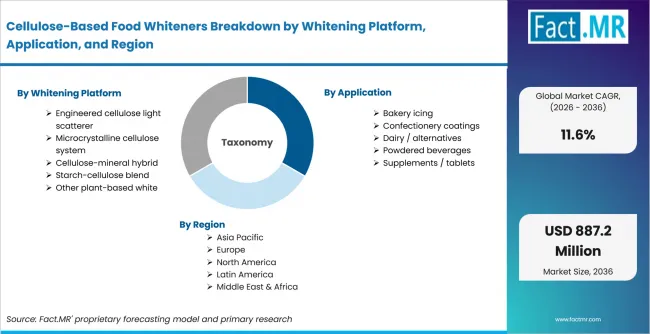
Cellulose Based Food Whiteners Breakdown By Whitening Platform, Application, And Region | Source: Fact.MR
| Attribute | Details |
|---|---|
| Quantitative Units | USD million |
| Market Definition | Food-grade cellulose-based materials used to create or increase whiteness, opacity or brightness in food, beverage and ingestible coating applications, including systems positioned as TiO2 alternatives. |
| Whitening Platform | Engineered cellulose light scatterer; Microcrystalline cellulose system; Cellulose-mineral hybrid; Starch-cellulose blend; Other plant-based white |
| Application | Bakery icing; Confectionery coatings; Dairy / alternatives; Powdered beverages; Supplements / tablets |
| Performance | Opacity / brightness; Low replacement ratio; pH stability; Heat stability; Neutral sensory |
| Product Position | TiO2 replacement; Mineral-free white; Clean-label white; Renewable white; Multi-functional opacifier |
| Regions Covered | North America; Latin America; Western Europe; Eastern Europe; East Asia; South Asia & Pacific; Middle East & Africa |
| Countries Covered | USA; Netherlands; Germany; France; UK |
| Key Companies Profiled | Seprify; Oterra; JRS; IFF; Roquette; Accent Microcell |
| Forecast Period | 2026 to 2036 |
| Approach | Application-led assessment using food-manufacturing indicators, regulatory developments, supplier portfolios, formulation requirements and country-level activity. |
How is the market segmented?
-
By Whitening Platform
- Engineered cellulose light scatterer
- Microcrystalline cellulose system
- Cellulose-mineral hybrid
- Starch-cellulose blend
- Other plant-based white
-
By Application
- Bakery icing
- Confectionery coatings
- Dairy / alternatives
- Powdered beverages
- Supplements / tablets
-
By Performance
- Opacity / brightness
- Low replacement ratio
- pH stability
- Heat stability
- Neutral sensory
-
By Product Position
- TiO2 replacement
- Mineral-free white
- Clean-label white
- Renewable white
- Multi-functional opacifier
-
By Region
- North America
- Latin America
- Western Europe
- Eastern Europe
- East Asia
- South Asia & Pacific
- Middle East & Africa