- Market Value (2025): USD 485.2 Mn
- Estimated Value (2026): USD 510.9 Mn
- Forecast Value (2036): USD 855.3 Mn
- CAGR (2026-2036): 5.3%
What is the Cetyl Hydroxyethylcellulose Market forecast to be worth by 2036?
USD 510.9 million in 2026 to USD 855.3 million by 2036 at a 5.3% CAGR.
- As per Fact.MR analysis, the cetyl hydroxyethylcellulose market was valued at USD 485.2 million in 2025.
- Demand will grow from USD 510.9 million in 2026 to USD 855.3 million by 2036.
- The forecast records a 5.3% CAGR from 2026 to 2036 as demand for multifunctional formulation ingredients increases across personal care and other applications.
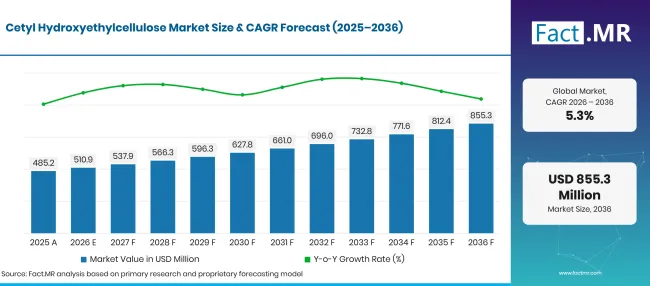
Cetyl Hydroxyethylcellulose Market Forecast Global | Source: Fact.MR
| Year | Basis | Market Value (USD million) |
|---|---|---|
| 2025 | Actual | 485.2 |
| 2026 | Estimate | 510.9 |
| 2036 | Forecast | 855.3 |
| CAGR 2026 to 2036 | Forecast period | 5.3% |
Source: Fact.MR analysis. Updated Nov 4, 2026
What are the defining numbers behind Cetyl Hydroxyethylcellulose Market growth?
USD 344.4 million absolute opportunity between 2026 and 2036.
- Demand Drivers in the Market
- Expanding cosmetics and personal care industry supports demand for functional ingredients that improve formulation performance. Cosmetics Europe reported that European cosmetics and personal care retail sales reached €104 billion in 2024, with skincare accounting for €30.1 billion and toiletries contributing €24.7 billion [9].
- Rising demand for multifunctional haircare ingredients drives the adoption of specialty cellulose polymers. European haircare retail sales reached €18.1 billion in 2024. Cetyl hydroxyethylcellulose supports viscosity control and stability in shampoos and conditioners while offering compatibility with different surfactant systems [10].[10]
- Product development across the global beauty industry provides a potential application base for specialty formulation ingredients. L'Oréal estimated that the global beauty market exceeded €290 billion in 2024, recording 4.5% growth during the year [11].
- Key Segments Analyzed
- By Product Type: Cosmetic Grade will account for 48.2% of the market in 2026, driven by its application in personal care and cosmetic formulations.
- By Application: Personal Care and Cosmetics leads with a 42.3% share in 2026, reflecting the use of functional polymers in creams, lotions and other topical formulations.
- By End-User: Cosmetics and Personal Care Industry will capture 42.3% of the market in 2026, supported by demand for formulation ingredients that improve product texture and stability.
- Analyst Opinion at Fact.MR
- Shambhu Nath Jha, Principal Consultant at Fact.MR, states, “Demand for cetyl hydroxyethylcellulose will be shaped by the need for reliable rheology control and formulation stability across personal care products. Suppliers that demonstrate consistent thickening performance and compatibility with different formulation systems can strengthen their position among cosmetic and pharmaceutical manufacturers.”
- Strategic Implications
- Manufacturers should focus on improving polymer consistency and thickening performance across different cosmetic formulations.
- Cosmetic ingredient suppliers need to provide formulation guidance covering compatibility, processing conditions and stability.
- Distributors must strengthen relationships with personal care manufacturers to support product sampling and technical evaluation.
- Pharmaceutical and industrial suppliers need to demonstrate grade-specific performance to address application requirements beyond cosmetics.
- Ingredient developers can explore formulations that provide improved sensory characteristics and stability without compromising product quality.
Germany is set to record 6.7% CAGR through 2036. Brazil is set to post 6.1%, followed by the USA at 5.5%. The UK is estimated to advance at 4.9%, while Japan is forecast at 4.4%.
How does the Cetyl Hydroxyethylcellulose Market break down by segment?
Fact.MR finds that Cosmetic Grade leads Product Type at 48.2%; Personal Care and Cosmetics leads Application at 42.3%; Cosmetics and Personal Care Industry leads End-User at 42.3%.
Which Product Type dominates?
Cosmetic Grade is set to hold 48.2% share in 2026.
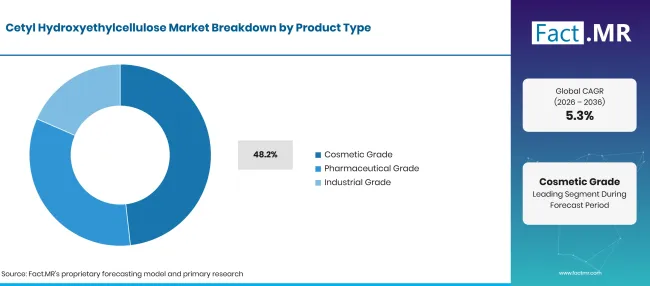
Cetyl Hydroxyethylcellulose Market Breakdown Product Type | Source: Fact.MR
| Product Type | Share (2026) |
|---|---|
| Cosmetic Grade (Leading segment) | 48.2% |
| Other segments combined | 51.8%* |
| Total | 100.0% |
Source: Fact.MR analysis. Updated Nov 4, 2026
Cosmetic Grade accounts for the largest individual product-type share because cetyl hydroxyethylcellulose is primarily used as a functional polymer in personal care and cosmetic formulations. Its thickening and emulsion-stabilizing properties support the development of creams, lotions, shampoos and conditioners. Pharmaceutical and industrial grades address additional requirements where formulation consistency and viscosity control are important. Buyers evaluate grade selection according to purity specifications, processing compatibility and intended product performance.
What leads the Application segment?
Personal Care and Cosmetics is set to represent 42.3% share in 2026.
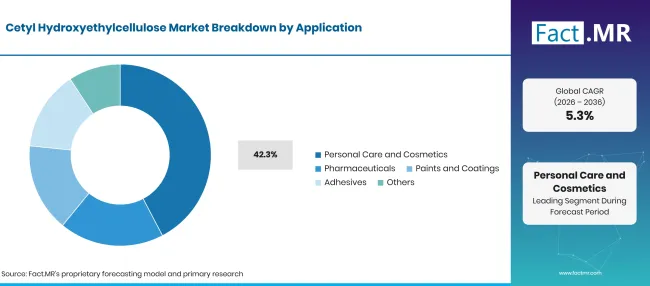
Cetyl Hydroxyethylcellulose Market Breakdown Application | Source: Fact.MR
| Application | Share (2026) |
|---|---|
| Personal Care and Cosmetics (Leading segment) | 42.3% |
| Other segments combined | 57.7%* |
| Total | 100.0% |
Source: Fact.MR analysis. Updated Nov 4, 2026
Personal care and cosmetics account for the leading application share because formulators use functional polymers to improve product consistency and texture. Cetyl hydroxyethylcellulose can provide viscosity control and support emulsion stability in different topical formulations. Pharmaceutical applications require controlled formulation properties, while paints and coatings and adhesives use other functional polymer systems according to their specific processing needs.
How does End-User shape demand?
Cosmetics and Personal Care Industry is likely to account for 42.3% share in 2026.
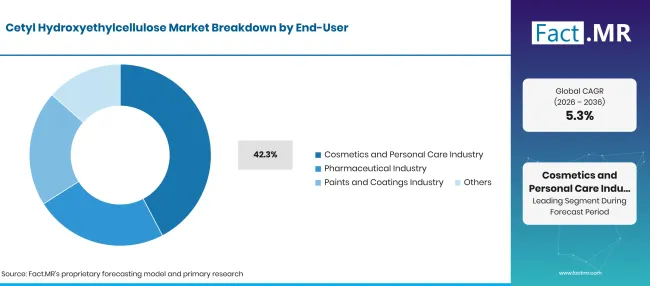
Cetyl Hydroxyethylcellulose Market Breakdown End User | Source: Fact.MR
| End-User | Share (2026) |
|---|---|
| Cosmetics and Personal Care Industry (Leading segment) | 42.3% |
| Other segments combined | 57.7%* |
| Total | 100.0% |
Source: Fact.MR analysis. Updated Nov 4, 2026
Cosmetics and personal care manufacturers represent the leading end-user category because they require ingredients that deliver consistent texture, stability and application characteristics. Product developers evaluate polymers according to their compatibility with surfactants, oils and other formulation components. Pharmaceutical manufacturers have different requirements related to ingredient quality and dosage-form performance. Paints, coatings and adhesive producers evaluate thickening and rheological properties according to application and processing conditions.
What is accelerating Cetyl Hydroxyethylcellulose Market adoption, and what is holding it back?
Demand for multifunctional cosmetic polymers supports market expansion, while formulation costs, ingredient substitution and application-specific performance requirements can constrain adoption.
Drivers Impact Analysis
| DRIVER | (~) % IMPACT ON CAGR | GEOGRAPHIC RELEVANCE | IMPACT TIMELINE |
|---|---|---|---|
| Expanding cosmetics and personal care formulations | +1.0% | Europe, North America, Asia | Medium term (2–4 years) |
| Rising demand for multifunctional haircare ingredients | +0.9% | Global | Short term (≤ 2 years) |
| Growing adoption of specialty rheology modifiers | +0.7% | Global | Medium term (2–4 years) |
| Increasing development of premium skincare and haircare products | +0.6% | Europe, Asia, Americas | Medium term (2–4 years) |
| Demand for surfactant-compatible thickening agents | +0.5% | Global | Long term (≥ 4 years) |
Source: Fact.MR analysis. Updated Nov 4, 2026
Opportunity Impact Analysis
| OPPORTUNITY | (~) % IMPACT ON CAGR | GEOGRAPHIC RELEVANCE | IMPACT TIMELINE |
|---|---|---|---|
| Expansion of APG-based and mild surfactant formulations | +0.8% | Europe, North America | Medium term (2–4 years) |
| Development of customized cosmetic-grade polymers | +0.7% | Global | Medium term (2–4 years) |
| Growing demand for multifunctional conditioning and thickening ingredients | +0.6% | Asia, Americas | Long term (≥ 4 years) |
| Expansion of premium haircare and personal care products | +0.5% | Asia, Europe | Short term (≤ 2 years) |
Source: Fact.MR analysis. Updated Nov 4, 2026
Restraints Impact Analysis
| RESTRAINT | (~) % IMPACT ON CAGR | GEOGRAPHIC RELEVANCE | IMPACT TIMELINE |
|---|---|---|---|
| Higher cost compared with conventional cellulose thickeners | -0.8% | Global | Short term (≤ 2 years) |
| Limited availability of specialized cetyl-modified grades | -0.7% | Asia, Americas | Medium term (2–4 years) |
| Competition from alternative rheology modifiers | -0.6% | Global | Medium term (2–4 years) |
| Formulation compatibility and performance validation requirements | -0.4% | Global | Short term (≤ 2 years) |
Source: Fact.MR analysis. Updated Nov 4, 2026
Which countries are scaling the Cetyl Hydroxyethylcellulose Market through 2036?
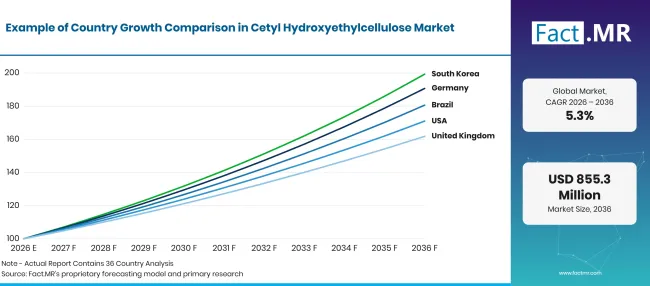
Cetyl Hydroxyethylcellulose Market Growth Index | Source: Fact.MR
| Country | CAGR (2026–2036) |
|---|---|
| Germany | 6.7% |
| Brazil | 6.1% |
| USA | 5.5% |
| UK | 4.9% |
| Japan | 4.4% |
Source: Fact.MR analysis. Updated Nov 4, 2026
What supports Germany adoption?
6.7% CAGR, supported by an established cosmetics industry and demand for specialty formulation ingredients.
Germany's cosmetics and personal care industry creates opportunities for specialty polymer suppliers serving skincare, haircare and personal hygiene manufacturers. Cosmetics Europe reported that Germany recorded approximately EUR 18.0 billion in cosmetics and personal care retail sales in 2025, making it the largest national market in Europe [1]. Manufacturers can find opportunities in functional ingredients that improve formulation stability and product texture.
How is Brazil developing cetyl hydroxyethylcellulose adoption?
6.1% CAGR, driven by a large beauty and personal care industry and expanding demand for cosmetic formulations.
Brazil's personal care industry provides a substantial customer base for specialty cosmetic ingredients. According to ABIHPEC, the Brazilian beauty and personal care sector generated approximately BRL 200 billion in revenue in 2025 and ranked third globally in consumer market size [2]. The country also recorded approximately USD 1.061 billion in beauty and personal care exports during 2025 [3].
What supports United States adoption?
5.5% CAGR, led by established personal care manufacturing and demand for multifunctional formulation ingredients.
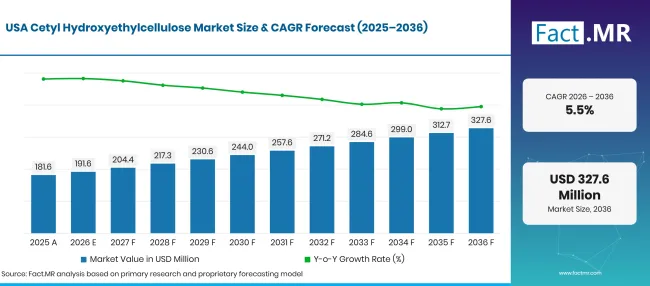
Cetyl Hydroxyethylcellulose Market Forecast Usa | Source: Fact.MR
The United States has an extensive cosmetics and personal care industry with established ingredient availability and distribution networks. The Personal Care Products Council reported that U.S. personal care product trade reached USD 37.4 billion in 2025, including USD 15.8 billion in exports [4]. Cosmetic manufacturers can use functional polymers to develop stable skincare, haircare and cleansing formulations.
How is the United Kingdom building adoption?
4.9% CAGR, driven by demand for skincare, haircare and premium personal care formulations.
The United Kingdom provides opportunities for specialty ingredient suppliers through its established beauty and personal care sector. The British Beauty Council reported that the UK beauty industry generated an economic contribution of GBP 28.3 billion in 2025 [5]. Growth in skincare and haircare product development supports demand for formulation ingredients that improve viscosity, texture and stability.
What supports Japan adoption?
4.4% CAGR, backed by established cosmetics manufacturing and demand for advanced skincare formulations.
Japan's cosmetics industry creates opportunities for functional ingredients used in skincare, haircare and personal hygiene products. The Japan Cosmetic Industry Association reported that domestic cosmetic shipments reached JPY 1.3907 trillion in 2025, increasing 1.2% from the previous year [6].
Who leads the Cetyl Hydroxyethylcellulose Market?
Fact.MR identifies Ashland Global Holdings Inc., Henan Tianfu Chemical, Spectrum Chemical Manufacturing, Shaanxi Dideu Medichem among the companies included in the competitive landscape.
Ashland has a directly relevant position through its Natrosol Plus 330 CS and PolySurf 67 CS products, which are based on cetyl-modified hydroxyethylcellulose. These materials function as associative thickeners and support viscosity control and formulation stability in personal care products [7]. Spectrum Chemical Manufacturing, Henan Tianfu Chemical and Shaanxi Dideu Medichem appear in supplier listings for cetyl hydroxyethylcellulose [8].
Which companies are the key providers?
Key companies include Ashland Global Holdings Inc.; Henan Tianfu Chemical Co., Ltd.; Spectrum Chemical Manufacturing Corp.; Shaanxi Dideu Medichem Co. Ltd.
- Ashland Global Holdings Inc.
- Henan Tianfu Chemical Co., Ltd.
- Spectrum Chemical Manufacturing Corp.
- Shaanxi Dideu Medichem Co. Ltd.
Bibliography
- [1] Cosmetics Europe. (n.d.). Our industry. https://cosmeticseurope.eu/our-industry/
- [2] Associação Brasileira da Indústria de Higiene Pessoal, Perfumaria e Cosméticos. (2026, August 16). Tamanho do mercado de beleza e cuidados pessoais no Brasil. https://abihpec.org.br/tamanho-mercado-cosmeticos-brasil-2026/
- [3] Associação Brasileira da Indústria de Higiene Pessoal, Perfumaria e Cosméticos. (2026, January 19). Setor de Beleza e Cuidados Pessoais bate recorde de exportações e ultrapassa US$ 1 bi. https://abihpec.org.br/release/setor-de-beleza-e-cuidados-pessoais-bate-recorde-de-exportacoes-e-ultrapassa-us-1-bi/
- [4] Personal Care Products Council. (n.d.). International trade. https://www.personalcarecouncil.org/issues/international-trade/
- [5] British Beauty Council. (2026, July 1). The Value of Beauty 2026. https://britishbeautycouncil.com/reports/value-of-beauty-2026/
- [6] Japan Cosmetic Industry Association. (2024, October 11). Cosmetic shipments. https://jcia.org/user/statistics/shipment
- [7] Ashland. (n.d.). Natrosol Plus and PolySurf cetyl-modified hydroxyethylcellulose. https://www.ashland.com/industries/personal-and-home-care/hair-care/natrosol-plus-and-polysurf-cetyl-modified-hydroxyethylcellulose
- [8] Spectrum Chemical. (n.d.). Cetyl hydroxyethylcellulose, CAS 80455-45-4. https://www.spectrumchemical.com/cas/80455-45-4
- [9] Cosmetics Europe. (2025). Cosmetics Europe Annual Report 2024. https://cosmeticseurope.eu/wp-content/uploads/2025/06/CE-Annual-Report-2024-2.pdf
- [10] Ashland. (n.d.). Hair care ingredients portfolio. https://www.ashland.com/file_source/Ashland/Industries/Personal%20and%20Home%20Care/Articles/PC-11502.6_Hair_Care_digital.pdf
- [11] L'Oréal. (2025). Beauty market. In Annual Report 2024. https://www.loreal-finance.com/en/annual-report-2024/beauty-market/
This Report Answers
- The report describes how cetyl hydroxyethylcellulose is used as a functional polymer across cosmetic and industrial formulations.
- Product type analysis compares cosmetic, pharmaceutical and industrial grades.
- Application analysis evaluates personal care and cosmetics, pharmaceuticals, paints and coatings and adhesives.
- End-user analysis examines demand from cosmetic manufacturers, pharmaceutical companies and industrial formulators.
- Country analysis discusses Germany, Brazil, USA, UK and Japan alongside personal care industry developments.
- The competitive overview profiles ten companies involved in the ingredient and specialty chemical competitive landscape.
What does the Cetyl Hydroxyethylcellulose Market cover?
The market covers cetyl-modified hydroxyethylcellulose used as a functional polymer in cosmetic, pharmaceutical and industrial formulations. The ingredient supports viscosity control, emulsion stabilization and film formation. It is particularly relevant to personal care formulations where manufacturers require consistent texture and product stability. Market coverage includes cosmetic, pharmaceutical and industrial grades and their use across the specified applications and end-user industries.
What is included in the scope?
The analysis includes cetyl hydroxyethylcellulose products and qualifying formulations containing this functional polymer.
It covers cosmetic grades used in skincare and haircare products, pharmaceutical grades intended for relevant formulation applications and industrial grades used in paints, coatings and adhesives. Market value is assessed at the ingredient and qualifying product level rather than the total value of finished cosmetic or pharmaceutical products.
What is excluded from the scope?
The analysis excludes conventional hydroxyethylcellulose and other cellulose ethers that do not contain the specified cetyl modification.
General-purpose thickeners such as carbomers, xanthan gum and unmodified cellulose derivatives are excluded unless they are part of a qualifying cetyl hydroxyethylcellulose product. Finished cosmetics, pharmaceutical formulations and industrial coatings are not counted as ingredient market revenue. Distribution services and formulation equipment are also excluded.
How Was the Analysis Built?
The analysis draws on 120+ sources, 35+ company portfolios, 25+ countries, and more than 20 industry interviews.
- Primary Research: Primary research includes discussions with specialty chemical manufacturers, cosmetic ingredient suppliers, pharmaceutical formulators, distributors, end users and subject-matter experts. These conversations examine purchasing priorities, formulation requirements, product adoption, technical performance, competitive positioning and factors influencing wider ingredient acceptance.
- Desk Research: Desk research covers government statistics, regulatory publications, company filings, chemical databases, ingredient catalogues, technical studies, industry associations and public product documentation. Every source used in the analysis is documented in the bibliography.
- Market Sizing and Forecasting: Market estimates combine historical performance, demand indicators, pricing and volume trends, segment shares, company participation, country-level growth, formulation adoption patterns and barriers to market expansion.
- Data Validation and Update Cycle: Findings are validated by comparing primary interviews with public data, company portfolios, product specifications, regulatory changes and industry developments. Regular updates review new product launches, manufacturing capabilities, distribution agreements and changes in commercial adoption.
Segmentation
What is the report's scope and coverage?
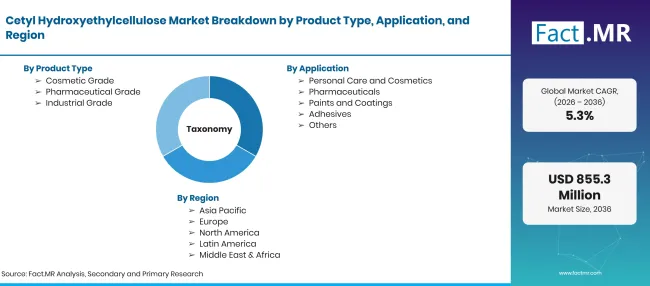
Cetyl Hydroxyethylcellulose Market Taxonomy | Source: Fact.MR
| Attribute | Details |
|---|---|
| Quantitative Units | USD million in 2026 to USD million by 2036, at CAGR |
| Market Definition | The Cetyl Hydroxyethylcellulose Market comprises hydrophobically modified cellulose polymers used in cosmetic and personal care formulations to control viscosity and improve emulsion stability and product texture. |
| Product Type | Cosmetic Grade; Pharmaceutical Grade; Industrial Grade |
| Application | Personal Care and Cosmetics; Pharmaceuticals; Paints and Coatings; Adhesives; Others |
| End-User | Cosmetics and Personal Care Industry; Pharmaceutical Industry; Paints and Coatings Industry; Others |
| Regions Covered | North America; Latin America; Western Europe; Eastern Europe; East Asia; South Asia & Pacific; Middle East & Africa |
| Countries Covered | Germany; Brazil; USA; UK; Japan |
| Companies Profiled | Ashland Global Holdings Inc.; Henan Tianfu Chemical Co., Ltd.; Spectrum Chemical Manufacturing Corp.; Shaanxi Dideu Medichem Co. Ltd. |
| Forecast Period | 2026 to 2036 |
| Approach | Market segmentation and scenario-based analysis supported by company portfolios, ingredient specifications and personal care industry statistics |
Source: Fact.MR analysis. Updated Nov 4, 2026
How is the market segmented?
-
By Product Type
- Cosmetic Grade
- Pharmaceutical Grade
- Industrial Grade
-
By Application
- Personal Care and Cosmetics
- Pharmaceuticals
- Paints and Coatings
- Adhesives
- Others
-
By End-User
- Cosmetics and Personal Care Industry
- Pharmaceutical Industry
- Paints and Coatings Industry
- Others
-
By Region
- North America
- Latin America
- Western Europe
- Eastern Europe
- East Asia
- South Asia & Pacific
- Middle East & Africa
Frequently Asked Questions
How big is the cetyl hydroxyethylcellulose market in 2026?
What is the CAGR from 2026 to 2036?
Which product type has the largest market share?
Which application leads the market?
Which end-user holds the largest share?
Which country is expected to grow fastest?
Which companies are covered in the report?
Who worked on this report


Preview the report firsthand - request a free sample
Free SampleGet the brochure for pricing and purchase details
Download PDF