- Market Value (2025): USD 417.1 Mn
- Estimated Value (2026): USD 437.3 Mn
- Forecast Value (2036): USD 701.5 Mn
- CAGR (2026-2036): 4.8%
What is the Single-stage Diaphragm Compressors Market forecast to be worth by 2036?
USD 437.3 million in 2026 to USD 701.5 million by 2036 at a 4.8% CAGR.
- The single-stage diaphragm compressors market was valued at USD 417.1 million in 2025, with gas processing and refinery sites placing the bulk of orders.
- Revenue will grow from USD 437.3 million in 2026 to USD 701.5 million by 2036 as operators replace leaking piston units on hazardous duties and add hydrogen handling capacity.
- A 4.8% CAGR for 2026 to 2036 reflects steady replacement demand in oil, gas and chemicals, with hydrogen and high-purity gas projects adding new volume.
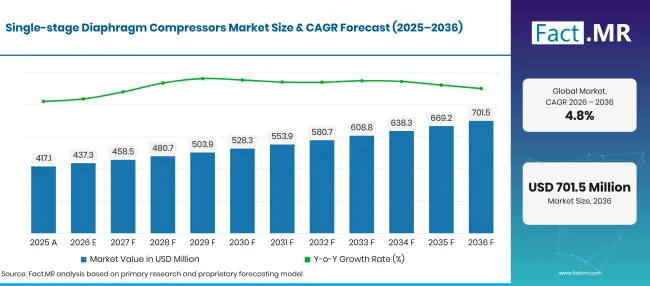
Single Stage Diaphragm Compressors Market Forecast Global | Source: Fact.MR
| Year | Basis | Market Value (USD million) |
|---|---|---|
| 2025 | Actual | 417.1 |
| 2026 | Estimate | 437.3 |
| 2036 | Forecast | 701.5 |
| CAGR 2026 to 2036 | Forecast period | 4.8% |
Source: Fact.MR analysis. Updated Nov 4, 2026
What are the defining numbers behind Single-stage Diaphragm Compressors Market growth?
The 2026 to 2036 period adds USD 264.2 million in new value, drawn mainly from gas processing, chemical plants and hydrogen supply chains.
- Demand Drivers in the Market
- Hydrogen spending is turning into equipment orders. The International Energy Agency reports that low-emission hydrogen capital spending reached USD 4.3 billion in 2024, up 80% on 2023, and recent final investment decisions point to nearly USD 8 billion in 2025 [1]. Every electrolyser and trailer filling point needs a compressor that keeps the gas clean.
- Drug and fine chemical capacity is growing in Asia. India had commissioned 38 bulk drug projects under its production-linked incentive scheme by December 2025, adding about 56,800 MT of annual capacity [2]. Plants of this kind handle hydrogen, nitrogen and solvent vapours where contamination is not acceptable.
- Chemical makers are moving into specialty products. NITI Aayog puts India at 3% to 3.5% of global chemicals consumption in 2023 and targets a 5% to 6% share of the chemicals value chain by 2030 [3]. Specialty chemistry relies on toxic and reactive gases that suit sealed diaphragm heads.
- Leak rules on hazardous gases are getting stricter. Operators handling hydrogen sulphide, chlorine or fluorine gain a zero-emission seal by isolating the gas behind a metal diaphragm. That benefit often decides the purchase even when a piston machine costs less.
- Key Segments Analyzed
- By Product Type: Oil-Free will hold 58.2% share in 2026, since gas purity is the main reason buyers choose a diaphragm design in the first place.
- By Application: Chemical Processing will account for 28.4% of 2026 value, given the steady flow of reactive and toxic gases inside chemical plants.
- By End-User: Oil and Gas will capture 56.8% of 2026 revenue, as refineries and gas processors run many small streams of hazardous gas.
- Analyst Opinion at Fact.MR
- Shambhu Nath Jha, Principal Consultant at Fact.MR, states, “Buyers of single-stage diaphragm compressors care less about nameplate flow and more about how long a diaphragm set lasts on their own gas. Suppliers that publish verified diaphragm life and leak data will win the replacement cycle in refineries and chemical plants. Hydrogen trailer filling and semiconductor gas supply will open a second stream of orders through 2036.”
- Strategic Implications
- Manufacturers should report diaphragm service life and leak detection performance for each gas they quote, since operators now compare total running cost.
- Distributors should hold diaphragm sets, valves and seals near refinery clusters, because downtime on a hazardous gas line costs far more than the parts.
- Plant operators should test candidate units on their actual gas mixture before ordering, as moisture and particles shorten diaphragm life.
- Investors should follow hydrogen trailer filling and specialty gas projects, where standard skid packages are shortening delivery times.
Brazil leads the five countries at 6.2%, with record oil and gas output and a growing drug industry both feeding demand. Japan follows at 5.0%, where state price-gap support is moving low-carbon hydrogen projects toward construction. The United Kingdom, at 4.6%, draws on a pharmaceutical sector that keeps adding output. Germany grows at 3.9%, since its hydrogen grid is still at the planning stage. The United States closes the group at 3.6%, as a large installed base means most orders replace existing machines.
How does the Single-stage Diaphragm Compressors Market break down by segment?
Oil-Free will lead Product Type at 58.2%; Chemical Processing will head Application at 28.4%; Oil and Gas will hold End-User at 50.0% in 2026.
Which Product Type leads?
Oil-Free units take 58.2% of 2026 sales.
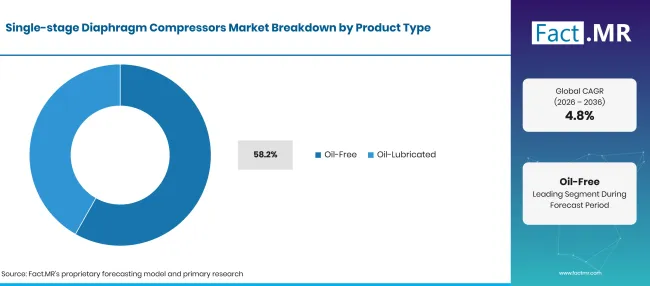
Single Stage Diaphragm Compressors Market Breakdown Product Type | Source: Fact.MR
| Product Type | Share (2026) |
|---|---|
| Oil-Free (Leading segment) | 58.2% |
| Other segments combined | 41.8%* |
| Total | 100.0% |
Source: Fact.MR analysis. Updated Nov 4, 2026
Specialty gas suppliers and electronics fabs cannot accept any oil carryover, so they specify oil-free heads with metal diaphragms and dry gas paths. Many buyers weigh these units against conventional oil-free compressors and choose the diaphragm design when the gas is toxic or costly. Oxygen service is another fixed outlet, since oil in an oxygen line creates a fire risk. Oil-lubricated designs serve duties where a small amount of lubricant in the gas causes no harm, such as some inert gas transfer and recovery tasks. They cost less to buy and to maintain. Buyers pick them for clean, non-reactive gases at moderate pressure.
What supports Chemical Processing within Application?
Chemical Processing accounts for 28.4% of 2026 revenue.
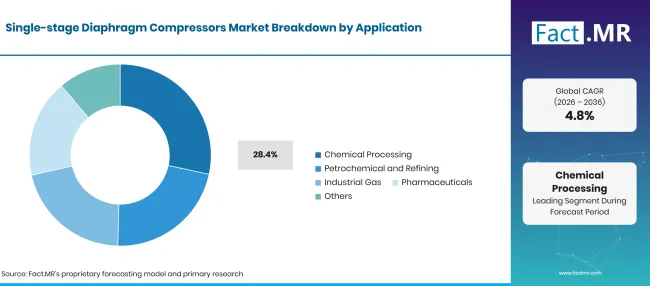
Single Stage Diaphragm Compressors Market Breakdown Application | Source: Fact.MR
| Application | Share (2026) |
|---|---|
| Chemical Processing (Leading segment) | 28.4% |
| Other segments combined | 71.6%* |
| Total | 100.0% |
Source: Fact.MR analysis. Updated Nov 4, 2026
Reactors and recovery loops in chemical plants move small volumes of chlorine, ammonia and fluorinated gases every day. A sealed diaphragm head keeps these gases inside the process and out of the work area. India alone aims to grow chemical production to USD 220 to 280 billion by 2030, according to NITI Aayog [3]. Growth of that scale means new reactors and new gas handling lines. Petrochemical and refining duties overlap with chemical work but tend to run at higher flow. Industrial gas applications cover cylinder filling and specialty gas blending, while pharmaceutical plants use the same machines for hydrogenation and inert blanketing. Other uses include research labs, nuclear sites and pilot plants.
How does End-User shape demand?
Oil and Gas represents 50.0% of 2026 value.
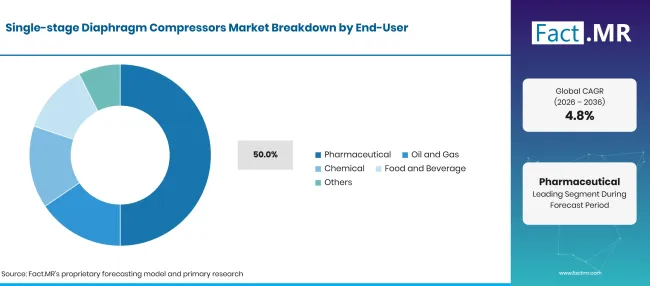
Single Stage Diaphragm Compressors Market Breakdown End User | Source: Fact.MR
| End-User | Share (2026) |
|---|---|
| Oil and Gas (Leading segment) | 50.0% |
| Other segments combined | 43.2%* |
| Total | 100.0% |
Source: Fact.MR analysis. Updated Nov 4, 2026
Refineries and gas plants run hydrotreaters, sampling systems and flare recovery loops that carry sour or flammable gas. Operators use diaphragm units where a seal leak would release hydrogen sulphide or hydrogen. The IEA notes that more than half of low-emission hydrogen investment in 2024 and 2025 targets oil refining and industrial sites that already use hydrogen [1]. Many of these sites also run larger reciprocating compressors and add diaphragm units for the purest streams. Pharmaceutical producers buy for hydrogenation and controlled gas supply. Chemical companies use the machines for toxic and corrosive gases, while food and beverage plants handle carbon dioxide and nitrogen. Other end users include electronics fabs, universities and defence labs.
What is accelerating Single-stage Diaphragm Compressors Market adoption, and what is holding it back?
Hydrogen investment, tighter leak control on hazardous gases and new chemical and drug capacity all favour sealed diaphragm units. High purchase prices and limited flow per head hold some buyers back. Diaphragm wear on wet or dirty gas also raises running costs, and piston or screw machines remain cheaper for large volumes of clean gas.
Drivers Impact Analysis
| DRIVER | (~) % IMPACT ON CAGR | GEOGRAPHIC RELEVANCE | IMPACT TIMELINE |
|---|---|---|---|
| DRIVER | (~) % IMPACT ON CAGR | GEOGRAPHIC RELEVANCE | IMPACT TIMELINE |
| Leak-free handling of hazardous gases in refining and gas processing | +1.5% | Global | Short term (<=2 years) |
| Hydrogen production, storage and trailer filling projects | +1.1% | Western Europe, North America, East Asia | Medium term (2-4 years) |
| New chemical and pharmaceutical capacity | +0.8% | South Asia & Pacific, Latin America, East Asia | Medium term (2-4 years) |
| Purity demands from specialty and electronic gas supply | +0.5% | East Asia, North America | Long term (>=4 years) |
Source: Fact.MR analysis. Updated Nov 4, 2026
Opportunity Impact Analysis
| OPPORTUNITY | (~) % IMPACT ON CAGR | GEOGRAPHIC RELEVANCE | IMPACT TIMELINE |
|---|---|---|---|
| OPPORTUNITY | (~) % IMPACT ON CAGR | GEOGRAPHIC RELEVANCE | IMPACT TIMELINE |
| Standard skid packages for hydrogen trailer filling | +0.7% | Western Europe, North America | Short term (<=2 years) |
| Ultra-high-purity hydrogen supply to semiconductor fabs | +0.5% | East Asia | Medium term (2-4 years) |
| Replacement of leaking piston units on sour gas duties | +0.4% | Global | Medium term (2-4 years) |
| Service contracts and diaphragm monitoring retrofits | +0.3% | Global | Long term (>=4 years) |
Source: Fact.MR analysis. Updated Nov 4, 2026
Restraints Impact Analysis
| RESTRAINT | (~) % IMPACT ON CAGR | GEOGRAPHIC RELEVANCE | IMPACT TIMELINE |
|---|---|---|---|
| RESTRAINT | (~) % IMPACT ON CAGR | GEOGRAPHIC RELEVANCE | IMPACT TIMELINE |
| High purchase price compared with piston compressors | -0.4% | Global | Short term (<=2 years) |
| Diaphragm wear and replacement on wet or dirty gas | -0.3% | Global | Short term (<=2 years) |
| Limited flow per head for large volume duties | -0.2% | Global | Medium term (2-4 years) |
| Delays and cancellations in hydrogen projects | -0.1% | Western Europe, North America | Long term (>=4 years) |
Source: Fact.MR analysis. Updated Nov 4, 2026
Which countries are scaling the Single-stage Diaphragm Compressors Market through 2036?
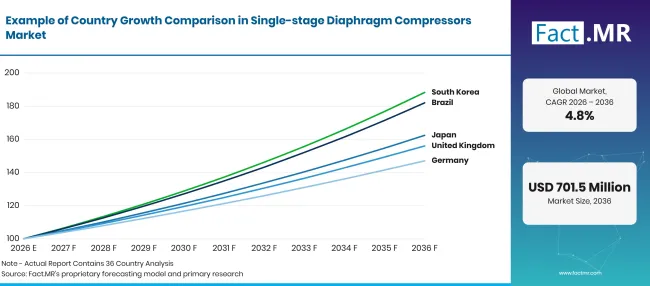
Single Stage Diaphragm Compressors Market Growth Index | Source: Fact.MR
| Country | CAGR (2026 to 2036) |
|---|---|
| Brazil | 6.2% |
| Japan | 5.0% |
| United Kingdom | 4.6% |
| Germany | 3.9% |
| United States | 3.6% |
Source: Fact.MR analysis. Updated Nov 4, 2026
How is Brazil developing demand?
6.2% CAGR, driven by record oil and gas output and a growing drug industry.
Brazil produced a record 3.77 million barrels of oil per day in 2025, and gas output rose 17% to 179 million cubic metres per day, the ANP reports [4]. Pre-salt gas carries carbon dioxide and must be treated before it moves onshore. The pharmaceutical market also earned about BRL 182 billion in 2025, a nominal gain of 13.7% over 2024, according to ANVISA [5]. Both sectors need sealed gas handling.
What supports Japan’s adoption?
5.0% CAGR, backed by state price-gap support for low-carbon hydrogen.
In September 2025, Aichi Prefecture announced that a local electrolytic hydrogen project had been certified under the price-gap support scheme of the Hydrogen Society Promotion Act [6]. The project led by Toyota Tsusho plans to make about 1,600 tons of hydrogen a year for a steel plant from around 2030 [7]. Japan’s electronics and specialty gas makers form a second buyer group for high-purity units.
How is the United Kingdom developing demand?
4.6% CAGR, helped by rising pharmaceutical output.
The Office for National Statistics reports that output of basic pharmaceutical products rose 4.2% in the second quarter of 2026, the top positive contribution among manufacturing subsectors [8]. Drug plants use diaphragm units for hydrogenation and inert gas supply. North Sea gas terminals and refineries add a steady replacement market for sour gas duties.
What is supporting Germany’s adoption?
3.9% CAGR, reflecting a hydrogen grid that is still being planned.
Germany’s Hydrogen Acceleration Act came into force on 2 April 2026 and gives hydrogen plants and pipelines overriding public interest in permitting [9]. The Federal Network Agency’s June 2026 draft plan proposes a 9,241 km hydrogen network by 2037 with about EUR 24.3 billion of investment [10]. Large pipeline flows will use other machines, but filling stations, storage sites and chemical parks need smaller diaphragm units.
How does the United States perform?
3.6% CAGR, as replacement drives most orders.
United States marketed natural gas production reached a record 118.5 billion cubic feet per day in 2025, and the EIA forecasts 122.5 billion cubic feet per day in 2026 [11]. Gas processing plants, refineries and petrochemical complexes run a large installed base of diaphragm machines. Most purchases replace worn units or add capacity at existing sites.
Who leads the Single-stage Diaphragm Compressors Market?
Buyers choose between broad compressor groups and diaphragm specialists. Burckhardt Compression, NEUMAN & ESSER and Howden sell diaphragm units next to large piston machines. These broad compressor makers win when a refinery or gas company wants one supplier for a whole project. Burckhardt Compression won an order in April 2025 for an MD10-L diaphragm package for hydrogen trailer filling in Sweden [12].
NEUMAN & ESSER is supplying four NEA|HOFER MKZ diaphragm compressors to a Delfzijl hydrogen hub that fills trailers at up to 420 bar, a March 2026 release states [13]. Burckhardt Compression also announced orders in October 2026 for diaphragm units serving semiconductor plants in Taiwan and Korea [14]. PDC Machines, Fluitron and Sundyne with its PPI line focus on diaphragm heads. These specialists compete on purity, pressure range and service know-how. SERA covers smaller metal diaphragm units for electronic and toxic gases. Contest for the next round of orders will turn on diaphragm life, delivery time and local service.
Which companies are the key providers?
Key companies in the Single-stage Diaphragm Compressors Market include Burckhardt Compression, NEUMAN & ESSER, Howden, PDC Machines, Fluitron, Sundyne and SERA.
- Burckhardt Compression
- NEUMAN & ESSER
- Howden
- PDC Machines
- Fluitron
- Sundyne
- SERA
Bibliography
- [1] International Energy Agency. (2025). Global Hydrogen Review 2025: Investment and innovation.
- [2] Press Information Bureau. (2026, March 27). Establishment of Pharmaceutical Industry.
- [3] NITI Aayog. (2025, July 2). Chemical Industry: Powering India’s participation in Global Value Chains.
- [4] Agência Nacional do Petróleo, Gás Natural e Biocombustíveis. (2026, February 2). Produção de petróleo e gás em 2025 bate recorde histórico.
- [5] Agência Nacional de Vigilância Sanitária. (2026, September 28). CMED divulga 9° edição do Anuário Estatístico do Mercado Farmacêutico.
- [6] Aichi Prefecture. (2025, September 30)
- [7] Toyota Tsusho Corporation. (2025, September 30). Toyota Tsusho, Eurus Energy, and Iwatani Consider Starting Onsite Low-Carbon Hydrogen Production and Supply Project at Aichi Steel.
- [8] Office for National Statistics. (2026, August 13). Index of Production, UK: June 2026.
- [9] Die Bundesregierung. (2026, April 2). Bessere Bedingungen beim Wasserstoffhochlauf.
- [10] Bundesnetzagentur. (2026, June 15). Bundesnetzagentur launches consultation for Gas and Hydrogen Network Development Plan 2025 to 2037/2045.
- [11] U.S. Energy Information Administration. (2026, August 12). United States on track for record natural gas production in 2026.
- [12] Burckhardt Compression. (2025, April 10). Burckhardt Compression secures order for MD10-L diaphragm compressor package in Sweden from major gas player.
- [13] NEUMAN & ESSER. (2026, March 17). Driving the Hydrogen Economy in the Northern Netherlands.
- [14] Burckhardt Compression. (2026, October 22). Burckhardt Compression secures orders for semiconductor hydrogen application.
This Report Answers
- How much revenue will oil-free and oil-lubricated single-stage diaphragm units earn in each application and end-use sector through 2036?
- Why do refineries and gas processors buy most of these machines?
- Which national hydrogen, energy and drug industry trends separate growth in Brazil, Japan, the United Kingdom, Germany and the United States?
- Where does a diaphragm head beat a piston or screw machine, and where does it lose on cost?
- How do broad compressor groups and diaphragm specialists compete for the same orders?
- What part will hydrogen trailer filling and semiconductor gas supply play in new demand?
What does the Single-stage Diaphragm Compressors Market cover?
A diaphragm compressor uses a hydraulic piston to flex a thin metal diaphragm, usually built as a set of three sheets. The gas stays on one side of the diaphragm and the oil on the other, so the two never mix. A single-stage machine compresses the gas in one head, which suits pressure ratios up to about seven.
Revenue counts new single-stage units sold as bare compressors or packaged skids. Buyers include oil and gas, chemical, pharmaceutical, food and other users. Values are given at the price of the equipment sold.
What is included in the scope?
New oil-free and oil-lubricated single-stage diaphragm compressors with their drive, head and diaphragm set.
Packaged skids built around a single-stage diaphragm unit, including the motor, cooling, controls and leak detection when sold with the machine.
Units built for hydrogen production and storage, including duties linked to hydrogen generation plants and electrolyser outlets.
Units for refinery, gas processing, chemical, pharmaceutical, food and specialty gas duties, including sites that supply the industrial hydrogen trade.
What is excluded from the scope?
Multi-stage diaphragm compressors and piston, screw and centrifugal compressors of any kind.
Complete hydrogen plants, including green hydrogen electrolysis systems, beyond the value of the compressor itself.
Valves, piping and oil and gas flow control equipment sold separately from the compressor package.
Spare diaphragms, repair services and used machines sold on their own.
How Was the Analysis Built?
The analysis draws on 120+ sources, 35+ company portfolios, 25+ countries, and more than 20 industry interviews.
- Primary Research: Primary research includes discussions with manufacturers, service providers, technology developers, distributors, end users, and subject-matter experts. These conversations examine purchasing priorities, product adoption, operational challenges, approval requirements, competitive positioning, and the factors that influence wider market acceptance.
- Desk Research: Desk research covers government statistics, regulatory publications, company filings, trade data, technical studies, industry associations, standards, public policy, and other authoritative sources. Every source used in the analysis is documented in the bibliography.
- Market Sizing and Forecasting: Market estimates combine historical performance, demand indicators, pricing and volume trends, segment shares, company participation, country-level growth, adoption patterns, investment activity, and barriers to market expansion.
- Data Validation and Update Cycle: Findings are validated by comparing primary interviews with public data, company activity, regulatory changes, trade patterns, and industry developments. Regular updates review new product launches, capacity changes, partnerships, approvals, and shifts in commercial adoption.
Segmentation
What is the report’s scope and coverage?
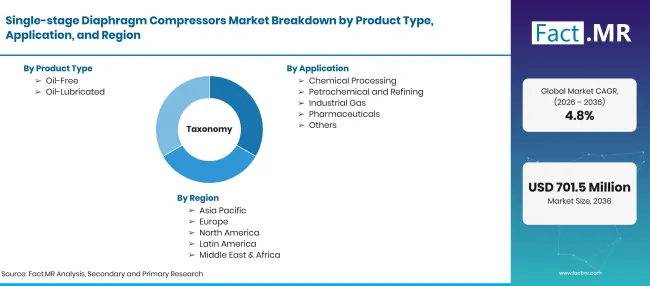
Single Stage Diaphragm Compressors Market Taxonomy | Source: Fact.MR
| Attribute | Details |
|---|---|
| Quantitative Units | USD million |
| Market Definition | Compressors with a single compression stage in which a hydraulically driven metal diaphragm moves the process gas and keeps it sealed from the lubricated drive. |
| Product Type | Oil-Free; Oil-Lubricated |
| Application | Chemical Processing; Petrochemical and Refining; Industrial Gas; Pharmaceuticals; Others |
| End-User | Oil and Gas; Pharmaceutical; Chemical; Food and Beverage; Others |
| Regions Covered | North America; Latin America; Western Europe; Eastern Europe; East Asia; South Asia & Pacific; Middle East & Africa |
| Countries Covered | Brazil; Japan; United Kingdom; Germany; United States |
| Companies Profiled | Burckhardt Compression; NEUMAN & ESSER; Howden; PDC Machines; Fluitron; Sundyne; SERA |
| Forecast Period | 2026 to 2036 |
| Approach | Installed base and replacement cycles in refining, gas processing and chemicals, combined with hydrogen project pipelines and checked against manufacturer product lines. |
Source: Fact.MR analysis. Updated Nov 4, 2026
How is the market segmented?
-
By Product Type
- Oil-Free
- Oil-Lubricated
-
By Application
- Chemical Processing
- Petrochemical and Refining
- Industrial Gas
- Pharmaceuticals
- Others
-
By End-User
- Oil and Gas
- Pharmaceutical
- Chemical
- Food and Beverage
- Others
-
By Region
- North America
- Latin America
- Western Europe
- Eastern Europe
- East Asia
- South Asia & Pacific
- Middle East & Africa
Frequently Asked Questions
How large is the single-stage diaphragm compressors market in 2026?
What growth rate will the single-stage diaphragm compressors market record?
Which product type leads?
Which application leads?
Which end-user leads?
Which country will grow quickest?
Who are the main companies?
What holds the market back?
Who worked on this report


Preview the report firsthand - request a free sample
Free SampleGet the brochure for pricing and purchase details
Download PDF