- Market Value (2025): USD 3.73 Bn
- Estimated Value (2026): USD 3.96 Bn
- Forecast Value (2036): USD 7.21 Bn
- CAGR (2026-2036): 6.2%
What is the Chemical Sterilization Equipment Market forecast to be worth by 2036?
USD 4.0 billion in 2026 to USD 7.2 billion by 2036, at a 6.2% CAGR.
- The chemical sterilization equipment market reached USD 3.73 billion in 2025.
- According to Fact.MR, market value rises from USD 3.96 billion in 2026 to USD 7.21 billion by 2036.
- Fact.MR forecasts a 6.2% CAGR from 2026 to 2036, with facilities expected to replace and maintain validated low-temperature sterilization equipment.
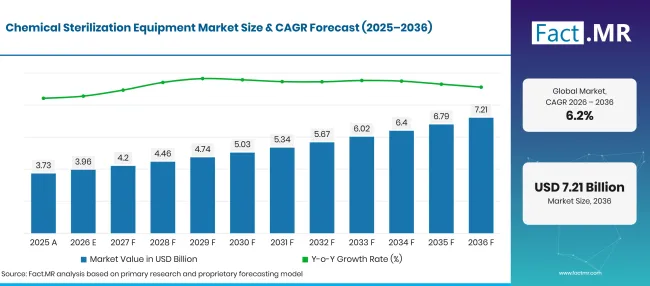
Chemical Sterilization Equipment Market Forecast Global | Source: Fact.MR
| Year | Basis | Market Value (USD Billion) |
|---|---|---|
| 2025 | Actual | 3.73 |
| 2026 | Estimate | 3.96 |
| 2036 | Forecast | 7.21 |
| CAGR 2026 to 2036 | Forecast period | 6.2% |
Source: Fact.MR analysis. Updated Oct 30, 2026
What are the defining numbers behind Chemical Sterilization Equipment Market growth?
Annual chemical sterilization equipment revenue is forecast to increase by USD 3.2 billion between 2026 and 2036.
- Demand Drivers in the Market
- Facilities handling delicate surgical tools require material-compatible sterilization. Hydrogen peroxide systems suit certain temperature-sensitive devices under approved instructions.
- Healthcare operators evaluate cycle records, operating costs and service support before selecting equipment. Documented cycle conditions help staff investigate failures and maintain consistent processing.
- Medical device manufacturers require sterilization methods compatible with both product materials and packaging. Contract sterilization sites handle large volumes, but each product still requires process-specific validation.
- Key Segments Analyzed
- By Product Type: Ethylene Oxide Sterilizers are projected to account for 42.3% of 2026 value, reflecting use for packaged medical devices that require gas penetration.
- By Application: Healthcare is estimated to account for 48.6% of 2026 sales, supported by instrument processing and hospital infection-control routines.
- By End-User: Hospitals are projected to represent 35.4% of 2026 sales as sterile processing departments maintain equipment for reusable instruments.
- Analyst Opinion at Fact.MR
- Shambhu Nath Jha, Principal Consultant at Fact.MR, states, “Chemical sterilization equipment decisions depend on process compatibility, validation requirements, and the ability to keep systems operating reliably after installation. Hospitals and medical device manufacturers need technologies that suit specific instruments, packaging, and load conditions.”
- Strategic Implications
- Hospital engineering teams should compare instrument compatibility and validated load configurations before replacing a sterilizer.
- Equipment makers should provide clear cycle documentation and service procedures for routine audits and corrective action.
- Commercial sterilization operators should match ventilation systems and monitoring equipment to the specific sterilant used.
- Medical device manufacturers should verify sterilization compatibility early in product development to avoid later process changes.
Germany is projected to advance at a 7.8% CAGR through 2036, reflecting replacement of low-temperature hospital sterilizers. Brazil follows at 7.1%, where local support capacity influences equipment selection. The USA is forecast to record 6.5% as medical device processing continues to require validated cycles. UK demand is projected to grow at 5.8% as hospitals assess equipment service lives. Japan is estimated to increase at 5.1%, with careful technology selection shaping purchases.
How does the Chemical Sterilization Equipment Market break down by segment?
Ethylene Oxide Sterilizers lead Product Type at 42.3%; Healthcare leads Application at 48.6%; Hospitals lead End-User at 35.4%.
Which Product Type dominates?
Ethylene Oxide Sterilizers account for 42.3% of projected 2026 sales.
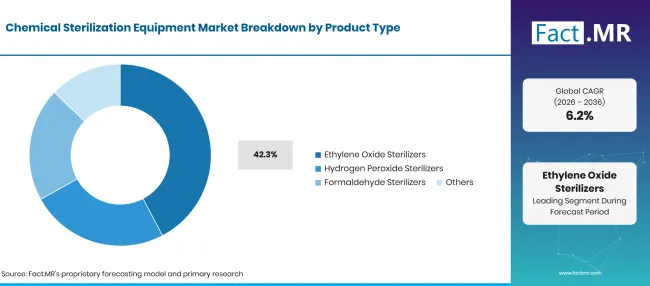
Chemical Sterilization Equipment Market Breakdown Product Type | Source: Fact.MR
| Product Type | Share (2026) |
|---|---|
| Ethylene Oxide Sterilizers (Leading segment) | 42.3% |
| Other segments combined | 57.7% |
| Total | 100.0% |
Source: Fact.MR analysis. Updated Oct 30, 2026
Ethylene oxide systems remain relevant for terminally sterilized medical products that include delicate polymers and complex internal pathways. The method can reach surfaces inside suitable packaging, provided that an approved process has been validated for the device. Hydrogen peroxide sterilizers are used in settings that need lower-temperature cycles for compatible equipment. Formaldehyde systems occupy narrower applications because operators must consider chemical handling and residues. The EPA’s January 2025 decision gave particular attention to worker exposure in ethylene oxide operations [2].
What leads Application demand?
Healthcare leads with 48.6% of projected 2026 sales.
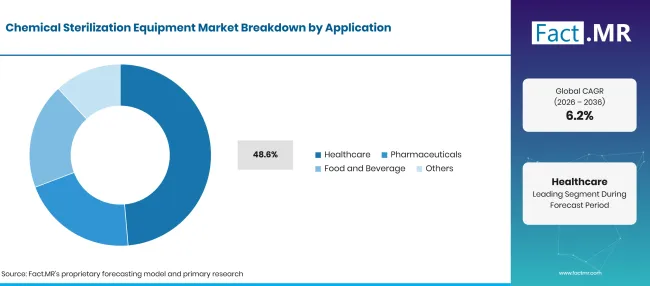
Chemical Sterilization Equipment Market Breakdown Application | Source: Fact.MR
| Application | Share (2026) |
|---|---|
| Healthcare (Leading segment) | 48.6% |
| Other segments combined | 51.4% |
| Total | 100.0% |
Source: Fact.MR analysis. Updated Oct 30, 2026
Healthcare facilities process reusable equipment throughout the working day, making consistent cycle turnaround a practical concern. Sterile processing teams need verified methods for instruments that tolerate neither steam temperature nor moisture. Laboratories also use chemical sterilization where the equipment and material permit it, but laboratory decontamination should be distinguished from terminal sterilization of finished medical devices.
How does End-User shape demand?
Hospitals capture 35.4% of projected 2026 sales.
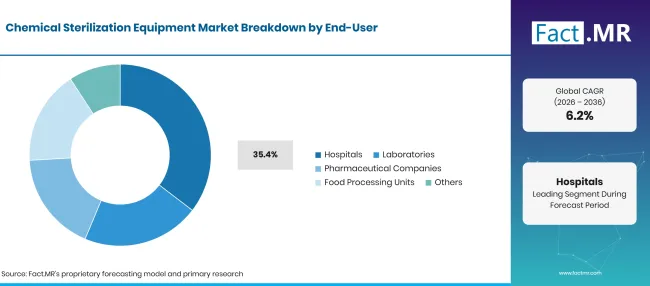
Chemical Sterilization Equipment Market Breakdown End User | Source: Fact.MR
| End-User | Share (2026) |
|---|---|
| Hospitals (Leading segment) | 35.4% |
| Other segments combined | 64.6% |
| Total | 100.0% |
Source: Fact.MR analysis. Updated Oct 30, 2026
Hospitals purchase sterilizers for clinical equipment that must be ready for reuse after an approved process. A unit’s chamber size, cycle compatibility and ongoing maintenance affect the way a sterile processing department works. Smaller clinics may send selected loads to outside service providers instead of installing additional equipment. Food processing units represent a separate user category in the market, although their sterilization needs and accepted methods differ from those of medical facilities.
What is accelerating Chemical Sterilization Equipment Market adoption, and what is holding it back?
Growth will be supported by medical device sterilization, hospital instrument reprocessing, low-temperature systems, and replacement of aging equipment. Expansion will be moderated by ethylene oxide exposure controls, requalification costs, material compatibility limits, and facility installation requirements.
Drivers Impact Analysis
| DRIVER | (~) % IMPACT ON CAGR | GEOGRAPHIC RELEVANCE | IMPACT TIMELINE |
|---|---|---|---|
| Medical device sterilization requirements | +1.3% | North America, Europe | Short term |
| Hospital instrument reprocessing | +1.1% | Global | Short term |
| Low-temperature instrument compatibility | +0.9% | Europe, East Asia | Medium term |
| Sterile processing capacity renewal | +0.7% | Global | Medium term |
| Cycle documentation needs | +0.5% | Global | Long term |
Source: Fact.MR analysis. Updated Oct 30, 2026
Opportunity Impact Analysis
| OPPORTUNITY | (~) % IMPACT ON CAGR | GEOGRAPHIC RELEVANCE | IMPACT TIMELINE |
|---|---|---|---|
| Hydrogen peroxide system replacement | +0.8% | Europe, East Asia | Medium term |
| Local equipment servicing | +0.6% | Latin America, Asia | Medium term |
| Validated contract sterilization capacity | +0.5% | North America | Long term |
| Facility monitoring upgrades | +0.3% | Global | Short term |
Source: Fact.MR analysis. Updated Oct 30, 2026
Restraints Impact Analysis
| RESTRAINT | (~) % IMPACT ON CAGR | GEOGRAPHIC RELEVANCE | IMPACT TIMELINE |
|---|---|---|---|
| Ethylene oxide exposure controls | −0.7% | North America | Short term |
| Validation and requalification costs | −0.6% | Global | Medium term |
| Instrument material incompatibility | −0.5% | Global | Long term |
| Installation and facility constraints | −0.3% | Global | Medium term |
Source: Fact.MR analysis. Updated Oct 30, 2026
Which countries are scaling the Chemical Sterilization Equipment Market through 2036?
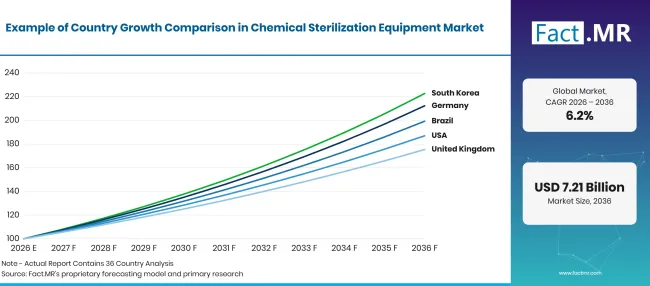
Chemical Sterilization Equipment Market Growth Index | Source: Fact.MR
| Country | CAGR (2026 to 2036) |
|---|---|
| Germany | 7.8% |
| Brazil | 7.1% |
| USA | 6.5% |
| UK | 5.8% |
| Japan | 5.1% |
Source: Fact.MR analysis. Updated Oct 30, 2026
How is Germany supporting chemical sterilization equipment sales?
7.8% CAGR, supported by hospital sterilization needs and equipment replacement.
German hospitals have an established need for chemical sterilization equipment that fits their reusable instrument mix. The market is forecast to expand at a 7.8% CAGR through 2036. Destatis reported in October 2026 that Germany treated 17.7 million hospital inpatients during 2025 [4].
What shapes Brazil’s equipment demand?
7.1% CAGR, linked to service access, supplies, and hospital processing requirements.
Brazilian facilities weigh equipment cost against access to trained service teams and supplies. Chemical sterilization equipment demand is projected to advance at a 7.1% CAGR through 2036. The Ministry of Health maintains the national healthcare establishment register through its official health information systems [5].
Why does the USA remain a major equipment market?
6.5% CAGR, driven by packaged medical device sterilization and hospital processing capacity.
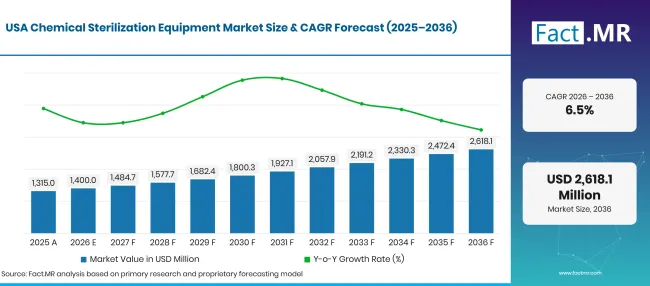
Chemical Sterilization Equipment Market Forecast Usa | Source: Fact.MR
In the United States, manufacturers of packaged medical devices form an important part of the market alongside hospital sterile processing teams. The market is estimated to record a 6.5% CAGR through 2036. In January 2025, the EPA reported that ethylene oxide sterilized 50% of the nation’s sterilized medical devices [1].
How is the UK market developing?
5.8% CAGR, shaped by instrument compatibility and ongoing healthcare equipment spending.
UK hospital departments generally judge chemical sterilization equipment by instrument compatibility and the practical cost of keeping a unit in service. Demand is projected to rise at a 5.8% CAGR through 2036. The Office for National Statistics reported in April 2026 that UK healthcare spending reached approximately £345 billion in 2025 [6].
What is influencing Japan’s sterilization equipment outlook?
5.1% CAGR, tied to compact system requirements and carefully managed sterile processing.
Japan’s chemical sterilization equipment market is forecast to increase at a 5.1% CAGR through 2036. Sterile processing teams pay close attention to chamber footprint and the time required to process instruments safely. The Ministry of Health, Labour and Welfare reports hospital establishment information in its official medical institution survey [3].
Who leads the Chemical Sterilization Equipment Market?
Competition covers equipment designed for hospital instrument reprocessing and systems used for terminal medical device sterilization.
STERIS sells V-PRO low-temperature sterilization systems and supports established hospital installations. In January 2025, STERIS announced modified service coverage for its V-PRO 1 and V-PRO 1 Plus units from February 2025 [7]. The change shows why hospitals assess parts availability before choosing replacement equipment. Getinge and ASP compete in selected low-temperature systems, while Andersen Sterilizers offers ethylene oxide equipment for suitable applications.
Which companies are the key providers?
Key companies include STERIS plc; MMM Group; Getinge AB; Advanced Sterilization Products (ASP); SteelcoBelimed (Steelco S.p.A.); Matachana Group; Tuttnauer; Andersen Sterilizers, Inc.; Shinva Medical Instrument Co., Ltd.
- STERIS plc
- MMM Group
- Getinge AB
- Advanced Sterilization Products (ASP)
- SteelcoBelimed (Steelco S.p.A.)
- Matachana Group
- Tuttnauer
- Andersen Sterilizers, Inc.
- Shinva Medical Instrument Co., Ltd.
Bibliography
- [1] U.S. Environmental Protection Agency. (2025, January 14). EPA finalizes protections for workers and communities from cancer-causing ethylene oxide pollution.
- [2] U.S. Environmental Protection Agency. (n.d.). Regulation of ethylene oxide (EtO) under the Federal Insecticide, Fungicide, and Rodenticide Act.
- [3] Ministry of Health, Labour and Welfare. (2026, September 30). 医療施設動態調査(令和8(2026)年7月末概数) [Monthly survey of medical institutions: Preliminary figures as of the end of July 2026].
- [4] Statistisches Bundesamt (Destatis). (2026, October 28). 1,2 % mehr Krankenhausbehandlungen im Jahr 2025.
- [5] Ministério da Saúde. (n.d.). Cadastro Nacional de Estabelecimentos de Saúde (CNES).
- [6] Office for National Statistics. (2026, April 29). Healthcare expenditure, UK Health Accounts: 2024 and 2025.
- [7] STERIS. (2025, January 1). V-PRO 1 and V-PRO 1 Plus low temperature sterilization system service-mature notice.
This Report Answers
- The report explains how ethylene oxide, hydrogen peroxide, formaldehyde, and other chemical sterilization systems differ in their use and operating requirements.
- Application analysis shows how healthcare facilities, laboratories, and pharmaceutical companies use chemical sterilization equipment across different processing environments.
- End-user analysis examines how hospitals and other facilities assess chamber size, cycle compatibility, maintenance needs, and validated load requirements.
- Country analysis reviews how hospital activity, medical device sterilization, service availability, healthcare spending, and facility requirements influence sales in Germany, Brazil, the USA, the UK, and Japan.
- Competitive analysis compares major equipment providers based on sterilization technology, service coverage, cycle documentation, installation needs, and support for validated processing.
What does the Chemical Sterilization Equipment Market cover?
The market covers chemical sterilization systems used with suitable medical instruments and products. It includes equipment deployed by hospitals and other facilities that operate validated chemical cycles. The boundary includes ethylene oxide, hydrogen peroxide, formaldehyde and other chemical systems.
What is included in the scope?
Included products are sterilization machines and associated equipment sold for a defined chemical sterilization process. Revenue covers equipment used in hospital sterile processing and suitable production settings. Process compatibility, installation needs and routine cycle verification are considered in the analysis.
What is excluded from the scope?
Sterilant chemicals sold separately from equipment are outside the equipment revenue boundary. Standalone surface cleaning products and routine disinfection supplies are also excluded. Steam-only sterilizers and radiation-only sterilization systems fall outside the chemical equipment categories.
How Was the Analysis Built?
The analysis draws on 120+ sources, 35+ company portfolios, 25+ countries, and more than 20 industry interviews.
- Primary Research: Primary research includes discussions with manufacturers, service providers, technology developers, distributors, end users, and subject-matter experts. These conversations examine purchasing priorities, product adoption, operational challenges, approval requirements, competitive positioning, and the factors that influence wider market acceptance.
- Desk Research: Desk research covers government statistics, regulatory publications, company filings, trade data, technical studies, industry associations, standards, public policy, and other authoritative sources. Every source used in the analysis is documented in the bibliography.
- Market Sizing and Forecasting: Market estimates combine historical performance, demand indicators, pricing and volume trends, segment shares, company participation, country-level growth, adoption patterns, investment activity, and barriers to market expansion.
- Data Validation and Update Cycle: Findings are validated by comparing primary interviews with public data, company activity, regulatory changes, trade patterns, and industry developments. Regular updates review new product launches, capacity changes, partnerships, approvals, and shifts in commercial adoption.
Segmentation
What is the report’s scope and coverage?
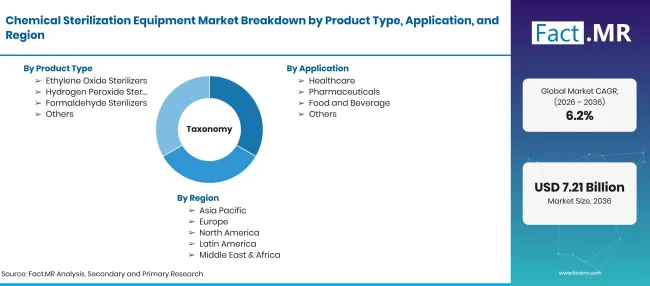
Chemical Sterilization Equipment Market Taxonomy | Source: Fact.MR
| Attribute | Details |
|---|---|
| Quantitative Units | USD billion in 2026 to USD billion by 2036, at CAGR |
| Market Definition | Equipment that uses chemical agents for validated sterilization of suitable instruments, devices or products. |
| Product Type | Ethylene Oxide Sterilizers; Hydrogen Peroxide Sterilizers; Formaldehyde Sterilizers; Others |
| Application | Healthcare; Laboratories; Pharmaceutical Companies; Others |
| End-User | Hospitals; Food Processing Units; Others |
| Regions Covered | North America; Latin America; Western Europe; Eastern Europe; East Asia; South Asia & Pacific; Middle East & Africa |
| Countries Covered | Germany; Brazil; USA; UK; Japan |
| Companies Profiled | STERIS plc; MMM Group; Getinge AB; Advanced Sterilization Products (ASP); SteelcoBelimed (Steelco S.p.A.); Matachana Group; Tuttnauer; Andersen Sterilizers, Inc.; Shinva Medical Instrument Co., Ltd. |
| Forecast Period | 2026 to 2036 |
| Approach | Category-based demand estimates informed by equipment uses and published institutional evidence. |
Source: Fact.MR analysis. Updated Oct 30, 2026
How is the market segmented?
-
By Product Type
- Ethylene Oxide Sterilizers
- Hydrogen Peroxide Sterilizers
- Formaldehyde Sterilizers
- Others
-
By Application
- Healthcare
- Laboratories
- Pharmaceutical Companies
- Others
-
By End-User
- Hospitals
- Food Processing Units
- Others
-
By Region
- North America
- Latin America
- Western Europe
- Eastern Europe
- East Asia
- South Asia & Pacific
- Middle East & Africa
Frequently Asked Questions
How big is the chemical sterilization equipment market in 2026?
What is the market CAGR from 2026 to 2036?
Which product type has the largest share?
Which application leads the market?
Which businesses are profiled?
Who worked on this report


Preview the report firsthand - request a free sample
Free SampleGet the brochure for pricing and purchase details
Download PDF