- Market Value (2025): USD 4.26 Bn
- Estimated Value (2026): USD 4.48 Bn
- Forecast Value (2036): USD 7.47 Bn
- CAGR (2026-2036): 5.2%
What is the Chemically Modified Hydrocolloid Market forecast to be worth by 2036?
USD 4.5 billion in 2026 to USD 7.5 billion by 2036 at a 5.2% CAGR.
- As per Fact.MR analysis, the chemically modified hydrocolloid market was valued at USD 4.26 billion in 2025.
- Demand will grow from USD 4.48 billion in 2026 to USD 7.47 billion by 2036.
- The forecast records a 5.2% CAGR from 2026 to 2036 as manufacturers seek functional ingredients that provide consistent thickening, gelling and stabilization.
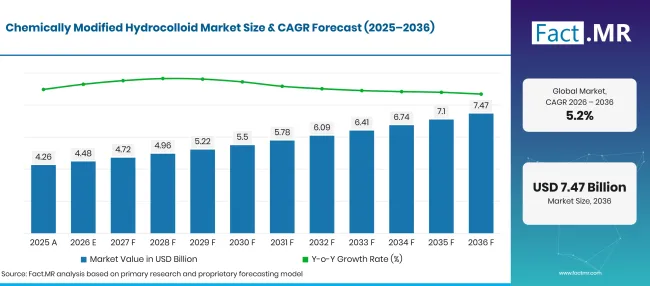
Chemically Modified Hydrocolloid Market Forecast Global | Source: Fact.MR
| Year | Basis | Market Value (USD billion) |
|---|---|---|
| 2025 | Actual | 4.26 |
| 2026 | Estimate | 4.48 |
| 2036 | Forecast | 7.47 |
| CAGR 2026 to 2036 | Forecast period | 5.2% |
Source: Fact.MR analysis. Updated Oct 27, 2026
What are the defining numbers behind Chemically Modified Hydrocolloid Market growth?
USD 3.0 billion absolute opportunity between 2026 and 2036
- Demand Drivers in the Market
- Food processors need ingredients that support consistent texture, stability and product quality. Germany's Federal Ministry for Economic Affairs reports that the country's food industry generated EUR 232.7 billion in revenue in 2024, illustrating the scale of a major downstream market for functional ingredients [1].
- Pharmaceutical manufacturers require excipients that meet defined performance and quality requirements. In June 2026, the U.S. Food and Drug Administration announced seven participants in its PreCheck pilot to support domestic pharmaceutical manufacturing and supply-chain resilience [2].
- Food processing investment supports the wider market for formulation ingredients. India's Ministry of Food Processing Industries reported on July 30, 2026, that investments under its Production Linked Incentive Scheme for Food Processing Industry had created processing capacity of 34 lakh metric tonnes per annum. This is a food-processing capacity indicator rather than direct hydrocolloid demand [3]. [3]
- Key Segments Analyzed
- By Product Type: Cellulose Derivatives will account for 35.2% of the market in 2026, reflecting their use in viscosity control, water retention and stabilization.
- By Application: Food & Beverages leads with 42.3% of the market in 2026, supported by the need for consistent texture and stability across processed food categories.
- By Function: Thickening holds a 36.8% share in 2026, reflecting demand for ingredients that control flow and product consistency.
- By Source: Plant-derived materials account for 52.1% of the market in 2026, reflecting the importance of plant-origin raw materials in hydrocolloid formulations.
- Analyst Opinion at Fact.MR
- Shambhu Nath Jha, Principal Consultant at Fact.MR, states, “Chemically modified hydrocolloids serve a practical role in formulations that require consistent texture, viscosity and stability. Suppliers that demonstrate performance under actual processing conditions and provide clear quality documentation are better positioned to meet the needs of food, pharmaceutical and personal care manufacturers.”
- Strategic Implications
- Manufacturers need to document viscosity, stability and functional performance under the processing conditions relevant to each customer application.
- Food ingredient suppliers should demonstrate that modified hydrocolloids perform consistently across changes in temperature, acidity, storage and mixing conditions.
- Pharmaceutical ingredient suppliers must maintain appropriate quality documentation and demonstrate suitability for the intended formulation.
- Buyers should evaluate total formulation cost, ingredient dosage, processing efficiency and finished-product performance rather than purchase price alone.
Germany is set to record a 6.0% CAGR through 2036. Brazil is set to post 5.5%, followed by the USA at 4.9%. The UK is estimated to advance at 4.4%, while Japan is forecast at 3.9%.
How does the Chemically Modified Hydrocolloid Market break down by segment?
Fact.MR identifies Cellulose Derivatives as the leading product type at 35.2%; Food & Beverages leads Application at 42.3%; Thickening leads Function at 36.8%; and Plant-derived materials lead Source at 52.1%.
Which Product Type dominates?
Cellulose Derivatives is set to hold a 35.2% share in 2026.
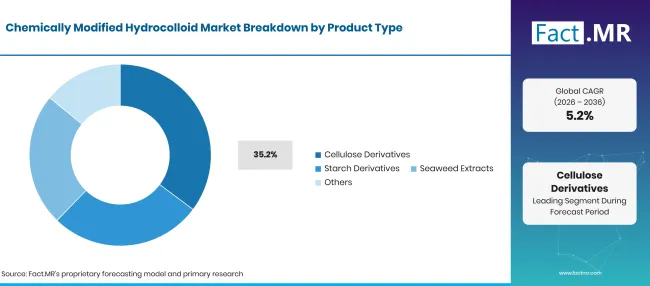
Chemically Modified Hydrocolloid Market Breakdown Product Type | Source: Fact.MR
| Product Type | Share (2026) |
|---|---|
| Cellulose Derivatives (Leading segment) | 35.2% |
| Other segments combined | 64.8%* |
| Total | 100.0% |
Source: Fact.MR analysis. Updated Oct 27, 2026
Cellulose derivatives are used to modify viscosity, retain moisture and improve the stability of formulated products. Their performance depends on the specific derivative, substitution characteristics, concentration and processing conditions. Starch derivatives and seaweed extracts serve other formulation needs, while additional materials compete according to their functional properties and cost.
What leads the Application segment?
Food & Beverages hold 42.3% share in 2026.
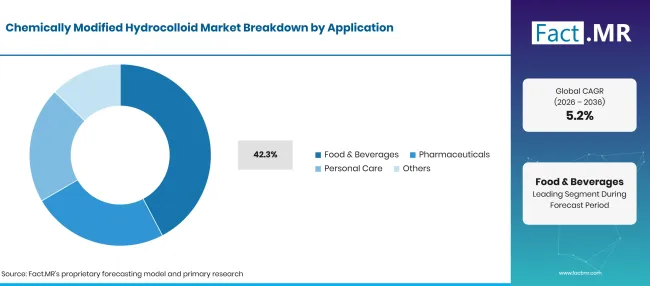
Chemically Modified Hydrocolloid Market Breakdown Application | Source: Fact.MR
| Application | Share (2026) |
|---|---|
| Food & Beverages (Leading segment) | 42.3% |
| Other segments combined | 57.7%* |
| Total | 100.0% |
Source: Fact.MR analysis. Updated Oct 27, 2026
Food and beverage manufacturers use hydrocolloids to adjust thickness, mouthfeel, suspension and stability. Application requirements differ across sauces, dairy products, bakery items, beverages and other processed foods. Pharmaceutical and personal care formulations require separate performance and quality assessments, depending on the intended product.
How does Function shape demand?
Thickening is likely to account for a 36.8% share in 2026.
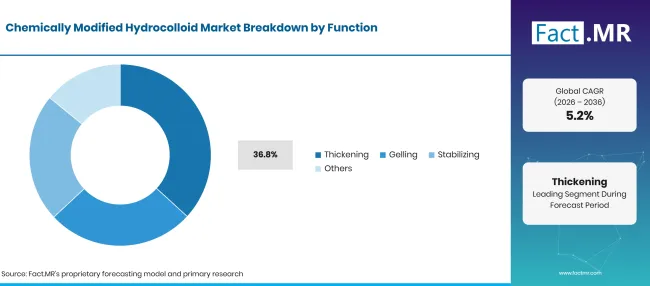
Chemically Modified Hydrocolloid Market Breakdown Function | Source: Fact.MR
| Function | Share (2026) |
|---|---|
| Thickening (Leading segment) | 36.8% |
| Other segments combined | 63.2%* |
| Total | 100.0% |
Source: Fact.MR analysis. Updated Oct 27, 2026
Thickening agents influence viscosity and flow, helping manufacturers achieve a consistent finished product. Gelling agents create or strengthen gel structures, while stabilizers help limit separation and maintain uniformity. A single hydrocolloid may perform more than one function, depending on the formulation and dosage.
Which Source leads the market?
Plant-derived materials are expected to account for 52.1% of the market in 2026.
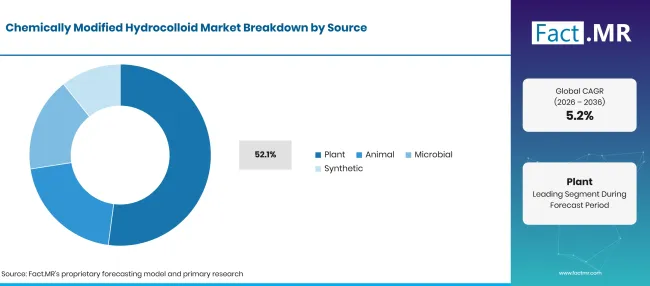
Chemically Modified Hydrocolloid Market Breakdown Source | Source: Fact.MR
| Source | Share (2026) |
|---|---|
| Plant (Leading segment) | 52.1% |
| Other segments combined | 47.9%* |
| Total | 100.0% |
Source: Fact.MR analysis. Updated Oct 27, 2026
Plant-derived inputs form an important source category for hydrocolloid production. Animal-derived materials serve selected gelling and stabilizing applications, while microbial sources are relevant to certain fermentation-derived gums. Synthetic or other specified sources serve additional formulation requirements. Actual performance and suitability depend on the individual ingredient rather than source classification alone.
What is accelerating Chemically Modified Hydrocolloid Market adoption, and what is holding it back?
Demand for formulation consistency and multifunctional ingredients supports adoption, while raw-material volatility, reformulation costs and regulatory requirements can slow expansion.
Drivers Impact Analysis
| DRIVER | (~) % IMPACT ON CAGR | GEOGRAPHIC RELEVANCE | IMPACT TIMELINE |
|---|---|---|---|
| Demand for consistent food texture | +1.0% | Global | Medium term (2–4 years) |
| Growth in processed food formulations | +0.9% | Americas, Europe, Asia | Medium term (2–4 years) |
| Need for viscosity control | +0.7% | Global | Short term (≤ 2 years) |
| Pharmaceutical formulation requirements | +0.5% | Global | Medium term (2–4 years) |
| Demand for plant-derived ingredients | +0.4% | Global | Long term (≥ 4 years) |
Source: Fact.MR analysis. Updated Oct 27, 2026
Opportunity Impact Analysis
| OPPORTUNITY | (~) % IMPACT ON CAGR | GEOGRAPHIC RELEVANCE | IMPACT TIMELINE |
|---|---|---|---|
| Application-specific cellulose derivatives | +0.8% | Global | Medium term (2–4 years) |
| Improved stability in complex formulations | +0.6% | Global | Medium term (2–4 years) |
| Ingredient systems for processed foods | +0.5% | Asia, Americas | Long term (≥ 4 years) |
| Technical formulation support | +0.4% | Global | Short term (≤ 2 years) |
Source: Fact.MR analysis. Updated Oct 27, 2026
Restraints Impact Analysis
| RESTRAINT | (~) % IMPACT ON CAGR | GEOGRAPHIC RELEVANCE | IMPACT TIMELINE |
|---|---|---|---|
| Raw-material price volatility | -0.8% | Global | Short term (≤ 2 years) |
| Reformulation and testing costs | -0.6% | Global | Medium term (2–4 years) |
| Regulatory and quality requirements | -0.5% | Global | Medium term (2–4 years) |
| Functional variability between grades | -0.4% | Global | Short term (≤ 2 years) |
Source: Fact.MR analysis. Updated Oct 27, 2026
Which countries are scaling the Chemically Modified Hydrocolloid Market through 2036?
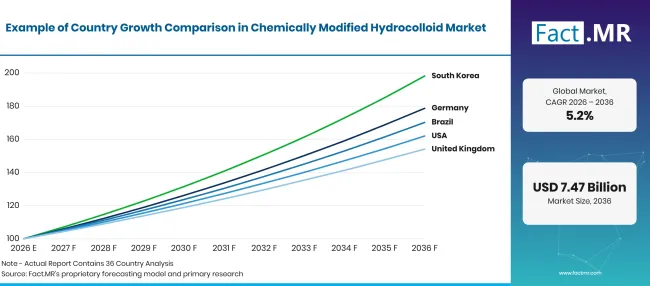
Chemically Modified Hydrocolloid Market Growth Index | Source: Fact.MR
| Country | CAGR (2026–2036) |
|---|---|
| Germany | 6.0% |
| Brazil | 5.5% |
| USA | 4.9% |
| UK | 4.4% |
| Japan | 3.9% |
Source: Fact.MR analysis. Updated Oct 27, 2026
What supports Germany adoption?
6.0% CAGR, shaped by a large food-processing industry and demand for consistent ingredient performance.
Germany’s chemically modified hydrocolloid market is driven by demand from food manufacturers for ingredients that improve texture, viscosity and stability across processed food products. The need to maintain product quality during processing, storage and distribution supports the use of modified starches, cellulose derivatives and other hydrocolloid-based ingredients in sauces, dairy products, bakery items and convenience foods.
How is Brazil developing chemically modified hydrocolloid adoption?
5.5% CAGR, supported by the potential to serve food-processing and personal care formulation requirements.
Brazil's agricultural and industrial economy supports a broad food-production ecosystem. The Brazilian Institute of Geography and Statistics reported that national GDP reached BRL 12.7 trillion in 2025 [4]. This is a broad economic indicator rather than a direct measure of food ingredient consumption. Hydrocolloid suppliers can pursue opportunities by offering reliable supply, formulation support and performance suited to local manufacturing requirements.
What supports United States adoption?
4.9% CAGR, driven by established food and pharmaceutical manufacturing and continued attention to ingredient performance.
The U.S. Food and Drug Administration published information on its food chemical safety review program in May 2026, including the review of selected ingredients and food additives [5]. This regulatory environment makes ingredient identity, intended use, documentation and formulation suitability important considerations. Suppliers should verify applicable requirements for each hydrocolloid and end use rather than assume that all modified ingredients have the same regulatory status.
How is the United Kingdom building adoption?
4.4% CAGR, shaped by a substantial food and drink manufacturing sector and continued demand for product consistency.
The UK government's Food Statistics in Your Pocket, updated in July 2026, reports that the agri-food sector contributed £162.3 billion in gross value added in 2024. Food and drink manufacturing contributed £39.3 billion of that total [6]. This manufacturing base provides a relevant downstream market for thickening and stabilizing ingredients. Adoption depends on formulation performance, customer specifications and compliance with applicable food regulations.
What supports Japan adoption?
3.9% CAGR, led by food manufacturing activity and demand for carefully controlled ingredient functionality.
Japan's Ministry of Agriculture, Forestry and Fisheries publishes monthly food-manufacturing production statistics, including reports for 2026 [7]. These statistics provide a way to monitor activity in downstream food categories that may use hydrocolloids. Market opportunities will depend on product-specific requirements, processing compatibility and the ability to supply ingredients that perform consistently.
Who leads the Chemically Modified Hydrocolloid Market?
Fact.MR profiles Cargill, Incorporated; Ingredion Incorporated; International Flavors & Fragrances Inc. (IFF); Ashland Inc.; and Tate & Lyle PLC as companies relevant to the chemically modified hydrocolloid market. These companies participate in ingredient supply, hydrocolloid technologies, specialty formulations or functional ingredient systems across relevant applications.
Cargill and Ingredion have established food ingredient portfolios that support texture modification and formulation performance. IFF is associated with hydrocolloid and specialty ingredient solutions, while Ashland supplies specialty ingredients for food, personal care and pharmaceutical applications. Tate & Lyle focuses on food and beverage ingredients, including solutions for texture and stability. Their respective portfolios differ, and inclusion in this competitive landscape does not imply that every company manufactures every category of chemically modified hydrocolloids.
Competition in the market depends on functional performance, formulation compatibility, regulatory compliance, supply reliability and application-specific technical support. Suppliers must demonstrate that their individual hydrocolloid grades deliver the required thickening, stabilization, binding or texturizing properties for the intended application.
Which companies are the key providers?
Key companies include Cargill, Incorporated; Ingredion Incorporated; International Flavors & Fragrances Inc. (IFF); Ashland Inc.; and Tate & Lyle PLC.
- Cargill, Incorporated
- Ingredion Incorporated
- International Flavors & Fragrances Inc. (IFF)
- Ashland Inc.
- Tate & Lyle PLC
Bibliography
- [1] Federal Ministry for Economic Affairs and Energy. (n.d.). Lebensmittelindustrie [Food industry]. German Federal Ministry source
- [2] U.S. Food and Drug Administration. (2026, June 29). FDA selects seven participants for PreCheck pilot program to advance U.S. drug manufacturing. FDA source
- [3] Ministry of Food Processing Industries, Government of India. (2026, July 30). Government boosts food processing, exports and employment through PLISFPI and PMFME schemes. Press Information Bureau. PIB source
- [4] Instituto Brasileiro de Geografia e Estatística. (2026, March 3). GDP grows 2.3% in 2025 and closes the year at R$ 12.7 trillion. IBGE source
- [5] U.S. Food and Drug Administration. (2026, May 12). FDA finalizes food chemical safety post-market assessment program, launches reassessment of BHT, ADA. FDA source
- [6] Department for Environment, Food & Rural Affairs. (2026, July 29). Food statistics in your pocket. GOV.UK. DEFRA source
- [7] Ministry of Agriculture, Forestry and Fisheries. (n.d.).[Food industry dynamics survey]. MAFF source
This Report Answers
- The report describes the role of chemically modified hydrocolloids across food and beverage, pharmaceutical and personal care applications.
- Segment analysis compares the specified product types, applications, functions and sources.
- Country analysis discusses Germany, Brazil, the USA, the UK and Japan alongside relevant official industrial indicators.
- The competitive overview profiles five companies active in the wider ingredient and formulation landscape.
- Functional analysis distinguishes thickening, gelling and stabilizing requirements across formulations.
What does the Chemically Modified Hydrocolloid Market cover?
The market covers chemically modified hydrocolloid ingredients used to influence the physical properties of formulated products. It includes ingredients used to manage viscosity, stabilize mixtures, retain water and create or modify gel structures. The analysis considers demand across food and beverages, pharmaceuticals and personal care, subject to the market's defined product and revenue boundaries.
What is included in the scope?
Included products are hydrocolloid ingredients that meet the market’s defined chemical-modification criteria and are sold for functional applications.
Native and unmodified materials should be excluded unless a defined modification process is documented. Coverage includes the specified cellulose derivatives, starch derivatives, seaweed extracts and other product categories, together with applications classified by end use, function and source. The analysis considers ingredient selection, functional performance and suitability for different manufacturing processes.
What is excluded from the scope?
The analysis excludes unmodified hydrocolloids unless explicitly included in the defined market boundary.
It also excludes finished consumer products containing hydrocolloids, unrelated industrial chemicals, application equipment and revenues from downstream products that are not attributable to the sale of the specified ingredients. Products should be classified according to their actual chemical modification and commercial use.
How Was the Analysis Built?
The analysis framework draws on 120+ sources, 35+ company portfolios, 25+ countries and more than 20 industry interviews.
- Primary Research: Discussions with ingredient manufacturers, distributors, formulation specialists, end users and subject-matter experts examine purchasing priorities, functional requirements, product adoption, competitive positioning and barriers to market expansion.
- Desk Research: Research covers government statistics, regulatory publications, company filings, technical literature, trade data, industry associations and public policy. The bibliography identifies the sources used for the supporting indicators.
- Market Sizing and Forecasting: Estimates combine historical market performance, pricing and volume trends, segment shares, company participation, country-level growth, formulation demand and barriers to adoption. The market values and forecast assumptions require validation against Fact.MR's underlying market model.
- Data Validation and Update Cycle: Findings are checked against company portfolios, official industrial statistics, regulatory developments and industry feedback. Updates should account for changes in product availability, manufacturing capacity, ingredient specifications and customer adoption.
Segmentation
What is the report’s scope and coverage?
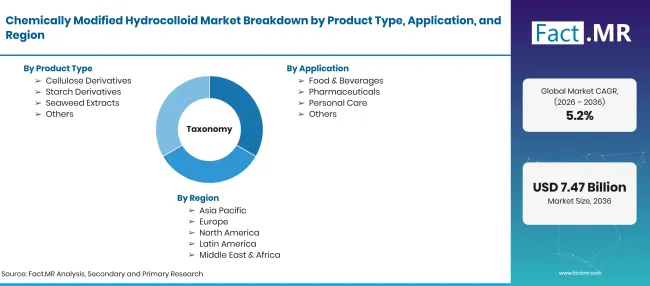
Chemically Modified Hydrocolloid Market Taxonomy | Source: Fact.MR
| Attribute | Details |
|---|---|
| Quantitative Units | USD billion |
| Market Definition | The chemically modified hydrocolloid market comprises hydrocolloid ingredients that have undergone chemical modification to enhance or alter their functional properties, including viscosity control, thickening, gel formation, stabilization, water retention and texture modification. |
| Product Type | Cellulose Derivatives; Starch Derivatives; Seaweed Extracts; Others |
| Application | Food & Beverages; Pharmaceuticals; Personal Care; Others |
| Function | Thickening; Gelling; Stabilizing; Others |
| Source | Plant; Animal; Microbial; Synthetic |
| Regions Covered | North America; Latin America; Western Europe; Eastern Europe; East Asia; South Asia & Pacific; Middle East & Africa |
| Countries Covered | Germany; Brazil; USA; UK; Japan |
| Companies Profiled | Cargill, Incorporated; Ingredion Incorporated; International Flavors & Fragrances Inc. (IFF); Ashland Inc.; and Tate & Lyle PLC |
| Forecast Period | 2026 to 2036 |
| Approach | Market segmentation and scenario-based analysis supported by official industrial indicators and company portfolio reviews |
Source: Fact.MR analysis. Updated Oct 27, 2026
How is the market segmented?
-
By Product Type
- Cellulose Derivatives
- Starch Derivatives
- Seaweed Extracts
- Others
-
By Application
- Food & Beverages
- Pharmaceuticals
- Personal Care
- Others
-
By Function
- Thickening
- Gelling
- Stabilizing
- Others
-
By Source
- Plant
- Animal
- Microbial
- Synthetic
-
By Region
- North America
- Latin America
- Western Europe
- Eastern Europe
- East Asia
- South Asia & Pacific
- Middle East & Africa
Frequently Asked Questions
How big is the chemically modified hydrocolloid market in 2026?
What is the CAGR from 2026 to 2036?
Which product type has the largest share?
Which application leads the market?
Which function has the largest share?
Which source leads the market?
Which companies are covered?
Who worked on this report


Preview the report firsthand - request a free sample
Free SampleGet the brochure for pricing and purchase details
Download PDF