- Market Value (2025): USD 213.4 Bn
- Estimated Value (2026): USD 227.0 Bn
- Forecast Value (2036): USD 420.6 Bn
- CAGR (2026-2036): 6.4%
What is the Chemical Intermediates Market forecast to be worth by 2036?
USD 227.0 billion in 2026 to USD 420.6 billion by 2036, registering a CAGR of 6.4%.
- As per the market analysis, the Chemical Intermediates Market was valued at USD 213.4 billion in 2025.
- Market revenue is projected to rise from USD 227.0 billion in 2026 to USD 420.6 billion by 2036.
- The market is expected to register a CAGR of 6.4% between 2026 and 2036.
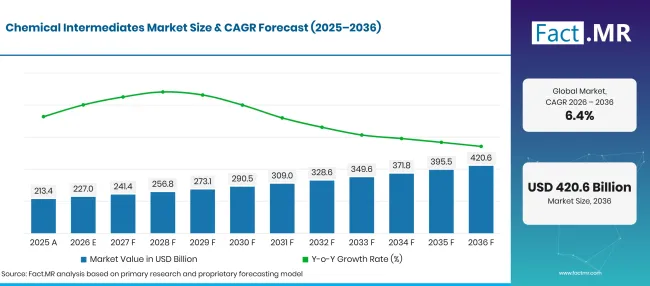
Factmr Chemical Intermediates Market Forecast Global | Source: Fact.MR
| Year | Basis | Market value (USD Billion) |
|---|---|---|
| 2025 | Actual | 213.4 |
| 2026 | Estimate | 227.0 |
| 2036 | Forecast | 420.6 |
| CAGR 2026 to 2036 | Forecast period | 6.4% |
Source: Fact.MR analysis. Updated Oct 14, 2026
What are the defining numbers behind Chemical Intermediates Market growth?
The market is expected to generate an absolute revenue opportunity of USD 193.6 billion between 2026 and 2036.
- Demand Drivers in the Market
- Expanding downstream chemical applications: Chemical intermediates are supporting the manufacture of paints, coatings, pharmaceutical ingredients, and agricultural chemicals. Increasing demand for specialized formulations is encouraging manufacturers to broaden their intermediate portfolios.
- Industrial manufacturing expansion: Chemical producers are strengthening their production capabilities to meet the requirements of industrial customers. Greater emphasis on process efficiency and consistent input quality is supporting demand across manufacturing value chains.
- Growing pharmaceutical requirements: Pharmaceutical manufacturers are relying on chemical building blocks, reagents, and protective groups to facilitate complex synthesis processes. Continued development of specialized compounds is expected to support demand for high-purity intermediates.
- Product innovation and process optimization: Manufacturers are investing in improved synthesis methods, resource utilization, and production controls. These measures are helping suppliers improve operating efficiency while meeting increasingly specific customer requirements.
- Key Segments Analyzed
- By Form: Liquid will account for 54.2% of the market in 2026, supported by its versatility in chemical processing, formulation, and industrial applications.
- By End User: Paints & Coatings will represent 29.4% of the market in 2026, reflecting demand for chemical inputs used in coating formulations and surface-protection products.
- By Type: Solvents will hold 31.2% of the market in 2026, supported by their use in dissolution, extraction, synthesis, and formulation processes.
- Analyst Opinion
- Shambhu Nath Jha, Principal Consultant at Fact.MR, states, “Chemical intermediates are becoming essential to efficient manufacturing across paints and coatings, pharmaceuticals, agriculture, and industrial processing. Buyers will increasingly prioritize consistent product quality, application-specific formulations, and reliable supply arrangements. Suppliers that combine advanced production capabilities with stringent quality control and technical expertise will be better positioned to capitalize on emerging opportunities across downstream chemical industries.”
- Strategic Implications
- Manufacturers need to expand application-specific product portfolios to address changing requirements across coatings, pharmaceuticals, agriculture, and industrial processing.
- Chemical suppliers must improve process efficiency and quality assurance to maintain consistent product specifications and strengthen customer relationships.
- Market participants are advised to diversify sourcing and reinforce supply-chain resilience to mitigate exposure to raw-material volatility and production interruptions.
- Investors and strategic planners can prioritize opportunities in high-value intermediates and specialized chemical inputs that serve growing downstream applications.
Germany will record the highest country-level growth among the listed markets, with a projected CAGR of 7.3% from 2026 to 2036. Brazil will follow at 6.6%, while the United States will register 6.0%. The United Kingdom is expected to expand at 5.4%, and Japan will record a CAGR of 4.7% over the forecast period.
How does the Chemical Intermediates Market break down by segment?
Liquid will lead the Form segment at 54.2%, Paints & Coatings will lead the End-Users segment at 29.4%, and Solvents will lead the Types segment at 31.2% in 2026.
Which Form segment dominates?
Liquid will account for 54.2% of the Chemical Intermediates Market in 2026.
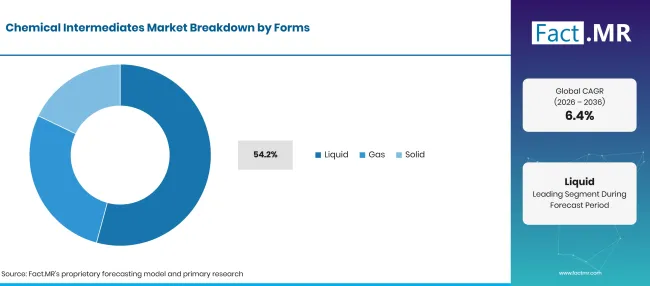
Factmr Chemical Intermediates Market Breakdown Forms | Source: Fact.MR
| Segment Name | Share (2026) |
|---|---|
| Leading segment — Liquid | 54.2% |
| Other segments combined | 45.8% |
| Total | 100.0% |
Source: Fact.MR analysis. Updated Oct 14, 2026
Liquid intermediates are expected to retain their leading position because they can be incorporated into a broad range of chemical synthesis, blending, and formulation processes. Their handling characteristics make them suitable for industrial production systems that require controlled dosing, transfer, and mixing. Manufacturers are continuing to optimize liquid chemical processing to improve operational efficiency and product consistency. Solid intermediates serve applications that require defined physical characteristics, convenient storage, or controlled material handling. Gaseous intermediates are used in selected chemical reactions and industrial processes where gas-phase inputs are necessary. Demand across these forms will continue to depend on processing requirements, product specifications, and end-use applications.
What supports Paints & Coatings within End Users?
Paints & Coatings will account for 29.4% of the market in 2026.
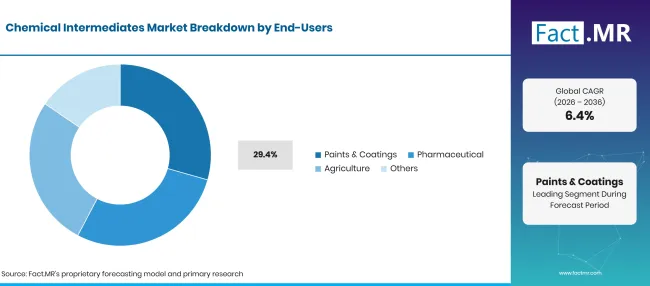
Factmr Chemical Intermediates Market Breakdown End Users | Source: Fact.MR
| Segment Name | Share (2026) |
|---|---|
| Leading segment — Paints & Coatings | 29.4% |
| Other segments combined | 70.6% |
| Total | 100.0% |
Source: Fact.MR analysis. Updated Oct 14, 2026
Paints and coatings are expected to remain a major end-use segment as manufacturers require chemical intermediates for formulation, processing, and performance enhancement. These inputs support the development of products designed to meet requirements related to durability, application properties, and surface protection. Demand is also being influenced by ongoing maintenance, construction, and industrial finishing activities. Pharmaceutical applications require intermediates that support the synthesis of active compounds and other specialized ingredients. Agricultural applications rely on chemical inputs used in the manufacture of crop-protection products and related formulations. Other end users contribute to demand through a range of industrial and specialty chemical applications.
What leads the Types segment?
Solvents will hold 31.2% of the Chemical Intermediates Market in 2026.
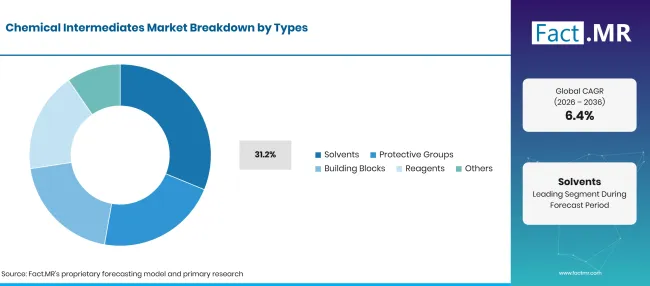
Factmr Chemical Intermediates Market Breakdown Types | Source: Fact.MR
| Segment Name | Share (2026) |
|---|---|
| Leading segment — Solvents | 31.2% |
| Other segments combined | 68.8% |
| Total | 100.0% |
Source: Fact.MR analysis. Updated Oct 14, 2026
Solvents will lead the Types segment because they perform essential functions in chemical processing, including dissolution, extraction, reaction control, and formulation. Their use across multiple industries provides a broad demand base. Manufacturers are expected to continue developing solvent solutions that align with application-specific performance, safety, and process-efficiency requirements. Protective groups support multistep chemical synthesis by temporarily modifying reactive functional groups. Building blocks serve as foundational compounds in the production of more complex molecules, while reagents facilitate chemical transformations. Other types contribute to specialized synthesis and processing requirements across diverse industrial applications.
What is accelerating Chemical Intermediates Market adoption, and what is holding it back?
Market growth is being supported by expanding industrial applications, pharmaceutical synthesis requirements, and continued demand for formulation chemicals. However, raw-material price volatility, regulatory compliance costs, and production complexity may constrain expansion.
Drivers Impact Analysis
| DRIVER | (~) % IMPACT ON CAGR | GEOGRAPHIC RELEVANCE | IMPACT TIMELINE |
|---|---|---|---|
| Expanding demand for chemical inputs across industrial applications | +2.0% | Global | Medium term (2–4 years) |
| Increasing requirements for pharmaceutical intermediates | +1.6% | North America, Europe, East Asia | Medium term (2–4 years) |
| Demand for solvents in manufacturing and formulation processes | +1.2% | Global | Short term (≤ 2 years) |
| Growth in specialized chemical production and product development | +0.8% | Asia Pacific, Europe, North America | Long term (≥ 4 years) |
Source: Fact.MR analysis. Updated Oct 14, 2026
Opportunity Impact Analysis
| OPPORTUNITY | (~) % IMPACT ON CAGR | GEOGRAPHIC RELEVANCE | IMPACT TIMELINE |
|---|---|---|---|
| Development of high-value specialty intermediates | +1.2% | Global | Medium term (2–4 years) |
| Process optimization and improved production efficiency | +0.9% | Global | Medium term (2–4 years) |
| Expansion of pharmaceutical and advanced synthesis applications | +0.6% | North America, Europe, East Asia | Long term (≥ 4 years) |
| Diversification of supply chains and regional manufacturing | +0.4% | Europe, Asia Pacific, Latin America | Short term (≤ 2 years) |
Source: Fact.MR analysis. Updated Oct 14, 2026
Restraints Impact Analysis
| RESTRAINT | (~) % IMPACT ON CAGR | GEOGRAPHIC RELEVANCE | IMPACT TIMELINE |
|---|---|---|---|
| Volatility in feedstock and raw-material prices | -0.8% | Global | Short term (≤ 2 years) |
| Environmental compliance and chemical-handling requirements | -0.6% | Europe, North America, Asia Pacific | Medium term (2–4 years) |
| Production complexity and quality-control requirements | -0.4% | Global | Long term (≥ 4 years) |
Source: Fact.MR analysis. Updated Oct 14, 2026
Which countries are scaling the Chemical Intermediates Market through 2036?
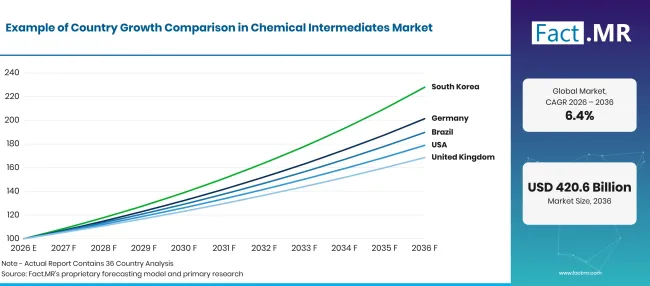
Factmr Chemical Intermediates Market Growth Index 1 | Source: Fact.MR
| Country | CAGR (2026–2036) |
|---|---|
| Germany | 7.3% |
| Brazil | 6.6% |
| United States | 6.0% |
| United Kingdom | 5.4% |
| Japan | 4.7% |
Source: Fact.MR analysis. Updated Oct 14, 2026
What supports Germany's adoption?
7.3% CAGR, supported by its established chemical manufacturing base and demand for specialized intermediates.
Germany's chemical industry serves a broad range of downstream applications, including coatings, pharmaceuticals, and industrial manufacturing. Manufacturers are strengthening production efficiency and developing specialized chemical inputs to meet evolving formulation requirements. Demand for high-quality intermediates will continue to shape market expansion through 2036.
How is Brazil scaling demand?
6.6% CAGR, driven by industrial chemical demand and expanding downstream applications.
Brazil's chemical intermediates market is benefiting from demand across agricultural chemicals, coatings, and industrial processing. Manufacturers are focusing on production capabilities and supply-chain reliability to serve downstream customers. Greater adoption of specialized intermediates will support market development as industrial requirements evolve.
What supports United States adoption?
6.0% CAGR, supported by diverse manufacturing industries and demand for high-performance chemical inputs.
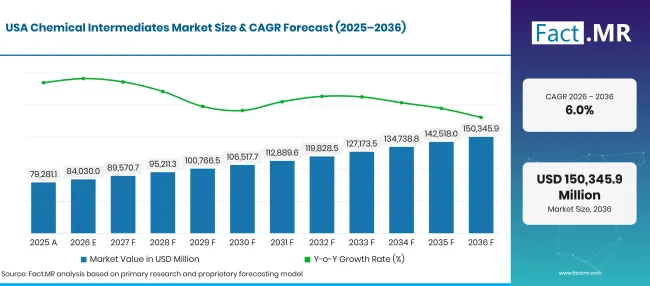
Factmr Chemical Intermediates Market Forecast Usa | Source: Fact.MR
U.S. manufacturers use solvents, reagents, and other intermediates across pharmaceutical synthesis, coatings, and industrial applications. Companies are prioritizing process optimization and consistent product specifications to meet increasingly specialized requirements. Continued demand from established downstream industries will support market growth through 2036.
How is the United Kingdom developing demand?
5.4% CAGR, supported by specialty chemical applications and established downstream manufacturing industries.
The United Kingdom's market is being sustained by demand for chemical inputs used in pharmaceutical production, coatings, and industrial formulations. Suppliers are focusing on product quality and application-specific solutions to meet changing customer requirements. Market expansion will depend on manufacturing activity and demand for specialized chemical intermediates.
What is supporting Japan's adoption?
4.7% CAGR, supported by advanced manufacturing capabilities and demand for specialized chemical intermediates.
Japan's chemical industry serves downstream manufacturers requiring precise specifications and consistent intermediate quality. Companies are emphasizing production efficiency, specialized synthesis, and process optimization to support industrial applications. Demand from established manufacturing sectors will sustain market development, although the country is projected to record the lowest CAGR among the five markets analyzed.
Who leads the Chemical Intermediates Market?
Competition includes diversified chemical manufacturers and specialized producers serving industrial, pharmaceutical, and formulation applications. Companies compete through product breadth, manufacturing scale, process expertise, technical support, and supply reliability. Suppliers with established production networks can serve multiple downstream industries, while specialized manufacturers can differentiate themselves through tailored chemistry and application-specific performance.
BASF SE, Dow Inc., Eastman Chemical, Evonik Industries, and Huntsman Corporation are among the major companies identified in the market. Lanxess AG, LyondellBasell Industries, Mitsubishi Chemical Holdings also form part of the competitive landscape.
Competitive positioning through 2036 will depend on the ability to maintain consistent quality, manage input costs, meet applicable regulatory requirements, and respond to changes in downstream demand.
Which companies are the key providers?
The key companies identified for the Chemical Intermediates Market are:
- BASF SE
- Dow Inc.
- Eastman Chemical
- Evonik Industries
- Huntsman Corporation
- Lanxess AG
- LyondellBasell Industries
- Mitsubishi Chemical Holdings
Bibliography
- [1] BASF SE. (2026). BASF report 2025: Chemicals segment and intermediates business. BASF SE.
- [2] Verband der Chemischen Industrie. (2026). The German chemical industry in figures: Statistical data on the chemical and pharmaceutical industry. VCI.
- [3] Germany Trade & Invest. (2026). The chemical industry in Germany: Industry statistics and market overview. Germany Trade & Invest.
- [4] European Chemical Industry Council. (2025). Facts & figures of the European chemical industry 2025. Cefic.
- [5] Associação Brasileira da Indústria Química. (2026). Brazilian chemical industry: Key indicators and industry statistics. ABIQUIM.
- [6] BASF SE. (2025). BASF report 2024: Chemicals and intermediates business. BASF SE.
- [7] BASF SE. (2026). Intermediates: Products, production capabilities, and downstream applications. BASF SE.
- [8] Verband der Chemischen Industrie. (2026). Quarterly report 4/2025: Chemical industry still in trouble. VCI.
This Report Answers
- The report explains how chemical intermediates support downstream manufacturing across form, end-use, and product-type categories.
- Segment analysis identifies the leading category within each reported segment and its share of the 2026 market.
- Country analysis compares Germany, Brazil, the United States, the United Kingdom, and Japan by their projected CAGRs.
Strategic analysis examines growth drivers, market opportunities, and constraints affecting chemical intermediate production and demand.
What does the Chemical Intermediates Market cover?
The Chemical Intermediates Market covers chemical substances used as inputs in the production of other chemicals, formulations, and industrial products. These substances support synthesis, processing, extraction, and formulation activities across industries such as paints and coatings, pharmaceuticals, and agriculture.
The assessment includes intermediates classified by physical form, end-user industry, and chemical function. It considers solvents, protective groups, building blocks, reagents, and other intermediate categories used in downstream production.
What is included in the scope?
The scope includes chemical intermediates used in industrial processing, synthesis, and formulation. It covers liquid, gaseous, and solid forms, alongside products serving coatings, pharmaceutical, agricultural, and other end-use applications.
The assessment also considers the principal supplier landscape, country-level growth projections, and commercial factors influencing demand for chemical inputs.
What is excluded from the scope?
The scope excludes finished products that do not function as chemical intermediates, as well as downstream goods sold solely for final consumption. Equipment, processing machinery, and unrelated industrial services are not included as chemical intermediate market revenue.
Where products serve multiple functions, classification depends on their role as intermediate chemical inputs rather than their final application or end-product value.
How Was the Analysis Built?
The analysis draws on 120+ sources, 35+ company portfolios, 25+ countries, and more than 20 industry interviews.
- Primary Research: Primary research includes discussions with manufacturers, service providers, technology developers, distributors, end users, and subject-matter experts. These conversations examine purchasing priorities, product adoption, operational challenges, approval requirements, competitive positioning, and the factors that influence wider market acceptance.
- Desk Research: Desk research covers government statistics, regulatory publications, company filings, trade data, technical studies, industry associations, standards, public policy, and other authoritative sources. Every source used in the analysis is documented in the bibliography.
- Market Sizing and Forecasting: Market estimates combine historical performance, demand indicators, pricing and volume trends, segment shares, company participation, country-level growth, adoption patterns, investment activity, and barriers to market expansion.
- Data Validation and Update Cycle: Findings are validated by comparing primary interviews with public data, company activity, regulatory changes, trade patterns, and industry developments. Regular updates review new product launches, capacity changes, partnerships, approvals, and shifts in commercial adoption.
Segmentation
What is the report's scope and coverage?
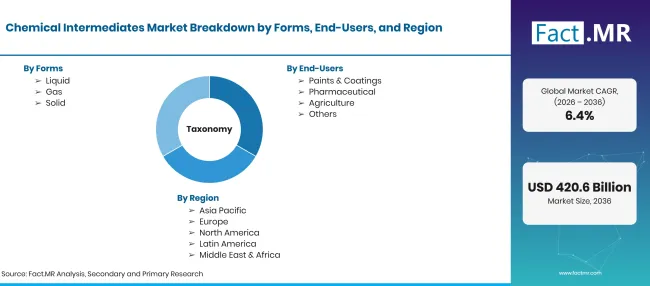
Factmr Chemical Intermediates Market Taxonomy | Source: Fact.MR
| Attribute | Details |
|---|---|
| Quantitative Units | USD 227.0 billion in 2026 to USD 420.6 billion by 2036 at a 6.4% CAGR |
| Market Definition | Chemical substances used as intermediate inputs in the production of other chemicals, formulations, and industrial products. The market covers intermediates used in synthesis, processing, extraction, and formulation across paints & coatings, pharmaceuticals, agriculture, and other industrial applications. |
| Form | Liquid; Gas; Solid |
| End User | Paints & Coatings; Pharmaceutical; Agriculture; Others |
| Type | Solvents; Protective Groups; Building Blocks; Reagents; Others |
| Regions Covered | North America; Latin America; Western Europe; Eastern Europe; East Asia; South Asia & Pacific; Middle East & Africa |
| Countries Covered | Germany; Brazil; United States; United Kingdom; Japan |
| Key Companies Profiled | BASF SE; Dow Inc.; Eastman Chemical; Evonik Industries; Huntsman Corporation; Lanxess AG; LyondellBasell Industries; Mitsubishi Chemical Holdings |
| Forecast Period | 2026 to 2036 |
| Approach | Market sizing and forecasting based on historical performance, demand indicators, pricing and volume trends, segment shares, company participation, country-level growth, adoption patterns, investment activity, and barriers to market expansion. |
Source: Fact.MR analysis. Updated Oct 14, 2026
How is the market segmented?
-
By Form
- Liquid
- Gas
- Solid
-
By End User
- Paints & Coatings
- Pharmaceutical
- Agriculture
- Others
-
By Type
- Solvents
- Protective Groups
- Building Blocks
- Reagents
- Others
-
By Region and Country
- Germany
- Brazil
- United States
- United Kingdom
- Japan
Frequently Asked Questions
How big is the Chemical Intermediates Market in 2026?
What is the forecast value of the Chemical Intermediates Market by 2036?
What is the CAGR of the Chemical Intermediates Market from 2026 to 2036?
Which form leads the Chemical Intermediates Market?
Which end-user segment leads the Chemical Intermediates Market?
Which type leads the Chemical Intermediates Market?
Which country will grow the fastest in the Chemical Intermediates Market?
Who are the main companies in the Chemical Intermediates Market?
Who worked on this report


Preview the report firsthand - request a free sample
Free SampleGet the brochure for pricing and purchase details
Download PDF