- Market Value (2025): USD 21.4 Bn
- Estimated Value (2026): USD 25.0 Bn
- Forecast Value (2036): USD 120.4 Bn
- CAGR (2026-2036): 17.0%
What is the Chemical Industry 4.0 Market forecast to be worth by 2036?
USD 25.0 billion in 2026 to USD 120.4 billion by 2036, at 17.0% CAGR.
- The chemical industry 4.0 market size was valued at USD 21.4 billion in 2025, influenced by connected manufacturing software uptake across process-heavy plants.
- Demand is projected to increase from USD 25.0 billion in 2026 to USD 120.4 billion by 2036.
- The market is forecast to record a 17.0% CAGR from 2026 to 2036, led by plant teams connecting workflow control and enterprise decision systems.
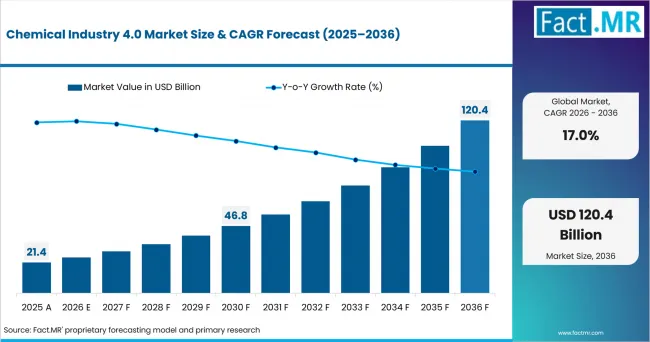
Chemical Industry 4 | Source: Fact.MR
What are the defining numbers behind Chemical Industry 4.0 Market growth?
USD 95.4 billion absolute opportunity by 2036, led by Software & Platforms under Component, Industrial IoT under Technology, Process Optimization under Application, and Petrochemicals under End Use.
- Demand Drivers in the Market
- Chemical plant operators need connected batch records supported by live equipment data and clearer shift-level accountability.
- Process engineers use workflow automation tools supported by alarm history and operating procedure updates.
- Enterprise risk teams depend on plant-data access for financing review and operating exposure assessment.
- Manufacturing technology teams require secure API tools for linking plant historians and planning platforms.
- Key Segments Analyzed
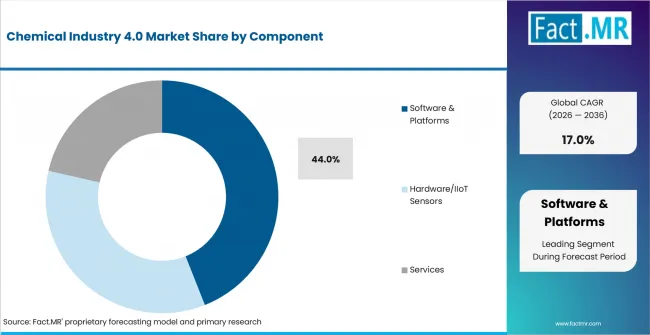
- By Component: Software & platforms is projected to garner 44% share in 2026, supported by platform orchestration and workflow configuration.
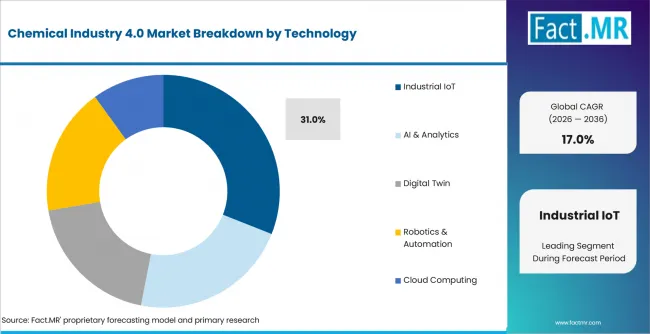
- By Technology: Industrial IoT is forecast to account for 31% share in 2026, shaped by connected equipment data and real-time monitoring.
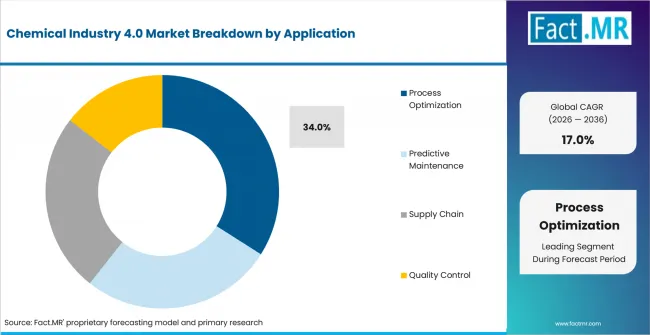
- By Application: Process optimization is expected to hold 34% share in 2026, driven by yield review and operating efficiency tools.
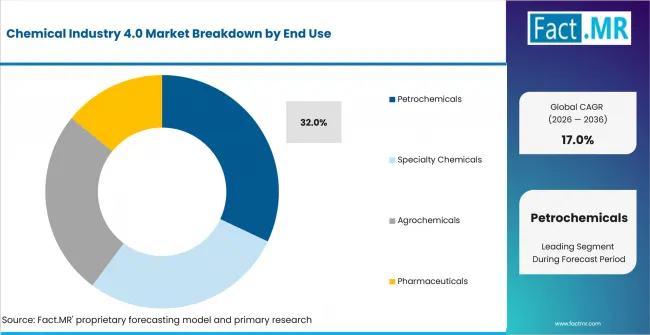
- By End Use: Petrochemicals are estimated to represent 32% share in 2026, reflected by complex continuous production and asset-intensive operations.
- Analyst Opinion at Fact.MR
- Shambhu Nath Jha, Senior Analyst at Fact.MR, states, “Chemical Industry 4.0 adoption is now a plant-discipline issue beyond a software purchase. Demand is expected to favor providers proving secure data movement between engineering tools and compliance records. Better-qualified vendors should combine workflow design and cybersecurity validation.”
- Strategic Implications
- Chemical producers are expected to validate workflow tools against live batch-review routines before expanding across other plants.
- Automation vendors are likely to pair control-system knowledge with open integration support for lab and planning systems.
- Cloud providers are estimated to document data-residency safeguards before targeting regulated chemical accounts.
- Enterprise leaders are anticipated to separate dashboard pilots from production workflow approvals during investment review.
Emerson completed its remaining AspenTech share acquisition in March 2025, and Emerson stated shareholders received USD 265.00 per AspenTech common share. AspenTech stock also stopped trading on Nasdaq after deal completion. Transaction detail supports stronger industrial software depth for modeling and production decision systems inside chemical operations.
India is projected to record 18.8% CAGR by 2036, reflected by chemical production scale and manufacturing modernization. China is anticipated to post 18.1% CAGR through 2036 propelled by robotics and high-tech factory investment. Australia is estimated to advance at 16.8% CAGR from 2026 to 2036 due to business AI uptake among innovation-active firms. United Kingdom is expected to hold 16.5% CAGR between 2026 and 2036, reinforced by AI use among larger businesses. United States is forecast to record 16.3% CAGR during the study period, shaped by enterprise AI experimentation.
How does the Chemical Industry 4.0 Market break down by segment?
Software & platforms is expected to lead at 44%, Process optimization is estimated to dominate at 34%.
What component is set to lead demand?
Software & platforms is anticipated to hold 44% share in 2026.
Chemical Industry 4 | Source: Fact.MR
Software & platforms is projected to account for 44% share in 2026, guided by workflow configuration and plant-data orchestration. Hardware/IoT Sensors continue serving plants requiring live equipment data and shopfloor connectivity. Services support migration work and process-specific configuration. Siemens stated in March 2025 its Accenture Siemens Business Group would comprise 7,000 professionals worldwide and its Hannover Messe showcase covered industrial AI and digital twin technology. Platform depth is therefore central to factory operating systems.
What technology is likely to dominate the market?
Industrial IoT is projected to secure 31% share in 2026.
Chemical Industry 4 | Source: Fact.MR
Industrial IoT is forecast to account for 31% share in 2026, shaped by connected equipment data and real-time monitoring. AI & analytics follows in use cases linked to anomaly review and decision support. Digital twin and robotics & automation support simulation-led planning and automated plant tasks. Eurostat reported in January 2026 that 52.74% of EU enterprises used paid cloud computing services in 2025. Platform acceptance across industrial and business operations supports faster rollout of connected plant workflows.
What application is projected to garner Chemical Industry 4.0 usage?
Process optimization is set to hold 34% share in 2026.
Chemical Industry 4 | Source: Fact.MR
Process optimization is estimated to represent 34% share in 2026, supported by yield review and equipment-performance improvements. Predictive Maintenance helps maintenance planning across process plants. Supply chain and quality control support audit-ready records for material movement and product release. ABB launched Industrial Knowledge Vault in March 2025 using generative AI to preserve workforce knowledge and stated ABB Process Automation had around 20,000 employees. Chemical operators gain a practical route for standardizing repeated plant decisions.
What end use is anticipated to support adoption?
Petrochemicals is expected to hold 32% share in 2026.
Chemical Industry 4 | Source: Fact.MR
Petrochemicals are anticipated to capture 32% share in 2026, due to asset-intensive operations and high-value process uptime. Specialty Chemicals follow as teams need flexible batch records and quality workflows. Agrochemicals and Pharmaceuticals add demand for documentation-led operating systems. Press Information Bureau reported in January 2026 that chemicals and petrochemicals contributed 8.1% to India's manufacturing GVA in Financial Year 2024. Large production bases increase demand for connected operating systems.
What is accelerating Chemical Industry 4.0 Market adoption, and what is holding it back?
Plant-data integration drives it; brownfield system complexity restrains it.
Drivers Impact Analysis
| DRIVER | (~) % IMPACT ON CAGR | GEOGRAPHIC RELEVANCE | IMPACT TIMELINE |
|---|---|---|---|
| Plant-data integration across production sites | +1.8% | Global | Medium term (2-4 years) |
| Cloud for multi-site operations | +1.5% | North America, Europe and Asia Pacific | Short term (<= 2 years) |
| AI-assisted workflow automation | +1.3% | United States, China and United Kingdom | Medium term (2-4 years) |
| Governance tools for audit-ready plant records | +0.9% | Europe and regulated Asian markets | Medium term (2-4 years) |
| SME modernization through modular software | +0.6% | India, Australia and United States | Long term (>= 4 years) |
Source: Fact.MR analysis. Updated Jul 10, 2026
- Plant-data integration: Chemical producers are replacing isolated reporting files with connected plant-data layers. International Federation of Robotics reported in September 2025 stating 542,000 industrial robots were installed worldwide in 2024. Factory automation depth increases the need for production software, since equipment data needs review and operating context before it supports plant decisions.
- Cloud: Cloud platforms reduce entry barriers for multi-site analytics and remote operating support. Eurostat reported in January 2026, 96.44% of EU enterprises buying cloud services purchased at least one software-as-a-service function in 2025. Chemical teams gain easier rollout paths for workflow and reporting tools as software delivery gains acceptance among enterprise users.
- AI-assisted workflow automation: AI tools are entering maintenance triage, document search and operator guidance. United States Census Bureau reported in May 2026, overall AI use among businesses hovered between 17% and 20% from December 2025 to May 2026. Chemical accounts are expected to apply AI first to repeated review tasks, since those workflows already have documented procedures and decision checkpoints.
- Governance tools: Compliance teams need version control for formulas, operating records and plant-change approvals. Eurostat reported in June 2026, 19.95% of EU enterprises used AI technologies in 2025. AI adoption increases the need for model oversight and data accountability inside regulated production settings.
- SME modernization: Smaller chemical companies are adopting modular tools before full platform changeovers. Australian Bureau of Statistics reported in June 2026, 46% of Australian businesses were innovation-active in 2024-25. Innovation activity supports software trials among smaller industrial firms as providers package workflow tools into shorter qualification cycles.
Opportunity Impact Analysis
| OPPORTUNITY | (~) % IMPACT ON CAGR | GEOGRAPHIC RELEVANCE | IMPACT TIMELINE |
|---|---|---|---|
| Industrial copilots for process teams | +1.2% | United States and Europe | Medium term (2-4 years) |
| Plant twins for simulation-led operations | +1.0% | China, Germany and Japan | Medium term (2-4 years) |
| Hybrid cloud for regulated chemical sites | +0.8% | Europe, United States and Japan | Short term (<= 2 years) |
| API tools linking lab and plant records | +0.6% | Global | Long term (>= 4 years) |
Source: Fact.MR analysis. Updated Jul 10, 2026
- Industrial copilots: Operator guidance tools create opportunity around knowledge retention and faster fault review. Schneider Electric stated in May 2025, it introduced a generative AI assistant developed with Microsoft for Automate 2025. Process teams gain practical support for engineering tasks and document navigation as copilots connect plant knowledge with user prompts.
- Plant twins: Simulation-led operating tools support scenario testing before chemical plants change settings or recipes. Siemens stated in March 2025, its Hannover Messe showcase included industrial AI and twin technology for factories. Opportunity is projected to expand as chemical plants link process models with operating records and engineering updates.
- Hybrid cloud: Hybrid gives plants more control over sensitive production data and keeps enterprise analytics accessible. International Federation of Robotics reported in September 2025, Asia accounted for 74% of new industrial robots in 2024. Automation concentration increases data volumes, making hybrid architectures useful for plants balancing local control and enterprise review.
- API tools: Integration tools help connect laboratory information, maintenance records and production planning systems. Rockwell Automation stated in October 2025, more than 30 new products were planned for Automation Fair 2025. Chemical software providers gain room as customers seek smoother data movement across established systems.
Restraints Impact Analysis
| RESTRAINT | (~) % IMPACT ON CAGR | GEOGRAPHIC RELEVANCE | IMPACT TIMELINE |
|---|---|---|---|
| Brownfield control-system complexity | -1.0% | Global | Medium term (2-4 years) |
| Data-governance and model-trust gaps | -0.8% | Europe and North America | Medium term (2-4 years) |
| Skills shortage across plant software roles | -0.7% | Global | Long term (>= 4 years) |
| Cybersecurity exposure in connected plants | -0.5% | Global | Short term (<= 2 years) |
Source: Fact.MR analysis. Updated Jul 10, 2026
- Brownfield complexity: Older chemical plants often operate with mixed control systems and custom interfaces. Integration work slows as teams map historian data and equipment tags. Adoption is expected to stay staged unless providers prove migration safety and protect existing production routines.
- Model-trust gaps: Plant teams need evidence before AI recommendations affect shift decisions. Eurostat reported in June 2026, 55.03% of large EU enterprises used AI technologies in 2025. Chemical operators need stronger validation before similar tools support audit explanations and maintenance prioritization.
- Skills shortage: Process plants need engineers who understand automation, chemistry and data systems. Yokogawa launched OpreX Plant Stewardship in April 2025 as a lifecycle service program for operational excellence. Service-led adoption is projected to rise as internal teams seek outside support for complex plant systems.
- Cybersecurity exposure: Connected factories expand access points across plant and enterprise systems. Honeywell and Google Cloud announced in October 2024 a collaboration connecting AI agents with assets and processes for industrial operations. Spending is anticipated to slow at sites lacking clear responsibility across automation and IT teams.
What countries are scaling Chemical Industry 4.0 Market?
India 18.8%, China 18.1%, Australia 16.8%, United Kingdom 16.5%, United States 16.3%.
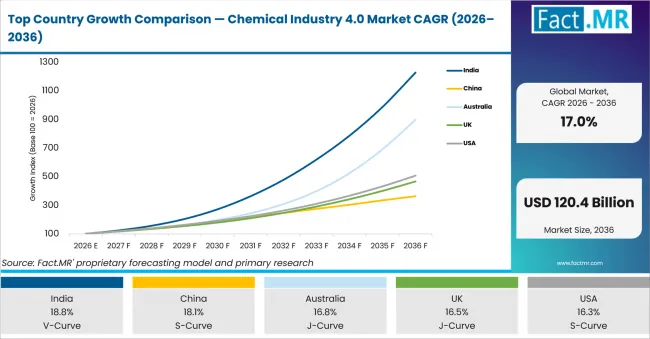
Top Country Growth Comparison Chemical Industry 4 | Source: Fact.MR
Regional analysis covers North America, Latin America, Europe, East Asia, South Asia and Pacific, and Middle East and Africa.
| COUNTRY | CAGR |
|---|---|
| India | 18.8% |
| China | 18.1% |
| Australia | 16.8% |
| United Kingdom | 16.5% |
| United States | 16.3% |
Source: Fact.MR analysis. Updated Jul 10, 2026
What is driving India's growth through 2036?
18.8% CAGR, driven by chemical production scale and plant modernization.
Indian chemical producers are moving from basic plant reporting toward connected production planning. Press Information Bureau reported in January 2026 that chemicals and petrochemicals contributed 8.1% to India's manufacturing GVA in Financial Year 2024, giving software vendors a wide operating base. Industry in India is projected to record 18.8% CAGR by 2036 due to mid-sized operators adding workflow tools and cloud dashboards.
How is China scaling Chemical Industry 4.0 demand?
18.1% CAGR, supported by high-tech manufacturing and industrial robot.
China's chemical plants are adopting connected production tools inside a larger factory-upgrade cycle. National Bureau of Statistics of China reported in February 2026 that raw chemical materials and chemical products manufacturing grew 7.8% in 2025, and industrial robot output reached 77.3 ten-thousand sets. The market in China is anticipated to post 18.1% CAGR through 2036 since robotics and process control converge.
What supports the Australia outlook?
16.8% CAGR, shaped by AI uptake across innovation-active businesses.
Australia offers a smaller but active enterprise base for AI-led plant and workflow tools. The Australian Bureau of Statistics reported in June 2026 that 12% of Australian businesses used AI in 2024–25, while AI use among manufacturing businesses stood at 9%. Sector in Australia is estimated to grow at 16.8% CAGR between 2026 and 2036, as industrial teams test software-led operations.
What underpins United Kingdom adoption?
16.5% CAGR, reinforced by enterprise AI use and compliance-focused operations.
United Kingdom chemical accounts operate in a setting with close attention to safety files and data governance. Office for National Statistics reported in January 2026 that 25% of businesses used AI in late December 2025, up 15 percentage points from late September 2023. Demand in the United Kingdom is expected to hold 16.5% CAGR during the study period, driven by larger sites connect operating data to management systems.
How is United States demand developing?
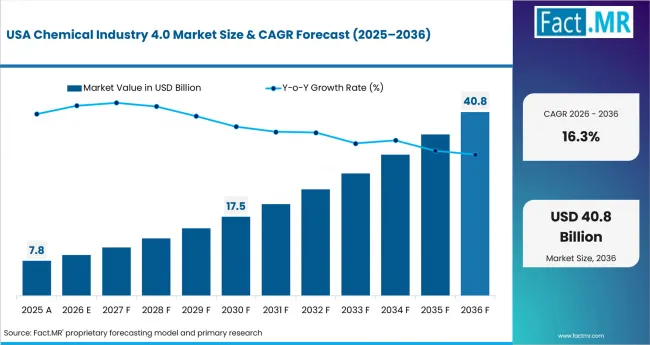
16.3% CAGR, driven by enterprise AI pilots and software-defined operations.
Chemical Industry 4 | Source: Fact.MR
United States chemical producers are expanding plant software around maintenance and energy-performance. United States Census Bureau reported in May 2026 that 37% of firms with at least 250 employees used AI in operations during its survey period ending May 3, 2026. Sales in the United States are forecast to record 16.3% CAGR during the forecast period, reflected by large enterprises moving pilots into operating routines.
Who leads the Chemical Industry 4.0 Market?
Siemens and Emerson lead direct Chemical Industry 4.0 coverage, and ABB and Schneider Electric strengthen industrial AI and automation software capabilities.
Siemens brings factory software and automation platforms into chemical operating environments. Emerson strengthened process-software coverage based on AspenTech, extending reach across asset optimization and operational analytics. ABB adds industrial knowledge tools and automation software for process teams needing worker guidance and plant-data context.
Schneider Electric and AVEVA support industrial software and automation architecture. Honeywell connects operational efficiency and asset management through its current Honeywell Technologies positioning. Yokogawa adds lifecycle service and plant stewardship support, and Rockwell Automation expands connected automation tools for plant-level data and workflow control.
What companies are the key providers?
Siemens and Emerson are key providers. ABB and Schneider Electric are also profiled. Honeywell, Yokogawa Electric and Rockwell Automation complete the company set.
- Siemens
- Emerson
- ABB
- Schneider Electric
- Honeywell
- Yokogawa Electric
- Rockwell Automation
Bibliography
- ABB. (2025, March 31). ABB launches ABB Ability Industrial Knowledge Vault, a generative AI solution to safeguard expertise and empower workforces. ABB.
- Australian Bureau of Statistics. (2026, June 25). Characteristics of Australian Business, 2024-25 financial year. Australian Bureau of Statistics.
- Emerson. (2025, March 12). Emerson completes acquisition of remaining outstanding shares of AspenTech. Emerson.
- Eurostat. (2026, January 13). Cloud computing - statistics on use by enterprises. Eurostat.
- Eurostat. (2026, June 2). Use of artificial intelligence in enterprises. Eurostat.
- Google Cloud. (2024, October 21). Honeywell and Google Cloud to accelerate autonomous operations with AI agents for the industrial sector. Google Cloud.
- International Federation of Robotics. (2025, September 25). World Robotics 2025 report - industrial robots. International Federation of Robotics.
- National Bureau of Statistics of China. (2026, February 28). Statistical communiqué of the People's Republic of China on the 2025 national economic and social development. National Bureau of Statistics of China.
- Office for National Statistics. (2026, January 8). Business insights and impact on the UK economy: 8 January 2026. Office for National Statistics.
- Press Information Bureau. (2026, January 30). Chemicals and Petrochemicals sector contributed 8.1 per cent to manufacturing GVA in FY24; CPSEs under the Department achieve capex target. Press Information Bureau.
- Rockwell Automation. (2025, October 21). Rockwell Automation to showcase breakthrough technology and solutions at Automation Fair 2025. Rockwell Automation.
- Schneider Electric. (2025, May 12). Schneider Electric unveils innovations advancing American manufacturing at Automate 2025. Schneider Electric.
- Siemens. (2025, March 31). Siemens accelerates path toward AI-driven industries through innovation and partnerships. Siemens.
- United States Census Bureau. (2026, May 26). Large firms with at least 20 employees biggest AI users. United States Census Bureau.
- Yokogawa Electric Corporation. (2025, April 8). Yokogawa launches OpreX Plant Stewardship. Yokogawa Electric Corporation.
This Report Addresses
- The report provides strategic intelligence on Chemical Industry 4.0 across component and technology choices that shape connected chemical operations.
- Segment analysis covers Software & Platforms and Petrochemicals as share leaders within the 2026 market structure.
- Regional outlook evaluates India, China, Australia, United Kingdom and United States.
- Competitive analysis profiles Siemens, Emerson, ABB, Schneider Electric, Honeywell, Yokogawa Electric and Rockwell Automation.
- Application assessment covers Process Optimization, Predictive Maintenance, Supply Chain, and Quality Control.
- Forecast interpretation uses official technology-adoption statistics and company portfolio checks.
What does the Chemical Industry 4.0 Market cover?
Cloud, on-premise, hybrid and software-led systems used for chemical manufacturing modernization.
The chemical industry 4.0 market covers software and service systems used to connect production workflows and enterprise records. Coverage includes component types, application groups and end-use interfaces in market structure.
Market boundary differs from general industrial automation since value centers on chemical-production workflows, plant data and process-specific decision support. Standalone sensors, conventional control hardware and generic enterprise software remain outside scope unless sold as part of a chemical manufacturing modernization package.
What is included in the scope?
Chemical Industry 4.0 systems used in connected production, workflow automation and plant-data governance.
The scope includes Software, Services and API tools used across cloud, on-premise and hybrid models. Application coverage includes workflow automation, analytics, governance, and integration. End-use coverage follows the platform-use framework, including petrochemicals and other end-use categories. Included systems support batch review, maintenance routing, quality workflow, emissions records, asset optimization and production planning.
What is excluded from the scope?
Standalone control hardware and generic enterprise software are outside the scope.
The scope excludes field instruments, valves, pumps and basic control devices sold without a connected software or service layer. Generic office software and ordinary cloud storage remain excluded unless packaged for chemical plant workflows, operating-data governance or process optimization.
How was the analysis built?
120+ sources, 40+ company portfolios, 25+ countries, 20+ interviews.
- Primary Research
- Primary research includes interviews with chemical plant managers, process engineers, automation integrators and enterprise transformation heads. It also includes input from software architects, maintenance leaders, quality managers and industrial cybersecurity teams involved in Chemical Industry 4.0 selection.
- Desk Research
- Desk research reviews official AI adoption statistics, enterprise cloud data, chemical-sector production releases, industrial robot reports and product portfolios. Company announcements, software launch pages, lifecycle service releases and industrial automation documents are also evaluated to assess market developments and competitive positioning.
- Market-Sizing and Forecasting
- Forecasting uses chemical production activity, plant modernization cycles, workflow automation attachment, software subscription patterns and integration intensity. Forecast models also consider country-level AI uptake, cloud adoption, industrial automation depth and validation across chemical manufacturing use cases.
- Data Validation and Update Cycle
- Forecasts are validated through provider checks and industry interviews that test assumptions on software attachment and workflow adoption. Portfolio mapping, country assessment and operator feedback help confirm market direction, and recurring reviews of official statistics and company launches support forecast updates.
Segmentation
What is the report's scope and coverage?
| Attribute | Details |
|---|---|
| Quantitative Units | USD billion in2026to USD billion by2036at CAGR |
| Market Definition | Connected software, service and integration systems used to modernize chemical production workflows, plant-data governance, analytics and operating decisions |
| Component | Software & Platforms; Hardware/IoTSensors; Services |
| Technology | Industrial IoT; AI & Analytics; Digital Twin; Robotics & Automation; Cloud Computing |
| Application | Process Optimization; Predictive Maintenance; Supply Chain; Quality Control |
| End Use | Petrochemicals; Specialty Chemicals; Agrochemicals; Pharmaceuticals |
| Regions Covered | North America; Latin America; Europe; East Asia; South Asia and Pacific; Middle East and Africa |
| Countries Covered | India; China; Australia; United Kingdom; United States; Germany; Japan |
| Key Companies Profiled | Siemens AG, Emerson Electric Co., ABB Ltd., Schneider Electric SE, Honeywell International Inc., Yokogawa Electric Corporation, and Rockwell Automation, Inc. |
| Forecast Period | 2026 to 2036 |
| Approach | Hybrid top-down and bottom-up approach using chemical-production scale; technology adoption; AI usage; industrial automation; workflow attachment; platform validation and provider portfolio checks |
Source: Fact.MR analysis. Updated Jul 10, 2026
How is the market segmented?
-
By Component
- Software & Platforms
- Hardware/IoT Sensors
- Services
-
By Technology
- Industrial IoT
- AI & Analytics
- Digital Twin
- Robotics & Automation
- Cloud Computing
-
By Application
- Process Optimization
- Predictive Maintenance
- Supply Chain
- Quality Control
-
By End Use
- Petrochemicals
- Specialty Chemicals
- Agrochemicals
- Pharmaceuticals
-
By Region
- North America
- United States
- Canada
- Latin America
- Brazil
- Mexico
- Argentina
- Chile
- Europe
- Germany
- United Kingdom
- France
- Italy
- Spain
- East Asia
- China
- Japan
- South Korea
- South Asia and Pacific
- India
- Australia
- Singapore
- Indonesia
- Middle East and Africa
- UAE
- Saudi Arabia
- South Africa
- North America
Frequently Asked Questions
What component is set to lead chemical industry 4.0 market?
What technology is anticipated to dominate chemical industry 4.0 market?
What application is expected to notably lead chemical industry 4.0 market?
What end use is anticipated to dominate chemical industry 4.0 market?
What country is likely to record the leading CAGR?
How is China expected to perform in chemical industry 4.0 market?
What companies are profiled in chemical industry 4.0 market?
Who worked on this report


Preview the report firsthand - request a free sample
Free SampleGet the brochure for pricing and purchase details
Download PDF