- Base Value(2025): 125 Mn
- Estimated Value(2026): 145 Mn
- Forecast Value (2036): 620 Mn
- CAGR (2026 - 2036): 15.6%
Chemically Recycled Methyl Methacrylate (r-MMA) Market Forecast and Outlook 2026 to 2036
In 2025, the chemically recycled methyl methacrylate (r-MMA) market was valued at USD 125 million. Based on Fact.MR analysis, demand for chemically recycled MMA is estimated to grow to USD 145 million in 2026 and USD 620 million by 2036. Fact.MR projects a CAGR of 15.6% during the forecast period.
The r-MMA market is expanding by an additional USD 475 million between 2026 and 2036, reflecting the early scaling of a new circular supply chain that converts end-of-life PMMA waste back into high-purity MMA monomer. Growth is supported by rising volumes of acrylic waste, corporate recycled-content commitments, and stricter construction and automotive material standards in Europe and Asia. The main constraint is limited commercial recycling capacity, as depolymerization plants require three to five years to build and commission.
Market momentum is being driven more by production investment than by demand uncertainty. Leading MMA producers such as Mitsubishi Chemical, Röhm, and Arkema are moving from pilot projects to commercial-scale facilities, positioning recycled MMA as a certified drop-in substitute for virgin monomer.
Country growth reflects regulatory and industrial maturity. China leads at 12.5% CAGR due to its large PMMA base and circular economy policies. The United States follows at 11.8%, supported by voluntary recycled content commitments. Germany grows at 10.5% under EU Green Deal mandates, while Japan records 9.8%, driven by technology leadership.
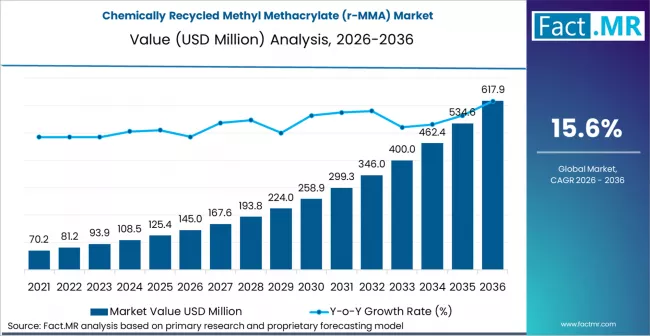
Chemically Recycled Methyl Methacrylate R Mma Market Market Value Analysis | Source: Fact.MR
Market Definition
The chemically recycled methyl methacrylate market covers high-purity r-MMA produced by depolymerizing post-consumer and industrial PMMA waste. The product sold is certified recycled monomer used in acrylic sheets, coatings, and adhesives as a direct substitute for virgin MMA.
Market Inclusions
The report analyzes global and regional forecasts from 2026 to 2036 by grade, application, and end use. It evaluates recycling technologies, feedstock supply chains, certification frameworks, pricing versus virgin MMA, and competitive positioning of key producers.
Market Exclusions
It excludes mechanically recycled PMMA, virgin or bio-based MMA, downstream PMMA products, and recycling streams that do not produce specification-grade MMA monomer.
Research Methodology
- Primary Research: Primary research involved structured interviews with process development engineers at PMMA chemical recycling facilities, procurement managers at acrylic sheet and coatings manufacturers, sustainability and circular economy directors at automotive and construction OEMs, and regulatory affairs specialists at European and Japanese chemical industry associations tracking recycled content certification frameworks in the MMA and PMMA supply chain.
- Desk Research: Desk research synthesized data from European Commission circular economy action plan publications and recycled content regulatory dossiers, Japanese Ministry of Economy Trade and Industry polymer recycling program reports, corporate sustainability disclosures from Mitsubishi Chemical Corporation, Rohm GmbH, Arkema S.A., and Trinseo PLC, and national PMMA waste volume estimates from chemical industry association material flow reports in Europe, Japan, and North America.
- Market-Sizing and Forecasting: Market sizing employed a hybrid top-down and bottom-up approach, combining total addressable PMMA waste volumes by geography and collection infrastructure maturity with depolymerization capacity investment announcements and average r-MMA pricing relative to virgin MMA, validated against disclosed corporate chemical recycling program milestones and benchmarked against European Commission recycled content obligation timelines for construction and automotive polymer materials.
- Data Validation and Update Cycle: Outputs were cross-validated against disclosed chemical recycling investment milestones from Mitsubishi Chemical, Rohm GmbH, and Arkema, reconciled semi-annually with European Commission circular economy regulatory update publications and Japanese METI polymer recycling program reports, and updated annually with commercial-scale r-MMA plant commissioning announcements and OEM recycled content procurement standard revisions in key markets.
Summary
- Market Definition
- The chemically recycled MMA market encompasses r-MMA monomer derived from the depolymerization of post-consumer and post-industrial PMMA waste streams, supplied as a certified circular drop-in replacement for virgin MMA to acrylic sheet manufacturers, coatings producers, and adhesives formulators in construction, automotive, and electronics sectors seeking traceable recycled polymer content.
- Demand Drivers
- The European Commission's circular economy action plan and forthcoming recycled content obligations under the Construction Products Regulation and End-of-Life Vehicles Directive are compelling European acrylic sheet and automotive polymer manufacturers to establish certified r-MMA supply chains ahead of mandatory recycled content thresholds that will apply to construction and transport material categories from the late 2020s onward.
- Major automotive OEMs including those in Germany, Japan, and South Korea have embedded recycled polymer content targets into their multi-year supply chain sustainability programs, creating structured procurement demand for certified r-MMA from tier-one plastic component suppliers who are required to disclose and verify circular material content in vehicle component specifications.
- Corporate sustainability commitments from large acrylic sheet and coatings manufacturers, including public recycled content targets disclosed in annual sustainability reports, are creating voluntary pull-through demand for r-MMA that complements regulatory-mandated adoption and supports earlier-than-required supply chain qualification programs for certified depolymerization-grade r-MMA.
- Key Segments Analyzed
- By grade, optical grade r-MMA holds the leading 38% share, reflecting its highest purity specification and its role as the most technically demanding and value-accretive application category, where r-MMA must match virgin MMA optical clarity and polymerization consistency standards for display, signage, and precision optical component manufacturing.
- By application, acrylic sheets account for the dominant 42% share, driven by the breadth and volume of PMMA sheet applications in construction glazing, architectural cladding, retail signage, and automotive glazing where recycled content certification adds procurement value and supports OEM sustainability reporting requirements.
- By geography, Asia Pacific contributes the largest share of production-capacity-led growth, with China recording the fastest country-level CAGR at 12.5%, while Europe generates the highest regulatory-conversion premium demand driven by EU circular economy mandates and the concentration of PMMA processing infrastructure in Germany and France.
- Analyst Opinion at FACT.MR
- Shambhu Nath Jha, Principal Consultant at Fact.MR, opines, 'CXOs will find this report essential for understanding how the chemical depolymerization of PMMA waste is creating an entirely new certified r-MMA supply chain with above-market pricing power, and which grade segments, application categories, and geographic markets offer the most durable first-mover contract advantages for producers who commission commercial-scale depolymerization capacity ahead of the demand inflection point projected between 2027 and 2030.'
- Strategic Implications / Executive Takeaways
- MMA producers evaluating chemical recycling investment should prioritize commissioning depolymerization capacity in Germany or Japan before 2028, as these markets combine mature PMMA waste collection infrastructure, the largest concentrations of quality-demanding r-MMA buyers, and the strongest regulatory tailwinds for certified recycled content, creating first-mover supply contract opportunities that late entrants will find structurally difficult to displace.
- Acrylic sheet manufacturers should proactively qualify r-MMA supply from at least two certified depolymerization producers per grade specification, as the limited number of commercial-scale r-MMA facilities creates supply concentration risk during the period of rapid demand growth expected between 2026 and 2031, when recycled content requirements begin to exceed available certified supply in key regulated markets.
- Chemical distributors serving the coatings and adhesives industries should build technical service capabilities around r-MMA specification verification and recycled content chain-of-custody documentation, as coatings formulators qualifying r-MMA for the first time require hands-on support to verify that recycled monomer performs to specification within existing resin synthesis processes before committing to long-term certified supply agreements.
- Methodology
- Market size estimates were based on addressable PMMA waste volumes by region combined with commercial depolymerization capacity investment timelines, cross-checked against corporate chemical recycling program milestones disclosed by leading MMA and PMMA producers.
- Segment analysis used European Commission circular economy regulatory dossiers, Japanese METI polymer recycling program reports, and automotive and construction OEM recycled content procurement standard disclosures by market.
- Country forecasts were validated using national chemical industry association PMMA material flow data, government circular economy policy implementation timelines, and commercial r-MMA plant commissioning announcements across key producing and consuming geographies.
Segmental Analysis
Chemically Recycled Methyl Methacrylate (r-MMA) Market Analysis by Grade
Chemically Recycled Methyl Methacrylate R Mma Market Analysis By Grade | Source: Fact.MR
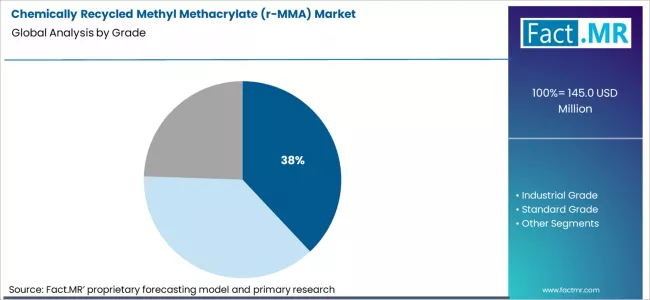
Based on FACT.MR’s report, optical grade r-MMA is estimated to hold 38% share in 2026. It leads due to its high value and strict purity requirements for applications such as display panels, automotive glazing, and precision optics. Premium pricing is justified where OEMs prioritize certified circular content.
- Mitsubishi Chemical r-MMA Program: Mitsubishi Chemical has advanced PMMA depolymerization initiatives, targeting commercial-scale r-MMA supply for acrylic sheet and specialty polymer customers. [5]
- Rohm GmbH Depolymerization Technology: Rohm has invested in chemical recycling as part of its circular strategy, aiming to supply certified r-MMA to European customers requiring traceable recycled content. [6]
- Industrial Grade Demand Expansion: Industrial grade r-MMA, holding 35% share, is expanding quickly in coatings and adhesives, where optical purity is less critical and sustainability procurement drives adoption. [1]
Chemically Recycled Methyl Methacrylate (r-MMA) Market Analysis by Application
Chemically Recycled Methyl Methacrylate R Mma Market Analysis By Application | Source: Fact.MR
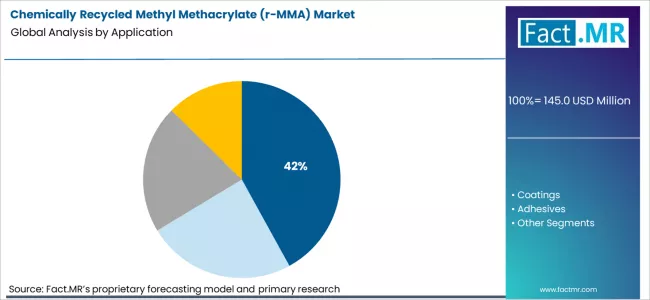
Acrylic sheets are projected to account for 42% share in 2026. This segment dominates because sheet manufacturers both generate PMMA scrap and supply end markets increasingly subject to recycled content mandates, enabling closed-loop production models.
- Trinseo PMMA Circularity Investment: Trinseo has invested in circular polymer initiatives, including recycled-content PMMA programs for construction and automotive applications. [7]
- Arkema Chemical Recycling Development: Arkema is developing depolymerization capabilities to support r-MMA supply for circular acrylic products in Europe and North America. [8]
- Coatings Segment Qualification Trends: Coatings, at 28% share, are adopting r-MMA as automotive OEMs integrate recycled monomer targets into supplier specifications under Scope 3 emissions programs. [3]
Drivers, Restraints, and Opportunities
Fact.MR analysis indicates that the chemically recycled MMA market, currently valued at USD 125 million, is still in an early commercial scaling phase. Growth so far has been driven by technology investments from major PMMA producers and rising demand from acrylic sheet and coatings manufacturers seeking certified circular content. Unlike mature chemical markets, supply capacity is still catching up with expected regulatory and OEM-driven demand projected to strengthen between 2027 and 2030.
The key tension lies between fast-moving recycled content mandates and the capital-intensive nature of depolymerization plants. Commercial facilities require three to five years to build, and feedstock collection systems remain underdeveloped in some regions. This supply constraint supports premium pricing for early producers but may limit adoption where certified volumes are insufficient.
- EU Circular Economy Mandates: The European Commission’s circular economy action plan and proposed Construction Products Regulation revisions are expected to introduce recycled content thresholds in polymer building materials and automotive components, creating statutory demand for traceable r-MMA from the late 2020s. [2]
- Japan PMMA Producer Technology Leadership: Mitsubishi Chemical and Sumitomo Chemical are advancing proprietary depolymerization programs supported by Japan’s Green Innovation Fund, positioning Japan as a technology leader in MMA recovery from PMMA waste. [3]
- China Circular Economy Policy Acceleration: China’s 14th Five-Year Plan sets industrial polymer recycling targets, while export-oriented PMMA producers face recycled content requirements from European buyers, accelerating domestic r-MMA adoption. [4]
Regional Analysis
The chemically recycled MMA market is analyzed across North America, Europe, Asia Pacific, Latin America, and Middle East and Africa. Regional demand patterns reflect the maturity of PMMA waste collection infrastructure, the pace of chemical recycling capacity investment by leading producers. The full report offers detailed market attractiveness analysis comparing depolymerization technology readiness, regulatory demand timelines, and competitive intensity by region.
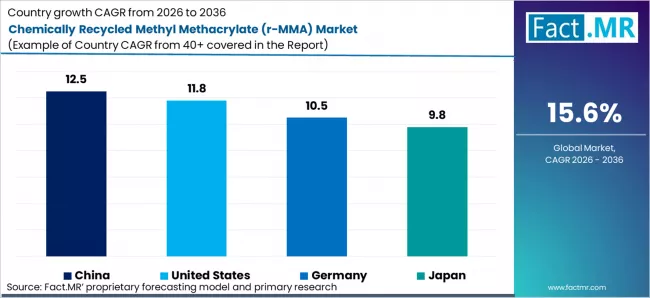
Chemically Recycled Methyl Methacrylate R Mma Market Cagr Analysis By Country | Source: Fact.MR
| Country | CAGR% |
|---|---|
| China | 12.5% |
| United States | 11.8% |
| Germany | 10.5% |
| Japan | 9.8% |
Source: Fact.MR analysis. Updated Feb 20, 2026
Source: Fact.MR (FACT.MR) analysis, based on proprietary forecasting model and primary research
Asia Pacific Chemically Recycled MMA Market Analysis
Asia Pacific is the production-technology leadership region for chemically recycled MMA, anchored by Japan's depolymerization technology pioneer status and China's world-leading PMMA production and waste volume base. Mitsubishi Chemical and Sumitomo Chemical are the dominant regional r-MMA technology developers, leveraging their existing MMA and PMMA manufacturing infrastructure to integrate chemical recycling at scale.
- China: Demand for chemically recycled MMA in China is projected to rise at 12.5% CAGR through 2036. China's growth is driven by the world's largest PMMA production base generating substantial post-industrial waste available for depolymerization, the 14th Five-Year Plan circular economy targets that explicitly address polymer chemical recycling rates, and the export compliance pressure on Chinese acrylic sheet manufacturers supplying European construction and automotive material buyers who are beginning to impose recycled content certification requirements on imported polymer products.
- Japan: Demand for chemically recycled MMA in Japan is projected to rise at 9.8% CAGR through 2036. Japan leads in depolymerization technology maturity rather than volume-driven market growth, with Mitsubishi Chemical's chemical recycling program for PMMA representing the most advanced commercial-scale development initiative globally, supported by the Ministry of Economy Trade and Industry's Green Innovation Fund.
FACT.MR's analysis of the chemically recycled MMA market in Asia Pacific includes country-level assessment covering China, Japan, South Korea, India, and ASEAN markets. Readers can find detailed depolymerization technology investment analysis, government circular economy policy impacts, OEM export compliance program timelines, and competitive positioning of leading Asian r-MMA technology developers and producers.
Europe Chemically Recycled MMA Market Analysis
Europe is the global regulatory demand laboratory for chemically recycled MMA, defined by the European Commission's circular economy action plan creating the most comprehensive mandatory framework for recycled polymer content in construction and automotive materials. Regional producers Rohm GmbH and Arkema S.A. are the primary technology investors, supported by EU Green Deal funding mechanisms including Horizon Europe grants for chemical recycling innovation.
- Germany: Demand for chemically recycled MMA in Germany is projected to rise at 10.5% CAGR through 2036. Germany is the European market combining the highest PMMA waste volume, the most advanced chemical recycling investment activity, and the most demanding OEM sustainability procurement standards across automotive and construction sectors. Rohm GmbH, headquartered in Darmstadt, has disclosed its chemical recycling research program in sustainability communications referencing depolymerization technology development for PMMA waste as a strategic priority.
- United States: Demand for chemically recycled MMA in the United States is projected to rise at 11.8% CAGR through 2036. U.S. growth is driven by voluntary corporate sustainability commitments from construction materials companies and automotive OEMs rather than statutory recycled content mandates, creating a market structure where early r-MMA supply relationships are formed through sustainability procurement programs rather than compliance deadlines.
FACT.MR's analysis of the chemically recycled MMA market in Europe includes country-level assessment covering Germany, the United Kingdom, France, the Netherlands, and Nordic markets. Readers can find EU circular economy mandate timelines, automotive OEM r-MMA procurement program analysis.
Competitive Aligners for Market Players
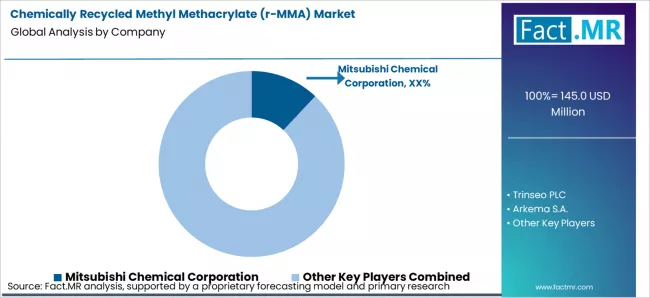
Chemically Recycled Methyl Methacrylate R Mma Market Analysis By Company | Source: Fact.MR
The chemically recycled MMA market is highly concentrated at the technology ownership level. Mitsubishi Chemical Corporation, Rohm GmbH, Arkema S.A., and Trinseo account for most of the publicly disclosed commercial depolymerization programs worldwide. In this market, competitive strength is defined less by pricing or distribution and more by how quickly companies can commission commercial-scale plants and secure certification for optical and industrial grades under recognized circular content schemes.
Structural advantages are strongest among vertically integrated PMMA producers. Mitsubishi Chemical benefits from full integration across MMA, PMMA, and downstream products, giving it control over feedstock sourcing, recycling, and re-polymerization within a closed-loop system. Rohm GmbH’s integration within the European PMMA sheet and compounding ecosystem provides direct access to high-quality production scrap and technically demanding customers, supporting premium-grade positioning.
Acrylic sheet and coatings manufacturers are mitigating supply risk by qualifying two to three r-MMA suppliers per grade during this early commercial phase, ensuring continuity as capacity scales.
Recent Developments
- In 2026, Lummus Technology and Sumitomo Chemical rolled out a commercial-ready PMMA chemical recycling process. This technology enables efficient conversion of end-of-life PMMA into high-purity MMA monomer, marking a major step toward scalable circular monomer production.
- In 2025, Lummus Technology and Sumitomo Chemical rolled out a commercial-ready PMMA chemical recycling process. This technology enables efficient conversion of end-of-life PMMA into high-purity MMA monomer, marking a major step toward scalable circular monomer production.
Key Players
- Mitsubishi Chemical Corporation
- Trinseo PLC
- Arkema S.A.
- Rohm GmbH
- Lucite International Ltd.
Bibliography
- [1] European Commission, Circular Economy Action Plan for a Cleaner and More Competitive Europe, March 2020, updated 2023.
- [2] European Commission, Proposal for Revision of the Construction Products Regulation, March 2022.
- [3] Ministry of Economy Trade and Industry of Japan, Green Innovation Fund Programme for Chemical Recycling, September 2021.
- [4] Ministry of Industry and Information Technology of China, 14th Five-Year Plan for the Development of the Circular Economy, July 2021.
- [5] Mitsubishi Chemical Corporation, Integrated Report 2023, June 2023.
- [6] Rohm GmbH, Sustainability and Corporate Responsibility Report 2023, October 2023.
- [7] Trinseo PLC, 2023 Sustainability Report, March 2024.
This Report Addresses
- Market intelligence for strategic planning with analysis of chemically recycled MMA market evolution from technology pilot stage to commercial-scale depolymerization supply chains serving acrylic sheet, coatings, and adhesives manufacturers in construction, automotive, and electronics sectors globally.
- Market size and forecast showing global valuation of USD 145 million in 2026 and projected USD 620 million by 2036 at a CAGR of 15.6%.
- Growth opportunity mapping across optical-grade r-MMA supply for display and automotive glazing applications, industrial-grade depolymerization monomer for coatings and adhesive reformulation programs, and standard-grade r-MMA for construction-sector acrylic sheet manufacturers implementing circular content compliance programs.
- Segment and regional forecasts covering all major countries with grade, application, and end-use industry breakdowns including construction, automotive, and electronics sector r-MMA demand analysis.
- Competition strategy assessment of leading r-MMA technology developers including depolymerization technology ownership, commercial-scale plant commissioning timelines, grade certification status, and OEM supply agreement pipeline analysis for Mitsubishi Chemical, Rohm GmbH, Arkema, Trinseo, and Lucite International.
- Regulatory compliance tracking of EU circular economy action plan recycled content obligation timelines, European Commission Construction Products Regulation revision milestones, End-of-Life Vehicles Regulation recycled content thresholds, Japanese Plastic Resource Circulation Act implementation, and China 14th Five-Year Plan circular economy target enforcement.
- Technology adoption analysis covering PMMA depolymerization process efficiency improvements, optical-grade r-MMA purity certification protocols, chain-of-custody documentation requirements under EU circular economy verified content schemes, and feedstock collection infrastructure development by geography.
- Report delivery in Excel, PowerPoint, and PDF formats with fully validated data, primary research evidence, and verified regulatory and company source documentation.
Segmentation
Scope of Report
| Items | Values |
|---|---|
| Quantitative Units | USD 145 million (2026) to USD 620 million (2036), at a CAGR of 15.6% |
| Market Definition | The chemically recycled MMA market covers r-MMA monomer produced through depolymerization of post-consumer and post-industrial PMMA waste, used as a drop-in replacement for virgin MMA in optical-grade, industrial-grade, and standard-grade polymer applications across acrylic sheet manufacturing, coatings, and adhesives industries. |
| By Grade | Optical Grade, Industrial Grade, Standard Grade |
| By Application | Acrylic Sheets, Coatings, Adhesives, Others |
| By End-Use Industry | Construction, Automotive, Electronics, Others |
| Regions Covered | Asia Pacific, Europe, North America, Latin America, Middle East & Africa |
| Countries Covered | China, Japan, South Korea, Australia & New Zealand, India, ASEAN, Rest of Asia Pacific, Norway, Germany, United Kingdom, France, Spain, Netherlands, Nordics, Rest of Europe, United States, Canada, Mexico, Brazil, Chile, Ecuador, Rest of Latin America, Kingdom of Saudi Arabia, United Arab Emirates, South Africa, Turkey, Rest of Middle East & Africa |
| Key Companies Profiled | Mitsubishi Chemical Corporation, Trinseo PLC, Arkema S.A., Rohm GmbH, Lucite International Ltd., Sumitomo Chemical Co. Ltd., Asahi Kasei Corporation, Kuraray Co. Ltd., Chi Mei Corporation |
| Forecast Period | 2026 to 2036 |
| Approach | Hybrid top-down and bottom-up market modeling validated through primary interviews with PMMA recycling process engineers, acrylic sheet procurement managers, automotive and electronics OEM sustainability directors, and specialty chemical distributors, supported by national waste management agency data, corporate circularity program disclosures, and European Commission recycled content regulatory documentation. |
Source: Fact.MR analysis. Updated Feb 20, 2026
Chemically Recycled Methyl Methacrylate (r-MMA) Market by Segment
-
By Grade :
- Optical Grade
- Industrial Grade
- Standard Grade
-
By Application :
- Acrylic Sheets
- Coatings
- Adhesives
- Others
-
By End-Use Industry :
- Construction
- Automotive
- Electronics
- Others
-
Region :
- Asia Pacific
- China
- Japan
- South Korea
- Australia & New Zealand
- India
- ASEAN
- Rest of Asia Pacific
- Europe
- Norway
- Germany
- United Kingdom
- France
- Spain
- Netherlands
- Nordics
- Rest of Europe
- North America
- United States
- Canada
- Mexico
- Latin America
- Brazil
- Chile
- Ecuador
- Rest of Latin America
- Middle East & Africa
- Kingdom of Saudi Arabia
- United Arab Emirates
- South Africa
- Turkey
- Rest of Middle East & Africa
- Asia Pacific
Frequently Asked Questions
How large is the chemically recycled MMA market in 2025?
What will the market size be in 2026?
What is the projected market size by 2036?
What is the expected CAGR for the forecast period 2026 to 2036?
Which Grade segment holds the largest share?
Which Application segment dominates in 2026?
Which country shows the fastest CAGR?
What is the absolute dollar growth from 2026 to 2036?
How significant is the construction end-use industry?
Who worked on this report


Preview the report firsthand - request a free sample
Free SampleGet the brochure for pricing and purchase details
Download PDF