- Market Value (2025): USD 5.7 Bn
- Estimated Value (2026): USD 6.0 Bn
- Forecast Value (2036): USD 10.0 Bn
- CAGR (2026-2036): 5.2%
What is the Chloromethane Market forecast to be worth by 2036?
USD 6.0 billion in 2026 to USD 10.0 billion by 2036 at a 5.2% CAGR.
- The chloromethane market reached approximately USD 5.7 billion in 2025.
- Demand is projected to increase from USD 6.0 billion in 2026 to USD 10.0 billion by 2036.
- The market is forecast to expand at a 5.2% CAGR from 2026 to 2036.
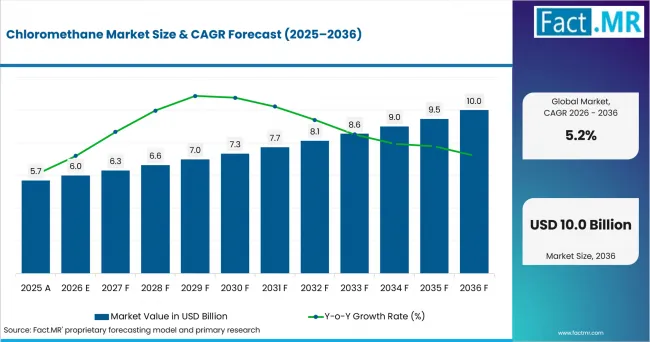
Chloromethane Market Value Analysis | Source: Fact.MR
What are the defining numbers behind Chloromethane Market growth?
An absolute opportunity of USD 4.0 billion is expected between 2026 and 2036.
- Demand Drivers in the Market
- Silicone manufacturing remains the central volume driver. The U.S. Agency for Toxic Substances and Disease Registry identifies silicone production as the predominant commercial use of chloromethane. Occidental Chemical states that 49% of methyl chloride produced in the USA is consumed as feedstock for methyl chlorosilanes, which are used to make silicone fluids, elastomers and resins. Expansion in downstream silicone resins therefore translates into recurring demand for chloromethane feedstock at chemical plants.
- Chemical synthesis broadens the addressable demand base. KEM ONE identifies methyl chloride use in methylcellulose, water-treatment intermediates and vanillin synthesis, while Shin-Etsu lists silicone, methylcellulose, pesticides and surfactants among its applications. These routes make chloromethane relevant to buyers outside the silicone value chain.
- High-purity supply supports process consistency. Current commercial specifications from Occidental Chemical set methyl chloride purity at 99.95% minimum, while Gujarat Alkalies and Chemicals specifies 99.9% minimum for its methyl chloride grade. Low water and acid limits reduce the risk of side reactions in continuous chemical synthesis.
- Integrated production capacity improves supply availability for bulk customers. Gujarat Alkalies and Chemicals commissioned a 105,000 TPA chloromethane plant at Dahej in 2022, complementing its chlor-alkali operations. Such integration can reduce transfer distances between chlorine-derived feedstocks and downstream chloromethane production.
- Lower-carbon production is creating a procurement opportunity for customers tracking upstream emissions. KEM ONE extended its Kemaia range to chloromethanes in 2025, while Nobian states that certified low-carbon chloromethanes can carry a 30% to 57% lower product carbon footprint than its conventional portfolio.
- Key Segments Analyzed
- Methyl Chloride (Chloromethane Gas) accounts for 64.8% of Product in 2026 because it is the base industrial feedstock for chlorosilanes and several methylation routes.
- Silicone Production represents 57.3% of Application in 2026 as methyl chloride is consumed directly in methyl chlorosilane production.
- Chemical Manufacturing Industry accounts for 68.4% of End Use in 2026 because a substantial share of demand arises as a process intermediate rather than as a finished chemical.
- Chlorination Process Technology represents 73.2% of Technology in 2026 due to its fit with continuous, integrated chlorine-derivative operations.
- High Purity Chloromethane Formulations account for 61.7% of Formulation in 2026 as sensitive downstream reactions require controlled moisture and impurity levels.
- Direct Industrial Sales represent 55.8% of Distribution Channel in 2026 because large users buy bulk volumes under plant-level supply and safety arrangements.
- Analyst Opinion at Fact.MR
- Shambhu Nath Jha, Principal Consultant at Fact.MR, states, “Chloromethane purchasing is governed by feedstock continuity and process reliability. Silicone producers need a steady stream of methyl chloride at controlled purity because interruptions can affect downstream chlorosilane output. Suppliers that combine integrated production with safe bulk logistics and lower-carbon options are positioned to defend long-term industrial contracts.”
- Strategic Implications
- Producers should prioritize silicone-grade and other high-purity chloromethane because Silicone Production, which accounts for 57.3% of Application in 2026, depends on controlled moisture and impurity levels during continuous synthesis.
- Backward integration with chlorine, hydrogen chloride or methanol supply can reduce feedstock disruption and support steadier utilization of chloromethane assets.
- Bulk suppliers should treat containment and transport capability as part of the commercial offer because methyl chloride is shipped as a liquefied compressed gas and requires controlled handling.
- Lower-carbon chloromethane grades can support customers seeking to reduce purchased-material emissions without changing the core chemical function of methyl chloride.
How does the Chloromethane Market break down by segment?
The market is segmented by Product, Application, End Use, Technology, Formulation and Distribution Channel.
Why does Methyl Chloride (Chloromethane Gas) lead Product?
Methyl Chloride (Chloromethane Gas) accounts for a 64.8% share of Product in 2026.
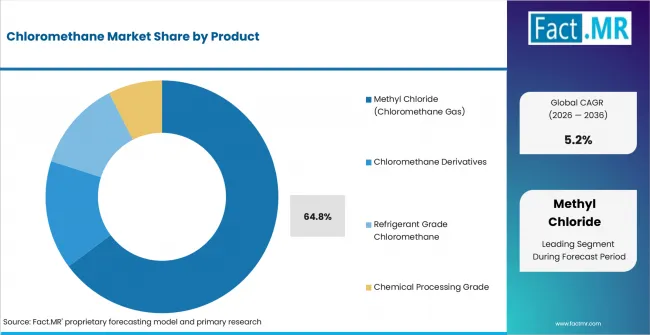
Chloromethane Market Analysis By Product | Source: Fact.MR
The segment holds its position because methyl chloride is the direct molecular feedstock used in chlorosilane chemistry and several methylation reactions. It can be consumed continuously inside integrated chemical plants, which supports recurring bulk demand rather than episodic purchasing.
Shin-Etsu identifies methyl chloride as a raw material for silicone, methylcellulose, pesticides and surfactants. This range of uses gives the base gas a broader industrial role than grades tied to one specific processing route.
Anhydrous and liquefied forms allow buyers to match storage and feed conditions to their reactors. Selection is driven by moisture tolerance, pressure-system design and the way the gas is transferred into the process.
Why does Silicone Production lead Application?
Silicone Production accounts for a 57.3% share of Application in 2026.
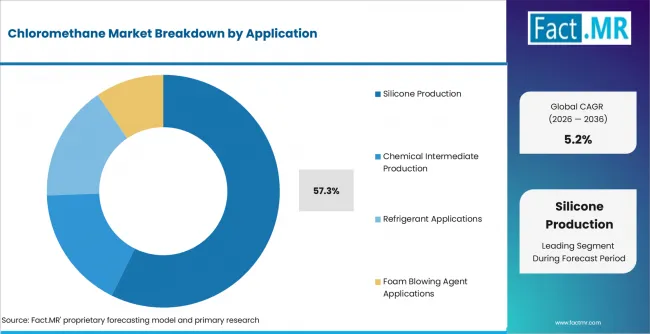
Chloromethane Market Analysis By Application | Source: Fact.MR
Silicone production leads because methyl chloride is reacted to form methyl chlorosilanes, which are the building blocks used for silicone polymers and fluids. Occidental Chemical reports that 49% of U.S. methyl chloride production is used as methyl chlorosilane feedstock, making the relationship between chloromethane supply and silicone operating rates direct.
Downstream demand spans industrial sealing, coatings and electrical applications. Growth in silicone sealants increases feedstock requirements upstream because those products begin with organosilicon intermediates produced from methyl chloride.
Silicone fluids also create recurring demand because they are used in processing aids and specialty formulations. Producers therefore value supply contracts that reduce variability in purity and delivery timing across extended production campaigns.
Why does Chemical Manufacturing Industry lead End Use?
Chemical Manufacturing Industry accounts for a 68.4% share of End Use in 2026.
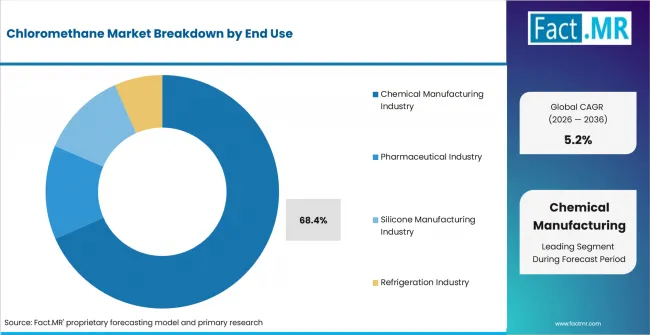
Chloromethane Market Analysis By End Use | Source: Fact.MR
Chemical manufacturing leads because chloromethane is commonly consumed as an intermediate inside another synthesis step. Bulk chemical producers use it in high-throughput reactions, while specialty chemical companies use controlled grades where purity or low moisture affects product yield.
The demand mechanism extends through organosilicon chemistry and other C1 intermediates. Activity in the siloxane market therefore has an upstream connection to methyl chloride procurement where siloxane production begins from chlorosilane chemistry.
This end-use structure also explains the importance of direct sales. Large chemical users typically require cylinder, tank or pipeline-compatible delivery protocols supported by safety documentation and plant-level acceptance specifications.
Why does Chlorination Process Technology lead Technology?
Chlorination Process Technology accounts for a 73.2% share of Technology in 2026.
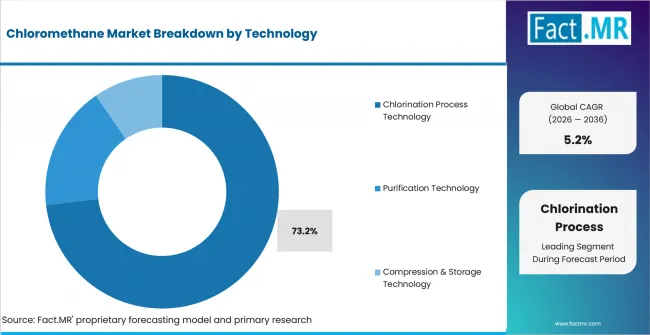
Chloromethane Market Analysis By Technology | Source: Fact.MR
Chlorination process technology leads because industrial chloromethane production is closely integrated with chlorine chemistry. U.S. EPA process descriptions identify thermal chlorination of methane as one commercial route, while methanol hydrochlorination is another route used to produce methyl chloride.
Integrated chemical sites can connect these routes with upstream chlor-alkali operations that supply chlorine or hydrogen chloride. This reduces material transfers and supports continuous operation across the chlorine-derivative chain.
Gas-phase and liquid-phase systems are selected according to feed composition, conversion control and downstream separation requirements. Plant economics depend on yield, energy use and the ability to contain chlorinated streams throughout the process.
Why do High Purity Chloromethane Formulations lead Formulation?
High Purity Chloromethane Formulations account for a 61.7% share of Formulation in 2026.
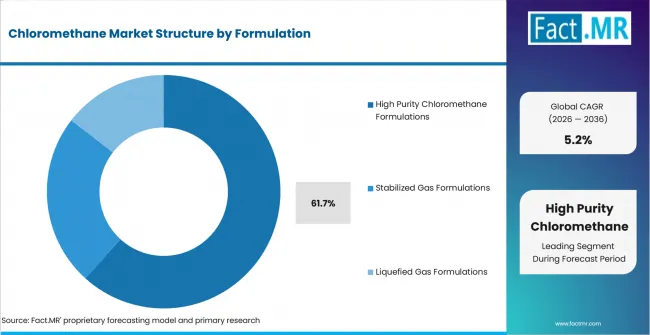
Chloromethane Market Analysis By Formulation | Source: Fact.MR
High-purity formulations lead because downstream reactors are sensitive to water, acidity and higher-boiling impurities. Suppliers therefore specify purity and impurity ceilings that help customers maintain reaction consistency and reduce additional purification inside the consuming plant.
Occidental Chemical lists 99.95% minimum methyl chloride content in its 2026 sales specification, with separate limits for water, acidity and higher-boiling compounds. Gujarat Alkalies and Chemicals specifies 99.9% minimum purity for methyl chloride.
Ultra-pure gas grades are more relevant where process control is tight, while industrial grades serve synthesis routes that can tolerate broader specifications. The common requirement is a repeatable composition backed by batch-level quality documentation.
Why do Direct Industrial Sales lead Distribution Channel?
Direct Industrial Sales account for a 55.8% share of Distribution Channel in 2026.
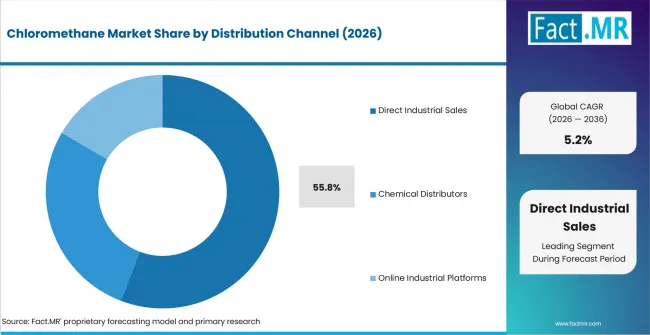
Chloromethane Market Analysis By Distribution Channel | Source: Fact.MR
Direct industrial sales lead because chloromethane is a pressurized, flammable gas and major users consume it as a production feedstock. Bulk supply agreements allow the producer and buyer to align storage capacity, delivery frequency and emergency procedures before routine shipments begin.
Occidental Chemical lists rail tank cars and tank trucks among its commercial container options for methyl chloride. This transport profile favors structured industrial contracts over small-quantity retail distribution for the majority of market volume.
Chemical distributors remain relevant for regional coverage and smaller industrial users, while online industrial platforms are more suited to enquiry generation and low-volume specialty purchasing than sustained bulk consumption.
What is accelerating Chloromethane Market adoption, and what is holding it back?
Silicone feedstock demand, broader methylation chemistry and higher-purity supply support market growth, while safety requirements, regulatory handling and feedstock-cost exposure constrain expansion.
Drivers Impact Analysis
| Driver | (~) % Impact on CAGR | Geographic Relevance | Impact Timeline |
|---|---|---|---|
| Silicone feedstock demand | +1.4% | Global; Germany; USA; Japan | Near to mid term |
| Broader methylation chemistry | +0.8% | Global; Germany; Brazil; Japan | Mid term |
| High-purity process requirements | +0.5% | Global | Near term |
| Integrated chloromethane production capacity | +0.4% | Germany; USA; Asia | Mid to long term |
Opportunity Impact Analysis
| Opportunity | (~) % Impact on CAGR | Geographic Relevance | Impact Timeline |
|---|---|---|---|
| Lower-carbon chloromethane grades | +0.4% | Europe; Germany | Mid term |
| Specialty high-purity formulations | +0.3% | Global | Mid term |
| Regional supply localization | +0.3% | Brazil; Japan; ANZ | Long term |
Restraints Impact Analysis
| Restraint | (~) % Impact on CAGR | Geographic Relevance | Impact Timeline |
|---|---|---|---|
| Worker-safety and containment requirements | -0.8% | Global | Near term |
| Regulatory handling and cross-border reporting | -0.4% | UK; Europe; ANZ | Near to mid term |
| Feedstock and energy-cost volatility | -0.7% | Global | Near to mid term |
Which countries are scaling the Chloromethane Market through 2036?
- Germany: Domestic chloromethane production and an established chemical-processing base support demand. Chloromethanes are produced in Frankfurt, while lower-carbon grades address silicone, methylcellulose and other chemical uses.
- Brazil: Chemical and pharmaceutical manufacturing support industrial chloromethane demand. IBGE reported 1.0% growth in chemical production and 2.3% growth in pharmaceutical output during 2025.
- USA: Domestic methyl chloride production supplies silicone and specialty-chemical customers. Occidental Chemical states that 49% of U.S. methyl chloride output is used for methyl chlorosilanes.
- UK: Specialty chemical demand continues, but cross-border supply must account for hazardous-gas controls and ozone-depleting-substance reporting requirements for chloromethane imports and exports.
- Japan: Shin-Etsu supplies methyl chloride for silicone, methylcellulose and other synthesis routes, giving the country an integrated domestic demand and supply base.
- ANZ: Demand is moderated by smaller local chemical production and strict hazardous-substance controls. New Zealand EPA approves methyl chloride with controls and classifies it as a flammable gas with inhalation toxicity.
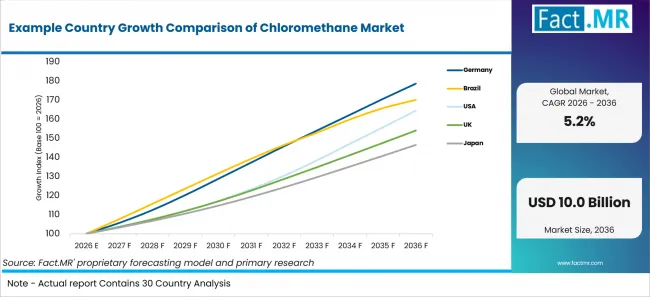
Example Country Growth Comparison Of Chloromethane Market | Source: Fact.MR
| Country / Market | CAGR (2026-2036) |
|---|---|
| Germany | 6.0% |
| Brazil | 5.5% |
| USA | 5.1% |
| UK | 4.4% |
| Japan | 3.9% |
| ANZ | 3.2% |
What is driving Germany's growth through 2036?
Germany is forecast to expand at a 6.0% CAGR from 2026 to 2036.
Germany benefits from active domestic chloromethane production and a chemical industry that consumes methyl chloride in silicone and cellulose-related synthesis. Chloromethane production in Frankfurt supports local access to product and technical supply infrastructure.
Certified lower-carbon chloromethane grades provide downstream buyers with a route to reduce purchased-material emissions while retaining the same basic chemical feedstock.
What is driving Brazil's growth through 2036?
Brazil is forecast to expand at a 5.5% CAGR from 2026 to 2036.
Brazil’s demand is supported by chemical production and pharmaceutical manufacturing, both of which use chlorinated intermediates across multiple synthesis routes. IBGE reported that chemical production increased 1.0% in 2025, while pharmaceutical and pharmochemical production rose 2.3%.
Handling requirements influence supplier selection. CETESB identifies methyl chloride as UN 1063, Class 2.1, and describes it as a liquefied compressed flammable gas. Buyers therefore need suppliers that can combine product availability with compliant storage and emergency procedures.
What is driving USA's growth through 2036?
USA demand is forecast to rise at a 5.1% CAGR from 2026 to 2036.
The USA has domestic methyl chloride production and a direct downstream pull from silicone manufacturing. Occidental Chemical identifies production facilities in Geismar, Louisiana and Wichita, Kansas, which support supply to industrial users without relying entirely on imports.
The company states that 49% of methyl chloride produced in the USA is consumed as feedstock for methyl chlorosilanes. That linkage makes silicone production rates a practical indicator of chloromethane demand, especially for large bulk contracts.
What is driving UK's growth through 2036?
The UK market is forecast to expand at a 4.4% CAGR from 2026 to 2036.
Demand is tied to specialty chemical and downstream manufacturing, but the market operates under a tighter handling environment. UK guidance lists chloromethane as a Part B ozone-depleting substance with an ozone-depleting potential of 0.02.
The substance is not covered by licence or quota in that category, but importers and exporters must report movements. This keeps the product available for controlled industrial use while adding documentation requirements for cross-border supply.
What is driving Japan's growth through 2036?
Japan is forecast to expand at a 3.9% CAGR from 2026 to 2036.
Japan has an integrated chloromethane demand base through silicone and specialty chemical manufacturing. Shin-Etsu lists methyl chloride as a raw material for silicone, methylcellulose, pesticides and surfactants, showing the product’s role across multiple domestic value chains.
Environmental management also shapes production. Shin-Etsu reports chloromethane releases within its PRTR-controlled chemical disclosures and sets air-emission reduction targets. Suppliers therefore compete on process control alongside product quality.
What is driving ANZ's growth through 2036?
ANZ is forecast to expand at a 3.2% CAGR from 2026 to 2036.
ANZ demand is more dependent on controlled industrial distribution than on large local chloromethane production. Applications in specialty chemical synthesis and selected refrigeration or laboratory uses require imported or regionally supplied product to move through hazardous-gas logistics systems.
New Zealand EPA approves methyl chloride with controls and classifies it as a flammable gas that is harmful if inhaled. These requirements support demand for specialized suppliers, but they also increase the cost of storage and handling, which moderates the regional growth rate.
Who leads the Chloromethane Market?
Key companies operating in the Chloromethane Market include INEOS Group, AkzoNobel N.V., KEM ONE, Shin-Etsu Chemical Co., Gujarat Alkalies and Chemical Limited (GACL), Solvay, Occidental Petroleum Corporation, Gujarat Fluorochemicals Ltd., The Sanmar Group, SRF Limited, Alfa Aesar, Tokuyama Corporation, AGC Chemicals, and Tokyo Chemical Industry.
Competition is shaped by integrated chlorine chemistry, reliable bulk logistics and access to downstream customers. Producers with chlor-alkali or broader chlorinated-organics operations can coordinate feedstock supply with chloromethane production, while silicone-linked suppliers benefit from captive or contracted demand.
AkzoNobel’s former Specialty Chemicals business was separated in 2018, so its historical chloromethane activities no longer sit within AkzoNobel’s current portfolio. KEM ONE produces the chloromethane family at Lavera and identifies methyl chloride as a feedstock for silicones, methylcellulose and water-treatment intermediates.
Shin-Etsu sells methyl chloride for silicone and organic synthesis applications. Gujarat Alkalies and Chemicals operates chloromethane capacity at Vadodara and Dahej, while Occidental Chemical supplies technical-grade methyl chloride from U.S. facilities. SRF manufactures chloromethanes at Dahej and Bhiwadi, and Chemplast Sanmar lists methyl chloride within its chloromethane product range.
Supplier selection depends on purity consistency, containment capability and delivery reliability. Lower-carbon product lines are emerging as a further differentiator, particularly for customers seeking to reduce upstream emissions without reformulating downstream chemistry.
Which companies are the key providers?
Key Companies include INEOS Group; AkzoNobel N.V.; KEM ONE; Shin-Etsu Chemical Co.; Gujarat Alkalies and Chemical Limited (GACL); Solvay; Occidental Petroleum Corporation; Gujarat Fluorochemicals Ltd.; The Sanmar Group; SRF Limited; Alfa Aesar; Tokuyama Corporation; AGC Chemicals; Tokyo Chemical Industry
- INEOS Group
- AkzoNobel N.V.
- KEM ONE
- Shin-Etsu Chemical Co.
- Gujarat Alkalies and Chemical Limited (GACL)
- Solvay
- Occidental Petroleum Corporation
- Gujarat Fluorochemicals Ltd.
- The Sanmar Group
- SRF Limited
- Alfa Aesar
- Tokuyama Corporation
- AGC Chemicals
- Tokyo Chemical Industry
Bibliography
- Agency for Toxic Substances and Disease Registry. (2024). Toxicological Profile for Chloromethane. U.S. Department of Health and Human Services.
- U.S. Environmental Protection Agency. (2001). Toxicological Review of Methyl Chloride (CAS No. 74-87-3). U.S. EPA.
- U.S. Environmental Protection Agency. (2026). 2024 Chemical Data Reporting Information. U.S. EPA.
- National Institute for Occupational Safety and Health. (2026). Methyl Chloride: NIOSH Pocket Guide to Chemical Hazards. CDC.
- Occupational Safety and Health Administration. (2021). Methyl Chloride: Occupational Chemical Database. U.S. Department of Labor.
- Government of the United Kingdom. (2024). Ozone-Depleting Substances: Import, Export and Reporting Guidance. UK Government.
- Health and Safety Executive. (2026). Toxicity Levels of Chemicals. UK Government.
- CETESB. (2026). Chemical Product Information: Methyl Chloride. Government of the State of Sao Paulo.
- Brazilian Institute of Geography and Statistics. (2026). Industrial Production: December 2025. Government of Brazil.
- New Zealand Environmental Protection Authority. (2026). Methane, Chloro- (Methyl Chloride): Approved Hazardous Substance with Controls.
- Nouryon. (2018). AkzoNobel Specialty Chemicals is now Nouryon. Nouryon.
- Nobian. (n.d.). Chloromethanes: Methyl Chloride and Industrial Applications.
- KEM ONE. (2025). Kemaia Product Range with an Improved Environmental Footprint.
- KEM ONE. (n.d.). Chloromethanes: Product and Application Overview.
- Shin-Etsu Chemical Co., Ltd. (n.d.). Methyl Chloride: Business and Product Information.
- Shin-Etsu Chemical Co., Ltd. (n.d.). Environmental Data: PRTR Controlled Chemical Substances.
- Occidental Chemical Corporation. (2025). Product Stewardship Summary: Methyl Chloride.
- Occidental Chemical Corporation. (2026). Methyl Chloride Technical Grade Sales Specification.
- Gujarat Alkalies and Chemicals Limited. (2025). Annual Report 2024-25.
- Gujarat Alkalies and Chemicals Limited. (2022). Chloromethanes and Caustic Soda Expansion at Dahej.
- SRF Limited. (n.d.). Industrial Chemicals: Chloromethanes.
- Chemplast Sanmar Limited. (n.d.). Chloromethanes: Solvents Product Portfolio.
This Report Answers
- How is chloromethane demand developing across product grades and industrial applications?
- Why does silicone production account for a significant share of chloromethane consumption?
- How do purity requirements and process technology influence purchasing decisions?
- Which country markets are expected to expand through 2036, and what is supporting demand in each?
- How do chloromethane producers compete through production integration and bulk-supply capability?
What does the Chloromethane Market cover?
Chloromethane, also known as methyl chloride or monochloromethane, supplied for industrial use across the defined product grades and applications.
The market covers chloromethane supplied as a feedstock for silicone production and as a methylating or synthesis intermediate in chemical manufacturing. Chloromethane is a colorless gas under ambient conditions and is commonly stored and transported as a liquefied compressed gas.
What is included in the scope?
Anhydrous, liquefied, high-purity and process-grade chloromethane sold within the stated Product, Application, End Use, Technology, Formulation and Distribution Channel categories.
Coverage includes grades used as silicon or pharmaceutical intermediates, refrigerant-grade material and chemical-processing-grade chloromethane. Demand is assessed across chemical manufacturing, pharmaceutical production, silicone manufacturing and refrigeration applications, with distribution through direct industrial sales, chemical distributors and online industrial platforms.
What is excluded from the scope?
Separate chloromethanes, finished downstream products and equipment whose commercial value does not represent chloromethane itself.
Methylene chloride, chloroform and carbon tetrachloride are excluded as standalone products. Finished silicone polymers, silicone fluids, sealants, pharmaceuticals, agrochemicals, surfactants and methylcellulose products are excluded unless the transaction itself is for chloromethane. Refrigeration equipment, compressors, HVAC systems, laboratory analytical services and unrelated chlorinated solvents also fall outside the market.
How Was the Analysis Built?
The market boundary covers chloromethane supplied as an industrial feedstock or process chemical within the defined segmentation and regional scope.
- Primary Research: Interviews with chloromethane producers, silicone manufacturers, specialty chemical companies, industrial distributors and bulk-gas logistics providers examine purity requirements, supply contracts, plant utilization, purchasing criteria and handling constraints.
- Secondary Research: Government industrial statistics, chemical-safety regulations, company production disclosures, technical specifications and downstream application evidence support the assessment. Sources used in the analysis are documented in the bibliography.
- Market Sizing and Forecasting: Estimates combine chloromethane production capacity, consumption across silicone and other synthesis routes, industrial pricing, product mix and country-level demand. Safety requirements and regulatory costs that influence supply economics are incorporated into the forecast.
- Validation and Updates: Findings are checked against current company activity and public regulatory information. Updates account for capacity additions, ownership changes, new product grades and changes in handling requirements.
What is the report's scope and coverage?
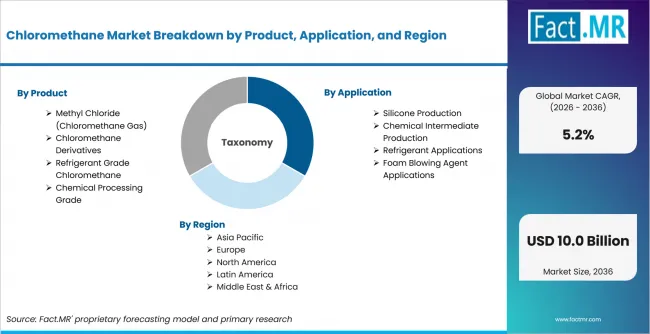
Chloromethane Market Breakdown By Product, Application, And Region | Source: Fact.MR
| Attribute | Details |
|---|---|
| Quantitative Units | USD Billion |
| Market Definition | Chloromethane / methyl chloride supplied across the defined product grades and industrial applications |
| Segments Covered | Product; Application; End Use; Technology; Formulation; Distribution Channel |
| Regions Covered | North America; Latin America; Europe; East Asia; South Asia and Pacific; Middle East and Africa |
| Countries Covered | Germany; Brazil; USA; UK; Japan; ANZ |
| Key Companies Profiled | INEOS Group; AkzoNobel N.V.; KEM ONE; Shin-Etsu Chemical Co.; Gujarat Alkalies and Chemical Limited; and others |
| Forecast Period | 2026 to 2036 |
| Base Year | 2025 |
| Market Value, 2026 | USD 6.0 billion |
| Market Value, 2036 | USD 10.0 billion |
| CAGR, 2026-2036 | 5.2% |
| Absolute Opportunity | USD 4.0 billion |
| Approach | Production, application demand, segment share, country growth and company activity are combined in a hybrid top-down and bottom-up analysis. |
How is the market segmented?
-
By Product
- Methyl Chloride (Chloromethane Gas)
- Anhydrous Chloromethane
- Liquefied Chloromethane
- Chloromethane Derivatives
- Silicon Intermediate Chloromethane
- Pharmaceutical Intermediate Grade
- Refrigerant Grade Chloromethane
- Low Moisture Refrigerant Gas
- Blended Refrigerant Systems
- Chemical Processing Grade
- Chlorination Feedstock Grade
- Methylation Process Gas
- Methyl Chloride (Chloromethane Gas)
-
By Application
- Silicone Production
- Silicone Polymers Manufacturing
- Silicone Fluids Production
- Chemical Intermediate Production
- Methylating Agent Applications
- Organic Synthesis Applications
- Refrigerant Applications
- Industrial Cooling Systems
- Commercial HVAC Systems
- Foam Blowing Agent Applications
- Polyurethane Foam Production
- Specialty Foam Applications
- Silicone Production
-
By End Use
- Chemical Manufacturing Industry
- Bulk Chemical Producers
- Specialty Chemical Companies
- Pharmaceutical Industry
- API Manufacturing Companies
- Research Laboratories
- Silicone Manufacturing Industry
- Sealant Manufacturers
- Polymer Manufacturers
- Refrigeration Industry
- Industrial Refrigeration Operators
- HVAC Equipment Manufacturers
- Chemical Manufacturing Industry
-
By Technology
- Chlorination Process Technology
- Gas Phase Chlorination Systems
- Liquid Phase Chlorination
- Purification Technology
- Distillation Systems
- Gas Scrubbing Technology
- Compression & Storage Technology
- High Pressure Storage Systems
- Gas Liquefaction Systems
- Chlorination Process Technology
-
By Formulation
- High Purity Chloromethane Formulations
- Ultra Pure Gas Grades
- Industrial Grade Gas Formulations
- Stabilized Gas Formulations
- Moisture Controlled Gas Systems
- Blended Gas Formulations
- Liquefied Gas Formulations
- Pressurized Liquid Gas Systems
- Cryogenic Gas Formulations
- High Purity Chloromethane Formulations
-
By Distribution Channel
- Direct Industrial Sales
- OEM Supply Contracts
- Enterprise Bulk Supply
- Chemical Distributors
- Regional Chemical Suppliers
- Global Distribution Networks
- Online Industrial Platforms
- B2B Chemical Marketplaces
- Manufacturer Direct Platforms
- Direct Industrial Sales