- Market Value (2025): USD 125.8 Mn
- Estimated Value (2026): USD 131 Mn
- Forecast Value (2036): USD 196 Mn
- CAGR (2026-2036): 4.1%
What is the Chromocyanine Green Pigments Market forecast to be worth by 2036?
USD 131 million in 2026 to USD 196 million by 2036, at 4.1% CAGR.
- The USD 125.8 million market value in 2025 reflects established use of green phthalocyanine pigments across printing inks, coatings, plastics, rubber, and textile printing.
- Revenue is projected to rise from USD 131 million in 2026 to USD 196 million in 2036 as converters demand durable green shades in both high-volume and performance-sensitive formulations.
- The 4.1% CAGR is supported by Pigment Green 7's broad application base, with growth shaped by weather fastness, solvent resistance, and easier-to-process supply forms.
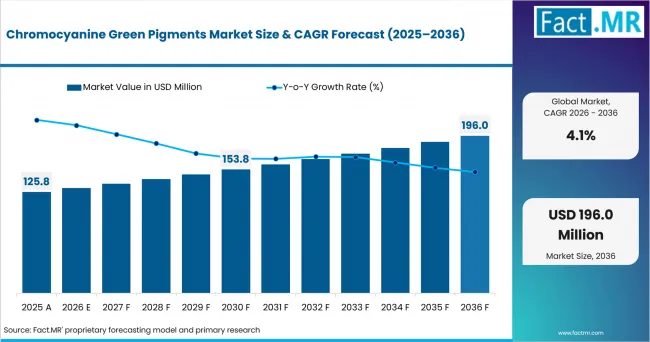
Chromocyanine Green Pigments Market Value Analysis | Source: Fact.MR
What are the defining numbers behind Chromocyanine Green Pigments Market growth?
USD 65 million absolute opportunity by 2036, led by Pigment Green 7 and Printing inks within their respective segments.
- Demand Drivers in the Market
- Printing-ink manufacturers use chromocyanine green to build strong blue-shade greens with the rheology and fastness needed for liquid-ink systems.
- Paint and coating producers require green pigments that retain color through solvent exposure, weathering, and cure conditions.
- Plastic compounders value Pigment Green 7 for its established use in masterbatch and its ability to deliver concentrated color across common polymers.
- Customers are looking beyond nominal PG7 identity toward grades differentiated by chroma, dispersion, shade direction, and delivery form.
- Key Segments Analyzed
- By Green Grade Type: Pigment Green 7 leads at 46.0% of demand. Industrial PG7 is typically described as carrying 14 to 16 chlorine atoms on the copper phthalocyanine ring on average, with the fully chlorinated C32Cl16CuN8 structure serving as the idealized reference point, and reaching that chlorination level without adding bromine keeps production cheaper than the mixed chloro-bromo copper phthalocyanine sold as Pigment Green 36, which is why PG7 remains the grade formulators specify first.
- By Application: Printing inks leads at 30.0% of demand. PG7's fine, readily dispersed particle size and high tinting strength carry across the different resin and varnish systems used in offset, flexographic, gravure, and screen printing, so packaging, publication, and commercial print converters all draw on the same pigment rather than each process needing a separate colorant.
- By Performance Need: Weather fastness leads at 24.0% of demand. The chlorine atoms bonded around the phthalocyanine ring and the copper ion chelated at its center lock the macrocycle against the photooxidative breakdown that fades color, so PG7 retains its shade through prolonged UV and outdoor exposure better than most organic colorants at a comparable price point.
- By Supply Form: Dry powder leads at 41.0% of demand. Once the crude pigment is washed to remove soluble salts, it is dried and pulverized into powder, the form producers ship as standard and the one plastics compounders, coating formulators, and toll grinders can use directly without the wet-handling equipment that presscake or flush paste requires.
- By Buyer Type: Ink manufacturers leads at 30.0% of demand. Because printing ink is PG7's largest end use, ink houses formulating offset, flexo, and gravure systems purchase the pigment directly into their resin and varnish bases in greater volume than plastics compounders or coatings formulators buying for narrower, single-process lines.
- Analyst Opinion at Fact.MR
- Shambhu Nath Jha, Senior Analyst at Fact.MR, states, "Pigment Green 7 has a large established base, but that does not make every grade interchangeable. Commercial performance comes from matching shade, rheology, fastness, and supply form to the buyer's ink, coating, or polymer process with enough evidence to support a repeatable specification."
- Strategic Implications
- Green pigment producers should organize portfolios by application and shade direction so buyers can distinguish general PG7 from high-strength or predispersed grades quickly.
- Ink manufacturers can lower formulation variation by qualifying mill-base viscosity and pigment loading alongside color strength.
- Coating companies should test weather, solvent, and heat performance together because the leading failure mode changes with binder and service environment.
- Plastic compounders need polymer-specific dispersion and processing data before replacing a proven dry powder with a lower-cost alternative.
Sudarshan's official Pigment Green 7 page highlights low mill-base viscosity and suitability for high-loading colorants in liquid inks, while DIC lists PG7 grades for both printing inks and plastics. These portfolios show the category being differentiated by processing route and application, not color index alone.
The United States is projected to expand at a 5.4% CAGR from 2026 to 2036, with weatherable coatings, controlled ink systems, and documented plastics applications carrying demand. Germany follows at 5.2% as durable coatings and engineered plastics reward measured fastness and process control, while the United Kingdom at 5.1% and Spain at 4.9% add packaging, decorative, and outdoor-product demand across Europe. Japan is anticipated to advance at a 5.0% CAGR in carefully controlled specifications with long qualification lives.
How does the Chromocyanine Green Pigments Market break down by segment?
The leading shares are Pigment Green 7 at 46.0% by Green Grade Type and Printing inks at 30.0% by Application.
Why does Pigment Green 7 dominate the grade mix?
At 46.0% share in 2026, the leading position goes to Pigment Green 7 because it combines recognized phthalocyanine chemistry with broad use in inks, coatings, and plastics.
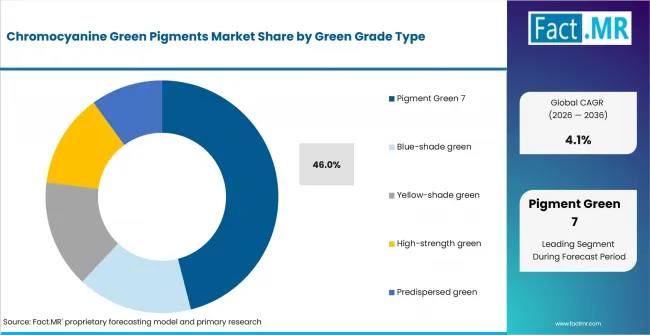
Chromocyanine Green Pigments Market Analysis By Green Grade Type | Source: Fact.MR
Pigment Green 7 holds 46.0%, almost three times the share of blue-shade green at 16.0%. Its installed formulation history, color strength, and supplier breadth make it the default reference grade for many buyers. Yellow-shade, high-strength, and predispersed greens remain valuable where color direction, loading, or ease of incorporation matters more than a standard PG7 specification.
What keeps printing inks at the center of green pigment demand?
The 2026 leader is Printing inks at 30.0% share as liquid and paste ink systems require strong color, controlled rheology, and dependable fastness.
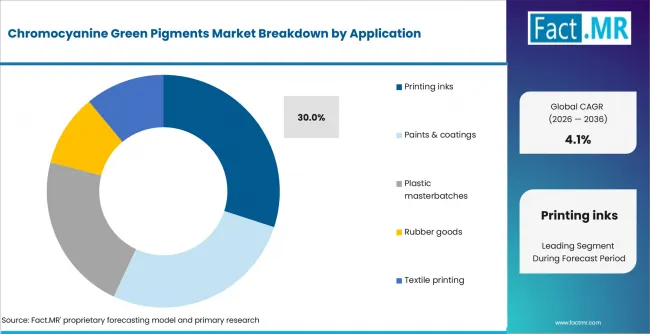
Chromocyanine Green Pigments Market Analysis By Application | Source: Fact.MR
Printing inks account for 30.0%, with paints and coatings close behind at 27.0%. Ink manufacturers need a green that develops consistently through milling and remains stable on press, particularly when high pigment loading affects viscosity. Plastic masterbatches at 22.0% emphasize heat and dispersion, while rubber and textile printing create smaller, process-specific requirements.
Which performance need most often determines green pigment approval?
A 24.0% share puts Weather fastness first in 2026 because outdoor and long-life products expose color loss before many other formulation weaknesses.
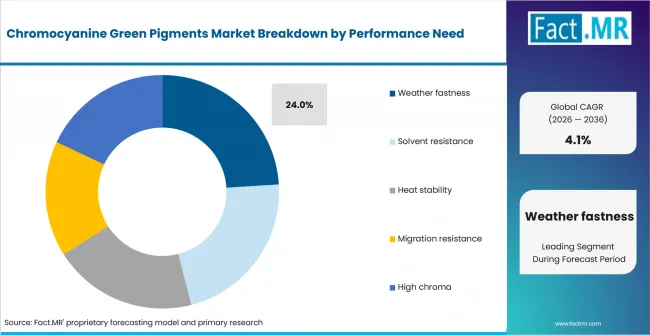
Chromocyanine Green Pigments Market Analysis By Performance Need | Source: Fact.MR
Weather fastness leads with 24.0%, followed by solvent resistance at 22.0% and heat stability at 20.0%. The close spread shows that no single property defines every PG7 application. High chroma matters for visual impact, while migration resistance becomes a targeted gate in plastics, packaging, and layered materials.
Why do buyers continue to favor dry powder?
For Supply Form, the top 2026 position is Dry powder at 41.0% share since it provides concentrated color and maximum freedom to choose the dispersing vehicle.
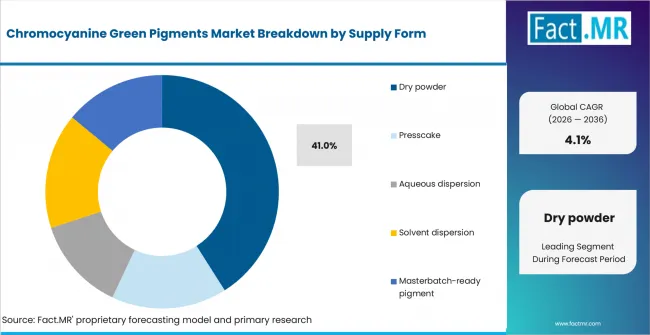
Chromocyanine Green Pigments Market Analysis By Supply Form | Source: Fact.MR
Dry powder represents 41.0% of the market. Presscake and solvent dispersion each hold 16.0%, serving customers that want a different balance of handling, vehicle compatibility, and milling work. Aqueous dispersion addresses water-based formulations, while masterbatch-ready pigment transfers part of the dispersion task to the supplier.
Who has the greatest influence on chromocyanine green specifications?
The leading 2026 share is 30.0% for Ink manufacturers because ink manufacturers purchase across multiple printing processes and judge both color and flow.
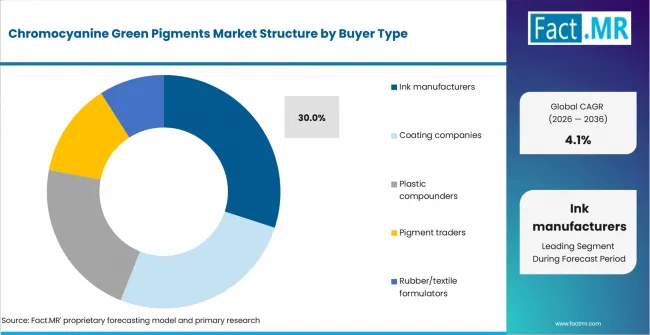
Chromocyanine Green Pigments Market Analysis By Buyer Type | Source: Fact.MR
Ink manufacturers lead with 30.0%, ahead of coating companies at 26.0% and plastic compounders at 22.0%. Ink users focus on strength, viscosity, transparency or opacity, and solvent-system behavior. Coating and plastics buyers apply different weather, heat, and migration screens, while traders and rubber or textile formulators serve more fragmented demand.
What is accelerating Chromocyanine Green Pigments Market adoption, and what is holding it back?
The market is accelerated by demand for durable, high-chroma green across inks, coatings, and plastics. Growth is held back by grade-specific dispersion behavior, the need to qualify fastness in each binder or polymer, and price competition around standard PG7 powder.
Drivers Impact Analysis
| DRIVER | (~) % IMPACT ON CAGR | GEOGRAPHIC RELEVANCE | IMPACT TIMELINE |
|---|---|---|---|
| Liquid ink color strength | +0.6% | The Americas, Europe, and Japan | Medium term (2-4 years) |
| Weatherable coatings | +0.5% | North America and Europe | Long term (>= 4 years) |
| Plastic masterbatch expansion | +0.5% | Asia Pacific, United States, and Germany | Medium term (2-4 years) |
| High-chroma product design | +0.4% | Global consumer and industrial markets | Medium term (2-4 years) |
| Prepared pigment convenience | +0.3% | Europe, North America, Japan, and selected Asian converters | Short term (<= 2 years) |
Source: Fact.MR analysis. Updated Jul 16, 2026
- Liquid ink color strength: Ink producers need green pigments that deliver high loading without making the mill base or finished ink difficult to handle. Grades with controlled rheology and repeatable strength can reduce press adjustments and batch correction.
- Weatherable coatings: Exterior and industrial finishes require green color to withstand sunlight, moisture, and chemical exposure. Weather-fast PG7 grades can become long-lived specifications where replacement risk is costly.
- Plastic masterbatch expansion: Compounders use concentrated green pigment across packaging, consumer goods, construction products, and other plastics. Consistent heat and dispersion behavior supports wider use of one approved grade across customer formulations.
Opportunity Impact Analysis
| OPPORTUNITY | (~) % IMPACT ON CAGR | GEOGRAPHIC RELEVANCE | IMPACT TIMELINE |
|---|---|---|---|
| Low-viscosity high-loading dispersions | +0.3% | Asia Pacific and the Americas | Short term (<= 2 years) |
| Weather-fast green for durable goods | +0.3% | Germany, United States, and Japan | Long term (>= 4 years) |
| Predispersed masterbatch-ready PG7 | +0.2% | Global compounder networks | Medium term (2-4 years) |
| Shade-extension portfolios | +0.2% | Global | Medium term (2-4 years) |
Source: Fact.MR analysis. Updated Jul 16, 2026
- Low-viscosity high-loading dispersions: Liquid-ink producers can raise color strength without sacrificing flow when a dispersion combines high pigment loading with manageable viscosity. Suppliers can tailor the carrier and resin to flexographic, gravure, or other liquid-ink systems.
- Weather-fast green for durable goods: Construction products, equipment, and outdoor plastics need green that resists fading and film degradation. Strong exposure data can move a pigment from a trial grade into multi-year specifications.
- Predispersed masterbatch-ready PG7: Masterbatch-ready pigments can help compounders control color development and reduce dispersion defects. The value proposition improves when the supplier supports multiple polymers with consistent particle and heat behavior.
Restraints Impact Analysis
| RESTRAINT | (~) % IMPACT ON CAGR | GEOGRAPHIC RELEVANCE | IMPACT TIMELINE |
|---|---|---|---|
| Standard PG7 price competition | -0.3% | Global | Short term (<= 2 years) |
| Dispersion and rheology variation | -0.2% | Global ink and coating markets | Medium term (2-4 years) |
| Application-specific fastness testing | -0.2% | North America, Europe, Japan, and export-oriented Asia | Medium term (2-4 years) |
| Environmental scrutiny of halogenated chemistry | -0.1% | Europe, North America, and Japan | Long term (>= 4 years) |
Source: Fact.MR analysis. Updated Jul 16, 2026
- Standard PG7 price competition: Pigment Green 7 is supplied by several established producers and is often bought against familiar specifications. Price comparison can overshadow technical differences unless those differences improve processing or end-use performance.
- Dispersion and rheology variation: Particle treatment and finishing affect viscosity, color development, and settling even within the same color index. Customers must confirm performance in their own mill base and let-down before switching grades.
- Application-specific fastness testing: Weather, solvent, heat, and migration tests vary by binder, polymer, exposure, and customer standard. Multiple approval paths raise technical cost and slow commercial conversion.
Where is chromocyanine green demand concentrated by country?
United States 5.4% CAGR. Germany 5.2%. United Kingdom 5.1%. Spain 4.9%. Japan 5.0%.
Regional analysis takes in North America, Europe, and Asia Pacific, with country detail for the United States, Germany, the United Kingdom, Spain, and Japan. More than 30 countries are analyzed in the complete report.
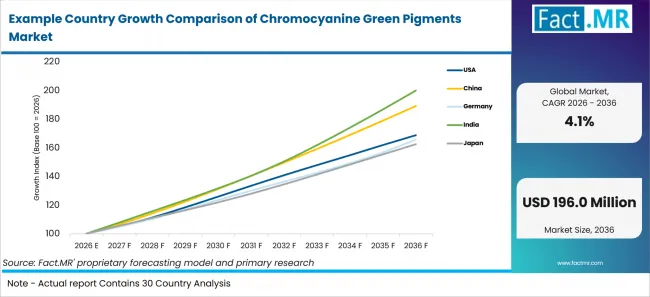
Example Country Growth Comparison Of Chromocyanine Green Pigments Market | Source: Fact.MR
| COUNTRY | CAGR |
|---|---|
| United States | 5.4% |
| Germany | 5.2% |
| United Kingdom | 5.1% |
| Spain | 4.9% |
| Japan | 5.0% |
Source: Fact.MR analysis. Updated Jul 16, 2026
What Is Driving Chromocyanine Green Pigment Demand Across US Packaging Corridors?
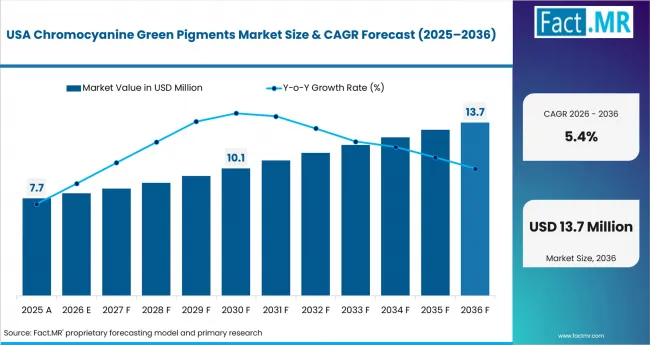
Chromocyanine Green Pigments Market Country Value Analysis | Source: Fact.MR
NAPIM describes itself as the national trade association for the US printing ink industry and dates its founding to 1916; it also maintains a technical arm, the National Printing Ink Research Institute. EPA NESHAP volatile-organic-compound limits on coating manufacture have pushed corrugated printers toward water-based flexographic systems, and dry powder chlorinated copper phthalocyanine feeds that dispersion chemistry directly.
Packaging, already the majority share of US ink demand, keeps expanding on e-commerce shipping volumes. The 5.4% CAGR projected from 2026 to 2036 tracks packaging's outpacing of publication and commercial print rather than any single new end use. Ink formulators serving national retail and shipping brands set purchasing volume, and Solar Organics and Sudarshan Chemical both maintain US supply relationships built around consistent shade matching across long production runs.
Why Does Germany's Pigment Green 7 Market Run Through a Century-Old Domestic Supply Base?
Germany's printing ink and coatings industry organizes through the VdL, founded in 1900 and and merged with the printing-ink association in 2009,covering roughly 85% of national output across more than 200 member firms, from multinationals to family-owned Mittelstand producers. Langelsheim-based Heubach traces pigment production back more than two centuries and has operated around 17 to 19 production sites worldwide, now under Sudarshan Chemical Industries following its acquisition of the group.
It built that reputation in the same domestic base, giving German formulators direct access to a heritage phthalocyanine producer rather than import-only supply. That density of local manufacturing supports a 5.2% CAGR from 2026 to 2036 even as broader eurozone chemical output stays uneven. VdL's member base skews toward buyers who need shade consistency across long packaging and publication print runs, a standard the domestic pigment industry was built to meet.
How Are Post-Brexit Packaging Rules Reshaping UK Demand for Pigment Green 7?
The UK has run its own REACH regime since January 2021, separate from the EU's and administered by the Health and Safety Executive rather than ECHA. Ink formulators supplying British Printing Industries Federation members track this regime independently of continental suppliers. Layered onto that is the Plastic Packaging Tax, which charges GBP 228.82 per tonne from April 2026 on packaging under 30% recycled plastic content and has already pushed more than half of UK plastic packaging past that threshold.
A revised packaging Extended Producer Responsibility scheme, billing producers from October 2025, names printing inks as one technical area PackUK will review on its roadmap to 2030. Buyers positioning for a 5.1% CAGR through 2036 are ink houses tied to recycled-content plastic and flexible packaging runs, where dry powder pigment feeds formulations built to hold shade on reprocessed film.
What Makes Catalonia the Center of Spain's Pigment Green 7 Demand?
Spain's paint and printing ink sector is represented by ASEFAPI, which reported total turnover of EUR 2.067 billion and exports up 61% since 2015, evidence that formulators increasingly sell beyond national borders. Much of that capacity sits in Catalonia, where a food packaging cluster of 556 companies and 11,000 workers spans films, printers, and what the cluster itself designates as special inks, with flexible packaging named a priority growth format.
Barcelona became label and flexible packaging's new meeting point in 2025, when Labelexpo Europe relocated there after 38 years in Brussels, putting Catalan converters at the center of the industry's largest annual gathering. A 4.9% CAGR from 2026 to 2036 marks the softest pace among these five countries, though converters supplying food and consumer label runs still generate steady demand for weather-fast green shades on shelf.
Why Does Japan's Pigment Green 7 Market Run on Its Own Ink Majors?
Japan's printing ink industry grew up around domestic manufacturers rather than import channels. DIC Corporation traces to a Tokyo ink workshop founded in 1908, becoming Dainippon Ink and Chemicals in 1962 and DIC Corporation in 2008. It began producing its own organic pigments in 1925 and remains active in this market today. Toyo Ink SC Holdings and Sakata Inx are also Japanese-founded, and both sit alongside DIC among the flexographic ink majors serving domestic converters.
That vertically rooted supply base supports a 5.0% CAGR from 2026 to 2036, carried more by steady replacement inside a mature, self-sufficient ink industry than by new demand categories. Buyers here are packaging and label converters accustomed to sourcing chlorinated copper phthalocyanine from producers with in-house pigment synthesis, a structural difference from markets leaning more heavily on imported dry powder.
Who leads the Chromocyanine Green Pigments Market?
Sudarshan Chemical leads the supplied company set, while Solar Organics, Meghmani Organics, DIC, and Heubach compete with PG7 powders and application-oriented portfolios.
No listed supplier reaches a double-digit share. Sudarshan Chemical stands at 8.0%; Solar Organics, Meghmani Organics, and DIC each hold 6.0%, while Heubach accounts for 5.0%, leaving ample room for specialists to compete through shade, rheology, availability, or technical response.
Official sources show PG7 offered for printing inks and plastics, in dry-pigment portfolios, and as products emphasizing liquid-ink rheology or high-loading colorants. Competition through 2036 should increasingly separate standard powder supply from grades and preparations that solve a defined processing or exposure problem.
Which companies are the key providers?
The company set includes Solar Organics, Sudarshan Chemical, Meghmani Organics, DIC, and Heubach.
- Solar Organics
- Sudarshan Chemical
- Meghmani Organics
- DIC
- Heubach
Alongside these five, the full report reviews more than 30 companies active in green pigment production, dispersion, and distribution.
Bibliography
- Sudarshan Chemical Industries Limited. (n.d.). Sudafast GREEN 2718D.
- DIC Corporation. (n.d.). Printing ink pigments.
- DIC Corporation. (n.d.). Plastics pigments.
- Solar Organics. (n.d.). Phthalocyanine pigments.
- Meghmani Organics Limited. (n.d.). MEGHAFast GREEN GN 792 safety data sheet.
- Heubach Colorants. (2023). Organic pigments product portfolio.
This Report Addresses
- The report evaluates how shade, chroma, fastness, rheology, and supply form influence chromocyanine green purchasing.
- The regional lens concentrates on the United States, Germany, the United Kingdom, Spain, and Japan, inside coverage of more than 30 countries.
- Supplier analysis tracks Solar Organics, Sudarshan Chemical, Meghmani Organics, DIC, and Heubach, with 30+ companies examined in the full report.
- Grade intelligence distinguishes standard PG7, blue- and yellow-shade greens, high-strength grades, and predispersed products.
- Application assessment covers printing inks, paints and coatings, plastic masterbatches, rubber goods, and textile printing.
- Forecast evidence links shipments and prices to performance qualification, buyer type, supply form, and regional converter activity.
What does the Chromocyanine Green Pigments Market cover?
Chromocyanine green pigment powders and preparations used to color inks, coatings, plastics, rubber, and textile-printing systems.
The report follows the supplied green-grade, application, performance, supply-form, and buyer-type dimensions. It measures pigment and pigment-preparation value rather than the downstream finished formulation.
Coverage spans more than 30 countries, led by the United States and Europe, and reviews 30+ companies around the USD million forecast from 2026 through 2036.
What is included in the scope?
Included products span standard PG7 powder and differentiated shade, strength, and dispersion forms.
The analysis includes blue-shade, yellow-shade, high-strength, and predispersed green alongside Pigment Green 7. Performance needs cover weather fastness, solvent resistance, heat stability, migration resistance, and high chroma.
Supply coverage includes dry powder, presscake, aqueous dispersion, solvent dispersion, and masterbatch-ready pigment sold to ink, coating, plastics, trading, rubber, and textile customers.
What is excluded from the scope?
Finished color products and green colorants outside the supplied phthalocyanine taxonomy are excluded.
The market does not include the full value of ink, paint, coated articles, masterbatch resin, rubber goods, or printed textiles. Dyes, natural greens, inorganic pigments, and unrelated organic green chemistries sit outside the boundary.
How was the analysis built?
PG7 portfolio evidence, converter interviews, trade records, and forecast cross-checks gathered across more than 30 countries.
- Primary Research: Interviews with PG7 producers, formulators, compounders, distributors, and textile or rubber users tested loading, viscosity, chroma, fastness, migration, and the value of prepared forms.
- Desk Research: Official product pages, technical sheets, company reports, regulatory records, and trade evidence tracked end-use and documentation shifts without importing outside market sizes.
- Market-Sizing and Forecasting: Volume was built by powder, presscake, aqueous or solvent dispersion, and masterbatch-ready form, with form-specific realized prices applied and channel double counting removed.
- Data Validation and Update Cycle: Shipments, stocks, trials, utilization, and repeat orders were cross-checked, and the forecast is refreshed for dispersion launches, performance rules, output, costs, and documentation changes.
Segmentation
What is the report's scope and coverage?
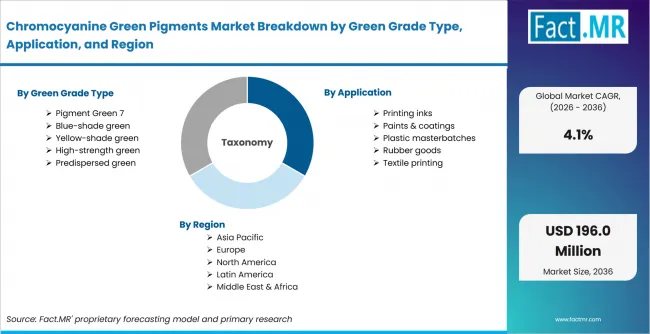
Chromocyanine Green Pigments Market Breakdown By Green Grade Type, Application, And Region | Source: Fact.MR
| ATTRIBUTE | DETAILS |
|---|---|
| Quantitative Units | USD million in 2026 to USD million by 2036 at CAGR |
| Market Definition | The market covers copper phthalocyanine green pigments, led by Pigment Green 7, and prepared green colorants sold for printing inks, paints and coatings, plastics, rubber, and textile printing. |
| Green Grade Type | Pigment Green 7; Blue-shade green; Yellow-shade green; High-strength green; Predispersed green |
| Application | Printing inks; Paints & coatings; Plastic masterbatches; Rubber goods; Textile printing |
| Performance Need | Weather fastness; Solvent resistance; Heat stability; Migration resistance; High chroma |
| Supply Form | Dry powder; Presscake; Aqueous dispersion; Solvent dispersion; Masterbatch-ready pigment |
| Buyer Type | Ink manufacturers; Coating companies; Plastic compounders; Pigment traders; Rubber/textile formulators |
| Regions Covered | North America; Europe; Asia Pacific |
| Countries Covered | United States; Germany; United Kingdom; Spain; Japan (analysis extends to 30+ countries) |
| Key Companies Profiled | Solar Organics; Sudarshan Chemical; Meghmani Organics; DIC; Heubach |
| Forecast Period | 2026 to 2036 |
| Approach | Sizing combines green pigment shipment volume, grade and supply-form prices, application loading, customer-channel demand, and qualification cycles for weather, solvent, heat, migration, and chroma performance. |
Source: Fact.MR analysis. Updated Jul 16, 2026
How is the market segmented?
-
By Green Grade Type
- Pigment Green 7
- Blue-shade green
- Yellow-shade green
- High-strength green
- Predispersed green
-
By Application
- Printing inks
- Paints & coatings
- Plastic masterbatches
- Rubber goods
- Textile printing
-
By Performance Need
- Weather fastness
- Solvent resistance
- Heat stability
- Migration resistance
- High chroma
-
By Supply Form
- Dry powder
- Presscake
- Aqueous dispersion
- Solvent dispersion
- Masterbatch-ready pigment
-
By Buyer Type
- Ink manufacturers
- Coating companies
- Plastic compounders
- Pigment traders
- Rubber/textile formulators
-
By Region
- North America
- United States
- Europe
- Germany
- United Kingdom
- Spain
- Asia Pacific
- Japan
Frequently Asked Questions
What is the 2036 outlook for the Chromocyanine Green Pigments Market?
Which green grade type leads?
Which application is largest?
Which supply form dominates?
How do the United States and Europe compare on growth?
What sustains Japanese demand?
What is the main demand driver?
What is the leading restraint?
Who worked on this report


Preview the report firsthand - request a free sample
Free SampleGet the brochure for pricing and purchase details
Download PDF