- Base Value(2025): 14.20 Bn
- Estimated Value(2026): 15.34 Bn
- Forecast Value (2036): 33.11 Bn
- CAGR (2026 - 2036): 8.0%
Green Chemicals Market Size, Market Forecast and Outlook By Fact.MR
The green chemicals market was valued at USD 14.20 billion in 2025, projected to reach USD 15.34 billion in 2026, and is forecast to expand to USD 33.11 billion by 2036 at an 8.0% CAGR. Corporate scope 3 emission reduction commitments and government bio-based procurement mandates are driving chemical manufacturers to scale production of bio-alcohols, biopolymers, and bio-organic acids derived from renewable feedstocks. Construction material formulators that once evaluated green chemical alternatives as optional sustainability features now face procurement specifications from building certification programs that mandate minimum bio-based content thresholds in adhesives, coatings, and concrete additives.
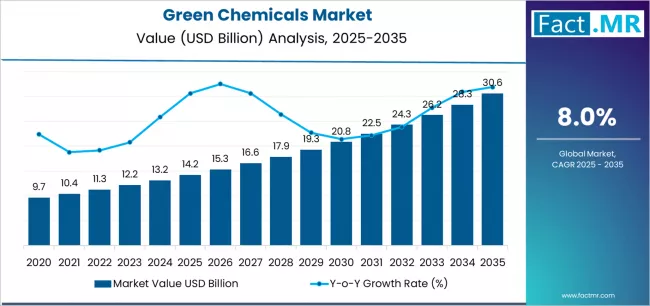
Green Chemicals Market Market Value Analysis | Source: Fact.MR
Summary of Green Chemicals Market
- Market Overview
- The green chemicals market is valued at USD 14.20 billion in 2025 and is projected to reach USD 33.11 billion by 2036.
- The industry is expected to grow at an 8.0% CAGR from 2026 to 2036, creating an incremental opportunity of USD 17.77 billion.
- The market is a feedstock-transition, sustainability-mandated chemicals category where corporate emission reduction targets, government bio-based procurement policies, and building certification bio-content requirements define procurement volumes.
- Demand and Growth Drivers
- Demand is accelerating as corporate scope 3 emission reduction commitments force chemical supply chain transitions from petroleum-derived to bio-based feedstocks.
- Government bio-based procurement mandates and building certification programs specify minimum bio-based content thresholds for construction adhesives, coatings, and concrete additives.
- PLA and PHA biopolymer production is scaling as packaging converters comply with single-use plastic reduction legislation across major consumer markets.
- Among key countries, India leads at 10.8% CAGR, followed by China at 9.5%, Brazil at 9.0%, the USA at 7.2%, Germany at 6.8%, the UK at 6.5%, and Japan at 6.2%.
- Product and Segment View
- Green chemicals are chemical products manufactured wholly or partially from renewable biological feedstocks (agricultural crops, waste biomass, microbial fermentation) as alternatives to petroleum-derived chemical counterparts.
- Primary applications span construction (bio-based adhesives, waterproofing, concrete additives), automotive (bio-plastics, bio-foams, bio-composites), pharmaceutical synthesis, packaging, food preservation, paints and coatings, and textile processing.
- Bio-alcohols lead by Product Type with 34.5% share in 2026.
- Construction leads by Application with 26.5% share in 2026.
- Scope includes bio-alcohols, biopolymers, bio-organic acids, and other renewable-feedstock chemicals, excluding petroleum-derived chemicals with carbon offset credits and bio-fuel products not sold as chemical intermediates.
- Geography and Competitive Outlook
- India and China are the fastest-growing markets due to ethanol blending mandates, bio-chemical manufacturing incentives, and PLA production scale-up, while the USA and Germany represent mature markets driven by clean manufacturing tax credits and bio-based construction specification.
- Competition is shaped by bio-feedstock sourcing and conversion technology, fermentation and synthesis scale-up capability, and bio-based product certification portfolios.
- Key companies include BASF SE, Dow Inc., Archer Daniels Midland Company (ADM), Cargill, Incorporated, Corbion N.V., Merck KGaA, Syensqo SA, Solugen, Inc., Evonik Industries AG, Mitsubishi Chemical Group Corporation, and DuPont de Nemours, Inc.
- Analyst Opinion at Fact.MR
- Shambhu Nath Jha, Principal Consultant for Chemicals and Materials, opines: 'In my analysis, I have observed that the true scale-up constraint for green chemicals is not technology readiness but the feedstock logistics infrastructure required to deliver consistent volumes of agricultural or waste biomass to bio-refinery facilities at costs competitive with petroleum feedstock supply chains. Chemical producers scaling bio-based production from pilot to commercial volumes face biomass procurement costs that fluctuate with agricultural commodity cycles and compete with food and feed applications. Companies delaying bio-refinery feedstock supply chain investment risk permanent cost disadvantage as competitors lock in long-term biomass supply agreements with agricultural cooperatives and waste management operators.'
- Strategic Implications / Executive Takeaways
- Green chemical producers must establish long-term biomass feedstock supply agreements with agricultural cooperatives and waste management operators to stabilize bio-refinery input costs during commercial scale-up.
- Construction material formulators should begin bio-based additive qualification programs aligned with building certification program timelines to meet mandatory bio-content specification thresholds.
- Packaging converters must qualify PLA and PHA biopolymer suppliers with demonstrated production scale capability to meet single-use plastic reduction legislation compliance deadlines.
Green Chemicals Market Key Takeaways
| Metric | Details |
|---|---|
| Industry Size (2026) | USD 15.34 billion |
| Industry Value (2036) | USD 33.11 billion |
| CAGR (2026 to 2036) | 8.0% |
Source: Fact.MR analysis. Updated Apr 8, 2026
Source: Future Market Insights, 2026
The absolute dollar opportunity of USD 17.77 billion between 2026 and 2036 reflects broadening adoption of bio-based chemical feedstocks across construction, automotive, packaging, and pharmaceutical supply chains. Bio-ethanol and bio-methanol production capacity expansion supports both fuel blending and chemical intermediate applications. PLA and PHA biopolymer production volumes are scaling as packaging converters respond to single-use plastic reduction legislation. Bio-based organic acid production for food preservation, pharmaceutical synthesis, and polymer precursor applications adds diversified demand beyond traditional bio-fuel pathways. All major green chemical adoption corridors reflect accelerated growth.
India sets the pace with a 10.8% CAGR as ethanol blending mandates and bio-based chemical manufacturing incentives drive production capacity investment. China follows at 9.5% with state-directed bio-chemical industry development programs and PLA production scale-up. Brazil tracks at 9.0% through established bio-ethanol infrastructure expansion into chemical intermediate production. United States operations advance at 7.2%, supported by Inflation Reduction Act clean manufacturing tax credits. Germany registers a 6.8% pace anchored by bio-based construction material specification and automotive bio-composite adoption. United Kingdom expands at 6.5% through bio-based packaging mandate compliance. Japan tracks at 6.2% through bio-polymer production and bio-based pharmaceutical intermediate development.
Imperatives for Stakeholders in Green Chemicals Market
Design for sustainability and performance, not just bio-based production
- Offer complete green chemistry solutions: renewable chemicals + lifecycle assessment support + certification documentation + application development systems + carbon footprint tracking platforms.
- Preconfigured application packages: construction material specifications, automotive component configurations, packaging formulations, and pharmaceutical ingredient protocols for diverse industrial requirements.
Carbon readiness for industrial applications
- Comprehensive sustainability documentation, carbon accounting systems, and environmental infrastructure (renewable feedstock certification, biodegradability validation, circular economy protocols).
Affordability-by-design approach
- Cost-optimized product portfolios, flexible volume pricing models, industry loyalty programs, and transparent total sustainability cost documentation.
Technical support-focused market penetration
- Established formulation development workshops + comprehensive certification programs (application optimization, performance testing, regulatory compliance); direct manufacturer engagement for relationship development and product confidence building.
Segmental Analysis
The market segments by product into Bio-alcohols, biopolymers, bio-organic acids, and other green chemicals, representing the evolution from traditional petrochemical derivatives toward diverse renewable chemical integration with enhanced environmental capabilities, comprehensive biodegradability characteristics, and sustainable feedstock sourcing.
The application segmentation divides the market into Construction (26.5%) with green adhesives and coatings, Automotive (18.0%) with bio-based plastics and foams, followed by pharmaceuticals, packaging, food & beverages, paints & coatings, textile, and other applications, reflecting distinct utilization objectives for sustainable building materials and environmental compliance versus lightweighting automotive components and renewable feedstock processing requirements.
The segmentation structure reveals green chemicals evolution from basic bio-based alternatives toward comprehensive sustainable chemistry platforms with enhanced performance characteristics and multi-dimensional environmental compliance capabilities, while product diversity spans from commodity bio-alcohols to advanced biopolymer systems requiring sophisticated processing techniques.
What makes Bio-alcohols Command the Largest Share in the Green Chemicals Market?
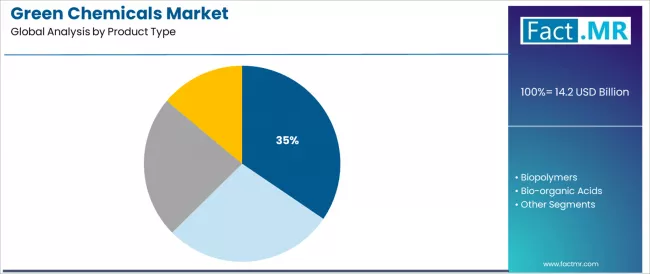
Green Chemicals Market Analysis By Product Type | Source: Fact.MR
Bio-alcohols command the leading position in the green chemicals market with a 34.5% market share through superior renewable feedstock characteristics, including established fermentation production, extensive fuel blending documentation, and standardized quality pathways that enable manufacturers to achieve predictable performance outcomes across varied solvent application categories and diverse fuel blending demographics.
The segment benefits from versatility advantages through multiple application compatibility, established infrastructure without requiring extensive processing modifications, and proven performance validation documentation without extensive reformulation procedures. Advanced fermentation technology enables yield optimization, purity enhancement customization, and feedstock flexibility enhancement, where renewable content and carbon reduction represent critical sustainability requirements.
Ethanol formulations hold significant share within the bio-alcohol segment at 15.0%, appealing to fuel blenders seeking renewable content capabilities for emission reduction determination. Bio-alcohol products differentiate through proven fuel blending profiles, industrial solvent familiarity advantages, and integration with established chemical processing protocols that enhance sustainability confidence while maintaining compliant performance outcomes for diverse industrial applications.
Key market characteristics:
- Advanced renewable properties with high bio-based content and reproducible performance for carbon footprint reduction
- Superior feedstock flexibility, enabling agricultural waste utilization and production scalability for industrial manufacturing
- Comprehensive regulatory acceptance, including renewable fuel standards and biofuel mandates for global market applications
Why do Biopolymers Represent a Fast-Growing Sustainable Material Segment?
Biopolymers maintain substantial market position at 27.0% through biodegradable characteristics and circular economy advantages. These products appeal to manufacturers seeking plastic alternatives with compostability credentials, offering PLA and PHA integration and end-of-life management through advanced polymer technologies. Market adoption is driven by packaging applications, emphasizing waste reduction requirements and regulatory compliance through innovative material solutions.
How does Construction Dominance Shape Application Preferences in Green Chemicals?
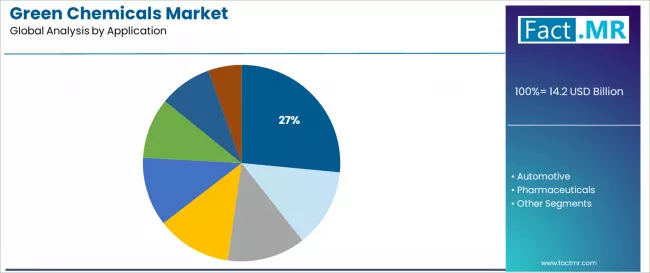
Green Chemicals Market Analysis By Application | Source: Fact.MR
Construction demonstrates application leadership in the green chemicals market with a 26.5% share due to widespread green building requirements and established focus on sustainable adhesives, low-VOC coatings, and environmental certification that maximizes LEED compliance while maintaining consistent performance characteristics.
Builders and contractors prioritize green chemicals for adhesive and sealant applications, waterproofing system integration, and compatibility with established construction workflows that enable coordinated sustainable building experiences across multiple project types. The segment benefits from substantial green building standardization and certification documentation that emphasizes bio-based approaches for construction material applications across diverse commercial and residential demographics.
Green adhesives and sealants capture significant share within the construction segment at 10.0%, demonstrating contractor preference for low-emission bonding materials. Sustainable building expansion incorporates green chemicals as essential compliance components for environmental certifications, while renovation market adoption increases demand for low-VOC product integration with indoor air quality systems for comprehensive occupant health outcomes.
What Drives Automotive Adoption in Lightweighting Material Applications?
Automotive captures substantial application share at 18.0% through comprehensive requirements in weight reduction systems, interior component capabilities, and sustainability optimization.
These applications demand sophisticated bio-based plastic protocols capable of achieving automotive standards while providing consistent structural reliability and processing compatibility, appealing to manufacturers and engineering teams seeking evidence-based sustainability advantages beyond traditional petroleum-based plastic approaches.
What Establishes Ethanol's Market Position in Biofuel Applications?
Ethanol establishes substantial product position in the green chemicals sector with a 15.0% share due to comprehensive fuel blending requirements and sustained focus on renewable content mandates, octane enhancement properties, and emission reduction that maximizes gasoline sustainability while maintaining appropriate engine performance standards.
Fuel blenders and refiners prioritize ethanol for gasoline blending applications, comprehensive renewable fuel standard compliance services, and integration with established fuel distribution systems that enable coordinated sustainability experiences across multiple fuel grades. The sector benefits from substantial biofuel mandate infrastructure maturity and agricultural feedstock availability that emphasize fermentation-based delivery for transportation fuel applications.
Renewable fuel standard expansion incorporates ethanol as standard blending component for carbon intensity reduction, while advanced biofuel development increases cellulosic ethanol adoption that meets sustainability requirements and ensures feedstock diversification capabilities.
Product dynamics include:
- Strong growth in cellulosic ethanol requiring agricultural waste utilization and carbon intensity improvement arrangements
- Increasing adoption in high-blend formulations for flex-fuel vehicle and E85 positioning
- Rising integration with renewable natural gas for biorefinery optimization and sustainability development
How are PLA Biopolymers Advancing Packaging Requirements?
PLA (Polylactic Acid) captures substantial biopolymer share at 10.0% through established compostability frameworks, food contact approval capabilities, and integrated packaging protocols.
The segment demonstrates specialized material expertise across diverse packaging populations, with advanced rigid container applications and film development gaining traction in food service programs while circular economy frameworks drive continued material adoption requiring careful balance between compostability performance and mechanical property assurance.
What are the Drivers, Restraints, and Key Trends of the Green Chemicals Market?
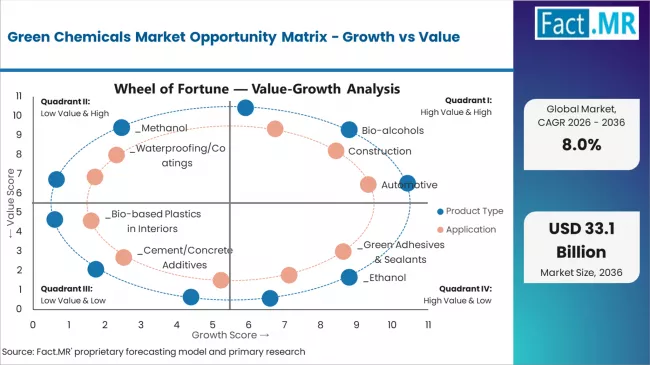
Green Chemicals Market Opportunity Matrix Growth Vs Value | Source: Fact.MR
| Category | Factor | Impact | Why It Matters |
|---|---|---|---|
| Driver | Rising environmental regulations & carbon reduction mandates (emission targets, plastic bans) | ★★★★★ | Government policies enable green chemical demand for sustainable alternatives; increasing environmental compliance drives bio-based adoption across industrial markets and diverse manufacturing segments. |
| Driver | Growth in circular economy initiatives and sustainability goals (ESG commitments, corporate pledges) | ★★★★★ | Drives demand for renewable materials and biodegradable solutions; manufacturers providing sustainable alternatives gain competitive advantage in environmentally focused industrial segments. |
| Driver | Consumer preference shifts & brand sustainability (eco-conscious consumers, green marketing) | ★★★★☆ | Brands demand sustainable ingredients and renewable materials; consumer awareness expanding addressable segments beyond regulatory-driven demographics and mandatory compliance clientele. |
| Restraint | Higher production costs & price premiums (feedstock expenses, processing complexity) | ★★★★☆ | Cost-conscious manufacturers face budget limitations and price competitiveness challenges, restricting green chemical adoption and affecting market penetration in price-sensitive applications and commodity chemical markets. |
| Restraint | Performance limitations & technical challenges (property trade-offs, processing requirements) | ★★★☆☆ | Manufacturers face application suitability concerns and formulation adjustments; increases development barriers and affects adoption penetration in high-performance requirements and demanding applications. |
| Trend | Advanced biorefinery development & integrated production (cascading processes, waste valorization) | ★★★★★ | Growing focus on efficiency optimization and feedstock utilization beyond single-product facilities; integrated biorefinery positioning becomes core differentiation strategy for economic viability. |
| Trend | Bio-based chemical diversity & specialty products (platform chemicals, functional materials) | ★★★★☆ | Industry evolving beyond commodity bio-alcohols toward specialized chemistry portfolios; specialty positioning drives enhanced margins and application innovation in sophisticated industrial markets. |
Source: Fact.MR analysis. Updated Apr 8, 2026
Analysis of the Green Chemicals Market by Key Countries
The green chemicals market demonstrates robust regional growth dynamics with emerging leaders including India (9.2% CAGR) and China (8.9% CAGR) driving expansion through sustainable manufacturing programs and renewable chemistry infrastructure development. Strong performers encompass South Korea (8.3% CAGR), Brazil (7.9% CAGR), and USA (7.4% CAGR), benefiting from established bio-based production infrastructure and corporate sustainability demographics. Developed markets feature Germany (6.8% CAGR) and Japan (6.5% CAGR), where circular economy normalization and green chemistry expertise support consistent growth patterns.
Regional synthesis reveals Asian markets leading adoption through comprehensive industrial capacity positioning and sustainability investment expansion, while Western countries demonstrate measured growth potential supported by environmental regulation preferences and corporate ESG influence. North American markets show solid development driven by renewable fuel mandate culture integration and advanced biorefinery infrastructure.
.webp "Top Country Growth Comparison Green Chemicals Market Cagr (2026 2036)")
Top Country Growth Comparison Green Chemicals Market Cagr (2026 2036) | Source: Fact.MR
| Region/Country | 2025-2035 Growth | How to win | What to watch out |
|---|---|---|---|
| India | 9.2% | Focus on agricultural feedstock portfolios | Infrastructure development; technology transfer gaps |
| China | 8.9% | Lead with industrial scale positioning | Quality consistency; environmental enforcement |
| South Korea | 8.3% | Provide advanced technology solutions | Market size; import dependencies |
| Brazil | 7.9% | Offer sugarcane-based strategies | Economic volatility; policy changes |
| USA | 7.4% | Maintain innovation leadership technologies | Market maturity; petrochemical competition |
| Germany | 6.8% | Deliver circular economy solutions | Cost competitiveness; feedstock availability |
| Japan | 6.5% | Push specialty chemical programs | Limited feedstock; high production costs |
Source: Fact.MR analysis. Updated Apr 8, 2026
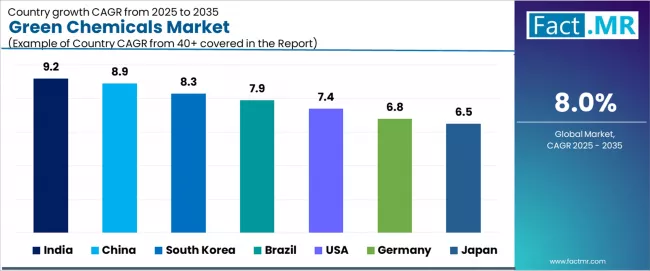
Green Chemicals Market Cagr Analysis By Country | Source: Fact.MR
India Drives Fastest Market Growth
India establishes fastest market growth through progressive sustainable manufacturing expansion and comprehensive agricultural feedstock infrastructure development, positioning green chemical technologies as essential renewable alternatives in industrial processing centers and emerging bio-based production facilities. The country's 9.2% growth rate reflects rising sustainability investment levels supporting bio-based material spending and growing environmental compliance segments that encourage the deployment of cost-effective renewable products in diverse application settings.
Growth concentrates in major industrial clusters, including Maharashtra, Gujarat, and Tamil Nadu, where manufacturing facilities showcase increasing capacity for green chemistry adoption that appeal to sustainability-focused producers demanding carbon reduction performance and renewable feedstock integration outcomes.
Indian manufacturers are developing standardized production protocols that combine imported fermentation technologies with domestic agricultural residue partnerships, including biorefinery expansion and sustainable chemical growth. Distribution channels through chemical distributors and industrial suppliers expand market access, while technical training initiatives support adoption across diverse facility types and application specialization levels.
China Emerges as Production Scale Leader
In Shanghai, Jiangsu, and Shandong regions, chemical manufacturers and biorefinery facilities are adopting advanced green chemical technologies as essential sustainable materials for industrial operations, driven by increasing environmental regulation alignment with carbon neutrality targets and elevation of renewable content expectations that emphasize the importance of bio-based chemistry integration.
The market holds an 8.9% growth rate, supported by industrial park development and sustainability investment that promote green chemical production for domestic and export applications. Chinese manufacturers are favoring bio-alcohol and biopolymer production that provides comprehensive carbon footprint documentation and scale economics evidence, particularly appealing in industrial clusters where production volume and cost competitiveness represent critical operational factors.
Market expansion benefits from substantial chemical facility investment and biorefinery establishment that enable widespread adoption of renewable chemistry methodologies for diverse solvent and material applications. Industry adoption follows patterns established in manufacturing scale excellence, where production capacity advantages and feedstock integration optimization drive customer confidence and market penetration achievement.
South Korea Shows Technology Innovation Leadership
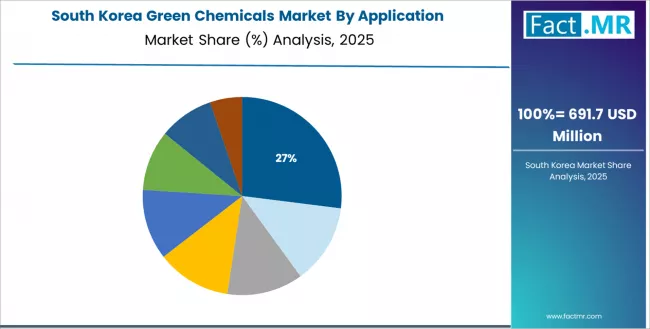
Green Chemicals Market South Korea Market Share Analysis By Application | Source: Fact.MR
South Korea establishes technology innovation leadership through comprehensive chemical industry infrastructure and established research ecosystem, integrating green chemical technologies across specialty chemical facilities, polymer production plants, and advanced material organizations.
The country's 8.3% growth rate reflects established chemical industry maturity and sophisticated innovation capability levels that support widespread deployment of advanced bio-based products in specialty and performance applications. Growth concentrates in established industrial regions, including Ulsan, Yeosu, and Daesan, where manufacturers showcase advanced technology adoption that appeals to innovation-focused organizations seeking differentiated renewable products and comprehensive intellectual property outcomes.
Korean manufacturers leverage established technology development relationships and comprehensive commercialization frameworks, including pilot plant infrastructure and scale-up programs that create innovation confidence and market introduction success. The market benefits from substantial R&D investment and government support that encourage advanced green chemistry development while supporting continuous technology innovation investments and process optimization funding.
Brazil Shows Feedstock Advantage Integration
Brazil's progressive agricultural market demonstrates established green chemical adoption with documented feedstock emphasis in sugarcane utilization and bio-based production implementation through specialized ethanol producers and emerging biorefinery operations. The country maintains a 7.9% growth rate, leveraging abundant biomass resources and established biofuel industry cultures in renewable chemistry production.
Major agricultural regions, including São Paulo, Goiás, and Mato Grosso areas, showcase resource-driven production priorities where green chemical technologies integrate with established sugarcane processing and regional agricultural capacity to optimize feedstock economics and maintain renewable content under comprehensive sustainability requirements.
Brazilian producers prioritize integrated biorefinery strategies and comprehensive agricultural waste integration in production implementation, creating demand for cascading process technologies with established economics, including cellulosic conversion, lignin valorization, and byproduct utilization optimization. The market benefits from established biofuel industry clusters and feedstock availability that provide cost positioning opportunities and maintain alignment with national renewable content policies.
USA Shows Innovation Ecosystem Leadership
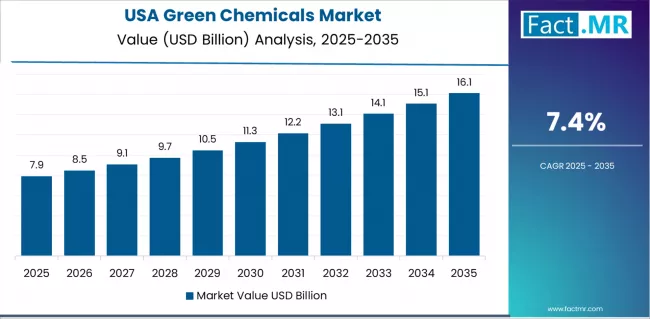
Green Chemicals Market Country Value Analysis | Source: Fact.MR
USA's mature chemical market demonstrates sophisticated green chemical integration with documented innovation emphasis in advanced biorefinery development and specialty bio-based material commercialization through comprehensive research facilities and established chemical producers. The country leverages rigorous sustainability commitments and evidence-based technology development to maintain a 7.4% growth rate.
Premium innovation centers, including California, Texas, and Midwest regions, showcase technology-driven production priorities where green chemical technologies integrate with established venture capital cultures and thorough commercialization practices to optimize market introduction and ensure appropriate scale-up validation.
American producers prioritize renewable fuel standard compliance and comprehensive lifecycle analysis in product development, creating demand for low-carbon materials with extensive sustainability characteristics, including carbon intensity documentation, feedstock certification, and comprehensive environmental impact assessment. The market benefits from established specialty chemical segments and corporate sustainability maturity that provide premium positioning opportunities and compliance with strict EPA renewable chemistry requirements.
Germany Demonstrates Circular Economy Integration
Germany's advanced chemical market demonstrates established green chemical integration with documented sustainability focus in bio-based material adoption and circular economy protocol implementation through comprehensive chemical manufacturers and specialized biorefinery networks. The country maintains a 6.8% growth rate, leveraging established chemical industry heritage and comprehensive environmental oversight frameworks in sustainable chemistry.
Major chemical centers, including North Rhine-Westphalia and Bavaria regions, showcase circular economy emphasis where green chemical technologies integrate with established European sustainability standards and meticulous lifecycle practices to optimize environmental performance and maintain regulatory compliance under comprehensive chemical policy supervision.
German manufacturers prioritize bio-based content requirements and comprehensive sustainability system integration in product development, creating demand for certified renewable materials with extensive documentation characteristics, including biomass balance certification, ISCC PLUS compliance, and comprehensive product carbon footprint reports. The market benefits from established chemical industry reputation and sustainability-focused innovation culture that provide premium positioning opportunities and comply with strict German chemical regulations.
Japan Shows Specialty Application Integration
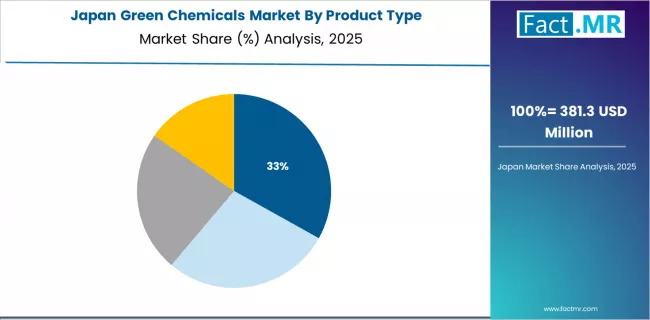
Green Chemicals Market Japan Market Share Analysis By Product Type | Source: Fact.MR
Japan's sophisticated chemical market demonstrates progressive green chemical adoption with documented quality standards in specialty formulation and high-performance application execution through established chemical manufacturers and specialized material facilities. The country maintains a 6.5% growth rate, leveraging established chemical industry heritage and comprehensive quality oversight frameworks in advanced materials. Major industrial centers, including Tokyo Bay and Osaka regions, showcase precision emphasis where green chemical technologies integrate with established Japanese quality standards and meticulous processing practices to optimize material performance and maintain application reliability under comprehensive industrial specification supervision.
Japanese manufacturers prioritize performance equivalence requirements and comprehensive quality system integration in formulation development, creating demand for high-specification materials with extensive testing characteristics, including mechanical property validation, thermal stability assessment, and comprehensive application verification reports. The market benefits from established specialty chemical reputation and quality-focused development culture that provide premium positioning opportunities and comply with strict Japanese industrial standards.
Europe Market Split by Country
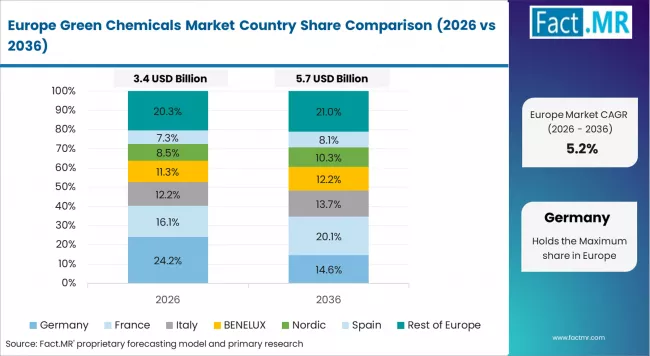
Green Chemicals Market Europe Country Market Share Analysis 2026 & 2036 | Source: Fact.MR
The European green chemicals market is projected to grow from USD 3.2 billion in 2025 to USD 6.4 billion by 2035, representing 22.5% of the global market in 2025 and expanding to 20.9% by 2035. Germany is expected to maintain its leadership position with USD 0.9 billion in 2025, accounting for 26.8% of the European market, supported by its advanced chemical manufacturing infrastructure and established biorefinery networks.
France follows with USD 0.6 billion, representing 18.9% of the European market in 2025, driven by comprehensive agricultural feedstock integration and specialty chemical concentration. UK holds USD 0.6 billion with 17.3% market share through established circular economy acceptance and sustainable chemistry facility density.
Italy commands USD 0.5 billion representing 14.2% share, while Spain accounts for USD 0.4 billion or 11.6% in 2025. The rest of Europe region maintains USD 0.4 billion, representing 11.2% of the European market, attributed to increasing green chemical adoption in Nordic countries and emerging Eastern European biorefinery sectors implementing sustainable chemistry programs.
Competitive Landscape of the Green Chemicals Market
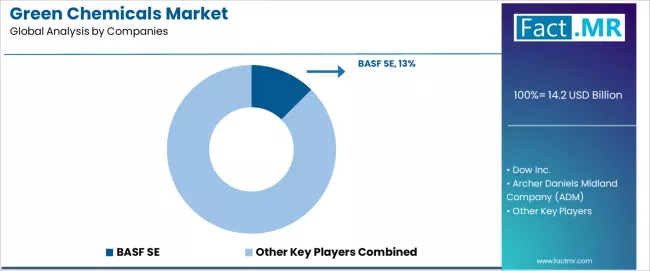
Green Chemicals Market Analysis By Company | Source: Fact.MR
The green chemicals market exhibits a moderately fragmented competitive structure with approximately 60-90 active players operating across global sustainable chemistry networks and regional bio-based production distribution portfolios. BASF maintains market leadership at a 12.5% share, reflecting strong product portfolio positioning across diverse green chemistry applications with sophisticated global sustainability strategies.
This competitive landscape demonstrates the maturation of green chemical technology, where established players leverage chemical industry expertise advantages, extensive R&D capability documentation, and customer relationship programs to maintain dominant positions, while emerging biorefinery operators and specialty bio-based producers create niche opportunities through differentiated feedstock offerings and competitive sustainability strategies.
Market leadership is maintained through several critical competitive advantages extending beyond production capabilities and product portfolios. Global distribution networks enable leading players to navigate diverse regulatory requirements and access varied customer segments including construction material manufacturers, automotive component suppliers, and packaging converters.
Technical support infrastructure and application development program availability represent crucial differentiators in green chemical categories, where decades of formulation expertise, processing optimization protocols, and performance validation frameworks create purchasing preference among quality-focused industrial customers.
Production efficiency in large-scale biorefinery facilities, feedstock supply chain management, and sustainability certification systems separate major suppliers from smaller competitors, while comprehensive environmental documentation addressing carbon footprint analysis, lifecycle assessment studies, and renewable content verification strengthen market position and customer confidence.
The market demonstrates emerging differentiation opportunities in advanced biopolymer categories and specialty bio-based chemical technologies, where traditional petrochemical materials face competition from innovation-focused entrants offering sustainability advantages.
Significant competitive advantages persist in established bio-alcohol categories through comprehensive cost-effectiveness profiles and production scale depth. Premium positioning strategies with specialty formulation capabilities and application-specific development command margin premiums through superior performance and environmental credentials.
Specialized product portfolios combining multiple green chemistry platforms with application-specific solutions create comprehensive positioning that justifies higher price points beyond commodity bio-based competition. Integrated sustainability solution offerings emphasizing complementary certification compatibility, unified technical support, and cross-application chemistry expertise generate brand loyalty and product line preferences beyond transactional chemical purchases.
| Stakeholder | What they actually control | Typical strengths | Typical blind spots |
|---|---|---|---|
| Global chemical corporations | Comprehensive product portfolios; global distribution; R&D resources | Market presence; technical expertise; financial capabilities; customer relationships | Innovation speed; feedstock flexibility; niche applications; startup agility |
| Specialized biorefinery companies | Feedstock expertise; production technology; sustainability focus | Process innovation; environmental positioning; feedstock integration; application knowledge | Distribution scale; market access; product diversity; financial resources |
| Agricultural companies | Feedstock control; supply chain; commodity trading; farmer relationships | Raw material access; volume capability; cost position; logistics infrastructure | Chemical expertise; product development; application knowledge; downstream integration |
| Startup innovators | Novel technologies; specialized applications; IP development; agility | Innovation capability; technology differentiation; sustainability credentials; flexibility | Production scale; market access; financial resources; commercialization experience |
| Industrial customers | Demand generation; specifications; volume purchasing; sustainability targets | Market pull; application requirements; ESG influence; purchasing power | Technology development; feedstock sourcing; production operations; supply chain complexity |
Source: Fact.MR analysis. Updated Apr 8, 2026
Key Players in the Green Chemicals Market
- BASF SE
- Dow Inc.
- Archer Daniels Midland Company (ADM)
- Cargill, Incorporated
- Corbion N.V.
- Merck KGaA
- Syensqo SA
- Solugen, Inc.
- Evonik Industries AG
- Mitsubishi Chemical Group Corporation
- DuPont de Nemours, Inc.
Bibliography
- European Commission. (2024, November). European bioeconomy strategy: Progress report on bio-based chemical production targets. EC, DG RTD.
- U.S. Department of Agriculture. (2025, January). BioPreferred program: Updated bio-based product procurement requirements for federal agencies. USDA.
- International Energy Agency. (2024). Renewables 2024: Bio-based chemicals and materials production capacity update. IEA.
- Ministry of New and Renewable Energy, India. (2024). National policy on biofuels 2024 amendment: Ethanol blending and bio-chemical production targets. MNRE, Government of India.
- European Bioplastics. (2025, January). Bioplastics market data 2024: Global production capacities for PLA and PHA. European Bioplastics.
This bibliography is provided for reader reference. The full Fact.MR report contains the complete reference list with primary research documentation.
This Report Addresses
- Market sizing and quantitative forecast metrics detailing green chemical expenditure across construction, automotive, packaging, pharmaceutical, and industrial sectors through 2036.
- Segmentation analysis mapping adoption by product type and evaluating feedstock conversion technology and bio-content certification requirements.
- Regional deployment intelligence comparing bio-ethanol infrastructure leverage in the Americas against bio-polymer and bio-acid scale-up in Asia and Europe.
- Sustainability mandate assessment analyzing how scope 3 emission targets, building certification bio-content thresholds, and packaging legislation drive green chemical adoption.
- Competitive posture evaluation tracking bio-refinery capacity, feedstock sourcing networks, and bio-based product certification portfolios.
- Feedstock economics guidance defining biomass procurement, conversion yield, and production cost parameters for commercial-scale green chemical manufacturing.
- Supply chain analysis identifying agricultural feedstock availability constraints and bio-refinery scale-up timelines.
- Custom data delivery formats encompassing interactive dashboards, raw Excel datasets, and comprehensive PDF narrative reports.
Green Chemicals Market Definition
Green chemicals are chemical products manufactured wholly or partially from renewable biological feedstocks including agricultural crops, lignocellulosic biomass, waste streams, and microbial fermentation outputs as sustainable alternatives to petroleum-derived chemical counterparts. Major product categories include bio-alcohols (bio-ethanol, bio-methanol, bio-butanol), biopolymers (polylactic acid, polyhydroxyalkanoates, bio-polyesters), bio-organic acids (lactic acid, succinic acid, citric acid), and other bio-based chemical intermediates. These products serve construction, automotive, packaging, pharmaceutical, food, coating, and textile applications.
Green Chemicals Market Inclusions
Market scope includes bio-alcohols, biopolymers, bio-organic acids, and other green chemical products manufactured from renewable feedstocks for industrial and commercial application. The report covers global and regional market sizes, forecast period 2026 to 2036, and segment breakdowns by product type and application.
Green Chemicals Market Exclusions
The scope excludes petroleum-derived chemicals claiming carbon neutrality through offset credits, bio-fuel products not sold as chemical intermediates, natural essential oils and botanical extracts, and genetically modified organism research reagents.
Green Chemicals Market Research Methodology
Primary Research: Analysts engaged with bio-refinery operators, green chemical procurement managers, and building certification program administrators to map bio-based content specification requirements and supply chain formation timelines.
Desk Research: Data collection aggregated bio-based chemical production capacity announcements, government bio-procurement mandate databases, biopolymer legislation timelines, and agricultural feedstock supply statistics.
Market-Sizing and Forecasting: Baseline values derive from a bottom-up aggregation of green chemical consumption volumes per application sector, applying bio-based content penetration rates and feedstock conversion yield factors.
Data Validation and Update Cycle: Projections are tested against publicly reported bio-based chemical segment revenues from major producers and government bio-economy progress tracking reports.
Segmentation
Scope of the Report
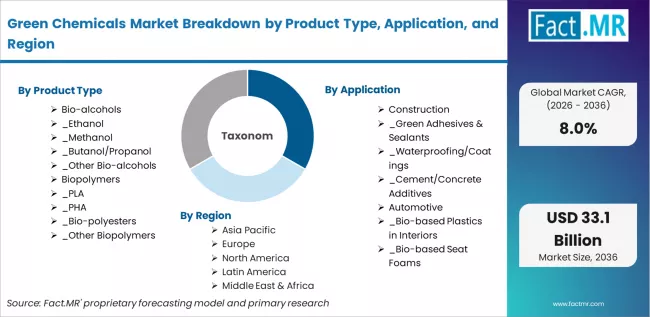
Green Chemicals Market Breakdown By Product Type Application And Region | Source: Fact.MR
| Metric | Value |
|---|---|
| Quantitative Units | USD 15.34 billion to USD 33.11 billion, at a CAGR of 8.0% |
| Market Definition | Green chemicals are chemical products manufactured wholly or partially from renewable biological feedstocks including agricultural crops, lignocellulosic biomass, waste streams, and microbial fermentation outputs as sustainable alternatives to petroleum-derived chemical counterparts. Major product categories include bio-alcohols (bio-ethanol, bio-methanol, bio-butanol), biopolymers (polylactic acid, polyhydroxyalkanoates, bio-polyesters), bio-organic acids (lactic acid, succinic acid, citric acid), and other bio-based chemical intermediates. These products serve construction, automotive, packaging, pharmaceutical, food, coating, and textile applications. |
| Product Type Segmentation | Bio-alcohols (Ethanol, Methanol, Butanol/Propanol, Other Bio-alcohols), Biopolymers (PLA, PHA, Bio-polyesters, Other Biopolymers), Bio-organic Acids, Other Green Chemicals |
| Application Segmentation | Construction (Green Adhesives & Sealants, Waterproofing/Coatings, Cement/Concrete Additives), Automotive (Bio-based Plastics in Interiors, Bio-based Seat Foams, Bio-composites), Pharmaceuticals, Packaging, Food & Beverages, Paints & Coatings, Textile, Other Applications |
| Regions Covered | North America, Latin America, Europe, East Asia, South Asia, Oceania, Middle East & Africa |
| Countries Covered | India, China, USA, Germany, Japan, Brazil, UK, and 40 plus countries |
| Key Companies Profiled | BASF SE, Dow Inc., Archer Daniels Midland Company (ADM), Cargill, Incorporated, Corbion N.V., Merck KGaA, Syensqo SA, Solugen, Inc., Evonik Industries AG, Mitsubishi Chemical Group Corporation, DuPont de Nemours, Inc. |
| Forecast Period | 2026 to 2036 |
| Approach | Baseline values derive from a bottom-up aggregation of green chemical consumption volumes per application sector, applying bio-based content penetration rates and feedstock conversion yield factors. |
Source: Fact.MR analysis. Updated Apr 8, 2026
Green Chemicals Market by Segments
-
Product Type :
- Bio-alcohols
- Ethanol
- Methanol
- Butanol/Propanol
- Other Bio-alcohols
- Biopolymers
- PLA (Polylactic Acid)
- PHA (Polyhydroxyalkanoates)
- Bio-polyesters
- Other Biopolymers
- Bio-organic Acids
- Other Green Chemicals
- Bio-alcohols
-
Application :
- Construction
- Green Adhesives & Sealants
- Waterproofing/Coatings
- Cement/Concrete Additives
- Automotive
- Bio-based Plastics in Interiors
- Bio-based Seat Foams
- Bio-composites (Panels)
- Pharmaceuticals
- Packaging
- Food & Beverages
- Paints & Coatings
- Textile
- Other Applications
- Construction
-
Region :
- North America
- USA
- Canada
- Mexico
- Europe
- Germany
- France
- UK
- Italy
- Spain
- Rest of Europe
- Asia Pacific
- India
- China
- Japan
- South Korea
- ASEAN
- Australia & New Zealand
- Rest of Asia Pacific
- Latin America
- Brazil
- Rest of Latin America
- Middle East & Africa
- GCC Countries
- South Africa
- Rest of Middle East & Africa
- North America
Frequently Asked Questions
How large is the demand for green chemicals in the global market in 2026?
What will be the market size of green chemicals by 2036?
What is the expected demand growth between 2026 and 2036?
Which Product Type is poised to lead global sales by 2026?
How significant is Construction in driving green chemical adoption in 2026?
What is the India growth outlook in this report?
What is China's growth outlook in this report?
What are green chemicals and what are they mainly used for?
Who worked on this report


Preview the report firsthand - request a free sample
Free SampleGet the brochure for pricing and purchase details
Download PDF