- Base Value(2025): 94 Bn
- Estimated Value(2026): 103 Bn
- Forecast Value (2036): 274 Bn
- CAGR (2026 - 2036): 10.2%
Green Ammonia Bunkering Sensors Market Forecast and Outlook By Fact.MR
In 2025, the green ammonia bunkering sensors market was valued at USD 94 billion. Based on Fact.MR analysis, demand for green ammonia bunkering sensors is estimated to grow to USD 103 billion in 2026 and USD 274 billion by 2036. FACT.MR projects a CAGR of 10.2% during the forecast period.
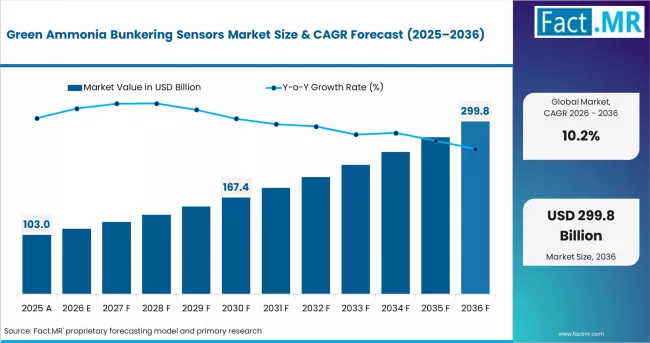
Green Ammonia Bunkering Sensors Market Value Analysis | Source: Fact.MR
Summary of Green Ammonia Bunkering Sensors Market
- Market Definition
- Market covers ammonia leak detection and gas monitoring sensors deployed at green ammonia bunkering terminals, onboard ammonia-fuelled vessels, and industrial ammonia storage and export facilities globally.
- Demand Drivers
- IMO MSC.1/Circ.1687 interim guidelines, approved December 2024, mandate ammonia leak detection systems across bunkering operations, fuel containment, and vessel machinery spaces, creating non-discretionary sensor procurement.
- Japan's national ammonia fuel adoption programme is driving fixed sensor installations at Yokohama, Kobe, and Nagoya port bunkering facilities ahead of planned first ammonia-fuelled vessel deployments from 2026.
- South Korea's Ministry of Oceans and Fisheries is funding ammonia bunkering hub development at Busan and Ulsan, requiring certified gas detection system integration across transfer and storage infrastructure.
- Key Segments Analyzed
- By Sensor Type: Electrochemical Sensors lead with 45% share in 2026, driven by marine certification breadth and low-concentration NH3 detection.
- By Application: Bunkering Safety & Leak Detection leads with 50% share in 2026, as primary regulatory compliance trigger for sensor procurement at ammonia bunkering terminals.
- By End Use: Ports & Bunkering Terminals lead with 55% share in 2026, driven by ammonia fuel infrastructure rollout and IMO safety mandate implementation.
- By Geography: China leads at 11.8% CAGR through 2036, driven by state-funded large-scale green ammonia port pilots and terminal electrification.
- Analyst Opinion at FACT.MR
- Shambhu Nath Jha, Principal Consultant at Fact.MR, opines, ' CXOs will find that ammonia bunkering sensor demand is no longer project-based. It is becoming structurally mandated. Marine-certified electrochemical and NDIR platforms are gaining importance. Integration with terminal safety systems is now essential. Vendors with these capabilities will capture a larger share of high-value contracts through 2036.
- Strategic Implications
- Obtain IMO and DNV certification for electrochemical and NDIR sensors. This is required for terminal procurement in key countries.
- Build integration capabilities with port terminal management systems. Focus on China and South Korea.
- Develop fixed multi-point detection systems with SCADA integration. Replace portable devices in large terminals.
- Methodology
- Market sizing is based on sensor revenues by type and region. Validated with vendor data and port procurement records.
- Analysis includes IMO guidelines, Rotterdam pilots, and DNV safety frameworks.
- Forecasts consider compliance timelines, terminal expansion, and expert inputs.
| Metric | Value |
|---|---|
| Estimated Value in 2026 | USD 103 billion |
| Forecast Value in 2036 | USD 274 billion |
| Forecast CAGR (2026 to 2036) | 10.2% |
Source: Fact.MR analysis. Updated Apr 22, 2026
Between 2026 and 2036, the market is projected to generate an absolute opportunity of USD 171 billion. Growth is structurally driven by port infrastructure commissioning and IMO compliance timelines. Sensor demand is non-discretionary at ammonia-fuelled bunkering terminals. Qualification cycles and marine certification requirements create barriers that limit rapid new entrant participation.
Procurement is shifting toward integrated fixed detection arrays rather than standalone portable instruments. Port authorities and terminal operators are specifying multi-zone sensor systems with SCADA-linked alarm outputs. Leading sensor providers including Honeywell, Drägerwerk, and MSA Safety maintain strong incumbent positions through marine certifications and established safety system integration credentials. Buyers are managing supply dependency through dual-qualified vendor programmes, consistent with LNG bunkering procurement models.
China leads with a projected CAGR of 11.8% through 2036, underpinned by large-scale green ammonia port pilots and state-backed terminal electrification mandates. Japan follows at 11.2%, driven by early ammonia fuel adoption in commercial shipping and national decarbonisation commitments. South Korea records 10.9%, supported by its dominant shipbuilding base and active ammonia bunkering hub development. The Netherlands grows at 10.5%, anchored by Rotterdam's first commercial ammonia bunkering pilot in April 2025. Germany records 10.2%, driven by EU FuelEU Maritime compliance requirements and port infrastructure investment. The United States follows at 9.8%, supported by port decarbonisation programmes and federal clean hydrogen hub funding.
Segmental Analysis
Green Ammonia Bunkering Sensors Market Analysis by Sensor Type
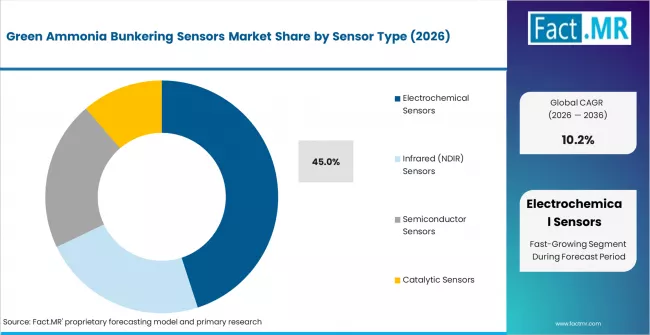
Green Ammonia Bunkering Sensors Market Analysis By Sensor Type | Source: Fact.MR
Based on FACT.MR analysis, electrochemical sensors hold 45% share in 2026. They lead due to high sensitivity at low ppm levels. This is critical for ammonia safety thresholds. These sensors are widely certified for marine use. They also require low maintenance. Ports prefer them for fixed detection systems.
- Honeywell Product Development: Honeywell updated its portfolio in April 2024. Ammonia sensors were moved to Process Solutions. This supports industrial and bunkering applications. It expands reach in maritime markets [1].
- MSA Safety Instrument Launch: MSA launched the ALTAIR io 6 in 2025. It supports multi-gas detection including ammonia. The system targets bunkering and confined environments. It improves monitoring across complex sites [2].
- IMO Safety Mandate Trend: IMO guidelines were approved in December 2024. Ammonia detection is now mandatory. It applies to bunkering and machinery spaces. This creates strong demand for certified sensors [3].
Green Ammonia Bunkering Sensors Market Analysis by Application
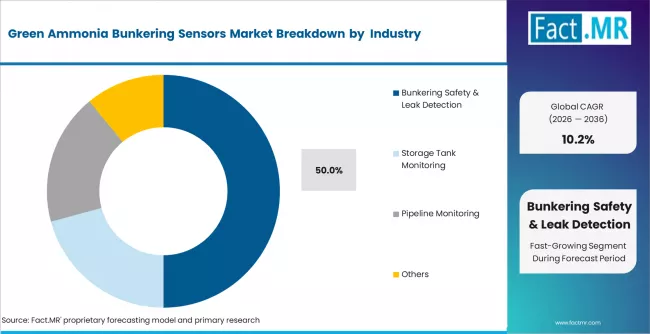
Green Ammonia Bunkering Sensors Market Analysis By Application | Source: Fact.MR
Based on FACT.MR analysis, bunkering safety and leak detection hold 50% share in 2026. This segment leads due to high toxicity risks. Real-time monitoring is required during transfer. Regulations mandate alarm-based detection systems. Procurement is linked to terminal certification.
- Rotterdam Pilot Infrastructure: Rotterdam completed a bunkering pilot in April 2025. Around 800 cubic meters of ammonia were transferred. The project validated safety systems. Sensor deployment was tested across zones [4].
- Dräger Marine Detection: Dräger supplies certified ammonia detection systems. Products meet ATEX and IECEx standards. Solutions include both fixed and portable formats. They are used in bunkering terminals [5].
- Vessel Ordering Trend: DNV reported 27 ammonia vessels in 2024. Orders increased sharply from 2023. Each vessel requires detection systems. This supports steady sensor demand [6].
Drivers, Restraints, and Opportunities
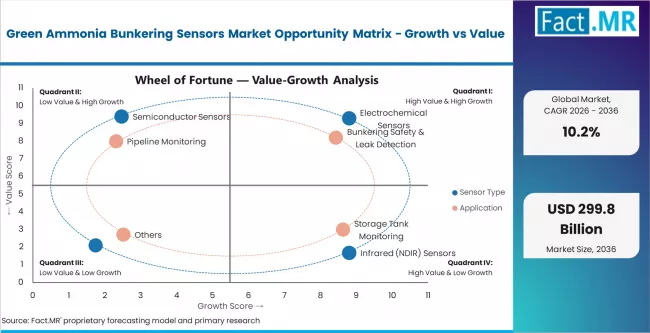
Green Ammonia Bunkering Sensors Market Opportunity Matrix Growth Vs Value | Source: Fact.MR
FACT.MR analysis indicates a shift toward mandatory safety systems. The market is moving beyond early-stage adoption. IMO rules are driving demand. Sensor systems are becoming essential infrastructure. Growth will accelerate after 2026.
Portable devices are declining in use. Fixed sensor arrays are becoming standard. Multi-point systems are replacing single-gas detectors. Real-time alarm integration is required. Certified sensors command 35–55% price premiums.
- IMO Compliance Mandate: IMO guidelines in 2024 made detection mandatory. This applies to vessels and terminals. Procurement is now non-discretionary. Demand is directly linked to compliance.
- Rotterdam and Asia Activation: Rotterdam completed a pilot in 2025. Asia also expanded demonstrations. Countries include Japan, South Korea, and China. These projects are building safety frameworks.
- FuelEU Maritime Regulation: EU rules apply from 2025. Emission limits are tightening. This supports ammonia fuel adoption. Ports are investing in infrastructure. Sensor demand is rising with compliance needs.
Regional Analysis
The green ammonia bunkering sensors market is assessed across Asia Pacific, North America, Europe, Latin America, and Middle East and Africa, covering 40+ countries with distinct demand profiles shaped by ammonia bunkering infrastructure maturity, regulatory compliance pace, vessel fleet composition, and port authority safety framework implementation. The full report offers market attractiveness analysis by region and country.
.webp "Top Country Growth Comparison Green Ammonia Bunkering Sensors Market Cagr (2026 2036)")
Top Country Growth Comparison Green Ammonia Bunkering Sensors Market Cagr (2026 2036) | Source: Fact.MR
| Country | CAGR (2026 to 2036) |
|---|---|
| China | 11.8% |
| Japan | 11.2% |
| South Korea | 10.9% |
| Netherlands | 10.5% |
| Germany | 10.2% |
| United States | 9.8% |
Source: Fact.MR analysis. Updated Apr 22, 2026
Source: Fact.MR (FACT.MR) analysis, based on proprietary forecasting model and primary research
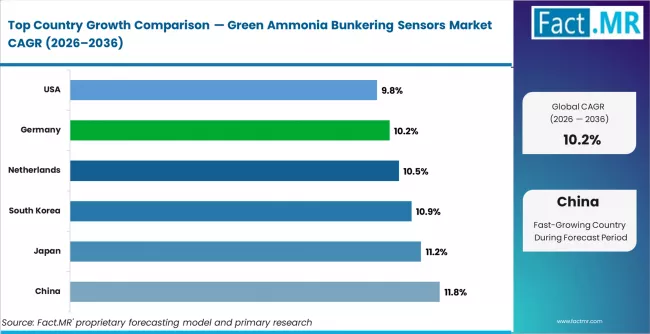
Green Ammonia Bunkering Sensors Market Cagr Analysis By Country | Source: Fact.MR
Asia Pacific Green Ammonia Bunkering Sensors Market Analysis
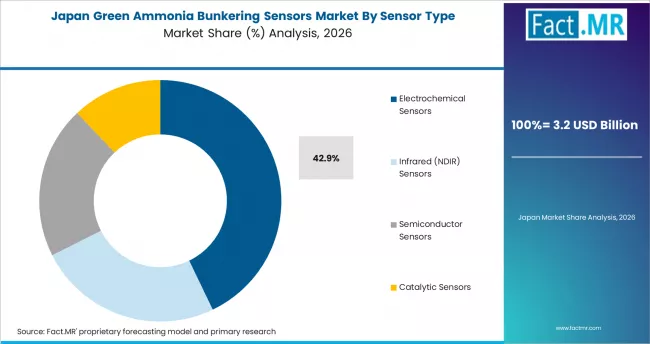
Green Ammonia Bunkering Sensors Market Japan Market Share Analysis By Sensor Type | Source: Fact.MR
Asia Pacific leads global growth in ammonia bunkering infrastructure. Demand is shaped by production scale and vessel adoption. Governments are actively building safety frameworks. Procurement is becoming structured and mandatory.
- China: China’s market expansion is driven by large-scale state-backed ammonia infrastructure. Growth is expected at 11.8% CAGR through 2036. Green Port policies now include ammonia readiness. New production hubs are linked to export terminals. Pilot bunkering operations validated safety systems in 2024. Sensor demand is tied directly to terminal construction and export corridors.
- Japan: Japan’s trajectory is supported by early adoption of ammonia-fueled vessels. Growth is projected at 11.2% CAGR through 2036. Dedicated bunkering vessels are entering the pipeline. Port trials have already established operational safety standards. National shipping corridor programmes are accelerating deployment. Sensor installation is required across vessels and port systems.
- South Korea: South Korea’s growth is linked to shipbuilding leadership and port investment. Expansion is estimated at 10.9% CAGR through 2036. Bunkering hubs are under development in major ports. Vessel construction programmes are increasing demand. Industrial partnerships are advancing ammonia energy systems. Sensor integration is becoming standard in vessel design.
FACT.MR covers China, Japan, South Korea, India, ASEAN, and Australia and New Zealand. It includes pilot outcomes, procurement timelines, and vessel deployment data.
Europe Green Ammonia Bunkering Sensors Market Analysis
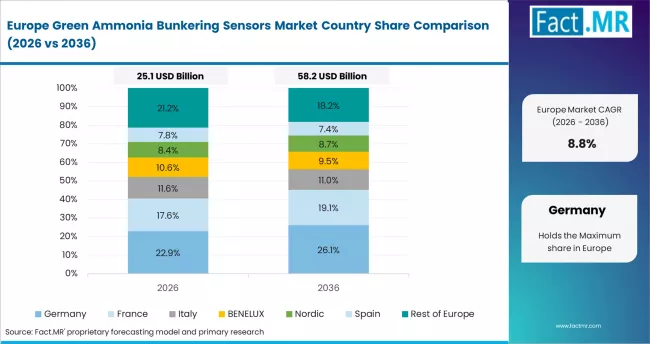
Green Ammonia Bunkering Sensors Market Europe Country Market Share Analysis 2026 & 2036 | Source: Fact.MR
Europe sets the regulatory benchmark for ammonia bunkering safety. Compliance frameworks are directly driving procurement. Major ports are leading infrastructure deployment.
- Netherlands: The Netherlands benefits from early pilot execution and port leadership. Growth is projected at 10.5% CAGR through 2036. Rotterdam completed large-scale bunkering trials in 2025. Safety frameworks are already validated. Commercial supply chain agreements are expanding. Sensor demand is linked to full-scale terminal deployment.
- Germany: Germany’s market is driven by regulatory compliance and industrial capability. Growth is expected at 10.2% CAGR through 2036. Ports are aligning with EU decarbonisation targets. Funding is supporting alternative fuel infrastructure. Sensor systems are being integrated into smart port programmes. Demand is tied to compliance timelines.
FACT.MR covers Germany, France, the United Kingdom, Netherlands, Italy, and Rest of Europe. It includes regulatory impact, pilot developments, and adoption trends.
North America Green Ammonia Bunkering Sensors Market Analysis
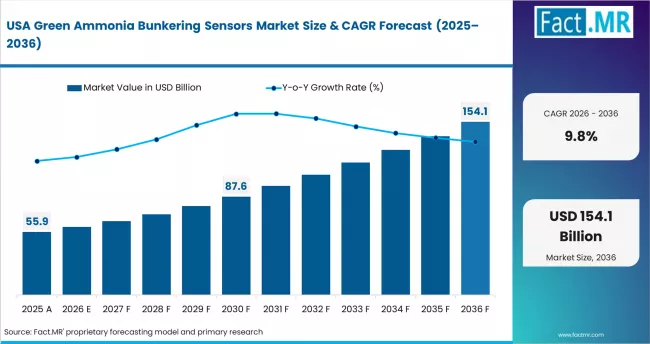
Green Ammonia Bunkering Sensors Market Country Value Analysis | Source: Fact.MR
North America is at an early adoption stage. Growth is supported by policy funding and energy transition programmes. Infrastructure development is accelerating gradually.
- United States: The United States is progressing through federal funding and clean energy initiatives. Growth is projected at 9.8% CAGR through 2036. Hydrogen hub programmes include ammonia infrastructure. Port decarbonisation grants are supporting development. Safety systems are part of funding requirements. Sensor demand will rise with infrastructure rollout.
FACT.MR covers the United States, Canada, and Mexico. It includes policy timelines, investment trends, and adoption patterns.
Competitive Aligners for Market Players
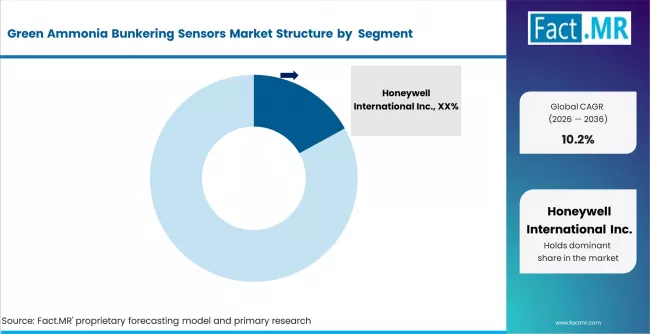
Green Ammonia Bunkering Sensors Market Analysis By Company | Source: Fact.MR
The green ammonia bunkering sensors market is evolving around safety, certification, and system integration rather than just product supply. Companies are no longer competing only on sensor accuracy. They are competing on how well their solutions fit into full terminal safety ecosystems. Players that can offer complete detection systems, including fixed multi-point arrays and real-time alert integration, are gaining stronger traction with port operators.A major shift is visible in buyer expectations. Ports and terminal operators are moving away from standalone or portable devices. They now prefer fully integrated safety systems that connect with control rooms and automation platforms. This is pushing vendors to expand beyond hardware and build software-enabled monitoring and reporting capabilities.
Certification is becoming a key differentiator. Marine approvals and compliance with IMO guidelines are no longer optional. Companies that already have certified products are moving faster in securing contracts. Others are facing delays due to long approval cycles. This creates a clear advantage for early movers with proven systems. Partnerships are also shaping competition. Sensor manufacturers are working closely with port authorities, EPC contractors, and automation providers to become part of large infrastructure projects. Being included at the design stage increases long-term revenue visibility.
Another important factor is reliability and service support. Buyers prefer vendors who can provide installation, calibration, and maintenance services over time. This shifts competition toward long-term relationships rather than one-time sales. Thus, success in this market depends on certification strength, integration capability, and the ability to support complex safety requirements at scale.
Key Players
- Honeywell International Inc.
- Drägerwerk AG
- MSA Safety Incorporated
- ABB Ltd.
- Siemens AG
- City Technology (Honeywell)
- Crowcon Detection Instruments Ltd.
- Industrial Scientific Corporation
- Teledyne Gas & Flame Detection
Scope of Report
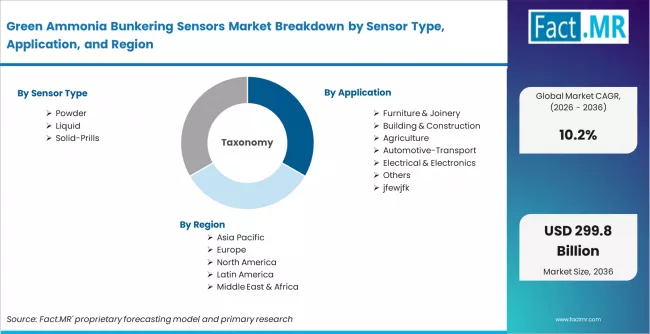
Green Ammonia Bunkering Sensors Market Breakdown By Sensor Type Application And Region | Source: Fact.MR
| Attribute | Details |
|---|---|
| Quantitative Units | USD 103 billion (2026) to USD 274 billion (2036), at a CAGR of 10.2% |
| Market Definition | Ammonia leak detection sensors and integrated gas monitoring systems certified for bunkering safety, storage tank monitoring, pipeline surveillance, and shipboard detection at green ammonia fuel terminals and vessels globally. |
| Sensor Type Segmentation | Electrochemical Sensors, Infrared (NDIR) Sensors, Semiconductor Sensors, Catalytic Sensors |
| Application Segmentation | Bunkering Safety & Leak Detection, Storage Tank Monitoring, Pipeline Monitoring, Others |
| End Use Segmentation | Ports & Bunkering Terminals, Shipboard Monitoring, Industrial Storage Facilities |
| Application Coverage | Ship-to-ship ammonia transfer monitoring, shore-side terminal leak detection, pipeline integrity surveillance, vessel fuel containment monitoring, and storage tank overpressure and release detection at green ammonia bunkering infrastructure. |
| Regions Covered | North America, Europe, Asia Pacific, Latin America, Middle East and Africa |
| Countries Covered | USA, Canada, Mexico, Germany, UK, France, Netherlands, Italy, Spain, Nordic, BENELUX, China, Japan, South Korea, India, ASEAN, Australia and New Zealand, Brazil, Argentina, Saudi Arabia, GCC, Turkey, South Africa, Rest of MEA |
| Key Companies Profiled | Honeywell International Inc., Drägerwerk AG, MSA Safety Incorporated, ABB Ltd., Siemens AG, City Technology (Honeywell), Crowcon Detection Instruments Ltd., Industrial Scientific Corporation, Teledyne Gas & Flame Detection |
| Forecast Period | 2026 to 2036 |
| Approach | Hybrid top-down and bottom-up model using sensor vendor ammonia detection revenues, terminal deployment volume estimates by application, average selling prices by platform and certification level, IMO compliance timelines, and primary interviews with port safety procurement professionals and vessel operators. |
Source: Fact.MR analysis. Updated Apr 22, 2026
Green Ammonia Bunkering Sensors Market by Segments
-
By Sensor Type:
- Electrochemical Sensors
- Infrared (NDIR) Sensors
- Semiconductor Sensors
- Catalytic Sensors
-
By Application:
- Bunkering Safety & Leak Detection
- Storage Tank Monitoring
- Pipeline Monitoring
- Others
-
By End Use:
- Ports & Bunkering Terminals
- Shipboard Monitoring
- Industrial Storage Facilities
-
By Region:
- North America
- United States
- Canada
- Mexico
- Latin America
- Brazil
- Mexico
- Argentina
- Chile
- Rest of Latin America
- Western Europe
- Germany
- United Kingdom
- France
- Italy
- Spain
- Nordic Countries
- BENELUX
- Rest of Western Europe
- Eastern Europe
- Russia
- Poland
- Hungary
- Balkan and Baltic
- Rest of Eastern Europe
- East Asia
- China
- Japan
- South Korea
- South Asia and Pacific
- India
- ASEAN
- Australia and New Zealand
- Rest of South Asia and Pacific
- Middle East and Africa
- Kingdom of Saudi Arabia
- Other GCC Countries
- Turkey
- South Africa
- Rest of Middle East and Africa
- North America
Bibliography
- [1] Honeywell International Inc. (April 2024). Business Realignment: Gas Detection Portfolio Including Ammonia Sensor Solutions Moved to Process Solutions Business Unit to Align with Industrial Bunkering and Safety Applications. April 2024. honeywell.com/newsroom
- [2] MSA Safety Incorporated. (November 2025). Product Launch: ALTAIR io 6 Multigas Detector with Ammonia Detection Capability Introduced at A+A International Trade Fair 2025 in Düsseldorf, Germany for Confined Space and Bunkering Sampling Applications. November 2025. msasafety.com/news
- [3] International Maritime Organization. (December 2024). MSC.1/Circ.1687 Interim Guidelines for the Safety of Ships Using Ammonia as Fuel: Approved at MSC 109th Session, Covering Bunkering Operations, Fuel Containment, Leak Detection Requirements, Toxicity Mitigation, and Crew Protection Standards. December 2024. imo.org
- [4] Port of Rotterdam Authority. (April 2025). Ammonia Bunkering Pilot Announcement: First Ship-to-Ship Ammonia Transfer of 800 Cubic Meters of Refrigerated Ammonia between Vessels Oceanic Moon and Gas Utopia at Maasvlakte 2 APM Terminal, Advancing Port Readiness Level to Level 7. April 2025. portofrotterdam.com/news
- [5] Drägerwerk AG & Co. KGaA. (2024). Product Portfolio: Marine and Hazardous Area Ammonia Detection Systems Including Electrochemical Sensors Certified to ATEX and IECEx Classifications for Fixed and Portable Bunkering Terminal Deployment. 2024. draeger.com/en
- [6] DNV AS. (September 2025). Ammonia as a Marine Fuel: Prospects and Challenges Report 27 Ammonia-Capable Vessels Ordered in 2024 and 39 Vessels on Order as of 2025, Each Requiring Certified Ammonia Detection Systems Across Fuel Containment and Bunkering Zones. September 2025. dnv.com
This Report Addresses
- Strategic intelligence on green ammonia bunkering sensor demand across electrochemical, NDIR, semiconductor, and catalytic detection platforms across bunkering, storage, pipeline, and shipboard applications globally.
- Market forecast from USD 103 billion in 2026 to USD 274 billion by 2036, at a CAGR of 10.2%.
- Opportunity mapping across China state-funded port pilot programmes, Japan vessel fleet commissioning, South Korea bunkering hub development, Rotterdam commercial bunkering activation, and U.S. clean hydrogen hub terminal infrastructure.
- Segment analysis by sensor type (electrochemical, NDIR, semiconductor, catalytic), application (bunkering safety, storage, pipeline, shipboard), and end use (ports, vessels, industrial storage) across global and regional markets.
- Regional outlook covering Asia Pacific vessel and terminal infrastructure commissioning, Europe FuelEU Maritime compliance-driven investment, and North America federal hydrogen hub and port decarbonisation programme demand.
- Competitive landscape of Honeywell, Drägerwerk, MSA Safety, ABB, Siemens, and City Technology. Focus on marine certification depth, terminal safety system integration capability, and IMO compliance platform positioning.
- Regulatory analysis covering IMO MSC.1/Circ.1687 interim guidelines, FuelEU Maritime GHG intensity requirements, DNV ammonia fuel class rules, ATEX and IECEx certification requirements, and U.S. DOE clean hydrogen hub safety standards.
- Report delivered in PDF, Excel, and presentation formats supported by validated vendor data, port authority procurement records, IMO regulatory documentation, and bunkering pilot outcome analysis.
Green Ammonia Bunkering Sensors Market Definition
The green ammonia bunkering sensors market covers detection instruments and integrated monitoring systems for identifying ammonia gas leaks, toxic concentrations, and pipeline releases at bunkering terminals, vessels, and storage facilities.
Green Ammonia Bunkering Sensors Market Inclusions
Covers global and regional forecasts from 2026 to 2036 by sensor type and application. Includes electrochemical, NDIR, semiconductor, and catalytic sensor platforms. Applications covered include bunkering safety, storage tank monitoring, pipeline monitoring, and shipboard detection.
Green Ammonia Bunkering Sensors Market Exclusions
Excludes general industrial ammonia detection systems not certified for marine bunkering environments. Omits refrigeration-grade ammonia sensors unless integrated into bunkering safety arrays. Excludes hydrogen and LNG detection systems unless deployed in combined green fuel bunkering stations.
Green Ammonia Bunkering Sensors Market Research Methodology
- Primary Research
- Interviews with port safety managers, bunkering terminal procurement heads, vessel safety officers, and gas detection system integrators across China, Japan, South Korea, the Netherlands, Germany, and the United States.
- Desk Research
- Analysis of IMO MSC.1/Circ.1687 interim guidelines, Port of Rotterdam bunkering pilot documentation, DNV ammonia fuel safety assessments, and safety system procurement disclosures from Honeywell, Drägerwerk, and MSA Safety from 2024–2025.
- Market-Sizing and Forecasting
- Hybrid approach using sensor vendor revenues, terminal deployment volumes, and average selling prices across fixed detection, portable instruments, and integrated safety system categories.
- Data Validation and Update Cycle
- Validated through vendor shipment data, port authority procurement volumes, and IMO compliance implementation timelines. Regular updates supported by expert interviews.
Frequently Asked Questions
How large is the global green ammonia bunkering sensors market in 2025?
What will the market size be in 2026?
What is the projected market size by 2036?
What is the expected CAGR from 2026 to 2036?
Which sensor type segment is poised to lead the market?
Which application segment holds the largest share?
Which end-use segment dominates?
Which country shows the fastest growth in the market?
What drives demand in this market?
Who are the key players in the market?
Who worked on this report


Preview the report firsthand - request a free sample
Free SampleGet the brochure for pricing and purchase details
Download PDF