- Market Value (2025): USD 47.80 Bn
- Estimated Value (2026): USD 50.5 Bn
- Forecast Value (2036): USD 87.4 Bn
- CAGR (2026-2036): 5.6%
What is the Chronic Depressive Personality Disorder Treatment Market forecast to be worth by 2036?
USD 50.5 billion in 2026 to USD 87.4 billion by 2036 at a 5.6% CAGR.
- As per Fact.MR analysis, the chronic depressive personality disorder treatment market reached USD 47.8 billion in 2025.
- Demand will increase from USD 50.5 billion in 2026 to USD 87.4 billion by 2036.
- The chronic depressive personality disorder treatment market will record 5.6% CAGR from 2026 to 2036.
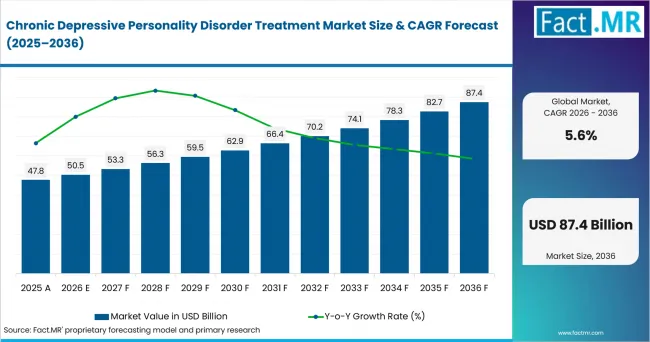
Chronic Depressive Personality Disorder Treatment Market Value Analysis | Source: Fact.MR
What are the defining numbers behind Chronic Depressive Personality Disorder Treatment Market growth?
An absolute opportunity of USD 36.9 billion will be created between 2026 and 2036.
- Demand Drivers in the Market
- The World Health Organization reported in September 2026 that approximately 322 million people live with depression [1]. Only about one third of people with depression in high-income countries receive mental health treatment, so narrowing that gap will add patients to long-term care [1].
- Measured depression in the United States has climbed over the past decade. The National Center for Health Statistics reported in April 2025 that prevalence among people aged 12 and older reached 13.1% in August 2021 to August 2023, up from 8.2% in 2013 to 2014 [2]. Persistent cases will support repeat prescribing and follow-up visits.
- Persistent depressive disorder often begins in childhood or adolescence, so pediatric psychiatry capacity has a direct bearing on how many patients enter treatment. Community and school-linked child mental health teams shorten the path from first symptoms to diagnosis.
- Prescribers are gaining options beyond older SSRIs for patients who respond poorly to first-line therapy. Nasal esketamine and atypical antipsychotic add-ons will raise treatment value per patient.
- Key Segments Analyzed
- By Treatment Type: Medication will hold 42.3% share in 2026, supported by long antidepressant maintenance courses and broad generic availability.
- By Patient Age Group: Children and Adolescents will account for 43.8% share in 2026 owing to early symptom onset and the long treatment window that follows a diagnosis made before adulthood.
- By Distribution Channel: Hospitals will capture 38.6% share in 2026, reflecting the role of psychiatric departments in diagnosis and treatment initiation.
- Analyst Opinion at Fact.MR
- Shambhu Nath Jha, Principal Consultant at Fact.MR, states, “Demand for chronic depressive personality disorder treatment will climb steadily through 2036. The condition keeps patients in care for years, so every new diagnosis adds to long-term demand for medication and therapy. Earlier detection in children and adolescents is widening the patient pool, while public health systems in Mexico, Poland and the United Kingdom are bringing more hidden cases into treatment. Hospitals will stay the main entry point. Companies that pair established antidepressants with add-on options and adherence support will benefit from this rise.”
- Strategic Implications
- Pharmaceutical companies should build long-term safety and adherence evidence, since persistent depression often requires treatment over several years.
- Hospital psychiatry departments should set step-down pathways to clinics so that stabilized patients keep regular follow-up.
- Payers should fund combined medication and psychotherapy packages for chronic depression, given that relapse-driven readmissions add avoidable cost to hospital budgets.
- Online pharmacies should link refill reminders with prescriber review to support patients on multi-month antidepressant courses.
Mexico will lead at 7.0% CAGR as public insurers widen mental health consultations. Poland will follow at 6.5% through its child and adolescent psychiatry reform. The United States will reach 5.8%, reflecting high adolescent depression prevalence. The United Kingdom will post 5.3% with NHS talking therapy capacity supporting combined care. Canada will record 4.7% owing to rising mood disorder diagnoses, while Belgium will reach 4.1% amid elevated depression screening rates among young adults.
How does the Chronic Depressive Personality Disorder Treatment Market break down by segment?
Medication will lead Treatment Type at 42.3%; Children and Adolescents will lead Patient Age Group at 43.8%; Hospitals will lead Distribution Channel at 38.6%.
Which Treatment Type dominates?
Medication will hold 42.3% share in 2026.
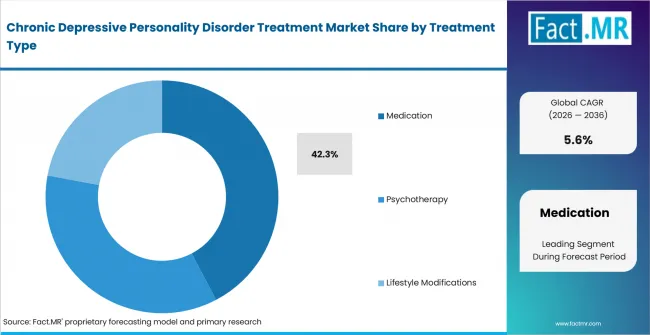
Chronic Depressive Personality Disorder Treatment Market Analysis By Treatment Type | Source: Fact.MR
Medication will lead since persistent depressive disorder usually requires maintenance treatment that runs for many months or years. Generic SSRIs keep daily costs low for payers, while branded depression drug therapies such as vortioxetine and desvenlafaxine serve patients who do not tolerate older agents.
The NHS Business Services Authority reported in July 2025 that 92.6 million antidepressant items were prescribed to an estimated 8.89 million identified patients in England during 2024/25 [3]. Psychotherapy remains the main complement, and patients who fail two medicines often move toward treatment-resistant depression care.
What leads the Patient Age Group segment?
Children and Adolescents will account for 43.8% share in 2026.
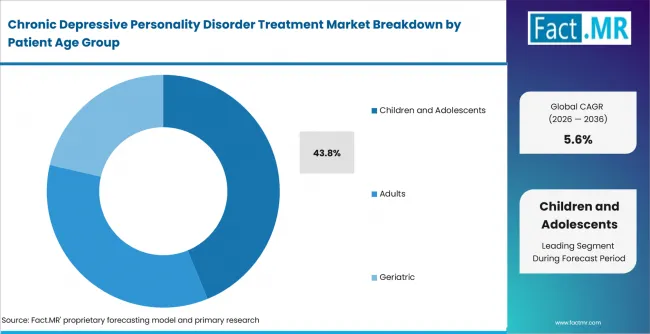
Chronic Depressive Personality Disorder Treatment Market Analysis By Patient Age Group | Source: Fact.MR
Children and adolescents will lead the age mix owing to early onset, and clinical criteria recognize the condition in young people after one year of symptoms instead of two. A diagnosis made in school years opens a long treatment window that often combines family-based therapy with medication where clinicians judge it appropriate.
SAMHSA reported in September 2025 that an annual average of 17.7% of adolescents aged 12 to 17 had a major depressive episode in the past year across 2022 to 2024 [4]. Part of this group carries low-grade symptoms between episodes, which keeps pediatric psychiatry and behavioral health treatment services in steady demand.
How does Distribution Channel shape demand?
Hospitals will capture 38.6% share in 2026.
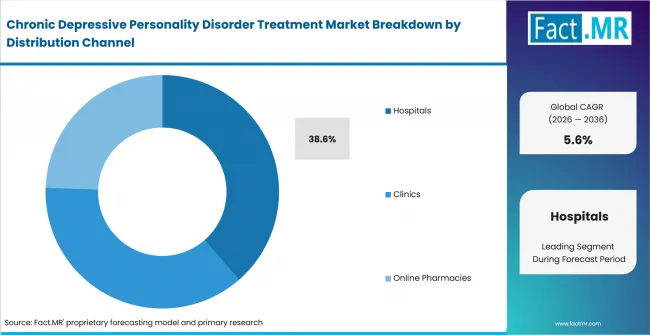
Chronic Depressive Personality Disorder Treatment Market Analysis By Distribution Channel | Source: Fact.MR
Hospitals will lead the channel mix given that psychiatric departments handle diagnosis, treatment initiation and care for patients whose symptoms worsen into major episodes. Online pharmacies are gaining ground through e-prescription systems that simplify repeat refills.
The Mexican Social Security Institute reported in June 2025 that its hospitals had delivered 2.1 million specialized mental health consultations since 2023, alongside 6.6 million in family medicine units [5]. Home delivery through prescription delivery services will shift part of maintenance dispensing away from hospital pharmacies.
What is accelerating Chronic Depressive Personality Disorder Treatment Market adoption, and what is holding it back?
Demand will rise with higher diagnosed prevalence among adolescents and adults and with wider access to combined medication and psychotherapy. Growth is constrained by psychiatrist shortages, stigma around low-grade symptoms and uneven adherence to long treatment courses.
Drivers Impact Analysis
| DRIVER | (~) % IMPACT ON CAGR | GEOGRAPHIC RELEVANCE | IMPACT TIMELINE |
|---|---|---|---|
| Rising diagnosed depression prevalence in adolescents and adults | +1.6% | North America, Western Europe | Short term (<= 2 years) |
| Expansion of public child and adolescent psychiatry services | +1.2% | Eastern Europe, Latin America, Western Europe | Medium term (2-4 years) |
| Newer adjunctive and rapid-acting pharmacotherapy options | +0.9% | North America, Western Europe | Medium term (2-4 years) |
| Telehealth follow-up and e-prescription refill pathways | +0.7% | North America, Western Europe | Long term (>= 4 years) |
| Payer coverage for combined medication and psychotherapy | +0.5% | Global | Long term (>= 4 years) |
Opportunity Impact Analysis
| OPPORTUNITY | (~) % IMPACT ON CAGR | GEOGRAPHIC RELEVANCE | IMPACT TIMELINE |
|---|---|---|---|
| Adherence support programs for long-course antidepressant therapy | +1.0% | Global | Short term (<= 2 years) |
| Pediatric-labelled treatments and adolescent outcome evidence | +0.8% | North America, Europe | Long term (>= 4 years) |
| Online pharmacy refill models for maintenance prescriptions | +0.6% | Latin America, North America | Medium term (2-4 years) |
Restraints Impact Analysis
| RESTRAINT | (~) % IMPACT ON CAGR | GEOGRAPHIC RELEVANCE | IMPACT TIMELINE |
|---|---|---|---|
| Shortage of child and adolescent psychiatrists | -0.8% | Global | Medium term (2-4 years) |
| Treatment discontinuation and side-effect burden | -0.6% | Global | Short term (<= 2 years) |
| Stigma and underdiagnosis of low-grade chronic symptoms | -0.4% | Latin America, Eastern Europe | Long term (>= 4 years) |
| Generic price erosion for SSRIs and SNRIs | -0.3% | North America, Western Europe | Short term (<= 2 years) |
Which countries are scaling the Chronic Depressive Personality Disorder Treatment Market through 2036?
- The country comparison spans 2.9 percentage points between Mexico at 7.0% and Belgium at 4.1%.
- Mexico will remain 0.5 percentage point above Poland as public insurers widen mental health consultations in family medicine and hospital settings.
- Poland will remain 0.7 percentage point above the United States through a three-level child and adolescent psychiatry model funded by the National Health Fund.
- The United States will remain 0.5 percentage point above the United Kingdom, given high adolescent depression prevalence and steady treatment uptake.
- The United Kingdom will remain 0.6 percentage point above Canada, supported by NHS Talking Therapies capacity that works alongside GP prescribing.
- Canada will remain 0.6 percentage point above Belgium owing to rising mood disorder diagnoses among older adults.
- Belgium will close the displayed range with elevated depression screening rates among young adults sustaining demand in a mature reimbursement system.
Comparable CAGRs still create different entry conditions due to psychiatrist supply and reimbursement rules. Full report coverage includes North America, Latin America, Western Europe, Eastern Europe, East Asia, South Asia & Pacific, Middle East & Africa.
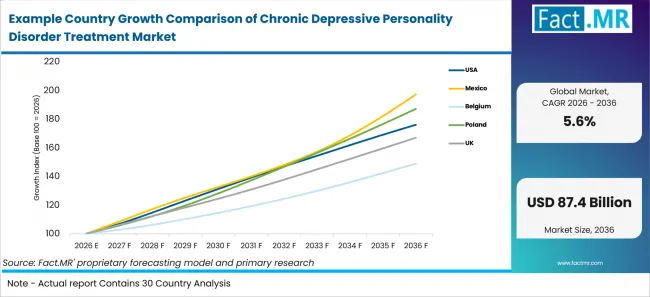
Example Country Growth Comparison Of Chronic Depressive Personality Disorder Treatment Market | Source: Fact.MR
| Country | CAGR (2026-2036) |
|---|---|
| Mexico | 7.0% |
| Poland | 6.5% |
| United States | 5.8% |
| United Kingdom | 5.3% |
| Canada | 4.7% |
| Belgium | 4.1% |
What supports Mexico adoption?
7.0% CAGR, supported by wider public mental health screening and consultations.
INEGI reported in July 2026 that 10.9% of adults showed signs of depression in 2025, with the rate reaching 13.3% among women [6]. Public insurers are adding mental health screening to primary care, which will convert more of these adults into diagnosed patients.
How is Poland scaling demand?
6.5% CAGR, driven by child and adolescent psychiatry reform and reimbursed antidepressant access.
Poland has rebuilt pediatric mental health care around a three-level model funded by the National Health Fund (NFZ). NFZ data published in December 2025 show that 878.3 thousand patients received care with depression as a primary or secondary diagnosis in 2024 [7]. Reimbursed antidepressant prescriptions were filled by 1.9 million people that year [7]. Continued reform funding will keep more adolescents in structured follow-up.
What supports United States adoption?
5.8% CAGR, supported by high adolescent depression prevalence and treatment uptake.
SAMHSA reported in September 2025 that 60.6% of adolescents with a past-year major depressive episode received mental health treatment in 2024 [8]. Among adults with any mental illness, the share was 52.1% [8]. Closing the remaining gap will add patients to antidepressant and therapy pathways.
What supports the United Kingdom’s growth?
5.3% CAGR, backed by NHS talking therapy capacity alongside primary care prescribing.
England’s stepped-care model sends most people with low-grade depression to psychological therapy and GP prescribing first. NHS England reported in September 2026 that NHS Talking Therapies received 1.81 million referrals in 2025-26, and 50.1% of referrals that finished a course of treatment moved to recovery [9]. Steady therapy volume will support combined care, since patients who relapse often return to GP-led medication review.
How is Canada developing demand?
4.7% CAGR, driven by rising mood disorder diagnoses and primary care access gaps.
Family physicians manage most antidepressant prescribing in Canada’s public system. Statistics Canada reported in December 2025 that 8.5% of older Canadians had a mood disorder diagnosis in 2023, up from 6.1% in 2015 [10]. Access remains tight for younger patients, since only 21% of children and youth with a diagnosed mental health disorder were able to see a primary care provider the same or next day [11].
How does Belgium perform?
4.1% CAGR, supported by persistently elevated depression screening rates among young adults.
Belgium’s growth is steadier, reflecting a mature reimbursement system. Sciensano’s Healthy Belgium platform reported in June 2026 that 16.5% of adults screened positive for depression in October 2025 [12]. Among women aged 18 to 29, the rate reached 30.6% [12]. High symptom levels in young adults will keep demand for psychological care and maintenance prescribing stable.
How is the competition in the Chronic Depressive Personality Disorder Treatment Market?
Competition in the chronic depressive personality disorder treatment market is led by large pharmaceutical companies with established antidepressant brands. Generic SSRIs and SNRIs keep price pressure high, so branded players compete on newer mechanisms, adjunctive therapies and tolerability data. Pipeline deals and label expansions will shape competitive positions.
Who leads the Chronic Depressive Personality Disorder Treatment Market?
Johnson & Johnson markets Spravato, which the FDA approved in January 2025 as a standalone treatment for adults with treatment-resistant depression [13].
Pfizer continues to sell Pristiq, while Viatris holds the Zoloft and Effexor XR brands. AbbVie offers Vraylar as an add-on to antidepressants and agreed in August 2025 to acquire bretisilocin, a Phase 2 candidate for major depressive disorder [14]. Otsuka and Lundbeck co-develop Rexulti for adjunctive use [15], and Takeda sells Lundbeck’s Trintellix in the United States under license. Eli Lilly and GSK keep Cymbalta and Paxil in their portfolios. Competition centers on long-term tolerability evidence and add-on options for partial responders.
Which companies are the key providers?
Key companies include Johnson & Johnson; Pfizer Inc.; Viatris Inc.; AbbVie Inc.; Eli Lilly and Company; GSK plc; Otsuka Pharmaceutical Co., Ltd.; H. Lundbeck A/S; and Takeda Pharmaceutical Company Limited.
- Johnson & Johnson
- Pfizer Inc.
- Viatris Inc.
- AbbVie Inc.
- Eli Lilly and Company
- GSK plc
- Otsuka Pharmaceutical Co., Ltd.
- H. Lundbeck A/S
- Takeda Pharmaceutical Company Limited
Bibliography
- World Health Organization. (2026, September 11). Depressive disorder (depression).
- National Center for Health Statistics. (2025, April 16). Depression prevalence in adolescents and adults: United States, August 2021-August 2023.
- NHS Business Services Authority. (2025, July 24). Medicines used in mental health - England - 2015/16 to 2024/25.
- Substance Abuse and Mental Health Services Administration. (2025, September). NSDUH Population Statistics Reports: Major depressive episode or serious thoughts of suicide in the past year among adolescents.
- Instituto Mexicano del Seguro Social. (2025, June 6). Traza IMSS ruta para fortalecer atención en salud mental en la Tercera Edición del Congreso FIMSS “Depresión y Ansiedad” [IMSS charts a route to strengthen mental health care at the third FIMSS Congress “Depression and Anxiety”].
- Instituto Nacional de Estadística y Geografía. (2026, July 14). Reporte de resultados 25/26: Encuesta Nacional de Bienestar Autorreportado (ENBIARE) 2025 [Results report 25/26: National Survey of Self-Reported Well-Being 2025].
- Narodowy Fundusz Zdrowia. (2025, December 16). NFZ o zdrowiu. Depresja [NFZ on health: Depression].
- Substance Abuse and Mental Health Services Administration. (2025, September). Mental health treatment among people who had a mental health condition in the past year.
- NHS England. (2026, September 24). NHS Talking Therapies, for anxiety and depression, Annual reports, 2025-26.
- Statistics Canada. (2025, December 17). Health Reports, December 2025: Mood disorders among older Canadians.
- Statistics Canada. (2025, November 24). Primary health care access and experience among children and youth: Results from the 2024 Canadian Health Survey on Children and Youth.
- Sciensano. (2026, June 30). Anxiety and depression.
- Johnson & Johnson. (2025, January 21). SPRAVATO® (esketamine) approved in the U.S. as the first and only monotherapy for adults with treatment-resistant depression.
- AbbVie. (2025, August 25AbbVie to acquire Gilgamesh Pharmaceuticals’ bretisilocin, a novel, investigational therapy for major depressive disorder, expanding psychiatry pipeline.
- Otsuka Pharmaceutical Co., Ltd. (2025, September 20). Otsuka and Lundbeck receive Complete Response Letter from U.S. FDA for sNDA of REXULTI® (brexpiprazole) in combination with sertraline for the treatment of adults with post-traumatic stress disorder (PTSD).
This Report Answers
- The report explains how treatment is delivered by treatment type, patient age group and distribution channel.
- Segment analysis identifies the subsegment that leads each category and the clinical reasons behind its 2026 share.
- Country analysis compares the six listed markets through prevalence data and public care programs.
- Competitive analysis reviews companies active in antidepressants, adjunctive medicines and treatment-resistant depression care.
- Treatment analysis assesses how adherence and tolerability shape long-course care.
What does the Chronic Depressive Personality Disorder Treatment Market cover?
The Chronic Depressive Personality Disorder Treatment Market covers care for a long-lasting depressed mood that clinicians now classify as persistent depressive disorder, also known as dysthymia. Diagnostic criteria require symptoms on most days for at least two years in adults, or one year in children and adolescents.
The assessment covers medication, psychotherapy and lifestyle programs across all three age groups. Revenue includes care for patients whose persistent symptoms overlap with major depressive episodes.
What is included in the scope?
The scope includes branded and generic antidepressants and psychotherapy delivered in person or by video.
It covers a typical antipsychotic drugs when prescribed as adjuncts for depression. Clinician-led digital support is included, such as mental health apps used between therapy sessions.
What is excluded from the scope?
The scope excludes treatments for bipolar disorder, schizophrenia and anxiety disorders when prescribed without a depressive diagnosis.
Neurostimulation equipment such as depression treatment devices remains outside the revenue boundarzy.
How Was the Analysis Built?
The analysis draws on 120+ sources, 35+ company portfolios, 25+ countries, and more than 20 industry interviews.
- Primary Research: Primary research includes discussions with manufacturers, service providers, technology developers, distributors, end users, and subject-matter experts. These conversations examine purchasing priorities, product adoption, operational challenges, approval requirements, competitive positioning, and the factors that influence wider market acceptance.
- Desk Research: Desk research covers government statistics, regulatory publications, company filings, trade data, technical studies, industry associations, standards, public policy, and other authoritative sources. Every source used in the analysis is documented in the bibliography.
- Market Sizing and Forecasting: Market estimates combine historical performance, demand indicators, pricing and volume trends, segment shares, company participation, country-level growth, adoption patterns, investment activity, and barriers to market expansion.
- Data Validation and Update Cycle: Findings are validated by comparing primary interviews with public data, company activity, regulatory changes, trade patterns, and industry developments. Regular updates review new product launches, capacity changes, partnerships, approvals, and shifts in commercial adoption.
What is the report’s scope and coverage?
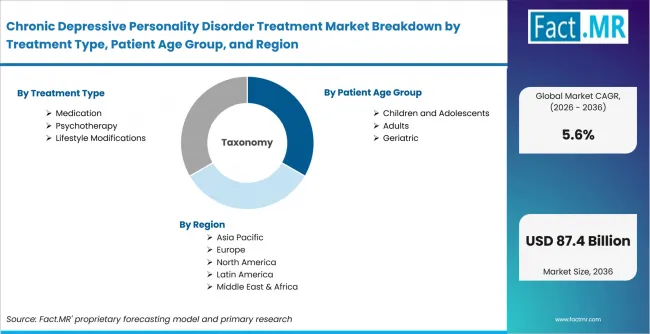
Chronic Depressive Personality Disorder Treatment Market Breakdown By Treatment Type, Patient Age Group, And Region | Source: Fact.MR
| Attribute | Details |
|---|---|
| Quantitative Units | USD billion in 2026 to USD billion by 2036 at a CAGR |
| Market Definition | Treatments for chronic depressive personality disorder, a long-lasting depressed mood condition, covering medication, psychotherapy and clinician-guided lifestyle programs. |
| Treatment Type | Medication; Psychotherapy; Lifestyle Modifications |
| Patient Age Group | Children and Adolescents; Adults; Geriatric |
| Distribution Channel | Hospitals; Clinics; Online Pharmacies |
| Regions Covered | North America; Latin America; Western Europe; Eastern Europe; East Asia; South Asia & Pacific; Middle East & Africa |
| Countries Covered | Mexico; Poland; United States; United Kingdom; Canada; Belgium |
| Key Companies Profiled | Johnson & Johnson; Pfizer Inc.; Viatris Inc.; AbbVie Inc.; Eli Lilly and Company; GSK plc; Otsuka Pharmaceutical Co., Ltd.; H. Lundbeck A/S; Takeda Pharmaceutical Company Limited |
| Forecast Period | 2026 to 2036 |
| Approach | Hybrid top-down and bottom-up approach using diagnosed prevalence by age group, treatment rates, antidepressant prescription volumes, therapy capacity, channel mix, country growth and company portfolio review. |
How is the market segmented?
-
By Treatment Type
- Medication
- Psychotherapy
- Lifestyle Modifications
-
By Patient Age Group
- Children and Adolescents
- Adults
- Geriatric
-
By Distribution Channel
- Hospitals
- Clinics
- Online Pharmacies
-
By Region
- North America
- Latin America
- Western Europe
- Eastern Europe
- East Asia
- South Asia & Pacific
- Middle East & Africa