- Base Value(2025): 9.5 Bn
- Estimated Value(2026): 10.1 Bn
- Forecast Value (2036): 18.8 Bn
- CAGR (2026 - 2036): 7.8%
Chronic Venous Occlusions Treatment Market Forecast and Outlook 2026 to 2036
In 2025, the chronic venous occlusions treatment market was valued at USD 9.5 billion. Based on Fact.MR analysis, demand for chronic venous occlusions treatment is estimated to grow to USD 10.1 billion in 2026 and USD 18.8 billion by 2036. FACT.MR projects a CAGR of 7.8% during the forecast period.
Between 2026 and 2036, the market is projected to create an absolute dollar opportunity of USD 8.7 billion. This near-doubling of market value reflects rising global prevalence of chronic venous insufficiency linked to aging populations, sedentary lifestyles, and obesity, combined with expanding reimbursement coverage for minimally invasive ablation procedures. Structural constraints include limited specialist vascular care access in lower-income markets and price sensitivity in public hospital procurement for single-use ablation devices.
The chronic venous occlusions treatment market is expanding steadily due to rising prevalence of chronic venous disease and aging population demographics worldwide. Growing adoption of minimally invasive treatments such as endovenous laser and radiofrequency ablation is improving patient outcomes and increasing procedure volumes.
Country growth reflects aging populations, healthcare investment, and reimbursement support for minimally invasive venous procedures. China leads with a 7.8% CAGR driven by vascular hospital expansion and higher diagnosis rates. India follows at 7.0% supported by private hospital investment and rising awareness of endovenous ablation. Germany records 6.7% with insurer reimbursement support. France grows 6.0% through ambulatory procedure coverage. The United States posts 5.7%, while the United Kingdom grows 5.5%, both supported by aging demographics and vascular service expansion.
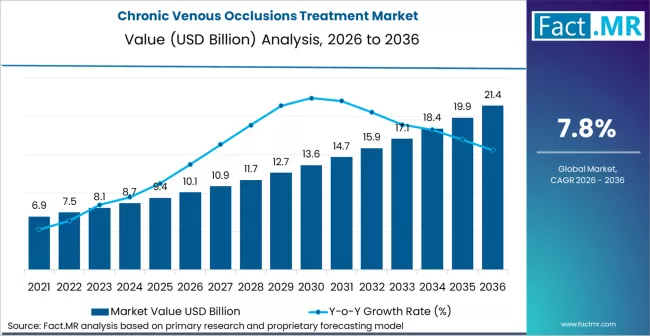
Chronic Venous Occlusions Treatment Market Market Value Analysis | Source: Fact.MR
| Metric | Value |
|---|---|
| Estimated Value in 2026 | USD 10.1 billion |
| Forecast Value in 2036 | USD 18.8 billion |
| Forecast CAGR (2026 to 2036) | 7.8% |
Source: Fact.MR analysis. Updated Mar 11, 2026
Market Definition
The F includes devices, drugs, and procedures used to treat chronic venous insufficiency, deep vein thrombosis, and venous occlusions. Key treatments include endovenous laser ablation, radiofrequency ablation, sclerotherapy, compression therapy, and anticoagulant medication.
Market Inclusions
Includes global and regional revenue forecasts from 2026 to 2036 by treatment type, product category, and end user. Covers ablation devices, compression systems, sclerosant agents, and anticoagulant drugs used across hospitals, ASCs, and specialty clinics globally.
Market Exclusions
Excludes arterial occlusion treatment devices and prophylactic anticoagulants used without chronic venous indication. Also excludes cosmetic varicose vein treatments and general anticoagulant drug revenues not linked to venous occlusion treatment.
Research Methodology
- Primary Research: Interviews with vascular surgeons, interventional F, phlebologists, hospital procurement teams, clinic directors, and medical device distributors.
- Desk Research: Sources include FDA and EU MDR device approvals, CMS reimbursement data, NHS guidelines, WHO disease statistics, and OEM annual reports.
- Market Sizing and Forecasting: A hybrid model using venous disease prevalence, treatment procedure volumes, device and drug revenue per procedure, and reimbursement expansion timelines.
- Data Validation and Update Cycle: Forecasts validated using OEM revenue disclosures, CMS procedure data, NHS commissioning statistics, and global disease burden reports.
Chronic Venous Occlusions Treatment Market Summary
- Market Definition
- The market includes ablation devices, compression therapy systems, sclerosant agents, and anticoagulant drugs used to treat chronic venous insufficiency and venous occlusion conditions.
- Demand Drivers
- Aging populations in major regions are increasing the prevalence of chronic venous diseases and expanding the treatment-eligible patient pool.
- Reimbursement support for minimally invasive venous procedures is encouraging migration from hospital inpatient settings to ambulatory surgical centers.
- Rising obesity and sedentary lifestyles are increasing venous disease incidence across younger patient populations.
- Key Segments Analyzed
- By Treatment Type: Endovenous laser ablation leads with about 35% share in 2026 due to strong clinical adoption and reimbursement support.
- By Product: Devices dominate with nearly 54% share in 2026, reflecting the technology-driven nature of modern venous interventions.
- By End User: Hospitals hold around 47% share in 2026, though ambulatory surgical centers are the fastest-growing segment.
- Analyst Opinion at FACT.MR
- Shambhu Nath Jha, Principal Consultant at Fact.MR, states that the market’s growth through 2036 will be driven by procedure migration to ASCs and specialty clinics, benefiting manufacturers offering office-based treatment platforms.
- Strategic Implications
- Device manufacturers should develop compact ablation systems designed for ambulatory surgical centers and specialty clinics.
- Companies should work with European reimbursement authorities to accelerate approval of next-generation venous treatment technologies.
- Pharmaceutical firms should expand anticoagulant market access in China and India through vascular hospitals and outpatient clinics.
- Methodology
- Market sizing used disease prevalence and treatment procedure volumes validated with OEM device revenue data.
- CMS reimbursement data, NHS frameworks, GKV updates, and WHO statistics supported demand and coverage analysis.
- Forecasts incorporated vascular hospital investment trends, aging population projections, obesity prevalence data, and expert interviews.
Segmental Analysis
Chronic Venous Occlusions Treatment Market Analysis by Treatment Type
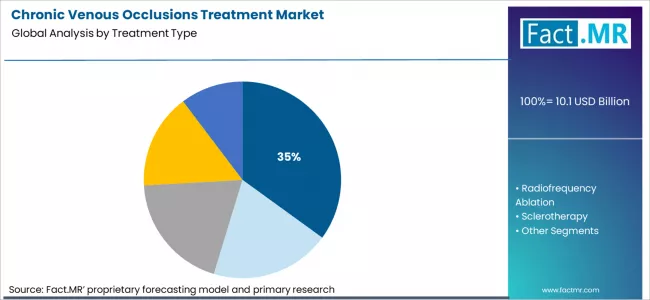
Chronic Venous Occlusions Treatment Market Analysis By Treatment Type | Source: Fact.MR
Based on FACT.MR’s report, endovenous laser ablation is expected to hold about 35% share in 2026. It leads due to strong clinical outcomes, extensive long-term evidence, and reimbursement support across hospital and outpatient settings.
- AngioDynamics EVLA Platform Investment: In 2025, AngioDynamics expanded distribution of its VenaCure EVLT laser ablation system with a new fibre designed to reduce bruising and improve patient comfort. [5]
- Boston Scientific RFA Technology Development: In 2024, Boston Scientific received FDA clearance for an upgraded ClosureFast radiofrequency ablation catheter improving thermal energy delivery during venous procedures. [6]
- Sclerotherapy Adoption Trend: A 2024 American College of Phlebology survey reported foam sclerotherapy as the most common office-based treatment due to its low cost and outpatient reimbursement coverage. [7]
Chronic Venous Occlusions Treatment Market Analysis by Product
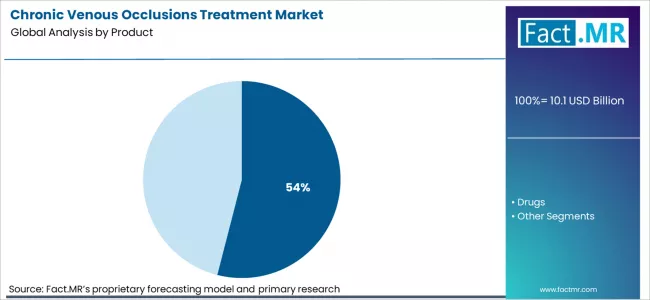
Chronic Venous Occlusions Treatment Market Analysis By Product | Source: Fact.MR
Based on FACT.MR’s report, devices are projected to hold about 54% share in 2026. Dominance reflects recurring revenue from single-use ablation fibres, catheters, and venous stent procedures.
- Gore Venous Stent Market Investment: In 2025, W. L. Gore expanded European availability of its VIABAL venous stent following CE mark renewal under EU MDR requirements. [8]
- Bayer Anticoagulant Drug Development: In 2024, Bayer received updated EU approval for Xarelto covering extended prevention of recurrent venous thromboembolism. [9]
- Single-Use Device Adoption Trend: Medical device manufacturers continue to report strong growth in single-use vascular devices due to rising procedure volumes in hospitals and outpatient centers. [10]
Drivers, Restraints, and Opportunities
FACT.MR analysts observe that the chronic venous occlusions treatment market has shifted from surgery-led care to minimally invasive interventional and pharmacological treatments. Growth is driven by ageing populations, rising venous disease prevalence, and expanding use of endovenous thermal ablation in vascular clinics.
The market is rebalancing between hospital and outpatient treatment settings. Open surgical stripping is declining as minimally invasive ablation offers faster recovery and shorter procedures. Expanding outpatient reimbursement and higher device pricing are supporting steady revenue growth.
- CMS Reimbursement for ASC Venous Ablation: CMS maintained separate reimbursement for endovenous thermal ablation procedures in ambulatory surgical centers in its 2025 payment update, encouraging procedure migration from hospital outpatient departments and increasing device sales. [2]
- China Vascular Specialty Hospital Expansion: China’s National Health Commission approved hundreds of new vascular surgery departments at county hospitals in 2024, expanding the treatment network for venous ablation procedures. [3]
- EU MDR Venous Device Compliance Impact: EU MDR 2017/745 enforcement requires venous device manufacturers to complete recertification to maintain market access, increasing compliance costs while ensuring regulatory continuity. [4]
Regional Analysis
The chronic venous occlusions treatment market is analysed across Asia Pacific, Europe, North America, Latin America, and Middle East and Africa, covering 40+ countries with distinct demand profiles shaped by venous disease prevalence, healthcare infrastructure investment, reimbursement frameworks, and minimally invasive procedure adoption rates. The full report offers market attractiveness analysis based on reimbursement expansion timelines and specialist care network development pipelines.
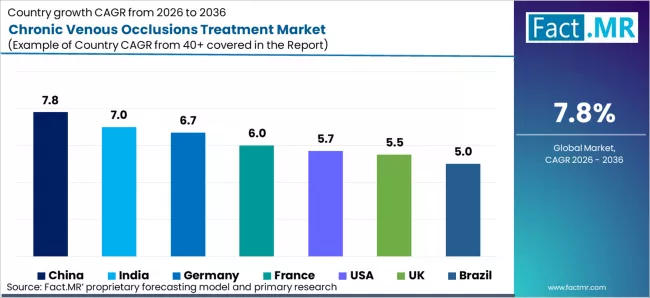
Chronic Venous Occlusions Treatment Market Cagr Analysis By Country | Source: Fact.MR
| Country | CAGR (2026-2036) |
|---|---|
| China | 7.8% |
| India | 7.0% |
| Germany | 6.7% |
| France | 6.0% |
| United States | 5.7% |
| United Kingdom | 5.5% |
| Brazil | 5.0% |
Source: Fact.MR analysis. Updated Mar 11, 2026
Source: Fact.MR (FACT.MR) analysis, based on proprietary forecasting model and primary research
Asia Pacific Chronic Venous Occlusions Treatment Market Analysis
Asia Pacific is the fastest-growing region for chronic venous occlusions treatment, supported by expanding vascular specialty hospitals in China and rising minimally invasive vascular procedures in India. Global device manufacturers supply advanced ablation systems, while regional distributors serve mid-tier hospital procurement.
- China: China is projected to expand at a 7.8% CAGR through 2036. Government programmes are increasing vascular surgery department capacity at county hospitals, while reimbursement inclusion for endovenous laser ablation is expanding outpatient procedure volumes.
- India: India is anticipated to record a 7.0% CAGR through 2036. Private hospital networks are expanding vascular surgery services and insurance coverage for radiofrequency and laser ablation is improving patient access to minimally invasive treatments.
FACT.MR’s Asia Pacific analysis of the chronic venous occlusions treatment market covers China, Japan, South Korea, India, Australia and New Zealand, ASEAN, and Rest of South Asia and Pacific. Readers can find country CAGR forecasts, reimbursement policy timelines, hospital vascular programme investment data, and treatment type adoption benchmarks.
Europe Chronic Venous Occlusions Treatment Market Analysis
Europe represents a mature, reimbursement-led market where national health systems and EU MDR regulations shape venous treatment technology adoption.
- Germany: Germany is expected to grow at a 6.7% CAGR through 2036. Reimbursement updates for endovenous ablation procedures are encouraging treatment migration to accredited outpatient vascular clinics.
- France: France is forecast to rise at a 6.0% CAGR through 2036. Expanded reimbursement for sclerotherapy and thermal ablation in outpatient centers is supporting minimally invasive venous treatment growth.
- United Kingdom: The United Kingdom is estimated to progress at a 5.5% CAGR through 2036. NHS guidelines prioritizing endovenous ablation as first-line therapy are increasing procedure volumes across public and private treatment centers.
FACT.MR’s European analysis of the chronic venous occlusions treatment market covers Germany, France, the United Kingdom, Italy, Spain, Nordic countries, BENELUX, and Rest of Western Europe. Readers can find EU MDR compliance impact data, national reimbursement framework updates, treatment site migration trends, and country-level revenue forecasts by treatment type and product.
North America Chronic Venous Occlusions Treatment Market Analysis
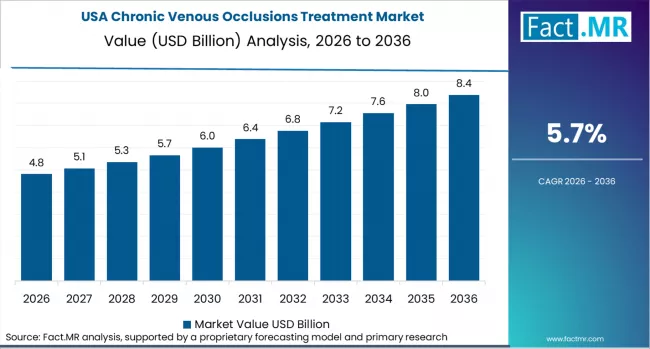
Chronic Venous Occlusions Treatment Market Country Value Analysis | Source: Fact.MR
North America is the largest revenue market, supported by high treatment volumes, strong reimbursement frameworks, and rapid migration of venous procedures to ambulatory surgical centers.
- United States: The United States is projected to advance at a 5.7% CAGR through 2036. CMS reimbursement support and rising office-based ablation procedures are sustaining steady demand for venous treatment devices.
FACT.MR’s North American analysis of the chronic venous occlusions treatment market covers the United States, Canada, and Mexico. Readers can find CMS reimbursement rate data, ASC procedure volume trends, OEM commercial strategy benchmarks, and country-level revenue forecasts by treatment type and end user.
Latin America Chronic Venous Occlusions Treatment Market Analysis
Latin America is an emerging market driven by expanding private healthcare coverage and growing vascular surgery infrastructure in major urban centers.
- Brazil: Brazil is expected to register a 5.0% CAGR through 2036. Private insurance coverage for endovenous ablation and rising specialty clinic investment are gradually increasing adoption of minimally invasive venous treatments.
FACT.MR’s Latin American analysis of the chronic venous occlusions treatment market covers Brazil, Chile, Ecuador, and Rest of Latin America. Readers can find private health insurance coverage expansion data, vascular specialty hospital investment trends, treatment adoption benchmarks, and country-level revenue forecasts by treatment type and end user.
Competitive Aligners for Market Players
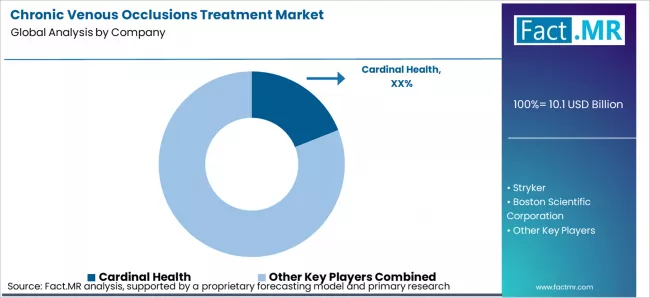
Chronic Venous Occlusions Treatment Market Analysis By Company | Source: Fact.MR
The global chronic venous occlusions treatment market shows a mixed competitive structure. The premium interventional device segment is relatively concentrated, while categories such as ablation catheters and sclerosant drugs remain more fragmented. Major companies including Boston Scientific, Medtronic, AngioDynamics, and Gore hold strong global positions in venous stents, endovenous ablation systems, and catheter-based treatment technologies. Their leadership comes from extensive regulatory approvals, well-established relationships with vascular surgeons and interventional radiologists, and strong clinical evidence that supports reimbursement approvals across key healthcare systems.
Cook Medical and Cardinal Health play important roles through broad hospital supply networks and integrated procurement agreements. These companies often bundle venous treatment products with other vascular and critical care supplies, helping them secure stable distribution channels. In the pharmaceutical segment, Bayer and Sanofi dominate anticoagulant therapies through widely adopted direct oral anticoagulants such as rivaroxaban and apixaban, which are already included in major healthcare formularies.
Hospitals typically manage supplier risk by approving multiple vendors for standard devices. However, physicians often prefer specific stent platforms or ablation systems they are familiar with, creating loyalty toward certain brands and allowing established manufacturers to maintain pricing strength in advanced treatment categories.
Key Players
- Cardinal Health
- Stryker
- Boston Scientific Corporation
- Edward Lifesciences
- Cook Medical
- Medtronic
- AngioDynamics
- Gore
- Bayer AG
- Sanofi
Bibliography
- [1] Centers for Medicare and Medicaid Services. (2025). Hospital Outpatient Prospective Payment System 2025 Final Rule: Endovenous Thermal Ablation Separate Payment Status in Ambulatory Surgical Center Settings. November 2024. cms.gov
- [2] Medtronic plc. (2024). Q3 Fiscal Year 2025 Earnings Supplement: China Vascular Segment Commercial Performance and County Hospital Procurement Growth Commentary. December 2024. investorrelations.medtronic.com
- [3] European Commission. (2025). EU Medical Device Regulation 2017/745 Transition Enforcement Update: Cardiovascular Implant and Venous Stent Product Conformity Assessment Status. January 2025. ec.europa.eu
- [4] AngioDynamics Inc. (2025). Product Launch Release: VenaCure EVLT 1470 nm Next Wave Endovenous Laser Ablation System for Ambulatory and Office-Based Venous Treatment. March 2025. angiodynamics.com
- [5] Boston Scientific Corporation. (2024). Regulatory Clearance Notice: ClosureFast Radiofrequency Ablation Catheter Updated Design FDA 510(k) Clearance. August 2024. bostonscientific.com
- [6] American College of Phlebology. (2024). Annual Practice Survey Report: Treatment Modality Frequency and Procedure Setting Distribution in U.S. Office-Based Phlebology Practices. October 2024. phlebology.org
- [7] W. L. Gore and Associates. (2025). Regulatory Filing Update: GORE VIABAL Venous Leg Stent CE Mark Renewal Under EU MDR 2017/745 and European Commercial Expansion. January 2025. goremedical.com
- [8] European Medicines Agency. (2024). Xarelto (Rivaroxaban) Updated Label Approval: Extended Indication for Long-Term Secondary Prevention of Recurrent Venous Thromboembolism Including Chronic Venous Occlusion. June 2024. ema.europa.eu
- [9] Stryker Corporation. (2025). Investor Day Presentation: MedSurg Segment Recurring Revenue Profile, Single-Use Device Growth, and Peripheral Vascular Category Performance. February 2025. ir.stryker.com
This Report Addresses
- Strategic intelligence on CMS reimbursement expansion for ASC venous ablation, NHS service specification updates mandating endovenous ablation, GKV outpatient specialist reimbursement changes, and China vascular hospital network expansion driving chronic venous treatment demand.
- Market forecast from USD 10.1 billion in 2026 to USD 18.8 billion by 2036 at 7.8% CAGR, segmented by treatment type, product, end user, and region.
- Growth opportunity mapping across China’s vascular hospital expansion, India Ayushman Bharat procedure coverage update, Germany ASV outpatient specialist reimbursement reform, France Assurance Maladie ablation coverage expansion, and U.S. CMS 2025 fee schedule impact.
- Country CAGR outlook for China 7.8%, India 7.0%, Germany 6.7%, France 6.0%, United States 5.7%, United Kingdom 5.5%, and Brazil 5.0%, with key reimbursement, infrastructure, and specialist access drivers per country.
- Competitive analysis of Boston Scientific, Medtronic, AngioDynamics, Gore, Cook Medical, Cardinal Health, Bayer, and Sanofi covering device portfolios, drug formulary positions, reimbursement strategies, and ASC and hospital channel penetration.
- Technology tracking including single-use endovenous ablation platforms for ASC settings, next-generation venous stent designs for chronic iliofemoral occlusion, DOAC extended-indication label expansions, and drug-coated balloon venous treatment programmes.
- Regulatory analysis covering FDA 510(k) and PMA venous device clearance requirements, EU MDR 2017/745 venous implant compliance, CMS CPT reimbursement code schedules, NHS service specifications, GKV ASV reimbursement frameworks, and India PM-JAY covered procedure updates.
- Report delivered in PDF, Excel datasets, PowerPoint summary, and dashboard formats supported by FDA clearance databases, CMS procedure volume data, NHS commissioning records, and primary research interviews.
Segmentation
Scope of Report
| Metric | Value |
|---|---|
| Quantitative Units | USD 10.1 billion (2026) to USD 18.8 billion (2036), at a CAGR of 7.8% |
| Market Definition | Devices, drugs, and clinical procedures for chronic venous insufficiency and venous occlusion treatment across hospital, ASC, and specialty clinic settings. |
| Treatment Type Segmentation | Endovenous Laser Ablation (35%), Radiofrequency Ablation, Sclerotherapy, Compression Therapy, Others |
| Product Segmentation | Devices (54%), Drugs |
| End User Segmentation | Hospitals (47%), Ambulatory Surgical Centers, Specialty Clinics, Others |
| Application Coverage | Chronic venous insufficiency ablation, deep vein thrombosis treatment, iliofemoral venous stenting, foam sclerotherapy, compression therapy, and anticoagulant drug management. |
| Regions Covered | Asia Pacific, Europe, North America, Latin America, Middle East and Africa |
| Countries Covered | China, Japan, South Korea, India, Australia and New Zealand, ASEAN, Rest of South Asia and Pacific, Germany, UK, France, Italy, Spain, Nordic, BENELUX, Rest of Western Europe, Russia, Poland, Hungary, Balkan and Baltic, USA, Canada, Mexico, Brazil, Chile, Ecuador, Rest of Latin America, Saudi Arabia, GCC, Turkey, South Africa, Rest of MEA |
| Key Companies Profiled | Cardinal Health, Stryker, Boston Scientific, Edward Lifesciences, Cook Medical, Medtronic, AngioDynamics, Gore, Bayer AG, Sanofi |
| Forecast Period | 2026 to 2036 |
| Approach | Hybrid top-down and bottom-up model using venous disease prevalence data, procedure volumes by treatment type, average device and drug revenue per procedure, reimbursement coverage timelines, and primary interviews with vascular surgeons and interventional radiologists. |
Source: Fact.MR analysis. Updated Mar 11, 2026
Chronic Venous Occlusions Treatment Market by Segments
-
By Treatment Type:
- Endovenous Laser Ablation
- Radiofrequency Ablation
- Sclerotherapy
- Compression Therapy
- Others
-
By Product:
- Devices
- Drugs
-
By End User:
- Hospitals
- Ambulatory Surgical Centers
- Specialty Clinics
- Others
-
By Region:
- North America
- United States
- Canada
- Mexico
- Latin America
- Brazil
- Chile
- Ecuador
- Rest of Latin America
- Western Europe
- Germany
- United Kingdom
- France
- Italy
- Spain
- Nordic
- BENELUX
- Rest of Western Europe
- Eastern Europe
- Russia
- Poland
- Hungary
- Balkan and Baltic
- Rest of Eastern Europe
- East Asia
- China
- Japan
- South Korea
- South Asia and Pacific
- India
- ASEAN
- Australia and New Zealand
- Rest of South Asia and Pacific
- Middle East and Africa
- Kingdom of Saudi Arabia
- Other GCC Countries
- Turkey
- South Africa
- Other African Union
- Rest of Middle East and Africa
- North America
Frequently Asked Questions
How large is the chronic venous occlusions treatment market in 2025?
What will the market size be in 2026?
What is the projected market size by 2036?
What is the expected CAGR?
Which treatment type leads the market?
Which product segment dominates?
Which end user holds the largest share?
Which country shows the fastest growth?
What is the primary restraint?
Who worked on this report


Preview the report firsthand - request a free sample
Free SampleGet the brochure for pricing and purchase details
Download PDF