- Base Value(2026): 62.1 Bn
- Forecast Value (2036): 124.3 Bn
- CAGR (2036): 7.2%
Cigar & Cigarillos Market Forecast and Outlook 2026 to 2036
In 2025, the cigar & cigarillos market was valued at approximately USD 57.9 billion, moderately adjusted from baseline estimates. Based on Fact.MR analysis, demand for cigars and cigarillos is projected to reach around USD 62.1 billion in 2026 and expand to nearly USD 124.3 billion by 2036, reflecting a CAGR of 7.2% during the forecast period. Market expansion reflects rising premium cigar consumption in developed markets and expanding flavored cigarillo penetration in emerging economies. Commenting on recent performance, Niels Frederiksen, CEO of Scandinavian Tobacco Group, noted that the company observed stable sales with margin pressure driven by market and product mix, while growth continued in handmade cigars. Fact.MR analysis interprets this as evidence that premium handmade formats are contributing disproportionately to value growth even when volume expansion remains moderate.
The market is projected to add approximately USD 66.4 billion in incremental value over the forecast window, reflecting a blend of pricing strategy, product differentiation, and retail channel diversification. Early-period growth is supported by premium handmade cigar demand in North America and Europe. Mid-period performance aligns with flavored cigarillo expansion and online retail penetration. In later years, value realization increasingly reflects brand positioning, regulatory navigation, and evolving consumer purchasing behavior rather than pure unit shipment increases.
China leads growth at 9.7% CAGR, supported by rising disposable income and premium product uptake. India follows at 9.0%, driven by urban consumption and expanding retail networks. Germany records 8.3%, reflecting strong premium cigar demand, while France posts 7.6% aligned with specialty retail channels. The United Kingdom grows at 6.8%, the United States at 6.1%, and Brazil at 5.4%, each influenced by regulatory frameworks and established distribution infrastructure.
Cigar & Cigarillos Market
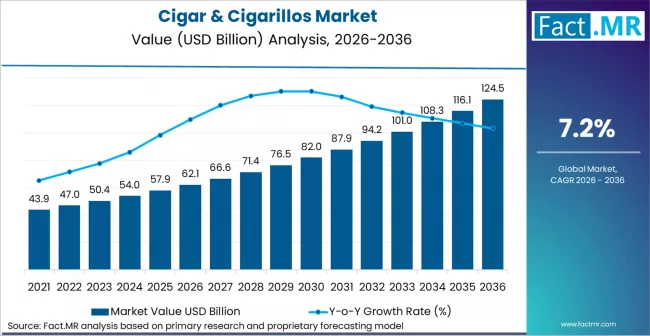
Cigar & Cigarillos Market Market Value Analysis | Source: Fact.MR
| Metric | Value |
|---|---|
| Market Value (2026) | USD 62.1 billion |
| Forecast Value (2036) | USD 124.3 billion |
| Forecast CAGR (2026-2036) | 7.2% |
Source: Fact.MR analysis. Updated Feb 27, 2026
Summary of Cigar & Cigarillos Market
- Market definition
- The cigar and cigarillos market comprises handmade and machine-made tobacco products sold to adult consumers through licensed channels under regulated tobacco control, labeling, and excise duty frameworks.
- Demand Drivers
- Premiumization trends in North America and Europe are driving higher value growth through handmade and aged tobacco formats.
- Expansion of flavored cigarillos in emerging economies is supporting transaction frequency in mass retail channels.
- Growth of organized offline specialty stores and regulated online distribution is widening controlled access to adult consumers.
- Key Segments Analyzed
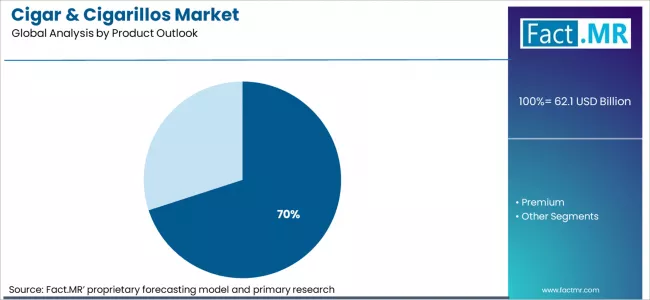
- Product outlook: Mass cigars and cigarillos account for nearly 70% share, supported by lower price points and wider retail penetration.
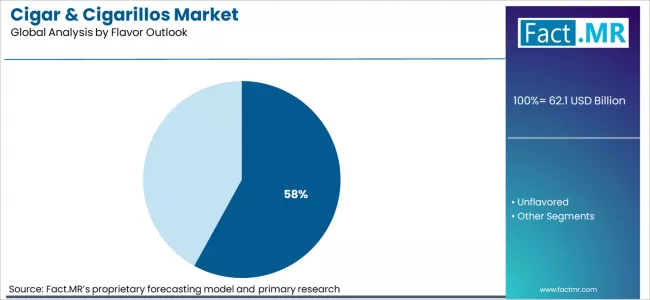
- Flavor outlook: Flavored variants hold approximately 58% share, reflecting portfolio diversification and differentiated taste positioning.
- Geography: Asia Pacific represents the fastest-growing region, led by China and India due to rising disposable income and premium uptake.
- Analyst Opinion at Fact.MR
- Shambhu Nath Jha, Principal Consultant at Fact.MR, opines, ‘CXOs will find this report useful for understanding how product mix optimization, excise structures, premium positioning, and regulatory navigation influence long-term revenue expansion in the cigar and cigarillos sector.’
- Strategic Implications / Executive Takeaways
- Manufacturers should balance premium handmade portfolios with mass cigarillo offerings to hedge against price sensitivity shifts.
- Regulatory compliance planning and tax structure management remain central to protecting margins across jurisdictions.
- Brand differentiation through heritage positioning and controlled distribution partnerships can support sustained value growth.
- Methodology
- Market estimates are derived from production volumes, retail sales reporting, excise tax disclosures, and adult consumption indicators across key regions.
- Regulatory validation references.
Cigar and Cigarillos Market Definition
The cigar and cigarillos market covers tobacco products made from cured and fermented tobacco leaves that are rolled into cylindrical shapes for smoking. Cigars are typically larger and contain more tobacco, while cigarillos are smaller and often machine made. These products are sold through licensed retail channels and are subject to age restrictions, labeling requirements, and excise duties. Manufacturing, packaging, and sale are regulated under tobacco control frameworks enforced by authorities such as the US Food and Drug Administration and public health regulations issued by national health agencies.[1]
Cigar and Cigarillos Market Inclusions
The report provides global and regional market size estimates in volume and value with a forecast from 2026 to 2036. Segmentation includes product type such as premium cigars, machine made cigars, and cigarillos, distribution channel including retail and specialty stores, and end use across adult consumers. Regional demand patterns, pricing structures, and excise tax influences are included.
Cigar and Cigarillos Market Exclusions
The scope excludes cigarettes, smokeless tobacco products, electronic nicotine delivery systems, and heated tobacco devices. Tobacco leaf cultivation and primary curing operations are not included. Smoking accessories such as cutters, lighters, and humidors are excluded. Retail services, hospitality venues, and online content related to tobacco promotion are also outside the scope.
Cigar and Cigarillos Market Research Methodology
- Primary Research: Interviews were conducted with tobacco product manufacturers, distributors, licensed retailers, and regulatory compliance specialists.
- Desk Research: Desk research reviewed tobacco product regulations and market authorization guidance issued by the US Food and Drug Administration and public health reporting from the Centers for Disease Control and Prevention, along with trade statistics and company disclosures.
- Market Sizing and Forecasting: Estimates were developed using production volumes, excise tax data, retail sales reporting, and adult consumption trends.
- Data Validation and Update Cycle: Data was cross checked against regulatory filings, trade records, tax revenue disclosures, and publicly reported company financial statements before updates were finalized.
Segmental Analysis
Cigar & Cigarillos Market Analysis by Product Outlook
Cigar & Cigarillos Market Analysis By Product Outlook | Source: Fact.MR
Based on Fact.MR analysis, consumption of mass cigars and cigarillos is estimated to hold 70% share of the global market. Fact.MR analysts note mass products lead due to lower price points, wider retail availability, and standardized production methods. As per Fact.MR, this product outlook addresses consumer demand for affordability, convenience store access, and smaller pack formats, supporting consistent sales volumes across urban and rural retail networks worldwide today within regulated tobacco distribution frameworks and established excise taxation structures globally.
- Tobacco regulation: Manufacturing and sale of cigars are governed under national tobacco control and labeling laws.[2]
- Retail spread: Fact.MR analysts note mass cigars dominate convenience and grocery channels.
- Price sensitivity: Lower unit pricing supports higher transaction frequency.
Cigar & Cigarillos Market Analysis by Flavor Outlook
Cigar & Cigarillos Market Analysis By Flavor Outlook | Source: Fact.MR
Based on Fact.MR analysis, consumption of flavored cigars and cigarillos is estimated to hold 58% share of the global market. Fact.MR analysts note flavored variants lead due to taste differentiation, product variety, and appeal among adult consumers seeking milder sensory profiles. As per Fact.MR, this flavor outlook addresses consumer preferences for sweet, fruit, and aromatic blends, supporting product portfolio expansion across retail outlets worldwide today within regulated tobacco marketing environments and evolving compliance requirements across jurisdictions globally.
- Flavor regulation: Flavored tobacco products are subject to federal oversight and product authorization rules.[3]
- Portfolio breadth: Fact.MR analysts note manufacturers offer multiple flavor extensions.
- Market positioning: Flavored products are often sold in smaller pack sizes.
Cigar & Cigarillos Market Drivers, Restraints, And Opportunities
Fact.MR analysis indicates that the cigar and cigarillos market exists as a tobacco product segment catering to adult consumers across premium, mass-market, and value tiers where product formulation, labelling, and distribution are governed by regulatory and public health frameworks. As per Fact.MR assessment, cigar and cigarillo products fall under tobacco control and tobacco product regulation in many jurisdictions, such as the U.S. Food and Drug Administration (FDA) regulation of tobacco products, which sets requirements for product listing, labelling, and marketing of cigars and related products to reduce harm and ensure compliance with age-of-sale and health disclosure mandates.[4] Fact.MR analysts observe that the current market scale is shaped by factors including adult smoking prevalence, price elasticity, taxation policies, and demographic preferences in key consuming markets such as North America, Europe, and Latin America.
Fact.MR is of the opinion that current market dynamics reflect a transition toward differentiated products, flavour variants, and premiumisation in certain consumer segments, even as regulatory tightening and public health interventions influence overall product reach and marketing strategies. Based on Fact.MR assessment, traditional large format cigars and machine-made cigarillos continue to account for a large share of unit volumes due to established consumer habits and brand loyalty, but growth is occurring in segments where artisanal production, flavoured blends (where permitted), and product innovation align with changing consumer tastes. Advanced product variants that emphasise aged tobaccos, flavour complexity, and branded experiences generally carry higher per-unit pricing because of craftsmanship, tobacco sourcing, and niche positioning, meaning realised market value can increase even where overall volumes grow at a measured pace. Fact.MR analysis suggests that this mix of product differentiation and regulatory navigation will shape near-term market evolution.
- Regulated tobacco control frameworks: Fact.MR analysts note that regulatory systems such as the U.S. FDA’s tobacco product requirements influence how cigars and cigarillos are listed, labelled, and marketed to adult consumers, affecting product design and compliance planning.[5]
- Shift toward differentiated formats: Based on Fact.MR assessment, demand is rising for premium and artisanal cigars and cigarillos that offer unique flavour profiles, aged tobacco blends, and brand heritage positioning among adult users in mature markets.
- Taxation and pricing pressures: Fact.MR opines that excise tax regimes and price increases in regions such as Europe and North America influence consumer choice toward value-oriented cigarillo formats in price-sensitive segments, even as premium products maintain resilience in upper income cohorts.
Regional Analysis
Based on regional assessment, the cigar and cigarillos sector is analyzed across North America, Europe, East Asia, South Asia, and Latin America, spanning more than 40 countries. Regional performance varies according to premium tobacco consumption patterns, regulatory frameworks governing tobacco sales, taxation policies, and growth of specialty retail and duty free distribution channels.
Cigar and Cigarillos Market CAGR Analysis by Country (2026-2036)
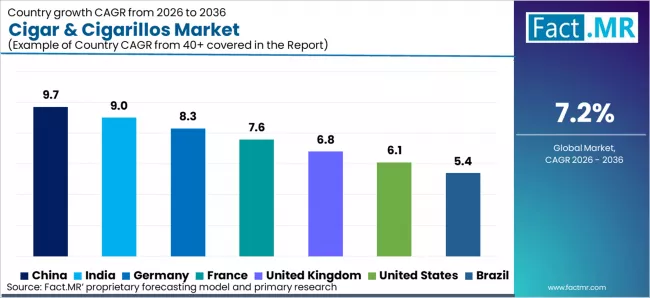
Cigar & Cigarillos Market Cagr Analysis By Country | Source: Fact.MR
| Country | CAGR |
|---|---|
| China | 9.7% |
| India | 9.0% |
| Germany | 8.3% |
| France | 7.6% |
| United Kingdom | 6.8% |
| United States | 6.1% |
| Brazil | 5.4% |
Source: Fact.MR analysis. Updated Feb 27, 2026
Source: Fact.MR analysis, based on proprietary forecasting models and primary research.
Outlook On Cigar and Cigarillos Demand in Asia Pacific
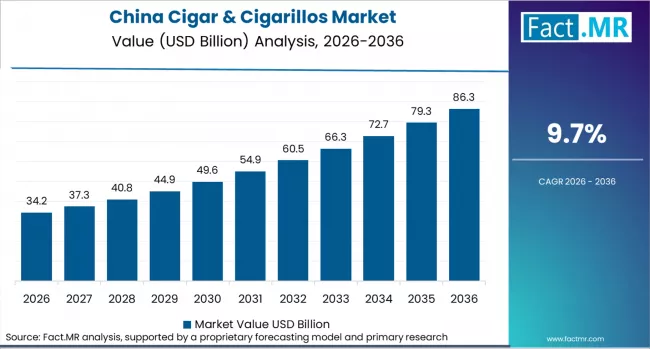
Cigar & Cigarillos Market Country Value Analysis | Source: Fact.MR
Asia Pacific reflects accelerating demand for cigars and cigarillos driven by premiumization urban income growth and expansion of organized tobacco retail. Consumption trends are influenced by gifting culture hospitality channels and specialty lounges in metropolitan centers. China and India anchor regional volume through expanding adult consumer segments and import distribution networks. Sales are regulated under national tobacco control frameworks with structured retail compliance. Market growth reflects discretionary spending patterns and gradual penetration of premium cigar formats across major cities regionwide.
- China: Demand for cigars and cigarillos in China is projected to rise at 9.7% CAGR through 2036. Growth reflects expansion of premium tobacco retail and duty free distribution channels, as per Fact.MR.
- India: Demand for cigars and cigarillos in India is projected to rise at 9.0% CAGR through 2036. Usage reflects urban premium tobacco demand and specialty retail growth, according to Fact.MR.
Fact.MR’s analysis of the Cigar & Cigarillos Market in Asia Pacific consists of country-wise assessment that includes China and India. Readers can find premiumization and retail expansion insights.
Analysis On Cigar and Cigarillos Sales In Europe
Europe demonstrates structured cigar and cigarillos sales shaped by excise taxation frameworks standardized packaging rules and established tobacconist networks. Consumption remains concentrated among adult premium segments and hospitality venues. Germany France and the United Kingdom contribute through regulated specialty retail and controlled advertising policies. Procurement emphasizes compliance traceability and brand heritage positioning. Market growth remains moderate reflecting stable adult participation and replacement purchasing across Western European markets operating under strict tobacco regulation regimes regionwide.
- Germany: Demand for cigars and cigarillos in Germany is projected to rise at 8.3% CAGR through 2036. Sales reflect regulated specialty tobacco retail and established premium consumer demand, as per Fact.MR.
- France: Demand for cigars and cigarillos in France is projected to rise at 7.6% CAGR through 2036. Usage reflects structured distribution through licensed tobacconists, according to Fact.MR.
- United Kingdom: Demand for cigars and cigarillos in the United Kingdom is projected to rise at 6.8% CAGR through 2036. Adoption reflects premium cigar consumption within regulated retail frameworks, as per Fact.MR.
Fact.MR’s analysis of the Cigar & Cigarillos Market in Europe consists of country-wise assessment that includes Germany, France, and the United Kingdom. Readers can find taxation and regulatory impact insights.
Demand for Cigars And Cigarillos In North America
North America shows steady demand for cigars and cigarillos supported by specialty tobacco stores convenience retail and online distribution where permitted. Consumption is driven by premium cigar culture flavored cigarillo segments and gifting patterns. The United States anchors regional volume through established importer networks and retail chains. Sales operate under federal and state level regulation including warning label requirements. Market growth reflects stable adult consumer participation and continued premium product positioning nationwide.
- United States: Demand for cigars and cigarillos in the United States is projected to rise at 6.1% CAGR through 2036. Growth reflects specialty retail presence and steady premium cigar consumption, as per Fact.MR.
Fact.MR’s analysis of the Cigar & Cigarillos Market in North America consists of country-wise assessment that includes the United States. Readers can find regulatory structure and retail distribution insights.
Outlook On Cigar and Cigarillos Demand in Latin America
Latin America reflects moderate demand for cigars and cigarillos supported by domestic tobacco cultivation export orientation and regional retail networks. Consumption patterns are influenced by local production and adult premium segments. Brazil anchors regional activity through established tobacco farming and manufacturing capacity. Market expansion remains incremental reflecting regulatory oversight and stable adult consumer demand across metropolitan areas regionwide.
- Brazil: Demand for cigars and cigarillos in Brazil is projected to rise at 5.4% CAGR through 2036. Usage reflects domestic production strength and structured retail distribution channels, according to Fact.MR.
Fact.MR’s analysis of the Cigar & Cigarillos Market in Latin America consists of country-wise assessment that includes Brazil. Readers can find production and consumption trend insights.
Competitive Landscape of Cigar and Cigarillos Market
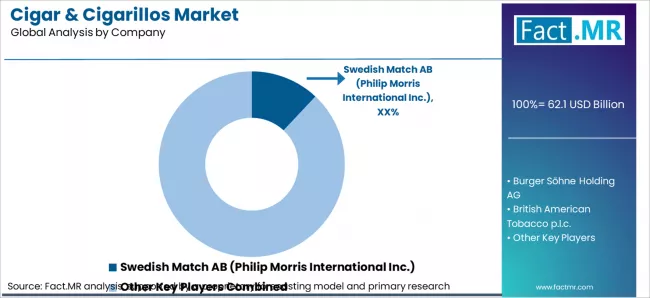
Cigar & Cigarillos Market Analysis By Company | Source: Fact.MR
As per Fact.MR analysis, the 2026 cigar and cigarillos market is defined by validated product quality, brand recognition, and multi-region regulatory compliance, which determine competitive advantage. Swedish Match AB (Philip Morris International) and Burger Söhne Holding AG lead with premium blends and consistent tobacco quality, which strengthens adoption among luxury and lifestyle consumers. British American Tobacco and JT International S.A. emphasize validated flavor consistency and proprietary curing processes, which improves consumer loyalty and repeat purchase rates. Gurkha Cigars and Habanos, S.A. focus on heritage brands with verified craftsmanship, which enhances appeal in premium and collector segments. Imperial Brands PLC and Oettinger Davidoff AG provide regionally compliant products with documented quality control, which supports adoption in regulated international markets. Scandinavian Tobacco Group A/S and Philip Morris International emphasize scalable production and verified quality standards, which ensures supply continuity. Swisher International, Inc. delivers verified consistency across mass-market and flavored cigarillos, which maintains competitive presence in entry-level segments. Across the market, validated product quality, brand heritage, and regulatory adherence form enduring competitive moats, reducing reliance on pricing or isolated product claims.
Recent Industry Developments
- STG Internal Brand Reshuffle: Effective February 2, 2026, Scandinavian Tobacco Group (STG) executed a massive internal restructuring. Iconic brands like non-Cuban Cohiba and Punch were moved to the "Forged Cigar Co." division, while Partagas and Room101 moved to "General Cigar Co." This move is designed to balance internal competition and sharpen their Focus2030 growth strategy. [6]
- The Expansion of Caribbean Luxury Lounges: In early February, Club Macanudo (the world’s most famous cigar lounge brand) opened its first Caribbean location in Puerto Rico. This reflects a broader 2026 market trend where brands are pivoting toward "retail experiences" and private lounges to insulate themselves from traditional advertising restrictions. [7]
Key Players in Cigar and Cigarillos Market
- Swedish Match AB (Philip Morris International Inc.)
- Burger Söhne Holding AG
- British American Tobacco p.l.c.
- Gurkha Cigars
- JT International S.A. (Japan Tobacco Inc.)
- Imperial Brands PLC
- Habanos, S.A.
- Oettinger Davidoff AG
- Scandinavian Tobacco Group A/S
- Philip Morris International Inc.
- Swisher International, Inc.
Bibliography
- [1] U.S. Food and Drug Administration. (2024). Tobacco products: Cigars and cigarillos regulatory overview. U.S. Department of Health and Human Services.
Centers for Disease Control and Prevention. (2024). Cigar and tobacco use among adults. U.S. Department of Health and Human Services. - [2] U.S. Food and Drug Administration. (2024). Tobacco product regulation and labeling requirements. U.S. Department of Health and Human Services.
- [3] U.S. Food and Drug Administration. (2024). Flavored tobacco products regulatory framework and product authorization guidance. U.S. Department of Health and Human Services.
- [4] U.S. Food and Drug Administration. (2024). Family Smoking Prevention and Tobacco Control Act: Regulatory authority over cigars and related products. U.S. Department of Health and Human Services.
- [5] U.S. Food and Drug Administration. (2024). Compliance, enforcement, and product listing requirements for tobacco manufacturers. U.S. Department of Health and Human Services.
- [6] Scandinavian Tobacco Group A/S. (2026). Corporate restructuring and brand portfolio realignment under Focus2030 strategy [Corporate announcement]. Scandinavian Tobacco Group A/S.
- [7] Club Macanudo. (2026). Club Macanudo expands with first Caribbean luxury cigar lounge opening in Puerto Rico [Corporate announcement]. Club Macanudo.
This Report Addresses
- Market intelligence to enable structured strategic decision-making across mature and emerging cigar and cigarillo markets
- Market size estimation and 10-year revenue forecasts from 2026 to 2036, supported by production data, retail sales reporting, and excise/tax disclosures
- Growth opportunity mapping across product outlooks (mass vs premium) and flavors (flavored vs unflavored), highlighting premiumization and mix-led value expansion
- Distribution channel assessment covering offline specialty retail, convenience, duty-free, and regulated online channels, including channel-shift implications for margins and control
- Competitive strategy benchmarking across brand equity, portfolio architecture, pricing tiers, and multi-jurisdiction regulatory compliance capability
- Technology and commercialization tracking including packaging compliance upgrades, traceability requirements where applicable, and age-verification/online compliance execution
- Regulatory impact analysis covering tobacco product standards, warning labels, marketing restrictions, and product authorization/oversight frameworks led by the US FDA and national public health regulators
- Market report delivery in PDF, Excel, PPT, and dashboard formats for executive planning, channel strategy, and portfolio management
Segmentation
Scope of the Report
| Metric | Value |
|---|---|
| Quantitative Units | USD 62.1 billion (2026) to USD 124.3 billion (2036), CAGR 7.2% |
| Market Definition | The cigar and cigarillos market covers tobacco products made from cured and fermented tobacco leaves rolled into cylindrical formats for smoking. Cigars are generally larger and premium, while cigarillos are smaller, often machine-made, and sold at lower price points. Products are subject to age restrictions, labeling requirements, excise duties, and retail regulations under authorities such as the US FDA and national public health frameworks. Sales occur through specialty retailers, convenience stores, duty-free shops, and regulated online channels. |
| Product Outlook Segmentation | Mass, Premium |
| Flavor Outlook Segmentation | Flavored, Unflavored |
| Distribution Channel Segmentation | Offline, Online |
| Regions Covered | Asia Pacific, Europe, North America, Latin America, Middle East & Africa |
| Countries Covered | China, India, Japan, South Korea, Indonesia, Australia & New Zealand, Germany, Italy, France, United Kingdom, Spain, Benelux, Nordics, Central & Eastern Europe, United States, Canada, Mexico, Brazil, Argentina, Chile, Kingdom of Saudi Arabia, United Arab Emirates, South Africa, Turkey |
| Key Companies Profiled | Swedish Match AB (Philip Morris International), Burger Söhne Holding AG, British American Tobacco p.l.c., Gurkha Cigars, JT International S.A. (Japan Tobacco Inc.), Imperial Brands PLC, Habanos, S.A., Oettinger Davidoff AG, Scandinavian Tobacco Group A/S, Philip Morris International Inc., Swisher International, Inc. |
| Forecast Period | 2026 to 2036 |
| Approach | Market sizing and forecasting based on production and retail sales data, adult consumption trends, excise tax structures, flavor and product mix analysis, and distribution channel dynamics. Data validated via interviews with manufacturers, distributors, licensed retailers, and regulatory experts. |
Source: Fact.MR analysis. Updated Feb 27, 2026
Cigar and Cigarillos Market Analysis by Segments
-
Product Outlook :
- Mass
- Premium
-
Flavor Outlook :
- Flavored
- Unflavored
-
Distribution Channel Outlook :
- Offline
- Online
-
Region :
- Asia Pacific
- India
- China
- Japan
- South Korea
- Indonesia
- Australia & New Zealand
- ASEAN
- Rest of Asia Pacific
- Europe
- Germany
- Italy
- France
- United Kingdom
- Spain
- Benelux
- Nordics
- Central & Eastern Europe
- Rest of Europe
- North America
- United States
- Canada
- Mexico
- Latin America
- Brazil
- Argentina
- Chile
- Rest of Latin America
- Middle East & Africa
- Kingdom of Saudi Arabia
- United Arab Emirates
- South Africa
- Turkey
- Rest of Middle East & Africa
- Asia Pacific
Frequently Asked Questions
How large is the cigar & cigarillos market in 2026?
What will the market size reach by 2036?
What is the expected CAGR of the cigar & cigarillos market during 2026–2036?
How much incremental value will the market add between 2026 and 2036?
What was the market valuation in 2025?
Which product segment accounts for the largest share of the market?
Which flavor category holds the leading share?
Which region is growing the fastest in the cigar & cigarillos market?
What is the projected growth rate for China?
How fast is the market expected to grow in India?
What is the expected growth rate in Germany?
How is France expected to perform during the forecast period?
What is the growth outlook for the United Kingdom?
How is the United States market projected to expand?
What is the projected growth rate for Brazil?
What is driving early-period growth in the market?
What supports mid-period performance in the forecast window?
What factors influence long-term value realization in the market?
Why are premium handmade cigars contributing disproportionately to value growth?
What structural factors influence long-term revenue expansion in this market?
Who worked on this report


Preview the report firsthand - request a free sample
Free SampleGet the brochure for pricing and purchase details
Download PDF