- Market Value (2025): USD 82.6 Mn
- Estimated Value (2026): USD 100 Mn
- Forecast Value (2036): USD 675 Mn
- CAGR (2026-2036): 21.0%
What is the Circular Elastomers Market forecast to be worth by 2036?
USD 100 million in 2026 to USD 675 million by 2036, at 21.0% CAGR.
- A USD 82.6 million market in 2025 reflects early commercial programs concentrated in high-value elastomer families and tightly specified components.
- Revenue is projected to increase from USD 100 million in 2026 to USD 675 million in 2036 as seal makers, OEMs, semiconductor-tool suppliers, and industrial users seek circular inputs that preserve service performance.
- The 21.0% CAGR is enabled by feedstock-recovery initiatives, certified allocation models, better compound traceability, and the high economic value attached to reliable elastomer function.
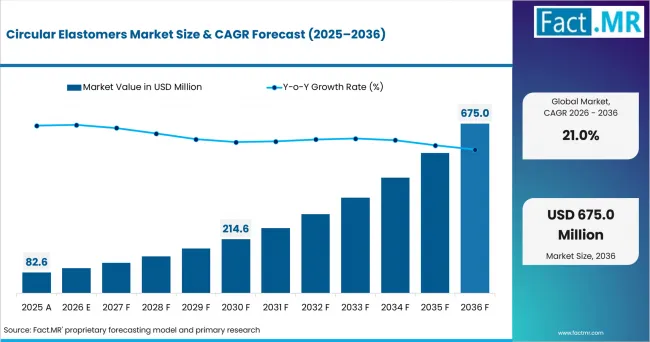
Circular Elastomers Market Value Analysis | Source: Fact.MR
What are the defining numbers behind Circular Elastomers Market growth?
USD 575 million absolute opportunity by 2036, led by Fluoroelastomers and Certified circular feedstock within their respective segments.
- Demand Drivers in the Market
- Seals and gaskets create an attractive entry point because elastomer mass is modest relative to the equipment value and leakage consequence.
- Fluoroelastomer supply chains are exploring recovered fluorine and certified circular content to reduce reliance on mined or virgin fluorine inputs.
- Semiconductor equipment requires high-purity, plasma-resistant, and heat-tolerant grades, encouraging carefully controlled circular routes rather than indiscriminate recyclate use.
- Compounders can introduce selected recovered or renewable ingredients while reformulating cure, reinforcement, and processing packages to retain final properties.
- Key Segments Analyzed
- By Elastomer Family: Fluoroelastomers lead at 38.0% of demand. FKM ranks among the costliest rubber compounds to mold, with yields running as low as 50%, so recovering scrap carries real economic weight that lower-cost elastomers don't generate, and growing PFAS classification scrutiny under EPA and EU REACH reviews adds further incentive to recover fluorine already in circulation rather than expand virgin fluorochemical output.
- By Circularity Route: Certified circular feedstock leads at 36.0% of demand. Mass balance chain-of-custody accounting, the same model AGC used to secure third-party UL 2809 verification for 100% recycled-fluorite content in its Aflas FFKM, lets producers like Syensqo credit recycled input, including the up to 29% post-industrial recycled hydrofluoric acid feedstock used in Tecnoflon elastomers made at its Spinetta Marengo site, against total output without physically blending degraded reclaim into the finished compound, so parts still meet the tensile and elongation specs that mechanical devulcanization typically falls short of.
- By Application: Seals and gaskets lead at 38.0% of demand. Fluoroelastomer's core function across automotive, oil and gas, and chemical processing equipment is precision sealing in small, low-mass parts, and because the polymer itself accounts for most of a seal's total cost, recovering and reusing high-value FKM content stays economically practical instead of being downcycled into lower-grade uses.
- By Performance Grade: High-temperature grade leads at 31.0% of demand. Turbocharger, crankshaft, and transmission seals routinely run above 200 degrees Celsius in continuous service, the exact band where FKM outperforms lower-cost elastomers, so buyers paying the fluoroelastomer premium are paying specifically for that heat tier rather than for general-purpose sealing.
- By Sales Route: Direct OEM supply leads at 33.0% of demand. Automotive and industrial sealing programs run under IATF 16949 quality systems that require PPAP documentation and lot-level traceability back to the raw polymer batch, a record set that is far easier to maintain through a direct supplier relationship than through distributor layers, and one that now also has to carry mass balance chain-of-custody records for recycled content.
- Analyst Opinion at Fact.MR
- Shambhu Nath Jha, Senior Analyst at Fact.MR, states, "Circularity in elastomers must be judged at the route and compound level. A recovered fluorine input, a mass-balanced attribute, a recycled monomer, and reclaimed rubber are materially different propositions; buyers need to know which one is present, where it enters, how it is verified, and whether the final seal still passes its service test."
- Strategic Implications
- Polymer producers should identify whether circular value is physically present, attributed through custody accounting, or created upstream through recovered feedstock.
- Compounders need property-based formulation work because fillers, curatives, plasticizers, pigments, and processing aids can determine whether a circular ingredient is technically acceptable.
- Seal manufacturers should qualify circular compounds by media, temperature, compression set, cleanliness, and lifetime rather than assuming family-level equivalence.
- OEM procurement teams can create scale by nominating circular grades for defined parts while retaining full traceability to the polymer and compound batch.
Syensqo introduced non-fluorosurfactant Tecnoflon FFKM grades in 2025 and stated that certified circular-content versions attributed by mass-balance chain of custody were planned. Daikin is developing fluorine-resource recovery and recycling routes, while Freudenberg Sealing Technologies is testing renewable and recycled ingredients for industrial elastomer compounds, illustrating how circularity can enter at monomer, polymer, or compounding stage.
Germany is expected to register a 24.8% CAGR through 2036 because its automotive, chemical, equipment, and sealing industries can coordinate material recovery, certification, compounding, and OEM qualification. The United States follows at 22.7% by pairing specialist material development with large automotive, semiconductor, oil and gas, and maintenance demand, while the Netherlands at 21.5% converts circular-economy policy into audited feedstock loops. Japan is positioned for 23.1% growth through deep fluorochemical expertise, and South Korea is anticipated to advance at 20.6% in semiconductor tools, electronics, and advanced industrial equipment.
How does the Circular Elastomers Market break down by segment?
The leading shares are Fluoroelastomers at 38.0% by Elastomer Family and Certified circular feedstock at 36.0% by Circularity Route.
Why do fluoroelastomers lead circular elastomer value?
At 38.0% share in 2026, the leading position goes to Fluoroelastomers because their high performance and fluorine-intensive feedstock make recovery, allocation, and supply-resilience programs commercially meaningful.
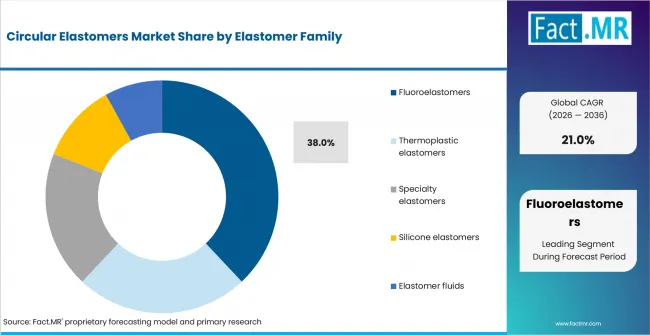
Circular Elastomers Market Analysis By Elastomer Family | Source: Fact.MR
Fluoroelastomers account for 38.0% of the market, compared with 24.0% for thermoplastic elastomers and 19.0% for specialty elastomers. FKM and FFKM grades serve harsh chemical, thermal, and semiconductor environments where buyers can justify a premium for a controlled circular route. Thermoplastic elastomers are generally more amenable to melt reprocessing, but application purity, aging, additives, and collection quality still determine how much recovered input can be used.
What places certified circular feedstock at the front of the market?
The 2026 leader is Certified circular feedstock at 36.0% share as certification can connect eligible circular inputs with demanding elastomer grades even when integrated production prevents physical segregation.
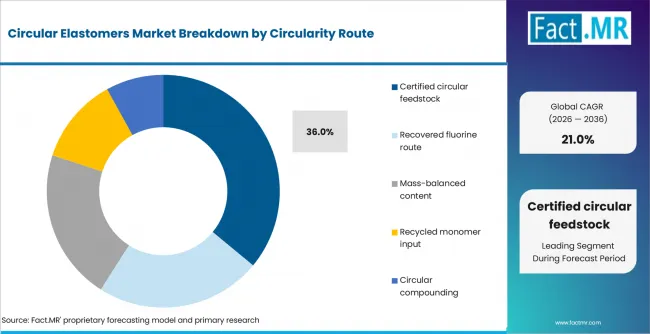
Circular Elastomers Market Analysis By Circularity Route | Source: Fact.MR
Certified circular feedstock represents 36.0%, followed by recovered fluorine at 23.0% and mass-balanced content at 21.0%. Certification helps reconcile input and output through complex chemical production, but an attributed claim does not establish a measurable recycled fraction in every delivered polymer batch. Recycled monomer and circular compounding can involve more direct physical recovery, although yield, contamination, cure history, and performance limits keep them application-specific.
Why are seals and gaskets the largest application?
A 38.0% share puts Seals and gaskets first in 2026 because they concentrate elastomer performance in small components whose reliability protects much more valuable equipment and process output.
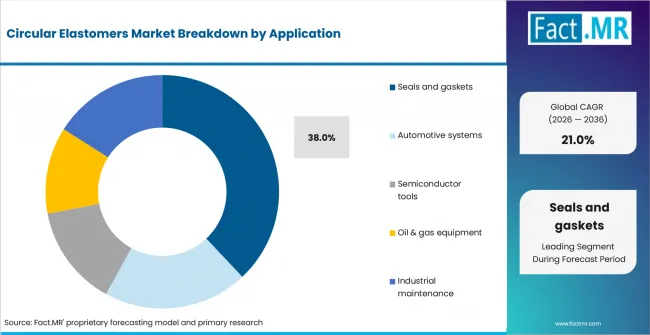
Circular Elastomers Market Analysis By Application | Source: Fact.MR
Seals and gaskets hold 38.0% of demand, with automotive systems at 20.0% and industrial maintenance at 16.0%. A circular compound can gain acceptance when it matches leakage, media, temperature, wear, and compression requirements in a known seal geometry. Semiconductor tools and oil or gas equipment have smaller shares but can carry high material value because purity, extreme media, pressure, and unplanned downtime narrow the acceptable grade set.
Why does high-temperature material lead the grade mix?
For Performance Grade, the top 2026 position is High-temperature grade at 31.0% share since heat resistance is central to the applications where premium elastomers and circular feedstock security command the greatest value.
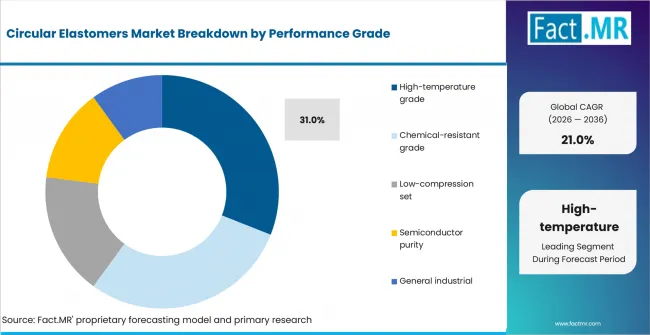
Circular Elastomers Market Analysis By Performance Grade | Source: Fact.MR
High-temperature grades contribute 31.0%, just ahead of chemical-resistant grades at 29.0%; low-compression-set products hold 17.0%. Heat and aggressive media accelerate permanent deformation and degradation, so circular grades must prove that feedstock or formulation changes do not reduce sealing life. Semiconductor-purity material remains a smaller 13.0% class because extractables, particles, plasma exposure, and trace contamination impose exceptional controls.
Why is direct OEM supply the leading route to market?
The leading 2026 share is 33.0% for Direct OEM supply because early circular grades require coordinated qualification, volume allocation, claim approval, and part-specific performance evidence.
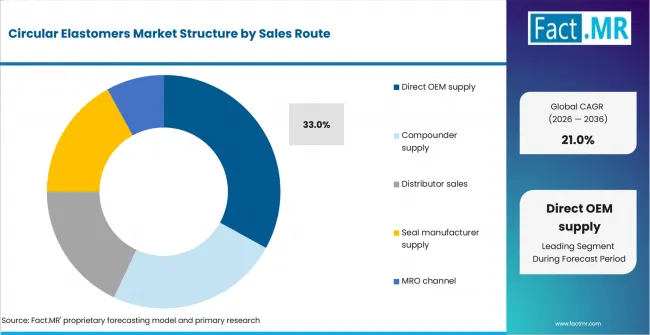
Circular Elastomers Market Analysis By Sales Route | Source: Fact.MR
Direct OEM supply accounts for 33.0%, ahead of compounder supply at 24.0% and distributor sales at 18.0%. Direct programs allow the polymer maker, compounder, seal producer, and equipment customer to agree on material identity and claim boundaries before scale-up. Distributor and MRO channels can broaden availability later, but mixed inventories and substitute-grade selling make traceability harder to maintain.
What is accelerating Circular Elastomers Market adoption, and what is holding it back?
The leading accelerator is a high-value component whose established performance can be retained while a verified circular route enters upstream. Technical limits on reuse, sparse recovery networks, regulatory scrutiny, and confusion among physical and attributed claims remain the principal brakes.
Drivers Impact Analysis
| DRIVER | (~) % IMPACT ON CAGR | GEOGRAPHIC RELEVANCE | IMPACT TIMELINE |
|---|---|---|---|
| Fluorine supply resilience | +3.2% | Germany, Japan, United States, and South Korea | Long term (>= 4 years) |
| Critical-seal qualification | +2.7% | Global industrial and mobility markets | Medium term (2-4 years) |
| Semiconductor process demand | +2.3% | Japan, United States, South Korea, and Germany | Long term (>= 4 years) |
| Certified chain of custody | +1.9% | Europe-led global supply chains | Short term (<= 2 years) |
| Compound ingredient innovation | +1.5% | United States, Germany, Japan, and specialist compounding clusters | Medium term (2-4 years) |
Source: Fact.MR analysis. Updated Jul 16, 2026
- Fluorine supply resilience: Recovery of fluorine-bearing streams can support resource security as well as circularity. Elastomer producers benefit when recovered inputs meet the purity and consistency needed for monomer or polymer manufacture.
- Critical-seal qualification: Seals use relatively little material but perform a critical containment function. This economics allows suppliers to invest in testing a circular grade against service media, temperature, pressure, and compression requirements.
- Semiconductor process demand: Advanced chipmaking uses elastomers around plasma, vacuum, wet chemistry, and thermal process steps. Suppliers that can combine circular feedstock evidence with purity and low-outgassing control gain access to a demanding value pool.
Opportunity Impact Analysis
| OPPORTUNITY | (~) % IMPACT ON CAGR | GEOGRAPHIC RELEVANCE | IMPACT TIMELINE |
|---|---|---|---|
| Closed-loop seal scrap | +1.7% | Germany, Japan, United States, and concentrated manufacturing sites | Medium term (2-4 years) |
| Recovered-fluorine partnerships | +1.5% | Japan, Europe, United States, and South Korea | Long term (>= 4 years) |
| Circular semiconductor seals | +1.3% | Japan, South Korea, United States, and Germany | Long term (>= 4 years) |
| MRO take-back programs | +1.1% | Germany, United States, and industrial clusters | Medium term (2-4 years) |
Source: Fact.MR analysis. Updated Jul 16, 2026
- Closed-loop seal scrap: Controlled factory scrap has a known formulation and cleaner collection path than mixed end-of-life rubber. Producers can route it into reclaim, devulcanization, feedstock recovery, or approved lower-demand compounds after technical evaluation.
- Recovered-fluorine partnerships: Partnerships across chemical plants, users, waste handlers, and fluorine processors can aggregate difficult streams and return useful feedstock. The opportunity improves when take-back specifications identify composition and contamination before material leaves the customer site.
- Circular semiconductor seals: FFKM and high-purity FKM command enough value to support specialized circular allocation and validation. Initial programs can target defined dry, wet, or plasma conditions rather than claiming one universal semiconductor grade.
Restraints Impact Analysis
| RESTRAINT | (~) % IMPACT ON CAGR | GEOGRAPHIC RELEVANCE | IMPACT TIMELINE |
|---|---|---|---|
| Thermoset crosslink barrier | -1.5% | Global | Long term (>= 4 years) |
| Contaminated return streams | -1.2% | Industrial and MRO channels worldwide | Medium term (2-4 years) |
| Qualification and liability | -0.9% | Semiconductor, oil and gas, automotive, and critical industry | Short term (<= 2 years) |
| Circularity claim ambiguity | -0.7% | Global | Short term (<= 2 years) |
Source: Fact.MR analysis. Updated Jul 16, 2026
- Thermoset crosslink barrier: Most conventional elastomers are chemically crosslinked and cannot simply be remelted into virgin-equivalent material. Reclaim, devulcanization, or chemical recovery can change properties, cost, and yield.
- Contaminated return streams: Used seals can carry oil, process chemicals, metals, fillers, and unknown polymers. Sorting and cleaning may cost more than the recovered material unless collection is concentrated and composition is known.
- Qualification and liability: A seal failure can cause leakage, contamination, downtime, or safety exposure. Users therefore require application testing and change control before accepting a circular route, even when the polymer supplier targets equivalent properties.
Which countries are moving first on circular elastomers?
Germany 24.8% CAGR. United States 22.7%. Japan 23.1%
Regional analysis covers North America, Europe, and Asia Pacific, with country detail on Germany, the United States, the Netherlands, Japan, and South Korea. The full report widens this view to more than 30 countries.
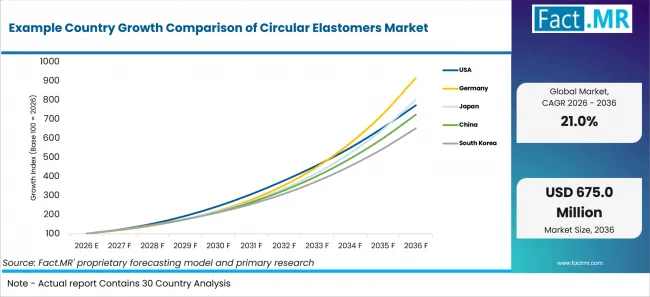
Example Country Growth Comparison Of Circular Elastomers Market | Source: Fact.MR
| COUNTRY | CAGR |
|---|---|
| Germany | 24.8% |
| United States | 22.7% |
| Japan | 23.1% |
Source: Fact.MR analysis. Updated Jul 16, 2026
Why Does Germany's PFAS Regulatory Role Give Its Circular Elastomer Market a 24.8% CAGR Edge?
Germany was one of five national authorities, with Denmark, the Netherlands, Norway and Sweden, that submitted the January 2023 REACH dossier proposing EU-wide PFAS controls to the European Chemicals Agency, with a consolidated opinion expected by late 2026. That places German regulators inside the process shaping how virgin fluoroelastomer output will be treated, ahead of most other national markets.
That regulatory position pairs with Germany's integrated chemical-park model, where sites such as Marl and Leverkusen link co-located plants through shared pipeline and utility networks, and with a domestic automotive base led by Volkswagen Group, BMW, Mercedes-Benz and Audi. Weinheim-based Freudenberg Sealing Technologies is the global leader in sealing systems, posting approximately EUR 2.4 billion in 2024 sales and employing roughly 12,500 people while supplying FKM seals from its German operations into that base. Germany's elastomer demand is expanding at a 24.8% CAGR from 2026 to 2036.
How Are US Reporting Rules and PFAS Litigation Reshaping Elastomer Sourcing at a 22.7% CAGR?
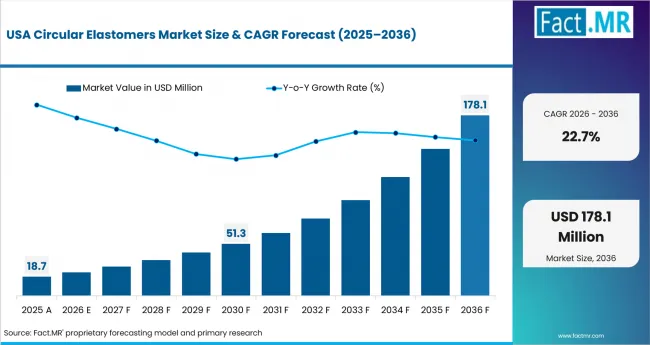
Circular Elastomers Market Country Value Analysis | Source: Fact.MR
The US EPA finalized its TSCA Section 8(a)(7) rule in October 2023, requiring any company that manufactured or imported PFAS or PFAS-containing articles since 2011 to report use and volume data, with the reporting window now set to open in October 2026. DuPont and Corteva separately established a USD 1.185 billion fund in 2023 to settle PFAS claims from US public water systems.
Why Does the Netherlands Combine PFAS Rulemaking Leadership With Its Most-Litigated PFAS Site?
The Netherlands' national institute RIVM co-authored the January 2023 REACH restriction dossier submitted with Denmark, Germany, Norway and Sweden, proposing controls on more than 10,000 PFAS substances.
How Is Daikin's Semiconductor-Driven Capacity Expansion Shaping Japan's 23.1% CAGR?
Osaka-headquartered Daikin Industries operates fluoroelastomer production across a multi-site global network spanning Japan and international facilities, and is building a new perfluoroelastomer (FFKM) plant at its Kashima site in Ibaraki Prefecture, scheduled for completion in August 2026 with commercial supply starting in 2027 to meet semiconductor-sector demand.
Japan's Chemical Substances Control Law fully banned PFOA production and import from January 2025 and added PFHxS to its Class I Specified Chemical Substances list by cabinet order in December 2025, tightening rules on the processing aids historically used to make virgin fluoropolymer resin. That tightening on virgin inputs, layered onto Daikin's own capacity build-out, supports a Japanese circular elastomer market expanding at a 23.1% CAGR from 2026 to 2036.
Why Is South Korea's Fab Investment Boom Outpacing Its PFAS Regulation at a 20.6% CAGR?
Samsung Electronics and SK Hynix are each building new fabrication plants in southwest Korea as part of an 800 trillion won (about USD 518 billion) national semiconductor investment plan, expanding a market where integrated device manufacturers already account for roughly 47% of semiconductor seal demand. Etch-chamber seals exposed to NF3, Cl2, HF and O3 plasma chemistries require FFKM and FKM materials replaced on a recurring basis.
South Korea's chemical regulation runs lighter than Europe's: K-REACH lists 147 PFAS substances, flags 18 tied to the Stockholm Convention's persistent-organic-pollutant list, and bans none outright, unlike the EU's pending restriction covering more than 10,000 substances. That gap leaves fab-driven volume, not compliance pressure, as the main force behind South Korea's 20.6% CAGR from 2026 to 2036.
Who leads the Circular Elastomers Market?
The source benchmark comprises Syensqo, Genan Holding A/S, Daikin, and Freudenberg Sealing Technologies across polymer supply, fluorine recovery, compounding, and critical sealing applications.
Syensqo carries a 16.0% share, Genan Holding A/S 11.0%, and Daikin 9.0%; and Freudenberg Sealing Technologies 5.0%. The group spans base fluoroelastomers, formulated compounds, sealing expertise, and circular-feedstock initiatives, so direct comparison must account for where each company operates between polymer supply and finished sealing products.
Syensqo has linked planned certified circular content to new Tecnoflon FFKM grades, while Daikin describes fluorine and fluoropolymer recovery as part of its resource strategy. Freudenberg's work on alternative elastomer ingredients; buyers will ultimately compare grade performance and claim evidence at the sold product level.
Which companies are the key providers?
The company set includes Syensqo, Genan Holding A/S, Daikin, and Freudenberg Sealing Technologies.
- Syensqo
- Genan Holding A/S
- Daikin
- Freudenberg Sealing Technologies
The full study extends beyond these five benchmarks to more than 30 companies across polymer supply, recycling, compounding, and sealing.
Bibliography
- Syensqo. (2025). Syensqo launches market-first non-fluorosurfactant perfluoroelastomer.
- Syensqo. (n.d.). Tecnoflon FKM and PFR FFKM FAQ.
- Daikin. (n.d.). Daikin's approach to PFAS and recycling initiatives.
- Freudenberg Sealing Technologies. (2023). Of eucalyptus and bone ash: sustainable ingredients and carbon footprint.
This Report Addresses
- The report distinguishes physical recovery, recycled monomer, circular compounding, recovered fluorine, and mass-balanced attribution.
- Country assessment concentrates on Germany, the United States, the Netherlands, Japan, and South Korea, part of a review spanning 30+ countries.
- The competitive section benchmarks Syensqo, Genan Holding A/S, Daikin, and Freudenberg Sealing Technologies, and the full report examines 30+ companies.
- Technology coverage compares fluoroelastomers, thermoplastic, specialty, silicone, and fluid families across four performance classes plus general industrial grade.
- Applications include seals and gaskets, automotive systems, semiconductor tools, oil and gas equipment, and industrial maintenance.
- Forecast evidence links recoverable streams, certified allocation, compound qualification, direct OEM nominations, and repeat sales.
What does the Circular Elastomers Market cover?
Documented circular elastomer supply measured at polymer, fluid, compound, or qualifying direct-sale level.
The research follows the exact source segmentation for elastomer family, circularity route, application, performance grade, and sales route. It values qualifying material rather than the equipment, vehicle, wafer output, or industrial service protected by the elastomer.
The forecast spans USD million sales from 2026 to 2036, with country analysis across more than 30 markets and profiles of 30+ companies.
What is included in the scope?
Included circularity can arise through certified attribution or physical feedstock and compound recovery, provided its path is evidenced.
The boundary includes high-temperature, chemical-resistant, low-compression-set, semiconductor-purity, and general-industrial material supplied through direct OEM, compounder, distributor, seal-manufacturer, or MRO routes. It captures the eligible polymer or compound once and avoids double counting transfers between those channels.
Recovered-fluorine and mass-balance programs are included only to the extent that their qualifying attribute reaches an elastomer sale, while physically recovered routes are adjusted for usable yield and grade approval.
What is excluded from the scope?
Generic recycled-rubber activity and circular programs without a qualifying elastomer output are outside the study.
Tire recycling, commodity crumb rubber, conventional elastomer production, non-elastomer fluorinated products, and corporate recycling totals are omitted unless they map directly to the five source families and routes. The final value of seals, vehicles, tools, and maintenance services is not added to material revenue.
How was the analysis built?
Recovery disclosures, certificate programs, buyer interviews, and forecast cross-checks compiled across 30+ countries.
- Primary Research: Interviews covered producers, fluorine processors, recyclers, compounders, seal makers, and OEM buyers to isolate route, yield, purity, qualification, certificate transfer, and price premium.
- Desk Research: Official technical pages, recovery disclosures, certificates, regulations, and OEM specifications were coded by input origin, custody model, site, grade, application, and verification.
- Market-Sizing and Forecasting: Eligible circular input was reconciled with conversion yield, attributed allocation, qualified grade output, and sales, removing transfers counted at more than one channel stage.
- Data Validation and Update Cycle: Estimates were tested against contracts, certificate volumes, batches, nominations, trials, and repeat orders, and are updated for plant milestones, new grades, process rules, and OEM approvals.
Segmentation
What is the report's scope and coverage?
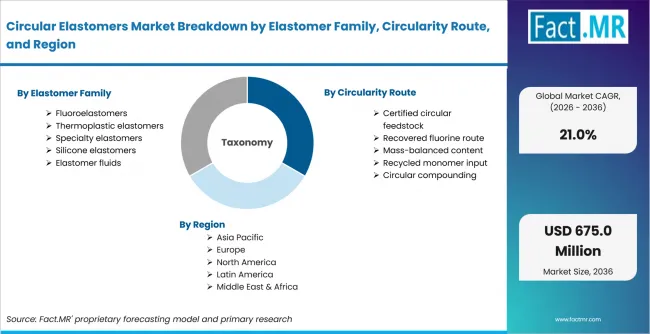
Circular Elastomers Market Breakdown By Elastomer Family, Circularity Route, And Region | Source: Fact.MR
| ATTRIBUTE | DETAILS |
|---|---|
| Quantitative Units | USD 100 million in 2026 to USD 675 million by 2036 at 21.0% CAGR |
| Market Definition | The market covers fluoroelastomers, thermoplastic elastomers, specialty elastomers, silicone elastomers, and elastomer fluids sold with a documented circular route based on certified circular feedstock, recovered fluorine, mass-balanced content, recycled monomer input, or circular compounding. |
| Elastomer Family | Fluoroelastomers; Thermoplastic elastomers; Specialty elastomers; Silicone elastomers; Elastomer fluids |
| Circularity Route | Certified circular feedstock; Recovered fluorine route; Mass-balanced content; Recycled monomer input; Circular compounding |
| Application | Seals and gaskets; Automotive systems; Semiconductor tools; Oil & gas equipment; Industrial maintenance |
| Performance Grade | High-temperature grade; Chemical-resistant grade; Low-compression set; Semiconductor purity; General industrial |
| Sales Route | Direct OEM supply; Compounder supply; Distributor sales; Seal manufacturer supply; MRO channel |
| Regions Covered | North America; Europe; Asia Pacific |
| Countries Covered | Germany; United States; Netherlands; Japan; South Korea (30+ countries reviewed in the full study) |
| Key Companies Profiled | Syensqo; Genan Holding A/S; Daikin; Freudenberg Sealing Technologies |
| Forecast Period | 2026 to 2036 |
| Approach | Sizing traces eligible circular feedstock and qualified compound output into sold elastomer grades, adjusting for recovery yield, allocation limits, application approval, sales route, and price premium. |
Source: Fact.MR analysis. Updated Jul 16, 2026
How is the market segmented?
-
By Elastomer Family
- Fluoroelastomers
- Thermoplastic elastomers
- Specialty elastomers
- Silicone elastomers
- Elastomer fluids
-
By Circularity Route
- Certified circular feedstock
- Recovered fluorine route
- Mass-balanced content
- Recycled monomer input
- Circular compounding
-
By Application
- Seals and gaskets
- Automotive systems
- Semiconductor tools
- Oil & gas equipment
- Industrial maintenance
-
By Performance Grade
- High-temperature grade
- Chemical-resistant grade
- Low-compression set
- Semiconductor purity
- General industrial
-
By Sales Route
- Direct OEM supply
- Compounder supply
- Distributor sales
- Seal manufacturer supply
- MRO channel
-
By Region
- North America
- United States
- Europe
- Germany
- Netherlands
- Asia Pacific
- Japan
- South Korea
Frequently Asked Questions
What is the Circular Elastomers Market forecast for 2036?
Which elastomer family leads?
Which circularity route is largest?
Which application has the highest share?
Which performance grade leads?
Which countries lead adoption?
Does circular elastomer always mean physically recycled rubber?
Why are thermoset elastomers difficult to recycle?
Who worked on this report


Preview the report firsthand - request a free sample
Free SampleGet the brochure for pricing and purchase details
Download PDF