Circular Phosphorus Recovery Granule Fertilizer Market
Circular Phosphorus Recovery Granule Fertilizer Market Size and Share Forecast Outlook 2026 to 2036
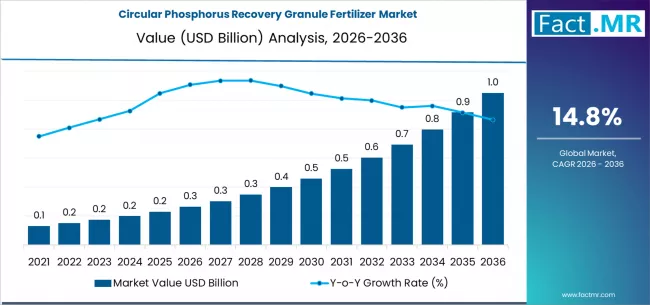
Circular phosphorus recovery granule fertilizer market is projected to grow from USD 0.3 billion in 2026 to USD 1.0 billion by 2036, at a CAGR of 14.8%. Animal Manure will dominate with a 42.6% market share, while anaerobic digestion will lead the technology segment with a 43.1% share.
Circular Phosphorus Recovery Granule Fertilizer Market Forecast and Outlook 2026 to 2036
The global market for circular phosphorus recovery granule fertilizer is poised for transformative growth, projected to increase from USD 0.26 billion in 2026 to USD 1.05 billion by 2036, achieving a robust CAGR of 14.8%.
Key Takeaways from the Circular Phosphorus Recovery Granule Fertilizer Market
- Market Value for 2026: USD 0.26 Billion
- Market Value for 2036: USD 1.05 Billion
- Forecast CAGR (2026-2036): 14.8%
- Leading Source Segment (2026): Animal Manure (43%)
- Leading Technology Segment (2026): Anaerobic Digestion (43%)
- Leading Sales Channel Segment (2026): Ag-Retailers (51%)
- Key Growth Countries: China (15.9% CAGR), Netherlands (15.3% CAGR), Germany (14.8% CAGR), USA (14.6% CAGR)
- Key Players in the Market: OCP, EuroChem Group A.G., The Mosaic Company, PhosAgro, Nutrien, ICL Group Ltd.

This market addresses one of the most critical resource challenges in modern agriculture, the unsustainable linear consumption of finite mineral phosphorus against a backdrop of widespread nutrient pollution. It represents a dedicated segment within the circular economy, focusing specifically on reclaiming, refining, and delivering phosphorus in a readily usable granular form.
Growth is propelled by the convergence of geopolitical supply risks associated with phosphate rock, increasingly stringent regulations limiting phosphorus discharge into waterways, and the agricultural sector’s need for efficient, predictable nutrient sources.
Granules produced from recovered phosphorus offer a direct, drop-in replacement for traditional phosphate fertilizers within existing farming practices, providing a practical pathway to close the phosphorus loop. These products transform waste liabilities into strategic assets, mitigating environmental harm while creating a domestic and renewable source of a critical agricultural input.
The market’s advancement hinges on scaling up recovery technologies to achieve cost parity with mined phosphates and ensuring the agronomic efficiency and safety of the resulting granules. Success will depend on creating integrated systems that efficiently capture phosphorus from diffuse waste streams and convert it into a standardized, trusted product for the world’s farmlands.
Metric
| Metric | Value |
|---|---|
| Market Value (2026) | USD 0.26 Billion |
| Market Forecast Value (2036) | USD 1.05 Billion |
| Forecast CAGR (2026-2036) | 14.8% |
Category
| Category | Segments |
|---|---|
| Source | Animal Manure, Food Waste, Wastewater Sludge, Crop Residue |
| Technology | Anaerobic Digestion, Pyrolysis, Chemical Precipitation, Composting |
| Sales Channel | Ag-Retailers, Direct-to-Farmer, Online Marketplaces, Cooperatives |
| Region | North America, Latin America, Western Europe, Eastern Europe, East Asia, South Asia & Pacific, Middle East & Africa |
Segmental Analysis
By Source, Which Stream Offers Reliable Phosphorus Concentration?
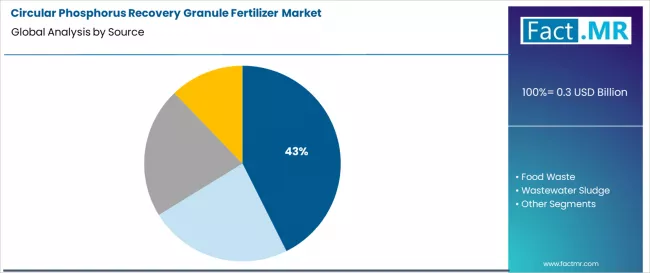
Animal manure leads the source segment with a 43% share. Its dominance is attributed to a relatively predictable and high phosphorus content, particularly from poultry and swine operations.
The concentrated nature of modern livestock farming creates point sources of manure rich in recoverable phosphorus, making it a logistically and economically viable primary feedstock for early recovery facilities aiming to produce consistent granule quality.
By Technology, Which Process is Most Prevalent in Early Deployment?
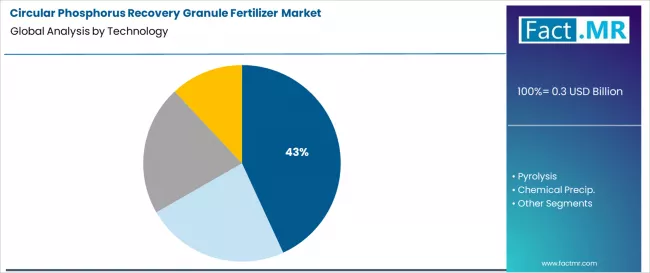
Anaerobic digestion holds a 43% share, frequently serving as the first step in a multi-technology recovery pathway. While anaerobic digestion itself is optimized for energy production, the resulting digestate contains solubilized phosphorus that is more readily extracted through subsequent chemical precipitation or stripping processes. Its role as a foundational, stabilizing pretreatment for wet organic wastes makes it integral to many phosphorus recovery value chains.
By Sales Channel, How are These Granules Integrated into Mainstream Agriculture?
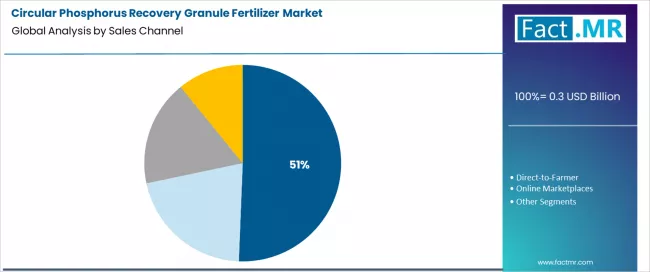
Ag-retailers are the primary channel, accounting for 51% of market sales. This highlights the product’s design compatibility with conventional farming. For recovered phosphorus granules to achieve significant displacement of mined phosphate fertilizers, they must flow through the established distribution networks farmers already use. Retailer endorsement and agronomic support are critical for building farmer confidence in the performance and reliability of these circular alternatives.
What are the Drivers, Restraints, and Key Trends of the Circular Phosphorus Recovery Granule Fertilizer Market?
The fundamental market driver is the strategic vulnerability created by geographic concentration of phosphate rock mining. This supply risk motivates governments and large agri-food companies to diversify sources.
Water quality regulations worldwide are mandating phosphorus removal from wastewater and manure effluent, creating a regulatory push that turns recovery from a cost into a potential revenue stream. The rising energy and carbon cost of processing and transporting mined phosphates further improves the relative economics of local recovery.
A principal restraint is the current higher production cost of recovered phosphorus granules compared to conventional fertilizers, except in regions with strict disposal mandates. The technical complexity of removing potential contaminants like heavy metals or emerging pollutants from some waste streams to meet fertilizer safety standards also presents a significant hurdle. Market education is required to overcome perceptions about product quality and efficacy compared to familiar mined products.
Key trends include the integration of recovery into water policy, where wastewater treatment plants are reimagined as phosphorus refineries. There is strong momentum toward standardization and certification of recovered phosphate products to ensure quality and build market trust. Technology hybridization is also prominent, combining processes like pyrolysis with chemical leaching to maximize phosphorus yield and value from diverse feedstocks.
Analysis of the Circular Phosphorus Recovery Granule Fertilizer Market by Key Countries
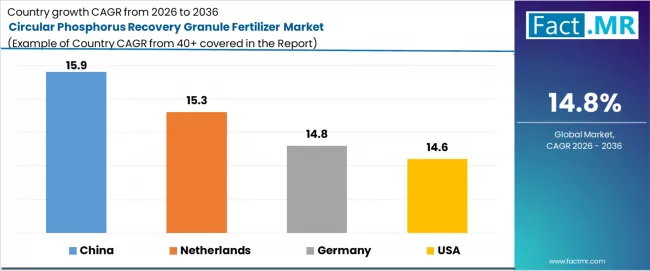
| Country | CAGR (2026-2036) |
|---|---|
| China | 15.9% |
| Netherlands | 15.3% |
| Germany | 14.8% |
| USA | 14.6% |
How is China's Scale and Policy Ambition Catalyzing Rapid Growth?
China’s leading CAGR of 15.9% stems from its massive scale in both waste generation and agricultural demand. The government’s Zero Waste city initiatives and Fertilizer Use Zero Growth policy create a powerful dual mandate.
China is investing heavily in advanced wastewater treatment with embedded phosphorus recovery to address eutrophication and to secure a domestic source of this critical nutrient, viewing it as a strategic imperative for food security.
Why are the Netherlands a Pioneer in Mandated Recovery?
The Netherlands' 15.3% growth is driven by the world’s most advanced and legally enforceable nutrient management system. Dutch law essentially mandates phosphorus recovery from manure surpluses and wastewater.
This regulatory certainty has spurred innovation and investment, making the country a living laboratory for technologies that produce high-purity, market-ready phosphate granules from waste, with a focus on protecting its vulnerable aquatic ecosystems.
What is Germany's Role in Engineering and Quality Assurance?
Germany’s 14.8% CAGR reflects its engineering excellence and rigorous standards. German companies are leaders in developing and exporting precise chemical precipitation and crystallization technologies.
The domestic market is characterized by a demand for high-quality recovered granules that meet strict limits on contaminants, ensuring their safe use on Germany’s productive farmland and setting a benchmark for product quality globally.
How is the USA's Regulatory and Agricultural Landscape Shaping Adoption?
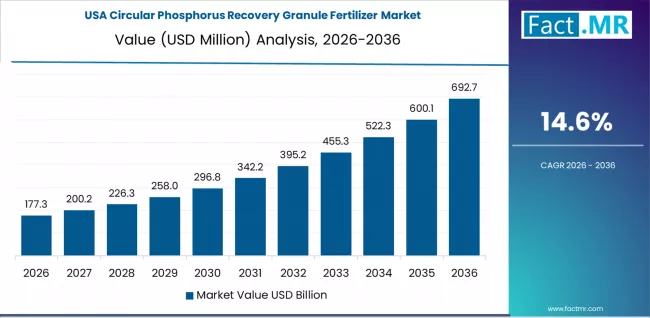
The USA’s 14.6% growth is evolving through a combination of state-level water quality regulations and corporate sustainability goals. Adoption is most advanced in regions with sensitive watersheds, such as the Great Lakes and Chesapeake Bay, where nutrient caps drive innovation.
Large fertilizer companies are also investing in recovery technologies to future-proof their supply chains and offer sustainable product lines to environmentally conscious large-scale growers.
Competitive Landscape of the Circular Phosphorus Recovery Granule Fertilizer Market
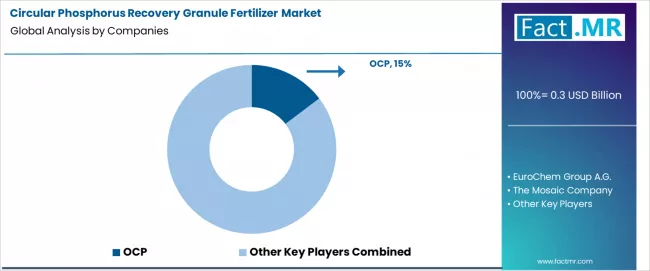
The competitive environment features a strategic mix of incumbent phosphate mining and fertilizer giants diversifying into circular sourcing and specialized technology firms offering proprietary recovery processes. Competition is intensifying around process efficiency, product purity, and the ability to secure long-term off-take agreements with municipalities and food processors for waste feedstock.
Strategic alliances are common, with technology providers partnering with waste handlers and fertilizer companies to deploy integrated solutions. Success requires navigating complex regulatory environments and proving the long-term agronomic value of recovered products through extensive field validation.
Key Players in the Circular Phosphorus Recovery Granule Fertilizer Market
- OCP
- EuroChem Group A.G.
- The Mosaic Company
- PhosAgro
- Nutrien
- ICL Group Ltd.
Scope of Report
| Items | Values |
|---|---|
| Quantitative Units | USD Billion |
| Source | Animal Manure, Food Waste, Wastewater Sludge, Crop Residue |
| Technology | Anaerobic Digestion, Pyrolysis, Chemical Precipitation, Composting |
| Sales Channel | Ag-Retailers, Direct-to-Farmer, Online Marketplaces, Cooperatives |
| Key Countries | Netherlands, Germany, China, USA |
| Key Companies | OCP, EuroChem Group A.G., The Mosaic Company, PhosAgro, Nutrien, ICL Group Ltd. |
| Additional Analysis | Agronomic phosphorus use efficiency comparison of recovered vs. mined granules; detailed analysis of contaminant removal technologies and thresholds; global phosphate rock supply risk assessment; economic models for municipal wastewater treatment plant retrofits; review of international and national standards for recycled phosphate fertilizers; lifecycle carbon footprint comparison of recovery pathways. |
Market by Segments
-
Source :
- Animal Manure
- Food Waste
- Wastewater Sludge
- Crop Residue
-
Technology :
- Anaerobic Digestion
- Pyrolysis
- Chemical Precipitation
- Composting
-
Sales Channel :
- Ag-Retailers
- Direct-to-Farmer
- Online Marketplaces
- Cooperatives
-
Region :
-
North America
- USA
- Canada
-
Latin America
- Brazil
- Mexico
- Argentina
- Rest of Latin America
-
Western Europe
- Germany
- UK
- France
- Spain
- Italy
- Netherlands
- BENELUX
- Rest of Western Europe
-
Eastern Europe
- Russia
- Poland
- Czech Republic
- Rest of Eastern Europe
-
East Asia
- China
- Japan
- South Korea
- Rest of East Asia
-
South Asia & Pacific
- India
- ASEAN
- Australia
- Rest of South Asia & Pacific
-
MEA
- Saudi Arabia
- UAE
- Turkiye
- Rest of MEA
-
Table of Content
- Executive Summary
- Global Market Outlook
- Demand to side Trends
- Supply to side Trends
- Technology Roadmap Analysis
- Analysis and Recommendations
- Market Overview
- Market Coverage / Taxonomy
- Market Definition / Scope / Limitations
- Market Background
- Market Dynamics
- Drivers
- Restraints
- Opportunity
- Trends
- Scenario Forecast
- Demand in Optimistic Scenario
- Demand in Likely Scenario
- Demand in Conservative Scenario
- Opportunity Map Analysis
- Product Life Cycle Analysis
- Supply Chain Analysis
- Investment Feasibility Matrix
- Value Chain Analysis
- PESTLE and Porter’s Analysis
- Regulatory Landscape
- Regional Parent Market Outlook
- Production and Consumption Statistics
- Import and Export Statistics
- Market Dynamics
- Global Market Analysis 2021 to 2025 and Forecast, 2026 to 2036
- Historical Market Size Value (USD Million) Analysis, 2021 to 2025
- Current and Future Market Size Value (USD Million) Projections, 2026 to 2036
- Y to o to Y Growth Trend Analysis
- Absolute $ Opportunity Analysis
- Global Market Pricing Analysis 2021 to 2025 and Forecast 2026 to 2036
- Global Market Analysis 2021 to 2025 and Forecast 2026 to 2036, By Source
- Introduction / Key Findings
- Historical Market Size Value (USD Million) Analysis By Source, 2021 to 2025
- Current and Future Market Size Value (USD Million) Analysis and Forecast By Source, 2026 to 2036
- Animal Manure
- Food Waste
- Wastewater Sludge
- Crop Residue
- Animal Manure
- Y to o to Y Growth Trend Analysis By Source, 2021 to 2025
- Absolute $ Opportunity Analysis By Source, 2026 to 2036
- Global Market Analysis 2021 to 2025 and Forecast 2026 to 2036, By Technology
- Introduction / Key Findings
- Historical Market Size Value (USD Million) Analysis By Technology, 2021 to 2025
- Current and Future Market Size Value (USD Million) Analysis and Forecast By Technology, 2026 to 2036
- Anaerobic Digestion
- Pyrolysis
- Chemical Precip.
- Composting
- Anaerobic Digestion
- Y to o to Y Growth Trend Analysis By Technology, 2021 to 2025
- Absolute $ Opportunity Analysis By Technology, 2026 to 2036
- Global Market Analysis 2021 to 2025 and Forecast 2026 to 2036, By Sales Channel
- Introduction / Key Findings
- Historical Market Size Value (USD Million) Analysis By Sales Channel, 2021 to 2025
- Current and Future Market Size Value (USD Million) Analysis and Forecast By Sales Channel, 2026 to 2036
- Ag-Retailers
- Direct-to-Farmer
- Online Marketplaces
- Cooperatives
- Ag-Retailers
- Y to o to Y Growth Trend Analysis By Sales Channel, 2021 to 2025
- Absolute $ Opportunity Analysis By Sales Channel, 2026 to 2036
- Global Market Analysis 2021 to 2025 and Forecast 2026 to 2036, By Region
- Introduction
- Historical Market Size Value (USD Million) Analysis By Region, 2021 to 2025
- Current Market Size Value (USD Million) Analysis and Forecast By Region, 2026 to 2036
- North America
- Latin America
- Western Europe
- Eastern Europe
- East Asia
- South Asia and Pacific
- Middle East & Africa
- Market Attractiveness Analysis By Region
- North America Market Analysis 2021 to 2025 and Forecast 2026 to 2036, By Country
- Historical Market Size Value (USD Million) Trend Analysis By Market Taxonomy, 2021 to 2025
- Market Size Value (USD Million) Forecast By Market Taxonomy, 2026 to 2036
- By Country
- USA
- Canada
- Mexico
- By Source
- By Technology
- By Sales Channel
- By Country
- Market Attractiveness Analysis
- By Country
- By Source
- By Technology
- By Sales Channel
- Key Takeaways
- Latin America Market Analysis 2021 to 2025 and Forecast 2026 to 2036, By Country
- Historical Market Size Value (USD Million) Trend Analysis By Market Taxonomy, 2021 to 2025
- Market Size Value (USD Million) Forecast By Market Taxonomy, 2026 to 2036
- By Country
- Brazil
- Chile
- Rest of Latin America
- By Source
- By Technology
- By Sales Channel
- By Country
- Market Attractiveness Analysis
- By Country
- By Source
- By Technology
- By Sales Channel
- Key Takeaways
- Western Europe Market Analysis 2021 to 2025 and Forecast 2026 to 2036, By Country
- Historical Market Size Value (USD Million) Trend Analysis By Market Taxonomy, 2021 to 2025
- Market Size Value (USD Million) Forecast By Market Taxonomy, 2026 to 2036
- By Country
- Germany
- UK
- Italy
- Spain
- France
- Nordic
- BENELUX
- Rest of Western Europe
- By Source
- By Technology
- By Sales Channel
- By Country
- Market Attractiveness Analysis
- By Country
- By Source
- By Technology
- By Sales Channel
- Key Takeaways
- Eastern Europe Market Analysis 2021 to 2025 and Forecast 2026 to 2036, By Country
- Historical Market Size Value (USD Million) Trend Analysis By Market Taxonomy, 2021 to 2025
- Market Size Value (USD Million) Forecast By Market Taxonomy, 2026 to 2036
- By Country
- Russia
- Poland
- Hungary
- Balkan & Baltic
- Rest of Eastern Europe
- By Source
- By Technology
- By Sales Channel
- By Country
- Market Attractiveness Analysis
- By Country
- By Source
- By Technology
- By Sales Channel
- Key Takeaways
- East Asia Market Analysis 2021 to 2025 and Forecast 2026 to 2036, By Country
- Historical Market Size Value (USD Million) Trend Analysis By Market Taxonomy, 2021 to 2025
- Market Size Value (USD Million) Forecast By Market Taxonomy, 2026 to 2036
- By Country
- China
- Japan
- South Korea
- By Source
- By Technology
- By Sales Channel
- By Country
- Market Attractiveness Analysis
- By Country
- By Source
- By Technology
- By Sales Channel
- Key Takeaways
- South Asia and Pacific Market Analysis 2021 to 2025 and Forecast 2026 to 2036, By Country
- Historical Market Size Value (USD Million) Trend Analysis By Market Taxonomy, 2021 to 2025
- Market Size Value (USD Million) Forecast By Market Taxonomy, 2026 to 2036
- By Country
- India
- ASEAN
- Australia & New Zealand
- Rest of South Asia and Pacific
- By Source
- By Technology
- By Sales Channel
- By Country
- Market Attractiveness Analysis
- By Country
- By Source
- By Technology
- By Sales Channel
- Key Takeaways
- Middle East & Africa Market Analysis 2021 to 2025 and Forecast 2026 to 2036, By Country
- Historical Market Size Value (USD Million) Trend Analysis By Market Taxonomy, 2021 to 2025
- Market Size Value (USD Million) Forecast By Market Taxonomy, 2026 to 2036
- By Country
- Kingdom of Saudi Arabia
- Other GCC Countries
- Turkiye
- South Africa
- Other African Union
- Rest of Middle East & Africa
- By Source
- By Technology
- By Sales Channel
- By Country
- Market Attractiveness Analysis
- By Country
- By Source
- By Technology
- By Sales Channel
- Key Takeaways
- Key Countries Market Analysis
- USA
- Pricing Analysis
- Market Share Analysis, 2025
- By Source
- By Technology
- By Sales Channel
- Canada
- Pricing Analysis
- Market Share Analysis, 2025
- By Source
- By Technology
- By Sales Channel
- Mexico
- Pricing Analysis
- Market Share Analysis, 2025
- By Source
- By Technology
- By Sales Channel
- Brazil
- Pricing Analysis
- Market Share Analysis, 2025
- By Source
- By Technology
- By Sales Channel
- Chile
- Pricing Analysis
- Market Share Analysis, 2025
- By Source
- By Technology
- By Sales Channel
- Germany
- Pricing Analysis
- Market Share Analysis, 2025
- By Source
- By Technology
- By Sales Channel
- UK
- Pricing Analysis
- Market Share Analysis, 2025
- By Source
- By Technology
- By Sales Channel
- Italy
- Pricing Analysis
- Market Share Analysis, 2025
- By Source
- By Technology
- By Sales Channel
- Spain
- Pricing Analysis
- Market Share Analysis, 2025
- By Source
- By Technology
- By Sales Channel
- France
- Pricing Analysis
- Market Share Analysis, 2025
- By Source
- By Technology
- By Sales Channel
- India
- Pricing Analysis
- Market Share Analysis, 2025
- By Source
- By Technology
- By Sales Channel
- ASEAN
- Pricing Analysis
- Market Share Analysis, 2025
- By Source
- By Technology
- By Sales Channel
- Australia & New Zealand
- Pricing Analysis
- Market Share Analysis, 2025
- By Source
- By Technology
- By Sales Channel
- China
- Pricing Analysis
- Market Share Analysis, 2025
- By Source
- By Technology
- By Sales Channel
- Japan
- Pricing Analysis
- Market Share Analysis, 2025
- By Source
- By Technology
- By Sales Channel
- South Korea
- Pricing Analysis
- Market Share Analysis, 2025
- By Source
- By Technology
- By Sales Channel
- Russia
- Pricing Analysis
- Market Share Analysis, 2025
- By Source
- By Technology
- By Sales Channel
- Poland
- Pricing Analysis
- Market Share Analysis, 2025
- By Source
- By Technology
- By Sales Channel
- Hungary
- Pricing Analysis
- Market Share Analysis, 2025
- By Source
- By Technology
- By Sales Channel
- Kingdom of Saudi Arabia
- Pricing Analysis
- Market Share Analysis, 2025
- By Source
- By Technology
- By Sales Channel
- Turkiye
- Pricing Analysis
- Market Share Analysis, 2025
- By Source
- By Technology
- By Sales Channel
- South Africa
- Pricing Analysis
- Market Share Analysis, 2025
- By Source
- By Technology
- By Sales Channel
- USA
- Market Structure Analysis
- Competition Dashboard
- Competition Benchmarking
- Market Share Analysis of Top Players
- By Regional
- By Source
- By Technology
- By Sales Channel
- Competition Analysis
- Competition Deep Dive
- OCP
- Overview
- Product Portfolio
- Profitability by Market Segments (Product/Age /Sales Channel/Region)
- Sales Footprint
- Strategy Overview
- Marketing Strategy
- Product Strategy
- Channel Strategy
- EuroChem Group A.G.
- The Mosaic Company
- PhosAgro
- Nutrien
- ICL Group Ltd.
- OCP
- Competition Deep Dive
- Assumptions & Acronyms Used
- Research Methodology
List Of Table
- Table 1: Global Market Value (USD Million) Forecast by Region, 2021 to 2036
- Table 2: Global Market Value (USD Million) Forecast by Source, 2021 to 2036
- Table 3: Global Market Value (USD Million) Forecast by Technology, 2021 to 2036
- Table 4: Global Market Value (USD Million) Forecast by Sales Channel, 2021 to 2036
- Table 5: North America Market Value (USD Million) Forecast by Country, 2021 to 2036
- Table 6: North America Market Value (USD Million) Forecast by Source, 2021 to 2036
- Table 7: North America Market Value (USD Million) Forecast by Technology, 2021 to 2036
- Table 8: North America Market Value (USD Million) Forecast by Sales Channel, 2021 to 2036
- Table 9: Latin America Market Value (USD Million) Forecast by Country, 2021 to 2036
- Table 10: Latin America Market Value (USD Million) Forecast by Source, 2021 to 2036
- Table 11: Latin America Market Value (USD Million) Forecast by Technology, 2021 to 2036
- Table 12: Latin America Market Value (USD Million) Forecast by Sales Channel, 2021 to 2036
- Table 13: Western Europe Market Value (USD Million) Forecast by Country, 2021 to 2036
- Table 14: Western Europe Market Value (USD Million) Forecast by Source, 2021 to 2036
- Table 15: Western Europe Market Value (USD Million) Forecast by Technology, 2021 to 2036
- Table 16: Western Europe Market Value (USD Million) Forecast by Sales Channel, 2021 to 2036
- Table 17: Eastern Europe Market Value (USD Million) Forecast by Country, 2021 to 2036
- Table 18: Eastern Europe Market Value (USD Million) Forecast by Source, 2021 to 2036
- Table 19: Eastern Europe Market Value (USD Million) Forecast by Technology, 2021 to 2036
- Table 20: Eastern Europe Market Value (USD Million) Forecast by Sales Channel, 2021 to 2036
- Table 21: East Asia Market Value (USD Million) Forecast by Country, 2021 to 2036
- Table 22: East Asia Market Value (USD Million) Forecast by Source, 2021 to 2036
- Table 23: East Asia Market Value (USD Million) Forecast by Technology, 2021 to 2036
- Table 24: East Asia Market Value (USD Million) Forecast by Sales Channel, 2021 to 2036
- Table 25: South Asia and Pacific Market Value (USD Million) Forecast by Country, 2021 to 2036
- Table 26: South Asia and Pacific Market Value (USD Million) Forecast by Source, 2021 to 2036
- Table 27: South Asia and Pacific Market Value (USD Million) Forecast by Technology, 2021 to 2036
- Table 28: South Asia and Pacific Market Value (USD Million) Forecast by Sales Channel, 2021 to 2036
- Table 29: Middle East & Africa Market Value (USD Million) Forecast by Country, 2021 to 2036
- Table 30: Middle East & Africa Market Value (USD Million) Forecast by Source, 2021 to 2036
- Table 31: Middle East & Africa Market Value (USD Million) Forecast by Technology, 2021 to 2036
- Table 32: Middle East & Africa Market Value (USD Million) Forecast by Sales Channel, 2021 to 2036
List Of Figures
- Figure 1: Global Market Pricing Analysis
- Figure 2: Global Market Value (USD Million) Forecast 2021 to 2036
- Figure 3: Global Market Value Share and BPS Analysis by Source, 2026 and 2036
- Figure 4: Global Market Y to o to Y Growth Comparison by Source, 2026 to 2036
- Figure 5: Global Market Attractiveness Analysis by Source
- Figure 6: Global Market Value Share and BPS Analysis by Technology, 2026 and 2036
- Figure 7: Global Market Y to o to Y Growth Comparison by Technology, 2026 to 2036
- Figure 8: Global Market Attractiveness Analysis by Technology
- Figure 9: Global Market Value Share and BPS Analysis by Sales Channel, 2026 and 2036
- Figure 10: Global Market Y to o to Y Growth Comparison by Sales Channel, 2026 to 2036
- Figure 11: Global Market Attractiveness Analysis by Sales Channel
- Figure 12: Global Market Value (USD Million) Share and BPS Analysis by Region, 2026 and 2036
- Figure 13: Global Market Y to o to Y Growth Comparison by Region, 2026 to 2036
- Figure 14: Global Market Attractiveness Analysis by Region
- Figure 15: North America Market Incremental Dollar Opportunity, 2026 to 2036
- Figure 16: Latin America Market Incremental Dollar Opportunity, 2026 to 2036
- Figure 17: Western Europe Market Incremental Dollar Opportunity, 2026 to 2036
- Figure 18: Eastern Europe Market Incremental Dollar Opportunity, 2026 to 2036
- Figure 19: East Asia Market Incremental Dollar Opportunity, 2026 to 2036
- Figure 20: South Asia and Pacific Market Incremental Dollar Opportunity, 2026 to 2036
- Figure 21: Middle East & Africa Market Incremental Dollar Opportunity, 2026 to 2036
- Figure 22: North America Market Value Share and BPS Analysis by Country, 2026 and 2036
- Figure 23: North America Market Value Share and BPS Analysis by Source, 2026 and 2036
- Figure 24: North America Market Y to o to Y Growth Comparison by Source, 2026 to 2036
- Figure 25: North America Market Attractiveness Analysis by Source
- Figure 26: North America Market Value Share and BPS Analysis by Technology, 2026 and 2036
- Figure 27: North America Market Y to o to Y Growth Comparison by Technology, 2026 to 2036
- Figure 28: North America Market Attractiveness Analysis by Technology
- Figure 29: North America Market Value Share and BPS Analysis by Sales Channel, 2026 and 2036
- Figure 30: North America Market Y to o to Y Growth Comparison by Sales Channel, 2026 to 2036
- Figure 31: North America Market Attractiveness Analysis by Sales Channel
- Figure 32: Latin America Market Value Share and BPS Analysis by Country, 2026 and 2036
- Figure 33: Latin America Market Value Share and BPS Analysis by Source, 2026 and 2036
- Figure 34: Latin America Market Y to o to Y Growth Comparison by Source, 2026 to 2036
- Figure 35: Latin America Market Attractiveness Analysis by Source
- Figure 36: Latin America Market Value Share and BPS Analysis by Technology, 2026 and 2036
- Figure 37: Latin America Market Y to o to Y Growth Comparison by Technology, 2026 to 2036
- Figure 38: Latin America Market Attractiveness Analysis by Technology
- Figure 39: Latin America Market Value Share and BPS Analysis by Sales Channel, 2026 and 2036
- Figure 40: Latin America Market Y to o to Y Growth Comparison by Sales Channel, 2026 to 2036
- Figure 41: Latin America Market Attractiveness Analysis by Sales Channel
- Figure 42: Western Europe Market Value Share and BPS Analysis by Country, 2026 and 2036
- Figure 43: Western Europe Market Value Share and BPS Analysis by Source, 2026 and 2036
- Figure 44: Western Europe Market Y to o to Y Growth Comparison by Source, 2026 to 2036
- Figure 45: Western Europe Market Attractiveness Analysis by Source
- Figure 46: Western Europe Market Value Share and BPS Analysis by Technology, 2026 and 2036
- Figure 47: Western Europe Market Y to o to Y Growth Comparison by Technology, 2026 to 2036
- Figure 48: Western Europe Market Attractiveness Analysis by Technology
- Figure 49: Western Europe Market Value Share and BPS Analysis by Sales Channel, 2026 and 2036
- Figure 50: Western Europe Market Y to o to Y Growth Comparison by Sales Channel, 2026 to 2036
- Figure 51: Western Europe Market Attractiveness Analysis by Sales Channel
- Figure 52: Eastern Europe Market Value Share and BPS Analysis by Country, 2026 and 2036
- Figure 53: Eastern Europe Market Value Share and BPS Analysis by Source, 2026 and 2036
- Figure 54: Eastern Europe Market Y to o to Y Growth Comparison by Source, 2026 to 2036
- Figure 55: Eastern Europe Market Attractiveness Analysis by Source
- Figure 56: Eastern Europe Market Value Share and BPS Analysis by Technology, 2026 and 2036
- Figure 57: Eastern Europe Market Y to o to Y Growth Comparison by Technology, 2026 to 2036
- Figure 58: Eastern Europe Market Attractiveness Analysis by Technology
- Figure 59: Eastern Europe Market Value Share and BPS Analysis by Sales Channel, 2026 and 2036
- Figure 60: Eastern Europe Market Y to o to Y Growth Comparison by Sales Channel, 2026 to 2036
- Figure 61: Eastern Europe Market Attractiveness Analysis by Sales Channel
- Figure 62: East Asia Market Value Share and BPS Analysis by Country, 2026 and 2036
- Figure 63: East Asia Market Value Share and BPS Analysis by Source, 2026 and 2036
- Figure 64: East Asia Market Y to o to Y Growth Comparison by Source, 2026 to 2036
- Figure 65: East Asia Market Attractiveness Analysis by Source
- Figure 66: East Asia Market Value Share and BPS Analysis by Technology, 2026 and 2036
- Figure 67: East Asia Market Y to o to Y Growth Comparison by Technology, 2026 to 2036
- Figure 68: East Asia Market Attractiveness Analysis by Technology
- Figure 69: East Asia Market Value Share and BPS Analysis by Sales Channel, 2026 and 2036
- Figure 70: East Asia Market Y to o to Y Growth Comparison by Sales Channel, 2026 to 2036
- Figure 71: East Asia Market Attractiveness Analysis by Sales Channel
- Figure 72: South Asia and Pacific Market Value Share and BPS Analysis by Country, 2026 and 2036
- Figure 73: South Asia and Pacific Market Value Share and BPS Analysis by Source, 2026 and 2036
- Figure 74: South Asia and Pacific Market Y to o to Y Growth Comparison by Source, 2026 to 2036
- Figure 75: South Asia and Pacific Market Attractiveness Analysis by Source
- Figure 76: South Asia and Pacific Market Value Share and BPS Analysis by Technology, 2026 and 2036
- Figure 77: South Asia and Pacific Market Y to o to Y Growth Comparison by Technology, 2026 to 2036
- Figure 78: South Asia and Pacific Market Attractiveness Analysis by Technology
- Figure 79: South Asia and Pacific Market Value Share and BPS Analysis by Sales Channel, 2026 and 2036
- Figure 80: South Asia and Pacific Market Y to o to Y Growth Comparison by Sales Channel, 2026 to 2036
- Figure 81: South Asia and Pacific Market Attractiveness Analysis by Sales Channel
- Figure 82: Middle East & Africa Market Value Share and BPS Analysis by Country, 2026 and 2036
- Figure 83: Middle East & Africa Market Value Share and BPS Analysis by Source, 2026 and 2036
- Figure 84: Middle East & Africa Market Y to o to Y Growth Comparison by Source, 2026 to 2036
- Figure 85: Middle East & Africa Market Attractiveness Analysis by Source
- Figure 86: Middle East & Africa Market Value Share and BPS Analysis by Technology, 2026 and 2036
- Figure 87: Middle East & Africa Market Y to o to Y Growth Comparison by Technology, 2026 to 2036
- Figure 88: Middle East & Africa Market Attractiveness Analysis by Technology
- Figure 89: Middle East & Africa Market Value Share and BPS Analysis by Sales Channel, 2026 and 2036
- Figure 90: Middle East & Africa Market Y to o to Y Growth Comparison by Sales Channel, 2026 to 2036
- Figure 91: Middle East & Africa Market Attractiveness Analysis by Sales Channel
- Figure 92: Global Market - Tier Structure Analysis
- Figure 93: Global Market - Company Share Analysis
- FAQs -
How big is the circular phosphorus recovery granule fertilizer market in 2026?
The global circular phosphorus recovery granule fertilizer market is estimated to be valued at USD 0.3 billion in 2026.
What will be the size of circular phosphorus recovery granule fertilizer market in 2036?
The market size for the circular phosphorus recovery granule fertilizer market is projected to reach USD 1.0 billion by 2036.
How much will be the circular phosphorus recovery granule fertilizer market growth between 2026 and 2036?
The circular phosphorus recovery granule fertilizer market is expected to grow at a 14.8% CAGR between 2026 and 2036.
What are the key product types in the circular phosphorus recovery granule fertilizer market?
The key product types in circular phosphorus recovery granule fertilizer market are animal manure, food waste, wastewater sludge and crop residue.
Which technology segment to contribute significant share in the circular phosphorus recovery granule fertilizer market in 2026?
In terms of technology, anaerobic digestion segment to command 43.1% share in the circular phosphorus recovery granule fertilizer market in 2026.