- Market Value (2025): USD 92.6 Bn
- Estimated Value (2026): USD 98.7 Bn
- Forecast Value (2036): USD 187.0 Bn
- CAGR (2026-2036): 6.6%
What is the Circular Plastics Market forecast to be worth by 2036?
USD 98.7 billion in 2026 to USD 187.0 billion by 2036 at a 6.6% CAGR.
- The Circular Plastics Market stood at USD 92.6 billion in 2025.
- Demand is projected to increase from USD 98.7 billion in 2026 to USD 187.0 billion by 2036.
- The market is forecast to expand at a 6.6% CAGR from 2026 to 2036.
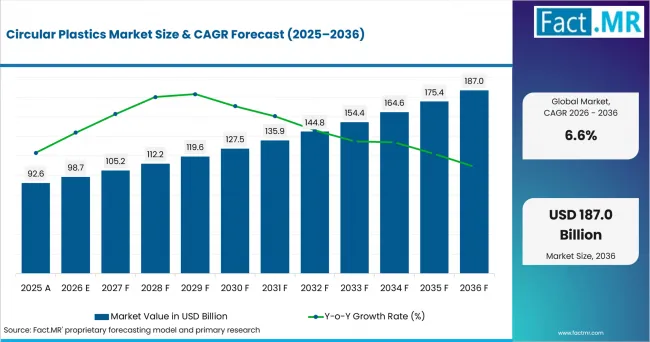
Circular Plastics Market Value Analysis | Source: Fact.MR
What are the defining numbers behind Circular Plastics Market growth?
An absolute opportunity of USD 88.3 billion is expected between 2026 and 2036.
- Demand Drivers in the Market
- Packaging rules are converting recycled-content policy into resin demand. Regulation (EU) 2025/40 establishes minimum post-consumer recycled-content requirements for several plastic packaging categories from 2030, so converters need qualified recycled material that can meet mechanical, visual and food-contact specifications.
- A wider recycled plastic value chain is developing around sorting, washing and reprocessing. OECD analysis shows that secondary plastics remain a minority of total polymer production, leaving room for more recovered feedstock to return to manufacturing when quality and price are competitive.
- Brazil is adding a direct recycled-content mechanism. Decree No. 12,688 of 2025 created a reverse-logistics system for plastic packaging and set a national recycled-content target of 22% for 2026, with higher requirements scheduled over time. This strengthens demand for recycled PE, PP and PET grades that can be traced into packaging applications.
- The UK Plastic Packaging Tax continues to favour packaging with verified recycled content. Packaging containing at least 30% recycled plastic is not chargeable, while businesses must retain evidence supporting recycled-content claims. This increases the commercial value of traceable resin supply and stable blend specifications.
- Food-contact and performance qualification create higher-value outlets for recycled resins. U.S. FDA guidance evaluates source control and decontamination for recycled plastics used in food packaging, encouraging investment in cleaner feedstock streams and better process control rather than volume recovery alone.
- Key Segments Analyzed
- Recycled Polyethylene (rPE) accounts for 63.8% of Product in 2026 because PE is widely used in films, bottles and industrial packaging and can be recovered through established mechanical recycling routes.
- Packaging Applications account for 41.6% of Application in 2026 as recycled-content requirements and brand specifications create recurring demand across rigid and flexible packaging.
- Packaging Manufacturers account for 72.4% of End Use in 2026 because converters directly purchase recycled resin and blends to meet product specifications and recycled-content targets.
- Mechanical Recycling Technology accounts for 54.7% of Technology in 2026 because sorted PE, PP and PET can be reprocessed through established washing, extrusion and pelletizing operations.
- Virgin-Recycled Blends account for 36.5% of Formulation in 2026 because blending lets manufacturers raise recycled content while maintaining process stability and selected performance properties.
- Direct Sales account for 68.1% of Distribution Channel in 2026 because large converters require specification control, traceability and recurring contracted supply from recyclers or resin producers.
- Analyst Opinion at Fact.MR
- Shambhu Nath Jha, Senior Consultant at Fact.MR, states, “Circular plastics purchasing is increasingly tied to grade consistency rather than recovered volume alone. Buyers need material that can run inside established conversion windows and carry evidence on recycled content. Suppliers that combine dependable feedstock access with formulation control and direct technical support are positioned to build repeat industrial demand through 2036.”
- Strategic Implications
- Recyclers should prioritize feedstock consistency before adding output capacity. Cleaner incoming streams improve yield and reduce the blending or additive burden needed to reach specification.
- Packaging suppliers should qualify recycled PE and other circular grades during package development because sealing, stiffness, colour and food-contact requirements can limit late-stage substitution.
- Blend suppliers should document virgin-to-recycled ratios and performance ranges at grade level. Buyers need repeatability across deliveries, particularly where recycled-content evidence supports tax or regulatory compliance.
- Direct-sales teams should combine commercial contracts with technical support on processing windows, contamination control and change management. This reduces qualification friction for high-volume converters.
How does the Circular Plastics Market break down by segment?
The market is segmented by Product, Application, End Use, Technology, Formulation and Distribution Channel.
Why does Recycled Polyethylene (rPE) lead Product?
Recycled Polyethylene (rPE) is projected to account for a 63.8% share in 2026.
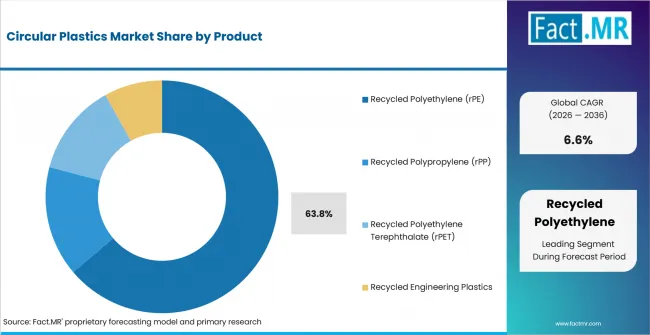
Circular Plastics Market Analysis By Product | Source: Fact.MR
rPE leads because polyethylene is used across flexible films, bottles, closures and industrial packaging, creating large post-consumer and post-industrial recovery streams. The availability of both LDPE and HDPE waste gives recyclers several routes into packaging and durable applications. The broader recycled resins market benefits when sorting and reprocessing can turn these streams into stable pellet grades.
The main operational constraint is contamination and mixed-film quality. Recyclers that can separate PE streams, control odour and blend batches to a repeatable melt-flow range are better positioned to serve packaging manufacturers that cannot tolerate large processing variation.
Why do Packaging Applications lead Application?
Packaging Applications are projected to account for a 41.6% share in 2026.
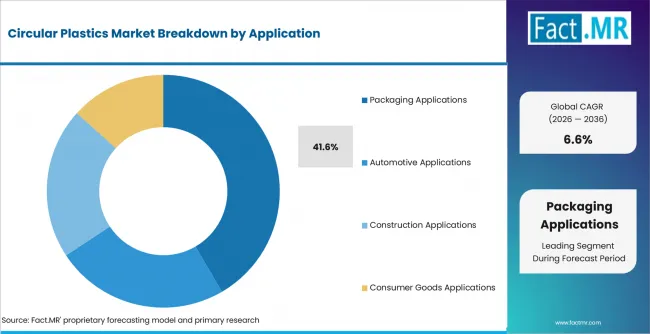
Circular Plastics Market Analysis By Application | Source: Fact.MR
Packaging leads because it uses large resin volumes and is increasingly subject to recycled-content requirements. Rigid bottles and containers can absorb recycled HDPE or PET where purity is sufficient, while flexible structures create demand for recycled PE grades that can meet sealing and mechanical requirements.
Brazil's 2025 plastic-packaging reverse-logistics decree and the EU packaging regulation both create direct reasons for packaging producers to specify recycled content. This turns circular resin procurement into a recurring bill-of-material decision rather than a discretionary sustainability purchase.
Why do Packaging Manufacturers lead End Use?
Packaging Manufacturers are projected to account for a 72.4% share in 2026.
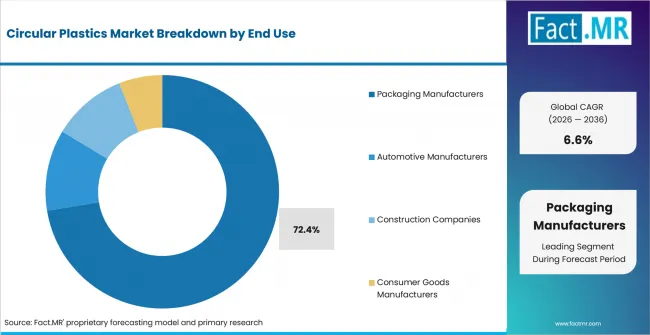
Circular Plastics Market Analysis By End Use | Source: Fact.MR
Packaging manufacturers lead because they convert recycled resin into bottles, films, trays and industrial packs and must balance recycled-content targets against processing and finished-pack requirements. They therefore purchase material at scale and qualify resin by melt behaviour, colour, odour and contamination level.
The UK tax framework illustrates the buyer mechanism. Packaging with at least 30% recycled plastic is not chargeable under Plastic Packaging Tax, provided the content can be evidenced. This gives converters a commercial reason to secure traceable recycled resin through repeat supplier relationships.
Why does Mechanical Recycling Technology lead Technology?
Mechanical Recycling Technology is projected to account for a 54.7% share in 2026.
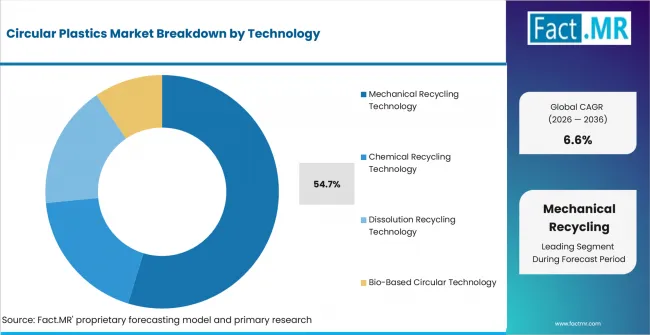
Circular Plastics Market Analysis By Technology | Source: Fact.MR
Mechanical recycling leads because sorted thermoplastics can be washed, shredded, melted and pelletized without first breaking the polymer into basic chemical feedstock. The installed process base supports repeated recovery of PE, PP and PET where incoming material is sufficiently controlled. This same workflow underpins mechanical recycling systems used for higher-purity packaging applications.
Chemical and dissolution routes remain useful for selected difficult streams, but mechanical processing retains the larger share because it can return sorted material to market with fewer conversion stages and is already integrated into packaging-recovery infrastructure.
Why do Virgin-Recycled Blends lead Formulation?
Virgin-Recycled Blends are projected to account for a 36.5% share in 2026.
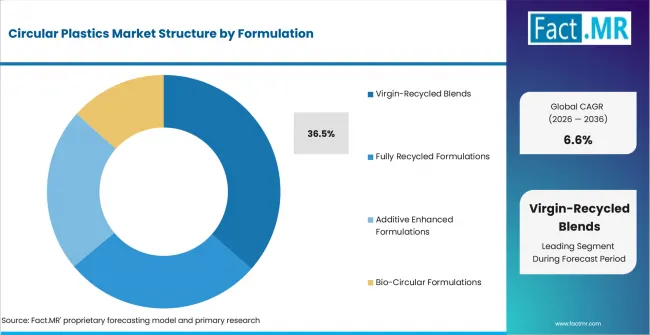
Circular Plastics Market Analysis By Formulation | Source: Fact.MR
Virgin-recycled blends lead because many manufacturers want to increase recycled content without taking the full variability of a 100% recycled formulation. Blending gives processors a way to manage melt strength, colour and mechanical performance while meeting a defined recycled-content target.
The approach is especially relevant to PE and PP applications, where a recycled polyolefin grade may be combined with virgin resin or additives to achieve a processing window acceptable to the converter. As recycled-content thresholds rise, suppliers that can document blend composition and maintain batch consistency gain an advantage.
Why does Direct Sales lead Distribution Channel?
Direct Sales are projected to account for a 68.1% share in 2026.
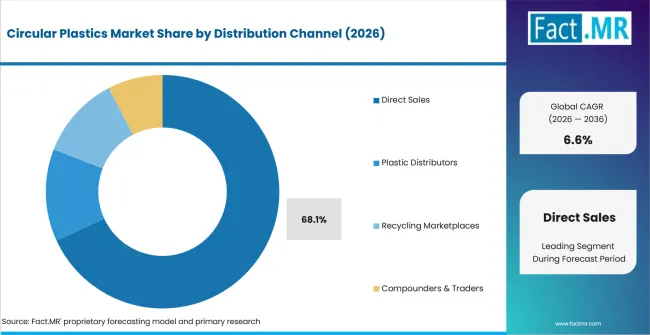
Circular Plastics Market Analysis By Distribution Channel | Source: Fact.MR
Direct sales lead because high-volume recycled-resin purchases usually require specification approval and recurring quality documentation. Packaging manufacturers and other industrial buyers need clear control over grade changes, recycled-content evidence and supply continuity before the material is accepted into routine production.
Direct supply also allows recycler and buyer to coordinate contracted volumes around feedstock availability. Distributors and marketplaces remain useful for smaller lots, but direct contracts are better suited to repeat industrial consumption where process variation can create scrap or line downtime.
What is accelerating Circular Plastics Market adoption, and what is holding it back?
Adoption is being accelerated by recycled-content requirements, reverse-logistics systems and industrial qualification of recycled PE, PP and PET. Growth is moderated by contamination, virgin-resin price competition and the need to keep recycled formulations within application-specific processing limits.
Drivers Impact Analysis
| Factor | (~) % Impact on CAGR | Geographic Relevance | Impact Timeline |
|---|---|---|---|
| Packaging recycled-content requirements | +1.5% | Europe; Brazil; UK | Short term (<= 2 years) |
| Mechanical recycling capacity and feedstock recovery | +1.2% | Global | Medium term (2-4 years) |
| Packaging-manufacturer qualification of recycled grades | +0.9% | Global | Medium term (2-4 years) |
| Traceability and recycled-content verification | +0.6% | Europe; UK; Brazil | Long term (>= 4 years) |
Opportunity Impact Analysis
Opportunity is strongest where recyclers can improve rPE and rPP quality, expand food-grade or packaging-grade output and use chemical recycling selectively for streams that cannot be recovered to useful quality through conventional processing.
| Factor | (~) % Impact on CAGR | Geographic Relevance | Impact Timeline |
|---|---|---|---|
| Higher-quality rPE for rigid and flexible packaging | +0.8% | Global | Medium term (2-4 years) |
| Brazilian recycled-content and reverse-logistics expansion | +0.7% | Brazil | Medium term (2-4 years) |
| Food-contact and traceable recycled resin | +0.5% | USA; Europe; UK | Long term (>= 4 years) |
| Advanced recycling for difficult feedstocks | +0.4% | Global | Long term (>= 4 years) |
Restraints Impact Analysis
| Factor | (~) % Impact on CAGR | Geographic Relevance | Impact Timeline |
|---|---|---|---|
| Feedstock contamination and inconsistent quality | -0.8% | Global | Short term (<= 2 years) |
| Virgin-resin price competition | -0.7% | Global | Short term (<= 2 years) |
| Property loss after repeated processing | -0.5% | Global | Medium term (2-4 years) |
| Certification and traceability burden | -0.4% | Europe; UK; Brazil | Medium term (2-4 years) |
Which countries are scaling the Circular Plastics Market through 2036?
- Germany: More than 70% of plastic packaging was sent for material recycling in 2024 according to the German Environment Agency and the Central Agency Packaging Register. This collection and sorting base supports mechanical recyclers supplying packaging manufacturers with rPE, rPP and rPET.
- Brazil: Decree No. 12,688 of 2025 established reverse logistics for plastic packaging and set national recycled-content targets beginning at 22% in 2026. The framework creates direct demand for traceable recycled resin and expands the value of domestic recovery and reprocessing.
- USA: Food-contact qualification supports higher-value recycled resin where processors can demonstrate source control and decontamination. FDA guidance gives recyclers a pathway to support packaging applications rather than limiting recovered plastic to lower-specification outlets.
- UK: Plastic Packaging Tax exempts plastic packaging with at least 30% recycled content from the tax charge, while recordkeeping remains mandatory. This creates a recurring procurement incentive for verified recycled material.
- Japan: The Fifth Fundamental Plan for Establishing a Sound Material-Cycle Society and the subsequent circular-economy acceleration package encourage closer cooperation between manufacturers and recycling businesses so recovered materials can meet required quality and quantity.
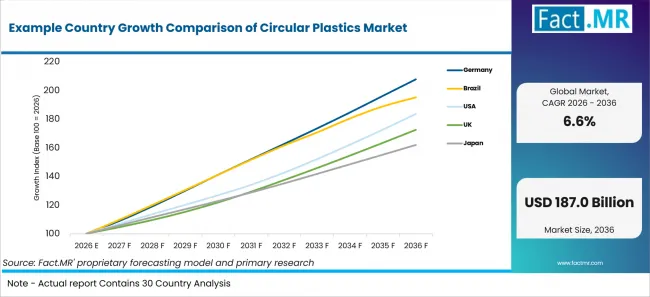
Example Country Growth Comparison Of Circular Plastics Market | Source: Fact.MR
Country CAGR (2026-2036)
| Country | CAGR, 2026-2036 |
|---|---|
| Germany | 7.6% |
| Brazil | 6.9% |
| USA | 6.3% |
| UK | 5.6% |
| Japan | 5.0% |
What is driving Germany’s growth through 2036?
Germany is forecast to expand at a 7.6% CAGR from 2026 to 2036.
Germany's established packaging collection and sorting system provides feedstock to mechanical recyclers at industrial scale. UBA and ZSVR reported that more than 70% of plastic packaging was sent for material recycling in 2024, creating a strong physical base for recycled PE, PP and PET production.
The commercial opportunity depends on converting collected material into repeatable grades. Packaging manufacturers need recyclate that can meet processing and product requirements under the EU packaging framework, so sorting quality and reprocessing control remain central to growth.
What is driving Brazil’s growth through 2036?
Brazil is forecast to expand at a 6.9% CAGR from 2026 to 2036.
Brazil's 2025 decree on plastic-packaging reverse logistics creates a direct market mechanism for circular resin. It requires large companies to begin meeting minimum recycled-content targets from January 2026 and establishes national recovery goals for plastic packaging.
This shifts demand toward domestic collection, traceability and reprocessing capacity. Packaging producers need recycled PE and other grades that can be incorporated consistently while the recovery system channels more post-consumer material back toward industrial users.
What is driving USA’s growth through 2036?
The USA is forecast to expand at a 6.3% CAGR from 2026 to 2036.
U.S. growth is supported by demand for higher-quality recycled material in packaging. FDA guidance on recycled plastics for food packaging focuses on source control, contaminant removal and process suitability, creating a premium outlet for recyclers that can meet tighter qualification requirements.
Industrial demand also extends beyond food contact. Recycled PE can move into packaging and durable products when suppliers maintain stable properties and provide material documentation required by large converters.
What is driving the UK’s growth through 2036?
The UK is forecast to expand at a 5.6% CAGR from 2026 to 2036.
Plastic Packaging Tax gives manufacturers and importers a direct economic reason to use recycled resin. Finished plastic packaging components containing at least 30% recycled plastic are not chargeable, provided businesses can substantiate the recycled content.
The evidence requirement increases the value of direct supply relationships and documented formulations. Recyclers that can provide consistent grades and chain-of-custody records are better positioned to serve packaging manufacturers making repeated tax-sensitive purchases.
What is driving Japan’s growth through 2036?
Japan is forecast to expand at a 5.0% CAGR from 2026 to 2036.
Japan's national circular-economy policy emphasizes closer coordination between manufacturing and recycling businesses. The Fifth Fundamental Plan adopted in 2024 and the subsequent acceleration package frame recovered resources as industrial inputs that need predictable quality and availability.
This supports investment in sorting and material preparation alongside longer-term supply arrangements. Recycled resin demand is therefore tied to the ability of processors to meet manufacturer specifications rather than collection volume alone.
Who Leads the Circular Plastics Market?
Veolia Environnement S.A. leads the Circular Plastics Market.
Veolia competes through an integrated plastics-recycling model that spans collection, sorting, washing, formulation and extrusion into ready-to-use circular polymers under its PlastiLoop offering. Its 2025 UK investment in closed-loop PET recycling also illustrates how the company links recovered feedstock with packaging-grade output.
SUEZ supplies recycled plastics including PET and LDPE for industrial applications. Indorama Ventures, Plastipak, Loop Industries, LyondellBasell and ALPLA compete through combinations of recycling capacity, polymer processing and customer qualification across PET, HDPE and other circular materials.
Borealis AG combined with Borouge and NOVA Chemicals in March 2026 to form Borouge International. Current operations associated with Borealis therefore sit within the combined company.
MBA Polymers, Trex Company, PreZero and Avangard Innovative add different positions across recycled engineering plastics, polyethylene recovery and resource management. Supplier selection depends on feedstock access, grade consistency, traceability and the ability to support application qualification.
Which companies are the key providers?
Key companies profiled include Veolia Environnement S.A.; SUEZ Group; Borealis AG; Indorama Ventures Public Company Limited; Plastipak Holdings, Inc.; Loop Industries, Inc.; LyondellBasell Industries N.V.; ALPLA Group; MBA Polymers, Inc.; Trex Company, Inc.; PreZero International GmbH; and Avangard Innovative LP.
- Veolia Environnement S.A.
- SUEZ Group
- Borealis AG
- Indorama Ventures Public Company Limited
- Plastipak Holdings, Inc.
- Loop Industries, Inc.
- LyondellBasell Industries N.V.
- ALPLA Group
- MBA Polymers, Inc.
- Trex Company, Inc.
- PreZero International GmbH
- Avangard Innovative LP
Bibliography
- OECD. (2022). Global Plastics Outlook: Economic Drivers, Environmental Impacts and Policy Options. OECD Publishing.
- European Parliament and Council of the European Union. (2025). Regulation (EU) 2025/40 on Packaging and Packaging Waste. Official Journal of the European Union.
- Presidency of the Republic of Brazil. (2025). Decree No. 12,688 of 21 October 2025: Reverse Logistics System for Plastic Packaging. Government of Brazil.
- U.S. Food and Drug Administration. (2021). Use of Recycled Plastics in Food Packaging: Chemistry Considerations. U.S. Department of Health and Human Services.
- HM Revenue & Customs. (2026). Plastic Packaging Tax. Government of the United Kingdom.
- German Environment Agency and Central Agency Packaging Register. (2026). Facts Against Myths: Packaging Waste Recycling in Germany Is Working. Federal Republic of Germany.
- Ministry of the Environment, Japan. (2025). Annual Report on the Environment in Japan 2025. Government of Japan.
- Veolia. (2025). Veolia to Build UK's First Closed-Loop Recycling Facility as Part of Plastic Recycling Investment. Veolia.
- Veolia. (2026). Plastics Recycling and PlastiLoop Circular Polymers. Veolia.
- SUEZ. (2026). Recycled Plastics for Industry. SUEZ.
- ALPLA. (2026). Global Recycling Day 2026: ALPLA Milestones. ALPLA Group.
- ALPLA. (2025). ALPLA Launches HDPE Recycling in Brazil. ALPLA Group.
- Borealis. (2026). Borealis Is Now Borouge International. Borealis / Borouge International.
- Trex Company, Inc. (2026). Turning Waste Into What's Next. Trex Company.
This Report Answers
- How recycled polyethylene, polypropylene, PET and engineering plastics differ within circular polymer demand.
- Why packaging applications and packaging manufacturers account for important commercial demand.
- How mechanical, chemical, dissolution and bio-based recycling routes differ in feedstock and output requirements.
- How recycled-content rules and reverse-logistics systems shape purchasing across Germany, Brazil, the USA, the UK and Japan.
- Why formulation consistency, traceability and direct supplier relationships matter in recycled-resin qualification.
- How supplier capabilities differ across collection, reprocessing, polymer production and application support.
What does the Circular Plastics Market cover?
The Circular Plastics Market covers recycled and circular plastic materials sold for productive reuse across Product, Application, End Use, Technology, Formulation and Distribution Channel. Counted revenue includes recycled PE, PP, PET, engineering plastics and the covered formulations when sold as material inputs to manufacturing.
The market follows the commercial material after recovery and processing. It does not count the full value of the finished package, vehicle component, construction product or consumer good made from that resin.
What is included in the scope?
Included products are Recycled Polyethylene (rPE), Recycled Polypropylene (rPP), Recycled Polyethylene Terephthalate (rPET) and Recycled Engineering Plastics together with the included subsegments.
Applications cover packaging, automotive, construction and consumer goods. End users include packaging manufacturers, automotive manufacturers, construction companies and consumer goods manufacturers. Technology coverage follows mechanical, chemical, dissolution and bio-based circular routes. Formulation coverage includes virgin-recycled blends, fully recycled formulations, additive-enhanced formulations and bio-circular formulations. Sales through direct supply, distributors, recycling marketplaces and compounders or traders are included.
What is excluded from the scope?
Waste collection and municipal hauling are excluded when the transaction does not result in the commercial sale of a covered recycled or circular plastic material. Recycling machinery and plant engineering are also excluded as standalone equipment or service revenue.
Virgin resin sold without recycled or circular attribution is outside the market. Finished packaging, automotive parts, building products and consumer goods are excluded where their value cannot be separated from the covered polymer material. Energy recovery and incineration are not counted as circular plastic sales.
How Was the Analysis Built?
The analysis combines primary research with desk research to evaluate circular-plastic demand by polymer type, application, buyer group and country.
- Primary Research:
- Interviews focus on recyclers, resin producers, compounders, packaging manufacturers, automotive material buyers, construction-material suppliers, consumer-goods manufacturers, distributors and compliance specialists. Discussions examine feedstock quality, grade qualification, formulation requirements and supply contracts.
- Desk Research:
- Desk research uses plastics and packaging regulation, national recycling statistics, food-contact guidance, reverse-logistics rules and current company disclosures. These sources are used to explain demand mechanisms and competitive capability.
- Market Sizing and Forecasting:
- Sizing variables include recycled-resin tonnage, realized material value, polymer mix, recycling route, formulation mix, application demand and distribution structure. Country forecasts consider recovery systems, recycled-content requirements and local manufacturing demand.
- Data Validation and Update Cycle:
- Findings are cross-checked against current recycling policy, packaging requirements, supplier activity and material-use evidence. Updates review changes in feedstock availability, resin pricing, processing capacity and corporate ownership.