- Market Value (2025): USD 2.5 Bn
- Estimated Value (2026): USD 2.7 Bn
- Forecast Value (2036): USD 7.2 Bn
- CAGR (2026-2036): 10.3%
What is the circular polyester building blocks market forecast to be worth by 2036?
USD 2.7 billion in 2026 to USD 7.2 billion by 2036 at a 10.3% CAGR.
- The circular polyester building blocks market reached USD 2.5 billion in 2025.
- As per Fact.MR analysis, demand is forecast to increase from USD 2.7 billion in 2026 to USD 7.2 billion by 2036.
- The market is forecast to record a 10.3% CAGR from 2026 to 2036. Resin makers and firms are forecast to use more reused resin feedstock.
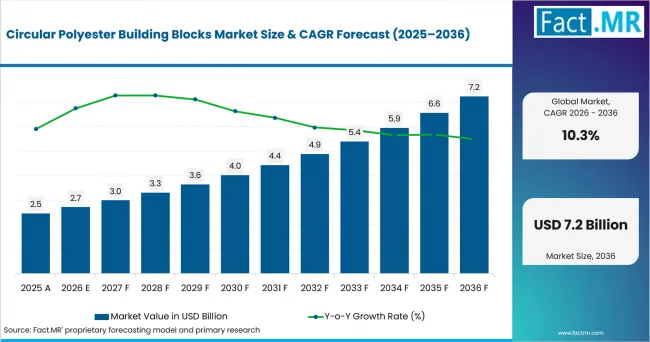
Circular Polyester Building Blocks Market Value Analysis | Source: Fact.MR
What are the main market growth numbers?
USD 4.5 billion absolute growth option is expected between 2026 and 2036.
- Demand Drivers in the Market
- PET resin makers need reused terephthalate and glycol that can be used again to make resin while keeping the required quality.
- Packaging makers need reused materials that can be tracked, as recycled-content rules increase the value of reused raw materials. HM Revenue & Customs reported in August 2026 that 37% of plastic packaging tonnage was declared taxable. Of the remaining 63%, 51% met the 30% or higher recycled-plastic level [1].
- Car and building material manufacturers use these resin inputs in resins and polyols, which creates demand above packaging.
- Key Segments Analyzed
- By Building Block: Recycled PTA is expected to hold a 38.0% share in 2026 because it is used to make PET resin.
- By Recovery Route: Glycolysis accounts for 34.0% share in 2026 as it produces BHET that can be reused.
- By Polyester: PET is expected to hold a 31.0% share in 2026 since it is widely used in packaging and textiles.
- By End Market: Packaging leads with 37.0% share in 2026 as reused-content rules increase the use of recycled materials that can be tracked.
- Analyst Opinion at Fact.MR
- Shambhu Nath Jha, Principal Consultant at Fact.MR, states, “Market growth depends on reused PTA, BHET, and oligomers resin quality needs. Buyers are choosing suppliers that provide clean and consistent materials with clear records.”
- Strategic Implications
- Resin makers can use different reuse methods instead of depending on one waste source.
- Packaging companies need clear records of reused materials to meet reused-content rules. The UK Department for Environment, Food & Rural Affairs reported in September 2026 that 1.207 million tonnes of plastic packaging were recycled in 2025 [2].
- Textile manufacturers need to check the color and flow of reused materials because textile differ from bottle-grade PET.
Japan is expected to grow at 10.6% CAGR through 2036, followed by the USA at 10.3%, the UK anticipated to grow at 10.0% CAGR, while Germany at 9.7% CAGR, and France is expected to lead at 9.4% CAGR.
How does the market break down by segment?
Reused PTA leads Building Block at 38.0%; Packs leads End Market at 37.0%.
Which Building Block leads?
Reused PTA is forecast to hold 38.0% share in 2026.
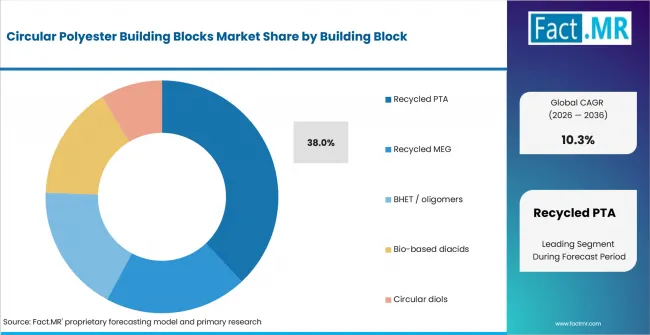
Circular Polyester Building Blocks Market Analysis By Building Block | Source: Fact.MR
Reused PTA can be used in existing PET production. Reused MEG supplies glycol, while BHET and oligomers can be used to make PET again. Bio-based diacids and reused diols are used for specific products. Buyers check material quality, supply, and use in existing PET production.
What leads the Recovery Route segment?
Glycolysis is forecast to account for 34.0% share in 2026.
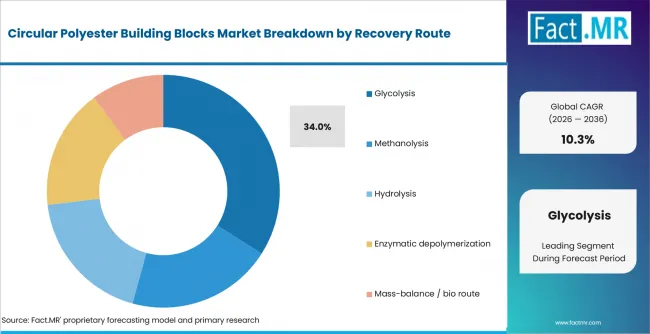
Circular Polyester Building Blocks Market Analysis By Recovery Route | Source: Fact.MR
Glycolysis converts PET waste into BHET for reuse. The methanolysis produces DMT and glycol and the hydrolysis produces terephthalic acid. Some PET waste can also be degraded by enzymes. Other material sources are provided by mass-balance and bio-based methods. Plants compare output, cleaning, energy use and quality of material. Methods are picked.
How does Polyester shape demand?
PET is forecast to capture 31.0% share in 2026.
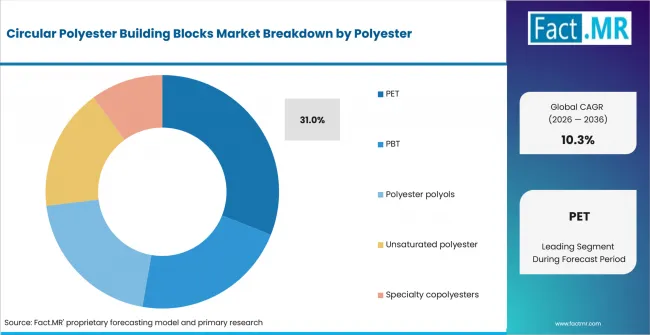
Circular Polyester Building Blocks Market Analysis By Polyester | Source: Fact.MR
PET is expected to lead because packaging and textiles create large amounts of reusable waste. PBT is used in engineering products, while polyols and unsaturated resin are used in coatings and composites. Material choice depends on the type and quality of resin needed. Reused materials also need to work well in existing production lines.
What supports Packaging within End Market?
Packs is forecast to make up 37.0% share in 2026.
Packaging produces large amounts of PET waste and has specifications for reused content. Textiles also produce PET waste, but require more sorting. Materials reused for cars, buildings and electronics products must meet quality needs. Packaging remains the largest use area, while other industries also use these materials.
What is driving market use, and what is holding it back?
Demand for reused materials increases growth, while limited waste supply and cleaning needs can slow growth.
Drivers Impact Analysis
| DRIVER | (~) % IMPACT ON CAGR | GEOGRAPHIC RELEVANCE | IMPACT TIMELINE |
|---|---|---|---|
| Recycled-content rules | +1.6% | Europe, North America | Short term (<= 2 years) |
| Hard-to-recycle polyester feedstock | +1.2% | Global | Medium term (2-4 years) |
| Textile circularity programs | +1.0% | Europe, East Asia | Medium term (2-4 years) |
| Commercial depolymerization capacity | +0.8% | North America, Europe, Asia | Long term (>= 4 years) |
| Traceable circular inputs | +0.6% | Global | Long term (>= 4 years) |
Source: Fact.MR analysis. Updated Oct 3, 2026
Opportunity Impact Analysis
| OPPORTUNITY | (~) % IMPACT ON CAGR | GEOGRAPHIC RELEVANCE | IMPACT TIMELINE |
|---|---|---|---|
| Textile-to-textile recovery | +1.1% | Europe, East Asia | Medium term (2-4 years) |
| Specialty DMT and glycol uses | +0.8% | Global | Medium term (2-4 years) |
| Automotive polyester systems | +0.6% | North America, Europe, Japan | Long term (>= 4 years) |
| Bio and mass-balance inputs | +0.5% | Europe, Asia | Long term (>= 4 years) |
Source: Fact.MR analysis. Updated Oct 3, 2026
Restraints Impact Analysis
| RESTRAINT | (~) % IMPACT ON CAGR | GEOGRAPHIC RELEVANCE | IMPACT TIMELINE |
|---|---|---|---|
| Feedstock contamination | -0.8% | Global | Short term (<= 2 years) |
| Purification cost | -0.6% | Global | Medium term (2-4 years) |
| Application qualification | -0.5% | Europe, North America, Japan | Medium term (2-4 years) |
| Project financing | -0.4% | Global | Long term (>= 4 years) |
Source: Fact.MR analysis. Updated Oct 3, 2026
Which countries are growing fastest through 2036?
- The country comparison spans 1.2 points and shows a closely grouped growth profile across the forecast period.
- Japan remains 0.3 point above the United States. PET reuse and resin output support wider base input reuse.
- The United States remains 0.3 point above the United Kingdom. Resin output and reused-input investment support more large-scale reuse routes.
- The United Kingdom remains 0.3 point above Germany. Packs rules increase demand for tracked reused inputs.
- Germany remains 0.3 point above France. Mature pickup systems support feedstock availability for resin reuse.
Comparable CAGRs can produce different entry conditions because pickup systems and resin demand vary by country. Power costs and sign-off rules differ as well. Full coverage includes North America, Latin America, Western Europe, Eastern Europe, East Asia, South Asia & Pacific, Middle East & Africa.
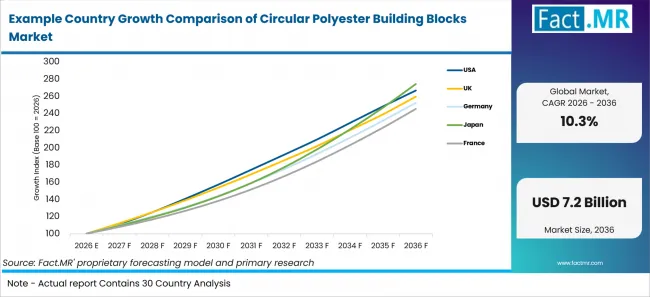
Example Country Growth Comparison Of Circular Polyester Building Blocks Market | Source: Fact.MR
| Country | CAGR (2026-2036) |
|---|---|
| Japan | 10.6% |
| United States | 10.3% |
| United Kingdom | 10.0% |
| Germany | 9.7% |
| France | 9.4% |
Source: Fact.MR analysis. Updated Oct 3, 2026
How is Japan developing demand?
10.6% CAGR through 2036, supported by resin reuse and waste processing.
Japan will grow at 10.6% CAGR through 2036 as more resin is reused. In March 2026, the Ministry of the Environment announced the statistics that 38.11 million tons of municipal waste was generated in FY2024 [3]. This waste can be used for more sorting and resin reuse.
What supports USA use?
USA anticipated to lead 10.3% CAGR, led by resin production and reused materials.
The USA is expected to grow at 10.3% CAGR through 2036 as resin makers use more reused materials. Federal Reserve data updated in February 2026 show that the annual industrial production index for U.S. plastics material and resin manufacturing reached 102.3852 in 2025, with 2017 equal to 100 [4]. This resin production increases the use of reused PTA, MEG, DMT, and other materials.
What supports the United Kingdom’s growth?
10.0% CAGR by 2036, driven by manufacturing and packaging reuse.
The UK is expected to grow at 10.0% CAGR through 2036 as packaging and manufacturing companies use more reused materials. The Office for National Statistics reported in July 2026 that UK manufacturers recorded GBP 452.0 billion in product sales in 2025 [5]. Reused resin materials are used in packaging, textiles, transport, and other products.
What is supporting Germany’s use?
Germany is anticipated to hold 9.7% CAGR from 2026 to 2036, shaped by waste collection and reuse.
Waste collection creates more materials for reuse. Germany should see 9.7% CAGR through 2036. In February 2026, Destatis announced that in 2024, 8.828 million tons of packaging were collected/taken back in Germany [6]. These materials can be sorted, cleaned, and reused in resin production.
How does France perform?
9.4% CAGR through 2036, driven by packaging rules and PET reuse.
France is expected to grow at 9.4% CAGR through 2036 as packaging rules increase PET reuse. The Ministry for Ecological Transition reported in June 2026 that 26% of plastic packaging was recycled in France [7]. More PET waste can be cleaned and reused to make resin.
Who leads the Circular Polyester Building Blocks Market?
Eastman, Indorama Ventures, Loop Industries, Carbios, and Far Eastern New Century are profiled firms.
Eastman’s methanolysis technology turns polyester waste into reusable materials. The company announced ISO 59014 certification for its Kingsport plant in May 2026. Loop Industries turns PET and polyester waste into DMT and MEG, which are cleaned and used to make recycled PET.
Carbios uses enzymes to recycle PET. Indorama Ventures supplies PET and recycled PET and operates recycling plants. SK Chemicals and Far Eastern New Century also supply recycled PET and recycling technologies.
In November 2025, Carbios and Wankai New Materials announced plans to build a PET recycling plant in China with an annual capacity of 50,000 tons of PET waste. The last partnership agreement was signed in December 2025.
Which companies are the key providers?
Eastman and Indorama Ventures are profiled with Loop Industries, Carbios, and Far Eastern New Century.
- Eastman
- Indorama Ventures
- Loop Industries
- Carbios
- Far Eastern New Century
Bibliography
- HM Revenue & Customs. (2026, August 27). Plastic Packaging Tax (PPT) statistics commentary. GOV.UK.
- Department for Environment, Food & Rural Affairs. (2026, September 23). UK statistics on waste. GOV.UK.
- Ministry of the Environment, Government of Japan. (2026, March 27). Municipal solid waste generation and disposal in FY2024.
- Board of Governors of the Federal Reserve System (US). (2026, February 18). Industrial production: Manufacturing: Nondurable goods: Plastics material and resin (NAICS = 325211). Federal Reserve Bank of St. Louis.
- Office for National Statistics. (2026, July 24). UK manufacturers' sales by product: 2025.
- Statistisches Bundesamt (Destatis). (2026, February 23). Abfallentsorgung 2024: Art und Menge der im Berichtsjahr 2024 gesammelten/zurückgenommenen Verpackungen [Waste disposal 2024: Type and quantity of packaging collected or taken back in 2024].
- Ministères de la Transition écologique, de l’Aménagement du territoire, des Transports, de la Ville et du Logement. (2026, June 18). Plan plastique : 12 leviers pour réduire, réemployer et recycler les emballages plastiques [Plastic plan: 12 levers to reduce, reuse and recycle plastic packaging].
- Loop Industries. (2025, September 15). Loop Industries announces offtake agreement with Taro Plast to supply Loop™ Dimethyl Terephthalate (DMT) made from 100% recycled content.
- Carbios. (2025, November 6). Carbios and Wankai New Materials, a subsidiary of Zhink Group, are committed to the large-scale deployment of Carbios’ PET biorecycling technology in Asia, with the first step being the construction of a PET biorecycling plant in China.
This Report Answers
- The report explains how circular polyester building blocks are used by building block type and recovery route. It also covers polyester type, end market, and region.
- Segment analysis identifies the leading subsegments and explains why recycled PTA, glycolysis, PET, and packaging hold strong positions in the market.
- Country analysis reviews the United States, United Kingdom, Germany, Japan, and France. It also examines how resin reuse, waste collection, packaging rules, and manufacturing activity support demand.
- Competitive analysis reviews companies active in polyester recycling and circular material supply, including Eastman, Indorama Ventures, Loop Industries, Carbios, SK Chemicals, and Far Eastern New Century.
- Application analysis looks at how recovered PTA, recycled MEG, BHET or oligomers, bio-based diacids, and circular diols are used across packaging, textiles, automotive, construction, and electronics.
What does the Circular Polyester Building Blocks Market cover?
Recovered PTA, recycled MEG, BHET or oligomers, bio-based diacids, and circular diols used in polyester production.
The market covers recovered or renewable inputs used to make polyester materials. It includes PET depolymerization outputs and circular diacid or diol inputs. These feed PET, PBT, polyols, unsaturated polyester, and specialty copolyesters.
Finished recycled resin remains outside this scope unless sold as a chemical building block. Mechanical recycling services and unrelated outputs sit in adjacent categories.
What is included in the scope?
Circular polyester building blocks used across packaging, textiles, automotive, construction, and electronics.
Included products cover recovered PTA, recycled MEG, BHET or oligomers, bio-based diacids, and circular diols. Recovery routes include glycolysis, methanolysis, hydrolysis, enzymatic depolymerization, and mass-balance or bio routes. The boundary overlaps with PET depolymerization technology where waste polyester returns to purified monomers for new polymer production.
The scope connects recovered chemical inputs with downstream recycled polyester value chains. It also covers enzymatic-recycled PET intermediates when purified outputs are sold as building blocks for new polyester production.
What is excluded from the scope?
The scope covers circular base chemicals before finished recycled polyester products.
The scope begins where recovered or renewable chemical inputs carry a circular claim into polyester production. General waste services, recycled flakes, and finished pellets remain adjacent categories. A transaction enters this scope when the material is sold as a chemical building block for new polyester synthesis.
How Was the Analysis Built?
The analysis draws on 120+ sources, 35+ company portfolios, 25+ countries, and more than 20 industry interviews.
- Primary Research: Primary research includes discussions with manufacturers, service providers, technology developers, distributors, end users, and subject-matter experts. These conversations examine purchasing priorities, product adoption, operational challenges, approval requirements, competitive positioning, and the factors that influence wider market acceptance.
- Desk Research: Desk research covers government statistics, regulatory publications, company filings, trade data, technical studies, industry associations, standards, public policy, and other authoritative sources. Every source used in the analysis is documented in the bibliography.
- Market Sizing and Forecasting: Market estimates combine historical performance, demand indicators, pricing and volume trends, segment shares, company participation, country-level growth, adoption patterns, investment activity, and barriers to market expansion.
- Data Validation and Update Cycle: Findings are validated by comparing primary interviews with public data, company activity, regulatory changes, trade patterns, and industry developments. Regular updates review new product launches, capacity changes, partnerships, approvals, and shifts in commercial adoption.
Segmentation
What is the report’s scope and coverage?
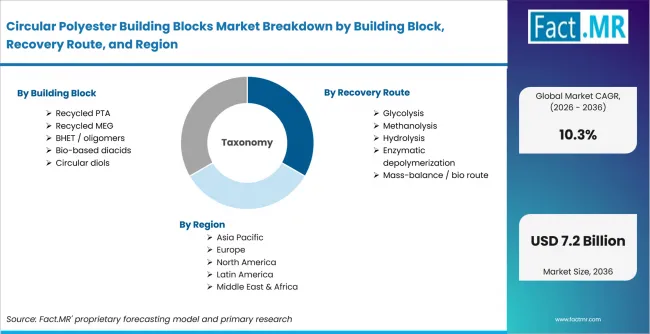
Circular Polyester Building Blocks Market Breakdown By Building Block, Recovery Route, And Region | Source: Fact.MR
| Attribute | Details |
|---|---|
| Quantitative Units | USD billion |
| Market Definition | Circular chemical building blocks recovered or produced for making polyester materials. The market includes inputs that can return to polyester production. |
| Building Block | Recycled PTA; Recycled MEG; BHET / oligomers; Bio-based diacids; Circular diols |
| Recovery Route | Glycolysis; Methanolysis; Hydrolysis; Enzymatic depolymerization; Mass-balance / bio route |
| Polyester | PET; PBT; Polyester polyols; Unsaturated polyester; Specialty copolyesters |
| End Market | Packaging; Textiles; Automotive; Construction; Electronics |
| Regions Covered | North America; Latin America; Western Europe; Eastern Europe; East Asia; South Asia & Pacific; Middle East & Africa |
| Countries Covered | United States; United Kingdom; Germany; Japan; France |
| Key Companies Profiled | Eastman; Indorama Ventures; Loop Industries; Carbios; SK Chemicals; Far Eastern New Century |
| Forecast Period | 2026 to 2036 |
| Approach | Analysis based on polyester recovery routes, building-block demand, end-market use, country growth, official data, company portfolios, and current market developments. |
Source: Fact.MR analysis. Updated Oct 3, 2026
How is the market segmented?
-
By Building Block:
- Recycled PTA
- Recycled MEG
- BHET / oligomers
- Bio-based diacids
- Circular diols
-
By Recovery Route:
- Glycolysis
- Methanolysis
- Hydrolysis
- Enzymatic depolymerization
- Mass-balance / bio route
-
By Polyester:
- PET
- PBT
- Polyester polyols
- Unsaturated polyester
- Specialty copolyesters
-
By End Market:
- Packaging
- Textiles
- Automotive
- Construction
- Electronics
-
By Region:
- North America
- Latin America
- Western Europe
- Eastern Europe
- East Asia
- South Asia & Pacific
- Middle East & Africa
Frequently Asked Questions
How big is the Circular Polyester Building Blocks Market in 2026?
What is the CAGR of the Circular Polyester Building Blocks Market from 2026 to 2036?
Which building block leads the Circular Polyester Building Blocks Market?
Which recovery route leads the Circular Polyester Building Blocks Market?
Who are the leading companies in the Circular Polyester Building Blocks Market?
Who worked on this report


Preview the report firsthand - request a free sample
Free SampleGet the brochure for pricing and purchase details
Download PDF