- Market Value (2025): USD 198.3 Mn
- Estimated Value (2026): USD 211.1 Mn
- Forecast Value (2036): USD 394.5 Mn
- CAGR (2026-2036): 6.4%
What is the Cleanroom Dispenser Market forecast to be worth by 2036?
USD 211.1 million in 2026 to USD 394.5 million by 2036, at a 6.4% CAGR.
- The cleanroom dispenser market was valued at USD 198.3 million in 2025.
- Demand will increase from USD 211.1 million in 2026 to USD 394.5 million by 2036.
- A 6.4% CAGR is projected for 2026 to 2036 across glove, wipe and garment dispensing products.
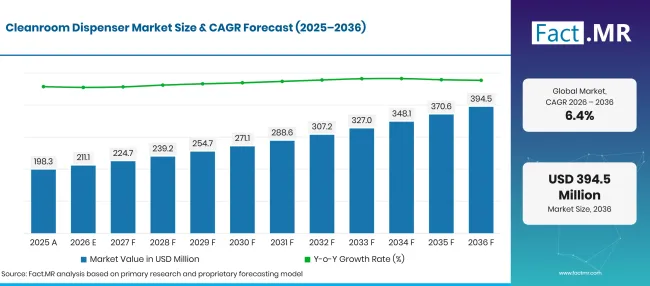
Cleanroom Dispenser Market Forecast Global | Source: Fact.MR
| Year | Basis | Market Value (USD million) |
|---|---|---|
| 2025 | Historical estimate | 198.3 |
| 2026 | Estimate | 211.1 |
| 2036 | Forecast | 394.5 |
| CAGR 2026 to 2036 | Forecast period | 6.4% |
Source: Fact.MR analysis. Updated Oct 22, 2026
What are the defining numbers behind Cleanroom Dispenser Market growth?
USD 183.4 million in additional market value by 2036, with glove dispensers and stainless steel products forming major purchasing categories.
- Demand Drivers in the Market
- Supervisors place glove dispensers near controlled-area entrances so workers can collect protection before beginning a task. Wall-mounted holders can keep the changing area orderly when staff move between gloves and other supplies.
- Biotechnology laboratories use wipes for daily cleaning and surface preparation. They therefore compare dispensers that let workers take one clean wipe without touching the rest of the pack.
- Pharmaceutical cleanroom teams choose dispensers that fit existing cleaning steps and staff routes through controlled areas. The goal is to keep gloves and wipes available without changing a routine that the facility has already approved.
- Medical-device teams check whether a dispenser can be cleaned and installed conveniently near work benches. They also consider refill speed before choosing an open holder or an enclosed unit.
- Key Segments Analyzed
- By Product Type: Glove Dispensers are projected to hold 38.2% share in 2026, reflecting frequent access to protective gloves at controlled-area entry points.
- By Material: In 2026, Stainless Steel leads 52.3% share, supported by its cleanable surface and durable construction.
- By End-User: Biotechnology is estimated to account for 24.3% share in 2026, linked to regular gowning and surface-cleaning routines.
- By Distribution Channel: Specialty Stores are anticipated to capture 44.8% share in 2026, supported by product guidance and fit checks.
- Analyst Opinion at Fact.MR
- Shambhu Nath Jha, Principal Consultant at Fact.MR, states, “A cleanroom dispenser needs to fit the work routine as well as the supply pack. Even a holder with the right glove-box dimensions can create problems if it blocks a gowning step. Clear measurements, suitable refill sizes and easy cleaning therefore matter more to repeat customers than a low purchase price alone.”
- Strategic Implications
- Facility managers should observe where staff put on gloves and take wipes before choosing wall-mounted holders. Daily movement and the separation of clean and used items help decide the best placement.
- Manufacturers can make approval easier by showing the holder’s size, refill opening, and cleaning access in product drawings. This helps facility teams decide whether it fits the gowning area.
- Specialty distributors can organize dispensers by material and supply format. Product pages should explain mounting and refill compatibility so facilities can narrow their choices before a site review.
- Quality teams should add dispenser surfaces to existing cleaning instructions. The cleaning method for a holder should match the controlled area and its approved maintenance routine.
Germany is projected to record an 8.2% CAGR, while Brazil is estimated at 7.6%. Japan follows at 6.5%, supported by established manufacturing controls. The United Kingdom is forecast at 5.6%, while the United States stands at 4.9% through 2036.
How does the Cleanroom Dispenser Market break down by segment?
Glove Dispensers 38.2%; Stainless Steel 52.3%; Biotechnology 24.3%; Specialty Stores 44.8% in 2026.
Which Product Type dominates?
Glove Dispensers accounts for 38.2% share in 2026.
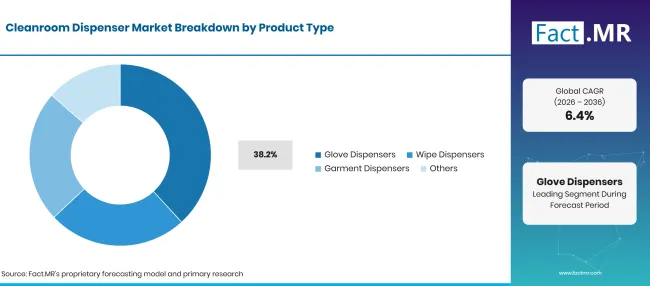
Cleanroom Dispenser Market Breakdown Product Type | Source: Fact.MR
| Product Type | Share (2026) |
|---|---|
| Glove Dispensers (Leading segment) | 38.2% |
| Other segments combined | 61.8% |
| Total | 100.0% |
Source: Fact.MR analysis. Updated Oct 22, 2026
Glove dispensers are commonly placed near entrances and workstations where staff change hand protection. Buyers check that each holder fits the glove carton and allows easy access without moving the entire box. Wipe units serve cleaning stations, while garment dispensers are used in changing areas. The best choice follows the consumable pack and the steps workers take to collect it. Teams may also compare nitrile glove box sizes when selecting wall-mounted fixtures.
What leads the Material segment?
Stainless Steel leads 52.3% share in 2026.
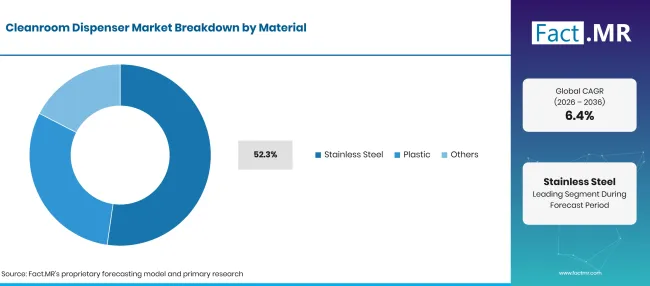
Cleanroom Dispenser Market Breakdown Material | Source: Fact.MR
| Material | Share (2026) |
|---|---|
| Stainless Steel (Leading segment) | 52.3% |
| Other segments combined | 47.7% |
| Total | 100.0% |
Source: Fact.MR analysis. Updated Oct 22, 2026
Stainless steel dispensers suit areas where fixtures must be wiped repeatedly with approved cleaning agents. Buyers check edges and openings because hard-to-reach corners can increase cleaning work. Plastic holders offer a lighter, lower-cost option where the site's material rules allow them. Other materials address particular mounting or chemical needs, so facilities compare cleaning methods and replacement cost before ordering for several rooms.
How does End-User purchasing shape sales?
Biotechnology represents 24.3% share in 2026.
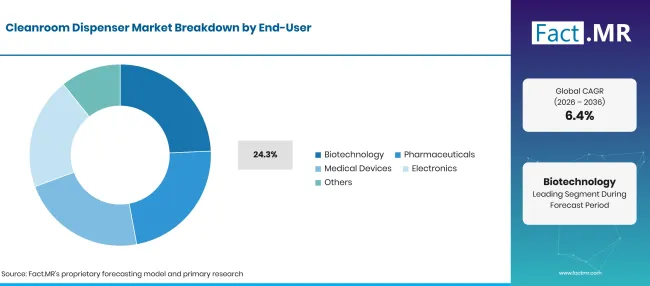
Cleanroom Dispenser Market Breakdown End User | Source: Fact.MR
| End-User | Share (2026) |
|---|---|
| Biotechnology (Leading segment) | 24.3% |
| Other segments combined | 75.7% |
| Total | 100.0% |
Source: Fact.MR analysis. Updated Oct 22, 2026
Biotechnology teams often place dispensers close to benches and changing areas where materials must be ready before a task begins. Pharmaceutical manufacturing uses similar products but may require a different location and cleaning record for each production area. Medical-device operations assess access at assembly points, while electronics sites pay close attention to material handling around sensitive components. End-user differences therefore affect dispenser placement and how supplies are restocked during a shift. Facilities handling ready-to-use disinfectant wipes need holders matched to the actual wipe pack and cleaning method.
Which Distribution Channel serves the largest share?
Specialty Stores capture 44.8% share in 2026.
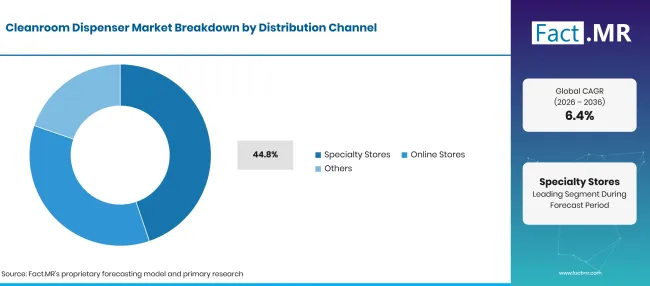
Cleanroom Dispenser Market Breakdown Distribution Channel | Source: Fact.MR
| Distribution Channel | Share (2026) |
|---|---|
| Specialty Stores (Leading segment) | 44.8% |
| Other segments combined | 55.2% |
| Total | 100.0% |
Source: Fact.MR analysis. Updated Oct 22, 2026
Specialty stores give cleanroom managers a way to compare holder dimensions and material finishes alongside compatible glove or wipe packs. A distributor familiar with controlled work areas can help resolve questions about installation and ordering replacements. Online stores suit repeat purchases after an item has been approved at the site. Other purchasing routes are useful for facilities ordering dispensers as part of a wider room setup. Reliable product details influence channel choice. Facilities building modular cleanroom solutions can plan glove dispensers early in the layout of controlled access points.
What is accelerating Cleanroom Dispenser Market adoption, and what is holding it back?
Regular glove access and controlled wipe handling support purchases; material compatibility and site approval shape replacement decisions.
Drivers Impact Analysis
| Driver | (~) % Impact on CAGR | Geographic Relevance | Impact Timeline |
|---|---|---|---|
| Gowning station renewal | +0.9% | Global | Medium term (2–4 years) |
| Cleaning point standardization | +0.8% | North America, Europe | Short term (<= 2 years) |
| Biotechnology facility activity | +0.7% | Europe, Japan | Medium term (2–4 years) |
| Specialist distribution | +0.6% | Global | Medium term (2–4 years) |
| Replaceable holder formats | +0.4% | Global | Long term (>= 4 years) |
Source: Fact.MR analysis. Updated Oct 22, 2026
Opportunity Impact Analysis
| Opportunity | (~) % Impact on CAGR | Geographic Relevance | Impact Timeline |
|---|---|---|---|
| Workstation retrofits | +0.7% | Global | Short term (<= 2 years) |
| Material upgrades | +0.6% | Europe, North America | Medium term (2–4 years) |
| Distributor refill guidance | +0.5% | Global | Medium term (2–4 years) |
| Multi-point facility orders | +0.4% | Global | Long term (>= 4 years) |
Source: Fact.MR analysis. Updated Oct 22, 2026
Restraints Impact Analysis
| Restraint | (~) % Impact on CAGR | Geographic Relevance | Impact Timeline |
|---|---|---|---|
| Fixture approval procedures | -0.7% | Global | Short term (<= 2 years) |
| Material and cleaning mismatch | -0.6% | Global | Medium term (2–4 years) |
| Refill size variation | -0.5% | Global | Medium term (2–4 years) |
| Installation limitations | -0.4% | Global | Long term (>= 4 years) |
Source: Fact.MR analysis. Updated Oct 22, 2026
Which countries are scaling the Cleanroom Dispenser Market through 2036?
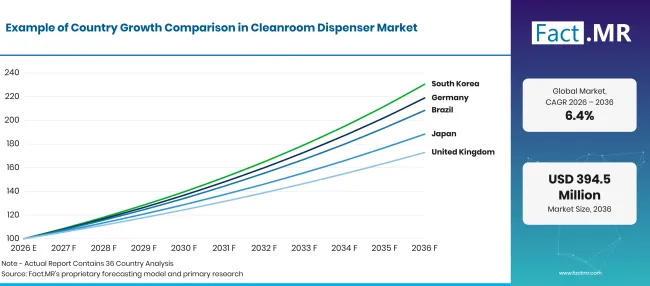
Cleanroom Dispenser Market Growth Index | Source: Fact.MR
| Country | CAGR (2026–2036) |
|---|---|
| Germany | 8.2% |
| Brazil | 7.6% |
| Japan | 6.5% |
| United Kingdom | 5.6% |
| United States | 4.9% |
Source: Fact.MR analysis. Updated Oct 22, 2026
Why is Germany recording a higher cleanroom dispenser CAGR?
8.2% CAGR, shaped by regulated manufacturing and repeated equipment review.
German cleanroom teams focus on stainless steel fittings that tolerate frequent wiping and remain accessible near gowning points. The European Medicines Agency reported 38 medicines with new active substances among its 2025 recommendations [1].
How is Brazil developing cleanroom dispenser purchasing?
7.6% CAGR, connected to pharmaceutical oversight and facility process changes.
Brazil is developing cleanroom dispenser purchasing as pharmaceutical oversight and facility process requirements continue to evolve. Pharmaceutical and biotechnology facilities are evaluating dispensing fixtures when they revise gowning routes, workbench layouts, and material-flow arrangements.
What shapes cleanroom dispenser sales in Japan?
6.5% CAGR, influenced by controlled handling and equipment fit.
Japanese cleanroom operations place weight on consistent fixture dimensions and orderly handling at the point of use. The Pharmaceuticals and Medical Devices Agency published its fiscal 2025 list of newly approved medical devices [2], reflecting activity in a related regulated manufacturing field.
How are United Kingdom facilities approaching dispenser upgrades?
5.6% CAGR, linked to life sciences manufacturing investment.
United Kingdom buyers plan glove and wipe dispensing around the design of their controlled production rooms. In July 2026, the UK Department for Science, Innovation and Technology reported that the life sciences sector had attracted more than GBP 3 billion in public-private investment over the preceding 12 months [3]. Facility expansion can create occasions to review gowning entrances and cleaning stations when the work involves controlled manufacturing.
What affects United States dispenser replacement sales?
4.9% CAGR, based on established pharmaceutical and medical-device workspaces.
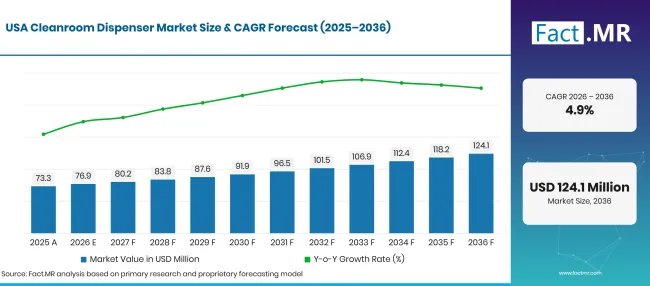
Cleanroom Dispenser Market Forecast Usa | Source: Fact.MR
United States cleanroom dispenser sales are likely to reflect replacement purchases across established pharmaceutical and medical-device work areas. The U.S. Food and Drug Administration recorded 2,740 inspections of domestic drug and device establishments during fiscal 2025 [4]. Such oversight places attention on controlled manufacturing practices, although inspection counts measure regulatory activity instead of dispenser orders.
Who leads the Cleanroom Dispenser Market?
Terra Universal and Micronova provide cleanroom-related handling equipment; other companies serve the wider cleanroom supply chain.
Terra Universal offers cleanroom furnishing and equipment options suited to controlled production spaces. Micronova Manufacturing specializes in cleaning tools and accessories for critical environments. Cleanroom World and Liberty Industries operate in the supply of cleanroom products, while Cleatech supplies cleanroom furnishings and related equipment. Actual dispenser stock availability depends on each supplier’s current catalog and the selected packaging format.
Contec Inc. supplies contamination-control cleaning products. Competition for dispenser orders centers on suitable dimensions, materials, ordering support and compatibility with supplies already in use. Selection of lab safety clothing is closely tied to gowning procedures and the position of garment dispensers.
Which companies are the key providers?
Key companies include Terra Universal Inc.; Micronova Manufacturing Inc.; Cleanroom World; Palbam Class; Cleatech LLC; Liberty Industries Inc.; and Contec Inc.
- Terra Universal Inc.
- Micronova Manufacturing Inc.
- Cleanroom World
- Palbam Class
- Cleatech LLC
- Liberty Industries Inc.
- Contec Inc.
Bibliography
- [1] European Medicines Agency. (2026). Evaluation and monitoring of medicines: Highlights. EMA annual report 2025.
- [2] Pharmaceuticals and Medical Devices Agency. (2026). 2025年度承認品目一覧(新医療機器).
- [3] Department for Science, Innovation and Technology. (2026, July 9). UK life sciences attracts £3bn investment, creating jobs and faster patient treatments.
- [4] U.S. Food and Drug Administration. (2026). FY 2025 annual report on inspections of establishments.
- [5] Agência Nacional de Vigilância Sanitária. (2026, May 15). Anvisa divulga relatório anual de pesquisa clínica.
- [6] Department for Business and Trade, Department of Health and Social Care, Department for Science, Innovation and Technology, & Office for Life Sciences. (2025, July 16). Life Sciences Sector Plan.
- [7] European Medicines Agency. (2026). Human medicines. EMA annual report 2025.
- [8] Agência Nacional de Vigilância Sanitária. (2026, May 18). Anvisa publica 2º Relatório de Métricas de Inspeções em Boas Práticas Clínicas (BPCs).
- [9] Department for Science, Innovation and Technology. (2026, August 21). Life Sciences Large Investment Portfolio.
This Report Answers
- The report explains how glove and wipe dispensers fit within defined gowning and cleaning activities.
- Product analysis compares the main types of dispenser and their handling roles.
- Material coverage examines stainless steel and plastic choices in routine cleaning settings.
- Country outlooks cover Germany, Brazil, Japan, the United Kingdom and the United States.
- Channel analysis explains the role of specialty stores when compatibility is part of a buying decision.
What does the Cleanroom Dispenser Market cover?
The market includes glove dispensers and wipe dispensers used to organize consumables within cleanroom work areas. Garment dispensers and other suitable holders are also included where they serve controlled handling routines. The focus is the dispensing fixture itself, rather than the gloves, wipes or garments placed inside it.
What is included in the scope?
Included products comprise wall-mounted and freestanding dispenser fixtures used in gowning points and controlled workrooms. The classification covers stainless steel and plastic construction, along with other applicable materials. End users include biotechnology teams and pharmaceutical facilities, plus medical-device and electronics operations. Customers may purchase through specialty stores or online routes after confirming the consumable size and local cleaning requirements.
What is excluded from the scope?
The scope excludes sales of disposable gloves and wipes sold without a dispenser. Air filters and ventilation equipment are separate cleanroom systems. General-purpose household holders are outside the market when they are not specified for controlled work areas.
Products such as cleanroom pass boxes manage transfers between spaces and are assessed separately from handheld-supply dispensing.
How Was the Analysis Built?
The analysis draws on 120+ sources, 35+ company portfolios, 25+ countries, and more than 20 industry interviews.
- Primary Research: Primary research includes discussions with manufacturers, service providers, technology developers, distributors, end users, and subject-matter experts. These conversations examine purchasing priorities, product adoption, operational challenges, approval requirements, competitive positioning, and the factors that influence wider market acceptance.
- Desk Research: Desk research covers government statistics, regulatory publications, company filings, trade data, technical studies, industry associations, standards, public policy, and other authoritative sources. Every source used in the analysis is documented in the bibliography.
- Market Sizing and Forecasting: Market estimates combine historical performance, demand indicators, pricing and volume trends, segment shares, company participation, country-level growth, adoption patterns, investment activity, and barriers to market expansion.
- Data Validation and Update Cycle: Findings are validated by comparing primary interviews with public data, company activity, regulatory changes, trade patterns, and industry developments. Regular updates review new product launches, capacity changes, partnerships, approvals, and shifts in commercial adoption.
Segmentation
What is the report’s scope and coverage?
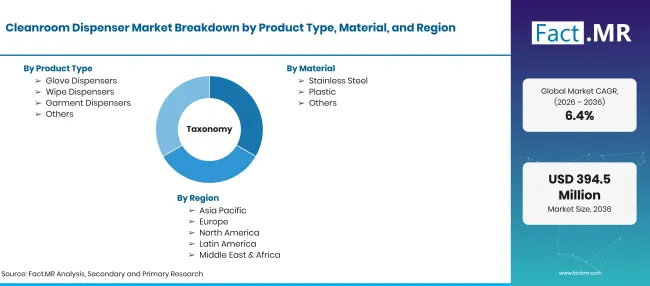
Cleanroom Dispenser Market Taxonomy | Source: Fact.MR
| Attribute | Details |
|---|---|
| Quantitative Units | USD million in 2026 to USD million by 2036 at CAGR |
| Market Definition | Fixed or portable units used to dispense cleanroom gloves, wipes, and garments at controlled work areas |
| Product Type | Glove Dispensers; Wipe Dispensers; Garment Dispensers; Others |
| Material | Stainless Steel; Plastic; Others |
| End-User | Biotechnology; Pharmaceuticals; Medical Devices; Electronics; Others |
| Distribution Channel | Specialty Stores; Online Stores; Others |
| Regions Covered | North America; Latin America; Western Europe; Eastern Europe; East Asia; South Asia & Pacific; Middle East & Africa |
| Countries Covered | Germany; Brazil; United States; United Kingdom; Japan |
| Companies Profiled | Terra Universal Inc.; Micronova Manufacturing Inc.; Cleanroom World; Palbam Class; Cleatech LLC; Liberty Industries Inc.; and Contec Inc. |
| Forecast Period | 2026 to 2036 |
| Approach | Application-led assessment of cleanroom dispensing needs and relevant public evidence |
Source: Fact.MR analysis. Updated Oct 22, 2026
How is the market segmented?
-
By Product Type
- Glove Dispensers
- Wipe Dispensers
- Garment Dispensers
- Others
-
By Material
- Stainless Steel
- Plastic
- Others
-
By End-User
- Biotechnology
- Pharmaceuticals
- Medical Devices
- Electronics
- Others
-
By Distribution Channel
- Specialty Stores
- Online Stores
- Others
-
By Region
- North America
- Latin America
- Western Europe
- Eastern Europe
- East Asia
- South Asia & Pacific
- Middle East & Africa
Frequently Asked Questions
How big is the Cleanroom Dispenser Market in 2026?
What is the CAGR of the Cleanroom Dispenser Market from 2026 to 2036?
Which product type leads the Cleanroom Dispenser Market?
Which material leads the Cleanroom Dispenser Market?
Who are the leading companies in the Cleanroom Dispenser Market?
Who worked on this report


Preview the report firsthand - request a free sample
Free SampleGet the brochure for pricing and purchase details
Download PDF