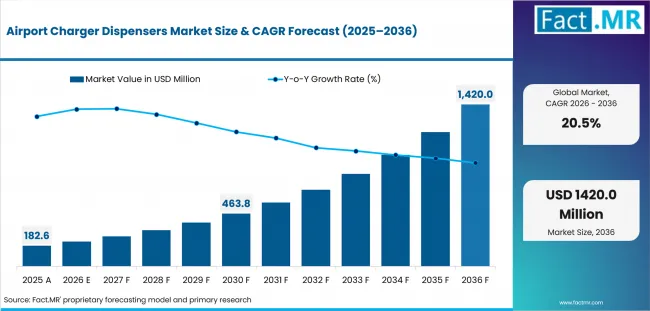
- Market Value (2025): USD 182.6 Mn
- Estimated Value (2026): USD 220 Mn
- Forecast Value (2036): USD 1420 Mn
- CAGR (2026-2036): 20.5%
What is the airport charger dispensers market forecast to be worth by 2036?
USD 220 million in 2026 to USD 1,420 million by 2036, at 20.5% CAGR.
- The airport charger dispensers market crossed a valuation of USD 182.6 million in 2025.
- Demand is expected to increase from USD 220 million in 2026 to USD 1,420 million by 2036.
- The market is forecast to record 20.5% CAGR from 2026 to 2036 as electric GSE fleets create new charging needs across gates and airside service areas. Charger dispensers also support airport operation workflows when charging availability is tied to turnaround planning.
Airport Charger Dispensers Market Market Value Analysis | Source: Fact.MR
What are the defining numbers behind airport charger dispensers market growth?
USD 1,200 million absolute opportunity by 2036, led by DC fast chargers and centralized depot deployment.
- Demand Drivers in the Market
- Airports need charger hardware that supports larger electric GSE fleets without ramp delays.
- Ground handlers need charging systems that match shift patterns and equipment duty cycles.
- Airlines need charged support equipment that protects turnaround reliability.
- Utilities need load management tools that prevent airside charging peaks from stressing local grids.
- Key Segments Analyzed
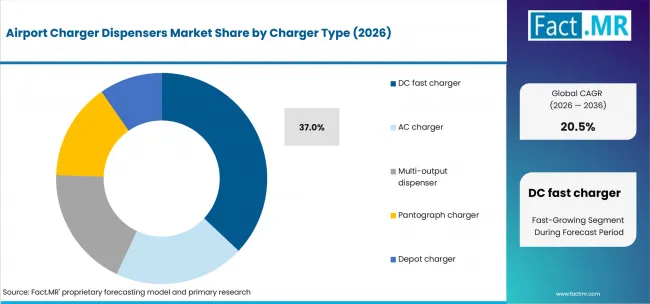
- By Charger Type: DC fast chargers are expected to hold 37.0% share in 2026 because ground handlers need shorter charging windows.
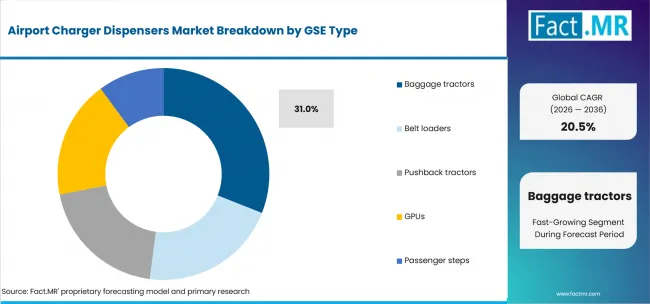
- By GSE Type: Baggage tractors lead because they are widely electrified and operate in high-cycle ramp workflows. The segment is projected to capture 31.0% share in 2026.
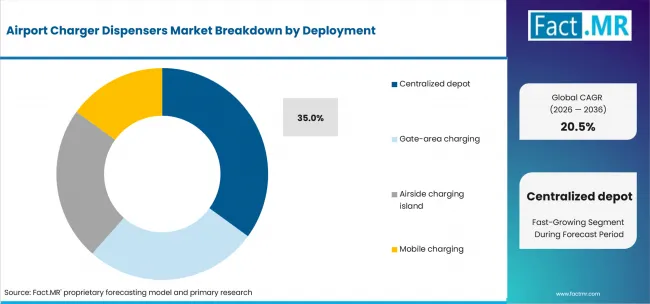
- By Deployment: Centralized depots are likely to account for 35.0% share in 2026 because many airports start electrification from controlled fleet yards.
- By Feature: Load balancing is expected to hold 34.0% share in 2026 because charging must be coordinated with limited airside power.
- By Buyer Type: Ground handlers are projected to record 36.0% share in 2026 because they operate electric GSE fleets daily.
- Analyst Opinion at Fact.MR
- Shambhu Nath Jha, Senior Analyst at Fact.MR, states, “Airport charger dispensers are becoming the missing infrastructure layer in GSE electrification. The market will grow where chargers are placed close to operations, managed through load controls and supported by service teams that understand airside constraints. Hardware alone will not be enough. Airports need charging systems that protect turnaround reliability.”
- Strategic Implications
- Charger suppliers should design airside systems around weather protection and cable safety.
- Airports should map charger placement before electric GSE procurement expands.
- Ground handlers should use duty-cycle data to select depot, gate-area or mobile charging.
- Utilities should support load-balancing plans before large fleets charge at the same time.
Airport charger dispensers sit below the wider Electric Airport GSE Market because the title focuses on charging hardware and fleet energy monitoring. The category differs from broad EV charging because it covers airside-rated chargers used for ground support vehicles. Charger design also connects with lithium-ion battery pack technology when airports manage battery health across electric GSE fleets.
ITW GSE states that its DC Charger can be installed at gates or remote stands and is designed to deliver high-speed power for electric GSE. [1] This supports the market boundary because airport charger dispensers are moving from simple plug points toward coordinated airside charging systems. Charger planning also connects with air start unit replacement cycles when airports modernize ramp support equipment around low-emission operations.
The United States is projected to record 22.2% CAGR through 2036 as large airports and FBOs scale electric GSE charging. Germany is expected to post 21.6% CAGR through 2036 as charging infrastructure and fleet electrification programs expand. UAE is likely to record 20.9% CAGR as Dubai-style electric GSE deployment creates charger demand. Singapore is forecast to advance at 20.1% CAGR as high-density airside operations require coordinated charging. India is set to record 19.4% CAGR as new airport projects add charger-ready GSE infrastructure.
How does the airport charger dispensers market break down by segment?
DC fast chargers lead at 37.0%; centralized depots lead at 35.0%.
Which charger type dominates?
DC fast chargers hold 37.0% share in 2026.
Airport Charger Dispensers Market Analysis By Charger Type | Source: Fact.MR
DC fast chargers are expected to hold 37.0% share in 2026 because electric GSE fleets need charging during short idle windows. AC chargers follow where overnight charging is enough. Multi-output dispensers are gaining adoption because several GSE units can charge from one system. Pantograph chargers are relevant for repeat-route equipment and automated charging concepts. Depot chargers support overnight fleet parking and controlled maintenance access.
Which GSE type dominates?
Baggage tractors hold 31.0% share in 2026.
Airport Charger Dispensers Market Analysis By Gse Type | Source: Fact.MR
Baggage tractors lead because they are common, high-cycle and well suited to electrification. The GSE type segment is projected to capture 31.0% share in 2026 as ground handlers add chargers for repeated baggage cart movement. Belt loaders follow where apron electrification is tied to baggage operations. Pushback tractors need higher charging capacity and stronger connectors. GPUs create demand for gate-area power coordination. Passenger steps support smaller charger formats. Charger placement can improve equipment readiness for belt loaders when baggage operations run close to aircraft turnaround windows.
Which deployment dominates?
Centralized depots hold 35.0% share in 2026.
Airport Charger Dispensers Market Analysis By Deployment | Source: Fact.MR
Centralized depots lead because airports often begin electrification where fleet parking, maintenance and power access are controlled. The deployment segment is likely to account for 35.0% share in 2026 as ground handlers organize charging around shift change and overnight use. Gate-area charging grows where equipment has idle time near aircraft operations. Airside charging islands help distributed ramp layouts. Mobile charging is useful where infrastructure upgrades are delayed. Oshkosh AeroTech states that AmpCart can bring charging directly to eGSE anywhere on the tarmac and can charge multiple units at the same time. [2]
Which feature dominates?
Load balancing holds 34.0% share in 2026.
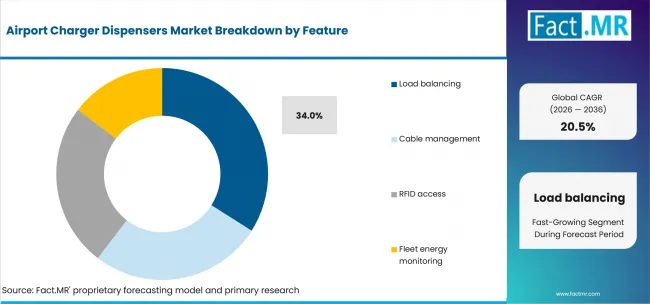
Airport Charger Dispensers Market Analysis By Feature | Source: Fact.MR
Load balancing leads because electric GSE fleets can create peak power demand if chargers operate without coordination. The feature segment is expected to hold 34.0% share in 2026 as airports manage charging around aircraft power and pre-conditioned air needs. Cable management follows because airside cables must avoid trip hazards and vehicle conflict. RFID access supports user control and billing. Fleet energy monitoring helps operators track charger use and equipment readiness. GEBAT states that airport GSE charging must support multi-shift fleets and coordinated operation of multiple chargers on the same grid. [3]
Which buyer type dominates?
Ground handlers hold 36.0% share in 2026.
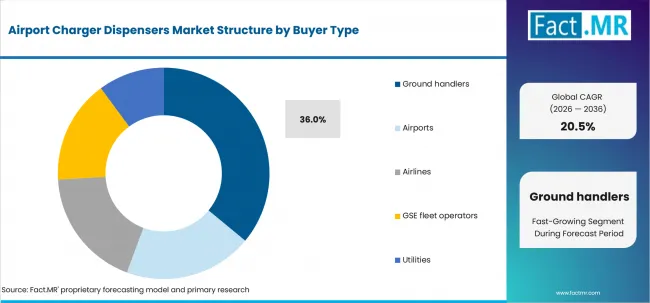
Airport Charger Dispensers Market Analysis By Buyer Type | Source: Fact.MR
Ground handlers lead because they operate baggage tractors, pushback tractors, GPUs and other electric equipment throughout the day. The buyer-type segment is projected to record 36.0% share in 2026 as handlers match charger capacity with vehicle schedules. Airports follow because they control electrical infrastructure and airside siting. Airlines influence charger investment through emissions and turnaround requirements. GSE fleet operators support multi-airport deployment. Utilities become important where grid capacity limits charger rollout. IATA highlighted sustainability and safety among ground handling priorities in 2025. [4]
What is accelerating Airport Charger Dispensers Market adoption, and what is holding it back?
GSE electrification and charging bottlenecks drive it; grid limits and charger placement restrain it.
Drivers Impact Analysis
| DRIVER | (~) % IMPACT ON CAGR | GEOGRAPHIC RELEVANCE | IMPACT TIMELINE |
|---|---|---|---|
| Electric GSE fleet conversion increasing charger need | +2.4% | United States, Germany, UAE, Singapore | Short term (≤ 2 years) |
| Charging bottlenecks pushing airports toward distributed dispensers | +2.0% | Large hubs globally | Short term (≤ 2 years) |
| Load balancing improving airside power utilization | +1.7% | Europe, North America, East Asia | Medium term (2–4 years) |
| Mobile charging reducing infrastructure delay at remote stands | +1.5% | United States, India, Middle East | Medium term (2–4 years) |
| Fleet energy monitoring supporting managed charging programs | +1.2% | Large hub airports and ground handlers | Long term (≥ 4 years) |
Source: Fact.MR analysis. Updated Jul 6, 2026
- Electric GSE fleet conversion
- Electric GSE fleet conversion is the strongest driver because airports are replacing diesel baggage tractors, loaders and support vehicles. More electric equipment creates direct need for airside chargers. Charger demand rises faster when fleets operate over multiple shifts. This driver also supports cleaner workflows around aircraft tugs when towing fleets electrify.
- Charging bottlenecks
- Charging bottlenecks support demand because electric GSE must be charged where equipment is actually used. A depot-only approach can create queues and towing distance. Distributed dispensers reduce downtime and help equipment return to service quickly. This driver is strongest at large hubs with crowded ramp operations.
- Load balancing
- Load balancing supports adoption because airports have limited airside power capacity. Chargers must coordinate with aircraft ground power and other gate equipment. A managed system can reduce peak load and avoid costly upgrades. Charger suppliers that provide intelligent power management will gain stronger adoption.
- Mobile charging
- Mobile charging reduces infrastructure delay because not every ramp zone can receive fixed chargers quickly. A towable or mobile charging dispenser can serve remote stands and temporary operations. This helps airports test electric GSE before major electrical work. Mobile charging also supports electrified aircraft tow tractors when fixed charging is not available nearby.
- Fleet energy monitoring
- Fleet energy monitoring supports long-term growth because operators need visibility into charger use, energy cost and vehicle readiness. Monitoring also helps maintenance teams detect weak batteries or failed charging cycles. This creates demand for charger software tied to fleet operations. It will matter more as charger networks scale across terminals.
Opportunity Impact Analysis
| OPPORTUNITY | (~) % IMPACT ON CAGR | GEOGRAPHIC RELEVANCE | IMPACT TIMELINE |
|---|---|---|---|
| Gate-area charging for opportunity charging during idle windows | +1.6% | United States, UAE, Singapore, Germany | Short term (≤ 2 years) |
| Multi-output dispensers for mixed GSE fleets | +1.4% | Large hubs globally | Medium term (2–4 years) |
| Mobile charging for remote stands and temporary ramp zones | +1.2% | India, Middle East, United States | Medium term (2–4 years) |
| Utility-linked load management for high-capacity charger clusters | +1.0% | Europe, North America, East Asia | Long term (≥ 4 years) |
Source: Fact.MR analysis. Updated Jul 6, 2026
- Gate-area charging
- Gate-area charging creates opportunity because GSE often waits near aircraft between tasks. Chargers placed close to gates can use idle time more effectively. This reduces the need to send equipment back to depots. Gate-area charging can also be planned with airfield ground lighting upgrades when airports modernize airside electrical infrastructure together.
- Multi-output dispensers
- Multi-output dispensers create opportunity because ground handlers operate mixed electric fleets. A single dispenser can support several vehicle categories when connectors and charging profiles are managed properly. This improves charger utilization and reduces hardware clutter. Airports will favor modular systems that can be expanded by fleet size.
- Mobile charging
- Mobile charging creates opportunity where remote stands lack fixed electrical infrastructure. A mobile charger can follow aircraft service patterns and reduce downtime for eGSE. It also helps airports electrify without waiting for full grid work. The use case is strong in fast-growing airports with dispersed apron layouts.
- Utility-linked load management
- Utility-linked load management creates opportunity because large charger clusters can create peak demand. Airports and utilities can coordinate charging windows and load limits. This supports lower energy cost and fewer grid constraints. The opportunity will grow as airports electrify more vehicle categories.
Restraints Impact Analysis
| RESTRAINT | (~) % IMPACT ON CAGR | GEOGRAPHIC RELEVANCE | IMPACT TIMELINE |
|---|---|---|---|
| Airside grid capacity limits slowing charger rollout | -1.8% | Global | Short term (≤ 2 years) |
| Charger placement complexity across busy ramp zones | -1.5% | Large hubs and brownfield airports | Medium term (2–4 years) |
| Mixed connector and battery requirements across GSE fleets | -1.2% | Global | Medium term (2–4 years) |
| Cable safety and maintenance burden in harsh airside environments | -0.9% | Global | Long term (≥ 4 years) |
Source: Fact.MR analysis. Updated Jul 6, 2026
- Grid capacity limits
- Grid capacity limits are the main restraint because high-power chargers can exceed available airside electrical capacity. Airports may need transformers, cabling and electrical rooms before large charger rollout. This adds time and cost. Load balancing can reduce the burden but cannot remove every capacity limit.
- Charger placement complexity
- Charger placement complexity slows deployment because ramp zones already handle aircraft and safety lanes. Poor placement can create congestion or cable hazards. Airports must plan charger locations around actual vehicle routes. Brownfield terminals face the highest layout constraint.
- Mixed fleet requirements
- Mixed connector and battery requirements make charger selection harder. Baggage tractors, belt loaders and pushback tractors may use different voltage levels or connector standards. This increases the need for multi-output dispensers and fleet-level planning. Standardization will improve over time but remains uneven.
- Cable safety
- Cable safety and maintenance burden matter because airside cables face weather and repeated handling. Damaged charging cables can create downtime and safety risk. Cable management and rugged connectors are important. Maintenance teams need clear inspection routines.
Which countries are scaling airport charger dispensers fastest?
United States 22.2%; Germany 21.6%; UAE 20.9%; Singapore 20.1%; India 19.4%.
Based on regional analysis, the airport charger dispensers market is segmented into North America, Western Europe, East Asia, South Asia, Latin America, and Middle East and Africa.
| Country | CAGR |
|---|---|
| United States | 22.2% |
| Germany | 21.6% |
| UAE | 20.9% |
| Singapore | 20.1% |
| India | 19.4% |
Source: Fact.MR analysis. Updated Jul 6, 2026
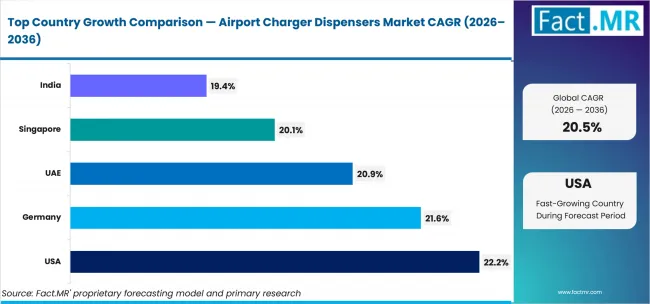
Airport Charger Dispensers Market Cagr Analysis By Country | Source: Fact.MR
What is powering the United States lead?
22.2% CAGR, driven by FBO electrification and large hub charger deployment.
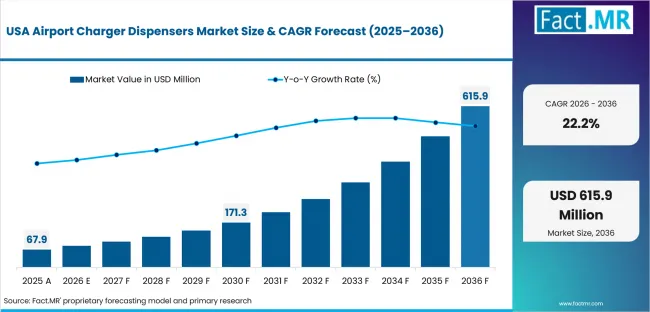
Airport Charger Dispensers Market Country Value Analysis | Source: Fact.MR
The United States is projected to record 22.2% CAGR from 2026 to 2036 as airports, FBOs and ground handlers expand eGSE charging. Growth will favor DC fast chargers, mobile charging and fleet energy monitoring. Charger placement can also support safer sequencing near aircraft refueler operations when ramp teams coordinate power and fuel service windows.
How is Germany scaling airport charger dispenser demand?
21.6% CAGR, backed by airside electrification and managed charging programs.
Germany is expected to post 21.6% CAGR through 2036 as airports and ground handlers use load-managed chargers to support electric GSE fleets. Demand will focus on depot chargers, multi-output dispensers and energy monitoring. Utilities will play a larger role as charger clusters expand.
What supports UAE’s outlook?
20.9% CAGR, driven by Dubai-style electric GSE deployment and high-capacity airport operations.
UAE is likely to record 20.9% CAGR by 2036 as large hubs electrify ground support equipment and add charger-ready infrastructure. Demand will favor DC fast chargers and gate-area charging. Harsh climate performance will remain a key equipment requirement.
What underpins Singapore’s growth?
20.1% CAGR, supported by dense ramp operations and coordinated charger placement.
Singapore is forecast to advance at 20.1% CAGR through 2036 as high-density airside operations require reliable charger access. Growth will favor compact dispensers, RFID access and load balancing. Charger systems will need to support strict ramp safety and high equipment availability.
How is India scaling airport charger dispenser adoption?
19.4% CAGR, driven by new airport projects and remote stand electrification.
India is set to record 19.4% CAGR through 2036 as new airport projects include charging-ready GSE infrastructure. Demand will focus on centralized depots, mobile charging and airside charging islands. Growth will favor rugged systems that can support mixed fleet electrification.
Who leads the airport charger dispensers market?
ITW GSE and Oshkosh AeroTech lead airside-specific charging coverage, while ABB and Siemens strengthen broader charging infrastructure pathways.
Airport charger dispensers are supplied by airside power specialists and EV charging infrastructure companies. ITW GSE is directly relevant through DC Charger, EcoGate and Power Share. Oshkosh AeroTech is relevant through AmpCart and JBT AeroTech’s legacy airport charging pathway.
ABB, Siemens are relevant through charging infrastructure, power electronics and networked charger platforms, but they are broader EV charging suppliers unless airside deployments are specified.
Competition through 2036 will be shaped by airside durability, charger output, cable management, fleet software and utility integration. Charger planning can also connect with ground support equipment tires replacement cycles when airports convert diesel fleets to electric platforms.
Which companies are the key providers?
ITW GSE and Oshkosh AeroTech are key providers. . ABB, Siemens and PosiCharge / Ampure complete the company set.
- ABB
- Siemens
- ITW GSE
- Oshkosh AeroTech
- PosiCharge / Ampure
Bibliography
- ITW GSE. (2026). ITW GSE DC Charger – scalable GSE charging station. ITW GSE.
- Oshkosh AeroTech. (2026). AmpCart: Mobile electric GSE charging solution. Oshkosh AeroTech.
- GEBAT. (2026). Airport GSE battery charger & charging stations. GEBAT Chargers.
- International Air Transport Association. (2025, May 13). Ground handling priorities: Safety, baggage, global standardization and sustainability. International Air Transport Association.
- TLD. (2026). Electric GSE. TLD.
- PosiCharge. (2026). Airport ground support equipment. PosiCharge.
This Report Addresses
- Strategic intelligence on airport charger dispensers across charger type and deployment.
- Segment analysis covering DC Fast Chargers and Centralized Depots.
- Regional outlook covering the United States, Germany, UAE, Singapore and India.
- Competitive analysis of ABB, Siemens, ITW GSE, Oshkosh AeroTech and PosiCharge / Ampure.
- Technology assessment covering AC charging, DC fast charging, multi-output dispensers, pantograph chargers and load balancing.
- Use case assessment covering baggage tractors, belt loaders, pushback tractors, GPUs and passenger steps.
- Airside-readiness screening separates airport charger dispensers from public EV charging infrastructure.
- Primary interviews, provider checks and official source review support the forecast.
What does the airport charger dispensers market cover?
Airside-rated charging dispensers used to charge electric ground support equipment.
The airport charger dispensers market covers AC chargers, DC fast chargers, multi-output dispensers, pantograph chargers, and depot chargers used for electric GSE fleets.
The market differs from general EV charging infrastructure because airport charger dispensers must operate in ramp areas with strict safety and equipment availability requirements. It excludes public passenger EV chargers and ordinary warehouse chargers unless they are used for airside GSE fleets.
What is included in the scope?
Charging hardware, cable systems and fleet energy interfaces for electric GSE.
The scope includes AC chargers, DC fast chargers, multi-output dispensers, pantograph chargers and depot chargers. Deployment coverage includes centralized depots and mobile charging.
Feature coverage includes load balancing and fleet energy monitoring. Buyer-type coverage includes airports, ground handlers, airlines, GSE fleet operators and utilities. Charger dispensers become more valuable when they support passenger boarding bridge gate power environments without disrupting aircraft-critical loads.
What is excluded from the scope?
Public EV chargers and non-airside charging systems are outside the scope.
The scope excludes public parking chargers and general depot chargers used outside airport ground operations. It also excludes electric GSE vehicles unless charger hardware is separately specified.
How was the analysis built?
100+ sources, 40+ company portfolios, 25+ countries, 20+ interviews.
- Primary Research: Primary research includes interviews with airport sustainability teams, GSE fleet managers and ground handlers. It includes input from charging suppliers and airside electrical contractors.
- Desk Research: Desk research reviews official charging pages and ground handling sustainability priorities.
- Market-Sizing and Forecasting: Forecasting uses electric GSE fleet conversion and utility-readiness scoring.
- Data Validation and Update Cycle: Forecasts are validated through provider checks and technical interviews. Charger output and airside duty cycle help confirm market direction.
Segmentation
What is the report’s scope and coverage?
| Attribute | Details |
|---|---|
| Quantitative Units | USD Million in 2026 to USD Million by 2036 at CAGR |
| Market Definition | Airside-rated charging dispensers used to charge electric ground support equipment |
| Charger Type | AC charger; DC fast charger; multi-output dispenser; pantograph charger; depot charger |
| GSE Type | Baggage tractors; belt loaders; pushback tractors; GPUs; passenger steps |
| Deployment | Centralized depot; gate-area charging; airside charging island; mobile charging |
| Feature | Load balancing; cable management; RFID access; fleet energy monitoring |
| Buyer Type | Airports; ground handlers; airlines; GSE fleet operators; utilities |
| Regions Covered | North America; Western Europe; East Asia; South Asia; Latin America; Middle East and Africa |
| Countries Covered | United States; Germany; UAE; Singapore; India |
| Key Companies Profiled | ABB; Siemens; ITW GSE; Oshkosh AeroTech; PosiCharge / Ampure |
| Forecast Period | 2026 to 2036 |
| Approach | Hybrid top-down and bottom-up approach using eGSE fleet conversion, charger-to-vehicle ratios, airside grid readiness, mobile charging adoption and provider validation |
Source: Fact.MR analysis. Updated Jul 6, 2026
How is the market segmented?
-
By Charger Type:
- AC charger
- DC fast charger
- Multi-output dispenser
- Pantograph charger
- Depot charger
-
By GSE Type:
- Baggage tractors
- Belt loaders
- Pushback tractors
- GPUs
- Passenger steps
-
By Deployment:
- Centralized depot
- Gate-area charging
- Airside charging island
- Mobile charging
-
By Feature:
- Load balancing
- Cable management
- RFID access
- Fleet energy monitoring
-
By Buyer Type:
- Airports
- Ground handlers
- Airlines
- GSE fleet operators
- Utilities
-
Region:
- North America
- United States
- Canada
- Western Europe
- Germany
- United Kingdom
- France
- Netherlands
- Spain
- East Asia
- Japan
- China
- South Korea
- South Asia
- India
- Singapore
- Thailand
- Latin America
- Brazil
- Chile
- Mexico
- Middle East & Africa
- UAE
- Saudi Arabia
- South Africa
- North America
Frequently Asked Questions
Which charger type leads the Airport Charger Dispensers Market?
Which GSE type leads the Airport Charger Dispensers Market?
Which deployment leads the Airport Charger Dispensers Market?
Which feature leads the Airport Charger Dispensers Market?
Which buyer type leads the Airport Charger Dispensers Market?
Which country expands fastest in the Airport Charger Dispensers Market?
How does Germany perform in the Airport Charger Dispensers Market?
How does UAE perform in the Airport Charger Dispensers Market?
How does Singapore perform in the Airport Charger Dispensers Market?
How does India perform in the Airport Charger Dispensers Market?
What is the primary driver in the Airport Charger Dispensers Market?
What is the main restraint in the Airport Charger Dispensers Market?
Why are DC fast chargers important?
Why do ground handlers dominate demand?
Who worked on this report


Preview the report firsthand - request a free sample
Free SampleGet the brochure for pricing and purchase details
Download PDF