Lab Safety Clothing Market (2026 - 2036)

Lab Safety Clothing Market Size and Share Forecast Outlook 2026 to 2036

Core Findings

    Lab Safety Clothing Market Forecast and Outlook 2026 to 2036

    Lab safety clothing market is likely to be valued at USD 3.1 billion in 2026 and reaches USD 5.9 billion by 2036, reflecting a 6.70% CAGR.

    Lab Safety Clothing Market Key Takeaways

    • Lab Safety Clothing Market Value (2026): USD 3.1 billion
    • Lab Safety Clothing Market Forecast Value (2036): USD 5.9 billion
    • Lab Safety Clothing Market Forecast CAGR: 6.7%
    • Leading Product Category in Lab Safety Clothing Market: Lab coats & jackets
    • Leading Use Environment in Lab Safety Clothing Market: Chemical handling laboratories
    • Key Growth Regions in Lab Safety Clothing Market: North America, Europe, Asia Pacific, Latin America, Middle East & Africa
    • Top Players in Lab Safety Clothing Market: DuPont, Ansell, 3M, Kimberly-Clark, Honeywell
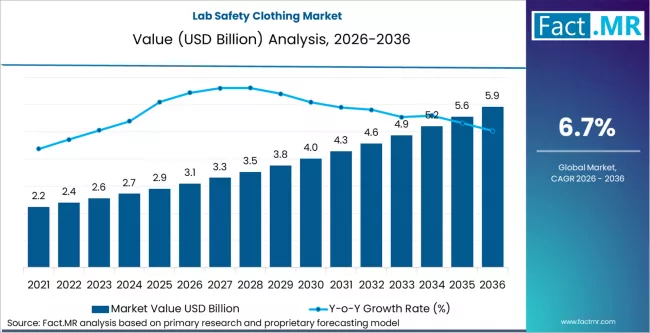
    Lab Safety Clothing Market Market Value Analysis

    Demand aligns with institutional compliance cycles rather than individual preference. Procurement teams prioritize garments that meet regulatory thresholds, material performance standards, and batch traceability. Manufacturers standardize fabrics, seams, and protective features to minimize variance across production lines.

    Reorders follow usage rates, lab headcount changes, and seasonal replacement programs. Inventory management tracks sterilization tolerance, garment life, and contamination risk. Pricing reflects lifecycle cost, including laundering and repair, more than unit production cost. Supply chain resilience depends on stable textile sourcing, validated suppliers, and contingency inventory. Adoption friction falls when institutions can rotate products without retraining personnel or updating safety protocols. Scale comes through contracts with large universities, pharmaceutical plants, and testing facilities. Volume growth reflects scheduled replacement cycles and capacity expansion rather than short-term fashion or trend-driven adoption.

    Lab Safety Clothing Market

    Metric Value
    Market Value (2026) USD 3.1 billion
    Forecast Value (2036) USD 5.9 billion
    Forecast CAGR (2026-2036) 6.7%

    Category

    Category Segments
    Product Category Lab coats and jackets; Coveralls and protective suits; Disposable gowns and aprons; Chemical-resistant garments; Flame-resistant / ESD garments; Accessories (sleeves, hoods, shoe covers)
    Primary Use Environment Chemical handling laboratories; Biosafety / BSL labs; Cleanroom and semiconductor; Healthcare labs and phlebotomy; Education and general research
    End User (Level-1) Pharma and biotech manufacturing; Hospitals and diagnostic labs; Academic institutions; Industrial / chemical plants; Semiconductor and electronics
    Region North America; Europe; Asia Pacific; Latin America; Middle East & Africa

    Segmental Analysis

    By Product Category, Why Do Lab Coats and Jackets Lead the Lab Safety Clothing Market?
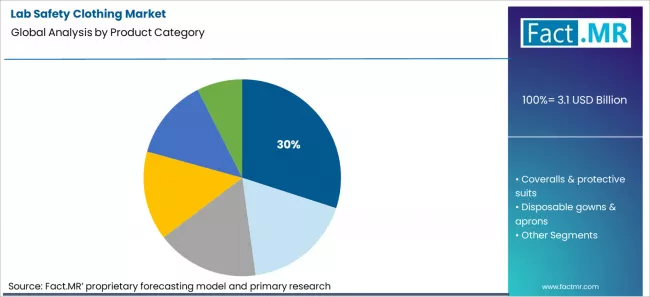
    Lab Safety Clothing Market Analysis By Product Category

    Fact.MR tracking shows that lab coats and jackets hold 30.0% share because they satisfy the most immediate operational need in laboratory settings: basic personal protection without impeding mobility. The unmet need is not specialized resistance but reliable coverage for routine chemical, biological, or procedural tasks. For users, the value is functional and habitual, forming part of daily laboratory routines rather than an occasional protective measure. Manufacturers benefit from standardized sizing, recurring replacement cycles, and broad applicability across research and clinical environments. Their dominance reflects how safety apparel succeeds when it integrates seamlessly into everyday laboratory workflow.

    By Primary Use Environment, Why Do Chemical Handling Laboratories Represent the Largest Segment in the Lab Safety Clothing Market?
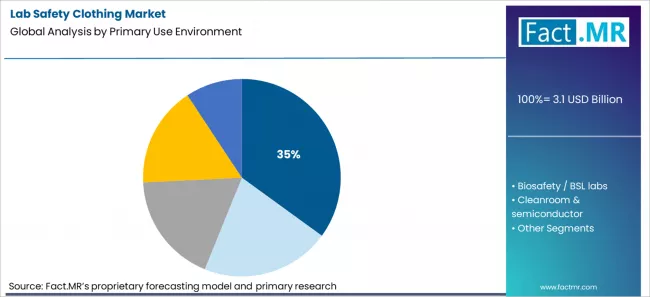
    Lab Safety Clothing Market Analysis By Primary Use Environment

    In Fact.MR compiled datasets, chemical handling laboratories account for 35.00% share because they present the highest exposure risk combined with predictable procedural workflows. The unmet need is consistent protection during frequent, repetitive tasks rather than occasional hazard mitigation. Users depend on apparel that supports operational efficiency while maintaining safety compliance. The value is practical and risk-focused. For institutions, this segment drives predictable procurement cycles and standardization in protective clothing programs. Its scale reflects how safety apparel adoption is strongest where hazards are routine, measurable, and require daily adherence to protective protocols rather than specialized or intermittent interventions.

    Country

    Country Driver Restraint Trend
    USA OSHA and NIH standards mandate comprehensive lab PPE High compliance and certification costs Growth in reusable high-performance protective wear
    UK HSE regulations drive adoption in research and industry Budget limits in public labs Shift toward certified supplier frameworks
    Germany EU and national safety laws require technical protective clothing Complex conformity assessments Adoption of ergonomic lab wear
    China Biopharma expansion increases lab PPE demand Uneven regional safety enforcement Local manufacturing of compliant clothing
    India Rising industrial and clinical lab activity Limited formal safety programs Growth in affordable compliant lab wear

    Analysis of the Lab Safety Clothing Market by Key Country
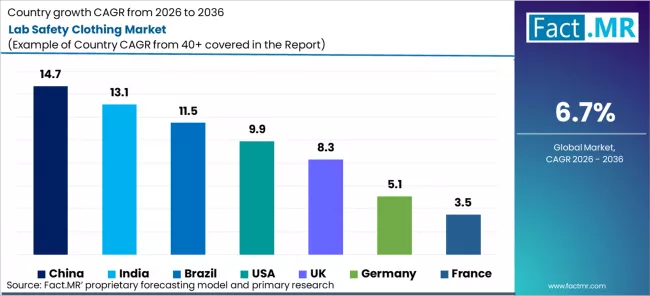
    Lab Safety Clothing Market Cagr Analysis By Country

    Country CAGR (2026-2036)
    USA 9.9%
    Brazil 11.5%
    China 14.7%
    India 13.1%
    Germany 5.1%
    France 3.5%
    UK 8.3%

    The report covers an in-depth analysis of 30+ countries; top-performing countries are highlighted below.

    How is the Lab Safety Clothing Market Developing In The United States?

    The lab safety clothing market in the United States grows at 9.9% annually through 2036. Hospitals, pharmaceutical labs, and academic research centers maintain high safety standards that require protective gowns, gloves, and aprons. Centralized procurement ensures consistency across multi-site laboratories. High throughput laboratories and automated workflows increase clothing turnover due to frequent laundering and replacement schedules. Regulatory standards for occupational health drive compliance spending. Growth arises from higher utilization per facility and expansion of safety protocols in research and clinical settings rather than from the establishment of new laboratories, reflecting steady operational demand across existing infrastructure.

    What Drives the Lab Safety Clothing Market in Brazil?

    The lab safety clothing market in Brazil expands at 11.5% per year through 2036. Private diagnostic laboratories, pharmaceutical R&D centers, and university research facilities adopt standardized clothing for safety and contamination control. Outsourced testing and contract research organizations consolidate demand by purchasing in bulk. Urban research hubs see higher turnover due to repeated laundering cycles and protocol adherence. Equipment upgrades and modernization increase clothing use in multi user labs. Growth occurs from operational compliance and centralized supply management rather than new laboratory creation, reflecting efficiency improvements and increasing institutional awareness of workplace safety regulations.

    Why is the Lab Safety Clothing Market Growing Rapidly in China?

    The lab safety clothing market in China follows a 14.7% annual growth trajectory through 2036. Expansion is fueled by large public hospitals, pharmaceutical manufacturing plants, and contract research laboratories that maintain high throughput operations. Protective garments are essential for research, clinical testing, and manufacturing compliance. Provincial hospital networks and industrial clusters replicate standardized procurement practices across multiple facilities. Clothing turnover rises due to strict sanitation and contamination prevention protocols. Growth comes from scaling existing operations and enforcing safety compliance in established institutions rather than from increases in laboratory count, resulting in rapid but controlled expansion.

    How is the Lab Safety Clothing Market Evolving in India?

    The lab safety clothing market in India advances at 13.1% per year through 2036. Centralized contract research laboratories, private hospitals, and academic institutions drive demand for gowns, aprons, and gloves. High patient and sample volumes require frequent replacement, particularly in urban laboratories. Telemedicine and diagnostic expansion indirectly increase clothing turnover in affiliated labs. Regulatory compliance and accreditation for occupational safety accelerate adoption across multi-site facilities. Growth is concentrated in operational efficiency, standardization, and high utilization rather than in new laboratory construction, ensuring steady demand across established research and clinical infrastructures.

    What Limits Growth of the Lab Safety Clothing Market in Germany?

    The lab safety clothing market in Germany grows at 5.1% per year through 2036. Most research and clinical laboratories already maintain comprehensive safety protocols and high compliance standards. Purchases focus on replacement cycles, upgrades, and certification adherence rather than expansion of facilities. Regulatory frameworks require careful documentation and periodic inspection. Volume growth arises from higher turnover and adoption of modern protective materials in existing labs. Incremental demand is predictable and conservative, linked to operational protocol enforcement and efficiency improvements, rather than sudden laboratory expansion or introduction of entirely new research centers.

    Why is the Lab Safety Clothing Market Expanding Slowly in France?

    The lab safety clothing market in France progresses at 3.5% per year through 2036. Public research institutions, hospital laboratories, and academic centers dominate usage. Procurement cycles are long and budget constrained, limiting rapid adoption. Clothing is replaced according to regulatory compliance schedules rather than project volume increases. Growth comes mainly from modernization of existing garments, minor upgrades in material technology, and adherence to updated occupational safety standards. Private sector contribution is limited. Expansion remains gradual and steady, tied to incremental operational improvements rather than structural growth in the number or size of laboratories.

    How Does the Lab Safety Clothing Market in the United Kingdom differ from Other Regions?

    The lab safety clothing market in the United Kingdom advances at 8.3% per year through 2036. University laboratories, contract research organizations, and private diagnostic facilities drive most demand. Clothing turnover rises with multi shift operations and high sample throughput. Shared laboratory spaces increase usage density per protective item. Safety protocol updates and accreditation requirements encourage regular replacement cycles. Startups and emerging research clusters add incremental consumption. Growth is supported by higher utilization rates and compliance enforcement in existing laboratories rather than creation of new facilities, making expansion steady and operations focused.

    Who determines supplier selection and long-term adoption in the lab safety clothing market, and why operational reliability outweighs product novelty?
    Lab Safety Clothing Market Analysis By Company

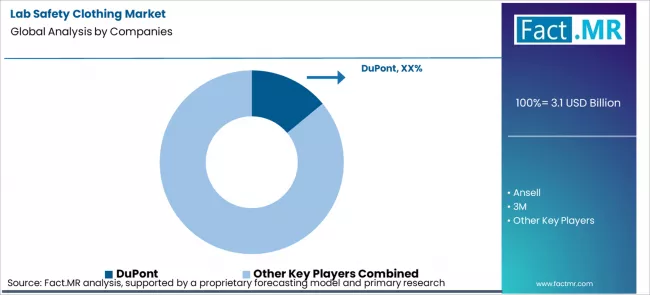
    In the lab safety clothing market, purchasing is heavily influenced by regulatory compliance, certification, and consistency rather than by isolated product features. DuPont, Ansell, 3M, Kimberly-Clark, and Honeywell secure positions by providing full portfolios of personal protective garments, chemical-resistant suits, and disposables that integrate into established safety protocols. Laboratories, research facilities, and manufacturing plants prefer suppliers that can deliver repeatable sizing, material performance, and documentation across multiple locations. Certification standards such as ISO 16602 and ASTM testing create switching friction, as replacing a supplier requires reapproval and risk assessment. DuPont and 3M leverage historical adoption and training programs, while Ansell and Honeywell compete on specialized material properties and fit compliance. Scale allows global coverage and rapid replenishment, whereas process discipline ensures consistent quality, audit readiness, and adherence to regulatory reporting. These operational capabilities now provide a more durable advantage than introducing incremental fabric or coating innovations.

    Key Players in Lab Safety Clothing Market

    • DuPont
    • Ansell
    • 3M
    • Kimberly-Clark
    • Honeywell
    • Others

    Scope of the Report

    Items Values
    Quantitative Units (2026) USD billion
    Product Category Lab coats & jackets, coveralls & protective suits, disposable gowns & aprons, chemical-resistant garments, flame-resistant / ESD garments, accessories (sleeves, hoods, shoe covers)
    Primary Use Environment Chemical handling laboratories, biosafety / BSL labs, cleanroom & semiconductor, healthcare labs & phlebotomy, education & general research
    End User (Level-1) Pharma & biotech manufacturing, hospitals & diagnostic labs, academic institutions, industrial / chemical plants, semiconductor & electronics
    Regions Covered Asia Pacific, Europe, North America, Latin America, Middle East & Africa
    Countries Covered United States, Canada, Mexico, Germany, United Kingdom, France, Italy, Spain, China, Japan, South Korea, India, Australia & New Zealand, ASEAN, Brazil, Chile, Saudi Arabia, Turkey, South Africa, and other regional markets
    Key Companies Profiled DuPont, Ansell, 3M, Kimberly-Clark, Honeywell
    Additional Attributes Dollar by sales by product category, use environment, and end user; focus on regulatory compliance, garment performance, and institutional standardization; demand driven by replacement cycles, lab headcount, and operational safety enforcement

    Lab Safety Clothing Market Segmentation

    • Product category :

      • Lab coats & jackets
      • Coveralls & protective suits
      • Disposable gowns & aprons
      • Chemical-resistant garments
      • Flame-resistant / ESD garments
      • Accessories (sleeves, hoods, shoe covers)
    • Primary Use Environment :

      • Chemical handling laboratories
      • Biosafety / BSL labs
      • Cleanroom & semiconductor
      • Healthcare labs & phlebotomy
      • Education & general research
    • End User (Level-1) :

      • Pharma & biotech manufacturing
      • Hospitals & diagnostic labs
      • Academic institutions
      • Industrial / chemical plants
      • Semiconductor & electronics
    • Region :

      • Asia Pacific

        • China
        • Japan
        • South Korea
        • India
        • Australia & New Zealand
        • ASEAN
        • Rest of Asia Pacific
      • Europe

        • Germany
        • United Kingdom
        • France
        • Italy
        • Spain
        • Nordic
        • BENELUX
        • Rest of Europe
      • North America

        • United States
        • Canada
        • Mexico
      • Latin America

        • Brazil
        • Chile
        • Rest of Latin America
      • Middle East & Africa

        • Kingdom of Saudi Arabia
        • Other GCC Countries
        • Turkey
        • South Africa
        • Other African Union
        • Rest of Middle East & Africa

    References

    • Occupational Safety and Health Administration. (2023). Personal protective equipment. U.S. Department of Labor.
    • National Institute for Occupational Safety and Health. (2023). Laboratory safety: Protective clothing and apparel.
    • Centers for Disease Control and Prevention. (2023). Biosafety in microbiological and biomedical laboratories (6th ed.): Personal protective equipment.
    • World Health Organization. (2020). Laboratory biosafety manual (4th ed.). World Health Organization.

    Table of Content

    1. Executive Summary
      • Global Market Outlook
      • Demand to side Trends
      • Supply to side Trends
      • Technology Roadmap Analysis
      • Analysis and Recommendations
    2. Market Overview
      • Market Coverage / Taxonomy
      • Market Definition / Scope / Limitations
    3. Research Methodology
      • Chapter Orientation
      • Analytical Lens and Working Hypotheses
        • Market Structure, Signals, and Trend Drivers
        • Benchmarking and Cross-market Comparability
        • Market Sizing, Forecasting, and Opportunity Mapping
      • Research Design and Evidence Framework
        • Desk Research Programme (Secondary Evidence)
          • Company Annual and Sustainability Reports
          • Peer-reviewed Journals and Academic Literature
          • Corporate Websites, Product Literature, and Technical Notes
          • Earnings Decks and Investor Briefings
          • Statutory Filings and Regulatory Disclosures
          • Technical White Papers and Standards Notes
          • Trade Journals, Industry Magazines, and Analyst Briefs
          • Conference Proceedings, Webinars, and Seminar Materials
          • Government Statistics Portals and Public Data Releases
          • Press Releases and Reputable Media Coverage
          • Specialist Newsletters and Curated Briefings
          • Sector Databases and Reference Repositories
          • FMR Internal Proprietary Databases and Historical Market Datasets
          • Subscription Datasets and Paid Sources
          • Social Channels, Communities, and Digital Listening Inputs
          • Additional Desk Sources
        • Expert Input and Fieldwork (Primary Evidence)
          • Primary Modes
            • Qualitative Interviews and Expert Elicitation
            • Quantitative Surveys and Structured Data Capture
            • Blended Approach
          • Why Primary Evidence is Used
          • Field Techniques
            • Interviews
            • Surveys
            • Focus Groups
            • Observational and In-context Research
            • Social and Community Interactions
          • Stakeholder Universe Engaged
            • C-suite Leaders
            • Board Members
            • Presidents and Vice Presidents
            • R&D and Innovation Heads
            • Technical Specialists
            • Domain Subject-matter Experts
            • Scientists
            • Physicians and Other Healthcare Professionals
          • Governance, Ethics, and Data Stewardship
            • Research Ethics
            • Data Integrity and Handling
        • Tooling, Models, and Reference Databases
      • Data Engineering and Model Build
        • Data Acquisition and Ingestion
        • Cleaning, Normalisation, and Verification
        • Synthesis, Triangulation, and Analysis
      • Quality Assurance and Audit Trail
    4. Market Background
      • Market Dynamics
        • Drivers
        • Restraints
        • Opportunity
        • Trends
      • Scenario Forecast
        • Demand in Optimistic Scenario
        • Demand in Likely Scenario
        • Demand in Conservative Scenario
      • Opportunity Map Analysis
      • Product Life Cycle Analysis
      • Supply Chain Analysis
      • Investment Feasibility Matrix
      • Value Chain Analysis
      • PESTLE and Porter’s Analysis
      • Regulatory Landscape
      • Regional Parent Market Outlook
      • Production and Consumption Statistics
      • Import and Export Statistics
    5. Global Market Analysis 2021 to 2025 and Forecast, 2026 to 2036
      • Historical Market Size Value (USD Million) Analysis, 2021 to 2025
      • Current and Future Market Size Value (USD Million) Projections, 2026 to 2036
        • Y to o to Y Growth Trend Analysis
        • Absolute $ Opportunity Analysis
    6. Global Market Pricing Analysis 2021 to 2025 and Forecast 2026 to 2036
    7. Global Market Analysis 2021 to 2025 and Forecast 2026 to 2036, By Product Category
      • Introduction / Key Findings
      • Historical Market Size Value (USD Million) Analysis By Product Category, 2021 to 2025
      • Current and Future Market Size Value (USD Million) Analysis and Forecast By Product Category, 2026 to 2036
        • Lab coats & jackets
        • Coveralls & protective suits
        • Disposable gowns & aprons
        • Chemical-resistant garments
        • Flame-resistant / ESD garments
        • Accessories (sleeves, hoods, shoe covers)
      • Y to o to Y Growth Trend Analysis By Product Category, 2021 to 2025
      • Absolute $ Opportunity Analysis By Product Category, 2026 to 2036
    8. Global Market Analysis 2021 to 2025 and Forecast 2026 to 2036, By Primary Use Environment
      • Introduction / Key Findings
      • Historical Market Size Value (USD Million) Analysis By Primary Use Environment, 2021 to 2025
      • Current and Future Market Size Value (USD Million) Analysis and Forecast By Primary Use Environment, 2026 to 2036
        • Chemical handling laboratories
        • Biosafety / BSL labs
        • Cleanroom & semiconductor
        • Healthcare labs & phlebotomy
        • Education & general research
      • Y to o to Y Growth Trend Analysis By Primary Use Environment, 2021 to 2025
      • Absolute $ Opportunity Analysis By Primary Use Environment, 2026 to 2036
    9. Global Market Analysis 2021 to 2025 and Forecast 2026 to 2036, By End User (Level-1)
      • Introduction / Key Findings
      • Historical Market Size Value (USD Million) Analysis By End User (Level-1), 2021 to 2025
      • Current and Future Market Size Value (USD Million) Analysis and Forecast By End User (Level-1), 2026 to 2036
        • Pharma & biotech manufacturing
        • Hospitals & diagnostic labs
        • Academic institutions
        • Industrial / chemical plants
        • Semiconductor & electronics
      • Y to o to Y Growth Trend Analysis By End User (Level-1), 2021 to 2025
      • Absolute $ Opportunity Analysis By End User (Level-1), 2026 to 2036
    10. Global Market Analysis 2021 to 2025 and Forecast 2026 to 2036, By Region
      • Introduction
      • Historical Market Size Value (USD Million) Analysis By Region, 2021 to 2025
      • Current Market Size Value (USD Million) Analysis and Forecast By Region, 2026 to 2036
        • North America
        • Latin America
        • Western Europe
        • Eastern Europe
        • East Asia
        • South Asia and Pacific
        • Middle East & Africa
      • Market Attractiveness Analysis By Region
    11. North America Market Analysis 2021 to 2025 and Forecast 2026 to 2036, By Country
      • Historical Market Size Value (USD Million) Trend Analysis By Market Taxonomy, 2021 to 2025
      • Market Size Value (USD Million) Forecast By Market Taxonomy, 2026 to 2036
        • By Country
          • USA
          • Canada
          • Mexico
        • By Product Category
        • By Primary Use Environment
        • By End User (Level-1)
      • Market Attractiveness Analysis
        • By Country
        • By Product Category
        • By Primary Use Environment
        • By End User (Level-1)
      • Key Takeaways
    12. Latin America Market Analysis 2021 to 2025 and Forecast 2026 to 2036, By Country
      • Historical Market Size Value (USD Million) Trend Analysis By Market Taxonomy, 2021 to 2025
      • Market Size Value (USD Million) Forecast By Market Taxonomy, 2026 to 2036
        • By Country
          • Brazil
          • Chile
          • Rest of Latin America
        • By Product Category
        • By Primary Use Environment
        • By End User (Level-1)
      • Market Attractiveness Analysis
        • By Country
        • By Product Category
        • By Primary Use Environment
        • By End User (Level-1)
      • Key Takeaways
    13. Western Europe Market Analysis 2021 to 2025 and Forecast 2026 to 2036, By Country
      • Historical Market Size Value (USD Million) Trend Analysis By Market Taxonomy, 2021 to 2025
      • Market Size Value (USD Million) Forecast By Market Taxonomy, 2026 to 2036
        • By Country
          • Germany
          • UK
          • Italy
          • Spain
          • France
          • Nordic
          • BENELUX
          • Rest of Western Europe
        • By Product Category
        • By Primary Use Environment
        • By End User (Level-1)
      • Market Attractiveness Analysis
        • By Country
        • By Product Category
        • By Primary Use Environment
        • By End User (Level-1)
      • Key Takeaways
    14. Eastern Europe Market Analysis 2021 to 2025 and Forecast 2026 to 2036, By Country
      • Historical Market Size Value (USD Million) Trend Analysis By Market Taxonomy, 2021 to 2025
      • Market Size Value (USD Million) Forecast By Market Taxonomy, 2026 to 2036
        • By Country
          • Russia
          • Poland
          • Hungary
          • Balkan & Baltic
          • Rest of Eastern Europe
        • By Product Category
        • By Primary Use Environment
        • By End User (Level-1)
      • Market Attractiveness Analysis
        • By Country
        • By Product Category
        • By Primary Use Environment
        • By End User (Level-1)
      • Key Takeaways
    15. East Asia Market Analysis 2021 to 2025 and Forecast 2026 to 2036, By Country
      • Historical Market Size Value (USD Million) Trend Analysis By Market Taxonomy, 2021 to 2025
      • Market Size Value (USD Million) Forecast By Market Taxonomy, 2026 to 2036
        • By Country
          • China
          • Japan
          • South Korea
        • By Product Category
        • By Primary Use Environment
        • By End User (Level-1)
      • Market Attractiveness Analysis
        • By Country
        • By Product Category
        • By Primary Use Environment
        • By End User (Level-1)
      • Key Takeaways
    16. South Asia and Pacific Market Analysis 2021 to 2025 and Forecast 2026 to 2036, By Country
      • Historical Market Size Value (USD Million) Trend Analysis By Market Taxonomy, 2021 to 2025
      • Market Size Value (USD Million) Forecast By Market Taxonomy, 2026 to 2036
        • By Country
          • India
          • ASEAN
          • Australia & New Zealand
          • Rest of South Asia and Pacific
        • By Product Category
        • By Primary Use Environment
        • By End User (Level-1)
      • Market Attractiveness Analysis
        • By Country
        • By Product Category
        • By Primary Use Environment
        • By End User (Level-1)
      • Key Takeaways
    17. Middle East & Africa Market Analysis 2021 to 2025 and Forecast 2026 to 2036, By Country
      • Historical Market Size Value (USD Million) Trend Analysis By Market Taxonomy, 2021 to 2025
      • Market Size Value (USD Million) Forecast By Market Taxonomy, 2026 to 2036
        • By Country
          • Kingdom of Saudi Arabia
          • Other GCC Countries
          • Turkiye
          • South Africa
          • Other African Union
          • Rest of Middle East & Africa
        • By Product Category
        • By Primary Use Environment
        • By End User (Level-1)
      • Market Attractiveness Analysis
        • By Country
        • By Product Category
        • By Primary Use Environment
        • By End User (Level-1)
      • Key Takeaways
    18. Key Countries Market Analysis
      • USA
        • Pricing Analysis
        • Market Share Analysis, 2025
          • By Product Category
          • By Primary Use Environment
          • By End User (Level-1)
      • Canada
        • Pricing Analysis
        • Market Share Analysis, 2025
          • By Product Category
          • By Primary Use Environment
          • By End User (Level-1)
      • Mexico
        • Pricing Analysis
        • Market Share Analysis, 2025
          • By Product Category
          • By Primary Use Environment
          • By End User (Level-1)
      • Brazil
        • Pricing Analysis
        • Market Share Analysis, 2025
          • By Product Category
          • By Primary Use Environment
          • By End User (Level-1)
      • Chile
        • Pricing Analysis
        • Market Share Analysis, 2025
          • By Product Category
          • By Primary Use Environment
          • By End User (Level-1)
      • Germany
        • Pricing Analysis
        • Market Share Analysis, 2025
          • By Product Category
          • By Primary Use Environment
          • By End User (Level-1)
      • UK
        • Pricing Analysis
        • Market Share Analysis, 2025
          • By Product Category
          • By Primary Use Environment
          • By End User (Level-1)
      • Italy
        • Pricing Analysis
        • Market Share Analysis, 2025
          • By Product Category
          • By Primary Use Environment
          • By End User (Level-1)
      • Spain
        • Pricing Analysis
        • Market Share Analysis, 2025
          • By Product Category
          • By Primary Use Environment
          • By End User (Level-1)
      • France
        • Pricing Analysis
        • Market Share Analysis, 2025
          • By Product Category
          • By Primary Use Environment
          • By End User (Level-1)
      • India
        • Pricing Analysis
        • Market Share Analysis, 2025
          • By Product Category
          • By Primary Use Environment
          • By End User (Level-1)
      • ASEAN
        • Pricing Analysis
        • Market Share Analysis, 2025
          • By Product Category
          • By Primary Use Environment
          • By End User (Level-1)
      • Australia & New Zealand
        • Pricing Analysis
        • Market Share Analysis, 2025
          • By Product Category
          • By Primary Use Environment
          • By End User (Level-1)
      • China
        • Pricing Analysis
        • Market Share Analysis, 2025
          • By Product Category
          • By Primary Use Environment
          • By End User (Level-1)
      • Japan
        • Pricing Analysis
        • Market Share Analysis, 2025
          • By Product Category
          • By Primary Use Environment
          • By End User (Level-1)
      • South Korea
        • Pricing Analysis
        • Market Share Analysis, 2025
          • By Product Category
          • By Primary Use Environment
          • By End User (Level-1)
      • Russia
        • Pricing Analysis
        • Market Share Analysis, 2025
          • By Product Category
          • By Primary Use Environment
          • By End User (Level-1)
      • Poland
        • Pricing Analysis
        • Market Share Analysis, 2025
          • By Product Category
          • By Primary Use Environment
          • By End User (Level-1)
      • Hungary
        • Pricing Analysis
        • Market Share Analysis, 2025
          • By Product Category
          • By Primary Use Environment
          • By End User (Level-1)
      • Kingdom of Saudi Arabia
        • Pricing Analysis
        • Market Share Analysis, 2025
          • By Product Category
          • By Primary Use Environment
          • By End User (Level-1)
      • Turkiye
        • Pricing Analysis
        • Market Share Analysis, 2025
          • By Product Category
          • By Primary Use Environment
          • By End User (Level-1)
      • South Africa
        • Pricing Analysis
        • Market Share Analysis, 2025
          • By Product Category
          • By Primary Use Environment
          • By End User (Level-1)
    19. Market Structure Analysis
      • Competition Dashboard
      • Competition Benchmarking
      • Market Share Analysis of Top Players
        • By Regional
        • By Product Category
        • By Primary Use Environment
        • By End User (Level-1)
    20. Competition Analysis
      • Competition Deep Dive
        • DuPont
          • Overview
          • Product Portfolio
          • Profitability by Market Segments (Product/Age /Sales Channel/Region)
          • Sales Footprint
          • Strategy Overview
            • Marketing Strategy
            • Product Strategy
            • Channel Strategy
        • Ansell
        • 3M
        • Kimberly-Clark
        • Honeywell
        • Others
    21. Assumptions & Acronyms Used

    List Of Table

    • Table 1: Global Market Value (USD Million) Forecast by Region, 2021 to 2036
    • Table 2: Global Market Value (USD Million) Forecast by Product Category, 2021 to 2036
    • Table 3: Global Market Value (USD Million) Forecast by Primary Use Environment, 2021 to 2036
    • Table 4: Global Market Value (USD Million) Forecast by End User (Level-1), 2021 to 2036
    • Table 5: North America Market Value (USD Million) Forecast by Country, 2021 to 2036
    • Table 6: North America Market Value (USD Million) Forecast by Product Category, 2021 to 2036
    • Table 7: North America Market Value (USD Million) Forecast by Primary Use Environment, 2021 to 2036
    • Table 8: North America Market Value (USD Million) Forecast by End User (Level-1), 2021 to 2036
    • Table 9: Latin America Market Value (USD Million) Forecast by Country, 2021 to 2036
    • Table 10: Latin America Market Value (USD Million) Forecast by Product Category, 2021 to 2036
    • Table 11: Latin America Market Value (USD Million) Forecast by Primary Use Environment, 2021 to 2036
    • Table 12: Latin America Market Value (USD Million) Forecast by End User (Level-1), 2021 to 2036
    • Table 13: Western Europe Market Value (USD Million) Forecast by Country, 2021 to 2036
    • Table 14: Western Europe Market Value (USD Million) Forecast by Product Category, 2021 to 2036
    • Table 15: Western Europe Market Value (USD Million) Forecast by Primary Use Environment, 2021 to 2036
    • Table 16: Western Europe Market Value (USD Million) Forecast by End User (Level-1), 2021 to 2036
    • Table 17: Eastern Europe Market Value (USD Million) Forecast by Country, 2021 to 2036
    • Table 18: Eastern Europe Market Value (USD Million) Forecast by Product Category, 2021 to 2036
    • Table 19: Eastern Europe Market Value (USD Million) Forecast by Primary Use Environment, 2021 to 2036
    • Table 20: Eastern Europe Market Value (USD Million) Forecast by End User (Level-1), 2021 to 2036
    • Table 21: East Asia Market Value (USD Million) Forecast by Country, 2021 to 2036
    • Table 22: East Asia Market Value (USD Million) Forecast by Product Category, 2021 to 2036
    • Table 23: East Asia Market Value (USD Million) Forecast by Primary Use Environment, 2021 to 2036
    • Table 24: East Asia Market Value (USD Million) Forecast by End User (Level-1), 2021 to 2036
    • Table 25: South Asia and Pacific Market Value (USD Million) Forecast by Country, 2021 to 2036
    • Table 26: South Asia and Pacific Market Value (USD Million) Forecast by Product Category, 2021 to 2036
    • Table 27: South Asia and Pacific Market Value (USD Million) Forecast by Primary Use Environment, 2021 to 2036
    • Table 28: South Asia and Pacific Market Value (USD Million) Forecast by End User (Level-1), 2021 to 2036
    • Table 29: Middle East & Africa Market Value (USD Million) Forecast by Country, 2021 to 2036
    • Table 30: Middle East & Africa Market Value (USD Million) Forecast by Product Category, 2021 to 2036
    • Table 31: Middle East & Africa Market Value (USD Million) Forecast by Primary Use Environment, 2021 to 2036
    • Table 32: Middle East & Africa Market Value (USD Million) Forecast by End User (Level-1), 2021 to 2036

    List Of Figures

    • Figure 1: Global Market Pricing Analysis
    • Figure 2: Global Market Value (USD Million) Forecast 2021 to 2036
    • Figure 3: Global Market Value Share and BPS Analysis by Product Category, 2026 and 2036
    • Figure 4: Global Market Y to o to Y Growth Comparison by Product Category, 2026 to 2036
    • Figure 5: Global Market Attractiveness Analysis by Product Category
    • Figure 6: Global Market Value Share and BPS Analysis by Primary Use Environment, 2026 and 2036
    • Figure 7: Global Market Y to o to Y Growth Comparison by Primary Use Environment, 2026 to 2036
    • Figure 8: Global Market Attractiveness Analysis by Primary Use Environment
    • Figure 9: Global Market Value Share and BPS Analysis by End User (Level-1), 2026 and 2036
    • Figure 10: Global Market Y to o to Y Growth Comparison by End User (Level-1), 2026 to 2036
    • Figure 11: Global Market Attractiveness Analysis by End User (Level-1)
    • Figure 12: Global Market Value (USD Million) Share and BPS Analysis by Region, 2026 and 2036
    • Figure 13: Global Market Y to o to Y Growth Comparison by Region, 2026 to 2036
    • Figure 14: Global Market Attractiveness Analysis by Region
    • Figure 15: North America Market Incremental Dollar Opportunity, 2026 to 2036
    • Figure 16: Latin America Market Incremental Dollar Opportunity, 2026 to 2036
    • Figure 17: Western Europe Market Incremental Dollar Opportunity, 2026 to 2036
    • Figure 18: Eastern Europe Market Incremental Dollar Opportunity, 2026 to 2036
    • Figure 19: East Asia Market Incremental Dollar Opportunity, 2026 to 2036
    • Figure 20: South Asia and Pacific Market Incremental Dollar Opportunity, 2026 to 2036
    • Figure 21: Middle East & Africa Market Incremental Dollar Opportunity, 2026 to 2036
    • Figure 22: North America Market Value Share and BPS Analysis by Country, 2026 and 2036
    • Figure 23: North America Market Value Share and BPS Analysis by Product Category, 2026 and 2036
    • Figure 24: North America Market Y to o to Y Growth Comparison by Product Category, 2026 to 2036
    • Figure 25: North America Market Attractiveness Analysis by Product Category
    • Figure 26: North America Market Value Share and BPS Analysis by Primary Use Environment, 2026 and 2036
    • Figure 27: North America Market Y to o to Y Growth Comparison by Primary Use Environment, 2026 to 2036
    • Figure 28: North America Market Attractiveness Analysis by Primary Use Environment
    • Figure 29: North America Market Value Share and BPS Analysis by End User (Level-1), 2026 and 2036
    • Figure 30: North America Market Y to o to Y Growth Comparison by End User (Level-1), 2026 to 2036
    • Figure 31: North America Market Attractiveness Analysis by End User (Level-1)
    • Figure 32: Latin America Market Value Share and BPS Analysis by Country, 2026 and 2036
    • Figure 33: Latin America Market Value Share and BPS Analysis by Product Category, 2026 and 2036
    • Figure 34: Latin America Market Y to o to Y Growth Comparison by Product Category, 2026 to 2036
    • Figure 35: Latin America Market Attractiveness Analysis by Product Category
    • Figure 36: Latin America Market Value Share and BPS Analysis by Primary Use Environment, 2026 and 2036
    • Figure 37: Latin America Market Y to o to Y Growth Comparison by Primary Use Environment, 2026 to 2036
    • Figure 38: Latin America Market Attractiveness Analysis by Primary Use Environment
    • Figure 39: Latin America Market Value Share and BPS Analysis by End User (Level-1), 2026 and 2036
    • Figure 40: Latin America Market Y to o to Y Growth Comparison by End User (Level-1), 2026 to 2036
    • Figure 41: Latin America Market Attractiveness Analysis by End User (Level-1)
    • Figure 42: Western Europe Market Value Share and BPS Analysis by Country, 2026 and 2036
    • Figure 43: Western Europe Market Value Share and BPS Analysis by Product Category, 2026 and 2036
    • Figure 44: Western Europe Market Y to o to Y Growth Comparison by Product Category, 2026 to 2036
    • Figure 45: Western Europe Market Attractiveness Analysis by Product Category
    • Figure 46: Western Europe Market Value Share and BPS Analysis by Primary Use Environment, 2026 and 2036
    • Figure 47: Western Europe Market Y to o to Y Growth Comparison by Primary Use Environment, 2026 to 2036
    • Figure 48: Western Europe Market Attractiveness Analysis by Primary Use Environment
    • Figure 49: Western Europe Market Value Share and BPS Analysis by End User (Level-1), 2026 and 2036
    • Figure 50: Western Europe Market Y to o to Y Growth Comparison by End User (Level-1), 2026 to 2036
    • Figure 51: Western Europe Market Attractiveness Analysis by End User (Level-1)
    • Figure 52: Eastern Europe Market Value Share and BPS Analysis by Country, 2026 and 2036
    • Figure 53: Eastern Europe Market Value Share and BPS Analysis by Product Category, 2026 and 2036
    • Figure 54: Eastern Europe Market Y to o to Y Growth Comparison by Product Category, 2026 to 2036
    • Figure 55: Eastern Europe Market Attractiveness Analysis by Product Category
    • Figure 56: Eastern Europe Market Value Share and BPS Analysis by Primary Use Environment, 2026 and 2036
    • Figure 57: Eastern Europe Market Y to o to Y Growth Comparison by Primary Use Environment, 2026 to 2036
    • Figure 58: Eastern Europe Market Attractiveness Analysis by Primary Use Environment
    • Figure 59: Eastern Europe Market Value Share and BPS Analysis by End User (Level-1), 2026 and 2036
    • Figure 60: Eastern Europe Market Y to o to Y Growth Comparison by End User (Level-1), 2026 to 2036
    • Figure 61: Eastern Europe Market Attractiveness Analysis by End User (Level-1)
    • Figure 62: East Asia Market Value Share and BPS Analysis by Country, 2026 and 2036
    • Figure 63: East Asia Market Value Share and BPS Analysis by Product Category, 2026 and 2036
    • Figure 64: East Asia Market Y to o to Y Growth Comparison by Product Category, 2026 to 2036
    • Figure 65: East Asia Market Attractiveness Analysis by Product Category
    • Figure 66: East Asia Market Value Share and BPS Analysis by Primary Use Environment, 2026 and 2036
    • Figure 67: East Asia Market Y to o to Y Growth Comparison by Primary Use Environment, 2026 to 2036
    • Figure 68: East Asia Market Attractiveness Analysis by Primary Use Environment
    • Figure 69: East Asia Market Value Share and BPS Analysis by End User (Level-1), 2026 and 2036
    • Figure 70: East Asia Market Y to o to Y Growth Comparison by End User (Level-1), 2026 to 2036
    • Figure 71: East Asia Market Attractiveness Analysis by End User (Level-1)
    • Figure 72: South Asia and Pacific Market Value Share and BPS Analysis by Country, 2026 and 2036
    • Figure 73: South Asia and Pacific Market Value Share and BPS Analysis by Product Category, 2026 and 2036
    • Figure 74: South Asia and Pacific Market Y to o to Y Growth Comparison by Product Category, 2026 to 2036
    • Figure 75: South Asia and Pacific Market Attractiveness Analysis by Product Category
    • Figure 76: South Asia and Pacific Market Value Share and BPS Analysis by Primary Use Environment, 2026 and 2036
    • Figure 77: South Asia and Pacific Market Y to o to Y Growth Comparison by Primary Use Environment, 2026 to 2036
    • Figure 78: South Asia and Pacific Market Attractiveness Analysis by Primary Use Environment
    • Figure 79: South Asia and Pacific Market Value Share and BPS Analysis by End User (Level-1), 2026 and 2036
    • Figure 80: South Asia and Pacific Market Y to o to Y Growth Comparison by End User (Level-1), 2026 to 2036
    • Figure 81: South Asia and Pacific Market Attractiveness Analysis by End User (Level-1)
    • Figure 82: Middle East & Africa Market Value Share and BPS Analysis by Country, 2026 and 2036
    • Figure 83: Middle East & Africa Market Value Share and BPS Analysis by Product Category, 2026 and 2036
    • Figure 84: Middle East & Africa Market Y to o to Y Growth Comparison by Product Category, 2026 to 2036
    • Figure 85: Middle East & Africa Market Attractiveness Analysis by Product Category
    • Figure 86: Middle East & Africa Market Value Share and BPS Analysis by Primary Use Environment, 2026 and 2036
    • Figure 87: Middle East & Africa Market Y to o to Y Growth Comparison by Primary Use Environment, 2026 to 2036
    • Figure 88: Middle East & Africa Market Attractiveness Analysis by Primary Use Environment
    • Figure 89: Middle East & Africa Market Value Share and BPS Analysis by End User (Level-1), 2026 and 2036
    • Figure 90: Middle East & Africa Market Y to o to Y Growth Comparison by End User (Level-1), 2026 to 2036
    • Figure 91: Middle East & Africa Market Attractiveness Analysis by End User (Level-1)
    • Figure 92: Global Market - Tier Structure Analysis
    • Figure 93: Global Market - Company Share Analysis

    - Frequently Asked Questions -

    How big is the lab safety clothing market in 2026?

    The global lab safety clothing market is estimated to be valued at USD 3.1 billion in 2026.

    What will be the size of lab safety clothing market in 2036?

    The market size for the lab safety clothing market is projected to reach USD 5.9 billion by 2036.

    How much will be the lab safety clothing market growth between 2026 and 2036?

    The lab safety clothing market is expected to grow at a 6.7% CAGR between 2026 and 2036.

    What are the key product types in the lab safety clothing market?

    The key product types in lab safety clothing market are lab coats & jackets, coveralls & protective suits, disposable gowns & aprons, chemical-resistant garments, flame-resistant / esd garments and accessories (sleeves, hoods, shoe covers).

    Which primary use environment segment to contribute significant share in the lab safety clothing market in 2026?

    In terms of primary use environment, chemical handling laboratories segment to command 35.0% share in the lab safety clothing market in 2026.

    Lab Safety Clothing Market