- Market Value (2025): USD 2.56 Bn
- Estimated Value (2026): USD 2.79 Bn
- Forecast Value (2036): USD 6.47 Bn
- CAGR (2026-2036): 8.8%
What is the Clinical Trials Consumables Market forecast to be worth by 2036?
USD 2.8 billion in 2026 to USD 6.5 billion by 2036 at an 8.8% CAGR.
- The clinical trials consumables market stood at USD 2.56 billion in 2025, a base built largely on collection kits, laboratory reagents and specimen containers used across active studies.
- Revenue will grow from USD 2.79 billion in 2026 to USD 6.47 billion by 2036 as sponsors run more multinational protocols with denser sampling schedules.
- An 8.8% CAGR reflects steady growth in trial starts together with more tests per patient, since biomarker panels and molecular assays now feature in most late-stage designs.
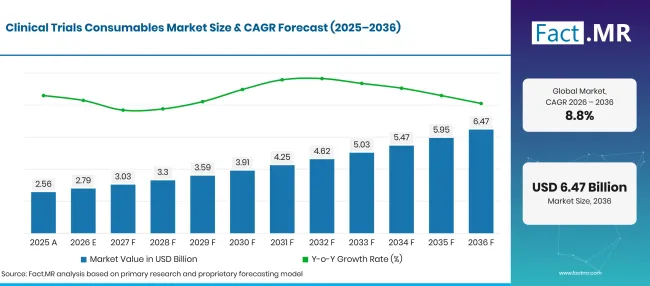
Clinical Trials Consumables Market Forecast Global | Source: Fact.MR
| Year | Basis | Market Value (USD billion) |
|---|---|---|
| 2025 | Actual | 2.56 |
| 2026 | Estimate | 2.79 |
| 2036 | Forecast | 6.47 |
| CAGR 2026 to 2036 | Forecast period | 8.8% |
Source: Fact.MR analysis. Updated Nov 2, 2026
What are the defining numbers behind Clinical Trials Consumables Market growth?
The 2026 to 2036 period adds USD 3.7 billion in new value, most of it tied to late-stage studies and protocol-specific kits.
- Demand Drivers in the Market
- The European Medicines Agency recorded 2,844 initial clinical trial applications through the Clinical Trials Information System in 2025 [1]. Each authorized multinational study opens a separate stream of orders for collection kits, reagents and shipping materials at every participating site.
- The European Commission counts more than 10,500 authorized studies running across over 9,500 European sites [2]. Around 6,500 of those are advanced-phase trials, which carry the heaviest sampling burden per participant.
- The U.S. Food and Drug Administration finalized its E6(R3) Good Clinical Practice guidance in September 2025, built around risk-based quality management [3]. Sponsors that tighten sample quality oversight tend to standardize on pre-labeled, protocol-specific kits that reduce site errors.
- Biomarker and molecular endpoints keep raising the number of tubes, stabilizers and assay reagents drawn per visit, especially in oncology and rare disease programs where small cohorts are tested intensively.
- Key Segments Analyzed
- By Product Type: Kits and Reagents will hold 38.5% share in 2026, since every protocol calls for its own assay reagents and pre-assembled visit kits.
- By Phase: Phase III will capture 38.2% of 2026 value given its large cohorts and long multi-site sampling calendars.
- By End-User: Pharmaceutical and Biotechnology Companies will account for 43.7% of 2026 revenue, as sponsors buy directly or set binding specifications for their vendors.
- Analyst Opinion at Fact.MR
- Shambhu Nath Jha, Principal Consultant at Fact.MR, states, “Consumable spend in clinical research tracks the number of samples. That count per patient keeps rising as protocols add biomarker and molecular endpoints. Suppliers that can deliver validated, pre-labeled kits to sites in many countries at once will win the larger Phase III contracts. Cold-chain reliability and sample traceability will separate preferred vendors from occasional ones through 2036.”
- Strategic Implications
- Manufacturers should build configurable kit platforms that pair collection tubes, stabilizers and assay reagents for specific protocols, with labeling that meets each country’s trial rules.
- Contract research organizations should consolidate consumable purchasing across their site networks so that one specification and one lot history follow a study from first patient to last.
- Sponsors should qualify at least two suppliers for critical tubes and reagents, because a single stock-out at a Phase III site can delay database lock.
- Investors should look at kitting, cold-chain packaging and biorepository capacity close to fast-growing trial hubs in Europe and Latin America.
Germany will post the quickest growth at 11.2%, helped by new federal rules that speed up trial approval. The United Kingdom follows at 10.3%, less than a point behind, as a rewritten trial framework shortens set-up. A wider gap of 2.4 points separates it from the United States at 7.9%, where trial activity is already large and growth comes from intensity per study. Brazil trails the United States by 0.6 points at 7.3% despite faster dossier reviews. Japan closes the group at 7.0% as it works to join more global studies.
How does the Clinical Trials Consumables Market break down by segment?
Kits and Reagents will lead Product Type at 38.5%; Phase III will head Phase at 38.2%; Pharmaceutical and Biotechnology Companies will hold End-User at 43.7% in 2026.
Which Product Type leads?
Kits and Reagents take 38.5% of 2026 sales.
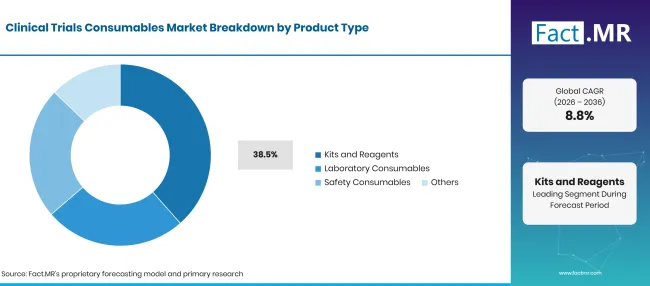
Clinical Trials Consumables Market Breakdown Product Type | Source: Fact.MR
| Product Type | Share (2026) |
|---|---|
| Kits and Reagents (Leading segment) | 38.5% |
| Other segments combined | 61.5%* |
| Total | 100.0% |
Source: Fact.MR analysis. Updated Nov 2, 2026
Protocol designers decide which analytes are measured at each visit, and every analyte needs a matching reagent or a tube with the right additive. Visit kits bundle these items with labels, requisition forms and shipping boxes, so site staff can collect a full sample set without sourcing parts locally. Growth in biomarker-based immunoassay testing adds reagent volume to each patient visit. Laboratory consumables such as pipette tips, plates, cryovials and specimen containers support processing and storage after collection. Safety consumables protect staff who handle biological specimens and chemicals. The others category covers specialized transport media and labels. Demand for ready-to-use laboratory test kits shows how sites prefer pre-assembled formats over loose components.
What supports Phase III within Phase?
Phase III represents 38.2% of 2026 revenue.
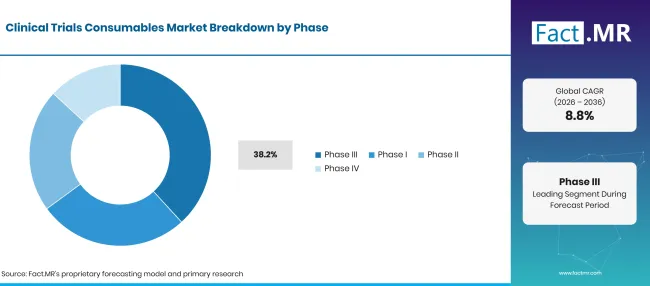
Clinical Trials Consumables Market Breakdown Phase | Source: Fact.MR
| Phase | Share (2026) |
|---|---|
| Phase III (Leading segment) | 38.2% |
| Other segments combined | 61.8%* |
| Total | 100.0% |
Source: Fact.MR analysis. Updated Nov 2, 2026
Late-stage studies confirm efficacy and safety across broad populations, which means more participants, more sites and longer follow-up. NIH-supported research enrolled 720,577 participants in NIH-defined Phase 3 clinical trials in fiscal year 2025 [4]. Each of those participants passes through repeated blood draws, safety laboratory panels and sample shipments to central laboratories. Phase I trials focus on safety and dosing in small groups, often with intensive pharmacokinetic sampling over a few days. Phase II studies test early efficacy and keep a heavy safety laboratory schedule. Phase IV work after approval monitors real-world use, and therapeutic drug monitoring in these studies keeps a steady need for collection and assay materials.
How does End-User shape demand?
Pharmaceutical and Biotechnology Companies command 43.7% of 2026 value.
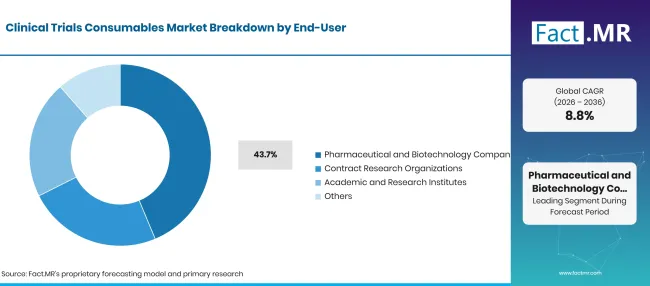
Clinical Trials Consumables Market Breakdown End User | Source: Fact.MR
| End-User | Share (2026) |
|---|---|
| Pharmaceutical and Biotechnology Companies (Leading segment) | 43.7% |
| Other segments combined | 56.3%* |
| Total | 100.0% |
Source: Fact.MR analysis. Updated Nov 2, 2026
Drug developers own the protocols, the budgets and the regulatory risk, so they set the consumable specifications that every vendor in a study must follow. Large sponsors often sign global supply agreements for tubes and kits to keep lot consistency across continents. Smaller biotechnology firms tend to buy through their central laboratory or CRO, though they still approve the kit design. Contract research organizations purchase or coordinate consumables for studies they manage on behalf of sponsors, and their share of trial operations keeps growing. Academic and research institutes use these products in investigator-led trials. Other end users include clinical laboratories handling clinical chemistry testing for trial safety panels.
What is accelerating Clinical Trials Consumables Market adoption, and what is holding it back?
More multinational studies, heavier sampling per patient and wider use of biomarker endpoints are lifting consumable volumes per trial. Sponsors and CROs also prefer validated kits that cut site errors. Against this, specialized kits and reagents are costly for small sponsors. Cold-chain shipping adds expense, and funding pauses can leave ordered stock unused.
Drivers Impact Analysis
| DRIVER | (~) % IMPACT ON CAGR | GEOGRAPHIC RELEVANCE | IMPACT TIMELINE |
|---|---|---|---|
| More multinational trials running at once, each needing its own kits, tubes and collection materials | +2.3% | Global | Medium term (2-4 years) |
| Heavier Phase III sampling schedules with repeat blood draws, storage aliquots and central lab shipments | +1.9% | North America, Western Europe, East Asia | Medium term (2-4 years) |
| Biomarker and molecular testing built into protocols, raising reagent use per patient | +1.6% | Global | Long term (>= 4 years) |
| Sponsors moving site and laboratory logistics to CROs that buy consumables in bulk | +1.5% | Global | Short term (<= 2 years) |
Source: Fact.MR analysis. Updated Nov 2, 2026
Opportunity Impact Analysis
| OPPORTUNITY | (~) % IMPACT ON CAGR | GEOGRAPHIC RELEVANCE | IMPACT TIMELINE |
|---|---|---|---|
| Protocol-specific kits packed in advance to cut site preparation time and handling errors | +0.9% | Global | Medium term (2-4 years) |
| Oncology and rare disease studies that draw many sample types from small cohorts | +0.7% | North America, Western Europe, East Asia | Long term (>= 4 years) |
| Faster trial approvals opening new sites in Latin America | +0.5% | Latin America | Medium term (2-4 years) |
| Home and remote sample collection kits for decentralized visits | +0.4% | North America, Western Europe | Long term (>= 4 years) |
Source: Fact.MR analysis. Updated Nov 2, 2026
Restraints Impact Analysis
| RESTRAINT | (~) % IMPACT ON CAGR | GEOGRAPHIC RELEVANCE | IMPACT TIMELINE |
|---|---|---|---|
| High cost of specialized kits, reagents and sterile consumables for smaller sponsors and sites | -0.4% | Global | Short term (<= 2 years) |
| Cold-chain and sample integrity rules that add shipping cost and limit supplier choice | -0.2% | Global | Medium term (2-4 years) |
| Trial delays and cancellations when funding tightens, leaving ordered stock unused | -0.1% | North America, Western Europe | Short term (<= 2 years) |
| Label and import requirements that differ by country and slow kit release | -0.1% | Emerging markets | Medium term (2-4 years) |
Source: Fact.MR analysis. Updated Nov 2, 2026
Which countries are scaling the Clinical Trials Consumables Market through 2036?
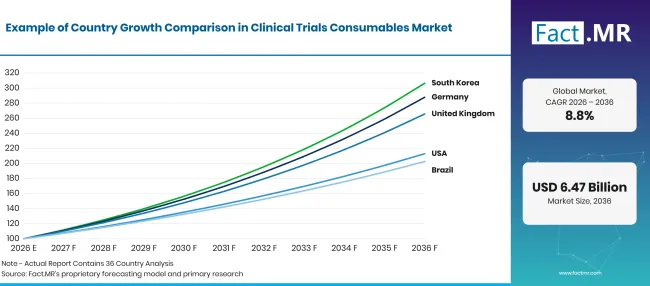
Clinical Trials Consumables Market Growth Index | Source: Fact.MR
| Country | CAGR (2026 to 2036) |
|---|---|
| Germany | 11.2% |
| United Kingdom | 10.3% |
| United States | 7.8% |
| Brazil | 7.3% |
| Japan | 7.0% |
Source: Fact.MR analysis. Updated Nov 2, 2026
What supports clinical trials consumables adoption in Germany?
11.2% CAGR, backed by federal reforms that cut trial approval steps.
Germany received 809 clinical trial applications in 2024, and 351 of them concerned vaccines and biomedicines, according to the Paul-Ehrlich-Institut [5]. The Medical Research Act, in force since 30 October 2024, folds radiation protection approval into the trial process and speeds up procedures. At the Paul-Ehrlich-Institut alone, applications for substantial modifications rose to 1,623 in 2025 from 1,065 in 2024 [6]. Amended protocols often add visits or analytes, which means new kit builds.
How is the United Kingdom developing demand?
10.3% CAGR, helped by a rewritten clinical trials law.
The UK government set a target to cut the time from trial application to first participant from 250 days to 150 days [7]. The amended Clinical Trials Regulations took full effect on 28 April 2026, with a single combined application to the MHRA and a research ethics committee and a decision due within 30 days of validation [8]. Earlier site activation brings forward orders for collection kits and laboratory supplies.
What is supporting United States adoption?
7.8% CAGR, reflecting deeper testing within an already large trial base.
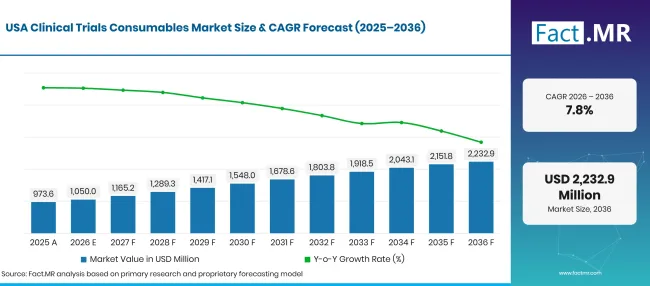
Clinical Trials Consumables Market Forecast Usa | Source: Fact.MR
NIH-supported clinical research enrolled 8,202,424 participants at U.S. sites in fiscal year 2025 [4]. The FDA’s final E6(R3) guidance asks sponsors to apply risk-based quality management to trial conduct [3]. Sponsors respond by tightening control over how samples are collected and shipped, which favors validated kits and tracked consumables. Growth here comes less from new trial counts and more from added tests per participant.
How is Brazil developing demand?
7.3% CAGR, driven by quicker review of trial dossiers.
ANVISA received 352 clinical trial dossiers in 2025, up 11% from 315 in 2024, and 64% of them covered Phase III studies [9]. Reliance-based review cut the agency’s average time on prioritized files from about 137 days to 84 days. Faster clearance lets global programs open Brazilian sites sooner, and those sites need imported kits with Portuguese labeling.
What supports Japan’s adoption?
7.0% CAGR, as regulators remove barriers to global studies.
Japan’s PMDA states that a Japanese Phase 1 study before joining a multi-regional trial is in principle not required unless deemed necessary [10]. The policy targets the drug loss problem, where medicines approved abroad never enter development in Japan. Its August 2025 symposium on the policy drew more than 2,600 registered participants, and PMDA reports that multi-regional trials including Japan have increased. Each added study brings Japanese sites into global kit and central laboratory networks.
Who leads the Clinical Trials Consumables Market?
Competition splits into three groups. Thermo Fisher Scientific and Avantor act as integrated suppliers that combine clinical ancillary sourcing and kitting with sample storage and laboratory services. That model suits sponsors that want one vendor across many countries.
Thermo Fisher’s PPD clinical research business opened a bioanalytical and biomarker laboratory in Gothenburg, Sweden in May 2026 [11]. BD, Greiner Bio-One and SARSTEDT form a second group built on blood and specimen collection systems that sites already know. Tube additive chemistry and lot consistency drive selection in this tier. BD launched a three-tube urine collection kit in February 2026 aimed at reducing contamination and repeat collections [12]. QIAGEN and COPAN form a specialist group: QIAGEN through PAXgene stabilization tubes and nucleic acid kits for molecular endpoints, and COPAN through flocked swabs and transport media. Through 2036, the edge will go to suppliers that can validate a kit once and ship it unchanged to sites on several continents.
Which companies are the key providers?
Key companies in the Clinical Trials Consumables Market include Thermo Fisher Scientific, Avantor, BD, Greiner Bio-One, SARSTEDT, QIAGEN and COPAN Diagnostics.
- Thermo Fisher Scientific
- Avantor
- BD
- Greiner Bio-One
- SARSTEDT
- QIAGEN
- COPAN Diagnostics
Bibliography
- [1] European Medicines Agency. (2026). The European Medicines Agency’s contribution to science, medicines and health in 2025: Annual report 2025.
- [2] European Commission. (2025, December). Revolutionising Clinical Trials.
- [3] U.S. Food and Drug Administration. (2025, September). E6(R3) Good Clinical Practice (GCP).
- [4] National Institutes of Health. (2026, May 27). FY25 Enrollment Data from NIH-Supported Clinical Research Now Available.
- [5] Paul-Ehrlich-Institut. (2025, October 28). 2025 Annual Meeting: Dialogue Between the Paul-Ehrlich-Institut and the Pharma Deutschland Association.
- [6] Paul-Ehrlich-Institut. (2026, March 6). Processing statistics for applications for clinical trials.
- [7] Medicines and Healthcare products Regulatory Agency. (2025, April 11). Clinical Trials regulations signed into law.
- [8] Medicines and Healthcare products Regulatory Agency. (2026, April 28). Clinical trials for medicines: apply for approval in the UK.
- [9] Agência Nacional de Vigilância Sanitária. (2026, May 14). Relatório Anual de Atividades 2025: Coordenação de Pesquisa Clínica em Medicamentos e Produtos Biológicos.
- [10] Pharmaceuticals and Medical Devices Agency. (2026, January). PMDA Updates 2026 No. 1: Efforts toward promotion of multi-regional clinical trials in Japan.
- [11] Thermo Fisher Scientific. (2026, May 18). Thermo Fisher Scientific’s PPD Clinical Research Business Expands Bioanalytical Capabilities with New Laboratory in Gothenburg, Sweden.
- [12] BD. (2026, February 23). BD Expands Testing Capabilities to Help Clinicians Improve Diagnostic Accuracy and Efficiency.
This Report Answers
- How much revenue clinical trials consumables will generate from 2026 to 2036, split by product type, trial phase and end-user.
- Why kits and reagents, Phase III studies and drug developers hold the leading position in their categories.
- Which regulatory changes in Germany, the United Kingdom, the United States, Brazil and Japan explain their different growth rates.
- How sampling intensity, biomarker endpoints and multinational designs change consumable use per patient.
- Where integrated suppliers, collection specialists and molecular sample firms each hold an advantage.
- Which cost, cold-chain and funding risks slow purchasing at trial sites.
What does the Clinical Trials Consumables Market cover?
This market counts the single-use products that move a patient sample from the trial site to a result. That includes collection devices, visit kits, reagents, processing plastics, storage containers, transport media and protective items used by site and laboratory staff.
Values reflect sales of new products to sponsors, CROs, academic centers and laboratories at the point of purchase, across all four trial phases. Kitting labor is counted when it is billed as part of the kit price.
What is included in the scope?
Sample collection kits assembled for a specific protocol, including tubes, needles, cups, swabs, labels and shipping boxes.
Assay reagents, stabilizers and test kits used for trial safety panels and biomarker testing, including those used in drug screening programs within studies.
Laboratory plastics such as pipette tips, plates, cryovials and specimen containers used to process and store trial samples.
Safety consumables such as gloves, sharps containers and spill materials used during trial sample handling.
What is excluded from the scope?
Laboratory instruments, centrifuges, freezers, analyzers and other reusable equipment.
Investigational drugs, comparators and the cartons or blisters used for clinical trial packaging of study medication.
Clinical research services such as project management, patient recruitment, data management and regulatory consulting.
Routine hospital diagnostic consumables not purchased for a registered clinical trial.
How Was the Analysis Built?
The analysis draws on 120+ sources, 35+ company portfolios, 25+ countries, and more than 20 industry interviews.
- Primary Research: Primary research includes discussions with manufacturers, service providers, technology developers, distributors, end users, and subject-matter experts. These conversations examine purchasing priorities, product adoption, operational challenges, approval requirements, competitive positioning, and the factors that influence wider market acceptance.
- Desk Research: Desk research covers government statistics, regulatory publications, company filings, trade data, technical studies, industry associations, standards, public policy, and other authoritative sources. Every source used in the analysis is documented in the bibliography.
- Market Sizing and Forecasting: Market estimates combine historical performance, demand indicators, pricing and volume trends, segment shares, company participation, country-level growth, adoption patterns, investment activity, and barriers to market expansion.
- Data Validation and Update Cycle: Findings are validated by comparing primary interviews with public data, company activity, regulatory changes, trade patterns, and industry developments. Regular updates review new product launches, capacity changes, partnerships, approvals, and shifts in commercial adoption.
Segmentation
What is the report’s scope and coverage?
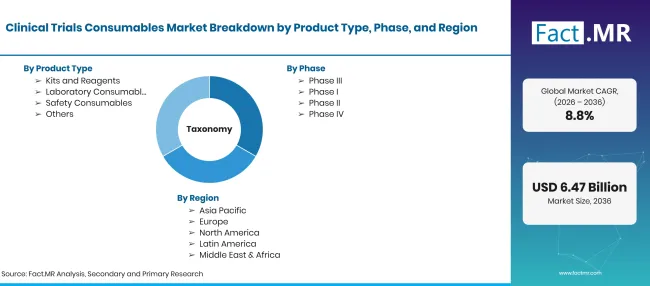
Clinical Trials Consumables Market Taxonomy | Source: Fact.MR
| Attribute | Details |
|---|---|
| Quantitative Units | USD billion in 2026 to USD billion by 2036 at CAGR |
| Market Definition | Consumable products used in clinical trials for sample collection, preparation, testing, storage, transport and staff safety. |
| Product Type | Kits and Reagents; Laboratory Consumables; Safety Consumables; Others |
| Phase | Phase III; Phase I; Phase II; Phase IV |
| End-User | Pharmaceutical and Biotechnology Companies; Contract Research Organizations; Academic and Research Institutes; Others |
| Regions Covered | North America; Latin America; Western Europe; Eastern Europe; East Asia; South Asia & Pacific; Middle East & Africa |
| Countries Covered | Germany; United Kingdom; United States; Brazil; Japan |
| Companies Profiled | Thermo Fisher Scientific; Avantor; BD; Greiner Bio-One; SARSTEDT; QIAGEN; COPAN Diagnostics |
| Forecast Period | 2026 to 2036 |
| Approach | Trial activity by phase and region was combined with consumable use per participant and supplier portfolio checks to build top-down and bottom-up estimates. |
Source: Fact.MR analysis. Updated Nov 2, 2026
How is the market segmented?
-
By Product Type
- Kits and Reagents
- Laboratory Consumables
- Safety Consumables
- Others
-
By Phase
- Phase III
- Phase I
- Phase II
- Phase IV
-
By End-User
- Pharmaceutical and Biotechnology Companies
- Contract Research Organizations
- Academic and Research Institutes
- Others
-
By Region
- North America
- Latin America
- Western Europe
- Eastern Europe
- East Asia
- South Asia & Pacific
- Middle East & Africa
Frequently Asked Questions
How large is the clinical trials consumables market in 2026?
What growth rate will the clinical trials consumables market record?
Which product type leads?
Which phase leads?
Which end-user leads?
Which country will grow quickest?
Who are the main companies?
What holds the market back?
Who worked on this report


Preview the report firsthand - request a free sample
Free SampleGet the brochure for pricing and purchase details
Download PDF