- Market Value (2025): USD 7.9 Bn
- Estimated Value (2026): USD 8.7 Bn
- Forecast Value (2036): UUSD 23.4 Bn
- CAGR (2026-2036): 10.4%
What is the Decentralized Clinical Trials Contract Research Organization CRO Market forecast to be worth by 2036?
USD 8.7 billion in 2026 to USD 23.4 billion by 2036 at 10.4% CAGR.
- The decentralized clinical trials contract research organization CRO market reached USD 7.9 billion in 2025.
- Demand is projected to increase from USD 8.7 billion in 2026 to USD 23.4 billion by 2036.
- The market is forecast to record 10.4% CAGR from 2026 to 2036.
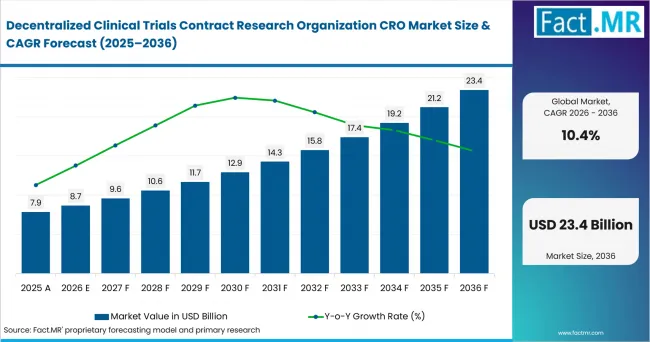
Decentralized Clinical Trials Contract Research Organization Cro Market Value Analysis | Source: Fact.MR
What are the defining numbers behind Decentralized Clinical Trials Contract Research Organization CRO Market growth?
USD 14.7 billion absolute opportunity is expected between 2026 and 2036.
- Demand Drivers in the Market
- Sponsors are expected to use decentralized CRO models when recruitment must reach beyond large trial sites.
- Trial teams need partners that can manage remote consent without weakening protocol control.
- Pharmaceutical companies are anticipated to rely on CROs when late-stage studies require enrollment scale and careful documentation.
- Digital platform use is expected to raise demand for providers that can manage recruitment and monitoring inside one operating plan.
- Key Segments Analyzed
- By Service Type: Virtual Patient Recruitment is expected to hold 36.0% share in 2026 because enrollment reach is the first test for decentralized studies.
- By Trial Phase: Phase III Trials are projected to account for 39.0% share in 2026 since large studies require wider patient access.
- By Therapeutic Area: Oncology is anticipated to capture 34.0% share in 2026 as complex studies need screening discipline and close follow-up.
- By Sponsor Type: Pharmaceutical Companies are estimated to represent 42.0% share in 2026 due to large pipelines and outsourcing budgets.
- By Digital Platform: Cloud-based Trial Management is forecast to hold 38.0% share in 2026 as sponsors need central oversight.
- Analyst Opinion at Fact.MR
- Shambhu Nath Jha, Principal Consultant at Fact.MR, states, “Decentralized clinical trials CRO providers must prove that remote delivery protects protocol quality and patient safety. Sponsors are expected to reward partners that combine recruitment reach with reliable data control and site support.”
- Strategic Implications
- CRO providers should define which trial activities can move outside sites. This helps sponsors judge protocol fit before vendor selection.
- Service teams can strengthen retention by documenting recruitment steps and remote monitoring procedures. Clear evidence is expected to reduce sponsor risk.
- Commercial teams should price around measurable study support. Sponsors are likely to compare providers on enrollment progress and data quality.
The USA leads at 11.5% CAGR through clinical research depth and sponsor concentration. Germany follows at 10.9% as compliance-led execution supports CRO demand. The UK reaches 10.3% through research-network access. Japan records 9.8% through disciplined trial quality. Canada reaches 9.2% through North American sponsor proximity. Australia posts 8.7% through regional study coordination. Singapore reaches 8.1% through specialist healthcare access.
How does the Decentralized Clinical Trials Contract Research Organization CRO Market break down by segment?
Virtual Patient Recruitment is expected to lead Service Type at 36.0% share in 2026. Phase III Trials are projected to lead Trial Phase at 39.0% share in 2026.
Why does virtual patient recruitment lead service type?
Virtual patient recruitment is projected to account for 36.0% share in 2026.
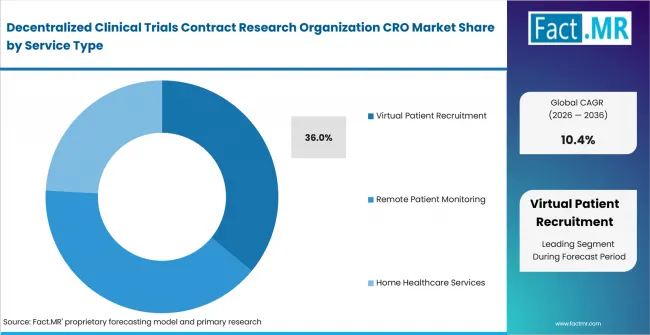
Decentralized Clinical Trials Contract Research Organization Cro Market Analysis By Service Type | Source: Fact.MR
Recruitment becomes the first major challenge when trials move beyond traditional sites. CROs gain value by managing outreach, screening and enrollment across wider patient groups. Clinical trial logistics adds support when home visits, sample collection and local delivery become part of the study design.
Why do phase III trials lead trial phase?
Phase III trials are expected to hold 39.0% share in 2026.
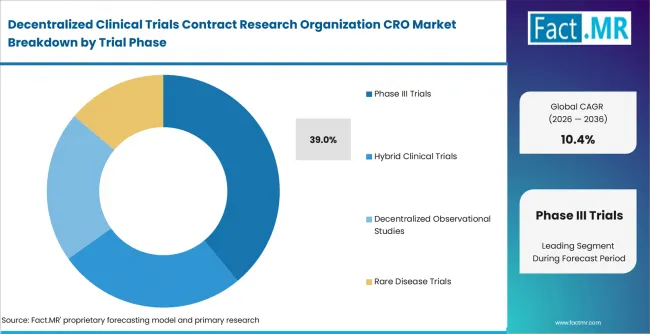
Decentralized Clinical Trials Contract Research Organization Cro Market Analysis By Trial Phase | Source: Fact.MR
Larger patient populations and more monitoring events give late-stage studies the strongest demand for decentralized support. Sponsors use CROs to improve enrollment speed and maintain follow-up across locations. Clinical trial kits also simplify local collection and reduce unnecessary site visits.
Why does oncology lead therapeutic area?
Oncology is anticipated to account for 34.0% share in 2026.
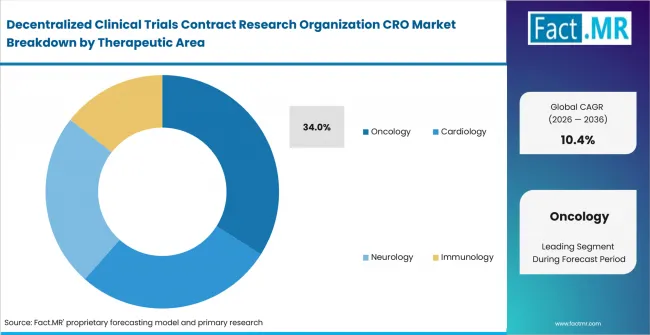
Decentralized Clinical Trials Contract Research Organization Cro Market Analysis By Therapeutic Area | Source: Fact.MR
Cancer studies involve strict eligibility criteria, frequent safety checks and complex treatment schedules. Decentralized models help reduce travel while keeping patient contact active. Omics-based clinical trials further increase demand for coordinated biomarker screening and specialist review.
What keeps pharmaceutical companies ahead by sponsor type?
Pharmaceutical companies are estimated to represent 42.0% share in 2026.
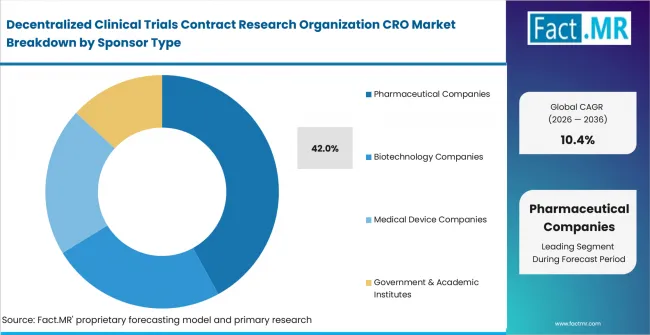
Decentralized Clinical Trials Contract Research Organization Cro Market Analysis By Sponsor Type | Source: Fact.MR
Large sponsors have the financial and operational capacity to outsource distributed trial activities at scale. RNA therapy clinical trials add further demand because repeated follow-up, protocol adherence and patient communication must remain consistent across the study period.
Why does cloud-based trial management lead digital platform?
Cloud-based trial management is forecast to hold 38.0% share in 2026.
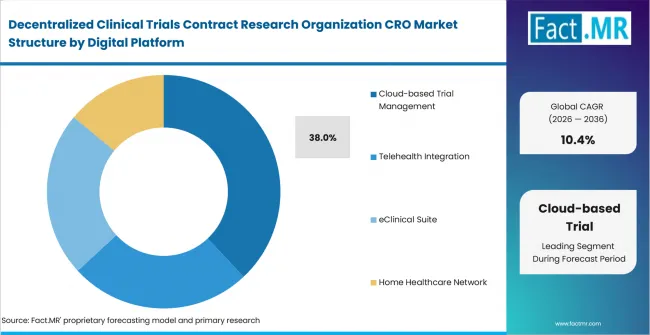
Decentralized Clinical Trials Contract Research Organization Cro Market Analysis By Digital Platform | Source: Fact.MR
A shared digital layer helps sponsors coordinate enrollment, monitoring and data review across dispersed trial locations. Cloud systems provide one operating view for study teams. Telehealth therapy services, home healthcare and specialist field support become easier to manage when schedules and records remain connected.
What is accelerating Decentralized Clinical Trials Contract Research Organization CRO Market adoption, and what is holding it back?
Demand is expected to rise as sponsors use decentralized elements to improve patient access. Growth may be limited by compliance review and service cost.
Drivers Impact Analysis
| DRIVER | (~) % IMPACT ON CAGR | GEOGRAPHIC RELEVANCE | IMPACT TIMELINE |
|---|---|---|---|
| Adoption and integration | +1.6% | Global | Short term (<= 2 years) |
| Regulatory and compliance support | +1.4% | USA, Germany, UK | Short term (<= 2 years) |
| Channel and access expansion | +1.1% | Global | Medium term (2-4 years) |
| Clear specification and documentation | +0.9% | USA, UK, Canada | Medium term (2-4 years) |
| Cost and efficiency gains | +0.6% | Global | Long term (>= 4 years) |
Source: Fact.MR analysis. Updated Aug 6, 2026
- Adoption and integration: Sponsors are expected to use decentralized elements when CROs can place remote tasks inside trial operations.
- Regulatory and compliance support: CROs that document consent clearly are expected to gain more sponsor trust.
- Channel and access expansion: Wider patient reach is anticipated to support demand where sites cannot find enough eligible participants.
Opportunity Impact Analysis
| OPPORTUNITY | (~) % IMPACT ON CAGR | GEOGRAPHIC RELEVANCE | IMPACT TIMELINE |
|---|---|---|---|
| Emerging application expansion | +1.0% | Global | Medium term (2-4 years) |
| Premium and specialist positioning | +0.8% | USA, UK, Germany | Medium term (2-4 years) |
| Channel and partner expansion | +0.7% | Global | Long term (>= 4 years) |
| Standards and compliance alignment | +0.5% | USA, Canada, Singapore | Long term (>= 4 years) |
Source: Fact.MR analysis. Updated Aug 6, 2026
- Emerging application expansion: Rare disease studies are expected to create room for specialist decentralized CRO models.
- Premium and specialist positioning: Providers with therapeutic depth are expected to defend pricing against general outsourcing vendors.
- Channel and partner expansion: Nursing partnerships are anticipated to widen delivery capacity without requiring CROs to build every capability internally.
Restraints Impact Analysis
| RESTRAINT | (~) % IMPACT ON CAGR | GEOGRAPHIC RELEVANCE | IMPACT TIMELINE |
|---|---|---|---|
| Cost and complexity | -1.1% | Global | Short term (<= 2 years) |
| Specification and compliance checks | -0.9% | USA, UK, Germany | Short term (<= 2 years) |
| Substitution by lower-cost alternatives | -0.7% | Import-dependent markets | Medium term (2-4 years) |
| Supply chain and pricing pressure | -0.5% | Global | Long term (>= 4 years) |
Source: Fact.MR analysis. Updated Aug 6, 2026
- Cost and complexity: Decentralized service models can raise planning effort when sponsors coordinate home healthcare support.
- Specification and compliance checks: Sponsors may slow adoption when remote elements need extra regulatory review.
- Substitution by lower-cost alternatives: Some sponsors are expected to choose site-based outsourcing when full decentralized support looks costly.
Which countries are scaling the Decentralized Clinical Trials Contract Research Organization CRO Market fastest?
- The country comparison spans 3.4 percentage points across the profiled markets.
- The USA remains 0.6 percentage point above Germany through deeper sponsor concentration.
- Germany remains 0.6 percentage point above the UK because compliance-led execution favors structured CRO delivery.
- The UK remains 0.5 percentage point above Japan with research-network access helping trial setup.
- Japan remains 0.6 percentage point above Canada through disciplined study quality and careful vendor review.
- Canada remains 0.5 percentage point above Australia where North American sponsor proximity aids outsourcing decisions.
- Australia remains 0.6 percentage point above Singapore as regional study coordination expands patient reach.
Comparable CAGRs can create different entry conditions due to sponsor mix and trial density. Full report coverage includes North America and Latin America. Europe and East Asia follow. South Asia and Pacific plus Middle East and Africa complete the regional view.
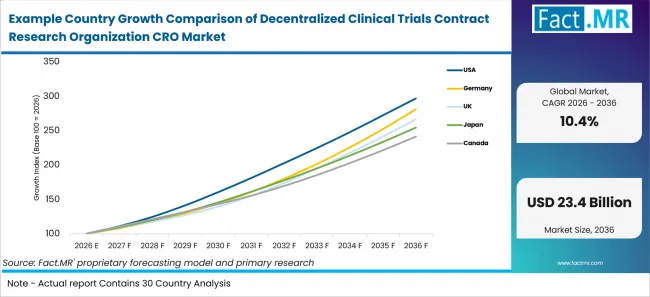
Example Country Growth Comparison Of Decentralized Clinical Trials Contract Research Organization Cro Market | Source: Fact.MR
| Country | CAGR (2026-2036) |
|---|---|
| USA | 11.5% |
| Germany | 10.9% |
| UK | 10.3% |
| Japan | 9.8% |
| Canada | 9.2% |
| Australia | 8.7% |
| Singapore | 8.1% |
Source: Fact.MR analysis. Updated Aug 6, 2026
What supports USA adoption?
11.5% CAGR, supported by sponsor concentration and digital trial infrastructure.
USA sponsors evaluate vendor depth before moving patient-facing work outside traditional sites. CROs are expected to win demand when they protect protocol control.
How is Germany scaling demand?
10.9% CAGR, driven by compliance-led clinical development and structured trial execution.
Germany is expected to favor CROs that can show disciplined study procedures. Sponsors are likely to approve decentralized elements when documentation is easy to audit.
What is driving the UK’s growth from 2026 to 2036?
10.3% CAGR, backed by research-network access and sponsor familiarity with outsourcing.
Research-network access gives the UK a practical base for hybrid study activity. Sponsors are expected to use CRO support when remote follow-up fits trial pathways.
How is Japan developing demand?
9.8% CAGR, led by trial quality expectations and specialist CRO coordination.
Japanese sponsors are expected to review decentralized delivery carefully before wider use. CRO demand should advance where providers can show patient communication discipline.
What supports Canada’s growth?
9.2% CAGR, supported by North American sponsor proximity and outsourced study-management depth.
Canada’s geography makes remote contact useful across several provinces. CROs are expected to support recruitment where site-only models add patient burden.
How does Australia perform?
8.7% CAGR, led by clinical trial participation and regional study coordination.
Australia’s clinical research base gives sponsors a route for regional studies. Decentralized CRO models are expected to help when remote assessment reduces travel.
What supports Singapore’s growth?
8.1% CAGR, backed by specialist healthcare access and regional trial coordination.
Singapore’s compact healthcare setting favors controlled study management. CRO demand is expected to concentrate on regional coordination and governed decentralized delivery.
Who leads the Decentralized Clinical Trials Contract Research Organization CRO Market?
IQVIA and Parexel hold strong positions through decentralized trial services, digital coordination and global study delivery, while Syneos Health and Fortrea add wider clinical outsourcing capacity.
ICON supports connected site networks and hybrid study execution. Medpace contributes focused CRO delivery for complex trials. Medable strengthens the digital platform layer, while PPD, Worldwide Clinical Trials and Precision for Medicine broaden support across remote recruitment, monitoring, specialist therapeutics and patient-centered study operations.
Which companies are the key providers?
Key companies include IQVIA Holdings Inc.; Parexel International Corporation; Syneos Health, Inc.; Fortrea Inc.; ICON plc; Medpace Holdings, Inc.; Medable, Inc.; PPD, INC. – THERMO FISHER SCIENTIFIC; Worldwide Clinical Trials; Precision for Medicine, Inc.
- IQVIA Holdings Inc.
- Parexel International Corporation
- Syneos Health, Inc.
- Fortrea Inc.
- ICON plc
- Medpace Holdings, Inc.
- Medable, Inc.
- PPD, INC. – THERMO FISHER SCIENTIFIC
- Worldwide Clinical Trials
- Precision for Medicine, Inc.
Bibliography
- Food and Drug Administration. (2024, September). Conducting clinical trials with decentralized elements.
- IQVIA. (2025, March 10). IQVIA recognized as a leader in IDC MarketScape’s 2024 assessment for decentralized clinical trial technologies and consulting services.
- Parexel International Corporation. (2025, September 15). Parexel and Paradigm Health partner to expand access and efficiency in clinical trials.
- ICON plc. (2026, March 24). ICON and Advarra introduce new research-ready, connected site network model.
This Report Answers
- The report provides strategic intelligence on Service Type and Trial Phase choices that shape decentralized CRO demand.
- Segment analysis covers Virtual Patient Recruitment and Phase III Trials as the share leaders within the 2026 market.
- Country outlook evaluates the USA and Germany. The UK and Japan follow. Canada, Australia and Singapore complete the growth comparison.
- Competitive analysis profiles IQVIA Holdings Inc. and Parexel International Corporation. Syneos Health, Inc. and Fortrea Inc. follow. ICON plc completes the central provider group.
- Platform assessment covers Cloud-based Trial Management and Telehealth Integration. eClinical Suite and Home Healthcare Network complete the digital view.
What does the Decentralized Clinical Trials Contract Research Organization CRO Market cover?
Decentralized clinical trials CRO services support sponsor-led studies where selected patient activities move beyond traditional trial sites.
The market covers virtual recruitment and remote monitoring. Home healthcare support is included. Phase III Trials and Hybrid Clinical Trials carry the main trial-phase scope.
What is included in the scope?
The scope includes decentralized and hybrid trial support across the listed segments and countries.
Service Type includes Virtual Patient Recruitment and Remote Patient Monitoring. Home Healthcare Services completes the service view. The country view includes the USA and Germany. UK and Japan follow. Canada, Australia and Singapore complete the scope.
What is excluded from the scope?
Services outside decentralized or hybrid clinical trial support remain outside this market.
The scope excludes conventional CRO services without remote or hybrid elements. Standalone software is excluded unless it is sold as part of CRO-led study execution.
How Was the Analysis Built?
The analysis draws on 120+ sources and 35+ company portfolios. It reviews 25+ countries and more than 20 interviews.
- Primary Research: Primary research includes discussions with manufacturers and service providers. Technology developers provide input on approval requirements. These conversations examine purchasing priorities.
- Desk Research: Desk research covers government statistics and regulatory publications. Company filings and standards are reviewed where they support the scope.
- Market Sizing and Forecasting: Market estimates combine historical performance and demand indicators. Segment shares are reviewed against company participation and country-level growth.
- Data Validation and Update Cycle: Findings are validated by comparing interviews with public data. Updates review service launches and partnerships.
Segmentation
What is the report’s scope and coverage?
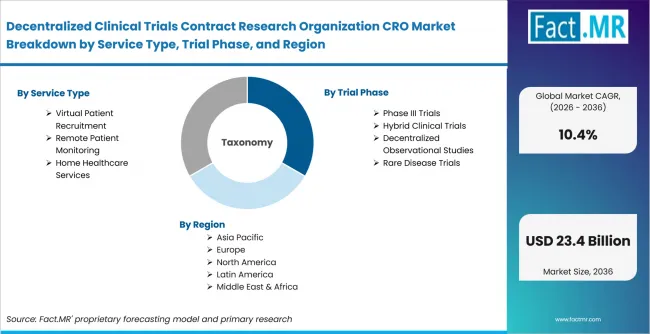
Decentralized Clinical Trials Contract Research Organization Cro Market Breakdown By Service Type, Trial Phase, And Region | Source: Fact.MR
| Attribute | Details |
|---|---|
| Quantitative Units | USD billion |
| Market Definition | CRO-led support for decentralized or hybrid clinical research across remote recruitment, home-based support, digital data capture and trial coordination |
| Service Type | Virtual Patient Recruitment; Remote Patient Monitoring; Home Healthcare Services |
| Trial Phase | Phase III Trials; Hybrid Clinical Trials; Decentralized Observational Studies; Rare Disease Trials |
| Therapeutic Area | Oncology; Cardiology; Neurology; Immunology |
| Sponsor Type | Pharmaceutical Companies; Biotechnology Companies; Medical Device Companies; Government & Academic Institutes |
| Digital Platform | Cloud-based Trial Management; Telehealth Integration; eClinical Suite; Home Healthcare Network |
| Regions Covered | North America; Latin America; Europe; East Asia; South Asia and Pacific; Middle East and Africa |
| Countries Covered | USA; Germany; UK; Japan; Canada; Australia; Singapore |
| Key Companies Profiled | IQVIA Holdings Inc.; Parexel International Corporation; Syneos Health, Inc.; Fortrea Inc.; ICON plc; Medpace Holdings, Inc.; Medable, Inc.; PPD, INC. – THERMO FISHER SCIENTIFIC; Worldwide Clinical Trials; Precision for Medicine, Inc. |
| Forecast Period | 2026 to 2036 |
| Approach | Hybrid top-down and bottom-up approach using segment demand; sponsor outsourcing patterns; decentralized service adoption; recruitment needs; remote monitoring use; country growth; pricing; platform integration; regulatory documentation and portfolio review |
Source: Fact.MR analysis. Updated Aug 6, 2026
How is the market segmented?
-
By Service Type
- Virtual Patient Recruitment
- AI-enabled Patient Matching
- Remote Patient Enrollment
- Remote Patient Monitoring
- Wearable Device Monitoring
- ePRO & eCOA Services
- ePRO Solutions
- eCOA Solutions
- Home Healthcare Services
- Home Nursing Visits
- Home Sample Collection
- Virtual Patient Recruitment
-
By Trial Phase
- Phase III Trials
- Global Multicenter Studies
- Adaptive Clinical Trials
- Hybrid Clinical Trials
- Chronic Disease Studies
- Decentralized Observational Studies
- Real-world Evidence Studies
- Patient Registry Studies
- Rare Disease Trials
- Orphan Drug Studies
- Gene Therapy Trials
- Phase III Trials
-
By Therapeutic Area
- Oncology
- Solid Tumors
- Hematologic Cancers
- Cardiology
- Heart Failure
- Neurology
- Neurodegenerative Disorders
- Rare Neurological Diseases
- Immunology
- Autoimmune Disorders
- Inflammatory Diseases
- Oncology
-
By Sponsor Type
- Pharmaceutical Companies
- Global Pharma Companies
- Specialty Pharma Companies
- Biotechnology Companies
- Emerging Biotech Firms
- Medical Device Companies
- Device Manufacturers
- Diagnostic Companies
- Government & Academic Institutes
- Research Institutes
- Public Health Agencies
- Pharmaceutical Companies
-
By Digital Platform
- Cloud-based Trial Management
- Clinical Data Platform
- eConsent Platform
- Telehealth Integration
- Remote Monitoring Platform
- eClinical Suite
- Cloud Analytics
- AI-enabled Patient Analytics
- Home Healthcare Network
- Connected Care Platform
- Integrated Telemedicine
- Cloud-based Trial Management
-
By Region
- North America
- Latin America
- Europe
- East Asia
- South Asia and Oceania
- Middle East and Africa
Frequently Asked Questions
How big is the decentralized clinical trials contract research organization CRO market in 2026?
What is the CAGR of the decentralized clinical trials contract research organization CRO market from 2026 to 2036?
The decentralized clinical trials contract research organization CRO market is projected to grow at a CAGR of 10.4% between 2026 and 2036, supported by wider patient recruitment, remote consent management and growing use of digital trial platforms.
Which trial phase leads the decentralized clinical trials contract research organization CRO market?
Who are the leading companies in the decentralized clinical trials contract research organization CRO market?
Who worked on this report


Preview the report firsthand - request a free sample
Free SampleGet the brochure for pricing and purchase details
Download PDF