What is the closed IV spikes market forecast to be worth by 2036?
USD 335 million in 2026 to USD 760 million by 2036 at 8.5% CAGR.
- The Closed IV Spikes Market was valued at USD 310 million in 2025.
- The market is estimated at USD 335 million in 2026. It is projected to reach USD 760 million by 2036.
- The market is forecast to expand at 8.5% CAGR during the forecast period as demand for closed system infusion devices continues rising and infection prevention remains a clinical priority.
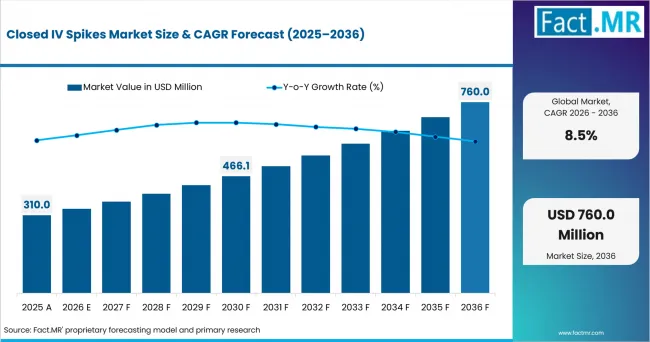
Closed Iv Spikes Market Market Value Analysis | Source: Fact.MR
What are the defining numbers behind closed IV spikes growth?
USD 425 million absolute opportunity by 2036 led by the United States and Germany.
- Demand Drivers in the Market
- Safe infusion practices continue strengthening worldwide.
- Oncology drug preparation continues increasing.
- Hospitals continue adopting closed transfer devices.
- Infection prevention standards continue supporting product demand.
- Key Segments Analyzed
- By Spike Type: Closed Spikes are expected to hold 35.0% share in 2026 because they reduce contamination during fluid transfer.
- By Safety Feature: Needle-Free is projected to account for 33.0% share in 2026 because it improves healthcare worker safety.
- By Fluid Type: IV Fluids are expected to hold 39.0% share in 2026 because they remain the most widely administered infusion products.
- By End User: Hospitals are projected to account for 58.0% share in 2026 because they perform the highest number of infusion procedures.
- By Geography: The United States is projected to record 8.9% CAGR through 2036.
- Analyst Opinion at Fact.MR
- Shambhu Nath Jha, Senior Analyst at Fact.MR, states, "Closed IV spikes are becoming an important part of safe infusion practice. Healthcare providers continue adopting closed transfer devices that reduce contamination risk and improve medication handling. Growing demand for oncology infusion and sterile compounding will support long-term market growth."
- Strategic Implications
- Expand production of closed transfer spike systems.
- Improve compatibility across IV containers.
- Strengthen partnerships with hospitals and compounding pharmacies.
- Invest in advanced fluid transfer safety technologies.
Closed IV spikes are sterile transfer devices used to access IV bags or bottles while minimizing leakage, contamination risk, and exposure during medication preparation or infusion. They support safer medication preparation and infusion across hospitals and pharmacies.
The United States is projected to record 8.9% CAGR through 2036 because hospitals continue strengthening infusion safety programs. Germany is expected to grow at 8.6% CAGR due to wider adoption of closed fluid transfer products. Japan is forecast to expand at 8.4% CAGR as healthcare providers improve medication safety practices. China is projected to register 8.2% CAGR through 2036 because hospital infrastructure continues expanding. South Korea is expected to grow at 8.0% CAGR due to increasing investment in oncology and infusion services.
How is the closed IV spikes market segmented?
Closed Spikes lead at 35.0%. Hospitals lead at 58.0%.
Which spike type generates the highest demand?
Closed Spikes hold 35.0% share in 2026.
Closed spikes lead because they reduce fluid exposure during medication preparation. They help maintain a sterile transfer path while lowering contamination risk. Healthcare providers prefer these products because they support safer infusion practices. They also improve handling of high value medications. Demand remains strong across hospital pharmacies and infusion units. Epic Medical Pte. Ltd. received FDA 510(k) clearance for the ZeroClear™ Bag Access, a component of the ProSeal™ Closed System Drug Transfer Device (CSTD) system. The device features an ISO 8536-4:2019 compliant IV bag spike and a bi-directional Luer lock connector for injecting and infusing IV fluids and drug solutions.
Which safety feature sees the highest adoption?
Needle-Free systems account for 33.0% share in 2026.
Needle-free designs remain the leading safety feature because they reduce accidental needlestick injuries. They also simplify fluid transfer during routine clinical practice. Healthcare facilities continue adopting these systems to improve staff safety. Compatibility with existing infusion equipment further supports demand. The Centers for Disease Control and Prevention continues to recommend the use of needleless intravascular catheter systems as part of evidence-based strategies to prevent occupational needlestick injuries and improve injection safety.
Which fluid type accounts for the largest market share?
IV Fluids hold 39.0% share in 2026.
IV fluids generate the highest demand because they are administered across almost every healthcare setting. Large procedure volumes continue supporting regular product use. Closed IV spikes help maintain sterile fluid transfer throughout preparation. They also reduce leakage during administration. Demand remains steady across acute and long-term care. B. Braun highlighted continued investments to increase the production of IV fluids and infusion therapy devices, including tubing, valves, connectors, and related products, to help meet sustained healthcare demand during the 2024 IV fluid shortage.
Which end-user segment leads the market?
Hospitals lead with 58.0% share in 2026.
Hospitals remain the largest end users because they perform the highest number of infusion procedures. They also follow strict medication handling and infection prevention protocols. Many healthcare facilities continue replacing conventional transfer devices with closed systems. This improves workflow while supporting patient safety. Demand remains highest across large medical centers. In 2024, the Infusion Nurses Society updated its Infusion Therapy Standards of Practice, reinforcing the use of aseptic technique, needleless connectors, and closed infusion systems to reduce contamination and catheter-related infections in healthcare settings.
What factors are driving market expansion?
Safe medication handling supports growth, while product cost remains a challenge.
Healthcare providers continue strengthening infusion safety practices to reduce contamination risk. Wider use of hazardous drugs is also increasing demand for closed transfer products. Growth in oncology treatment and sterile compounding continues supporting product adoption.
Updated healthcare guidelines further encourage safer medication preparation. Higher product cost remains a challenge for smaller healthcare facilities. Budget limitations may slow adoption in price-sensitive markets.
Where are future growth opportunities emerging?
- Oncology Pharmacies: Cancer treatment continues expanding worldwide. Closed transfer products improve safe drug preparation.
- Compounding Pharmacies: Sterile compounding services continue growing. Closed IV spikes support contamination control.
- Home Infusion Services: More patients are receiving infusion therapy at home. Closed systems improve medication safety outside hospitals.
- Ambulatory Surgery Centers: Outpatient procedures continue increasing. Closed fluid transfer products improve workflow efficiency.
- Emerging Healthcare Markets: Healthcare investment continues expanding across developing countries. Better access to infusion therapy supports future product demand.
Which countries are expanding the adoption of closed IV spikes?
United States 8.9%, Germany 8.6%, Japan 8.4%, China 8.2%, South Korea 8.0%.
Regional demand continues rising as healthcare providers strengthen infusion safety practices and improve sterile medication preparation. North America leads regional demand, while Asia Pacific continues creating opportunities through healthcare infrastructure expansion.
| Country | CAGR (2026-2036) |
|---|---|
| United States | 8.9% |
| Germany | 8.6% |
| Japan | 8.4% |
| China | 8.2% |
| South Korea | 8.0% |
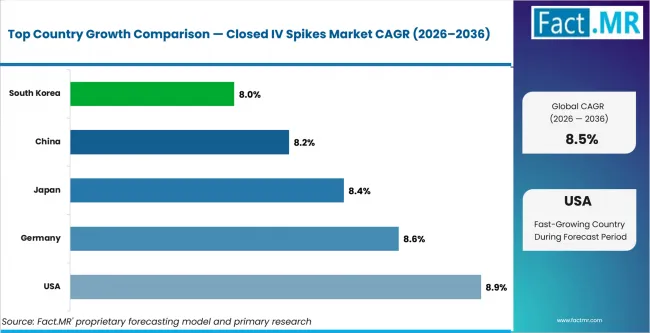
Closed Iv Spikes Market Cagr Analysis By Country | Source: Fact.MR
What supports the United States lead?
8.9% CAGR, supported by advanced infusion safety practices
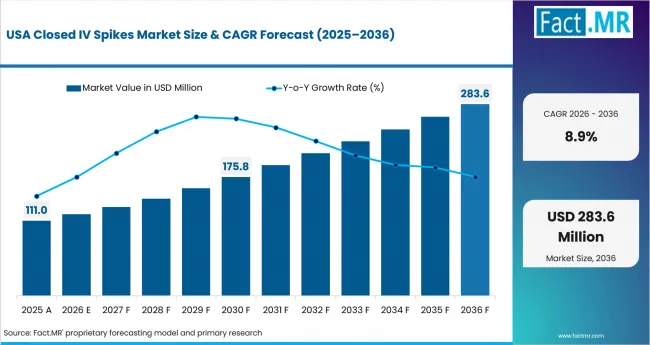
Closed Iv Spikes Market Country Value Analysis | Source: Fact.MR
The United States is projected to expand at an 8.9% CAGR through 2036 because hospitals perform a large number of intravenous therapy procedures. Healthcare providers are expanding the use of closed transfer devices to improve medication safety. Oncology treatment volumes also continue increasing. Strong infection prevention programs further support product adoption. The country leads market revenue contribution.
What is strengthening demand in Germany?
8.6% CAGR, driven by safe medication handling
Germany is expected to grow at an 8.6% CAGR by 2036 because hospitals and compounding pharmacies continue expanding the use of closed IV spikes. Healthcare providers place strong emphasis on sterile preparation of injectable medicines. Growing adoption of closed transfer systems supports safer clinical practice. Hospital quality initiatives also contribute to steady market growth. Germany remains a key market across Western Europe.
How is Japan supporting market growth?
8.4% CAGR, backed by healthcare quality improvements
Japan is forecast to register an 8.4% CAGR because hospitals and specialty care facilities continue increasing the use of closed IV spikes. Demand is supported by greater focus on medication safety and infection prevention. Healthcare providers continue modernizing infusion practices. This supports stable demand throughout the forecast period.
Why is China becoming an important market?
8.2% CAGR, supported by expanding hospital capacity
China is projected to expand at an 8.2% CAGR because investment in modern hospitals and advanced pharmacy services continues increasing. Demand for closed transfer products is rising as healthcare providers strengthen contamination control practices. Higher treatment volumes and growing oncology services continue supporting market expansion. China remains one of Asia’s higher-growth markets.
How is South Korea advancing safe infusion practices?
8.0% CAGR, supported by oncology care expansion
South Korea is expected to record an 8.0% CAGR by 2036 because hospitals continue improving infusion safety through greater use of sterile transfer products. Adoption of closed IV spikes is increasing to improve medication handling. Demand is also supported by expanding oncology services and critical care capacity. Continued healthcare investment supports long-term growth.
How are manufacturers building their competitive advantage?
B. Braun, ICU Medical, JMS maintain strong positions
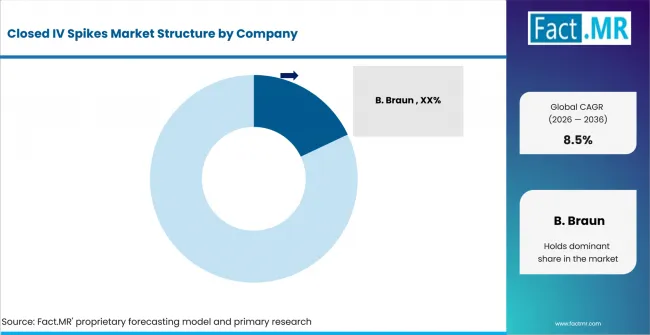
Closed Iv Spikes Market Analysis By Company | Source: Fact.MR
Manufacturers are focusing on safer fluid transfer technologies that reduce contamination during medication preparation. Product development also emphasizes leak prevention and compatibility with different IV containers and infusion systems.
Hospitals remain the largest customer group because they perform the highest volume of infusion procedures. Oncology centers continue increasing purchases as hazardous drug handling requirements become stricter. Compounding pharmacies are also expanding the use of closed IV spikes to improve sterile preparation practices.
IV fluids account for the largest application because they are administered across nearly every healthcare setting. Oncology drugs and biologics also generate consistent demand as sterile handling requirements continue increasing.
B. Braun maintain strong positions through broad infusion therapy portfolios. ICU Medical and Fresenius Kabi continue expanding closed transfer technologies for safer medication delivery. CODAN continue strengthening their presence through product innovation, broader distribution and clinical support. Companies that deliver dependable product quality, strong compatibility and reliable clinical performance are expected to strengthen their market position through 2036.
Who are the leading companies in the Closed IV Spikes Market?
B. Braun, ICU Medical, Fresenius Kabi, CODAN, Vygon, JMS
- B. Braun
- ICU Medical
- Fresenius Kabi
- CODAN
- Vygon
- JMS Co., Ltd.
Bibliography
- U.S. Food and Drug Administration. (2025, January 22). 510(k) substantial equivalence determination: ZeroClear™ Bag Access, K243976. Center for Devices and Radiological Health.
- B. Braun Medical Inc. (2024, October 18). B. Braun takes steps to secure the supply of critical IV fluids in the U.S.
- Centers for Disease Control and Prevention. (2024, February 28). Background information: Strategies for prevention of catheter-related infections in adult and pediatric patients.
- Infusion Nurses Society. (2024). Infusion Therapy Standards of Practice (9th ed.). Journal of Infusion Nursing, 47(1S Suppl 1), S1–S285.
- ICU Medical. (2026). ChemoLock™ needlefree closed system transfer device.
- CODAN Companies. (2026). Withdrawal, preparation and administration systems: CODAN Spikes.
- Vygon. (2026). Qimospike B.
- JMS Co., Ltd. (2026). Closed system drug transfer device: NEOSHIELD™.
- Epic Medical. (2026). Pharmacy compounding accessories: ProSeal™ IV Bag Spike.
This Report Addresses
- Strategic assessment of closed IV spike technologies.
- Analysis of spike type and safety feature trends.
- Evaluation of fluid type and end-user demand.
- Regional outlook covering the United States, Germany, Japan, China, and South Korea.
- Competitive assessment of leading infusion device manufacturers.
- Analysis of sterile medication preparation and infusion safety trends.
- Evaluation of hospital purchasing and compounding pharmacy demand.
- Primary interviews and supplier benchmarking supporting market estimates.
- Assessment of innovation in closed fluid transfer technologies.
- Analysis of future opportunities across infusion therapy applications.
How is the market defined?
Closed transfer spikes designed for sterile IV fluid access.
The market covers disposable IV spikes used to transfer fluids from bottles and bags while reducing contamination and leakage during infusion preparation.
Which products are included?
Closed IV transfer products.
The scope includes vented spikes, non-vented spikes, closed spikes, bag spikes and bottle spikes.
What falls outside the scope?
Conventional IV spikes without closed transfer features.
The scope excludes infusion pumps, IV sets, and standard administration tubing.
What methodology supports this study?
100+ sources, 30+ company assessments, 25+ countries, and industry interviews.
- Primary Research: Interviews with pharmacists, infusion specialists, hospital procurement teams and medical device manufacturers.
- Desk Research: Analysis of infusion safety guidelines, oncology drug handling practices and healthcare investment.
- Market Sizing and Forecasting: Estimates based on infusion procedure volumes, closed transfer product adoption and hospital purchasing trends.
- Data Validation and Update Cycle: Forecasts validated through supplier benchmarking and expert interviews.
What is the report's scope and coverage?
| Attribute | Details |
|---|---|
| Quantitative Units | USD Million in 2026 to USD Million by 2036 at CAGR |
| Market Definition | Closed IV spikes designed for sterile fluid transfer during medication preparation and infusion |
| Spike Types Covered | Vented Spikes, Non-Vented Spikes, Closed Spikes, Bag Spikes, Bottle Spikes |
| Safety Features Covered | Drip-Free, Needle-Free, Air-Filtered, Antimicrobial, Closed-System Compatible |
| Fluid Types Covered | IV Fluids, Oncology Drugs, Parenteral Nutrition, Antibiotics, Biologics |
| End Users Covered | Hospitals, Oncology Centers, Home Infusion, Compounding Pharmacies, ASCs |
| Regions Covered | North America, Western Europe, Asia Pacific, Latin America, Middle East & Africa |
| Key Countries Covered | United States, Germany, Japan, China, South Korea |
| Companies Covered | B. Braun, ICU Medical, Fresenius Kabi, CODAN, Vygon, JMS |
| Forecast Period | 2026 to 2036 |
| Research Approach | Hybrid top-down and bottom-up methodology using infusion procedure volumes, medication preparation practices and hospital purchasing analysis. |
How is the market segmented?
-
By Spike Type
- Vented Spikes
- Non-Vented Spikes
- Closed Spikes
- Bag Spikes
- Bottle Spikes
-
By Safety Feature
- Drip-Free
- Needle-Free
- Air-Filtered
- Antimicrobial
- Closed-System Compatible
-
By Fluid Type
- IV Fluids
- Oncology Drugs
- Parenteral Nutrition
- Antibiotics
- Biologics
-
By End User
- Hospitals
- Oncology Centers
- Home Infusion
- Compounding Pharmacies
- ASCs
-
Region:
- North America
- United States
- Canada
- Europe
- Germany
- United Kingdom
- France
- Italy
- Spain
- Asia Pacific
- China
- Japan
- South Korea
- India
- Singapore
- Latin America
- Brazil
- Mexico
- Argentina
- Middle East & Africa
- GCC Countries
- South Africa
- Israel
- North America