- Base Value(2025): 17.6 Bn
- Estimated Value(2026): 19.7 Bn
- Forecast Value (2036): 61.3 Bn
- CAGR (2026 - 2036): 12.0%
Cloud Music Streaming Market Analysis and Forecast by Fact.MR
- The global cloud music streaming market is estimated at US$ 17.6 billion in 2025 and has been forecast to expand at a CAGR of 12.0% to reach US$ 61.3 billion by 2036.
- Cloud music streaming platforms deliver on-demand audio content through subscription, ad-supported, and transactional models across smartphones, tablets, laptops, and connected devices.
- Adoption is concentrated among young adults and working professionals, with subscription-based revenue accounting for the largest share of platform monetization.
- Platform competition is shaped by catalog depth, algorithm-driven personalization, audio quality tiers, and integration with connected ecosystems including smart speakers and in-car infotainment.
- Mobile application access remains the primary delivery channel, with network quality and data affordability influencing adoption rates in emerging markets.
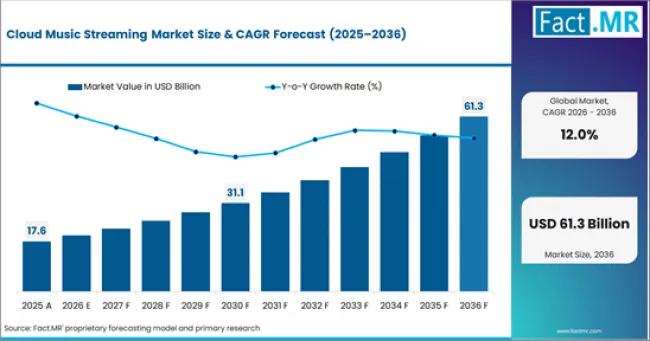
Cloud Music Streaming Market Market Value Analysis | Source: Fact.MR
Summary of Cloud Music Streaming Market
- Market Snapshot
- In 2025, the global Cloud Music Streaming Market was valued at approximately USD 17.6 billion.
- The market is estimated to reach USD 19.7 billion in 2026 and is projected to attain USD 61.3 billion by 2036.
- The cloud music streaming market is likely to expand at a CAGR of 12.0% during the forecast period.
- The market is anticipated to create an absolute dollar opportunity of USD 41.6 billion between 2026 and 2036.
- Cloud Music Streaming Subscription accounts for 46.8% of product share in 2026.
- China (15.4%) and India (14.3%) are the key growth markets during the forecast period.
- Demand and Growth Drivers
- Rising smartphone penetration in emerging markets is expanding the addressable listener base for subscription and ad-supported streaming platforms.
- Growth in connected device ecosystems, including smart speakers and in-car infotainment, is creating new listening occasions beyond personal mobile use.
- Platform investment in regional and local language catalogs is improving user retention in non-English markets across Asia Pacific and Latin America.
- Shift from physical and download-based music consumption toward on-demand streaming is supporting structural growth in recurring subscription revenue.
- Expansion of family and student subscription tiers is lowering per-user acquisition cost and improving household-level penetration rates.
- Product and Segment View
- Cloud Music Streaming Subscription accounts for 46.8% of the product segment in 2026, supported by strong installed base and continued procurement across primary end use channels.
- Smartphones accounts for 54.2% of the application segment in 2026, reflecting concentrated demand across established application areas.
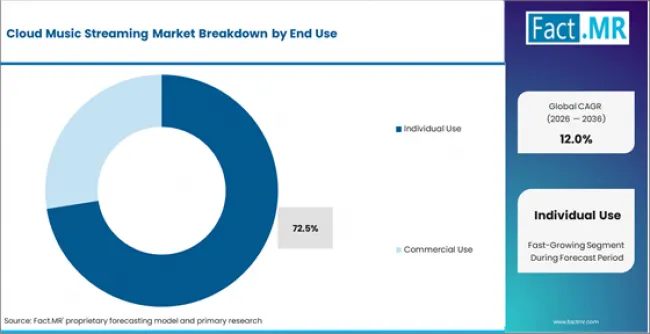
- Individual Use accounts for 72.5% of the end use segment in 2026, with adoption rising across both developed and emerging markets.
- Key segmentation includes:
- Product: Cloud Music Streaming Subscription, Cloud Music Download, Ad-based Cloud Music Streaming
- Application: Smartphones, Laptops, Tablets
- End Use: Individual Use, Commercial Use
- Platform: Mobile Applications, Web Platforms, Desktop Applications
- These systems enable:
- Targeted procurement and specification alignment across buyer segments
- Performance benchmarking across product and application categories
- Regional demand mapping across 30 plus countries
- Geography and Competitive Outlook
- North America accounts for a large share of global demand, supported by established procurement channels and a mature buyer base in the United States (10.9%).
- Europe shows stable demand patterns, with Germany (13.1%) and the U.K. contributing through regulatory compliance and institutional procurement.
- Asia Pacific is the fastest expanding region, led by China (15.4%) and India (14.3%), where capacity expansion and rising commercial adoption are supporting growth.
- China (15.4%) and India (14.3%) are the fastest growing country markets during the forecast period.
- Leading companies in this market include Spotify, Apple Inc., Amazon.com, Inc., Pandora Media, Inc., Google Inc..
- Analyst Opinion
- Shambhu Nath Jha, Principal Consultant at Fact.MR, says 'The cloud music streaming market is moving beyond subscriber count competition toward monetization depth. Platforms that can layer premium audio, podcast content, and bundled distribution partnerships are positioned to improve per-user economics, while ad-supported models face structural ceiling effects on revenue per stream. Regional content investment, particularly in local language music catalogs, is becoming the primary differentiator in markets like India, Brazil, and Southeast Asia where user growth potential is highest.'
Key Growth Drivers, Constraints, and Opportunities
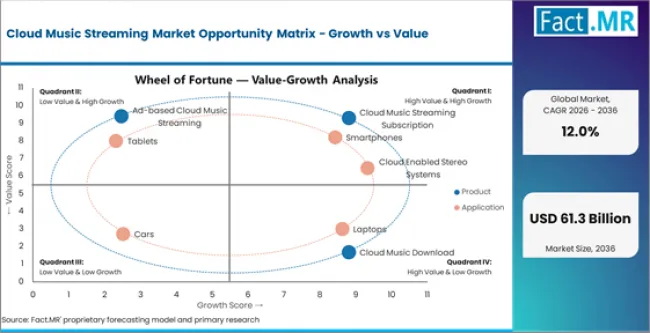
Cloud Music Streaming Market Opportunity Matrix Growth Vs Value | Source: Fact.MR
Key Factors Driving Growth
- Rising smartphone penetration in emerging markets is expanding the addressable listener base for subscription and ad-supported streaming platforms.
- Growth in connected device ecosystems, including smart speakers and in-car infotainment, is creating new listening occasions beyond personal mobile use.
- Platform investment in regional and local language catalogs is improving user retention in non-English markets across Asia Pacific and Latin America.
Key Market Constraints
- Licensing costs and royalty structures continue to compress margins for smaller platforms competing against well-capitalized incumbents.
- Ad-supported free tier monetization remains structurally limited by low audio advertising rates compared to video platforms.
- Market saturation in North America and Western Europe is slowing net subscriber additions among established platforms.
Key Opportunity Areas
- High definition and lossless audio tiers are creating premium pricing opportunities among audiophile and quality-conscious listener segments.
- Podcast and non-music audio integration is expanding per-user engagement and opening adjacent monetization channels.
- Bundling with telecom, gaming, and video subscriptions is improving retention and reducing standalone churn rates.
Segment-wise Analysis of the Cloud Music Streaming Market
- Cloud Music Streaming Subscription holds 46.8% of the product segment in 2026, supported by established demand channels and continued procurement across primary end use applications.
- Smartphones holds 54.2% of the application segment in 2026, supported by established demand channels and continued procurement across primary end use applications.
- Individual Use holds 72.5% of the end use segment in 2026, supported by established demand channels and continued procurement across primary end use applications.
The cloud music streaming market is segmented by product, application, end use, platform, and region.
By product, the market covers Cloud Music Streaming Subscription, Cloud Music Download, Ad-based Cloud Music Streaming.
By application, coverage includes Smartphones, Laptops, Tablets.
Which Product Segment Dominates the Cloud Music Streaming Market?
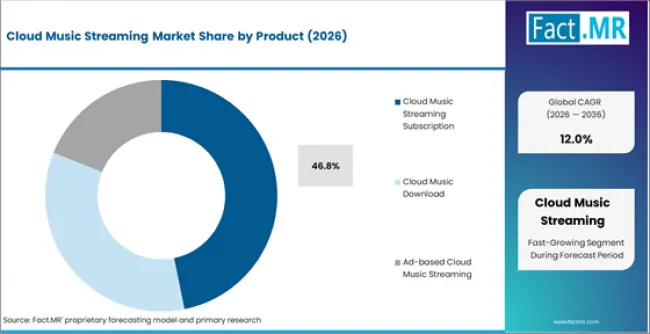
Cloud Music Streaming Market Analysis By Product | Source: Fact.MR
Cloud Music Streaming Subscription is expected to account for 46.8% of the product segment in 2026. Within this category, Premium Subscription, Family Subscription, Student Subscription represent the primary sub-segments generating procurement activity. The depth of the cloud music streaming subscription installed base across product applications sustains replacement demand and limits share erosion from newer alternatives in the cloud music streaming market.
Cloud Music Download is the second largest category in the product segment, with demand concentrated in Single Track Download and Album Download. Growth in cloud music download reflects shifting buyer requirements within the cloud music streaming market toward this category.
Which Application Segment Dominates the Cloud Music Streaming Market?
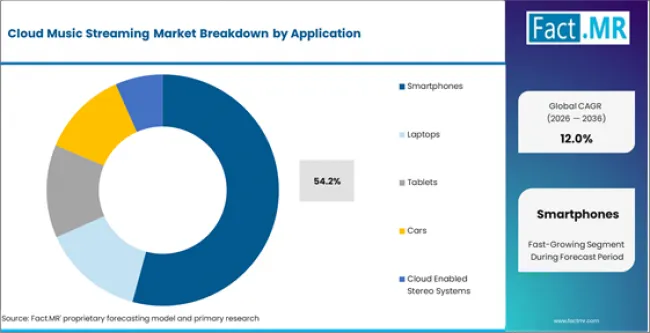
Cloud Music Streaming Market Analysis By Application | Source: Fact.MR
Smartphones is expected to account for 54.2% of the application segment in 2026. Within this category, Android Devices, iOS Devices represent the primary sub-segments generating procurement activity. The depth of the smartphones installed base across application applications sustains replacement demand and limits share erosion from newer alternatives in the cloud music streaming market.
Laptops is the second largest category in the application segment, with demand concentrated in Windows Devices and Mac Devices. Growth in laptops reflects shifting buyer requirements within the cloud music streaming market toward this category.
Which End Use Segment Dominates the Cloud Music Streaming Market?
Cloud Music Streaming Market Analysis By End Use | Source: Fact.MR
Individual Use is expected to account for 72.5% of the end use segment in 2026. Within this category, Personal Entertainment, Offline Listening represent the primary sub-segments generating procurement activity. The depth of the individual use installed base across end use applications sustains replacement demand and limits share erosion from newer alternatives in the cloud music streaming market.
Commercial Use is the second largest category in the end use segment, with demand concentrated in Retail and Hospitality and Fitness and Wellness Centers. Growth in commercial use reflects shifting buyer requirements within the cloud music streaming market toward this category.
Which Product Trend is Shaping the Next Phase of Growth in the Cloud Music Streaming Market?
High definition audio streaming is not yet the largest audio quality category, but it is emerging as a growth driver within the cloud music streaming market. Listeners are increasingly willing to pay for lossless and high resolution formats, and platforms that offer tiered audio quality are seeing improved average revenue per user. This is particularly visible in markets where broadband and mobile data speeds support uncompressed streaming without buffering or quality degradation.
The shift toward premium audio reflects a broader change in listener expectations. Early streaming adoption prioritized access and convenience over fidelity, but maturing markets are now segmenting along quality lines. Platforms investing in spatial audio, lossless codec support, and device-optimized playback are capturing incremental subscription upgrades, while commodity-positioned services face growing pressure to differentiate beyond catalog size alone.
Regional Outlook Across Key Markets
.webp "Top Country Growth Comparison Cloud Music Streaming Market Cagr (2026 2036)")
Top Country Growth Comparison Cloud Music Streaming Market Cagr (2026 2036) | Source: Fact.MR
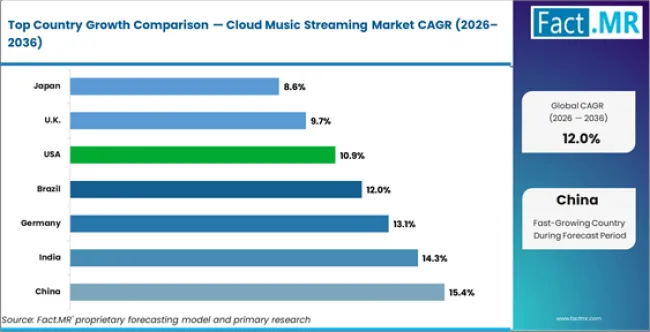
- China is growing at 15.4%, supported by domestic platform scale, mobile user base expansion, and growing catalog investment.
- India is growing at 14.3%, supported by affordable mobile data, regional language content, and telecom-bundled streaming access.
- Germany is growing at 13.1%, supported by quality audio preference, high willingness to pay, and connected device integration.
- Brazil is growing at 12.0%, supported by internet penetration growth, a culturally engaged music audience, and mobile-first consumption.
CAGR Table
| Country | CAGR (%) |
|---|---|
| China | 15.4% |
| India | 14.3% |
| Germany | 13.1% |
| Brazil | 12.0% |
| USA | 10.9% |
| U.K. | 9.7% |
| Japan | 8.6% |
Source: Fact.MR analysis. Updated May 28, 2026
Source: Fact MR (FMR) analysis, based on proprietary forecasting model and primary research.
Cloud Music Streaming Market Cagr Analysis By Country | Source: Fact.MR
Market Outlook for Cloud Music Streaming in China
The China Cloud Music Streaming market is projected to grow at a CAGR of 15.4% through 2036. Domestic platform dominance and a large mobile user base are supporting rapid expansion of cloud music streaming in China.
- Tencent Music and NetEase Cloud Music control the majority of licensed catalog access in the domestic market.
- Rising smartphone data affordability and 5G coverage are improving streaming quality and session duration.
- Social listening features and karaoke integration differentiate Chinese platforms from global competitors.
Cloud Music Streaming Demand Trends in India
The India Cloud Music Streaming market is projected to grow at a CAGR of 14.3% through 2036. Growth in affordable mobile data and regional language content is accelerating cloud music streaming adoption across Indian metropolitan and tier-2 cities.
- Regional language catalog expansion by JioSaavn, Gaana, and Spotify India is improving listener retention beyond English-language audiences.
- Telecom-bundled streaming access through Jio and Airtel plans is lowering the effective cost of premium subscriptions.
- Ad-supported free tiers remain the dominant model, with conversion to paid subscriptions still at early stage.
Germany Cloud Music Streaming Market Growth Outlook
The Germany Cloud Music Streaming market is projected to grow at a CAGR of 13.1% through 2036. Strong music consumption culture and high willingness to pay for quality audio support steady subscriber growth in Germany.
- Preference for lossless and high definition audio tiers reflects a quality-oriented listener base.
- Integration with connected car and smart home ecosystems is expanding beyond-smartphone listening time.
- GDPR compliance shapes data handling and personalization strategy for platforms operating in the market.
Brazil Cloud Music Streaming Market Demand Analysis
The Brazil Cloud Music Streaming market is projected to grow at a CAGR of 12.0% through 2036. Rising internet penetration and a culturally engaged music audience are supporting streaming platform expansion in Brazil.
- Local music genres including sertanejo, funk, and pagode account for a large share of streaming activity.
- Mobile-first access dominates, with prepaid data packages influencing streaming consumption patterns.
- Platform investment in creator tools and artist promotion features is supporting local content ecosystems.
Cloud Music Streaming Market Growth Assessment in USA
Cloud Music Streaming Market Country Value Analysis | Source: Fact.MR
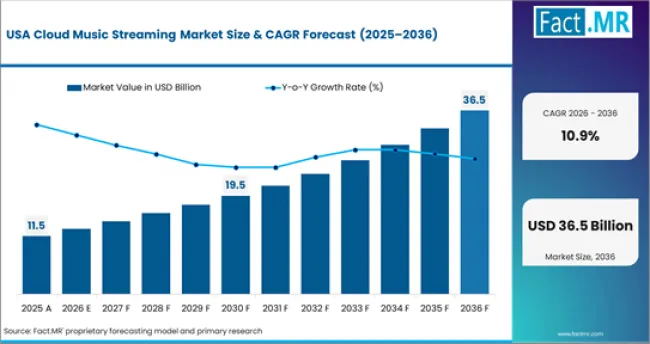
The USA Cloud Music Streaming market is projected to grow at a CAGR of 10.9% through 2036. The U.S. market is mature with high household penetration, and growth is increasingly tied to premium tier conversion and churn reduction.
- Family and multi-user plans account for a growing share of subscription revenue.
- Podcast integration and exclusive content are key retention tools for competing platforms.
- Smart speaker and connected car penetration support ambient and passive listening occasions.
Cloud Music Streaming Market Opportunity Outlook in U.K.
The U.K. Cloud Music Streaming market is projected to grow at a CAGR of 9.7% through 2036. High digital music adoption and strong integration with connected devices sustain the U.K. as a steady contributor to global streaming revenue.
- Premium subscription penetration is among the highest globally on a per-capita basis.
- Platform competition is shaped by playlist curation, podcast exclusives, and editorial content.
- Integration with BBC Sounds and other public broadcasting services adds a unique local layer to the market.
Demand Landscape for Cloud Music Streaming in Japan
Cloud Music Streaming Market Japan Market Share Analysis By Product | Source: Fact.MR
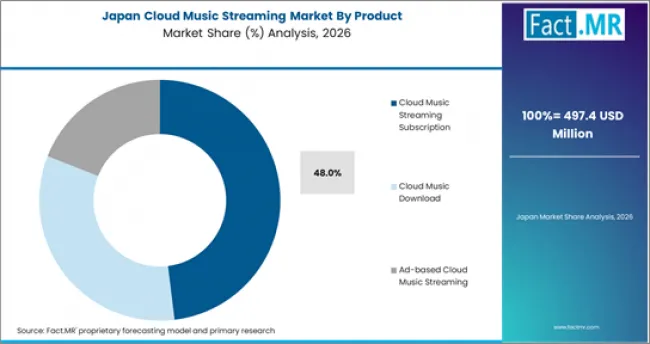
The Japan Cloud Music Streaming market is projected to grow at a CAGR of 8.6% through 2036. Japan is transitioning from a legacy physical and download market toward streaming-first consumption, with growth supported by smartphone adoption and catalog localization.
- J-pop and anime soundtrack licensing remain critical to platform success in the domestic market.
- Older demographics represent an underpenetrated listener segment with growing adoption of streaming.
- Apple Music and Spotify compete with domestic services like LINE Music and AWA for market share.
Competitive Benchmarking and Company Positioning
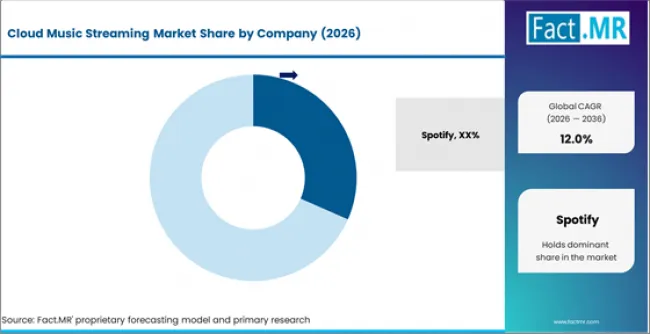
Cloud Music Streaming Market Analysis By Company | Source: Fact.MR
Cloud Music Streaming Market Analysis By Company
- Spotify, Apple Inc., Amazon.com, Inc., Pandora Media, Inc. hold established positions in the global cloud music streaming market through broad product portfolios, geographic reach, and growing capabilities in higher specification categories.
- Google Inc., Microsoft Corp., Sound Cloud, Tune-In Radio participate across specific price tiers, end use segments, and regional channels, with competition shaped by product quality, service support, and distribution access.
- Catalog licensing, algorithm-driven personalization, and connected ecosystem integration are the primary differentiators, with platform stickiness increasingly tied to exclusive content and bundled distribution.
The competitive landscape is dominated by a small number of global platforms with large subscriber bases. Spotify leads by subscription share, while Apple Music, Amazon Music, and YouTube Music compete through ecosystem bundling and content exclusivity. Regional platforms maintain relevance in markets like China, India, and Japan through local catalog depth.
Competition is structured around two tiers: global platforms competing on content breadth and algorithm quality, and regional services competing on local language catalogs and telecom partnerships. Pricing pressure is concentrated in ad-supported tiers, while premium subscription revenue is growing as platforms add lossless audio and spatial sound features.
Key Companies in the Cloud Music Streaming Market
Spotify, Apple Inc., Amazon.com, Inc., Pandora Media, Inc. are among the leading players in the cloud music streaming market globally, supported by strong brand visibility and broad product portfolios.
Google Inc., Microsoft Corp., Sound Cloud, Tune-In Radio hold established positions across specific categories, supported by durable products and regional distribution.
Recent Industry Developments
- Spotify - Subscription Tier Expansion (January 2026)
- Spotify introduced a new premium audio subscription tier with lossless and spatial audio support, targeting quality-conscious listeners willing to pay higher monthly rates.
- Apple Inc. - Regional Catalog Expansion (2025)
- Apple Inc. expanded its regional language music catalog across South Asian and Latin American markets, improving listener retention and engagement metrics in non-English territories.
- Amazon.com, Inc. - Connected Device Integration (2025)
- Amazon.com, Inc. launched native integration with automotive infotainment platforms, enabling voice-controlled streaming access for connected car users across major vehicle manufacturers.
- Pandora Media, Inc. - Creator Platform Launch (February 2026)
- Pandora Media, Inc. introduced a creator tools platform enabling independent artists to distribute, promote, and monetize content directly through the streaming service.
Leading Companies Shaping the Cloud Music Streaming Market
- Spotify
- Apple Inc.
- Amazon.com, Inc.
- Pandora Media, Inc.
- Google Inc.
- Microsoft Corp.
- Sound Cloud
- Tune-In Radio
- Rhapsody
- My Space
Sources and Research References
- Spotify. Product portfolio and corporate announcements.
- Apple Inc.. Product portfolio and corporate announcements.
- Amazon.com, Inc.. Product portfolio and corporate announcements.
- Industry association statistics, regulatory publications, trade databases, and company product catalogs.
- Primary interviews with manufacturers, distributors, buyers, and institutional users.
This bibliography is provided for reader reference and is not exhaustive. The full report contains the complete reference list and detailed citations.
Key Questions This Report Addresses
- What is the current and future size of the Cloud Music Streaming Market?
- How fast is the Cloud Music Streaming Market expected to grow between 2026 and 2036?
- Which product is likely to lead the market by 2026?
- Which application segment is expected to account for the highest demand by 2026?
- What factors are driving demand in this market globally?
- How is technology adoption influencing the market structure?
- Which countries are projected to show the fastest growth through 2036?
- What is driving market expansion in China and India?
- Who are the key companies active in the Cloud Music Streaming Market?
- How does Fact.MR estimate and validate the market forecast?
Cloud Music Streaming Market Definition
The cloud music streaming market covers products, technologies, and services associated with product, application, end use categories. The scope includes global and regional market size and forecasts for 2026 to 2036 across product, application, end use, platform, and region.
Cloud Music Streaming Market Inclusions
- The scope covers global and regional market size and forecasts for 2026 to 2036 across product, application, end use, platform, and region.
- It includes regional demand analysis across major geographies, based on factors such as technology adoption, regulatory requirements, institutional spending, and commercial demand patterns.
- The report includes pricing and cost analysis across entry-level, mid-range, and premium categories, including hardware, software, and service components where applicable.
- It covers technology trends, market drivers and constraints, and the competitive landscape, including product portfolios, pricing strategy, geographic reach, and distribution expansion of leading players.
Cloud Music Streaming Market Exclusions
- The scope excludes adjacent categories, general-purpose alternatives, and products not specifically classified under the cloud music streaming market taxonomy.
- It excludes custom-built in-house solutions, informal unbranded products with low market visibility, and rental or leasing services without direct product sales.
- The report excludes military or defense-grade variants, industrial systems outside the defined scope, and non-commercial applications without market transaction data.
- It also excludes software-only platforms sold independently from hardware, unless they are part of the defined product or service taxonomy.
Cloud Music Streaming Market Research Methodology
- The methodology combines secondary research, primary interviews, and forecast modelling.
- It draws on 120 plus secondary sources and benchmarks 65 plus company product portfolios.
- Market sizing covers 30 plus countries through a demand-side model, supported by top-down validation.
- Key inputs include end use adoption rates, technology penetration, pricing benchmarks, and regional procurement patterns.
- The model cross-checks demand with shipments, pricing trends, channel mix, and product launches.
- Primary validation includes 25 plus interviews across manufacturers, distributors, buyers, and institutional users.
- Final estimates go through trade-flow checks, sales-pattern review, and sensitivity testing.
Segmentation
Scope of Analysis
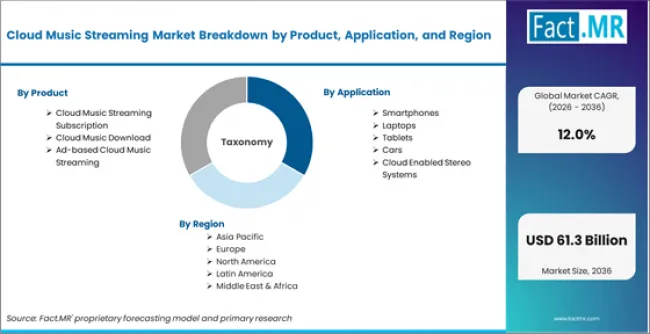
Cloud Music Streaming Market Breakdown By Product, Application, And Region | Source: Fact.MR
| Parameter | Details |
|---|---|
| Quantitative Units | USD 19.7 billion to USD 61.3 billion, at a CAGR of 12.0% |
| Market Definition | The Cloud Music Streaming Market covers products, technologies, and services across product, application, end use categories for commercial, institutional, and consumer applications. |
| Regions Covered | North America, Latin America, Europe, East Asia, South Asia and Pacific, Middle East and Africa |
| Countries Covered | USA, Canada, UK, Germany, China, India, 30 plus countries |
| Key Companies | Spotify, Apple Inc., Amazon.com, Inc., Pandora Media, Inc., Google Inc., Microsoft Corp., Sound Cloud, Tune-In Radio, Rhapsody, My Space |
| Forecast Period | 2026 to 2036 |
| Approach | Hybrid demand-side and top-down methodology built on country-level application demand, product benchmarking, pricing analysis, shipment validation, and primary interviews across manufacturers, distributors, and end users |
Source: Fact.MR analysis. Updated May 28, 2026
Cloud Music Streaming Market Segmentation
-
Cloud Music Streaming Market Segmented by Product:
- Cloud Music Streaming Subscription
- Premium Subscription
- Family Subscription
- Student Subscription
- Cloud Music Download
- Single Track Download
- Album Download
- Ad-based Cloud Music Streaming
- Audio Advertisement Supported
- Video Advertisement Supported
- Cloud Music Streaming Subscription
-
Cloud Music Streaming Market Segmented by Application:
- Smartphones
- Android Devices
- iOS Devices
- Laptops
- Windows Devices
- Mac Devices
- Tablets
- Android Tablets
- iPad
- Cars
- Connected Car Infotainment
- In-Car Voice Assistant Integration
- Cloud Enabled Stereo Systems
- Smart Speakers
- Home Audio Systems
- Smartphones
-
Cloud Music Streaming Market Segmented by End Use:
- Individual Use
- Personal Entertainment
- Offline Listening
- Commercial Use
- Retail and Hospitality
- Fitness and Wellness Centers
- Public Entertainment Venues
- Individual Use
-
Cloud Music Streaming Market Segmented by Platform:
- Mobile Applications
- Native Music Apps
- Third Party Music Apps
- Web Platforms
- Browser Based Streaming
- Web Player Access
- Desktop Applications
- Standalone Desktop Clients
- Integrated Media Players
- Mobile Applications
-
Cloud Music Streaming Market Segmented by Revenue Model:
- Subscription Revenue
- Monthly Plans
- Annual Plans
- Advertising Revenue
- Display Advertising
- Audio Advertising
- Transactional Revenue
- Pay Per Download
- Premium Content Purchase
- Subscription Revenue
-
Cloud Music Streaming Market Segmented by Audio Quality:
- Standard Audio Quality
- Compressed Streaming
- Basic Download Quality
- High Definition Audio
- Lossless Audio
- High Resolution Audio
- Adaptive Audio Streaming
- Network Optimized Streaming
- Standard Audio Quality
-
Cloud Music Streaming Market Segmented by User Age Group:
- Young Adults
- Students
- Working Professionals
- Adults
- Mid Age Consumers
- Senior Users
- Casual Listeners
- Young Adults
-
Cloud Music Streaming Market by Region:
- North America
- USA
- Canada
- Mexico
- Latin America
- Brazil
- Chile
- Rest of Latin America
- Western Europe
- Germany
- UK
- Italy
- Spain
- France
- Nordic
- BENELUX
- Rest of Western Europe
- Eastern Europe
- Russia
- Poland
- Hungary
- Balkan & Baltic
- Rest of Eastern Europe
- East Asia
- China
- Japan
- South Korea
- South Asia and Pacific
- India
- ASEAN
- Australia & New Zealand
- Rest of South Asia and Pacific
- Middle East & Africa
- Kingdom of Saudi Arabia
- Other GCC Countries
- Turkiye
- South Africa
- Other African Union
- Rest of Middle East & Africa
- North America
Frequently Asked Questions
How big is the cloud music streaming market in 2026?
What will be the size of cloud music streaming market in 2036?
How much will be the cloud music streaming market growth between 2026 and 2036?
What are the key product types in the cloud music streaming market?
Which application segment is expected to contribute significant share in the cloud music streaming market in 2026?
Who worked on this report


Preview the report firsthand - request a free sample
Free SampleGet the brochure for pricing and purchase details
Download PDF