- Base Value(2025): 122.0 Bn
- Estimated Value(2026): 133.1 Bn
- Forecast Value (2036): 318.0 Bn
- CAGR (2026 - 2036): 9.1%
Cloud Managed Services Market Analysis and Forecast by Fact.MR
- The Cloud Managed Services Market is expected to grow from USD 133.1 billion in 2026 to USD 318.0 billion by 2036, at a CAGR of 9.1%.
- The market growth is driven by the increasing enterprise cloud migration across hybrid and multi-cloud architectures, growing demand for managed security and compliance services, and the expanding adoption of AI-augmented cloud operations management.
- Infrastructure managed services hold 61.7% market share, while IT infrastructure management holds 66.9% market share as organizations focus on operational continuity, cost optimization, and regulatory compliance across distributed cloud environments.
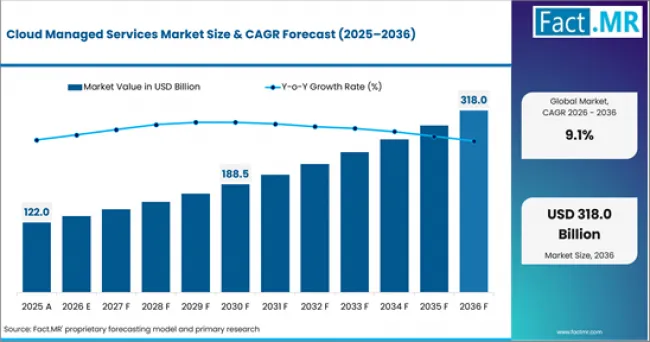
Cloud Managed Services Market Value Analysis | Source: Fact.MR
Summary of Cloud Managed Services Market
- Market Snapshot
- In 2025, the global Cloud Managed Services Market was valued at approximately USD 122.0 billion.
- The market is estimated to reach USD 133.1 billion in 2026 and is projected to attain USD 318.0 billion by 2036.
- The cloud managed services market is likely to expand at a CAGR of 9.1% during the forecast period.
- The market is anticipated to create an absolute dollar opportunity of USD 184.9 billion between 2026 and 2036.
- Infrastructure managed services account for 61.7% of product segment share in 2026.
- China (12.3%) and India (11.4%) are the key growth markets during the forecast period.
- Demand and Growth Drivers
- Enterprise migration to hybrid and multi-cloud environments drives demand for managed services that provide operational continuity, workload portability and consistent governance across cloud providers.
- The growing cybersecurity threats and regulatory compliance requirements are forcing organizations to outsource the cloud security management to specialized cloud security providers having threat detection and response capabilities.
- AI and generative AI workloads are driving demand for managed infrastructure services to provision, monitor and optimize GPU-intensive cloud environments at scale.
- Enterprises face pressure to optimize costs and look to managed service providers that can deliver FinOps capabilities, right-sizing recommendations and reserved capacity management to multi-cloud deployments.
- The growth of decentralized models for the remote and distributed workforce has increased the reliance on cloud-hosted collaboration, productivity and enterprise resource planning platforms that depend on continuing managed operations support.
- Product and Segment View
- Infrastructure managed services are expected to generate 61.7% of the service type segment revenue in 2026. Infrastructure managed services are driven by the demand for compute, storage, network and database management in hybrid and multi-cloud deployments.
- The application segment is dominated by IT infrastructure management at 66.9% in 2026, covering server management, storage administration, network monitoring and disaster recovery operations.
- Large enterprises drive end-use demand, representing 58.3% of the total in 2026, as their cloud environments are large and complex and require significant resources to manage multi-vendor cloud estates.
- Key segmentation includes:
- Product:Infrastructure Managed Services,Platform Managed Services,Security Managed Services,Application Managed Services
- Application Data Management Applications Enterprise Application Management IT Infrastructure Management Security and Compliance Applications
- End Use: Large Enterprises, Government Organizations, Healthcare Organizations, Manufacturing Enterprises, Retail and E-Commerce
- Distribution Channel: Direct Service Providers Managed Service Providers Cloud Platforms Online
- These services enable:
- Continuous monitoring, patching, and optimization of cloud infrastructure across multiple providers and regions
- Managed threat detection, incident response, and compliance reporting for regulated cloud workloads
- Automated scaling, cost governance, and performance management for enterprise cloud environments
- Geography and Competitive Outlook
- The region-market of North America is the largest owing to the presence of mature cloud adoption, high IT spending by enterprises and regulatory complexity that maintains the demand for managed compliance and security services.
- The fastest-growing region is Asia Pacific, led by China (12.3%) and India (11.4%), driven by faster enterprise cloud migration, government digital transformation mandates and expanding IT services ecosystems.
- Europe is growing steadily with Germany at 10.5% driven by the needs of data sovereignty, EU regulatory frameworks, and the digitalization of the manufacturing industry.
- The key players are Microsoft, IBM, Kyndryl, AWS, Infosys, TCS, Accenture, Wipro and HCLTech.
- Analyst Opinion
- Shambhu Nath Jha, Principal Consultant at Fact.MR, says "The cloud managed services market is being reshaped by two converging forces: the operational complexity of multi-cloud environments and the resource intensity of deploying AI workloads at scale. Enterprises that have already migrated to the cloud are now discovering that managing distributed cloud estates across multiple providers requires specialized operational capabilities that internal IT teams often lack. The fastest-growing segment is managed security, where threat sophistication and regulatory compliance are exceeding what most organizations can handle in-house. Providers that combine infrastructure management with embedded security, FinOps, and AI operations support are capturing the largest enterprise contracts."
Key Growth Drivers, Constraints, and Opportunities
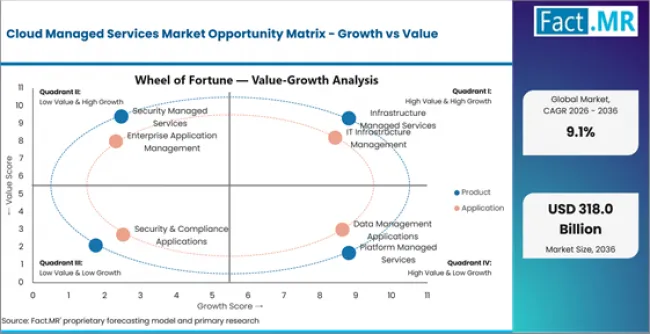
Cloud Managed Services Market Opportunity Matrix Growth Vs Value | Source: Fact.MR
Key Factors Driving Growth
- Multi-cloud complexity is outpacing internal IT team capabilities, with enterprises using multiple cloud providers need unified monitoring, governance, and cost management through managed services.
- Ransomware, supply chain attacks and regulatory penalties are pushing enterprises to engage specialized providers with 24/7 threat detection and incident response capabilities, and demand for managed security is accelerating.
- A new managed services category is emerging as a result of AI workload provisioning, and enterprises need GPU infrastructure management, model deployment support and inference optimization that requires specialized operational expertise.
Key Market Constraints
- Data sovereignty and residency requirements in the EU, China and select Asia Pacific markets limit cross-border managed service delivery, requiring providers to maintain localized operations and compliance certifications.
- Concerns about vendor lock-in prevent enterprises from consolidating all managed services with one vendor. This leads to fragmented multi-vendor environments that increase integration complexities.
- Hyperscalers can pressure independent managed service provider margins when they bundle managed services with cloud infrastructure.
Key Opportunity Areas
- A high-growth sub-category, FinOps-as-a-service, is emerging with managed service providers offering continuous cloud cost optimization, reserved instance management and spending governance across multi-cloud estates.
- Managed cloud services that are customized for specific industries such as healthcare compliance management, financial services audit support and manufacturing IoT platform operations command premium prices and improve the relationship between provider and customer.
- Differentiated positioning in markets with stringent data governance requirements is being driven by sovereign cloud managed services where providers operate within country-specific data residency and regulatory frameworks.
Segment-wise Analysis of the Cloud Managed Services Market
- Infrastructure managed services hold 61.7% of the product segment in 2026, covering compute, storage, network, and database management across hybrid and multi-cloud deployments.
- The IT infrastructure management segment will hold a share of 66.9% of the application segment in 2026, with server management, storage administration, disaster recovery, and network monitoring leading the segment.
- Direct service providers account for 71.2% of the distribution channel segment, indicating a strong affinity for direct engagement from enterprises with hyperscalers and global IT services firms.
The cloud managed services market is segmented by service type, application, end use, technology, delivery model, distribution channel, and region. By service type, the market covers infrastructure, platform, security, and application managed services. By application, coverage includes IT infrastructure management, data management, enterprise application management, and security and compliance. Infrastructure managed services lead because they represent the foundational layer of cloud operations that all enterprises require regardless of workload type.
Which Service Type Dominates the Cloud Managed Services Market?
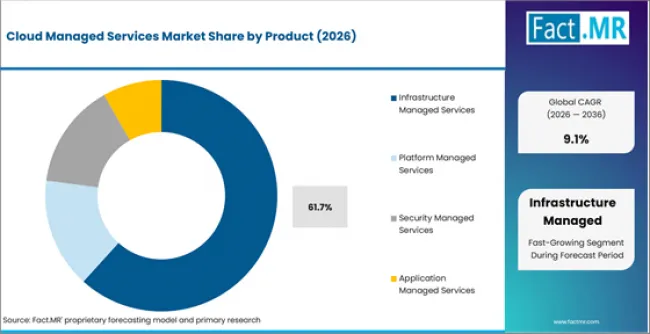
Cloud Managed Services Market Analysis By Product | Source: Fact.MR
Infrastructure managed services holds 61.7% of the product segment in 2026. Their leadership reflects the universal need for compute, storage, network and database management across cloud environments in enterprise. Every organization that runs in the cloud needs infrastructure operations support, irrespective of industry vertical or geographic market, thus the highest volume service category.
Platform managed services are a more specialized segment focused on container orchestration, serverless operations, and management of development environments. Security managed services is the fastest growing sub-category, driven by the sophistication of threats and compliance mandates. Application managed services provide complete lifecycle management of enterprise software including updates, patching and performance optimization for cloud-hosted business applications.
Which Application Segment Dominates the Cloud Managed Services Market?
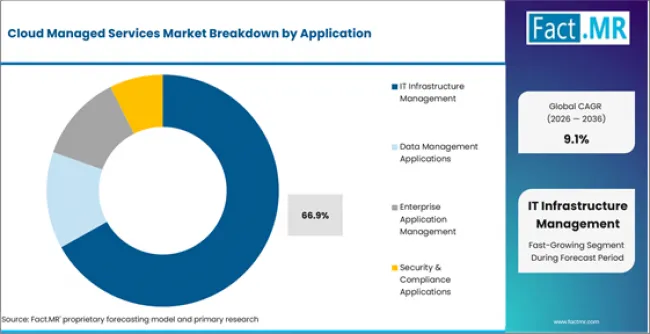
Cloud Managed Services Market Analysis By Application | Source: Fact.MR
IT Infrastructure Management is leading with 66.9% share in 2026. This application category includes server provisioning, storage tiering, network configuration, backup and disaster recovery, and workload monitoring, which are operational backbones of cloud environments. Companies contract these services to managed service providers so they can reduce the number of internal staff, provide 24/7 operational coverage, and make use of the provider’s expertise in managing multi-cloud environments.
The rest is taken up by data management applications, enterprise application management and security and compliance applications. Security and compliance is the fastest-growing, as regulatory frameworks grow and threat landscapes grow more complex. IT infrastructure management is forecast to remain the most lucrative segment as it provides the basic operational layer for all other types of managed services.
Which Product Trend is Shaping the Next Phase of Growth in the Cloud Managed Services Market?
The defining technology trend in the managed services market is AI-augmented cloud operations, more commonly referred to as AIOps. Managed service providers are embedding machine learning capabilities in monitoring, alerting and remediation workflows to reduce mean time to detection, automate incident triage and predict infrastructure failures before they impact workloads. This change moves managed services from reactive monitoring to predictive operations, allowing providers to deliver higher service levels at lower operational cost.
The commercial impact extends beyond efficiency. AIOps capabilities are becoming a differentiator in enterprise procurement decisions, with organizations increasingly requiring managed service providers to demonstrate AI-powered operations as a condition of contract awards. Providers that combine AIOps with FinOps and managed security are assembling comprehensive cloud operations platforms that deepen enterprise dependency and reduce switching risk. This trend favors larger providers with the data volumes and engineering resources to develop proprietary AI operations models.
Regional Outlook Across Key Markets
.webp "Top Country Growth Comparison Cloud Managed Services Market Cagr (2026 2036)")
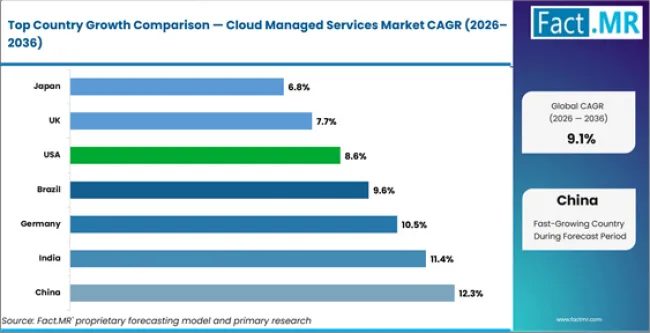
Top Country Growth Comparison Cloud Managed Services Market Cagr (2026 2036) | Source: Fact.MR
- China’s economy grew by 12.3% supported by government-led digital transformation in state-owned enterprises, growing domestic cloud infrastructure and technology self-sufficiency initiatives favoring local managed service providers.
- India is at 11.4% driven by global IT services firms based in India delivering managed cloud operations to multinational enterprises and ramping up local enterprise cloud adoption.
- Germany at 10.5% reflects the digitization of the manufacturing sector, the EU’s data sovereignty requirements, and the strong demand for managed compliance services under the GDPR and NIS2 frameworks.
- The USA is a mature but growing market at 8.6% with spending growth driven by multi-cloud complexity, AI workload deployment and managed security demand.
| Country | CAGR (%) |
|---|---|
| China | 12.3% |
| India | 11.4% |
| Germany | 10.5% |
| Brazil | 9.6% |
| USA | 8.6% |
| UK | 7.7% |
| Japan | 6.8% |
Source: Fact.MR analysis, based on proprietary forecasting model and primary research.
Cloud Managed Services Market Cagr Analysis By Country | Source: Fact.MR
Market Outlook for Cloud Managed Services in the United States
Cloud Managed Services Market Country Value Analysis | Source: Fact.MR
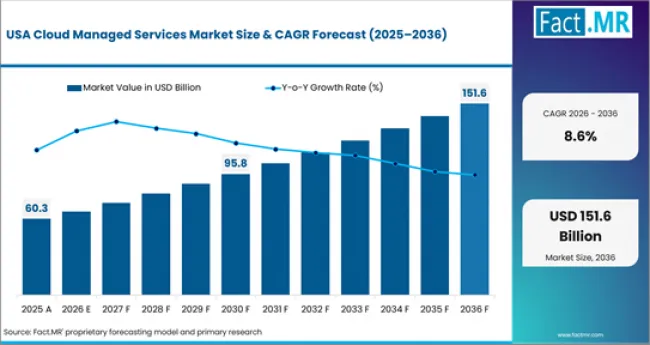
The U.S. cloud managed services market is expected to grow at a CAGR of 8.6% by 2036. Demand for managed infrastructure, security and FinOps services is supported by the installed base of enterprises operating in multi-cloud environments. Managed operations support for public sector and manufacturing cloud investment, fuelled by CHIPS Act and IRA provisions. Government-specific demand for managed service providers. Federal compliance frameworks such as FedRAMP and CMMC drive specialized demand for government-qualified managed service providers.
- FedRAMP and CMMC compliance requirements sustain specialized demand for government-qualified managed cloud service providers operating within authorized boundary environments.
- AI workload deployment across enterprise and government clients is creating a new managed services layer focused on GPU infrastructure management and model operations support.
China Cloud Managed Services Market Growth Assessment
The primary demand drivers for managed cloud services in China are government-driven digital transformation programs at state-owned enterprises and provincial government agencies, which are expected to grow at a CAGR of 12.3% through 2036. Policies to promote technology self-sufficiency provide domestic cloud and managed service providers with a competitive advantage, creating a protected environment for companies such as Alibaba Cloud, Huawei Cloud and Tencent Cloud. Cross-border service delivery is limited by data residency requirements, thus helping domestic providers.
- State enterprise digital transformation mandates are generating multi-year managed service contracts that provide revenue visibility and long-term client relationships for domestic providers.
- Technology self-sufficiency programs restrict foreign managed service provider access, concentrating market share among domestic cloud infrastructure operators and their service ecosystems.
India Cloud Managed Services Demand Trends
The PLI scheme-driven digital infrastructure investment and the size of India’s IT services workforce position the country as both a consumer and exporter of managed cloud services, which are projected to grow at a CAGR of 11.4% through the year 2036. Indian delivery centres of global IT services firms like Infosys, TCS, Wipro and HCLTech offer managed cloud operations for multinational enterprises but domestic enterprise cloud adoption is gaining momentum across banking, retail and manufacturing sectors.
- Global delivery center operations for multinational managed services contracts generate export revenue and deepen technical capabilities across Indian IT services workforces.
- Digital infrastructure programs and expanding mobile internet penetration are accelerating domestic enterprise cloud adoption, creating a growing local market alongside export service delivery.
Germany Cloud Managed Services Market Analysis
The managed cloud services in Germany are projected to grow at a CAGR of 10.5% to 2036. The EU data sovereignty requirements and GDPR compliance frameworks define the procurement specifications. With digitalization of manufacturing sector under Industrie 4.0, the need for managed IoT platform operations, management of edge computing and connected factory cloud infrastructure is growing. The rise in demand for managed security services to meet NIS2 directive compliance is evident for critical infrastructure operators.
- Industrie 4.0 connected factory programs are generating demand for managed IoT and edge computing operations that bridge shop-floor systems with cloud analytics platforms.
- GDPR and NIS2 compliance requirements create regulatory-driven demand for managed security and data governance services that independent providers can monetize at premium margins.
United Kingdom Cloud Managed Services Market Outlook
Post-Brexit regulatory divergence from EU frameworks is creating separate compliance requirements for managed cloud services in the UK, projected at a 7.7% CAGR through 2036. Financial services sector concentration in London sustains demand for managed compliance, security, and disaster recovery services. NHS digitalization programs are generating public sector managed cloud procurement at scale, with patient record digitization targets creating multi-year contract opportunities.
- Financial services regulatory compliance, including FCA and PRA requirements, creates specialized managed service demand for secure, auditable cloud operations in banking and insurance.
- NHS digitalization and patient record digitization programs create long-term public sector managed cloud service contracts with predictable revenue profiles.
Japan Cloud Managed Services Demand Analysis
Cloud Managed Services Market Japan Market Share Analysis By Product | Source: Fact.MR
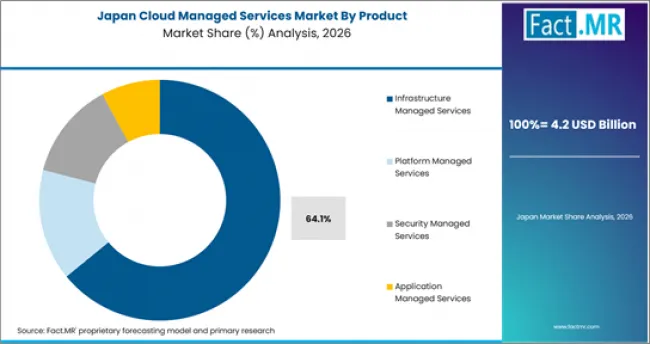
Legacy system modernization across Japanese enterprises is the primary driver for managed cloud services, projected at a 6.8% CAGR through 2036. Long decision cycles and strict quality expectations define procurement patterns, with enterprises preferring established provider relationships over competitive bidding processes. Domestic cloud providers including NTT DATA and Fujitsu Cloud Service maintain strong positions through local language support, regulatory familiarity, and pre-existing enterprise relationships.
- Semiconductor, automotive, and electronics sectors are migrating specialized workloads to cloud environments that require industry-specific managed operations expertise.
- Labor shortage mitigation through operational automation is driving managed services adoption as enterprises seek to reduce internal IT staffing requirements for cloud operations.
Competitive Benchmarking and Company Positioning
Cloud Managed Services Market Analysis By Company | Source: Fact.MR
Cloud Managed Services Market Analysis By Company
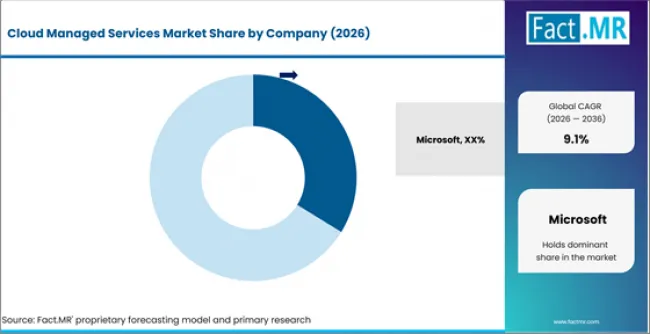
- The global cloud managed services market is dominated by Microsoft, AWS, and IBM, which combine hyperscale cloud platforms with expanding managed operations portfolios that take advantage of their existing customer bases.
- Infosys, TCS, Wipro, HCLTech and Accenture are all competing as global IT services providers that offer managed cloud operations at scale across enterprise verticals, geographic regions and multi-cloud environments.
- The key competitive differentiators are platform-agnostic service delivery, automation depth and industry vertical expertise, with providers that combine these capabilities commanding larger enterprise contracts and higher retention rates.
It is available to hyperscalers, global IT services companies, telecom operators and specialised managed service providers. Microsoft and AWS are infrastructure providers and managed services operators that compete with each other, using their cloud platforms as a distribution channel for bundled management offerings. IBM’s position through heritage in consulting and hybrid cloud especially in regulated industries.
Indian IT services firms such as Infosys, TCS, Wipro and HCLTech compete on delivery scale, cost efficiency and deep enterprise relationships built through decades of IT outsourcing. Accenture and Capgemini straddle consulting and managed services, combining strategic advisory with operational delivery.
Telecom carriers such as Kyndryl and NTT DATA are also shaping the market by using their network infrastructure assets to deliver integrated connectivity and cloud management services. Specialist vendors vie for specialized segments such as sovereign cloud, healthcare compliance or FinOps optimization.
Key Companies in the Cloud Managed Services Market
- The major players are Microsoft, IBM, AWS and Kyndryl, supported by cloud platform assets, global enterprise relationships and a portfolio of integrated technology and services.
- Infosys, TCS, Wipro, HCLTech, Accenture, Capgemini, NTT DATA and Rackspace compete in enterprise verticals and geographic markets on the basis of delivery scale, automation capabilities and managed operations expertise.
Recent Industry Developments
- May 2025 | Kyndryl and Microsoft | Partnership Extension: Distributed Cloud Services
- Kyndryl expanded its Distributed Cloud services using AI technology adopting the Microsoft adaptive cloud approach. The extension deepens the partnership between the two companies and positions Kyndryl to address demand for AI-augmented managed infrastructure services among Microsoft Azure enterprise customers.
- April 2025 | Accenture | Strategic Expansion: Google Cloud Relationship
- Accenture deepened its strategic partnership with Google Cloud and announced new offerings to help enterprises adopt advanced cloud and AI computing technologies. The expansion reinforces Accenture’s position as a multi-cloud managed services provider with deep capabilities across hyperscaler cloud platforms.
- August 2025 | Capgemini | Acquisition: Cloud4C Managed Services
- Capgemini entered into an agreement to acquire Cloud4C, a provider of automation-led managed services for hybrid and sovereign cloud environments. Capgemini’s managed cloud delivery capabilities are strengthened by the acquisition, and its sovereign cloud positioning across regulated markets is broadened.
- December 2024 | CDW | Acquisition: Mission Cloud
- CDW acquired Mission Cloud to expand its managed cloud services portfolio and add AWS-centric enterprise cloud management capabilities. The acquisition is a sign of continuing market consolidation, with larger IT services and distribution companies looking to grow scale in managed cloud operations through acquisitions.
Key Companies in the Cloud Managed Services Market
- Microsoft
- IBM
- Kyndryl
- AWS
- Infosys
- TCS
- Accenture
- Wipro
- HCLTech
Sources and Research References
- Accenture. (2025, April 9). Accenture helps organizations adopt and scale the latest technologies from Google Cloud to drive continuous reinvention. Accenture.
- Capgemini. (2025, August 26). Capgemini to acquire Cloud4C, a leader in hybrid cloud platform services. Capgemini.
- Capgemini. (2025, November 3). Capgemini announces the closing of the acquisition of Cloud4C. Capgemini.
- CDW Corporation. (2024, December 2). CDW announces acquisition of Mission Cloud Services Inc., a leading US-based Amazon Web Services (AWS) Premier Tier Partner. CDW Corporation.
- Kyndryl. (2025, May 13). Kyndryl and Microsoft collaborate to enable adaptive cloud services. Kyndryl.
This bibliography is provided for reader reference and is not exhaustive. The full report contains the complete reference list and detailed citations.
Key Questions This Report Addresses
- What is the current and future size of the Cloud Managed Services Market?
- How fast is the Cloud Managed Services Market expected to grow between 2026 and 2036?
- Which service type is likely to lead the market by 2026?
- Which application segment is expected to account for the highest demand by 2026?
- What factors are driving demand for cloud managed services globally?
- How is AI-augmented cloud operations influencing service delivery and competitive dynamics?
- Why are China and India emerging as the fastest-growing markets?
- How are data sovereignty requirements shaping regional market structures?
- Which countries are projected to show the fastest growth through 2036?
- Who are the key companies active in the Cloud Managed Services Market?
- How does Fact.MR estimate and validate the market forecast?
Cloud Managed Services Market Definition
The cloud managed services market covers outsourced management of cloud infrastructure, platforms, applications, and security across public, private, hybrid, and multi-cloud environments. It includes fully managed, co-managed, and modular service delivery models provided by hyperscalers, global IT services firms, telecom carriers, and specialized managed service providers.
Cloud Managed Services Market Inclusions
- The scope covers global and regional market size and forecasts for 2026 to 2036 across service type, application, end use, technology, delivery model, distribution channel, and region.
- It includes regional demand analysis based on enterprise cloud adoption maturity, IT spending trends, regulatory complexity, and digital transformation mandates.
- The report covers pricing and contract analysis across subscription-based, consumption-based, and outcome-based service delivery models.
Cloud Managed Services Market Exclusions
- The scope excludes cloud infrastructure-as-a-service (IaaS) and platform-as-a-service (PaaS) revenues generated directly by hyperscalers, unless delivered as part of a managed services engagement.
- It excludes on-premise IT managed services, traditional data center outsourcing, and desktop support services not linked to cloud infrastructure.
- The report excludes software licensing revenues, SaaS application subscriptions, and hardware sales not bundled with managed cloud operations.
Cloud Managed Services Market Research Methodology
- The methodology combines secondary research, primary interviews, and forecast modelling.
- It draws on 150+ secondary sources and benchmarks 80+ company service portfolios.
- Market sizing covers 30+ countries through a demand-side model, supported by top-down validation.
- Key inputs include enterprise IT spending data, cloud adoption rates, regulatory compliance requirements, and managed services contract values.
- The model cross-checks demand with provider revenue disclosures, contract announcements, and cloud workload migration estimates.
- Primary validation includes 30+ interviews across service providers, enterprise CIOs, cloud architects, and channel partners.
- Final estimates go through spending-pattern analysis, contract value validation, and sensitivity testing.
Segmentation
Scope of Analysis
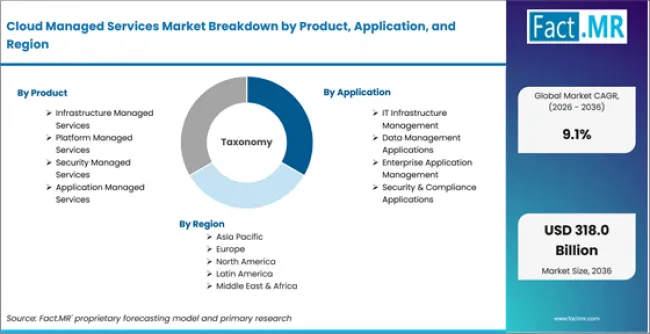
Cloud Managed Services Market Breakdown By Product, Application, And Region | Source: Fact.MR
| Parameter | Details |
|---|---|
| Quantitative Units | USD billion to USD billion, at a CAGR |
| Market Definition | The Cloud Managed Services Market covers outsourced management of cloud infrastructure, platforms, applications, and security across public, private, hybrid, and multi-cloud environments. |
| Product |
|
| Application | IT Infrastructure Management, Data Management Applications, Enterprise Application Management, Security & Compliance Applications |
| End Use | Large Enterprises, BFSI Institutions, Government Organizations, Healthcare Organizations, Manufacturing Enterprises, Retail & E-Commerce |
| Technology | Virtualization Technology, Cloud Orchestration Technology, AI Driven Cloud Management, Security Technology |
| Formulation | Fully Managed Cloud Services, Subscription Based Services, Co-Managed Cloud Services, Modular Cloud Services |
| Distribution channel | Direct Service Providers, Cloud Vendor Direct Channels, Managed Service Providers, Online Cloud Platforms |
| Regions Covered | North America, Latin America, Europe, East Asia, South Asia and Pacific, Middle East and Africa |
| Countries Covered | USA, China, India, Germany, Brazil, UK, Japan, 30 plus countries |
| Key Companies | Microsoft, IBM, Kyndryl, AWS, Infosys, TCS, Accenture, Wipro, HCLTech |
| Forecast Period | 2026 to 2036 |
| Approach | Hybrid demand-side and top-down methodology built on enterprise IT spending data, cloud adoption rates, regulatory compliance requirements, managed services contract values, and primary interviews across service providers, enterprise CIOs, and channel partners |
Cloud Managed Services Market Segmentation
-
Cloud Managed Services Market Segmented by Product:
- Infrastructure Managed Services
- Cloud Infrastructure Monitoring
- Real Time Resource Monitoring
- Capacity Optimization Services
- Cloud Infrastructure Maintenance
- Patch Management Services
- Server Optimization Services
- Cloud Infrastructure Monitoring
- Platform Managed Services
- PaaS Management Services
- Application Hosting Management
- Runtime Environment Management
- Database Management Services
- Cloud Database Optimization
- Backup & Recovery Management
- PaaS Management Services
- Security Managed Services
- Cloud Security Operations
- Threat Detection Services
- Identity Access Management Services
- Compliance Management Services
- Regulatory Compliance Monitoring
- Audit & Governance Services
- Cloud Security Operations
- Application Managed Services
- Application Performance Management
- Cloud Application Monitoring
- Load Balancing Optimization
- Application Lifecycle Services
- Deployment Automation Services
- Continuous Integration Support
- Application Performance Management
- Infrastructure Managed Services
-
Cloud Managed Services Market Segmented by Application:
- IT Infrastructure Management
- Cloud Server Management
- Virtual Machine Management
- Container Infrastructure Management
- Network Infrastructure Management
- Cloud Network Optimization
- Bandwidth Management Systems
- Cloud Server Management
- Data Management Applications
- Cloud Storage Management
- Object Storage Optimization
- Backup Data Management
- Data Analytics Infrastructure
- Big Data Pipeline Management
- Real Time Data Processing
- Cloud Storage Management
- Enterprise Application Management
- ERP Cloud Management
- SAP Cloud Hosting Management
- CRM Cloud Integration
- Business Application Hosting
- SaaS Application Management
- Collaboration Platform Management
- ERP Cloud Management
- Security & Compliance Applications
- Cybersecurity Operations
- Cloud Threat Monitoring
- Security Incident Response
- Regulatory Compliance Applications
- Data Privacy Management
- Audit Trail Monitoring
- Cybersecurity Operations
- IT Infrastructure Management
-
Cloud Managed Services Market Segmented by End Use:
- Large Enterprises
- IT & Technology Companies
- Software Development Firms
- Cloud Native Companies
- BFSI Institutions
- Banks & Financial Institutions
- Insurance Companies
- IT & Technology Companies
- Government Organizations
- Public Sector IT Departments
- E Governance Platforms
- Defense IT Infrastructure
- Public Sector IT Departments
- Healthcare Organizations
- Hospitals & Clinics
- Digital Health Platforms
- Medical Data Management Systems
- Hospitals & Clinics
- Manufacturing Enterprises
- Industrial Automation Firms
- Smart Factory Operators
- Supply Chain Management Firms
- Industrial Automation Firms
- Retail & E Commerce
- Online Retail Platforms
- Marketplace Operators
- Omnichannel Retail Systems
- Online Retail Platforms
- Large Enterprises
-
Cloud Managed Services Market Segmented by Technology:
- Virtualization Technology
- Server Virtualization
- Hypervisor Based Systems
- Container Virtualization Systems
- Desktop Virtualization
- VDI Platforms
- Remote Desktop Services
- Server Virtualization
- Cloud Orchestration Technology
- Automated Resource Scheduling
- Workload Distribution Systems
- Dynamic Scaling Platforms
- Service Orchestration Systems
- API Driven Integration Layers
- Microservices Orchestration Engines
- Automated Resource Scheduling
- AI Driven Cloud Management
- Predictive Analytics Systems
- Resource Forecasting Engines
- Anomaly Detection Systems
- Autonomous Cloud Operations
- Self Healing Infrastructure Systems
- AI Based Incident Resolution
- Predictive Analytics Systems
- Security Technology
- Zero Trust Architecture
- Identity Verification Systems
- Access Control Frameworks
- Encryption Technologies
- Data Encryption Systems
- Key Management Systems
- Zero Trust Architecture
- Virtualization Technology
-
Cloud Managed Services Market Segmented by Formulation:
- Fully Managed Cloud Services
- End to End Managed Solutions
- Complete Infrastructure Outsourcing
- Full Stack Cloud Management
- Subscription Based Services
- Monthly Service Models
- Annual Contract Services
- End to End Managed Solutions
- Co Managed Cloud Services
- Shared Responsibility Models
- Hybrid IT Management Models
- Partner Driven Cloud Operations
- Augmented IT Services
- Support Assisted Cloud Management
- On Demand Expert Services
- Shared Responsibility Models
- Modular Cloud Services
- Service Component Models
- Selective Infrastructure Management
- Tool Based Service Modules
- Scalable Service Architectures
- Expandable Service Frameworks
- Dynamic Resource Allocation Models
- Service Component Models
- Fully Managed Cloud Services
-
Cloud Managed Services Market Segmented by Distribution Channel:
- Direct Service Providers
- Enterprise Sales Teams
- Dedicated Account Management
- Corporate Contract Sales
- Cloud Vendor Direct Channels
- AWS Managed Service Channels
- Azure Managed Service Channels
- Enterprise Sales Teams
- Managed Service Providers
- Regional MSP Partners
- Local Cloud Service Firms
- Specialized IT Service Providers
- Global MSP Networks
- Multi Country Service Providers
- Enterprise Outsourcing Partners
- Regional MSP Partners
- Online Cloud Platforms
- Digital Service Marketplaces
- Cloud Service Aggregators
- Subscription Management Platforms
- Self Service Portals
- Customer Managed Dashboards
- Automated Service Ordering Systems
- Digital Service Marketplaces
- Direct Service Providers
-
Cloud Managed Services Market by Region:
- North America
- USA
- Canada
- Latin America
- Brazil
- Mexico
- Chile
- Rest of Latin America
- Western Europe
- Germany
- UK
- Italy
- Spain
- France
- Nordic
- BENELUX
- Rest of Western Europe
- Eastern Europe
- Russia
- Poland
- Hungary
- Balkan & Baltic
- Rest of Eastern Europe
- East Asia
- China
- Japan
- South Korea
- South Asia and Pacific
- India
- ASEAN
- Australia & New Zealand
- Rest of South Asia and Pacific
- Middle East & Africa
- Kingdom of Saudi Arabia
- Other GCC Countries
- Turkiye
- South Africa
- Other African Union
- Rest of Middle East & Africa
- North America
Frequently Asked Questions
How big is the cloud managed services market in 2026?
What will be the size of cloud managed services market in 2036?
How much will be the cloud managed services market growth between 2026 and 2036?
What are the key product in the cloud managed services market?
Which application segment is expected to contribute significant share in the cloud managed services market in 2026?
Who worked on this report


Preview the report firsthand - request a free sample
Free SampleGet the brochure for pricing and purchase details
Download PDF