- Base Value(2025): 48.5 Bn
- Estimated Value(2026): 55.5 Bn
- Forecast Value (2036): 213.0 Bn
- CAGR (2026 - 2036): 14.4%
Social Cloud Computing Market Analysis and Forecast by Fact.MR
- The global market for social cloud computing is estimated at USD 55.48 billion in 2026 and is projected to expand at a CAGR of 14.4% to reach USD 213.02 billion by 2036.
- Social Analytics accounts for 36.5% of the Service Type segment, supported by its established user base, broad retail availability, and consistent replacement cycles.
- Public Cloud represents 49.2% of the Deployment segment, reflecting buyer preference for specialized access and product expertise.
- Growth is supported by expanding end-use applications, growing participation rates in core categories, and improving distribution access across both developed and emerging markets.
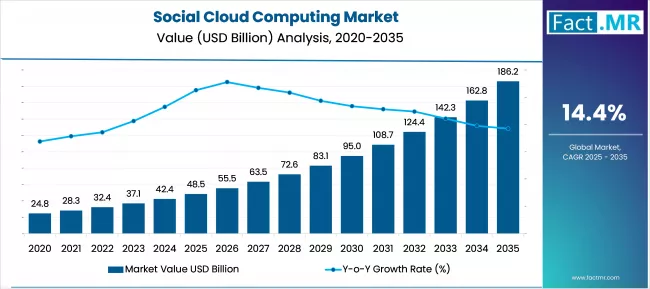
Social Cloud Computing Market Market Value Analysis | Source: Fact.MR
Summary of Social Cloud Computing Market
- Market Snapshot
- In 2025, the global Social Cloud Computing Market was valued at approximately USD 48.50 billion.
- The market is estimated to reach USD 55.48 billion in 2026 and is projected to attain USD 213.02 billion by 2036.
- The social cloud computing market is likely to expand at a CAGR of 14.4% during the forecast period.
- The market is anticipated to create an absolute dollar opportunity of USD 157.54 billion between 2026 and 2036.
- Social Analytics accounts for 36.5% of Service Type share in 2026.
- USA (16.2%) and Germany (15.8%) are the key growth markets during the forecast period.
- Demand and Growth Drivers
- Growing participation in core end-use categories is expanding the addressable buyer base for social cloud computing across both developed and emerging markets.
- Increasing preference for specialized and performance-oriented products is supporting demand in the Social Analytics segment, which accounts for 36.5% of the market.
- Expanding online distribution channels, which represent 58.7% of sales, are improving product accessibility and market penetration globally.
- Rising demand in USA and Germany is supported by higher disposable incomes, growing awareness, and improved retail infrastructure.
- Product upgrades in material quality, design, and functional performance are encouraging replacement purchases and supporting premium segment growth.
- Product and Segment View
- Social Analytics accounts for 36.5% of the Service Type segment in 2026, supported by broad demand across entry-level and mid-tier buyers.
- Public Cloud represents 49.2% of the Deployment segment in 2026, reflecting sustained buyer preference for this channel and product category.
- Marketing and Advertising accounts for 41.8% of the Application segment, supported by consistent demand patterns across core user groups.
- Key segmentation includes:
- Service Type: Social Analytics, Social Media Management, Social CRM, Others
- Deployment: Public Cloud, Private Cloud, Hybrid Cloud
- Organization Size: Large Enterprises, Small and Medium Enterprises
- Application: Marketing and Advertising, Customer Experience Management, Sales and Lead Generation, Risk and Compliance Management
- End Use Industry: Retail and E-Commerce, Banking Financial Services and Insurance, Media and Entertainment, Healthcare
- Pricing Model: Subscription-Based, Usage-Based Pricing, Tiered Pricing
- Geography and Competitive Outlook
- North America is the largest regional market, with the United States accounting for USD 18.94 billion in 2026, supported by high participation rates, established retail channels, and strong brand presence.
- Europe is experiencing steady demand, with Germany (15.8%) and the UK (15.4%) reflecting stable growth.
- Asia Pacific is expanding, with Japan and South Korea contributing to regional demand growth.
- USA (16.2%) and Germany (15.8%) are the fastest-growing country markets during the forecast period.
- Key companies in the market include Salesforce.com, IBM Corporation, Microsoft Corporation, Oracle Corporation, Adobe Systems, Hootsuite.
- Analyst Opinion
- Shambhu Nath Jha, Principal Consultant at Fact.MR, says 'The social cloud computing is moving beyond volume-led replacement cycles. Growth is increasingly shaped by premiumization, expanding distribution through direct-to-consumer and e-commerce channels, and rising participation in social analytics applications. Buyers in USA and Germany are entering the market at higher price points, while established markets like the United States are shifting toward performance-driven and specialty products.'
Key Growth Drivers, Constraints, and Opportunities
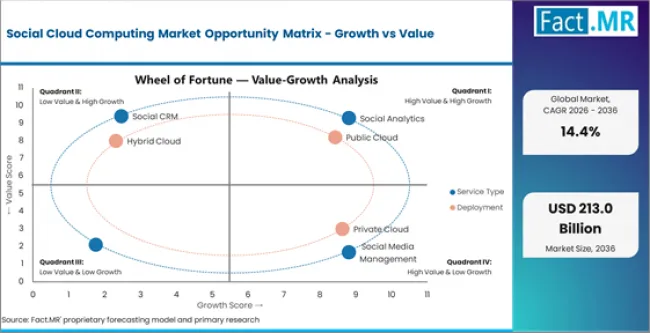
Social Cloud Computing Market Opportunity Matrix Growth Vs Value | Source: Fact.MR
Key Factors Driving Growth
- Expanding participation in core end-use categories is broadening the buyer base, with demand concentrated in Social Analytics which accounts for 36.5% of the market.
- Growing adoption of online and direct-to-consumer distribution is improving accessibility and supporting market penetration across both established and emerging regions.
- Product development in performance, material quality, and design is supporting premiumization and encouraging replacement demand from existing users.
Key Market Constraints
- Price sensitivity in entry-level and economy segments constrains margin growth and limits adoption of premium product lines in price-sensitive markets.
- Seasonal demand patterns in certain applications create uneven sales cycles and inventory management challenges for manufacturers and retailers.
- Competitive pressure from low-cost imports and unbranded products affects pricing power, particularly in the economy and mid-range tiers.
Key Opportunity Areas
- Rising demand in emerging markets including USA (16.2% CAGR) and Germany (15.8% CAGR) is creating new volume and value growth opportunities.
- Premiumization across product tiers is supporting higher average selling prices and improved margins for established brands.
- Expansion of e-commerce and brand-direct channels is reducing distribution costs and enabling broader geographic reach.
Segment-wise Analysis of the Social Cloud Computing Market
- Social Analytics holds 36.5% of the service type segment in 2026, supported by its established demand base, broad retail presence, and consistent replacement cycles across core user groups.
- Public Cloud represents 49.2% of the deployment segment in 2026, reflecting sustained buyer preference and strong channel coverage.
- Large Enterprises accounts for 58.7% of the organization size segment in 2026, supported by growing digital adoption and improving logistics infrastructure.
The social cloud computing market is segmented by service type, deployment, organization size, application, end use industry, pricing model, and region. By service type, the market covers Social Analytics, Social Media Management, Social CRM, Others. Social Analytics leads by value in the near term because of its installed base and broad accessibility, while faster-growing sub-segments are expected to gain share as demand diversifies.
Which Service Type Segment Dominates the Social Cloud Computing Market?
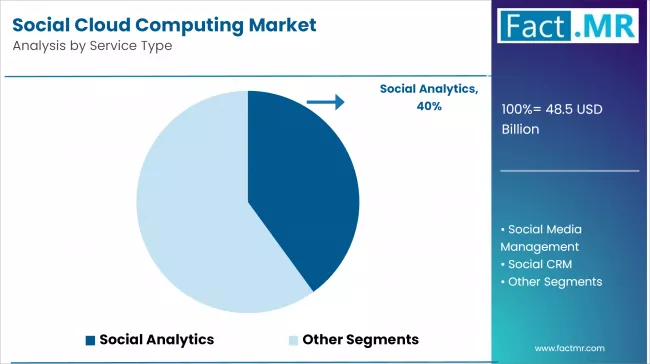
Social Cloud Computing Market Analysis By Service Type | Source: Fact.MR
Social Analytics is expected to account for 36.5% of the service type segment in 2026. Demand is supported by its broad applicability across core use cases, consistent replacement cycles, and strong presence across both online and offline retail channels. The segment benefits from wide buyer acceptance across entry-level, mid-tier, and professional user groups, making it the anchor of the category.
Other sub-segments within the service type category are growing as demand diversifies. Buyers are increasingly selecting products based on specific use-case requirements, supporting a wider range of product offerings across the category.
Which Deployment Segment Dominates the Social Cloud Computing Market?
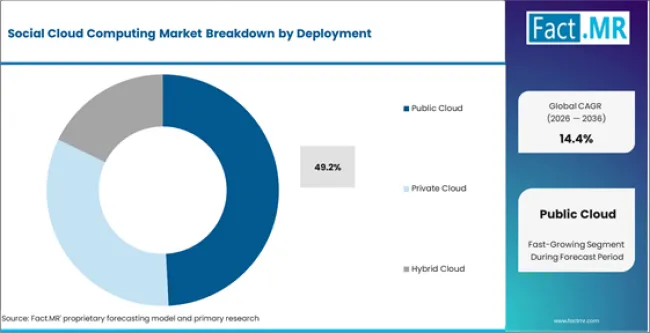
Social Cloud Computing Market Analysis By Deployment | Source: Fact.MR
Public Cloud is expected to account for 49.2% of the deployment segment in 2026. Demand is supported by its broad applicability across core use cases, consistent replacement cycles, and strong presence across both online and offline retail channels. The segment benefits from wide buyer acceptance across entry-level, mid-tier, and professional user groups, making it the anchor of the category.
Other sub-segments within the deployment category are growing as demand diversifies. Buyers are increasingly selecting products based on specific use-case requirements, supporting a wider range of product offerings across the category.
Which Organization Size Segment Dominates the Social Cloud Computing Market?
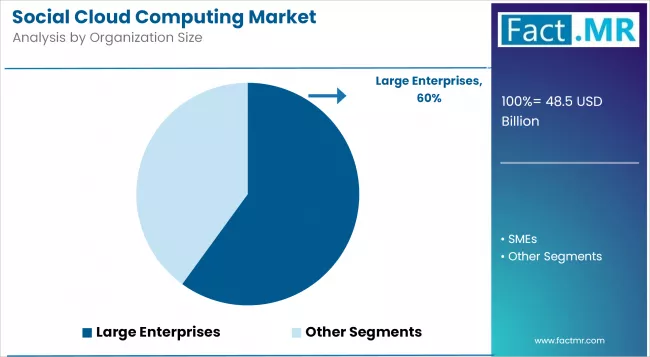
Social Cloud Computing Market Analysis By Organization Size | Source: Fact.MR
Large Enterprises is expected to account for 58.7% of the organization size segment in 2026. Demand is supported by its broad applicability across core use cases, consistent replacement cycles, and strong presence across both online and offline retail channels. The segment benefits from wide buyer acceptance across entry-level, mid-tier, and professional user groups, making it the anchor of the category.
Other sub-segments within the organization size category are growing as demand diversifies. Buyers are increasingly selecting products based on specific use-case requirements, supporting a wider range of product offerings across the category.
Which Product Trend is Shaping the Next Phase of Growth in the Social Cloud Computing Market?
Private Cloud are emerging as a growth area within the social cloud computing market, though Public Cloud currently holds the largest share at 49.2% of the deployment segment. The shift reflects changing buyer preferences toward products that offer improved performance, better material quality, and enhanced usability. This trend is particularly visible in markets where buyers are moving from entry-level to mid-range and premium products.
The transition is being supported by expanding product portfolios from established manufacturers, growing availability through online and direct-to-consumer channels, and increasing willingness among buyers to pay for functional and performance advantages. As a result, growth in the private cloud category is expected to outpace the broader market, attracting both new entrants and existing users upgrading from lower-tier products.
Regional Outlook Across Key Markets
.webp "Top Country Growth Comparison Social Cloud Computing Market Cagr (2026 2036)")
Top Country Growth Comparison Social Cloud Computing Market Cagr (2026 2036) | Source: Fact.MR
- USA leads growth at 16.2%, supported by expanding demand, improving retail infrastructure, and growing participation in core end-use applications.
- North America reflects mixed growth, with the United States at 16.2% reflecting a mature market with strong installed base and established distribution, while Germany at 15.8% benefits from rising demand and market expansion.
- European demand remains steady, with Germany at 15.8% and the UK at 15.4% reflecting stable replacement demand, brand loyalty, and premium product adoption.
CAGR Table
| Country | CAGR (%) |
|---|---|
| USA | 16.2% |
| Germany | 15.8% |
| UK | 15.4% |
| South Korea | 15% |
| Japan | 14.6% |
| France | 14.2% |
Source: Fact.MR analysis. Updated May 27, 2026
Source: Fact MR (FMR) analysis, based on proprietary forecasting model and primary research.
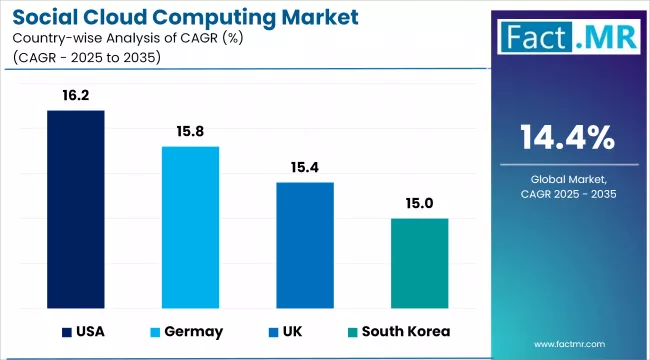
Social Cloud Computing Market Cagr Analysis By Country | Source: Fact.MR
Market Outlook for Social Cloud Computing in USA
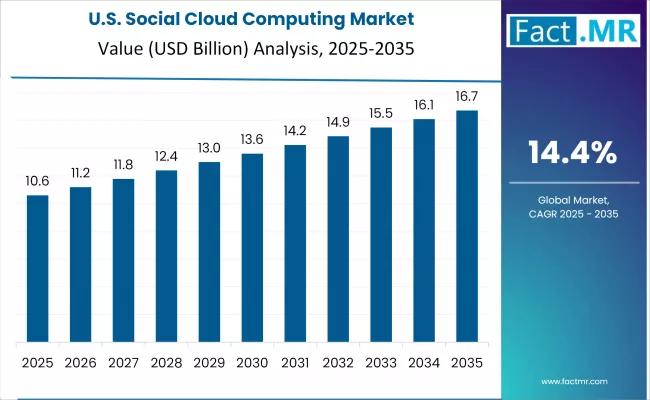
Social Cloud Computing Market Country Value Analysis | Source: Fact.MR
The USA Social Cloud Computing market is projected to grow at a CAGR of 16.2% through 2036. Demand is supported by strong participation rates and an established buyer base and growing retail penetration and improving product accessibility.
- Strong participation rates and an established buyer base.
- Growing retail penetration and improving product accessibility.
- Premium product adoption and replacement-driven demand.
Social Cloud Computing Demand Trends in Germany
Growth in Germany is estimated at a CAGR of 15.8% through 2036, reflecting expanding end-use applications and rising consumer awareness and improved distribution through online and specialty retail channels.
- Expanding end-use applications and rising consumer awareness.
- Improved distribution through online and specialty retail channels.
- Growing interest in higher-performance product categories.
UK Social Cloud Computing Growth Assessment
The UK market is projected to expand at 15.4% CAGR through 2036, with demand concentrated in institutional demand and organized procurement channels and rising household incomes and growing consumer participation.
- Institutional demand and organized procurement channels.
- Rising household incomes and growing consumer participation.
- Improving logistics and distribution infrastructure.
South Korea Social Cloud Computing Market Analysis
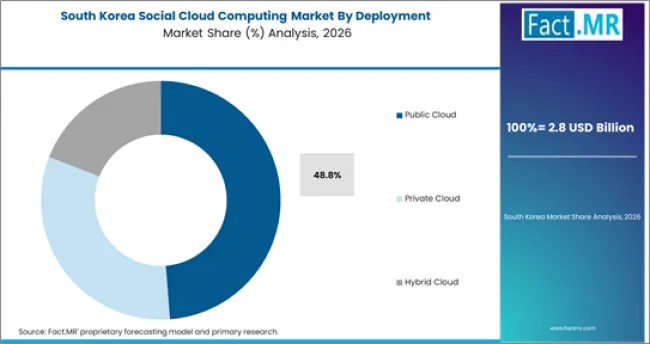
Social Cloud Computing Market South Korea Market Share Analysis By Deployment | Source: Fact.MR
Demand in South Korea reflects a 15% CAGR outlook through 2036, shaped by strong brand presence and established retail networks and regulatory standards supporting product quality and safety.
- Strong brand presence and established retail networks.
- Regulatory standards supporting product quality and safety.
- Growing demand for performance-oriented and premium products.
Social Cloud Computing Market Opportunity in Japan
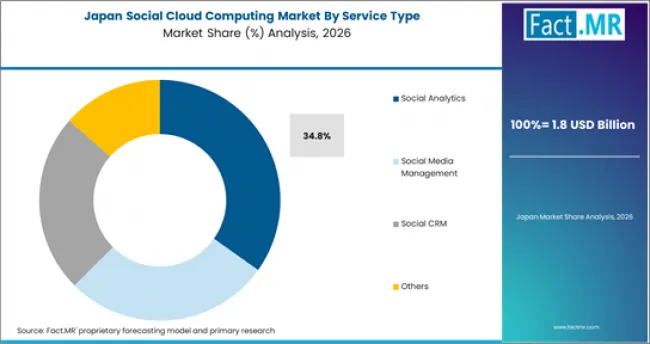
Social Cloud Computing Market Japan Market Share Analysis By Service Type | Source: Fact.MR
Japan is projected to record a CAGR of 14.6% through 2036, supported by rising participation in core use-case categories and expanding urban retail and e-commerce access.
- Rising participation in core use-case categories.
- Expanding urban retail and e-commerce access.
- Government and institutional procurement programs.
Competitive Benchmarking and Company Positioning
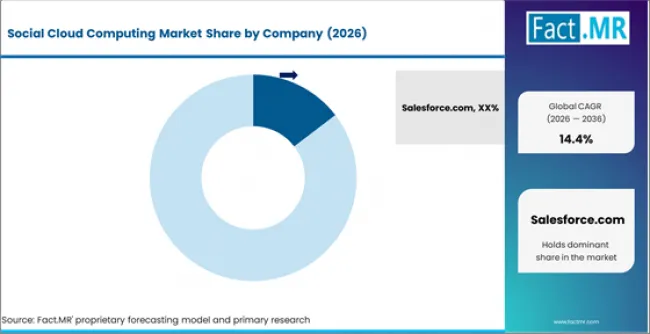
Social Cloud Computing Market Analysis By Company | Source: Fact.MR
Social Cloud Computing Market Analysis By Company
- Salesforce.com, IBM Corporation, Microsoft Corporation, Oracle Corporation hold strong positions in the global social cloud computing market through broad product portfolios, strong brand recognition, and established distribution networks.
- Adobe Systems, Hootsuite, Sprout Social, Buffer participate meaningfully across specific price tiers, user segments, and regional retail channels, with competition shaped by product quality, pricing, and channel access.
- Product differentiation, distribution reach, and brand loyalty are the primary competitive levers, particularly in mid-range and premium segments where buyers weigh performance and brand trust.
The competitive landscape is moderately fragmented, with a mix of global brands, specialty manufacturers, and regional players. Salesforce.com, IBM Corporation, Microsoft Corporation, Oracle Corporation compete strongly through product breadth, brand strength, and growing direct-to-consumer capabilities. These companies are better positioned to capture value from premiumization and digital channel expansion.
Below the top tier, Adobe Systems, Hootsuite, Sprout Social, Buffer maintain relevance through pricing strategies, niche product strength, and retail presence. These players compete on specific product attributes rather than through fully integrated brand ecosystems.
Strategic priorities across the market include expanding product portfolios, strengthening e-commerce and direct-to-consumer distribution, improving material quality, and broadening geographic reach. Companies that combine consistent product performance with wider distribution access are likely to strengthen their competitive positions over the forecast period.
Key Companies in the Social Cloud Computing Market
Salesforce.com, IBM Corporation, Microsoft Corporation, Oracle Corporation are among the leading players in the social cloud computing market, supported by strong brand visibility, broad product portfolios, and established positions across core distribution channels.
Adobe Systems, Hootsuite, Sprout Social, Buffer hold established positions across specific user segments and retail channels, supported by product quality, pricing competitiveness, and category familiarity among buyers.
Brandwatch, Socialbakers continue to compete through focused product offerings and regional strength, reinforcing their relevance in a moderately fragmented market.
Recent Industry Developments
- Salesforce.com, Platform Development / AI-Powered Social Cloud (2025)
- Salesforce continued advancing its Social Cloud and Customer 360 platform with expanded AI-powered analytics and marketing automation capabilities. The company maintained its market-leading position by integrating generative AI features into its social analytics and customer engagement tools for enterprise clients.
- Adobe Systems, Product Enhancement / Social Marketing Platform (2025)
- Adobe expanded its Experience Cloud platform with enhanced social media analytics, content management, and marketing automation features. The company sustained its competitive position in the social cloud computing space through deeper AI integration for customer experience personalization and campaign optimization.
Leading Companies Shaping the Social Cloud Computing Market
- Salesforce.com
- IBM Corporation
- Microsoft Corporation
- Oracle Corporation
- Adobe Systems
- Hootsuite
- Sprout Social
- Buffer
- Brandwatch
- Socialbakers
Sources and Research References
- Salesforce.com. Product portfolio and market activity updates.
- IBM Corporation. Product portfolio and market activity updates.
- Microsoft Corporation. Product portfolio and market activity updates.
- Industry associations, trade publications, retail data, customs databases, and company product catalogs.
- Primary interviews with manufacturers, distributors, retailers, and end users across major markets.
This bibliography is provided for reader reference and is not exhaustive. The full report contains the complete reference list and detailed citations.
Key Questions This Report Addresses
- What is the current and future size of the Social Cloud Computing Market?
- How fast is the Social Cloud Computing Market expected to grow between 2026 and 2036?
- Which service type is likely to lead the market by 2026?
- Which deployment segment is expected to account for the highest demand by 2026?
- What factors are driving demand globally?
- How is premiumization and channel diversification influencing the market?
- Why is USA emerging as the fastest-growing market?
- Which countries are projected to show the fastest growth through 2036?
- Who are the key companies active in the Social Cloud Computing Market?
- How does Fact.MR estimate and validate the market forecast?
Social Cloud Computing Market Definition
The social cloud computing market covers the global market for social cloud computing products used across social analytics, social media management, social crm applications. The scope includes products sold through large enterprises and other distribution channels, covering all major regions and country markets.
Social Cloud Computing Market Inclusions
- The scope covers global and regional market size and forecasts for 2026 to 2036 across service type, deployment, organization size, application, end use industry, pricing model, and region.
- It includes regional demand analysis across major geographies, based on factors such as participation rates, product adoption, retail penetration, and category-specific demand drivers.
- The report includes pricing and cost analysis across entry-level, mid-range, and premium products, including material costs and margin structures.
- It covers product trends, market drivers and constraints, and the competitive landscape, including product portfolios, pricing strategy, geographic reach, and distribution coverage of leading players.
Social Cloud Computing Market Exclusions
- The scope excludes products outside the defined social cloud computing category that serve adjacent or overlapping use cases.
- It excludes custom-built, prototype, or non-commercial products without measurable market presence.
- The report excludes second-hand and rental products, and informal or unbranded products with limited market visibility.
- It also excludes accessories and ancillary products not classified within the core product taxonomy of this study.
Social Cloud Computing Market Research Methodology
- The methodology combines secondary research, primary interviews, and forecast modelling.
- It draws on 120+ secondary sources and benchmarks 65+ company product portfolios.
- Market sizing covers 30+ countries through a demand-side model, supported by top-down validation.
- Key inputs include participation rates, product adoption, retail penetration, e-commerce growth, and category-specific demand indicators.
- The model cross-checks demand with shipments, pricing trends, channel mix, and product launches.
- Primary validation includes 25+ interviews across manufacturers, distributors, retailers, and end users.
- Final estimates go through trade-flow checks, sales-pattern review, and sensitivity testing.
Segmentation
Scope of Analysis
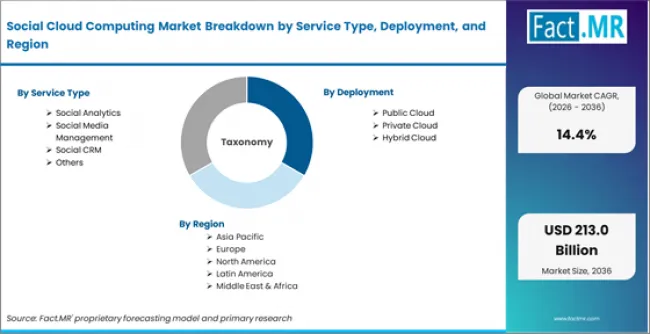
Social Cloud Computing Market Breakdown By Service Type, Deployment, And Region | Source: Fact.MR
| Parameter | Details |
|---|---|
| Quantitative Units | USD 55.48 billion to USD 213.02 billion, at a CAGR of 14.4% |
| Market Definition | The Social Cloud Computing Market covers social cloud computing products used across social analytics, social media management, social crm applications, sold through specialty, online, and mass retail channels. |
| Regions Covered | North America, Latin America, Europe, East Asia, South Asia and Pacific, Middle East and Africa |
| Countries Covered | USA, Germany, UK, South Korea, Japan, France, 30 plus countries |
| Key Companies | Salesforce.com, IBM Corporation, Microsoft Corporation, Oracle Corporation, Adobe Systems, Hootsuite, Sprout Social, Buffer, Brandwatch, Socialbakers |
| Forecast Period | 2026 to 2036 |
| Approach | Hybrid demand-side and top-down methodology built on country-level application demand, product benchmarking, pricing analysis, shipment validation, and primary interviews across manufacturers, distributors, retailers, and end users |
Source: Fact.MR analysis. Updated May 27, 2026
Social Cloud Computing Market Segmentation
-
Social Cloud Computing Market Segmented by Service Type:
- Social Analytics
- Sentiment Analysis
- Customer Insights
- Trend Analysis
- Social Media Management
- Content Scheduling
- Campaign Management
- Performance Tracking
- Social CRM
- Customer Engagement
- Lead Management
- Customer Support Integration
- Others
- Influencer Management
- Social Analytics
-
Social Cloud Computing Market Segmented by Deployment:
- Public Cloud
- Multi-Tenant Platforms
- Subscription-Based Deployment
- Private Cloud
- Enterprise Dedicated Infrastructure
- Hybrid Cloud
- Integrated Cloud Environment
- Public Cloud
-
Social Cloud Computing Market Segmented by Organization Size:
- Large Enterprises
- Global Enterprises
- Multi-Department Organizations
- Small and Medium Enterprises
- Startups
- Growing Businesses
- Large Enterprises
-
Social Cloud Computing Market Segmented by Application:
- Marketing and Advertising
- Campaign Optimization
- Brand Monitoring
- Customer Experience Management
- Feedback Analysis
- Customer Journey Tracking
- Sales and Lead Generation
- Lead Identification
- Conversion Tracking
- Risk and Compliance Management
- Fraud Detection
- Regulatory Monitoring
- Marketing and Advertising
-
Social Cloud Computing Market Segmented by End Use Industry:
- Retail and E-Commerce
- Online Retail Platforms
- Direct-to-Consumer Brands
- Banking Financial Services and Insurance
- Digital Banking
- Insurance Platforms
- Media and Entertainment
- Streaming Platforms
- Publishing Houses
- Healthcare
- Hospitals
- Pharmaceutical Companies
- Retail and E-Commerce
-
Social Cloud Computing Market Segmented by Pricing Model:
- Subscription-Based
- Monthly Subscription
- Annual Subscription
- Usage-Based Pricing
- Pay Per Use
- Tiered Pricing
- Basic Tier
- Premium Tier
- Subscription-Based
-
Social Cloud Computing Market by Region:
- North America
- USA
- Canada
- Mexico
- Latin America
- Brazil
- Chile
- Rest of Latin America
- Western Europe
- Germany
- UK
- Italy
- Spain
- France
- Nordic
- BENELUX
- Rest of Western Europe
- Eastern Europe
- Russia
- Poland
- Hungary
- Balkan & Baltic
- Rest of Eastern Europe
- East Asia
- China
- Japan
- South Korea
- South Asia and Pacific
- India
- ASEAN
- Australia & New Zealand
- Rest of South Asia and Pacific
- Middle East & Africa
- Kingdom of Saudi Arabia
- Other GCC Countries
- Turkiye
- South Africa
- Other African Union
- Rest of Middle East & Africa
- North America
Frequently Asked Questions
How big is the social cloud computing market in 2026?
What will be the size of social cloud computing market in 2036?
How much will be the social cloud computing market growth between 2026 and 2036?
What are the key product types in the social cloud computing market?
Which deployment segment is expected to contribute significant share in the social cloud computing market in 2026?
Who worked on this report


Preview the report firsthand - request a free sample
Free SampleGet the brochure for pricing and purchase details
Download PDF