CMOS Power Amplifier Market (2026 - 2036)

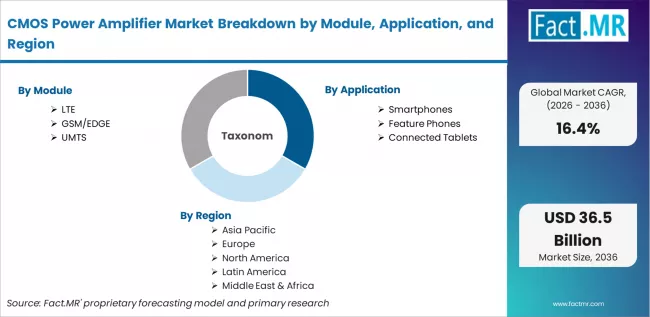
CMOS Power Amplifier Market is segmented by Module (GSM/EDGE, UMTS, LTE, CDMA 2000, TD-SCDMA, and FOMA/Others), Application (Smartphones, Feature Phones, Connected Tablets, and Others), and Region. Forecast for 2026 to 2036.

Core Findings

    CMOS Power Amplifier Market Forecast and Outlook By Fact.MR

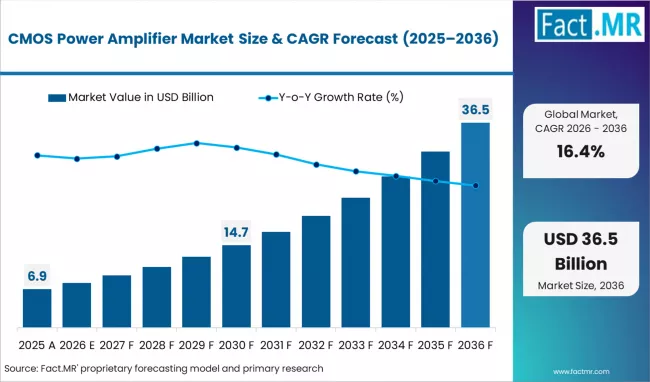
    In 2025, the CMOS power amplifier market was valued at USD 6.9 billion. Based on Fact.MR analysis, demand for CMOS power amplifiers is estimated to grow to USD 8.0 billion in 2026 and USD 36.5 billion by 2036. FACT.MR projects a CAGR of 16.4% during the forecast period.

    The market is expected to generate USD 28.5 billion in incremental revenue. This reflects transformational growth rather than incremental expansion. Growth is driven by rising 5G smartphone adoption and large-scale IoT deployment. CMOS offers a strong cost advantage over GaAs, supporting wider adoption. However, pricing pressure exists in low-band IoT segments. GaAs remains competitive in mmWave applications. These factors limit faster growth in premium segments.
    Cmos Power Amplifier Market Market Value Analysis

    Metric Value
    Estimated Value in 2026 USD 8.0 billion
    Forecast Value in 2036 USD 36.5 billion
    Forecast CAGR (2026 to 2036) 16.4%

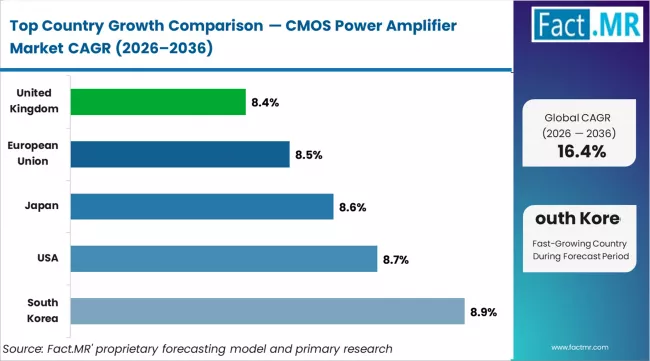
    South Korea leads country-level growth at 8.9% CAGR, supported by rapid 5G smartphone OEM expansion and advanced foundry capacity. The USA at 8.7% reflects strong IoT and defence RF adoption, while Japan at 8.6% benefits from hybrid vehicle electronics and precision semiconductor manufacturing. The European Union at 8.5% is driven by energy efficiency regulations and 5G infrastructure rollouts. The UK at 8.4% records steady growth from enterprise IoT and smart device deployment. Structural constraints across mature markets include high existing 4G LTE platform penetration and the capital intensity of transitioning to advanced-node CMOS PA fabrication.

    Summary of CMOS Power Amplifier Market

    • Market Definition
      • The market covers CMOS-based RF power amplification components used in mobile communication devices, IoT endpoints, and connected consumer electronics operating across 2G, 3G, 4G LTE, and 5G wireless standards.
    • Demand Drivers
      • 5G smartphone OEMs in South Korea, China, and the USA are increasing CMOS PA content per device to support sub-6 GHz and mmWave multi-band operation simultaneously.
      • The EU Energy Efficiency Directive is pushing device manufacturers toward CMOS PAs with higher power added efficiency, replacing GaAs components in mid-band smartphone tiers.
      • pSemi Corporation, a Murata company, launched the PE562212 IoT FEM at CES in January 2024, reflecting enterprise IoT device makers' demand for ultra-compact CMOS PA-LNA-switch integration in Thread, Zigbee, and Wi-Fi 2.4 GHz applications.
    • Key Segments Analyzed
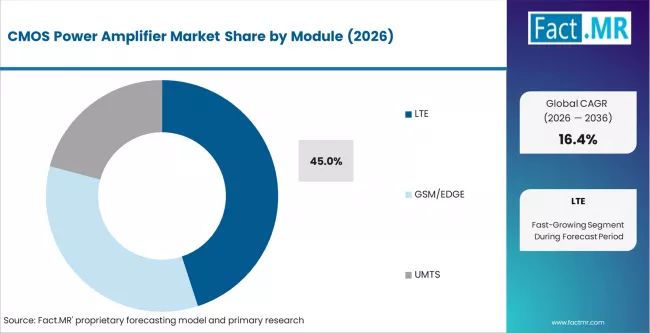
      • By Module: LTE holds approximately 45% share in 2026, anchored by global 4G device production volumes and backward-compatible 5G handset architectures.
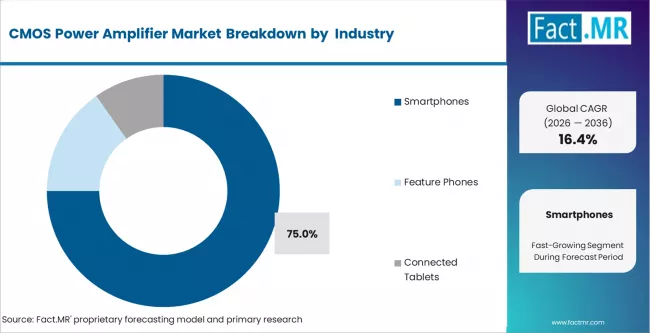
      • By Application: Smartphones hold approximately 75% share as the primary high-volume consumption segment for CMOS PA components.
      • By Geography: South Korea leads growth at 8.9% CAGR through 2036, supported by Samsung and LG OEM 5G device production volumes.
    • Analyst Opinion at FACT.MR
      • Shambhu Nath Jha, Senior Research Analyst at Fact.MR, opines, 'CXOs will find that the Skyworks-Qorvo merger and 5G device proliferation are forcing procurement teams to reassess supplier dependency risk across every tier of the CMOS PA supply chain.'
    • Strategic Implications
      • OEM procurement teams should model supply chain concentration risk arising from the Skyworks-Qorvo combination and develop dual-source CMOS PA qualification roadmaps for 5G tiers.
      • Vendors targeting EU markets should accelerate CMOS PA power efficiency certifications aligned with the EU Energy Efficiency Directive to capture regulatory-driven replacement cycles.
      • Companies serving the IoT segment should prioritise ultra-compact CMOS PA-LNA-switch integration using advanced RFSOI and UltraCMOS processes to serve space-constrained wearable and industrial IoT applications.
    • Methodology
      • Market sizing uses global smartphone and IoT device production volumes, CMOS PA attach rates, and average selling price benchmarks by module standard.
      • Regulatory data from EU Energy Efficiency Directive, South Korea MSIT 5G policies, Japan MIC spectrum guidelines, and ITU 5G subscription data supported country analysis.
      • Forecasts integrate 5G handset penetration trends, IoT platform adoption, and primary interviews with RF semiconductor supply chain directors.

    Segmental Analysis

    CMOS Power Amplifier Market Analysis by Module
    Cmos Power Amplifier Market Analysis By Module

    LTE module PAs are expected to hold ~45% share in 2026 due to continued global 4G usage. 5G devices also rely on LTE for backward compatibility, sustaining demand.

    • Skyworks-Qorvo Merger: Announced in 2025, forming a USD 22 billion entity. The merger strengthens combined portfolios across CMOS, GaAs, and GaN, reshaping OEM sourcing strategies. [4]
    • Broadcom-Tower RFSOI Wi-Fi 7 FEM: Introduced integrated RF modules with PA, LNA, and switch functions. This supports the shift toward highly integrated and power-efficient designs. [5]
    • LTE PA Market Consolidation Trend: Top five vendors dominate global revenue due to scale advantages. Their control over manufacturing and integration strengthens market leadership. [6]

    CMOS Power Amplifier Market Analysis by Application
    Cmos Power Amplifier Market Analysis By Application

    Smartphones are expected to hold ~75% share in 2026 due to high production volumes. Multi-band 5G requirements increase CMOS PA content per device.

    • pSemi IoT FEM Launch: Introduced compact integrated modules for IoT applications. This highlights growing CMOS PA adoption beyond smartphones into connected devices. [7]
    • Qualcomm 5G RF Front-End Platform: Offers integrated RF solutions with AI-based optimisation and wideband PA support. This strengthens its position in premium 5G smartphone segments. [8]
    • Feature Phone Segment Stability: Feature phones continue to drive demand for low-cost CMOS PAs in emerging markets. High volumes support stable production at mature nodes. [9]

    Drivers, Restraints, and Opportunities
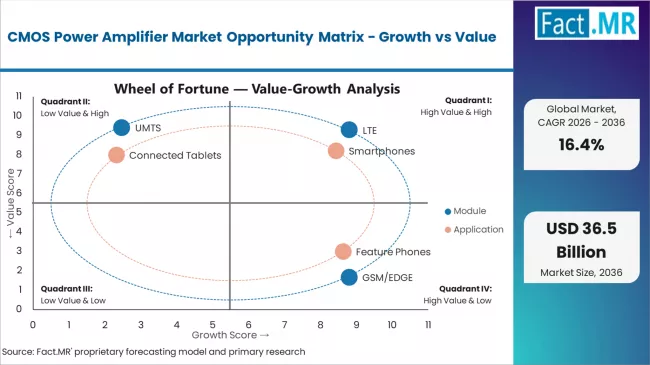
    Cmos Power Amplifier Market Opportunity Matrix Growth Vs Value

    FACT.MR analysts observe that CMOS PA has evolved from a cost substitute to a core RF component in 5G and IoT devices. It enables OEMs to reduce PCB size, improve integration, and lower overall bill of materials costs.

    Demand for standalone PAs is stabilising as OEMs shift toward integrated RF front-end modules. These combine PA, LNA, and switches on a single die, increasing module value despite declining per-unit PA prices. This transition supports higher overall revenue through multi-band 5G adoption.

    • 5G Infrastructure Deployment Acceleration: 5G subscriptions reached 2.27 billion in 2024, with continued growth expected. Each 5G device requires more CMOS PAs due to multi-band and mmWave support, increasing demand per unit. [1]
    • EU Energy Efficiency Directive Compliance: EU regulations are pushing OEMs to adopt more power-efficient CMOS and RFSOI PAs. This is accelerating replacement of legacy GaAs components across devices. [2]
    • South Korea 5G OEM Expansion: Samsung’s expanding 5G production and USD 230 billion semiconductor investment are strengthening demand for advanced CMOS RF components. [3]

    Regional Analysis

    The CMOS power amplifier market is analysed across North America, Europe, Asia Pacific, Latin America, and Middle East and Africa, covering 40+ country-level demand profiles shaped by 5G device production volumes, wireless infrastructure rollout timelines, energy efficiency regulatory requirements, and OEM semiconductor procurement strategies. The full report offers market attractiveness analysis based on module standard adoption, PA integration tier, and regional policy support benchmarks.

    Top Country Growth Comparison Cmos Power Amplifier Market Cagr (2026 2036)

    Country CAGR (2026 to 2036)
    South Korea 8.9%
    USA 8.7%
    Japan 8.6%
    European Union 8.5%
    United Kingdom 8.4%

    Source: Fact.MR (FACT.MR) analysis, based on proprietary forecasting model and primary research
    Cmos Power Amplifier Market Cagr Analysis By Country

    Asia Pacific CMOS Power Amplifier Market Analysis
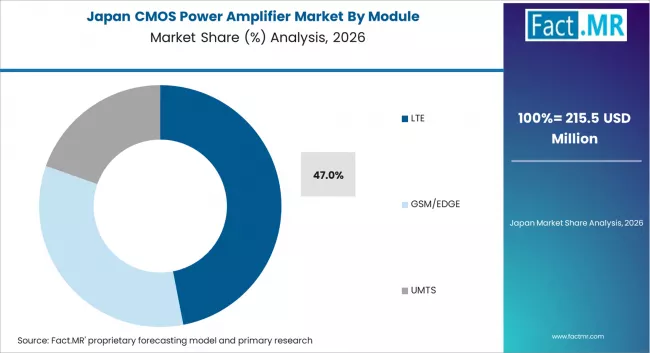
    Cmos Power Amplifier Market Japan Market Share Analysis By Module

    Asia Pacific is the production epicentre of the global CMOS power amplifier market, anchored by South Korea's 5G OEM concentration, Japan's semiconductor ecosystem, and China’s handset manufacturing base. Key players include Skyworks, Qualcomm, Murata, and regional fabless firms.

    • South Korea: Strong 5G rollout and OEM concentration are driving CMOS PA demand in South Korea, projected at 8.9% CAGR through 2036. Updated 5G spectrum guidelines in 2024 expanded sub-6 GHz and mmWave usage, increasing PA requirements per device. Samsung’s large-scale 5G smartphone production and LG’s IoT expansion are sustaining demand. Domestic RF procurement grew ~18% in 2024.
    • Japan: Policy-driven 5G expansion and advanced manufacturing capabilities are supporting CMOS PA growth in Japan, expected at 8.6% CAGR through 2036. Revised spectrum guidelines aim for 97% coverage by 2030, boosting long-term demand. Murata expanded RF module capacity, while Sony’s 5G device portfolio continues to support domestic demand. Japan remains a key secondary supply hub.

    FACT.MR's Asia Pacific coverage includes Japan, South Korea, China, India, ASEAN, Australia and New Zealand, and Rest of Asia Pacific. The report includes OEM design win benchmarks, government 5G policy timelines, and CMOS PA integration trends.

    North America CMOS Power Amplifier Market Analysis
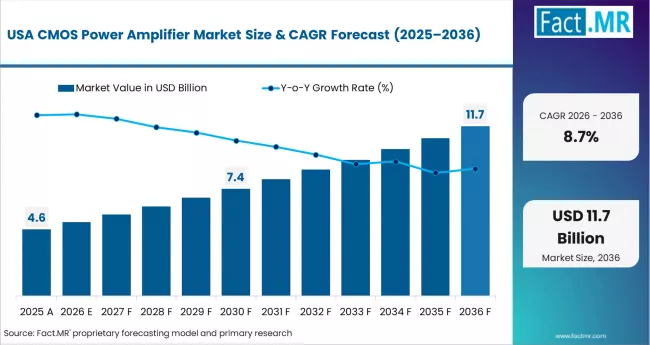
    Cmos Power Amplifier Market Country Value Analysis

    North America is the innovation and design hub for CMOS PA technologies, led by Qualcomm, Skyworks, Qorvo, and Broadcom. The region generates high value per unit due to premium device concentration.

    • USA: Government funding and strong OEM partnerships are sustaining CMOS PA demand in the United States, projected at 8.7% CAGR through 2036. The CHIPS Act is expanding semiconductor capacity, including RF-relevant fabs. Qualcomm secured major supply agreements in 2024, while ongoing FCC spectrum auctions continue to support 5G infrastructure demand.

    FACT.MR's North America coverage includes the United States, Canada, and Mexico. The report includes 5G design win data, CHIPS Act benchmarks, and adoption forecasts.

    Europe CMOS Power Amplifier Market Analysis
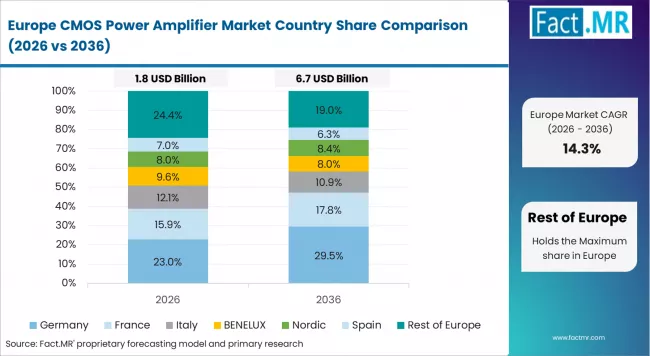
    Cmos Power Amplifier Market Europe Country Market Share Analysis, 2026 & 2036

    Europe acts as a regulatory-driven market, where energy efficiency standards shape CMOS PA adoption. Key suppliers include Infineon, STMicroelectronics, and Nordic Semiconductor.

    • European Union: Regulatory compliance and 5G expansion are driving CMOS PA demand across the EU, projected at 8.5% CAGR through 2036. The Ecodesign Regulation enforces efficiency benchmarks, pushing OEMs toward CMOS solutions. 5G coverage exceeded 80% in 2024, while Infineon expanded its RF portfolio for IoT and industrial use. The European Chips Act is supporting local semiconductor capacity.
    • United Kingdom: Spectrum expansion and semiconductor policy support are boosting CMOS PA demand in the UK, forecast at 8.4% CAGR through 2036. Ofcom’s licensing programme is sustaining infrastructure demand. Government funding is strengthening RF research clusters, while ARM is expanding RF chipset partnerships globally.

    FACT.MR's Europe coverage includes Germany, France, the United Kingdom, Italy, Spain, Nordic countries, BENELUX, Eastern Europe, and Russia. The report includes EU compliance benchmarks, 5G rollout data, and regional forecasts.

    Competitive Aligners for Market Players
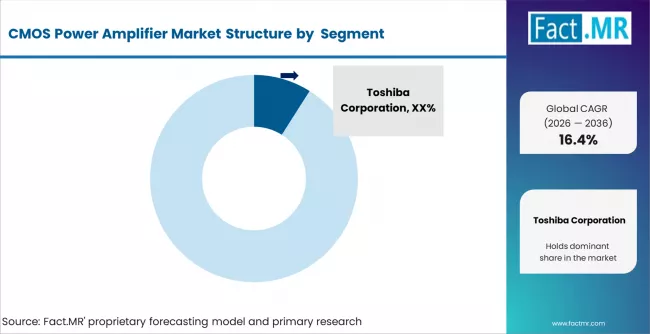
    Cmos Power Amplifier Market Analysis By Company

    The global CMOS power amplifier market shows a mix of concentration and fragmentation. In high-volume smartphone applications, a few major players dominate, including Skyworks Solutions, Qorvo, Broadcom, Qualcomm, and Murata. Together, they control a large share of enterprise revenue. Competition is no longer just about offering the lowest price. Instead, companies are competing on performance, integration, and the ability to deliver complete RF front-end solutions that combine multiple components into a single module.

    A major turning point in the market is the planned merger between Skyworks and Qorvo. This deal will create a powerful combined entity with one of the most comprehensive RF portfolios in the industry. With strong capabilities across CMOS, GaAs, and GaN technologies, the merged company is expected to achieve significant cost efficiencies and strengthen its position across mobile, IoT, and defence markets. Device manufacturers are trying to reduce dependence on a small number of suppliers by qualifying alternative sources.

    However, once a power amplifier is designed into a smartphone and approved by carriers, switching suppliers becomes extremely difficult. This creates strong long-term relationships between OEMs and established vendors, giving leading companies stable revenues while making it challenging for new entrants to break into the market.

    Key Players Of CMOS Power Amplifier Market

    • Toshiba Corporation
    • QUALCOMM Incorporated
    • ACCO Semiconductor Inc.
    • Broadcom Ltd.
    • DSP Group Inc.
    • Skyworks Solutions, Inc.
    • Texas Instruments Inc.
    • Qorvo, Inc.
    • Murata Manufacturing Co., Ltd.

    Scope of Report

    Cmos Power Amplifier Market Breakdown By Module, Application, And Region

    Attribute Details
    Quantitative Units USD 8.0 billion (2026) to USD 36.5 billion (2036), at a CAGR of 16.4%
    Market Definition CMOS-based radio frequency power amplifier components used in smartphones, IoT devices, tablets, and connected electronics operating across GSM, UMTS, LTE, CDMA 2000, TD-SCDMA, and FOMA wireless communication standards.
    Module Segmentation GSM/EDGE, UMTS, LTE, CDMA 2000, TD-SCDMA, FOMA/Others
    Application Segmentation Smartphones, Feature Phones, Connected Tablets, Others
    Application Coverage 5G and 4G LTE smartphone RF front ends, IoT multi-protocol FEMs, connected tablet PA modules, feature phone single-standard PAs, wearable device RF transmitters, and automotive IoT PA components.
    Regions Covered North America, Europe, Asia Pacific, Latin America, Middle East and Africa
    Countries Covered USA, Canada, Mexico, UK, Germany, France, Italy, Spain, Nordic, BENELUX, Eastern Europe, Japan, South Korea, China, India, ASEAN, Australia and New Zealand, Brazil, Argentina, Chile, KSA, GCC, Turkey, South Africa, Rest of MEA
    Key Companies Profiled Toshiba Corporation, QUALCOMM, ACCO Semiconductor, Broadcom Ltd., DSP Group, Skyworks Solutions, Texas Instruments, Qorvo, Murata Manufacturing
    Forecast Period 2026 to 2036
    Approach Hybrid top-down and bottom-up model using global smartphone and IoT device production volumes, CMOS PA attach rates by module standard, average selling price benchmarks by application tier, and primary interviews with RF semiconductor OEM procurement directors.

    CMOS Power Amplifier Market by Segments

    • By Module :

      • GSM/EDGE
      • UMTS
      • LTE
      • CDMA 2000
      • TD-SCDMA
      • FOMA/Others
    • By Application :

      • Smartphones
      • Feature Phones
      • Connected Tablets
      • Others
    • By Region :

      • North America
        • United States
        • Canada
        • Mexico
      • Latin America
        • Brazil
        • Mexico
        • Argentina
        • Chile
        • Rest of Latin America
      • Western Europe
        • Germany
        • United Kingdom
        • France
        • Italy
        • Spain
        • Nordic Countries
        • BENELUX
        • Rest of Western Europe
      • Eastern Europe
        • Russia
        • Poland
        • Hungary
        • Balkan and Baltic
        • Rest of Eastern Europe
      • East Asia
        • China
        • Japan
        • South Korea
      • South Asia and Pacific
        • India
        • ASEAN
        • Australia and New Zealand
        • Rest of South Asia and Pacific
      • Middle East and Africa
        • Kingdom of Saudi Arabia
        • Other GCC Countries
        • Turkey
        • South Africa
        • Rest of Middle East and Africa

    Bibliography

    • [1] International Telecommunication Union (ITU) / GSMA. 5G Global Subscription Data Update: 2.27 Billion 5G Subscriptions by End-2024 and Smartphone PA Content Per Device Analysis. December 2024.
    • [2] European Commission. Ecodesign Regulation for Mobile Phones and Tablets: Energy Performance Requirements for RF Front-End Components Effective 2025. Official Journal of the EU. 2024.
    • [3] Samsung Electronics. 2030 System Semiconductor Vision Programme and 5G Galaxy Series Production Volume Disclosures. 2024 Annual Report. March 2025.
    • [4] Skyworks Solutions / Qorvo. Skyworks and Qorvo Announce Definitive Agreement to Combine, Creating USD 22 Billion US-Based RF Semiconductor Leader. October 28, 2025.
    • [5] Tower Semiconductor / Broadcom Inc. Tower Semiconductor Sets New RFSOI Standard with Broadcom Wi-Fi 7 RF Front-End Modules Using 300mm RFSOI Technology. September 10, 2024.
    • [6] Yole Group. Status of the RF Industry 2025: Market Shares, Technology Roadmaps, and Competitive Positioning of Top Five Global RF PA Vendors. 2025.
    • [7] pSemi Corporation (Murata Company). pSemi Unveils PE562212 Smallest Fully Integrated PA-LNA-SW IoT Front-End Module for Thread Zigbee Bluetooth and Wi-Fi 2.4 GHz Applications. January 9, 2024.
    • [8] Qualcomm Technologies, Inc. Qualcomm Snapdragon X-Series 5G Modem-RF System and RFFE Solution for High-Performance 5G Mobile Devices. 2024 Product Documentation.

    This Report Addresses

    • Strategic intelligence on 5G spectrum allocation policies in South Korea and Japan, EU Ecodesign Regulation PA efficiency requirements, US CHIPS Act RF fabrication investments, and ITU 5G subscription expansion trends shaping CMOS PA procurement through 2036.
    • Market forecast projecting growth from USD 8.0 billion in 2026 to USD 36.5 billion by 2036 at a 16.4% CAGR, segmented by module standard, application, and region.
    • Growth opportunity analysis across South Korea 5G OEM production programmes, EU Ecodesign-driven CMOS PA replacement cycles, US CHIPS Act-supported RF fabrication, IoT FEM adoption in Thread and Zigbee applications, and Japan's precision CMOS manufacturing expansion.
    • Country CAGR outlook highlighting South Korea (8.9%), USA (8.7%), Japan (8.6%), EU (8.5%), and UK (8.4%), supported by OEM production data, 5G infrastructure capex benchmarks, and regulatory compliance timelines.
    • Competitive landscape analysis covering Skyworks Solutions, Qorvo, Broadcom, QUALCOMM, Murata Manufacturing, Texas Instruments, ACCO Semiconductor, DSP Group, and Toshiba, focusing on merger implications, CMOS process roadmaps, and design-win strategies.
    • Technology tracking including RFSOI integration, UltraCMOS IoT FEM architectures, AI-driven envelope tracking, Wi-Fi 7 PA module production, digitally assisted CMOS PAs, and mmWave CMOS beamforming front-end developments.
    • Regulatory coverage of EU Ecodesign Regulation mobile device efficiency rules, UK Semiconductor Strategy RF capability funding, US CHIPS Act RF fabrication investments, South Korea MSIT 5G spectrum guidelines, and Japan MIC coverage mandates.
    • Report deliverables include PDF report, Excel datasets, PowerPoint summary, and dashboards using data from Skyworks, Qorvo, Broadcom, and Murata filings, ITU 5G data, EU regulatory authority publications, and expert interviews.

    CMOS Power Amplifier Market Market Definition

    The CMOS power amplifier market includes semiconductor devices that amplify RF signals in wireless devices.

    CMOS Power Amplifier Market Inclusions

    Covers global forecasts (2026-2036) by module type and application across major standards and devices.

    CMOS Power Amplifier Market Exclusions

    Excludes GaAs, GaN PAs, standalone RF components, and manufacturing equipment.

    CMOS Power Amplifier Market Research Methodology

    • Primary Research: Interviews with procurement managers, OEMs, engineers, and IoT specialists.
    • Desk Research: Includes company filings, product releases, and telecom regulatory data.
    • Market Sizing and Forecasting: Based on device volumes, attach rates, pricing, and RF design trends.
    • Data Validation and Update Cycle: Validated using company revenues, 5G data, and expert interviews.

    Table of Content

    1. Executive Summary
      • Global Market Outlook
      • Demand to side Trends
      • Supply to side Trends
      • Technology Roadmap Analysis
      • Analysis and Recommendations
    2. Market Overview
      • Market Coverage / Taxonomy
      • Market Definition / Scope / Limitations
    3. Research Methodology
      • Chapter Orientation
      • Analytical Lens and Working Hypotheses
        • Market Structure, Signals, and Trend Drivers
        • Benchmarking and Cross-market Comparability
        • Market Sizing, Forecasting, and Opportunity Mapping
      • Research Design and Evidence Framework
        • Desk Research Programme (Secondary Evidence)
          • Company Annual and Sustainability Reports
          • Peer-reviewed Journals and Academic Literature
          • Corporate Websites, Product Literature, and Technical Notes
          • Earnings Decks and Investor Briefings
          • Statutory Filings and Regulatory Disclosures
          • Technical White Papers and Standards Notes
          • Trade Journals, Industry Magazines, and Analyst Briefs
          • Conference Proceedings, Webinars, and Seminar Materials
          • Government Statistics Portals and Public Data Releases
          • Press Releases and Reputable Media Coverage
          • Specialist Newsletters and Curated Briefings
          • Sector Databases and Reference Repositories
          • Fact.MR Internal Proprietary Databases and Historical Market Datasets
          • Subscription Datasets and Paid Sources
          • Social Channels, Communities, and Digital Listening Inputs
          • Additional Desk Sources
        • Expert Input and Fieldwork (Primary Evidence)
          • Primary Modes
            • Qualitative Interviews and Expert Elicitation
            • Quantitative Surveys and Structured Data Capture
            • Blended Approach
          • Why Primary Evidence is Used
          • Field Techniques
            • Interviews
            • Surveys
            • Focus Groups
            • Observational and In-context Research
            • Social and Community Interactions
          • Stakeholder Universe Engaged
            • C-suite Leaders
            • Board Members
            • Presidents and Vice Presidents
            • R&D and Innovation Heads
            • Technical Specialists
            • Domain Subject-matter Experts
            • Scientists
            • Physicians and Other Healthcare Professionals
          • Governance, Ethics, and Data Stewardship
            • Research Ethics
            • Data Integrity and Handling
        • Tooling, Models, and Reference Databases
      • Data Engineering and Model Build
        • Data Acquisition and Ingestion
        • Cleaning, Normalisation, and Verification
        • Synthesis, Triangulation, and Analysis
      • Quality Assurance and Audit Trail
    4. Market Background
      • Market Dynamics
        • Drivers
        • Restraints
        • Opportunity
        • Trends
      • Scenario Forecast
        • Demand in Optimistic Scenario
        • Demand in Likely Scenario
        • Demand in Conservative Scenario
      • Opportunity Map Analysis
      • Product Life Cycle Analysis
      • Supply Chain Analysis
      • Investment Feasibility Matrix
      • Value Chain Analysis
      • PESTLE and Porter’s Analysis
      • Regulatory Landscape
      • Regional Parent Market Outlook
      • Production and Consumption Statistics
      • Import and Export Statistics
    5. Global Market Analysis 2021 to 2025 and Forecast, 2026 to 2036
      • Historical Market Size Value (USD Million) Analysis, 2021 to 2025
      • Current and Future Market Size Value (USD Million) Projections, 2026 to 2036
        • Y to o to Y Growth Trend Analysis
        • Absolute $ Opportunity Analysis
    6. Global Market Pricing Analysis 2021 to 2025 and Forecast 2026 to 2036
    7. Global Market Analysis 2021 to 2025 and Forecast 2026 to 2036, By Module
      • Introduction / Key Findings
      • Historical Market Size Value (USD Million) Analysis By Module, 2021 to 2025
      • Current and Future Market Size Value (USD Million) Analysis and Forecast By Module, 2026 to 2036
        • LTE
        • GSM/EDGE
        • UMTS
      • Y to o to Y Growth Trend Analysis By Module, 2021 to 2025
      • Absolute $ Opportunity Analysis By Module, 2026 to 2036
    8. Global Market Analysis 2021 to 2025 and Forecast 2026 to 2036, By Application
      • Introduction / Key Findings
      • Historical Market Size Value (USD Million) Analysis By Application, 2021 to 2025
      • Current and Future Market Size Value (USD Million) Analysis and Forecast By Application, 2026 to 2036
        • Smartphones
        • Feature Phones
        • Connected Tablets
      • Y to o to Y Growth Trend Analysis By Application, 2021 to 2025
      • Absolute $ Opportunity Analysis By Application, 2026 to 2036
    9. Global Market Analysis 2021 to 2025 and Forecast 2026 to 2036, By Region
      • Introduction
      • Historical Market Size Value (USD Million) Analysis By Region, 2021 to 2025
      • Current Market Size Value (USD Million) Analysis and Forecast By Region, 2026 to 2036
        • North America
        • Latin America
        • Western Europe
        • Eastern Europe
        • East Asia
        • South Asia and Pacific
        • Middle East & Africa
      • Market Attractiveness Analysis By Region
    10. North America Market Analysis 2021 to 2025 and Forecast 2026 to 2036, By Country
      • Historical Market Size Value (USD Million) Trend Analysis By Market Taxonomy, 2021 to 2025
      • Market Size Value (USD Million) Forecast By Market Taxonomy, 2026 to 2036
        • By Country
          • USA
          • Canada
          • Mexico
        • By Module
        • By Application
      • Market Attractiveness Analysis
        • By Country
        • By Module
        • By Application
      • Key Takeaways
    11. Latin America Market Analysis 2021 to 2025 and Forecast 2026 to 2036, By Country
      • Historical Market Size Value (USD Million) Trend Analysis By Market Taxonomy, 2021 to 2025
      • Market Size Value (USD Million) Forecast By Market Taxonomy, 2026 to 2036
        • By Country
          • Brazil
          • Chile
          • Rest of Latin America
        • By Module
        • By Application
      • Market Attractiveness Analysis
        • By Country
        • By Module
        • By Application
      • Key Takeaways
    12. Western Europe Market Analysis 2021 to 2025 and Forecast 2026 to 2036, By Country
      • Historical Market Size Value (USD Million) Trend Analysis By Market Taxonomy, 2021 to 2025
      • Market Size Value (USD Million) Forecast By Market Taxonomy, 2026 to 2036
        • By Country
          • Germany
          • UK
          • Italy
          • Spain
          • France
          • Nordic
          • BENELUX
          • Rest of Western Europe
        • By Module
        • By Application
      • Market Attractiveness Analysis
        • By Country
        • By Module
        • By Application
      • Key Takeaways
    13. Eastern Europe Market Analysis 2021 to 2025 and Forecast 2026 to 2036, By Country
      • Historical Market Size Value (USD Million) Trend Analysis By Market Taxonomy, 2021 to 2025
      • Market Size Value (USD Million) Forecast By Market Taxonomy, 2026 to 2036
        • By Country
          • Russia
          • Poland
          • Hungary
          • Balkan & Baltic
          • Rest of Eastern Europe
        • By Module
        • By Application
      • Market Attractiveness Analysis
        • By Country
        • By Module
        • By Application
      • Key Takeaways
    14. East Asia Market Analysis 2021 to 2025 and Forecast 2026 to 2036, By Country
      • Historical Market Size Value (USD Million) Trend Analysis By Market Taxonomy, 2021 to 2025
      • Market Size Value (USD Million) Forecast By Market Taxonomy, 2026 to 2036
        • By Country
          • China
          • Japan
          • South Korea
        • By Module
        • By Application
      • Market Attractiveness Analysis
        • By Country
        • By Module
        • By Application
      • Key Takeaways
    15. South Asia and Pacific Market Analysis 2021 to 2025 and Forecast 2026 to 2036, By Country
      • Historical Market Size Value (USD Million) Trend Analysis By Market Taxonomy, 2021 to 2025
      • Market Size Value (USD Million) Forecast By Market Taxonomy, 2026 to 2036
        • By Country
          • India
          • ASEAN
          • Australia & New Zealand
          • Rest of South Asia and Pacific
        • By Module
        • By Application
      • Market Attractiveness Analysis
        • By Country
        • By Module
        • By Application
      • Key Takeaways
    16. Middle East & Africa Market Analysis 2021 to 2025 and Forecast 2026 to 2036, By Country
      • Historical Market Size Value (USD Million) Trend Analysis By Market Taxonomy, 2021 to 2025
      • Market Size Value (USD Million) Forecast By Market Taxonomy, 2026 to 2036
        • By Country
          • Kingdom of Saudi Arabia
          • Other GCC Countries
          • Turkiye
          • South Africa
          • Other African Union
          • Rest of Middle East & Africa
        • By Module
        • By Application
      • Market Attractiveness Analysis
        • By Country
        • By Module
        • By Application
      • Key Takeaways
    17. Key Countries Market Analysis
      • USA
        • Pricing Analysis
        • Market Share Analysis, 2025
          • By Module
          • By Application
      • Canada
        • Pricing Analysis
        • Market Share Analysis, 2025
          • By Module
          • By Application
      • Mexico
        • Pricing Analysis
        • Market Share Analysis, 2025
          • By Module
          • By Application
      • Brazil
        • Pricing Analysis
        • Market Share Analysis, 2025
          • By Module
          • By Application
      • Chile
        • Pricing Analysis
        • Market Share Analysis, 2025
          • By Module
          • By Application
      • Germany
        • Pricing Analysis
        • Market Share Analysis, 2025
          • By Module
          • By Application
      • UK
        • Pricing Analysis
        • Market Share Analysis, 2025
          • By Module
          • By Application
      • Italy
        • Pricing Analysis
        • Market Share Analysis, 2025
          • By Module
          • By Application
      • Spain
        • Pricing Analysis
        • Market Share Analysis, 2025
          • By Module
          • By Application
      • France
        • Pricing Analysis
        • Market Share Analysis, 2025
          • By Module
          • By Application
      • India
        • Pricing Analysis
        • Market Share Analysis, 2025
          • By Module
          • By Application
      • ASEAN
        • Pricing Analysis
        • Market Share Analysis, 2025
          • By Module
          • By Application
      • Australia & New Zealand
        • Pricing Analysis
        • Market Share Analysis, 2025
          • By Module
          • By Application
      • China
        • Pricing Analysis
        • Market Share Analysis, 2025
          • By Module
          • By Application
      • Japan
        • Pricing Analysis
        • Market Share Analysis, 2025
          • By Module
          • By Application
      • South Korea
        • Pricing Analysis
        • Market Share Analysis, 2025
          • By Module
          • By Application
      • Russia
        • Pricing Analysis
        • Market Share Analysis, 2025
          • By Module
          • By Application
      • Poland
        • Pricing Analysis
        • Market Share Analysis, 2025
          • By Module
          • By Application
      • Hungary
        • Pricing Analysis
        • Market Share Analysis, 2025
          • By Module
          • By Application
      • Kingdom of Saudi Arabia
        • Pricing Analysis
        • Market Share Analysis, 2025
          • By Module
          • By Application
      • Turkiye
        • Pricing Analysis
        • Market Share Analysis, 2025
          • By Module
          • By Application
      • South Africa
        • Pricing Analysis
        • Market Share Analysis, 2025
          • By Module
          • By Application
    18. Market Structure Analysis
      • Competition Dashboard
      • Competition Benchmarking
      • Market Share Analysis of Top Players
        • By Regional
        • By Module
        • By Application
    19. Competition Analysis
      • Competition Deep Dive
        • Toshiba Corporation
          • Overview
          • Product Portfolio
          • Profitability by Market Segments (Product/Age /Sales Channel/Region)
          • Sales Footprint
          • Strategy Overview
            • Marketing Strategy
            • Product Strategy
            • Channel Strategy
        • QUALCOMM Incorporated
        • ACCO Semiconductor Inc.
        • Broadcom Ltd.
        • DSP Group Inc.
        • Skyworks Solutions, Inc.
    20. Assumptions & Acronyms Used

    List Of Table

    • Table 1: Global Market Value (USD Million) Forecast by Region, 2021 to 2036
    • Table 2: Global Market Value (USD Million) Forecast by Module, 2021 to 2036
    • Table 3: Global Market Value (USD Million) Forecast by Application, 2021 to 2036
    • Table 4: North America Market Value (USD Million) Forecast by Country, 2021 to 2036
    • Table 5: North America Market Value (USD Million) Forecast by Module, 2021 to 2036
    • Table 6: North America Market Value (USD Million) Forecast by Application, 2021 to 2036
    • Table 7: Latin America Market Value (USD Million) Forecast by Country, 2021 to 2036
    • Table 8: Latin America Market Value (USD Million) Forecast by Module, 2021 to 2036
    • Table 9: Latin America Market Value (USD Million) Forecast by Application, 2021 to 2036
    • Table 10: Western Europe Market Value (USD Million) Forecast by Country, 2021 to 2036
    • Table 11: Western Europe Market Value (USD Million) Forecast by Module, 2021 to 2036
    • Table 12: Western Europe Market Value (USD Million) Forecast by Application, 2021 to 2036
    • Table 13: Eastern Europe Market Value (USD Million) Forecast by Country, 2021 to 2036
    • Table 14: Eastern Europe Market Value (USD Million) Forecast by Module, 2021 to 2036
    • Table 15: Eastern Europe Market Value (USD Million) Forecast by Application, 2021 to 2036
    • Table 16: East Asia Market Value (USD Million) Forecast by Country, 2021 to 2036
    • Table 17: East Asia Market Value (USD Million) Forecast by Module, 2021 to 2036
    • Table 18: East Asia Market Value (USD Million) Forecast by Application, 2021 to 2036
    • Table 19: South Asia and Pacific Market Value (USD Million) Forecast by Country, 2021 to 2036
    • Table 20: South Asia and Pacific Market Value (USD Million) Forecast by Module, 2021 to 2036
    • Table 21: South Asia and Pacific Market Value (USD Million) Forecast by Application, 2021 to 2036
    • Table 22: Middle East & Africa Market Value (USD Million) Forecast by Country, 2021 to 2036
    • Table 23: Middle East & Africa Market Value (USD Million) Forecast by Module, 2021 to 2036
    • Table 24: Middle East & Africa Market Value (USD Million) Forecast by Application, 2021 to 2036

    List Of Figures

    • Figure 1: Global Market Pricing Analysis
    • Figure 2: Global Market Value (USD Million) Forecast 2021 to 2036
    • Figure 3: Global Market Value Share and BPS Analysis by Module, 2026 and 2036
    • Figure 4: Global Market Y-o-Y Growth Comparison by Module, 2026 to 2036
    • Figure 5: Global Market Attractiveness Analysis by Module
    • Figure 6: Global Market Value Share and BPS Analysis by Application, 2026 and 2036
    • Figure 7: Global Market Y-o-Y Growth Comparison by Application, 2026 to 2036
    • Figure 8: Global Market Attractiveness Analysis by Application
    • Figure 9: Global Market Value (USD Million) Share and BPS Analysis by Region, 2026 and 2036
    • Figure 10: Global Market Y-o-Y Growth Comparison by Region, 2026 to 2036
    • Figure 11: Global Market Attractiveness Analysis by Region
    • Figure 12: North America Market Incremental Dollar Opportunity, 2026 to 2036
    • Figure 13: Latin America Market Incremental Dollar Opportunity, 2026 to 2036
    • Figure 14: Western Europe Market Incremental Dollar Opportunity, 2026 to 2036
    • Figure 15: Eastern Europe Market Incremental Dollar Opportunity, 2026 to 2036
    • Figure 16: East Asia Market Incremental Dollar Opportunity, 2026 to 2036
    • Figure 17: South Asia and Pacific Market Incremental Dollar Opportunity, 2026 to 2036
    • Figure 18: Middle East & Africa Market Incremental Dollar Opportunity, 2026 to 2036
    • Figure 19: North America Market Value Share and BPS Analysis by Country, 2026 and 2036
    • Figure 20: North America Market Value Share and BPS Analysis by Module, 2026 and 2036
    • Figure 21: North America Market Y-o-Y Growth Comparison by Module, 2026 to 2036
    • Figure 22: North America Market Attractiveness Analysis by Module
    • Figure 23: North America Market Value Share and BPS Analysis by Application, 2026 and 2036
    • Figure 24: North America Market Y-o-Y Growth Comparison by Application, 2026 to 2036
    • Figure 25: North America Market Attractiveness Analysis by Application
    • Figure 26: Latin America Market Value Share and BPS Analysis by Country, 2026 and 2036
    • Figure 27: Latin America Market Value Share and BPS Analysis by Module, 2026 and 2036
    • Figure 28: Latin America Market Y-o-Y Growth Comparison by Module, 2026 to 2036
    • Figure 29: Latin America Market Attractiveness Analysis by Module
    • Figure 30: Latin America Market Value Share and BPS Analysis by Application, 2026 and 2036
    • Figure 31: Latin America Market Y-o-Y Growth Comparison by Application, 2026 to 2036
    • Figure 32: Latin America Market Attractiveness Analysis by Application
    • Figure 33: Western Europe Market Value Share and BPS Analysis by Country, 2026 and 2036
    • Figure 34: Western Europe Market Value Share and BPS Analysis by Module, 2026 and 2036
    • Figure 35: Western Europe Market Y-o-Y Growth Comparison by Module, 2026 to 2036
    • Figure 36: Western Europe Market Attractiveness Analysis by Module
    • Figure 37: Western Europe Market Value Share and BPS Analysis by Application, 2026 and 2036
    • Figure 38: Western Europe Market Y-o-Y Growth Comparison by Application, 2026 to 2036
    • Figure 39: Western Europe Market Attractiveness Analysis by Application
    • Figure 40: Eastern Europe Market Value Share and BPS Analysis by Country, 2026 and 2036
    • Figure 41: Eastern Europe Market Value Share and BPS Analysis by Module, 2026 and 2036
    • Figure 42: Eastern Europe Market Y-o-Y Growth Comparison by Module, 2026 to 2036
    • Figure 43: Eastern Europe Market Attractiveness Analysis by Module
    • Figure 44: Eastern Europe Market Value Share and BPS Analysis by Application, 2026 and 2036
    • Figure 45: Eastern Europe Market Y-o-Y Growth Comparison by Application, 2026 to 2036
    • Figure 46: Eastern Europe Market Attractiveness Analysis by Application
    • Figure 47: East Asia Market Value Share and BPS Analysis by Country, 2026 and 2036
    • Figure 48: East Asia Market Value Share and BPS Analysis by Module, 2026 and 2036
    • Figure 49: East Asia Market Y-o-Y Growth Comparison by Module, 2026 to 2036
    • Figure 50: East Asia Market Attractiveness Analysis by Module
    • Figure 51: East Asia Market Value Share and BPS Analysis by Application, 2026 and 2036
    • Figure 52: East Asia Market Y-o-Y Growth Comparison by Application, 2026 to 2036
    • Figure 53: East Asia Market Attractiveness Analysis by Application
    • Figure 54: South Asia and Pacific Market Value Share and BPS Analysis by Country, 2026 and 2036
    • Figure 55: South Asia and Pacific Market Value Share and BPS Analysis by Module, 2026 and 2036
    • Figure 56: South Asia and Pacific Market Y-o-Y Growth Comparison by Module, 2026 to 2036
    • Figure 57: South Asia and Pacific Market Attractiveness Analysis by Module
    • Figure 58: South Asia and Pacific Market Value Share and BPS Analysis by Application, 2026 and 2036
    • Figure 59: South Asia and Pacific Market Y-o-Y Growth Comparison by Application, 2026 to 2036
    • Figure 60: South Asia and Pacific Market Attractiveness Analysis by Application
    • Figure 61: Middle East & Africa Market Value Share and BPS Analysis by Country, 2026 and 2036
    • Figure 62: Middle East & Africa Market Value Share and BPS Analysis by Module, 2026 and 2036
    • Figure 63: Middle East & Africa Market Y-o-Y Growth Comparison by Module, 2026 to 2036
    • Figure 64: Middle East & Africa Market Attractiveness Analysis by Module
    • Figure 65: Middle East & Africa Market Value Share and BPS Analysis by Application, 2026 and 2036
    • Figure 66: Middle East & Africa Market Y-o-Y Growth Comparison by Application, 2026 to 2036
    • Figure 67: Middle East & Africa Market Attractiveness Analysis by Application
    • Figure 68: Global Market - Tier Structure Analysis
    • Figure 69: Global Market - Company Share Analysis

    - Frequently Asked Questions -

    How large is the CMOS power amplifier market in 2025?

    The global CMOS power amplifier market was valued at USD 6.9 billion in 2025.

    What will the market size be in 2026?

    Based on Fact.MR analysis, the CMOS power amplifier market is estimated to grow to USD 8.0 billion in 2026.

    What is the projected market size by 2036?

    The market is projected to reach USD 36.5 billion by 2036, generating USD 28.5 billion in absolute revenue opportunity over the forecast period from 2026 to 2036.

    What is the expected CAGR?

    The forecast CAGR from 2026 to 2036 is 16.4%.

    Which module segment leads the CMOS power amplifier market?

    LTE holds approximately 45% share in 2026.

    Which application dominates CMOS PA demand?

    Smartphones hold approximately 75% share in 2026.

    Which country shows the fastest growth?

    South Korea leads at 8.9% CAGR through 2036.

    What is a CMOS power amplifier used for?

    It amplifies RF signals in smartphones, IoT devices, and wireless communication systems.

    Why is CMOS replacing GaAs in many applications?

    CMOS offers lower cost, higher integration, and compatibility with standard semiconductor processes.

    Which segment drives the highest demand?

    Smartphones dominate due to high production volumes and multi-band requirements.

    What is driving market growth?

    Growth is driven by 5G adoption and expanding IoT device ecosystems.

    What is the key advantage of integrated RF modules?

    They combine multiple components, reducing size and improving performance.

    Who are the leading companies in this market?

    Major players include Skyworks, Qorvo, Broadcom, Qualcomm, and Murata.

    Why is supplier switching difficult for OEMs?

    Design validation and carrier certification make switching costly and complex.

    What role does 5G play in this market?

    5G increases the number of PA components required per device.

    CMOS Power Amplifier Market