- Market Value (2025): USD 1.11 Bn
- Estimated Value (2026): USD 1.16 Bn
- Forecast Value (2036): USD 1.86 Bn
- CAGR (2026-2036): 4.8%
What is the Coating Plate Market forecast to be worth by 2036?
Fact.MR estimates USD 1.16 billion in 2026 and projects USD 1.86 billion by 2036, with a 4.8% CAGR over the forecast period.
- The market was valued at USD 1.11 billion in 2025.
- The 2026 estimate is USD 1.16 billion, rising to a forecast USD 1.86 billion in 2036.
- Growth of 4.8% annually is expected as manufacturers and equipment owners specify protective and functional surfaces for industrial plate components.
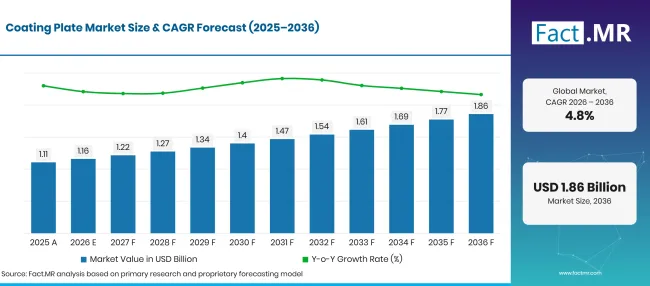
Coating Plate Market Forecast Global | Source: Fact.MR
| Year | Basis | Market Value (USD billion) |
|---|---|---|
| 2025 | Actual | 1.11 |
| 2026 | Estimate | 1.16 |
| 2036 | Forecast | 1.86 |
| CAGR 2026 to 2036 | Forecast period | 4.8% |
Source: Fact.MR analysis. Updated Oct 23, 2026
What are the defining numbers behind Coating Plate Market growth?
Annual market value increases by USD 0.7 billion between 2026 and 2036. Ceramic materials represent 41.9% of demand in 2026, while thermal spray holds 45.2% of the coating-type mix. Automotive applications account for 38.2%.
- Demand Drivers in the Market
- Wear protection gives a coated plate a direct operating purpose. A plant owner can compare the treatment with replacing a frequently worn component and scheduling another stoppage. LSU's 2025 work on atmospheric plasma spraying addresses corrosion and wear in steel components for petrochemical use. [5] The commercial opportunity is strongest where the coating addresses an identifiable cause of maintenance.
- A surface may need to conduct electricity while resisting the chemical environment around it. Fraunhofer FEP reported titanium thin films on polymer-composite bipolar plates in 2026, with the deposition adapted to avoid overheating the substrate. [6] This creates an application question for coaters: whether they can provide the required surface function without sacrificing the advantages of the underlying plate material.
- Comparable acceptance tests help purchasers separate a repeatable treatment from an attractive demonstration. ASTM C633-24 covers adhesion or cohesion testing of thermal-spray coatings and identifies quality control and acceptance testing among its uses. [2] Clear acceptance criteria can make a qualified treatment easier to reorder. They do not remove the need to assess the plate in its actual operating conditions.
- A coating order includes more than the selected powder or liquid. Surface preparation, access to the part and any finishing requirement influence the finished result and delivery cost. Bodycote's published surface-technology portfolio spans several thermal-spray and ceramic coating routes. [3] Purchasers can use this range to seek an appropriate process rather than assuming one deposition method suits every plate.
- Key Segments Analyzed
- By Material Type: Ceramic accounts for 41.9% in 2026; metal, polymer and other materials complete the classification.
- By Application: Automotive represents 38.2%, ahead of the other individual uses in the forecast.
- By Coating Type: Thermal Spray holds 45.2%, with physical vapor deposition, chemical vapor deposition, electroplating and other processes also covered.
- By End-User Industry: Automotive accounts for 38.2%. This identifies the buying industry, while the application classification identifies the use of the coated plate.
- Analyst Opinion at Fact.MR
- Shambhu Nath Jha, Sr. Consultant, Fact.MR
- A coating earns its premium when the finished plate solves a measurable operating problem. Hardness or adhesion figures alone rarely settle that decision. The buyer also needs the correct finish, stable dimensions and a practical route for replacing or refurbishing the part. Suppliers should build their offer around the failure mechanism they can address and the acceptance conditions they can meet consistently. Emerging electrochemical plates add a different opportunity, but pilot coating results still have to become reliable production routines before they support sustained orders.
- Strategic Implications
- Equipment owners should record why a plate is being replaced before choosing another surface treatment. Abrasive wear, corrosion and electrical contact problems call for different comparisons. A narrowly defined operating problem helps determine whether a more expensive coating is worth evaluating.
- Coaters should include preparation and finishing requirements in the quotation. Leaving those steps unresolved can shift cost or dimensional risk back to the purchaser. The most useful commercial comparison is the accepted finished part and its delivery schedule.
- Materials suppliers can strengthen customer relationships by describing the process conditions and application boundaries of a grade. Product data should help the applicator select a workable route, without turning a laboratory property into a promise about every service environment.
- Developers of electrochemical plates should assess physical vapor deposition alongside substrate temperature, contact resistance and corrosion requirements. A technically successful layer must also survive the manufacturing sequence and fit the cost of the completed plate.
Germany has the highest country CAGR at 6.1%, with Japan at 5.8% and the United Kingdom at 5.1%. The United States follows at 3.9% and Brazil at 3.4%. Growth opportunities span established maintenance work and newer functional plate designs. The relative attractiveness of each depends on the available application expertise and the ability to move a treatment into repeat production.
How does the Coating Plate Market break down by segment?
Ceramic leads materials at 41.9% and Thermal Spray leads coating types at 45.2% in 2026. Automotive represents 38.2% in both the application and end-user classifications. These are separate views of the market and are not added together.
What makes ceramic the leading material choice?
Ceramic materials account for 41.9% of the market in 2026.
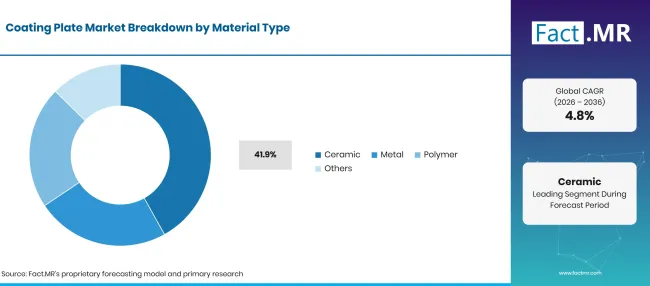
Coating Plate Market Breakdown Material Type | Source: Fact.MR
| Material Type | Share (2026) |
|---|---|
| Ceramic | 41.9% |
| Other segments combined | 58.1% |
| Total | 100.0% |
Source: Fact.MR analysis. Updated Oct 23, 2026
The appeal of ceramic coatings lies in the surface property required by the part. Oerlikon Metco's alumina-titania materials documentation distinguishes grades by coating behavior and application requirements, and includes wear protection among the uses. [10] This illustrates why a ceramic purchase cannot be reduced to the name of the base material. The applicator and customer must agree what the deposited layer is expected to do.
Metallic and polymer coatings remain relevant when the duty calls for another combination of protection, electrical behavior or finish. Ceramic's leading share does not make it the best answer to every plate specification. A purchasing team should compare the complete surface system and the underlying component.
Why do automotive applications account for 38.2%?
Automotive is the leading application group with a 38.2% share in 2026.
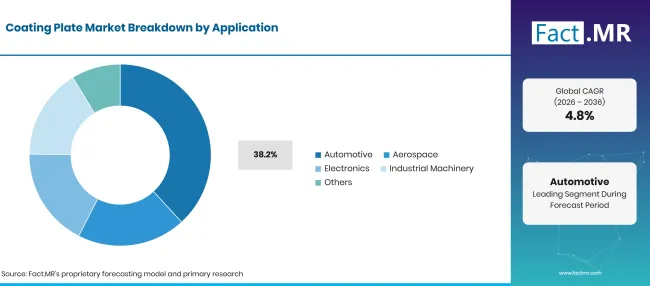
Coating Plate Market Breakdown Application | Source: Fact.MR
| Application | Share (2026) |
|---|---|
| Automotive | 38.2% |
| Other segments combined | 61.8% |
| Total | 100.0% |
Source: Fact.MR analysis. Updated Oct 23, 2026
The automotive application group includes plate-shaped components that require a functional surface within vehicle systems. The relevant purchasing question is which surface duty the component must perform. Work involving low friction coatings, for example, needs an understanding of the contact conditions; it cannot be justified solely by the size of the vehicle industry. Fact.MR sees value in offers that connect a treatment to a specific part and operating requirement.
Aerospace, electronics and industrial machinery bring different acceptance conditions. Some buyers prioritize a controlled electrical interface, while others need protection during repeated mechanical contact. These uses belong in separate commercial assessments even where the coating equipment is shared.
How does thermal spray sustain its position among coating types?
Thermal Spray accounts for 45.2% of the coating-type mix in 2026.
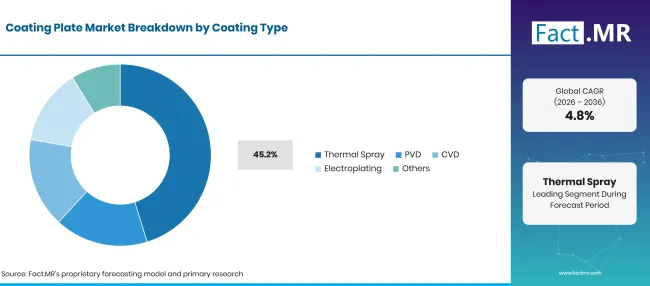
Coating Plate Market Breakdown Coating Type | Source: Fact.MR
| Coating Type | Share (2026) |
|---|---|
| Thermal Spray | 45.2% |
| Other segments combined | 54.8% |
| Total | 100.0% |
Source: Fact.MR analysis. Updated Oct 23, 2026
The thermal spray coatings category accommodates several materials and application routes. Bodycote lists plasma spray, high-velocity oxygen fuel and combustion spraying within its services. [3] That range gives a coating shop several ways to approach a plate duty. Selection still depends on the intended surface, part geometry and the finishing work that follows deposition.
PVD, CVD and electroplating are separate process options, each to be evaluated against the required coating and substrate. Thermal spray's share measures its commercial position within this market; it is not a universal performance ranking. For an equipment owner, the useful comparison is whether the completed treatment meets the component specification at a workable cost and turnaround time.
What distinguishes automotive end-user purchasing?
Automotive buyers represent 38.2% of the end-user industry classification in 2026.
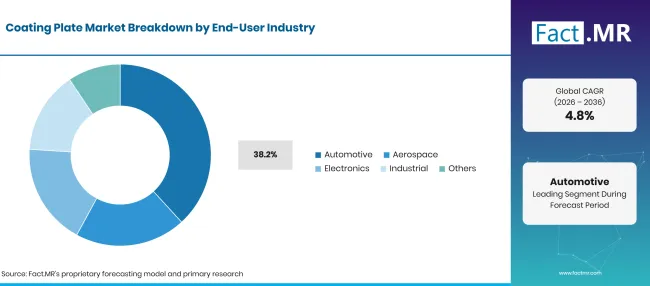
Coating Plate Market Breakdown End User Industry | Source: Fact.MR
| End-User Industry | Share (2026) |
|---|---|
| Automotive | 38.2% |
| Other segments combined | 61.8% |
| Total | 100.0% |
Source: Fact.MR analysis. Updated Oct 23, 2026
This view identifies the organization buying the coated component or treatment. An automotive account may place repeat production orders, commission a trial for a new plate design or purchase maintenance work for factory equipment. Those transactions have different order sizes and service needs. Coaters should establish which budget and approval route apply before offering a price based on assumed long production runs.
Industrial maintenance buyers may put greater weight on turnaround and refurbishment options. Electronics and aerospace customers can require a different inspection package. Fact.MR expects suppliers to gain from organizing their service around the buyer's actual acceptance and delivery needs.
What is accelerating Coating Plate Market adoption, and what is holding it back?
Pressure to reduce avoidable replacement work supports demand for better specified surfaces. New plate designs create further openings when the surface provides a function that the substrate alone cannot deliver. The difficulty is proving that an attractive treatment can be reproduced on the customer's actual part. A coating can succeed on a test specimen while still presenting unresolved issues in finishing, handling or inspection.
ASTM C633-24 explicitly limits the use of its adhesion or cohesion result as a direct prediction of resistance to service stresses. [2] That matters commercially: a seller should match the claim to the test, and a buyer should reserve part of the evaluation for the intended duty. Better evidence may lengthen the initial review, but it also gives both sides a clearer basis for repeat orders and warranty discussions.
Drivers Impact Analysis
| DRIVER | (~) % IMPACT ON CAGR | GEOGRAPHIC RELEVANCE | IMPACT TIMELINE |
|---|---|---|---|
| Replacement of wear-prone plate surfaces in operating equipment | +0.6% | United States, Germany and Brazil | 2026–2031 |
| Functional surface requirements in electrochemical plate designs | +0.4% | Germany, Japan and United Kingdom | 2027–2035 |
| Automotive demand for repeatable coating and finishing quality | +0.3% | Germany, Japan and United States | 2026–2036 |
| Purchasing specifications that include comparable coating tests | +0.2% | United Kingdom, Germany and export supply chains | 2026–2029 |
| Protection of components exposed to combined corrosion and wear | +0.5% | United States, Brazil and industrial Europe | 2026–2033 |
Source: Fact.MR analysis. Updated Oct 23, 2026
Opportunity Impact Analysis
| OPPORTUNITY | (~) % IMPACT ON CAGR | GEOGRAPHIC RELEVANCE | IMPACT TIMELINE |
|---|---|---|---|
| Production coating of conductive bipolar plates | +0.6% | Germany and Japan | 2028–2036 |
| Temperature-controlled layers on composite plate substrates | +0.3% | Germany, Japan and United Kingdom | 2027–2034 |
| Refurbishment services that combine coating and final finishing | +0.4% | United States, Brazil and Western Europe | 2026–2031 |
| Inspection services integrated with repeat coating orders | +0.2% | United Kingdom, Germany and aerospace supply chains | 2026–2030 |
Source: Fact.MR analysis. Updated Oct 23, 2026
Restraints Impact Analysis
| RESTRAINT | (~) % IMPACT ON CAGR | GEOGRAPHIC RELEVANCE | IMPACT TIMELINE |
|---|---|---|---|
| Uncertain transfer of coupon results to actual service conditions | -0.5% | All profiled countries | 2026–2036 |
| Preparation and finishing costs on small or varied batches | -0.3% | Brazil, United Kingdom and United States | 2026–2032 |
| Slow conversion of pilot coating processes into serial production | -0.4% | Germany, Japan and hydrogen component suppliers | 2027–2035 |
| Substrate damage or rejection when the deposition window is unsuitable | -0.2% | Composite and precision plate applications globally | 2026–2033 |
Source: Fact.MR analysis. Updated Oct 23, 2026
Which countries are developing Coating Plate Market demand through 2036?
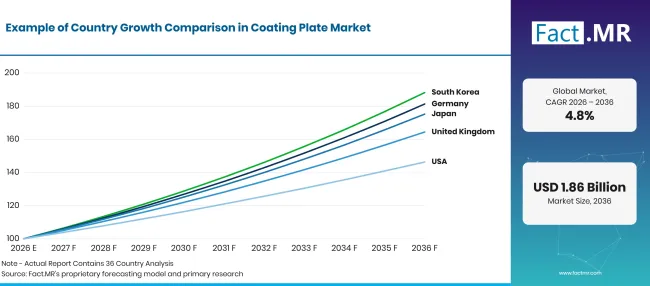
Coating Plate Market Growth Index | Source: Fact.MR
| Country | CAGR (2026–2036) |
|---|---|
| Germany | 6.1% |
| Brazil | 3.4% |
| United States | 3.9% |
| United Kingdom | 5.1% |
| Japan | 5.8% |
Source: Fact.MR analysis. Updated Oct 23, 2026
Can Germany turn bipolar-plate pilots into repeat manufacturing?
Germany's 6.1% CAGR outlook gives it the highest growth rate among the five country profiles.
Fraunhofer IWS placed a bipolar-plate coating pilot into operation in Dortmund and described the development in March 2025. Its roll-to-roll vacuum route was intended to coat metal strip at several metres per minute once fully implemented. [7] The distinction between a working pilot and an established production line is central to the German opportunity. Equipment integration and consistent output still have to justify the customer's investment.
Coating businesses can participate through process expertise, application trials or eventual production services. The commercially useful offer will identify how coating fits with forming and the rest of the plate manufacturing sequence. Orders should build where a developer can connect the process to a defined component requirement and a viable manufacturing cost.
Where does Brazil have a specific opening beyond routine protection?
Fact.MR projects a 3.4% CAGR for Brazil through 2036.
Brazil's materials research includes a directly relevant plate-coating theme. The Granioter-MCTI selection published by CDTN in June 2024 included a University of São Paulo project on niobium-based coatings for hydrogen fuel-cell bipolar plates. [4] This is evidence of a selected development effort, rather than completed commercial deployment. It identifies a potential route for local materials expertise to enter a specialized component market.
Nearer-term sales still need a convincing operating case. For a Brazilian equipment owner comparing treatment and replacement, price, delivery distance and access to finishing services can decide whether a coated plate is practical. A supplier can improve the offer by taking responsibility for the finished surface and providing an inspection record the customer can use.
Why do United States buyers focus on the damaged surface?
The United States market is forecast to increase at a 3.9% CAGR.
LSU's December 2025 account of its EPIC laboratory describes coating research for steel components used in petrochemical applications. The work includes fabrication and testing on flat plates as well as other shapes. [5] This puts the surface problem close to the operating environment: corrosion and wear are being considered in connection with the parts that industrial users need to keep working.
The buying decision should begin with the observed damage and the consequences of another stoppage. A higher-priced treatment may be worth testing when replacement is disruptive, but a broad promise of longer life is insufficient. Fact.MR expects the stronger proposals to specify the part condition they can accept, the finished surface they will deliver and the inspection used to release it.
What can better inspection change for United Kingdom purchasers?
United Kingdom demand is projected to grow at a 5.1% CAGR.
The National Physical Laboratory's February 2025 guide addresses non-destructive assessment of coating adhesion for manufacturing quality assurance and onsite inspection. [8] Its emphasis on selecting a technique for the application is commercially relevant. Buyers need evidence that fits the coating and the part, especially when they want to inspect without sacrificing the component.
A coater that can explain the inspection route may help a UK customer write a clearer purchase specification. That can reduce disputes about what a test result does and does not establish. Refurbishment work benefits from the same discipline because the substrate arrives with a service history. The opportunity lies in combining a suitable treatment with a defensible acceptance decision, while keeping the cost of testing proportionate to the component and its duty.
How does Japan balance electrical performance with coating durability?
Japan has a 5.8% CAGR forecast for 2026–2036.
A 2025 study involving Iwate University and Japanese industrial researchers examined a titanium-nitride and polymer coating on titanium bipolar plates for water electrolysis. The work reported reduced contact resistance, while surface analysis also identified local polymer degradation after durability testing. [9] Both findings matter to the commercial assessment. Initial electrical improvement and long-term surface behavior have to be considered together.
For Japanese developers of functional plates, this creates room for specialist coating and characterization work before large-volume procurement. A supplier must establish which requirement its treatment addresses and what remains to be demonstrated on the completed component. The research is a promising application lead, not evidence of an industry-wide material change. Fact.MR expects gradual adoption where performance, manufacturing consistency and component economics can be reconciled.
Which suppliers serve the Coating Plate Market?
Competition spans different positions in the surface-treatment chain. Oerlikon Metco supplies thermal-spray materials and related application expertise. Bodycote offers surface-treatment services, including plasma spray, HVOF and ceramic coating routes. [3] [10] A purchaser approaching these businesses is not necessarily buying the same item: one transaction may concern a coating feedstock, another the treatment of an existing component.
PPG's general industrial portfolio includes powder, liquid, electrocoat and pretreatment technologies for industrial equipment. AkzoNobel supplies coil and extrusion coating systems for metal applications. [1] [11] Their relevance is strongest in the protective finishing portions of the market.
Materials producers, applicators and plate manufacturers may work together on the same order. Fact.MR expects specialist knowledge of preparation, deposition and finishing to influence supplier selection, with service location becoming more important where the customer sends an existing plate for treatment or refurbishment.
Which companies are the key providers?
Key companies profiled include Oerlikon Metco (thermal-spray materials and application support); Bodycote plc (industrial surface-treatment services); PPG Industries, Inc. (industrial protective coating systems); and Akzo Nobel N.V. (coil and metal-finishing coating systems).
- Oerlikon Metco, for thermal-spray materials and application support
- Bodycote plc, for industrial surface-treatment services
- PPG Industries, Inc., for relevant industrial protective coating systems
- Akzo Nobel N.V., for relevant coil and metal-finishing coating systems
Bibliography
- [1] Akzo Nobel N.V. (n.d.). Industrial coatings.
- [2] ASTM International (2024). Standard test method for adhesion or cohesion strength of thermal spray coatings (ASTM C633-24).
- [3] Bodycote plc (n.d.). Surface technology.
- [4] Centro de Desenvolvimento da Tecnologia Nuclear (2024, June 13). Projetos selecionados Desafio Nacional Granioter-MCTI.
- [5] Duhé, K. (2025, December 8). LSU researchers strengthening Louisiana industry with metals and ceramics that endure heat and pressure. Louisiana State University
- [6] Fraunhofer Institute for Electron Beam and Plasma Technology FEP (2026, March 27). Innovative coating for hydrogen components: Fraunhofer FEP presents further development of titanium coating for composite bipolar plates. https://www.fep.fraunhofer.de/en/press_media/03-2026.html
- [7] Fraunhofer Institute for Material and Beam Technology IWS (2025, March 13). Efficient manufacturing techniques for bipolar plates: Advances in fuel cell production.
- [8] Maxwell, A., & Rudlin, J. (2025). Non-destructive assessment of coating adhesion. Measurement Good Practice Guide No. 100, Issue 2. National Physical Laboratory.
- [9] Minoura, A., Kumagai, M., Yashiro, H., Okabe, H., Michibata, H., & Murase, M. (2025). Surface modification of titanium bipolar plates with TiN/SBR coating for PEM water electrolysis. Electrochemistry, 93(7), Article 077002.
- [10] Oerlikon Metco (2025). Alumina 13% titania powders. Material product data sheet DSM-0258.2.
- [11] PPG Industries, Inc. (n.d.). General industrial.
This Report Answers
- Which coating material and deposition route lead the 2026 market.
- How the intended plate duty changes the choice of surface treatment.
- Where refurbishment and emerging electrochemical plates create distinct commercial opportunities.
- What testing and finishing requirements affect customer acceptance.
- How materials producers, coating applicators and industrial buyers participate in the value chain.
What does the Coating Plate Market cover?
Surface duties include protection against wear and corrosion, together with relevant electrical and thermal functions. Analysis distinguishes the coating material from the deposition process, the component's application and the industry making the purchase. The term does not refer to printing plates or decorative ceramic tiles.
What is included in the scope?
Included are ceramic, metallic, polymer and other relevant coating systems applied to the specified plate components. Thermal spray, PVD, CVD and electroplating are considered alongside other suitable deposition routes. Coverage extends to original industrial components and relevant recoating or refurbishment work within automotive, aerospace, electronics and machinery applications.
What is excluded from the scope?
Printing and lithographic plates, decorative wall and floor tiles, uncoated plate stock and general architectural paint are excluded. Coating equipment sales and unrelated treatment of non-plate components are outside the market boundary. The analysis does not count the entire global coatings industry, complete vehicles or the value of industrial machinery containing a coated plate.
How Was the Analysis Built?
The analysis draws on 120+ sources, 35+ company portfolios, 25+ countries, and more than 20 industry interviews.
- Primary Research: Primary research includes discussions with manufacturers, service providers, technology developers, distributors, end users, and subject-matter experts. These conversations examine purchasing priorities, product adoption, operational challenges, approval requirements, competitive positioning, and the factors that influence wider market acceptance.
- Desk Research: Desk research covers government statistics, regulatory publications, company filings, trade data, technical studies, industry associations, standards, public policy, and other authoritative sources. Every source used in the analysis is documented in the bibliography.
- Market Sizing and Forecasting: Market estimates combine historical performance, demand indicators, pricing and volume trends, segment shares, company participation, country-level growth, adoption patterns, investment activity, and barriers to market expansion.
- Data Validation and Update Cycle: Findings are validated by comparing primary interviews with public data, company activity, regulatory changes, trade patterns, and industry developments. Regular updates review new product launches, capacity changes, partnerships, approvals, and shifts in commercial adoption.
Segmentation
What is the report’s scope and coverage?
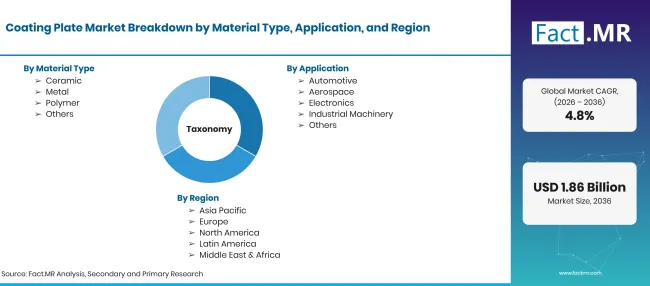
Coating Plate Market Taxonomy | Source: Fact.MR
| Attribute | Details |
|---|---|
| Quantitative Units | USD Billion |
| Market Definition | Functional industrial coatings applied to plates and plate-shaped components |
| Material Type | Ceramic; Metal; Polymer; Others |
| Application | Automotive; Aerospace; Electronics; Industrial Machinery; Others |
| Coating Type | Thermal Spray; PVD; CVD; Electroplating; Others |
| End-User Industry | Automotive; Aerospace; Electronics; Industrial; Others |
| Regions Covered | North America; Latin America; Western Europe; Eastern Europe; East Asia; South Asia & Pacific; Middle East & Africa |
| Countries Covered | Germany; Brazil; United States; United Kingdom; Japan |
| Companies Profiled | Oerlikon Metco; Bodycote; PPG Industries; Akzo Nobel |
| Forecast Period | 2026 to 2036 |
| Approach | Assessment of coating materials, deposition routes, plate duties, industrial buyers, country demand and supplier capabilities |
Source: Fact.MR analysis. Updated Oct 23, 2026
How is the market segmented?
-
By Material Type
- Ceramic
- Metal
- Polymer
- Others
-
By Application
- Automotive
- Aerospace
- Electronics
- Industrial Machinery
- Others
-
By Coating Type
- Thermal Spray
- Physical Vapor Deposition (PVD)
- Chemical Vapor Deposition (CVD)
- Electroplating
- Others
-
By End-User Industry
- Automotive
- Aerospace
- Electronics
- Industrial
- Others
-
By Region
- North America
- Latin America
- Western Europe
- Eastern Europe
- East Asia
- South Asia & Pacific
- Middle East & Africa
Frequently Asked Questions
How much is the coating plate market worth in 2026?
What is the outlook for 2036?
Which material and process lead?
What does the automotive share represent?
Does this report cover printing plates or ceramic tiles?
Who worked on this report


Preview the report firsthand - request a free sample
Free SampleGet the brochure for pricing and purchase details
Download PDF