- Base Value(2025): 4.57 Bn
- Estimated Value(2026): 4.83 Bn
- Forecast Value (2036): 8.41 Bn
- CAGR (2026 - 2036): 5.7%
Coating Pretreatment Market Size, Market Forecast and Outlook By Fact.MR
The coating pretreatment market was valued at USD 4.57 billion in 2025, projected to reach USD 4.83 billion in 2026, and is forecast to expand to USD 8.41 billion by 2036 at a 5.7% CAGR. Automotive OEM paint shop operators mandating multi-metal pretreatment compatibility and environmental regulators restricting hexavalent chromium discharge are driving specification shifts toward zirconium-based and silane-based chromate-free pretreatment systems.
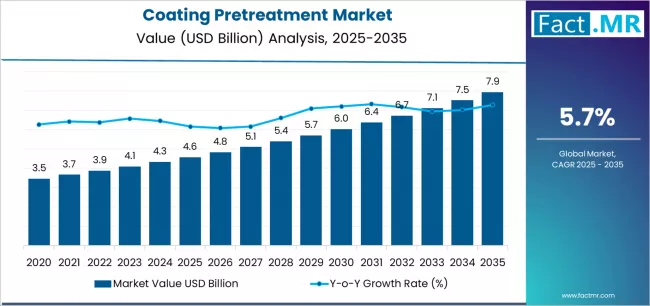
Coating Pretreatment Market Market Value Analysis | Source: Fact.MR
Summary of Coating Pretreatment Market
- Market Overview
- The coating pretreatment market is valued at USD 4.57 billion in 2025 and is projected to reach USD 8.41 billion by 2036.
- The industry is expected to grow at a 5.7% CAGR from 2026 to 2036, creating an incremental opportunity of USD 3.58 billion.
- The market is a process chemistry-driven, specification-intensive category where chromate-free conversion mandates, multi-metal automotive body compatibility, and wastewater compliance costs define procurement decisions.
- Demand and Growth Drivers
- Demand is accelerating as automotive paint shops mandate chromate-free pretreatment systems compatible with mixed aluminum and steel body structures.
- Environmental regulators restricting hexavalent chromium discharge are forcing specification shifts toward zirconium-based and silane-based conversion coating chemistries.
- Automotive manufacturing expansion and industrial construction growth in developing economies are creating new pretreatment chemical consumption volumes.
- Among key countries, India leads at 7.8% CAGR, followed by China at 7.0%, South Korea at 6.0%, the USA at 5.0%, Germany at 4.8%, the UK at 4.5%, and Japan at 4.3%.
- Product and Segment View
- Coating pretreatment chemicals are surface preparation compounds applied to metal substrates before painting or powder coating to improve adhesion, corrosion resistance, and coating durability through conversion coating formation.
- Primary applications span automotive paint shop operations, construction steel finishing, and appliance enclosure coating lines.
- Phosphate leads by Type with 32.4% share in 2026.
- Automotive & Transportation leads by Application with 41.7% share in 2026.
- Scope includes phosphate, chromate, chromate-free, and blast clean pretreatment systems, excluding post-coating topcoat chemistries, electrocoat primers, and mechanical surface preparation abrasives.
- Geography and Competitive Outlook
- India and China are the fastest-growing markets due to automotive manufacturing and construction expansion, while the USA and Germany represent mature markets driven by chromate-free conversion mandates and paint shop modernization.
- Competition is shaped by multi-metal pretreatment chemistry IP, automotive OEM paint shop qualification status, and wastewater treatment cost reduction technology.
- Key companies include Henkel AG & Co. KGaA, 3M, AkzoNobel N.V., Axalta Coating Systems LLC, Chemetall GmbH, PPG Industries, Kansai Paint Co. Ltd., Nihon Parkerizing Co., Ltd., Nippon Paint Co., Ltd., and The Sherwin-Williams Company.
- Analyst Opinion at Fact.MR
- Shambhu Nath Jha, Principal Consultant for Chemicals and Materials, opines: 'In my analysis, I have observed that the true conversion barrier for chromate-free pretreatment is not chemistry performance but the automotive OEM qualification testing cycle that requires 18 to 24 months of accelerated corrosion testing before approving a new pretreatment chemistry for production paint shops. Paint shop operators attempting to trial chromate-free systems face production risk during the transition period when both legacy and new chemistries must run in parallel. Pretreatment suppliers lacking complete process control automation packages face exclusion from automotive OEM qualification programs that now mandate real-time bath monitoring as a prerequisite for approval.'
- Strategic Implications / Executive Takeaways
- Pretreatment chemical suppliers must develop complete process control automation packages that include real-time bath monitoring to qualify for automotive OEM paint shop approval programs.
- Automotive paint shop managers should initiate chromate-free pretreatment qualification testing at least 24 months before planned conversion deadlines to accommodate full accelerated corrosion test cycles.
- Construction steel coaters must evaluate chromate-free pretreatment alternatives that deliver equivalent corrosion resistance while reducing hazardous waste generation and disposal costs.
Coating Pretreatment Market Key Takeaways
| Metric | Details |
|---|---|
| Industry Size (2026) | USD 4.83 billion |
| Industry Value (2036) | USD 8.41 billion |
| CAGR (2026 to 2036) | 5.7% |
Source: Fact.MR analysis. Updated Apr 8, 2026
Source: Future Market Insights, 2026
Metal finishing operations that once managed pretreatment as a low-cost chemical bath step now invest in automated process control systems that monitor conversion coating weight, bath chemistry, and rinse water quality in real time.
The absolute dollar opportunity of USD 3.58 billion between 2026 and 2036 reflects accelerating conversion from legacy phosphate and chromate chemistries to chromate-free alternatives across automotive, construction, and appliance manufacturing sectors. Chromate-free pretreatment systems offer reduced sludge generation and lower wastewater treatment costs that offset higher per-liter chemical pricing. Automotive paint shops processing mixed aluminum and steel body structures require nano-ceramic pretreatment chemistries capable of forming uniform conversion coatings on both substrates in a single bath, eliminating the need for separate pretreatment lines.
All major metal pretreatment corridors reflect differentiated adoption patterns. India sets the pace with a 7.8% CAGR as automotive manufacturing expansion and industrial construction drive pretreatment chemical demand. China follows at 7.0% with automotive assembly plant construction and appliance manufacturing growth. South Korea tracks at 6.0% through automotive and electronics enclosure coating pretreatment specification. United States operations advance at 5.0%, supported by automotive OEM chromate-free pretreatment conversion mandates. Germany registers a 4.8% pace anchored by automotive paint shop modernization programs. United Kingdom expands at 4.5% through construction steel pretreatment specification. Japan tracks at 4.3% through automotive multi-metal pretreatment technology adoption.
Why is the Coating Pretreatment Market Experiencing Steady Growth?
The coating pretreatment market grows by enabling automotive manufacturers, metal fabricators, and industrial finishers to access reliable surface preparation solutions that support coating performance while meeting industrial demand for consistent quality specifications. Coating line operators and quality managers face mounting pressure to develop durable finishing systems with proven adhesion and corrosion resistance characteristics, with pretreatment processes typically providing 5-10 times improvement in coating longevity and comprehensive surface cleaning capabilities essential for paint adhesion, substrate protection, and product durability, making these chemicals essential for competitive positioning in automotive, construction, and appliance categories. The metal finishing industry's need for dependable surface preparation infrastructure and consistent process results creates demand for diverse pretreatment chemistries that can provide superior coating adhesion, maintain predictable performance across different metal substrates, and ensure quality compliance without compromising production economics or environmental specifications.
Government initiatives promoting sustainable manufacturing practices and VOC emission reduction drive adoption in automotive painting facilities, metal fabrication plants, and appliance manufacturing operations, where pretreatment selection has a direct impact on coating quality outcomes and environmental compliance. The manufacturing industry's growing focus on corrosion prevention and product lifecycle extension further expands market opportunities, with industrial research demonstrating measurable performance advantages from proper surface pretreatment, including enhanced coating adhesion and improved corrosion resistance. However, supply chain complexity during chemical sourcing and the technical requirements for wastewater treatment and process optimization may limit accessibility among smaller finishing operations and developing regions with limited infrastructure for advanced coating pretreatment and environmental compliance systems.
Segmental Analysis
The market is segmented by type, application, and region. By type, the market is divided into phosphate, chromate, chromate free, and blast clean. By application, the market is divided into automotive & transportation, construction, and appliance. Regionally, the market is divided into Asia Pacific, North America, Europe, Latin America, and Middle East & Africa.
What Makes Phosphate the Dominant Type Segment in the Coating Pretreatment Market?
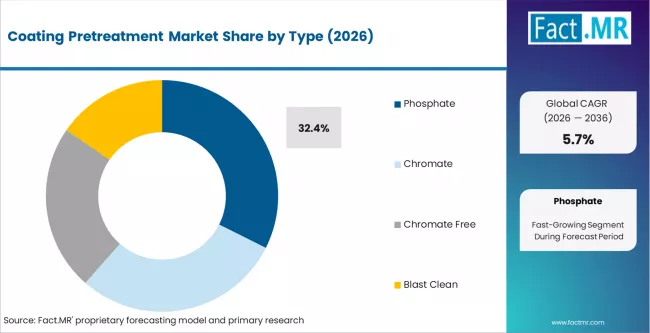
Coating Pretreatment Market Analysis By Type | Source: Fact.MR
The phosphate segment represents the dominant force in the coating pretreatment market, capturing 32.4% of the total market share in 2025. This category encompasses solutions featuring critical conversion coating functionality for automotive body panels, structural steel components, and appliance housings, including iron phosphate, zinc phosphate, and manganese phosphate processes that enable superior paint adhesion, enhanced corrosion protection, and proven surface preparation performance across all metal coating applications.
The phosphate segment's market leadership stems from its essential role in automotive finishing operations, with phosphate conversion coatings capable of meeting diverse quality requirements while maintaining cost-effective processing and operational reliability across all manufacturing environments. Within the phosphate segment, automotive applications account for the largest consumption share, driven by stringent corrosion warranty requirements and continuous quality improvement initiatives across global automotive production operations.
The chromate segment maintains a substantial 27.3% market share, serving aerospace manufacturers and specialty metal finishers who require exceptional corrosion protection for aluminum substrates, magnesium components, and high-performance applications.
Chromates offer superior corrosion resistance characteristics for demanding service environments and critical safety applications while providing sufficient process flexibility to meet performance demands and regulatory requirements.
The chromate free and blast clean segments account for the remaining market share, serving environmentally conscious manufacturers and mechanical surface preparation applications requiring alternative pretreatment methods and sustainable processing approaches.
Key advantages driving the phosphate segment include:
- Established application infrastructure with integrated automotive finishing lines that reduce process complexity and ensure consistent coating quality
- Critical adhesion functionality allowing enhanced paint performance across different metal substrates without significant cost penalties
- Proven corrosion protection, delivering reliable substrate preservation while maintaining competitiveness against alternative pretreatment technologies
- Broad industrial acceptance enabling straightforward process specification and quality standards across multiple manufacturing sectors
Which Application Category Leads the Coating Pretreatment Market?
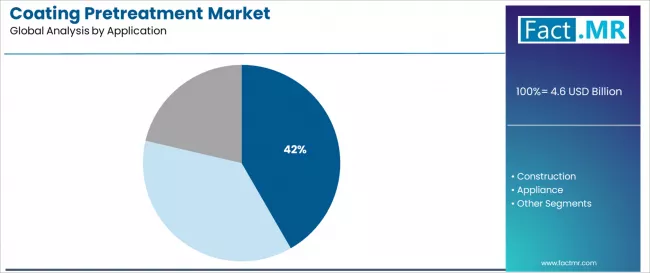
Coating Pretreatment Market Analysis By Application | Source: Fact.MR
The automotive & transportation segment captures approximately 41.7% of the coating pretreatment market in 2025, representing the most widely adopted application sector across vehicle manufacturing operations. This application category offers high-volume production characteristics, stringent quality requirements, and comprehensive corrosion protection demands that align with automotive finishing specifications.
The automotive & transportation segment's dominance reflects its widespread adoption in passenger vehicle production, commercial vehicle manufacturing, and automotive component finishing where pretreatment processes provide essential substrate preparation for e-coat primer application and multi-layer coating systems.
The construction segment maintains a 33.2% market share, serving architectural metal fabricators and building component manufacturers requiring durable coating systems, weather resistance capabilities, and long-term corrosion protection across structural steel, metal roofing, and curtain wall applications.
These application sectors provide comprehensive surface preparation requirements for construction materials exposed to environmental conditions, enabling enhanced building performance and extended service life. The appliance segment accounts for the remaining market share, serving household appliance manufacturers and industrial equipment producers where pretreatment processes offer specific advantages for white goods finishing and durable product coatings.
What are the Drivers, Restraints, and Key Trends of the Coating Pretreatment Market?
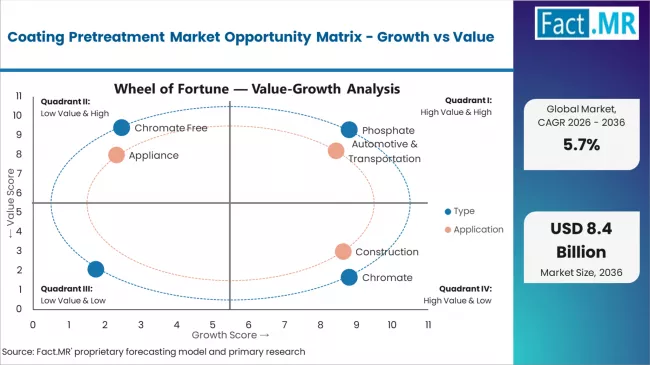
Coating Pretreatment Market Opportunity Matrix Growth Vs Value | Source: Fact.MR
The market is driven by three concrete demand factors tied to manufacturing growth and quality requirements. First, increasing automotive production and vehicle quality standards creates growing demand for advanced pretreatment systems, with global automotive manufacturing expanding by 3-5% annually in major production regions worldwide, requiring comprehensive surface preparation infrastructure. Second, expanding construction activity for infrastructure projects and building modernization drives increased adoption of protective coating systems, with many metal fabricators implementing comprehensive pretreatment programs for architectural applications by 2030. Third, technological advancements in chromate-free formulations and low-temperature processing enable more effective and efficient surface preparation that reduces environmental impact while improving energy efficiency and process sustainability capabilities.
Market restraints include fluctuating chemical costs for phosphate compounds and zirconium-based alternatives that can deter manufacturers from maintaining competitive processing economics, particularly in regions where raw material prices and disposal costs face volatility pressures or regulatory constraints. Environmental compliance requirements and discharge limitations pose another significant challenge, as pretreatment operations generate wastewater containing heavy metals and phosphates, potentially causing increased treatment expenditures and regulatory complexity. Process conversion challenges and equipment modification requirements create additional market obstacles for technology adoption, demanding ongoing investment in line upgrades and process validation improvements.
Key trends indicate accelerated chromate-free pretreatment adoption in Asia Pacific markets, particularly China and India, where environmental regulations and manufacturing modernization drive comprehensive sustainable pretreatment implementation. Technology integration trends toward thin-film conversion coatings with reduced chemical consumption, closed-loop process systems with water recycling capabilities, and digital process monitoring enable optimized manufacturing approaches that reduce waste generation and minimize environmental footprint. However, the market thesis could face disruption if significant advances in coating technologies or major shifts in surface preparation strategies reduce reliance on traditional chemical conversion coating processes.
Analysis of the Coating Pretreatment Market by Key Countries
.webp "Top Country Growth Comparison Coating Pretreatment Market Cagr (2026 2036)")
Top Country Growth Comparison Coating Pretreatment Market Cagr (2026 2036) | Source: Fact.MR
| Country | CAGR (2025-2035) |
|---|---|
| China | 7.3% |
| India | 7.1% |
| USA | 6.6% |
| Germany | 6.1% |
| Japan | 5.8% |
| Brazil | 5.4% |
| UAE | 4.9% |
Source: Fact.MR analysis. Updated Apr 8, 2026
Top Country Growth Comparison Coating Pretreatment Market Cagr (2026 2036) | Source: Fact.MR
The coating pretreatment market is expanding steadily, with China leading at a 7.3% CAGR through 2035, driven by rapid industrial manufacturing growth, expanding automotive production capacity, and comprehensive surface treatment infrastructure development. India follows at 7.1%, supported by strong infrastructure investment, expanding manufacturing base, and accelerated Make in India initiatives. USA records 6.6%, reflecting aerospace industry strength and increasing automotive innovation capabilities.
Germany posts 6.1%, anchored by stricter environmental regulations and advanced coating technology operations. Japan grows at 5.8%, with electronics manufacturing and automotive surface treatment expertise. Brazil advances at 5.4%, emphasizing industrial manufacturing scale-up and production capacity expansion, while UAE grows steadily at 4.9%, focusing on construction boom through building modernization programs and infrastructure development.
China Leads Global Market Expansion
China demonstrates the strongest growth potential in the coating pretreatment market with a CAGR of 7.3% through 2035. The country's leadership position stems from massive automotive manufacturing operations, expanding industrial production capacity, and comprehensive metal finishing infrastructure enabling mainstream pretreatment adoption.
Growth is concentrated in major manufacturing regions, including Guangdong, Jiangsu, Zhejiang, and Shanghai, where automotive clusters and expanding finishing infrastructure are implementing advanced pretreatment systems for vehicle production and metal fabrication applications.
Distribution channels through chemical distributors, direct supply agreements with automotive manufacturers, and long-term chemical management contracts expand deployment across finishing operations and coating lines. The country's growing manufacturing sector provides policy support for industrial development, including investment incentives for environmental technology upgrades.
Key market factors:
- Automotive production demand concentrated in manufacturing hubs and industrial zones with comprehensive finishing networks
- Infrastructure development through industrial park expansion and wastewater treatment facility improvements
- Comprehensive chemical supply ecosystem, including established distribution networks with proven logistics capabilities
- Technology integration featuring automated dosing systems, process control technologies, and environmental monitoring platforms
India Emerges as Manufacturing Growth Driver
In major industrial states including Maharashtra, Gujarat, Tamil Nadu, and Haryana, the adoption and consumption of coating pretreatment chemicals is accelerating across automotive manufacturing operations and metal fabrication segments, driven by expanding industrial base and comprehensive infrastructure development programs.
The market demonstrates strong growth momentum with a CAGR of 7.1% through 2035, linked to government manufacturing promotion policies, expanding automotive production infrastructure, and sustained industrial investment.
Indian manufacturers are implementing advanced pretreatment technologies and environmentally compliant systems to enhance coating quality while meeting growing demand in expanding automotive sectors and construction material industries. The country's Make in India initiatives create persistent demand for surface preparation chemicals, while increasing emphasis on quality standards drives adoption of proven pretreatment processing systems.
Key development areas:
- Automotive and construction sectors leading pretreatment chemical consumption with comprehensive quality programs
- Integrated supply chains providing efficient chemical delivery with extensive technical support infrastructure
- Technology partnerships between international chemical suppliers and domestic manufacturers are expanding market reach
- Integration of wastewater treatment systems and comprehensive environmental management protocols
USA Shows Innovation Leadership
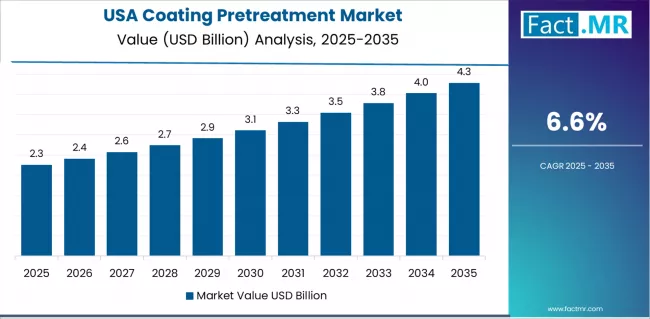
Coating Pretreatment Market Country Value Analysis | Source: Fact.MR
The market’s expansion in USA is driven by aerospace industry requirements, including specialized pretreatment programs in Washington and California, and expanding automotive innovation implementations across multiple manufacturing regions. The country demonstrates solid growth potential with a CAGR of 6.6% through 2035, supported by established manufacturing infrastructure, advanced aerospace sector, and growing integration with sustainable coating technologies across production facilities.
American manufacturers face implementation priorities related to environmental compliance and process optimization, requiring investment in chromate-free alternatives and support from chemical technology providers. However, growing quality demands and established manufacturing capacity create compelling business cases for advanced pretreatment adoption, particularly in aerospace regions where corrosion protection has a direct impact on safety and performance.
Key market characteristics:
- Aerospace and automotive segments showing sustained growth with continued investment in advanced pretreatment requirements
- Regional expansion trends focused on manufacturing clusters in Midwest and Southern states
- Future projections indicate the need for sustainable chemistry adoption and advanced process technology development programs
- Growing emphasis on environmental compliance and competitive manufacturing positioning in North American markets
Germany Demonstrates Environmental Excellence
The German market leads in environmentally compliant pretreatment applications based on integration with strict regulatory standards and sustainable manufacturing operations for enhanced environmental performance. The country shows robust potential with a CAGR of 6.1% through 2035, driven by world-class automotive industry presence, stringent environmental regulations, and the expansion of advanced coating facilities in major manufacturing centers, including Baden-Württemberg, Bavaria, North Rhine-Westphalia, and Lower Saxony.
German manufacturers are adopting advanced pretreatment configurations for sustainable surface preparation and regulatory compliance applications, particularly in regions with demanding environmental requirements and specialized quality demands requiring comprehensive process standards. Technology deployment channels through established chemical suppliers and coating equipment manufacturers expand coverage across automotive OEMs and metal fabrication facilities.
Leading market segments:
- Automotive manufacturing and metal fabrication operations in major production centers implementing comprehensive environmental strategies
- Strategic partnerships with chemical technology providers, achieving stringent environmental specifications and performance standards
- Collaborative initiatives between industry associations and regulatory authorities are expanding sustainability capabilities
- Focus on chromate-free technologies and zero-discharge process methodologies
Japan Emphasizes Quality Precision
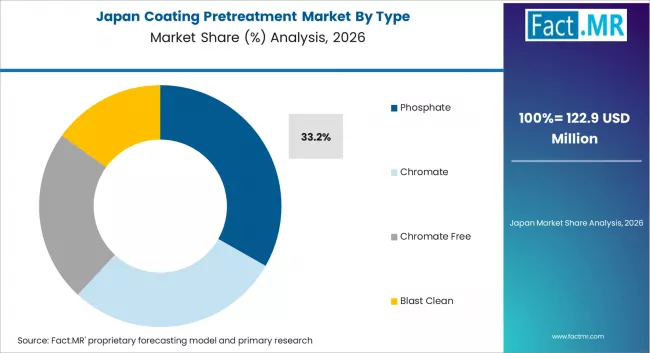
Coating Pretreatment Market Japan Market Share Analysis By Type | Source: Fact.MR
In major manufacturing regions including Aichi, Kanagawa, and Osaka, automotive manufacturers and electronics producers are implementing comprehensive pretreatment strategies to optimize coating quality and improve corrosion protection outcomes, with documented case studies showing significant performance improvements through advanced surface preparation integration and process control optimization techniques.
The market shows steady growth potential with a CAGR of 5.8% through 2035, linked to established manufacturing infrastructure, advanced quality management expertise, and ongoing precision requirements in major industrial regions.
Japanese manufacturers are adopting proven pretreatment technologies and quality protocols to enhance coating performance while maintaining standards demanded by automotive engineering specifications and electronics manufacturing operations. The country's quality-focused industrial culture creates persistent demand for reliable pretreatment supply and process excellence solutions that integrate with existing production systems.
Market development factors:
- Automotive and electronics manufacturers leading pretreatment adoption across Japan
- Quality management initiatives and technical standards providing support for process optimization development
- Strategic relationships between Japanese manufacturers and chemical technology suppliers are expanding innovation capabilities
- Emphasis on process precision and continuous quality improvement across manufacturing segments
Brazil Shows Industrial Scale-Up
Brazil's coating pretreatment market demonstrates competitive positioning focused on industrial manufacturing expansion and production capacity integration, with documented adoption of phosphate pretreatment systems, achieving enhanced coating durability through established surface preparation processes in São Paulo and Minas Gerais manufacturing regions.
The country maintains moderate growth momentum with a CAGR of 5.4% through 2035, driven by expanding automotive production, growing construction activity, and strategic emphasis on industrial development. Major manufacturing facilities, including operations in automotive production clusters and metal fabrication centers, showcase expanding pretreatment implementations where chemical processing supports coating quality and comprehensive corrosion protection programs.
Key market characteristics:
- Automotive and construction sectors driving pretreatment demand with emphasis on production capacity and quality improvement
- Manufacturing expansion partnerships enabling process capability development with comprehensive technical programs
- Technology collaboration between international suppliers and Brazilian manufacturers is expanding market capabilities
- Emphasis on cost-effective processing and production efficiency optimization methodologies
UAE Demonstrates Construction Focus
UAE's coating pretreatment market demonstrates growth-focused landscape, characterized by integration of architectural metal finishing with construction boom operations across building facade applications, structural steel protection, and premium architectural finishes. The country shows steady growth momentum with a CAGR of 4.9% through 2035, driven by extensive construction activity and building modernization investments in infrastructure projects concentrated in urban regions.
The UAE's emphasis on architectural quality and corrosion protection creates requirements for proven pretreatment configurations that support comprehensive building performance initiatives and stringent durability requirements in coastal construction environments.
The market benefits from strong partnerships between international chemical suppliers and regional metal fabricators, creating comprehensive coating ecosystems that prioritize performance reliability and environmental resistance. Metal finishing operations in major construction markets showcase established pretreatment implementations where surface preparation quality achieves demanding architectural standards through integrated quality programs.
Key market characteristics:
- Construction and architectural metal fabricators driving pretreatment requirements with emphasis on corrosion protection and aesthetic quality
- Performance partnerships enabling proven chemical specifications with comprehensive technical support programs
- Regional collaboration between international technology providers and local contractors is expanding application capabilities
- Emphasis on durability excellence and coastal environment protection methodologies
Europe Market Split by Country
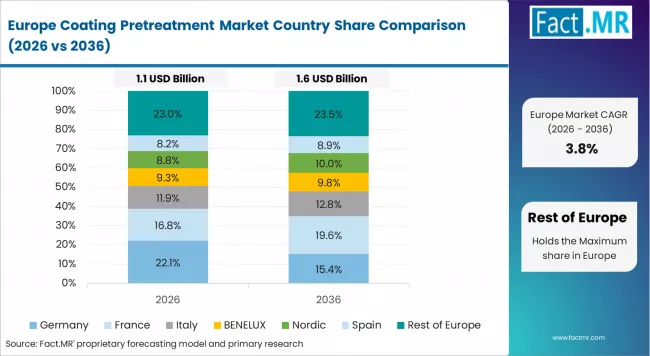
Coating Pretreatment Market Europe Country Market Share Analysis, 2026 & 2036 | Source: Fact.MR
The coating pretreatment market in Europe is projected to grow from USD 1.18 billion in 2025 to USD 1.96 billion by 2035, registering a CAGR of 5.2% over the forecast period. Germany is expected to maintain its leadership position with a 31.7% market share in 2025, supported by its advanced automotive manufacturing infrastructure, comprehensive environmental regulations, and strong chemical technology industry across major industrial centers.
France follows with a 22.4% share in 2025, driven by established automotive production operations and integrated aerospace manufacturing sectors. Italy holds a 17.9% share in 2025 through its specialized metal fabrication capabilities and architectural finishing expertise. The UK commands a 15.2% share, while rest of Europe accounts for 12.8% in 2025.
By 2035, Germany is projected to hold 31.4% share, France 22.6%, Italy 18.1%, UK 15.0%, and Rest of Europe 12.9%, reflecting sustained growth momentum across all major European markets and increasing pretreatment adoption in diversified manufacturing applications implementing comprehensive environmental compliance programs.
Competitive Landscape of the Coating Pretreatment Market
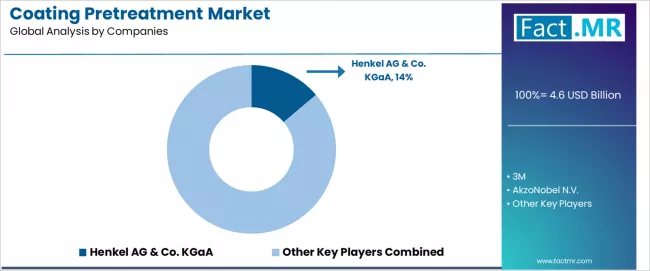
Coating Pretreatment Market Analysis By Company | Source: Fact.MR
The coating pretreatment market features approximately 25-35 meaningful players with moderate concentration, where the top three companies control roughly 35-45% of global market presence through established product portfolios and extensive customer relationships across automotive and industrial sectors.
Market leaders include Henkel AG & Co. KGaA, Chemetall GmbH, and PPG Industries, which maintain competitive advantages through comprehensive pretreatment chemical portfolios, global technical support networks, and deep expertise in the surface preparation technology and coating systems sectors, creating strong customer relationships among automotive manufacturers and metal finishers.
These companies leverage established application know-how and ongoing formulation innovation initiatives to defend market positions while expanding into adjacent sustainable chemistry applications and chromate-free technology markets. Henkel AG & Co. KGaA commands a 13.8% market share through integrated BONDERITE pretreatment solutions and strategic positioning in global automotive markets.
Challengers encompass 3M, AkzoNobel N.V., and Axalta Coating Systems LLC, which compete through diversified product portfolios and strong regional presence in key manufacturing markets. Specialty providers, including Kansai Paint Co. Ltd., Nihon Parkerizing Co., Ltd., Nippon Paint Co., Ltd., and The Sherwin-Williams Company, focus on specific geographical regions or application segments, offering differentiated capabilities in regional technical service, specialized formulations, and integrated coating solutions.
Regional players and emerging chemical companies create competitive pressure through cost-advantaged formulations and strategic market positioning, particularly in high-growth markets including China and India, where local presence provides advantages in technical support and customer proximity.
Market dynamics favor companies that combine chemical performance excellence with comprehensive application expertise that addresses the complete value chain from formulation development through process optimization and technical service. Strategic investments in sustainable chemistry development and chromate-free technology initiatives enable product differentiation and market leadership across manufacturing applications.
Global Coating Pretreatment Market - Stakeholder Contribution Framework
Coating pretreatment products represent a critical surface preparation technology that enables automotive manufacturers, metal fabricators, and industrial finishers to achieve superior coating adhesion and corrosion protection without substantial process redesign, typically providing essential surface conditioning and conversion coating capabilities while supporting diverse manufacturing applications.
With the market projected to grow from USD 4.57 billion in 2025 to USD 7.93 billion by 2035 at a 5.7% CAGR, these chemicals offer compelling advantages - enhanced coating durability, proven corrosion resistance, and reliable process performance - making them essential for phosphate-based processing (largest segment), automotive finishing (dominant application), and diverse industrial applications seeking reliable surface preparation technologies. Scaling market adoption and environmental compliance requires coordinated action across manufacturing policy, industry standards, chemical suppliers, equipment providers, and research institutions.
How Governments Could Spur Local Production and Adoption?
- Manufacturing Technology Programs: Include coating pretreatment capabilities in national industrial strategies, providing targeted funding for sustainable chemistry development in regions with established manufacturing infrastructure and supporting local chemical manufacturers through environmental technology incentives and development support.
- Environmental Policy & Compliance Support: Implement balanced frameworks for industrial discharge regulations, provide guidance for pretreatment waste management, and establish environmental standards that support sustainable surface preparation implementations.
- Trade Policy & Market Access: Create balanced import-export frameworks across chemical and manufacturing applications, establish harmonized regulatory practices for pretreatment products, and develop international cooperation protocols that facilitate technology transfer and quality standard alignment.
- Skills Development & Training: Fund technical education programs for surface treatment specialists, process engineers, and environmental compliance technicians. Invest in technology transfer initiatives that bridge chemical manufacturers with metal finishing operations and automotive production facilities.
How Industry Bodies Could Support Market Development?
- Quality Standards & Certification: Define standardized performance specifications for pretreatment chemicals across automotive, construction, and appliance applications, establish universal testing protocols and corrosion resistance metrics, and create certification programs for process quality that manufacturers can implement.
- Market Education & Best Practices: Lead communication initiatives that demonstrate pretreatment value propositions, emphasizing proven coating performance, corrosion protection benefits, and quality advantages compared to inadequate surface preparation and conventional cleaning methods.
- Sustainability Standards: Develop environmental performance benchmarks for pretreatment operations, comprehensive waste management methodologies, and sustainable chemistry best practices, ensuring responsible manufacturing across different finishing environments and operational scales.
How Manufacturers and Technology Players Could Strengthen the Ecosystem?
- Chemical Technology Development: Develop next-generation chromate-free formulations with enhanced corrosion protection, phosphate-free conversion coatings with reduced environmental impact, and process-specific features that enhance coating performance while improving sustainability and operational efficiency.
- Technical Support Platforms: Provide comprehensive application engineering that integrates process optimization, quality troubleshooting, waste reduction strategies, and performance validation, enabling customers to maximize coating quality and environmental compliance.
- Supply Chain Integration: Offer flexible supply arrangements for automotive manufacturers and metal finishers, including chemical management services, inventory optimization programs, and technical support pathways that keep pretreatment capabilities aligned with production requirements and quality standards.
Key Players in the Coating Pretreatment Market
- Henkel AG & Co. KGaA
- 3M
- AkzoNobel N.V.
- Axalta Coating Systems LLC
- Chemetall GmbH
- PPG Industries
- Kansai Paint Co. Ltd.
- Nihon Parkerizing Co., Ltd.
- Nippon Paint Co., Ltd.
- The Sherwin-Williams Company
Bibliography
- European Commission. (2024). REACH regulation: Chromium VI restriction, updated compliance deadlines for surface treatment applications. EC, ECHA.
- ASTM International. (2024). ASTM D5894-24 Standard practice for cyclic salt fog/UV exposure of painted metals. ASTM.
- Society of Automotive Engineers. (2024). SAE J2334:2024 Cosmetic corrosion lab test for automotive body panels. SAE International.
- International Organization for Standardization. (2024). ISO 9717:2024 Metallic and other inorganic coatings, phosphate conversion coatings. ISO.
- Bureau of Indian Standards. (2025, January). IS 6005:2025 Phosphate treatment of iron and steel, revised specification. BIS, Government of India.
This bibliography is provided for reader reference. The full Fact.MR report contains the complete reference list with primary research documentation.
This Report Addresses
- Market sizing and quantitative forecast metrics detailing coating pretreatment expenditure across automotive, construction, and appliance metal finishing sectors through 2036.
- Segmentation analysis mapping adoption of chromate-free pretreatment chemistries and evaluating automotive OEM qualification barriers.
- Regional deployment intelligence comparing automotive manufacturing expansion in Asia against paint shop modernization programs in North America and Europe.
- Regulatory compliance assessment analyzing hexavalent chromium restriction timelines and their impact on pretreatment chemistry conversion.
- Competitive posture evaluation tracking multi-metal pretreatment IP, automotive OEM qualification status, and process automation capabilities.
- Technology guidance defining conversion coating performance specifications for automotive, construction, and appliance applications.
- Supply chain analysis identifying pretreatment chemical raw material constraints and process water treatment requirements.
- Custom data delivery formats encompassing interactive dashboards, raw Excel datasets, and comprehensive PDF narrative reports.
Coating Pretreatment Market Definition
Coating pretreatment represents the chemical surface preparation processes applied to metal substrates before painting, powder coating, or electrocoating to form a conversion coating layer that improves paint adhesion, enhances corrosion resistance, and extends coating system durability. Pretreatment types include iron and zinc phosphate systems, chromate conversion coatings, chromate-free alternatives (zirconium oxide, silane, and nano-ceramic chemistries), and mechanical blast cleaning processes. Primary industrial functions include preparing automotive body panels, construction steel sections, and appliance enclosures for subsequent coating application.
Coating Pretreatment Market Inclusions
Market scope includes phosphate, chromate, chromate-free, and blast clean pretreatment chemical systems and associated process control equipment. The report covers global and regional market sizes, forecast period 2026 to 2036, and segment breakdowns by type and application.
Coating Pretreatment Market Exclusions
The scope excludes electrocoat primer formulations, powder coating and liquid topcoat chemistries, mechanical surface preparation abrasives and blasting media, and metal cleaning and degreasing agents used prior to pretreatment.
Coating Pretreatment Market Research Methodology
Primary Research: Analysts engaged with pretreatment chemical formulators, automotive paint shop process engineers, and construction steel coaters to map qualification cycles and chemistry conversion timelines.
Desk Research: Data collection aggregated automotive paint shop construction databases, chromate restriction regulatory timelines, and pretreatment chemical patent activity.
Market-Sizing and Forecasting: Baseline values derive from a bottom-up aggregation of pretreatment chemical consumption per square meter of metal surface treated, applying automotive, construction, and appliance production volume data.
Data Validation and Update Cycle: Projections are tested against publicly reported surface treatment segment revenues from major pretreatment chemical companies and automotive industry paint shop chemistry specifications.
Segmentation
Scope of the Report
Coating Pretreatment Market Breakdown By Type, Application, And Region | Source: Fact.MR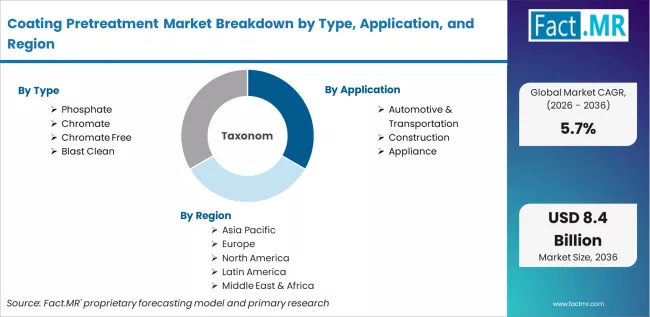
Coating Pretreatment Market by Segments
-
Type :
- Phosphate
- Chromate
- Chromate Free
- Blast Clean
-
Application :
- Automotive & Transportation
- Construction
- Appliance
-
Region :
- Asia Pacific
- China
- Japan
- South Korea
- India
- Australia & New Zealand
- ASEAN
- Rest of Asia Pacific
- North America
- USA
- Canada
- Mexico
- Europe
- Russia
- Germany
- Norway
- France
- Rest of Europe
- Latin America
- Brazil
- Rest of Latin America
- Middle East & Africa
- Kingdom of Saudi Arabia
- Other GCC Countries
- Turkey
- South Africa
- Rest of Middle East & Africa
- Asia Pacific
Frequently Asked Questions
How large is the demand for coating pretreatment in the global market in 2026?
What will be the market size of coating pretreatment in the global market by 2036?
What is the expected demand growth for coating pretreatment between 2026 and 2036?
Which Type is poised to lead global sales by 2026?
How significant is Automotive & Transportation in driving pretreatment adoption in 2026?
What is the India growth outlook in this report?
What are coating pretreatments and what are they mainly used for?
Who worked on this report


Preview the report firsthand - request a free sample
Free SampleGet the brochure for pricing and purchase details
Download PDF