- Market Value (2025): USD 620.4 Mn
- Estimated Value (2026): USD 668.7 Mn
- Forecast Value (2036): USD 1416.0 Mn
- CAGR (2026-2036): 7.8%
What is the Coconut Shell Powder Market forecast to be worth by 2036?
USD 668.7 million in 2026 to USD 1,416.0 million by 2036, at a 7.8% CAGR.
- The coconut shell powder market was valued at USD 620.4 million in 2025.
- Demand is projected to increase from USD 668.7 million in 2026 to USD 1,416.0 million in 2036.
- Revenue is projected to grow at a 7.8% CAGR from 2026 to 2036, with expansion tied to consistent industrial grades and qualification in downstream applications.
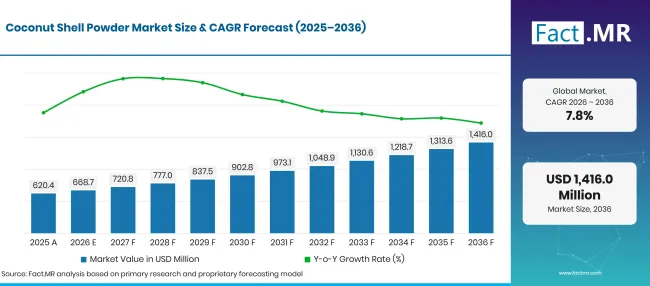
Coconut Shell Powder Market Forecast Global | Source: Fact.MR
| Year | Basis | Market Value (USD million) |
|---|---|---|
| 2025 | Actual | 620.4 |
| 2026 | Estimate | 668.7 |
| 2036 | Forecast | 1,416.0 |
| CAGR 2026 to 2036 | Forecast period | 7.8% |
Source: Fact.MR analysis. Updated Oct 27, 2026
What are the defining numbers behind Coconut Shell Powder Market growth?
Between 2026 and 2036, coconut shell powder sales will add USD 747.3 million, supported by consistent industrial grades, downstream qualification, and repeat purchasing across established applications.
- Demand Drivers in the Market
- Legacy applications like phenolic resins and laminated boards provide a high-floor revenue base. Post-qualification, buyer procurement shifts from price-shopping to risk-mitigation; supply consistency vastly outweighs marginal unit-cost savings because the operational penalties of reformulation easily eclipse raw material discounts.
- Powder processors are increasingly squeezed by the activated carbon supply chain, which aggressively bids up the price of mature shells. Consequently, margin defense relies just as much on securing cost-locked feedstock agreements as it does on downstream demand generation.
- While material science pilots (e.g., bio-composites) signal future whitespace, lab-scale viability does not equate to factory adoption. The true commercial moat is the operational discipline to scale repeatable manufacturing and guarantee month-over-month spec adherence, not just proving initial material compatibility.
- Because adhesive fillers and carbon feedstocks require mutually exclusive specs, generalist "renewable powder" strategies fail. Specialist distributors capture disproportionate value by reducing buyer qualification friction, holding tightly controlled, application-specific SKUs in trial-friendly volumes..
- Key Segments Analyzed
- By Product Type: Fine Powder accounts for 61.3% of the 2026 mix. Demand is concentrated where a controlled particle profile is essential to repeatable formulation and blending.
- By Application: Activated Carbon accounts for 34.2% in 2026. This is a downstream conversion outlet with its own input requirements, not evidence that untreated powder and finished activated carbon are equivalent.
- By Sales Channel: Specialty Stores represent 38.4% in 2026. Grade selection and small-lot availability make specialist distribution important, particularly during product trials and repeat purchasing.
- Analyst Opinion at Fact.MR
- Shambhu Nath Jha, Lead Consultant, Fact.MR Coconut shell powder is easy to describe as a low-cost renewable input; it is much harder to supply as a dependable industrial ingredient. Once a customer has qualified a filler, inconsistent moisture or particle distribution can quickly erase a small price saving. That favours processors able to hold specifications across deliveries, even without the largest milling capacity. The same discipline applies to experimental composite uses. Published formulations may justify trials, but recurring revenue begins only when a finished product passes the manufacturer's operating tests. Undifferentiated powder will remain exposed to competing shell outlets and freight costs; better-controlled grades have a more defensible place in customer procurement.
- Strategic Implications
- In adhesive resins, the accepted blend is the relevant commercial benchmark. Customers need agreed limits for moisture and particle distribution and confidence that a production shipment will match the approved sample. A nominally cheaper powder that forces a reformulation can be an expensive substitution.
- Raw-material contracts need to account for competing demand from carbon producers. Expanding milling capacity without secure access to mature shells increases exposure to input-price swings. Collection quality and appropriate storage may produce a better return than capacity added ahead of contracted orders.
- Composite applications warrant selective development rather than an indiscriminate sales push. A clearly defined, relatively low-load component is a more realistic starting point than a demanding structural use where moisture uptake or dispersion is unresolved. Qualification time should be treated as part of the commercial investment.
- Distributors should distinguish untreated shell powder from charcoal powder and activated carbon at the point of order. Similar-looking materials can have very different process roles and prices. Clear grade descriptions prevent substitution errors and make a successful sample order easier to repeat.
Germany leads the profiled country forecasts, with Brazil close behind, but the demand cases are different. Germany is more dependent on industrial grade approval; Brazil has an important processing and supply-organisation challenge. In the United States, United Kingdom and Japan, the route to business is more closely tied to application qualification and specialist distribution.
How does the Coconut Shell Powder Market break down by segment?
Fine Powder 61.3%; Activated Carbon 34.2%; Specialty Stores 38.4% in 2026.
Why does fine powder retain the larger share of formulated-material demand?
The Fine Powder segment leads Product Type with a 61.3% revenue share in 2026.
| Product Type | Share (2026) |
|---|---|
| Fine Powder (Leading segment) | 61.3% |
| Other segments combined | 38.7% |
| Total | 100.0% |
Source: Fact.MR analysis. Updated Oct 27, 2026
Fine powder commands market share because industrial formulators are buying dispersion stability, not just small particles. Hitting a nominal mesh size is merely the baseline. The real manufacturing risk lies in secondary variables: moisture load and particle variance. If a supplier cannot tightly control these, two shipments carrying the exact same technical grade will behave completely differently in a customer’s resin matrix.
Laboratory work also cautions against assuming that more filler always improves a product. A study in Discover Applied Sciences tested coconut shell material with E-glass in epoxy resins and found increased water absorption as shell content rose during immersion tests. [3] The purchasing implication is application-specific qualification, not a blanket preference for the finest or highest-loading grade.
What makes activated-carbon demand commercially different from filler demand?
The Activated Carbon segment leads Application with a 34.2% revenue share in 2026.
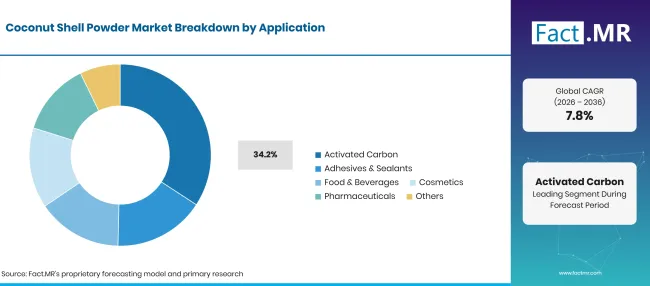
Coconut Shell Powder Market Breakdown Application | Source: Fact.MR
| Application | Share (2026) |
|---|---|
| Activated Carbon (Leading segment) | 34.2% |
| Other segments combined | 65.8% |
| Total | 100.0% |
Source: Fact.MR analysis. Updated Oct 27, 2026
Activated Carbon represents the largest application category, but it must be interpreted within the downstream conversion chain. Carbonisation and activation processes accept particular feedstock forms and conditions. Before quoting a milled-powder order, a supplier needs to know whether the plant actually purchases shell particles, charcoal or another prepared input.
The distinction matters for the forecast. Growth in the sales value of finished adsorbents may reflect processing and prices rather than proportional growth in raw powder tonnage. Powder demand is more directly supported when processors have a repeatable input specification. Resin and adhesive markets follow a different path, where performance in a blend determines subsequent orders.
Why does the choice of grade give specialty stores an important role?
The Specialty Stores segment leads Sales Channel with a 38.4% revenue share in 2026.
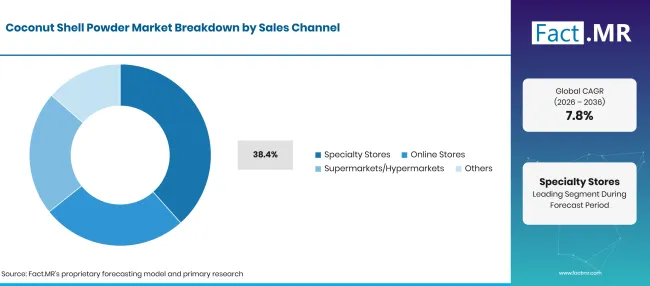
Coconut Shell Powder Market Breakdown Sales Channel | Source: Fact.MR
| Sales Channel | Share (2026) |
|---|---|
| Specialty Stores (Leading segment) | 38.4% |
| Other segments combined | 61.6% |
| Total | 100.0% |
Source: Fact.MR analysis. Updated Oct 27, 2026
Specialty Stores retain the largest channel position because industrial customers often begin with a small, technically specific order. Buying an untested bulk lot can create more risk than the discount is worth. Reliable labelling, grade continuity and quantities appropriate for trials make specialist distribution part of the qualification process.
After a grade is accepted, routine ordering may move online, but the specification cannot disappear in the transaction. The channel mix also includes Supermarkets/Hypermarkets and Others, which serve different buying occasions. None of those routes removes the need to establish whether the material is suitable for a given industrial, cosmetic or food-related use.
What will determine whether qualification work becomes recurring powder demand?
Repeat demand begins when a formulation can be manufactured consistently. Early trials may focus on acceptable filler loading; production teams also have to account for mixing time, storage and lot variation. Savings on the ingredient have little value if they are lost through extra processing or rejects. That is why supplier qualification can matter more than the novelty of the material.
Feedstock costs remain a second constraint. Competition for mature shells can change input availability, while wet or contaminated material raises preparation losses. Processors with collection arrangements aligned to customers' accepted specifications are better insulated than those selling whatever powder current shell supplies happen to yield.
Drivers Impact Analysis
| DRIVER | (~) % IMPACT ON CAGR | GEOGRAPHIC RELEVANCE | IMPACT TIMELINE |
|---|---|---|---|
| Repeat specification in resin-filler applications | +1.2% | Germany, Japan and United States | 2026 to 2030 |
| Downstream qualification of shell-derived carbon inputs | +0.9% | Asia Pacific and United States | 2026 to 2031 |
| More consistent drying and particle grading | +0.6% | Major processing and export markets | 2026 to 2029 |
| Industrial acceptance of renewable filler formulations | +0.8% | Europe and Asia Pacific | 2028 to 2034 |
| Specialist availability for repeat small-volume orders | +0.3% | United Kingdom, Germany and Japan | 2026 to 2030 |
Source: Fact.MR analysis. Updated Oct 27, 2026
Opportunity Impact Analysis
| OPPORTUNITY | (~) % IMPACT ON CAGR | GEOGRAPHIC RELEVANCE | IMPACT TIMELINE |
|---|---|---|---|
| Qualified shell-powder grades for low-load composites | +0.7% | Europe, Japan and United States | 2028 to 2036 |
| Organized recovery of suitable mature-shell feedstock | +0.5% | Brazil and Asian processing locations | 2026 to 2032 |
| Application testing packaged with supply contracts | +0.4% | Germany, United Kingdom and Japan | 2027 to 2033 |
| Regional inventory of clearly specified powder grades | +0.2% | United States and Europe | 2026 to 2029 |
Source: Fact.MR analysis. Updated Oct 27, 2026
Restraints Impact Analysis
| RESTRAINT | (~) % IMPACT ON CAGR | GEOGRAPHIC RELEVANCE | IMPACT TIMELINE |
|---|---|---|---|
| Competing shell and charcoal demand raising input costs | -1.1% | Global, especially Asian supply origins | 2026 to 2030 |
| Moisture sensitivity and lot-to-lot variation | -0.7% | Global formulation markets | 2026 to 2036 |
| Qualification delays in new composite applications | -0.4% | Europe, Japan and United States | 2027 to 2034 |
| Freight and handling eroding powder's cost advantage | -0.5% | Long-distance import markets | 2026 to 2032 |
Source: Fact.MR analysis. Updated Oct 27, 2026
Which countries are scaling the Coconut Shell Powder Market through 2036?
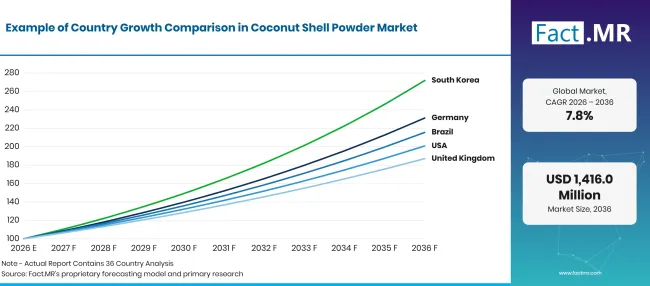
Coconut Shell Powder Market Growth Index | Source: Fact.MR
| Country | CAGR (2026 to 2036) |
|---|---|
| Germany | 8.7% |
| Brazil | 8.0% |
| United States | 7.2% |
| United Kingdom | 6.5% |
| Japan | 5.7% |
Source: Fact.MR analysis. Updated Oct 27, 2026
Germany (8.7% CAGR): Qualification-Led Value Capture
Growth in Germany is driven by stringent industrial QA, not "green" premiums. High-tech manufacturers will immediately reject renewable inputs that disrupt their process controls or compromise finished-part integrity. The commercial moat is absolute batch-to-batch consistency. Once a supplier passes the initial formulation audit, expansion relies on cross-selling the verified grade into adjacent applications, rather than waiting for a slow, wholesale shift in manufacturing categories.
Brazil (8.0% CAGR): Feedstock Upgrading and Supply Formalization
The market routinely conflates total agricultural residue with viable industrial feedstock. True scale requires isolating hard mature shells from low-value husk and coir pith. Processors who integrate raw material collection with rigorous cleaning, drying, and grading protocols will capture the market. By delivering a pre-validated input, they eliminate the preprocessing friction that currently forces buyers to adapt their own manufacturing lines.
United States (7.2% CAGR): The Reliability Premium Amid Feedstock Inflation
Headline US import values are heavily skewed by downstream activated carbon pricing, which masks the actual procurement dynamics of raw powder. For US formulators, the primary driver is supply chain resilience, not unit-cost arbitrage. Distributors win market share not by offering the cheapest sample, but by guaranteeing documented, repeatable specs to serve as a risk-mitigated secondary source for buyers exposed to volatile feedstock markets.
United Kingdom (6.5% CAGR): Overcoming the Trial-to-Scale Bottleneck
lab test UK procurement cycles are characterized by low-volume technical trials rather than immediate bulk contracts. The true commercial hurdle is converting initial R&D samples into routine production schedules. Specialist distributors win by offering highly traceable, manageable lot sizes and pristine dry-storage logistics, effectively de-risking the buyer's scale-up phase and bridging the gap between a successful and a stable recurring account.
Japan (5.7% CAGR): Lifecycle Validation and In-Field Durability
Factory-floor acceptance is insufficient; Japanese manufacturers mandate rigorous validation against real-world moisture and environmental degradation over the product's lifecycle. This creates a high barrier to entry but deep post-qualification stickiness. Suppliers who can operationally and financially absorb these extended validation cycles holding exact grade specifications steady for months while the customer tests end-use durability will secure highly defensible, long-term supply contracts.
Who leads the Coconut Shell Powder Market?
Market leadership in this sector is entirely decoupled from raw feedstock access or gross milling capacity. Uncommitted processing volume is effectively a stranded asset when industrial buyers demand narrow, application-specific tolerances.
The true competitive moat lies in post-mill operational discipline: grading, moisture control, and storage that convert raw shells into reproducible inputs. Because buyer requirements are deeply bifurcated, resin formulators require physical blending stability while carbon processors demand specific chemical conversion yields market leaders win by abandoning generic, one-size-fits-all bulk sales in favor of highly specified, reliably replenished product portfolios.
Which companies are the key providers?
Key companies profiled include Viet Delta Corporation; Shree Balajee Magnesite; S V Coconut Products; Premium Products; Aayush Enterprises; Kumaran Coir; Manjunath Enterprises; Cocovina; Sakthi Coir Exports; and Navya Sai Industries.
- Viet Delta Corporation
- Shree Balajee Magnesite
- S V Coconut Products
- Premium Products
- Aayush Enterprises
- Kumaran Coir
- Manjunath Enterprises
- Cocovina
- Sakthi Coir Exports
- Navya Sai Industries
Bibliography
- [1] Coconut Development Board. (n.d.). Coconut shell powder. Ministry of Agriculture and Farmers Welfare, Government of India.
- [2] International Coconut Community. (2026, April). Market review of coconut shell charcoal: April 2026.
- [3] Lala, S. D., Deb, P., Maradiya, D., Vyas, C., & Chaudhary, R. (2026). Development and characterization of coconut shell nano filler reinforced epoxy bio-composite. Discover Applied Sciences, 8, Article 100.
- [4] Ramesh, B. T., Maruthi, G. V., Abhinav, T., Malladad, S. K., Fernandes, L. J., Mujeebullakhan, G. M., Banagar, A. R., & Srinivasa, C. V. (2025). Estimation of engineering properties for coconut shell powder reinforced 100% bio-degradable beeswax composites to replace wood materials. MethodsX, 15, Article 103521.
This Report Answers
- Which product characteristics help a shell-powder grade earn repeat orders?
- How does the Activated Carbon application differ from direct filler uses?
- Why do fine powder and specialty channels hold leading positions?
- Where do feedstock competition and qualification delays limit expansion?
- How do the commercial routes differ across Germany, Brazil, the United States, the United Kingdom and Japan?
What does the Coconut Shell Powder Market cover?
This report examines the commercial outlook for coconut shell powder across product types, applications and sales channels. It relates the forecast to grade consistency, usable feedstock access and the conditions under which a customer can adopt the material repeatedly. Country analysis focuses on five markets with distinct routes to industrial and specialist demand. The competitive assessment considers specification quality and delivery capability, while the application discussion maintains the boundary between milled shell and products that require subsequent conversion.
What is included in the scope?
Coverage includes Fine Powder and Granular Powder sold through Specialty Stores, Online Stores, Supermarkets/Hypermarkets and Others.
The application assessment covers Activated Carbon, Adhesives & Sealants, Food & Beverages, Cosmetics, Pharmaceuticals and Others. Commercial analysis includes preparation, grading, storage and distribution where these affect powder purchasing. Downstream research and trade indicators are considered as application context, with their product boundaries retained.
What is excluded from the scope?
The scope excludes coconut kernel flour, desiccated coconut, coconut milk powder, coir fiber and coir pith.
It also excludes the full sales value of finished activated carbon, charcoal products, adhesives, composites, cosmetics and pharmaceuticals. Further processing does not make those products equivalent to untreated shell powder. Consumer-use suitability and regulatory acceptance remain specific to the product and application; the market classification does not itself establish either.
How Was the Analysis Built?
The analysis draws on 120+ sources, 35+ company portfolios, 25+ countries, and more than 20 industry interviews.
- Primary Research: Primary research includes discussions with manufacturers, service providers, technology developers, distributors, end users, and subject-matter experts. These conversations examine purchasing priorities, product adoption, operational challenges, approval requirements, competitive positioning, and the factors that influence wider market acceptance.
- Desk Research: Desk research covers government statistics, regulatory publications, company filings, trade data, technical studies, industry associations, standards, public policy, and other authoritative sources. Every source used in the analysis is documented in the bibliography.
- Market Sizing and Forecasting: Market estimates combine historical performance, demand indicators, pricing and volume trends, segment shares, company participation, country-level growth, adoption patterns, investment activity, and barriers to market expansion.
- Data Validation and Update Cycle: Findings are validated by comparing primary interviews with public data, company activity, regulatory changes, trade patterns, and industry developments. Regular updates review new product launches, capacity changes, partnerships, approvals, and shifts in commercial adoption.
Segmentation
What is the report’s scope and coverage?
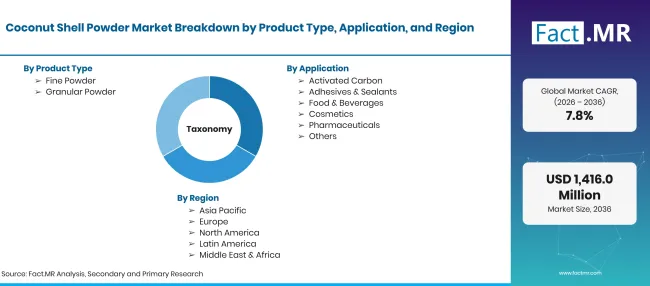
Coconut Shell Powder Market Taxonomy | Source: Fact.MR
| Attribute | Details |
|---|---|
| Industry Classification | Chemicals |
| Quantitative Units | USD million; revenue share and CAGR in percentages |
| Market Definition | The market covers commercially supplied powder made from the hard coconut shell, including fine and granular grades sold for industrial formulations and downstream processing. Application coverage includes Activated Carbon, Adhesives & Sealants, Food & Beverages, Cosmetics, Pharmaceuticals and Others. These application labels do not imply that untreated shell powder has the properties, approvals or performance of the finished products made through further processing. |
| Product Type | Fine Powder; Granular Powder |
| Application | Activated Carbon; Adhesives & Sealants; Food & Beverages; Cosmetics; Pharmaceuticals; Others |
| Sales Channel | Specialty Stores; Online Stores; Supermarkets/Hypermarkets; Others |
| Regions Covered | North America; Latin America; Western Europe; Eastern Europe; East Asia; South Asia & Pacific; Middle East & Africa |
| Countries Covered | Germany; Brazil; United States; United Kingdom; Japan |
| Companies Profiled | Viet Delta Corporation; Shree Balajee Magnesite; S V Coconut Products; Premium Products; Aayush Enterprises; Kumaran Coir; Manjunath Enterprises; Cocovina; Sakthi Coir Exports; Navya Sai Industries |
| Forecast Period | 2026 to 2036; base year 2026; historical year 2025 |
| Approach | The assessment considers the economics of usable shell supply, milling and grading, application qualification, channel availability and repeat purchasing, while distinguishing powder demand from activity in downstream carbon and composite products. |
Source: Fact.MR analysis. Updated Oct 27, 2026
How is the market segmented?
-
By Product Type
- Fine Powder
- Granular Powder
-
By Application
- Activated Carbon
- Adhesives & Sealants
- Food & Beverages
- Cosmetics
- Pharmaceuticals
- Others
-
By Sales Channel
- Specialty Stores
- Online Stores
- Supermarkets/Hypermarkets
- Others
-
By Region
- North America
- Latin America
- Western Europe
- Eastern Europe
- East Asia
- South Asia & Pacific
- Middle East & Africa
Frequently Asked Questions
How large is the coconut shell powder market?
What is the projected growth rate?
Which product type leads the coconut shell powder market in 2026?
Is coconut shell powder the same product as activated carbon?
Which country has the highest projected growth among those profiled?
Who worked on this report


Preview the report firsthand - request a free sample
Free SampleGet the brochure for pricing and purchase details
Download PDF