- Market Value (2025): USD 417.8 Bn
- Estimated Value (2026): USD 445.0 Bn
- Forecast Value (2036): USD 1,150 Bn
- CAGR (2026-2036): 10.0%
What is the Coconut Powder Market forecast to be worth by 2036?
USD 272.2 million in 2026 to USD 387.7 million by 2036, at a 4.4% CAGR.
- The market reached USD 260.7 million in 2025.
- Demand is projected to increase from USD 272.2 million in 2026 to USD 387.7 million by 2036.
- The market is forecast to record a 4.4% CAGR from 2026 to 2036, creating an absolute opportunity of USD 115.5 million.
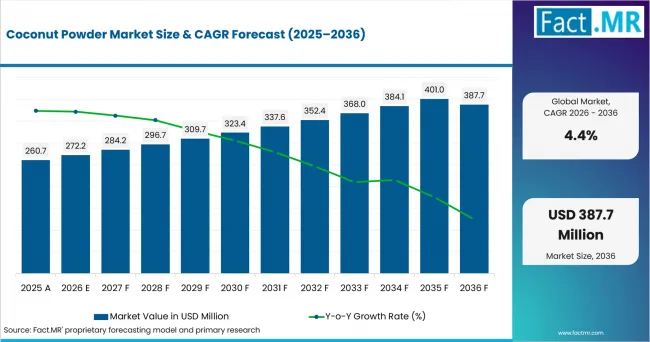
Coconut Powder Market Value Analysis | Source: Fact.MR
What are the defining numbers behind Coconut Powder Market growth?
USD 115.5 million absolute opportunity is expected between 2026 and 2036.
- Demand Drivers in the Market
- Beverage applications support steady repeat demand because coconut powder can be stored dry, blended quickly, and reconstituted when needed.
- Pure coconut powder appeals to brands and kitchens that want a shorter ingredient list and predictable coconut flavour.
- Bakery, confectionery, snacks and dairy-alternative uses keep demand spread across both household and food-manufacturing channels.
- Supply reliability matters because many consuming markets depend on imported coconut ingredients from tropical producing countries.
- Key Segments Analyzed
- By Type: Pure is the leading type, accounting for 61.9% share in 2026.
- By Application: Beverages leads with 27.0% share in 2026.
- Analyst Opinion at Fact.MR
- Coconut powder is not bought only as a flavouring. It is also bought as a dry, shelf-stable ingredient that helps beverage, bakery as well as snack and dairy-alternative formulators manage consistency. Pure formats gain preference where clean labelling and flavour control matter. Mixed formats still have a place when buyers want ready-to-use blends, but suppliers need to be clear about composition, solubility and intended application. Shambhu Nath Jha, Principal Consultant, Fact.MR.
- Strategic Implications
- Buyers should evaluate coconut powder by flavour, fat level, moisture as well as particle size as well as reconstitution behaviour and packaging stability.
- Suppliers can differentiate by showing where a powder performs best, such as beverages, bakery mixes as well as snack coatings or frozen desserts.
- Distribution planning should reflect the split between household retail packs and larger food-manufacturing or foodservice formats.
The UK records the highest country CAGR at 6.7%, followed by Australia at 6.4%. The USA and Canada are both projected at 5.2%, while Germany is forecast to expand at 4.0% through 2036.
How does the Coconut Powder Market break down by segment?
Pure leads Type with 61.9% share and Beverages leads Application with 27.0% share in 2026.
Why does Pure lead Type?
Pure is projected to account for 61.9% share in 2026.
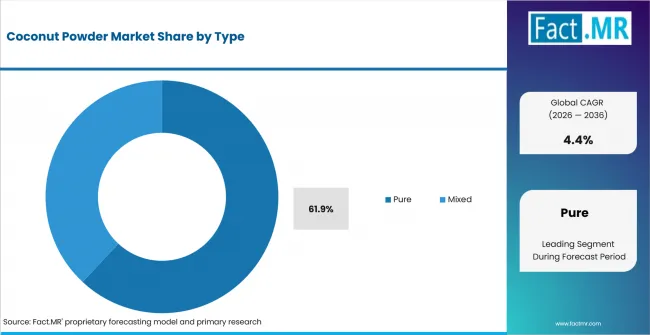
Coconut Powder Market Analysis By Type | Source: Fact.MR
Pure coconut powder leads because it gives buyers a clear base ingredient rather than a pre-adjusted blend. This matters in beverages and bakery formulations where processors want to control sweetness, fat balance, stabilisers and final texture themselves. Codex standards for desiccated coconut also put emphasis on product identity, sound coconut kernel, moisture as well as oil content as well as colour as well as flavour and odour. Those are practical buying checks for pure powder because they affect reconstitution, taste, storage stability and finished-product consistency. Mixed variants remain useful for flavoured, fortified, or convenience blends. They give buyers less formulation control.
Why does Beverages lead Application?
Beverages is projected to account for 27.0% share in 2026.
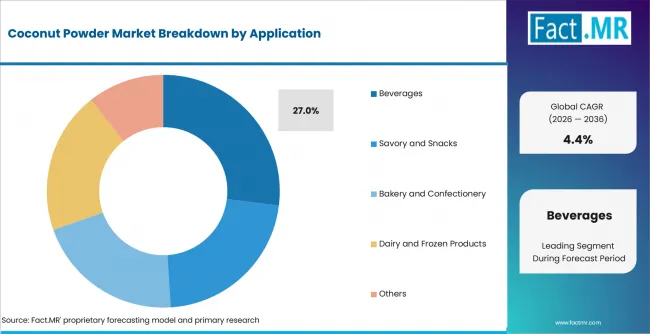
Coconut Powder Market Analysis By Application | Source: Fact.MR
Beverages lead because coconut powder solves a practical handling problem. It lets beverage makers, cafes, and households prepare coconut-based drinks without carrying as much liquid weight or cold-chain burden as ready-to-drink formats. The powder can be used in smoothies, instant mixes, coconut milk-style drinks as well as shakes and foodservice recipes where shelf life and portion control matter. Growth is also helped by the wider acceptance of plant-based drink options, although nutrition and labelling rules still require brands to be clear about what the product contains.
What is accelerating Coconut Powder Market adoption, and what is holding it back?
Adoption is being helped by beverage use, home preparation, bakery inclusion and the need for shelf-stable coconut ingredients. The main restraint is not weak awareness. It is the need to manage coconut-origin supply, price swings, moisture control and formulation performance across different applications.
Drivers Impact Analysis
| DRIVER | (~) % IMPACT ON CAGR | GEOGRAPHIC RELEVANCE | IMPACT TIMELINE |
|---|---|---|---|
| Dry-format convenience | +1.1% | UK, Australia and USA | Short term (<= 2 years) |
| Clean-label preference | +0.9% | UK, Australia and USA | Short term (<= 2 years) |
| Application range | +0.7% | USA, Canada and Germany | Medium term (2-4 years) |
| Import-led availability | +0.5% | Global sourcing and import-dependent markets | Medium term (2-4 years) |
Source: Fact.MR analysis. Updated Aug 4, 2026
- Dry-format convenience: Powder lowers storage pressure and works well in instant beverages, mixes, and manufacturing recipes.
- Clean-label preference: Pure powder is easier to position when buyers want a recognizable coconut ingredient.
- Application range: Coconut powder moves across beverages, bakery, snacks as well as confectionery as well as dairy alternatives and frozen products.
- Import-led availability: Established sourcing routes from coconut-producing countries help consumption markets maintain product access.
Opportunity Impact Analysis
| OPPORTUNITY | (~) % IMPACT ON CAGR | GEOGRAPHIC RELEVANCE | IMPACT TIMELINE |
|---|---|---|---|
| Application-grade differentiation | +0.7% | UK, Australia and USA | Medium term (2-4 years) |
| Dry-format manufacturing efficiency | +0.6% | Australia, USA and Canada | Medium term (2-4 years) |
| Home-use retail packs | +0.4% | UK, Australia and USA | Long term (>= 4 years) |
Source: Fact.MR analysis. Updated Aug 4, 2026
- Suppliers can build value around solubility, moisture control, fat specification and application-tested grades.
- Beverage and bakery manufacturers can use powder to reduce liquid handling and improve batch consistency.
- Retail packs can target home users who want coconut flavour for smoothies, desserts, curries and baking without opening canned coconut milk.
Restraints Impact Analysis
| RESTRAINT | (~) % IMPACT ON CAGR | GEOGRAPHIC RELEVANCE | IMPACT TIMELINE |
|---|---|---|---|
| Coconut-supply variability | -0.8% | Global sourcing and import-dependent markets | Short term (<= 2 years) |
| Imported-ingredient cost pressure | -0.6% | Global sourcing and import-dependent markets | Short term (<= 2 years) |
| Mixed-powder labelling scrutiny | -0.5% | UK, Australia and USA | Medium term (2-4 years) |
Source: Fact.MR analysis. Updated Aug 4, 2026
- Coconut supply can be affected by weather, ageing trees, labour intensity. Competition from coconut oilas well as milk as well as water and fresh coconut channels.
- Food inflation and imported ingredient costs can make buyers more selective, especially in mature European markets.
- Mixed powders can face greater scrutiny because added sugars, flavours, carriers or stabilisers need clear labelling.
Which countries are scaling the Coconut Powder Market fastest?
Country growth rates differ from the global 4.4% CAGR. The UK, Australia, USA and Canada sit above the global rate. Germany is slightly below it, which fits a mature European demand profile rather than a weak category position.
- The UK leads the country set at 6.7% CAGR.
- Australia follows at 6.4% CAGR.
- The USA records 5.2% CAGR.
- Canada advances at 5.2% CAGR.
- Germany expands at 4.0% CAGR.
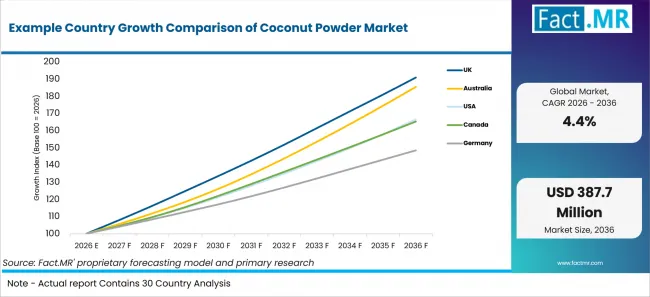
Example Country Growth Comparison Of Coconut Powder Market | Source: Fact.MR
| COUNTRY | CAGR, 2026 to 2036 |
|---|---|
| UK | 6.7% |
| Australia | 6.4% |
| USA | 5.2% |
| Canada | 5.2% |
| Germany | 4.0% |
Source: Fact.MR analysis. Updated Aug 4, 2026
What is driving the UK's growth through 2036?
The UK is forecast to grow at 6.7% CAGR through 2036, making it the fastest-growing country in the listed set.
Growth is supported by the UK’s role as one of Europe’s notable markets for desiccated coconut, with CBI identifying the United Kingdom among key opportunities for exporters. Demand is strongest where coconut powder works as a pantry and formulation ingredient: beverages, baking, desserts as well as curries and foodservice recipes. UK food-chain scale also helps. GOV.UK reported total consumer expenditure on food and alcoholic drinks of GBP 303.3 billion in 2025, while NHS dietary guidance recognises unsweetened calcium-fortified plant alternatives made from coconuts as dairy alternatives. That does not automatically prove coconut powder adoption, but it does show why coconut-based beverage and home-use formats have a clear route to consumers.
What is driving Australia's growth through 2036?
Australia is forecast to grow at 6.4% CAGR through 2036.
The country’s growth is tied to imported food ingredients, household cooking, beverages and a food-processing sector that already works with global inputs. USDA FAS reported that Australia’s food, beverage, and grocery industries account for about one-third of manufacturing activity. This includes food-manufacturing turnover of USD 107 billion in 2022-23. Australia also imported USD 13.6 billion of consumer-oriented products in 2024. Coconut powder fits this setting because it can serve beverage mixes, bakery goods, desserts and Asian-style cooking while offering easier storage than liquid coconut formats.
What is driving the USA's growth through 2036?
The USA is projected to grow at 5.2% CAGR through 2036.
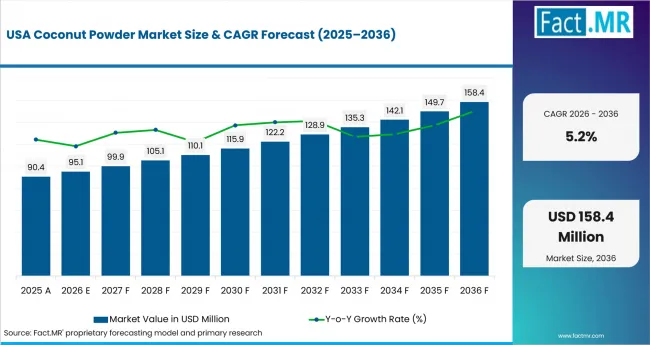
Coconut Powder Market Country Value Analysis | Source: Fact.MR
Its pace is above the global rate but below the UK and Australia because the market is already broad and competitive. Growth comes from scale: coconut powder can move through grocery, online retail, foodservice as well as bakery as well as smoothie and packaged-food channels. USDA ERS reported that total U.S. food spending reached USD 2.51 trillion in 2025, with food-away-from-home spending at USD 1.41 trillion and food-at-home spending at USD 1.10 trillion. FDA guidance on plant-based milk and animal-food alternatives also shows that plant-based products, including coconut-based beverage options, are now visible enough to require clearer naming and labelling practices. That creates room for powder suppliers, but it also pushes brands to be more precise about ingredients and nutrition.
What is driving Canada's growth through 2036?
Canada is forecast to grow at 5.2% CAGR through 2036.
Growth is supported by foodservice recovery, retail use, and food manufacturers looking for dry ingredients that can be used across beverages as well as bakery and dessert applications. Statistics Canada reported that annual sales of food services and drinking places reached CAD 101.4 billion in 2025, up 5.6% from 2024. This matters for coconut powder because cafes, limited-service outlets, bakeries and dessert operators need ingredients that store well and deliver repeatable flavour. Canada’s growth is therefore not only a grocery story. It also depends on foodservice recipes, private-label retail, and imported ingredient reliability.
What is driving Germany's growth through 2036?
Germany is forecast to expand at 4.0% CAGR through 2036, slightly below the global rate.
The country is not a weak market for coconut ingredients. Eurostat reported that Germany was the second-largest EU importer of coconuts from outside the EU in 2023, with 15,400 tonnes and 15% of extra-EU coconut imports. CBI also identifies Germany as Europe’s second-largest importer of desiccated coconut. The slower forecast pace reflects maturity, price sensitivity, and heavier competition from other bakery as well as confectionery as well as snack and dairy-alternative ingredients. Germany has scale, but value growth depends on import prices, food inflation and whether processors keep coconut powder in formulations when cheaper substitutes are available.
Who leads the Coconut Powder Market?
Cocomi is the largest named company in the assessed set, with 11.4% share. Other listed participants are Caribbean, Maggi, Fiesta and Renuka.
Competition is shaped by product consistency, pack format, supply reliability and how clearly each supplier positions pure and mixed powders for beverage as well as bakery as well as snack and household use. Buyers are likely to compare flavour, solubility, price and ingredient declaration rather than rely on brand name alone.
Which companies are the key providers?
Key companies include Cocomi; Caribbean; Maggi; Fiesta; Renuka; Cocos; Qbb; Thai-Choice; and Ayam.
- Cocomi
- Caribbean
- Maggi
- Fiesta
- Renuka
- Cocos
- Qbb
- Thai-Choice
- Ayam
Bibliography
- Centre for the Promotion of Imports from Developing Countries. (2023, December 18). Exporting desiccated coconut to Europe. CBI.
- Centre for the Promotion of Imports from Developing Countries. (2023, December 18). The European market potential for desiccated coconut. CBI.
- Codex Alimentarius Commission. (2023). Standard for Desiccated Coconut CXS 177-1991. FAO/WHO Codex Alimentarius.
- Eurostat. (2024, August 15). Extra-EU coconut imports worth EUR 146 million. European Commission.
- Food and Agriculture Organization of the United Nations. (n.d.). FAOSTAT statistical database.
- Food and Drug Administration. (2025, January 6). Plant-Based Milk and Animal Food Alternatives.
- Government of the United Kingdom. (2026). Food statistics in your pocket. GOV.UK.
- National Health Service. (n.d.). Dairy and alternatives in your diet. NHS.
- Statistics Canada. (2026, February 25). Food services and drinking places, December 2025. Government of Canada.
- U.S. Department of Agriculture, Economic Research Service. (2026, June 1). Total food spending reached USD 2.51 trillion in 2025.
- U.S. Department of Agriculture, Foreign Agricultural Service. (2025, March 7). Food Processing Ingredients Annual: Australia.
This Report Answers
- The report provides strategic intelligence on the Coconut Powder Market across Type and Application choices that shape ingredient selection and formulation.
- Segment analysis covers Pure and Beverages as the share leaders within the 2026 market.
- Country outlook evaluates the UK and Australia alongside the USA and Canada. Germany completes the growth comparison across the profiled markets.
- Competitive analysis profiles Cocomi and Caribbean alongside Maggi and Fiesta. Renuka completes the provider view.
- Application assessment covers Beverages and Savory and Snacks. Bakery and Confectionery plus Dairy and Frozen Products complete the main use view.
What does the Coconut Powder Market cover?
The market covers coconut powder products and related offerings across the defined type, application, and region categories. It includes pure and mixed powder formats used in beverages, savory and snack applications, bakery and confectionery as well as dairy and frozen products and other listed uses.
What is included in the scope?
The scope includes coconut powder products sold through the listed type and application categories, including retail and larger-format supply where the product is used as a food or beverage ingredient.
What is excluded from the scope?
Products outside the defined coconut powder type, application, and region categories are excluded. Liquid coconut milk, coconut water, coconut oil as well as fresh coconuts and non-food coconut derivatives are not treated as the core market unless they directly support coconut powder use or positioning.
How Was the Analysis Built?
The analysis combines structured desk research, company and product mapping, expert validation. Demand-side checks across major regions.
- Primary Research: Interviews with buyers, suppliers, food processors as well as distributors and category specialists test purchasing criteria as well as operating constraints as well as application fit and replacement behaviour.
- Desk Research: Public food standards, trade information, company literature as well as regulatory material and official statistics establish market boundaries and demand context.
- Market Sizing and Forecasting: Demand indicators, import dependence, application intensity as well as channel patterns and supplier participation are reconciled across top-down and bottom-up views.
- Data Validation and Update Cycle: Findings are cross-checked across independent evidence routes and reviewed when material market, regulatory, supply or company changes occur.
Segmentation
What is the report's scope and coverage?
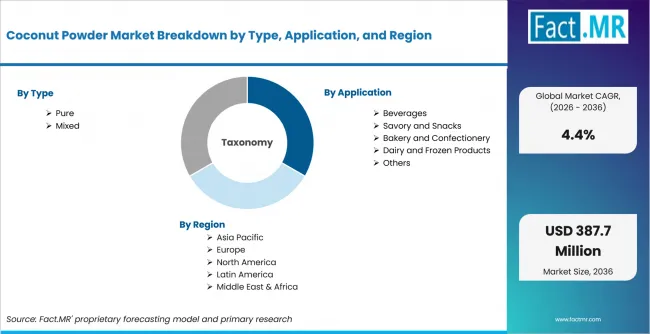
Coconut Powder Market Breakdown By Type, Application, And Region | Source: Fact.MR
| Attribute | Details |
|---|---|
| Quantitative Units | USD 272.2 million in 2026 to USD 387.7 million by 2036, at a 4.4% CAGR |
| Market Definition | Coconut Powder products and related offerings across the assessed categories |
| Type | Pure; Mixed |
| Application | Beverages; Savory and Snacks; Bakery and Confectionery; Dairy and Frozen Products; Others |
| Regions Covered | North America; Latin America; Europe; East Asia; South Asia & Oceania; Middle East & Africa |
| Countries Covered | UK; Australia; USA; Canada; Germany |
| Key Companies Profiled | Cocomi; Caribbean; Maggi; Fiesta; Renuka; Cocos; and others |
| Forecast Period | 2026 to 2036 |
| Approach | Hybrid top-down and bottom-up market assessment |
Source: Fact.MR analysis. Updated Aug 4, 2026
How is the market segmented?
-
By Type
- Pure
- Mixed
-
By Application
- Beverages
- Savory and Snacks
- Bakery and Confectionery
- Dairy and Frozen Products
- Others
-
By Region
- North America
- USA
- Canada
- Latin America
- Europe
- Germany
- UK
- East Asia
- South Asia & Oceania
- Australia
- Middle East & Africa
- North America
Frequently Asked Questions
How big is the Coconut Powder Market in 2026?
What is the CAGR of the Coconut Powder Market from 2026 to 2036?
Which type leads the Coconut Powder Market?
How much will the Coconut Powder Market add between 2026 and 2036?
Who are the leading companies in the Coconut Powder Market?
Who worked on this report


Preview the report firsthand - request a free sample
Free SampleGet the brochure for pricing and purchase details
Download PDF