- Market Value (2025): USD 1.53 Bn
- Estimated Value (2026): USD 1.61 Bn
- Forecast Value (2036): USD 2.74 Bn
- CAGR (2026-2036): 5.5%
What is the Cod Liver Oil Market forecast to be worth by 2036?
USD 1.6 billion in 2026 to USD 2.7 billion by 2036, at a 5.5% CAGR.
- As per Fact.MR analysis, the cod liver oil market reached USD 1.53 billion in 2025.
- Sales are projected to rise from USD 1.61 billion in 2026 to USD 2.74billion by 2036.
- The market is forecast to record a 5.5% CAGR is forecast for 2026 to 2036 as supplement users compare convenient formats and suppliers compete on product quality.
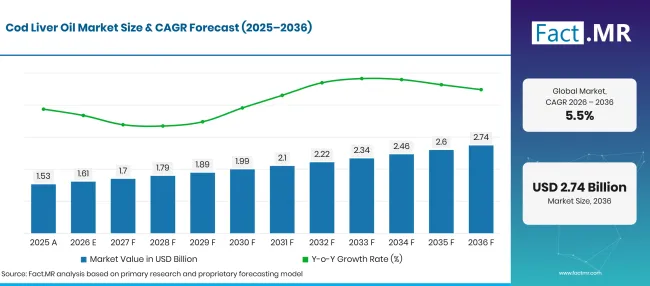
Factmr Cod Liver Oil Market Forecast Global | Source: Fact.MR
| Year | Basis | Market Value (USD billion) |
|---|---|---|
| 2025 | Historical estimate | 1.53 |
| 2026 | Estimate | 1.61 |
| 2036 | Forecast | 2.74 |
| CAGR 2026 to 2036 | Forecast period | 5.5% |
Source: Fact.MR analysis. Updated Oct 15, 2026
What are the defining numbers behind Cod Liver Oil Market growth?
USD 1.1 billion absolute opportunity from 2026 to 2036, led by dietary supplements and wild-caught oil.
- Demand Drivers in the Market
- Daily supplement users look for a combination of EPA and DHA and the fat-soluble vitamins found in cod liver oil. The NIH Office of Dietary Supplements distinguishes cod liver oil from regular fish oil because it also supplies vitamins A and D [1].
- Capsule buyers prefer measured portions and the absence of an oily taste, while liquid users can adjust a serving using the product instructions. Offering both types gives brands a practical route to households with different habits.
- Online shoppers compare the stated omega-3 amount per serving and review testing information before ordering. Brands that explain EPA and DHA content clearly make it easier to distinguish cod liver oil from other marine oils.
- Fish-oil processors require stable cod-liver supplies and careful handling between landing and refining.
- Key Segments Analyzed
- By Product Type: Liquid accounts for 35.2% share in 2026, reflecting established daily-dose use and flexible serving sizes.
- By Use: Dietary Supplements represent a 52.4% share in 2026, as customers purchase cod liver oil chiefly for nutritional use.
- By Sales Channel: Supermarkets/Hypermarkets account for 38.9% share in 2026, allowing shoppers to compare familiar packaged products.
- By Source: Wild-Caught oil holds 70.7% share in 2026, steady with the wild Arctic cod sourcing described by several direct suppliers.
- Analyst Opinion at Fact.MR
- Shambhu Nath Jha, Principal Consultant at Fact.MR, states, “Cod liver oil sits at the meeting point of traditional liquid supplementation and modern softgel shopping. Its value depends on the source of the oil and the stated vitamin content, not only the amount of omega-3 on a label. A research hypothesis for future primary interviews is that buyers who check both vitamins and purity records are more likely to remain with the same brand.”
- Strategic Implications
- Cod liver oil brands can make vitamin A and vitamin D levels easy to compare across different pack sizes so consumers can track their daily intake more easily.
- Processors benefit from keeping clear records for each batch and sharing sourcing information with brands that promote wild-caught fish oil.
- Retailers can present liquid and capsule products in separate sections while clearly showing serving counts alongside prices.
- Online sellers can provide full ingredient lists and supplement facts before purchase, especially for consumers who already use multivitamins.
United States sales are forecast to rise at a 7.0% CAGR, while Germany is projected to record 6.6%. Brazil follows at 6.3%, and Japan carries 5.6%. The United Kingdom is estimated to grow at 4.7%. These different rates reflect the market forecast rather than observed country sales statistics.
How does the Cod Liver Oil Market break down by segment?
Liquid 35.2%; Dietary Supplements 52.4%; Supermarkets/Hypermarkets 38.9%; Wild-Caught 70.7% in 2026.
Which Product Type dominates?
Liquid accounts for a 35.2% share in 2026.
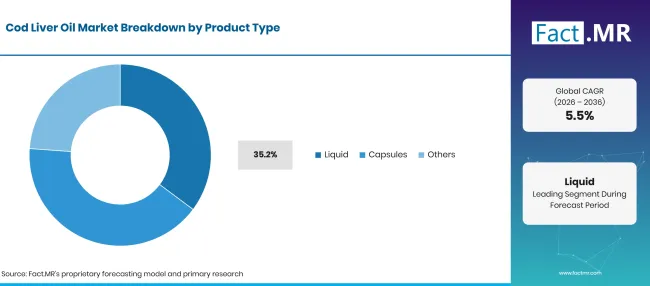
Factmr Cod Liver Oil Market Breakdown Product Type | Source: Fact.MR
| Product Type | Share (2026) |
|---|---|
| Liquid (Leading segment) | 35.2% |
| Other segments combined | 64.8% |
| Total | 100.0% |
Source: Fact.MR analysis. Updated Oct 15, 2026
Liquid cod liver oil is useful to shoppers who prefer a measured spoonful and can follow a familiar routine. Product taste and ease of storage still shape a repeat purchase. Capsules serve consumers who want a compact pack or prefer to avoid the taste of the oil. Other forms give brands limited room to serve different preferences without changing the underlying ingredient.
What leads the Application segment?
Dietary Supplements lead with 52.4% share in 2026.
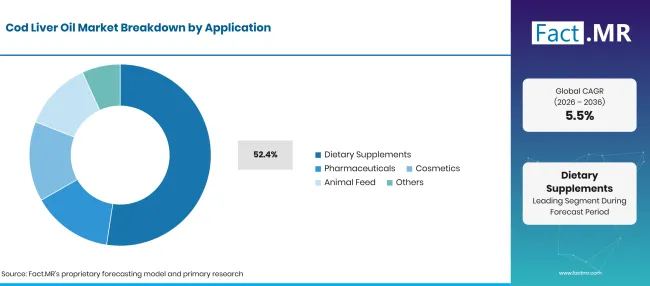
Factmr Cod Liver Oil Market Breakdown Application | Source: Fact.MR
| Application | Share (2026) |
|---|---|
| Dietary Supplements (Leading segment) | 52.4% |
| Other segments combined | 47.6% |
| Total | 100.0% |
Source: Fact.MR analysis. Updated Oct 15, 2026
Dietary supplements account for the main stated application because cod liver oil is sold with nutritional details about EPA and DHA. Its vitamin content also distinguishes it from conventional fish oil. Pharmaceutical use depends on the specification and applicable product rules, not simply on the oil being sold in a capsule. Cosmetic and animal-feed applications are separate commercial uses with different ingredient checks.
What leads the Sales Channel segment?
Supermarkets/Hypermarkets hold 38.9% share in 2026.
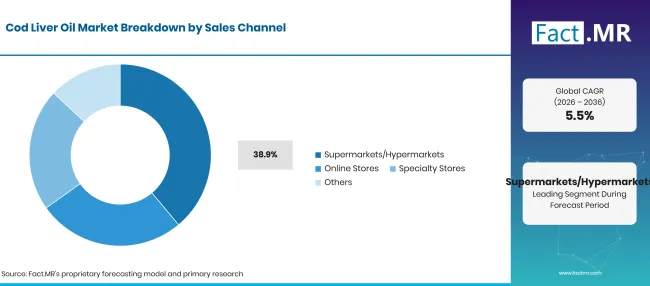
Factmr Cod Liver Oil Market Breakdown Sales Channel | Source: Fact.MR
| Sales Channel | Share (2026) |
|---|---|
| Supermarkets/Hypermarkets (Leading segment) | 38.9% |
| Other segments combined | 61.1% |
| Total | 100.0% |
Source: Fact.MR analysis. Updated Oct 15, 2026
During routine household shopping, supermarkets and hypermarkets allow the customer to compare bottle sizes and daily serving instructions. For one, online stores offer more product information and make it easier for customers who know what format they want to order again. Specialty stores remain related to shoppers seeking help comparing the oil with other omega-3 supplements.
What leads the Source segment?
Wild-Caught represents 70.7% share in 2026.
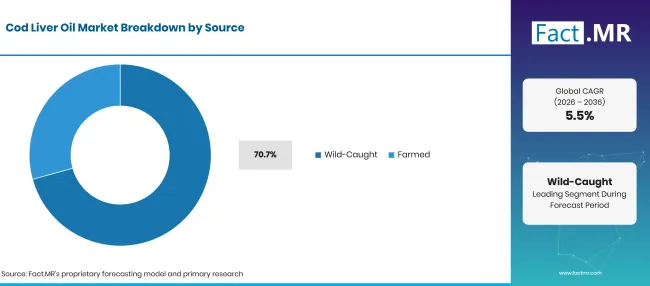
Factmr Cod Liver Oil Market Breakdown Source | Source: Fact.MR
| Source | Share (2026) |
|---|---|
| Wild-Caught (Leading segment) | 70.7% |
| Other segments combined | 29.3% |
| Total | 100.0% |
Source: Fact.MR analysis. Updated Oct 15, 2026
Wild-caught cod liver oil is the larger stated source segment, and direct suppliers describe sourcing Arctic cod from marine fisheries. Supply therefore depends on fishing operations and the handling of cod livers after landing. Farmed-source oil belongs to a different input arrangement and requires equally clear traceability.
What is accelerating Cod Liver Oil Market adoption, and what is holding it back?
Nutrient-rich supplement formats support sales; source quality and vitamin-label controls influence supplier choice.
Drivers Impact Analysis
| Driver | (~) % IMPACT ON CAGR | GEOGRAPHIC RELEVANCE | IMPACT TIMELINE |
|---|---|---|---|
| Interest in omega-3 supplementation | +1.0% | USA, Germany | Medium term (2–4 years) |
| Convenient capsule formats | +0.8% | Global | Short term (≤ 2 years) |
| Use of vitamin-containing marine oils | +0.7% | Europe, Japan | Medium term (2–4 years) |
| Product purity documentation | +0.6% | Global | Medium term (2–4 years) |
| Repeat retail purchasing | +0.4% | Global | Long term (≥ 4 years) |
Source: Fact.MR analysis. Updated Oct 15, 2026
Opportunity Impact Analysis
| Opportunity | (~) % IMPACT ON CAGR | GEOGRAPHIC RELEVANCE | IMPACT TIMELINE |
|---|---|---|---|
| Clear nutrient comparison | +0.7% | Global | Short term (≤ 2 years) |
| Traceable wild-caught sourcing | +0.6% | Europe, USA | Medium term (2–4 years) |
| Routine online reordering | +0.5% | USA, Japan | Medium term (2–4 years) |
| Different liquid flavors | +0.3% | Global | Short term (≤ 2 years) |
Source: Fact.MR analysis. Updated Oct 15, 2026
Restraints Impact Analysis
| Restraint | (~) % IMPACT ON CAGR | GEOGRAPHIC RELEVANCE | IMPACT TIMELINE |
|---|---|---|---|
| Variable raw-liver supply | -0.8% | North Atlantic supply chain | Medium term (2–4 years) |
| Testing and refining costs | -0.6% | Global | Short term (≤ 2 years) |
| Vitamin intake cautions | -0.5% | Global | Long term (≥ 4 years) |
| Taste and serving preferences | -0.3% | Global | Short term (≤ 2 years) |
Source: Fact.MR analysis. Updated Oct 15, 2026
Which countries are scaling the Cod Liver Oil Market through 2036?
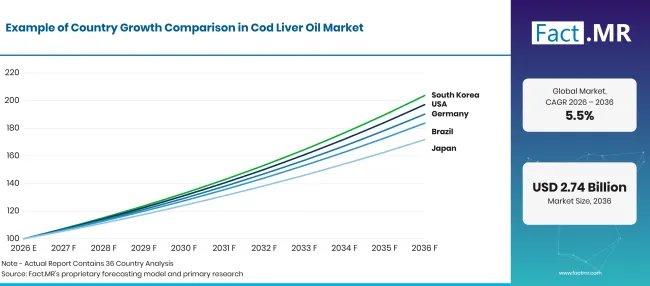
Factmr Cod Liver Oil Market Growth Index | Source: Fact.MR
| Country | CAGR (2026–2036) |
|---|---|
| United States | 7.0% |
| Germany | 6.6% |
| Brazil | 6.3% |
| Japan | 5.6% |
| United Kingdom | 4.7% |
Source: Fact.MR analysis. Updated Oct 15, 2026
What supports cod liver oil sales in the United States?
7.0% CAGR, linked to established supplement use and clearly labeled omega-3 and vitamin content.
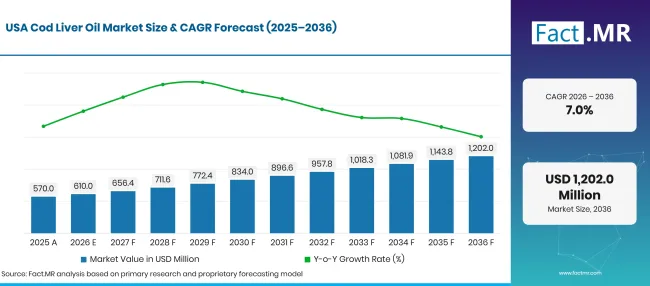
Factmr Cod Liver Oil Market Forecast Usa | Source: Fact.MR
U.S. consumers often compare cod liver oil products based on serving size, omega-3 content and the levels of vitamins A and D. According to the National Centre for Health Statistics, 60.2% of U.S. adults used dietary supplements during August 2021 to August 2023 [2]. Liquid oils and softgels fit different daily preferences and routines. Clear online product information also helps shoppers compare nutrient content before making repeat purchases.
Why is Germany an important cod liver oil market?
6.6% CAGR, supported by documented ingredients, retail comparison, and established supplement purchasing.
Germany's cod liver oil market is influenced by consumer interest in product quality and ingredient origin. Many buyers review vitamin content and serving information before making a purchase. Pharmacies continue to play a role in supplement sales, while online platforms help consumers compare products across brands. Clear sourcing details can help brands stand out in a competitive market.
What is shaping cod liver oil sales in Brazil?
6.3% CAGR, influenced by supplement retail controls and careful product identification.
Brazilian consumers buy cod liver oil in both capsule and liquid forms. Anvisa announced restrictions on dietary supplements from the Lirius and Natufab brands in November 2025 [3]. This has increased attention on product labeling and regulatory compliance across the supplement market. Distributors and retailers place importance on clear sourcing information, accurate labels and reliable batch records when selecting products for sale.
How is Japan developing cod liver oil demand?
5.6% CAGR, shaped by nutrient labeling, serving guidance, and supplement safety.
Japanese consumers often look at omega-3 levels, vitamin A and vitamin D content, and daily serving recommendations when choosing cod liver oil products. The Ministry of Health, Labour and Welfare published material for the 2025 Dietary Reference Intakes in February 2025 [4]. Clear labels help buyers understand nutrient content and recommended intake. They also make it easier to compare bottled oils and softgel products across different brands.
How is the United Kingdom developing cod liver oil sales?
4.7% CAGR, supported by established supplement routines and marine-source assurance.
UK consumers can choose cod liver oil in either liquid or capsule form depending on their daily preferences. The Marine Management Organisation reported 28 thousand tonnes of fish landings by UK vessels in June 2026 [5]. Many buyers check vitamin content, serving information and product source before making a purchase. Clear labeling and easy-to-read product details help consumers compare different brands and pack sizes.
Who leads the Cod Liver Oil Market?
Seven Seas offers cod liver oil products for daily supplement use, while Nordic Naturals sells Arctic Cod Liver Oil in both liquid and softgel formats. Carlson supplies cod liver oil sourced from Norwegian Arctic cod and highlights product testing for purity and strength.
NOW Foods offers cod liver oil softgels in different strengths, while Solgar sells cod liver oil supplements containing vitamins A and D. Rosita Real Foods focuses on traditionally sourced cod liver oil. Competition is largely based on ingredient source, product testing and clear labeling of oil content.
Which companies are the key providers?
Key companies include Seven Seas Limited (Procter & Gamble); Nordic Naturals; Carlson Laboratories; Lýsi hf.; Rosita Real Foods; NOW Foods; and Solgar (Nestlé Health Science).
- Seven Seas Limited (Procter & Gamble)
- Nordic Naturals
- Carlson Laboratories
- Lysi hf
- Rosita Real Foods
- Now Foods
- Solgar (Nestlé Health Science)
Bibliography
- [1] National Institutes of Health, Office of Dietary Supplements. (2024, December 17). Omega-3 fatty acids: Fact sheet for health professionals.
- [2] National Center for Health Statistics. (2026, May 21). Dietary supplement use: United States, August 2021–August 2023 (NCHS Data Brief No. 561).
- [3] Agência Nacional de Vigilância Sanitária. (2025, November 19). Proibidos suplementos alimentares das marcas Lirius e Natufab.
- [4] Ministry of Health, Labour and Welfare. (2025, February 5). 日本人の食事摂取基準(2025年版)スライド集について [Dietary Reference Intakes for Japanese (2025): Presentation materials].
- [5] Marine Management Organisation. (2026, July 31). Monthly Sea Fisheries Statistics June 2026.
This Report Answers
- The report examines why liquid cod liver oil remains a routine-use format alongside capsules.
- Application analysis separates dietary supplement use from pharmaceutical and other ingredient channels.
- Source comparison explains the importance of wild-caught origin and product traceability.
- Country analysis examines buyer habits and supplement controls across five national markets.
- Competitive analysis profiles cod liver oil products rather than broad fish-oil participation.
- Channel analysis assesses shelf comparison against online replenishment and specialist advice.
What does the Cod Liver Oil Market cover?
Cod liver oil consists of oil extracted from cod livers and sold for human nutrition or other specified uses. The wider fish oil category includes marine oils from several fish species and different tissues.
What is included in the scope?
Included products contain oil derived from cod liver and are assessed by format, end use, sales route, and source.
Finished supplements and bulk cod liver oil remain within scope, subject to local ingredient and labeling rules.
What is excluded from the scope?
The scope excludes generic fish oil extracted from other fish tissues when cod liver is not the ingredient.
Krill oil and algae-derived omega-3 products are separate sources. Sales of whole fish and ordinary seafood products are also excluded unless the transaction concerns a qualifying cod-liver-oil ingredient.
How Was the Analysis Built?
The analysis draws on 120+ sources, 35+ company portfolios, 25+ countries, and more than 20 industry interviews.
- Primary Research: Primary research includes discussions with manufacturers, service providers, technology developers, distributors, end users, and subject-matter experts. These conversations examine purchasing priorities, product adoption, operational challenges, approval requirements, competitive positioning, and the factors that influence wider market acceptance.
- Desk Research: Desk research covers government statistics, regulatory publications, company filings, trade data, technical studies, industry associations, standards, public policy, and other authoritative sources. Every source used in the analysis is documented in the bibliography.
- Market Sizing and Forecasting: Market estimates combine historical performance, demand indicators, pricing and volume trends, segment shares, company participation, country-level growth, adoption patterns, investment activity, and barriers to market expansion.
- Data Validation and Update Cycle: Findings are validated by comparing primary interviews with public data, company activity, regulatory changes, trade patterns, and industry developments. Regular updates review new product launches, capacity changes, partnerships, approvals, and shifts in commercial adoption.
Segmentation
What is the report’s scope and coverage?
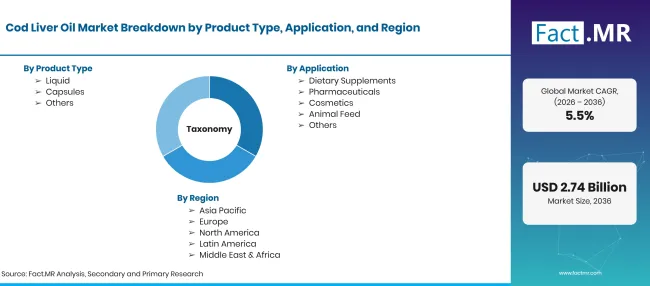
Factmr Cod Liver Oil Market Taxonomy | Source: Fact.MR
| Attribute | Details |
|---|---|
| Quantitative Units | USD billion |
| Market Definition | Oil extracted from cod liver, sold as a consumer supplement or as an ingredient for relevant applications. |
| Product Type | Liquid; Capsules; Others |
| Application | Dietary Supplements; Pharmaceuticals; Cosmetics; Animal Feed; Others |
| Sales Channel | Supermarkets/Hypermarkets; Online Stores; Specialty Stores; Others |
| Source | Wild-Caught; Farmed |
| Countries Covered | United States; Germany; Brazil; Japan; United Kingdom |
| Companies Profiled | Seven Seas Limited (Procter & Gamble); Nordic Naturals; Carlson Laboratories; Lýsi hf.; Rosita Real Foods; NOW Foods; and Solgar (Nestlé Health Science) |
| Forecast Period | 2026 to 2036 |
| Approach | Product composition, source traceability, retail formats, and supported institutional evidence |
Source: Fact.MR analysis. Updated Oct 15, 2026
How is the market segmented?
-
By Product Type:
- Liquid
- Capsules
- Others
-
By Application:
- Dietary Supplements
- Pharmaceuticals
- Cosmetics
- Animal Feed
- Others
-
By Sales Channel:
- Supermarkets/Hypermarkets
- Online Stores
- Specialty Stores
- Others
-
By Source:
- Wild-Caught
- Farmed
-
By Region:
- North America
- Latin America
- Western Europe
- Eastern Europe
- East Asia
- South Asia & Pacific
- Middle East & Africa
Frequently Asked Questions
How big is the Cod Liver Oil Market in 2026?
What is the CAGR of the Cod Liver Oil Market from 2026 to 2036?
Which product type leads the Cod Liver Oil Market?
Which application leads the Cod Liver Oil Market?
Who are the leading companies in the Cod Liver Oil Market?
Who worked on this report


Preview the report firsthand - request a free sample
Free SampleGet the brochure for pricing and purchase details
Download PDF