Coding and Marking Systems and Solutions Market Size, Share, Growth and Forecast (2026 - 2036)
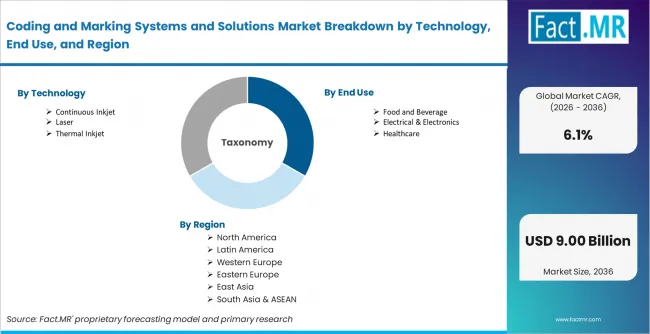
The Coding and Marking Systems and Solutions Market is segmented by Technology (Continuous Inkjet, Laser, Thermal Inkjet, Thermal Transfer Overprinting, Other Technologies), by End Use (Food & Beverages, Electrical & Electronics, Automotive & Aerospace, Healthcare, Other End Uses), by Offering (Printers & Coders, Consumables, Software & Services), by Substrate (Flexible Packaging, Rigid Plastic, Glass, Metal, Paper & Board), and by Sales Channel (Direct Sales, Distributor Sales, Online Sales) and Region. Forecast for 2026 to 2036.
Coding and Marking Systems and Solutions Market Size, Market Forecast and Outlook by Fact.MR
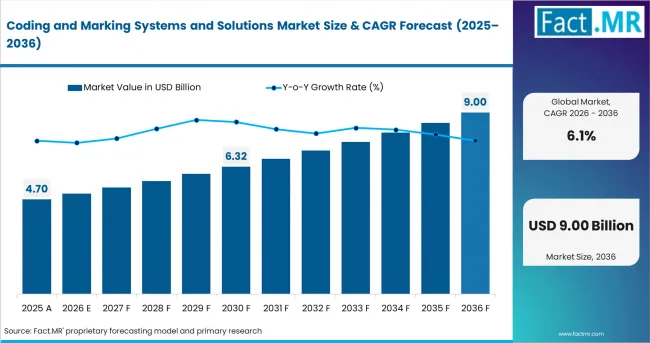
- The coding and marking systems and solutions market surpassed a value of USD 4.7 billion in 2025.
- Demand is estimated to reach USD 5.0 billion in 2026 and is projected to rise to USD 9.0 billion by 2036.
- The market is forecast to record 6.1% CAGR from 2026 to 2036 as product traceability and packaging-line automation expand in regulated manufacturing.
| Metric | Details |
|---|---|
| Industry Size 2026 | USD 5.0 billion |
| Industry Value 2036 | USD 9.0 billion |
| CAGR 2026 to 2036 | 6.1% |
Summary of Coding and Marking Systems and Solutions Market
- Demand Drivers in the Market
- Traceability Needs: Food and pharmaceutical manufacturers need clear batch and expiry codes for recall and audits.
- Line Uptime: Packaging engineers prefer printers that reduce stoppages and code rework.
- Anti-counterfeit Protection: Automotive and electronics producers use durable marks to protect part identity during inspections.
- Key Segments Analyzed
- By Technology: Continuous inkjet is expected to hold 42.0% share in 2026 as high-speed lines need non-contact printing across varied substrates.
- By End Use: Food & beverages are likely to account for 38.0% share in 2026 because packaged products require batch and shelf-life codes.
- By Offering: Printers & coders are projected to hold 51.0% share in 2026 since equipment selection controls print quality and uptime.
- By Substrate: Flexible packaging is anticipated to capture 34.0% share in 2026 as films and pouches need clean codes on moving lines.
- By Sales Channel: Direct sales are expected to hold 48.0% share in 2026 because large manufacturers need installation support and service contracts.
- By Geography: China is projected to record 7.0% CAGR through 2036 as packaged food and electronics output support coding demand.
- Analyst Opinion at Fact.MR
- Shambhu Nath Jha, Principal Consultant at Fact.MR, states, “Coding and marking demand is moving from simple pack marking to production control. Manufacturers need reliable code quality and proper data handling in one system. Suppliers that offer printer uptime with traceability software will gain better access to production lines.”
- Strategic Implications
- Printer Reliability: Suppliers need coding systems that keep print quality stable on fast packaging lines.
- Data Control: Manufacturers should connect printers with batch records and traceability systems for clear product tracking.
- Service Access: Local service support helps reduce downtime because production output needs quick repair and maintenance response.
Manufacturers are moving from basic date printing to coding systems connected with production lines. Quality managers need codes that stay readable during transport and handling. Packaging engineers need printers that work on flexible films and labels.
China is projected to record 7.0% CAGR through 2036 as packaged food and electronics production support coding demand. India is likely to post 6.8% CAGR as food processing and pharmaceutical packaging expand. The United States is expected to register 6.2% CAGR as traceability requirements support printer upgrades. Germany is poised to record 5.8% CAGR as automotive and industrial goods producers use durable marking. Japan is forecast to advance at 5.6% CAGR as manufacturers upgrade line-integrated systems.
Segmental Analysis
Coding and Marking Systems and Solutions Market Analysis by Technology
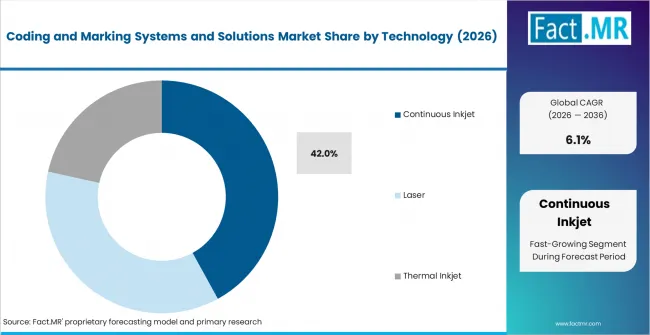
Continuous inkjet is expected to hold 42.0% share in 2026 as fast manufacturing lines need non-contact printing on different pack surfaces. The technology works well on curved and flexible packs with less line interruption. Laser systems are gaining use in applications that need permanent marks and low consumable use. Thermal inkjet printers support cartons and porous packaging with compact design. GS1 states that its General Specifications define how identification keys and barcodes are used in business applications. [1]
- CIJ Flexibility: Continuous inkjet prints fast codes on bottles and cartons across moving packaging lines.
- Laser Permanence: Laser marking creates durable codes on rigid packs and industrial parts that need long-term readability.
- TIJ Simplicity: Thermal inkjet supports clean carton printing with easier setup on paper-based packaging lines.
Coding and Marking Systems and Solutions Market Analysis by End Use
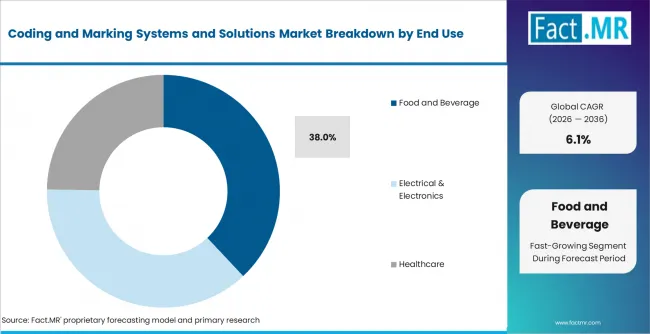
Food and beverage manufacturers need date and shelf-life codes on most packaged item. Pharmaceutical companies need tighter data control because serialization and product identity support compliance. Food & beverages are likely to account for 38.0% share in 2026 as packaged products require readable codes for recalls and retail handling. The FDA Food Traceability Rule creates additional recordkeeping requirements for foods on the Food Traceability List and supports faster removal of contaminated products from the market. [2]
- Food Coding: Food plants need batch and expiry codes that stay readable during distribution and retail handling.
- Pharma Traceability: Healthcare packaging needs reliable serialization and product identity marks for audits and patient safety.
- Part Identity: Automotive and electronics producers need durable component codes that stay readable during assembly and service checks.
Coding and Marking Systems and Solutions Market Analysis by Offering
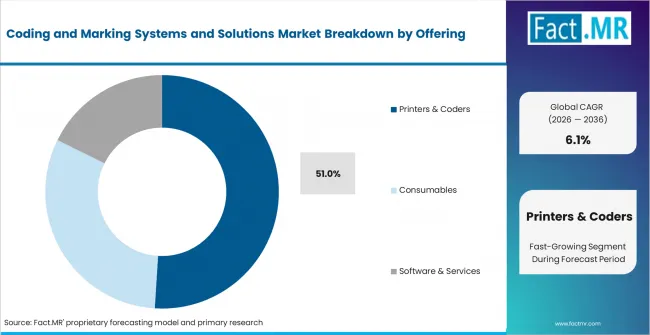
Equipment remains the main spending area because manufacturers first need printers and marking heads on production lines. Printers & coders are projected to hold 51.0% share in 2026 because hardware affects line speed and code quality. Inks and ribbons create repeat demand after installation. Software and services help manage codes and printer maintenance. Offering choice now depends on lifecycle cost and service response.
- Equipment Base: Printers and coders are central to each installation because every pack needs accurate product identification at speed.
- Consumable Pull: Inks and ribbons create repeat demand after equipment placement because codes need steady quality during daily production.
- Service Value: Maintenance and software help reduce coding errors and line downtime by keeping printers checked and ready.
Coding and Marking Systems and Solutions Market Analysis by Substrate
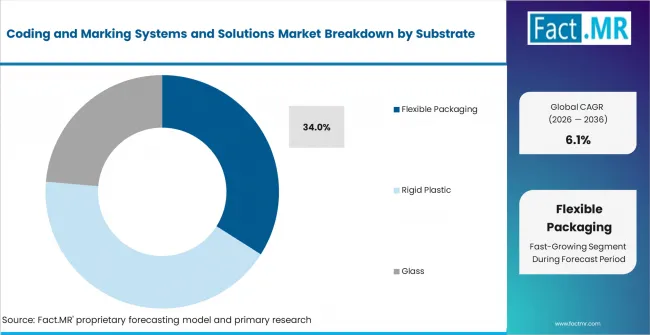
Flexible packaging is gaining share as food and healthcare products move toward pouches and films. Coding on film needs ink adhesion and print control because packs moves quickly through forming and sealing equipment. The substrate is anticipated to capture 34.0% share in 2026 as flexible packs need clean codes on high-speed lines. Videojet stated in 2024 that its V4234 ink is used for codes on flexible film and paper cartons. [3] Rigid plastic and glass remain important for beverages and personal care products. Metal substrates are used in automotive and industrial parts.
- Film Coding: Flexible packs need inks and lasers that keep codes readable on fast packaging lines and during distribution checks.
- Bottle Marking: Rigid plastic and glass containers need durable codes that resist handling and moisture during storage and movement.
- Carton Printing: Paper and board formats support box identification and logistics labels for inventory checks and shipment tracking.
Coding and Marking Systems and Solutions Market Analysis by Sales Channel
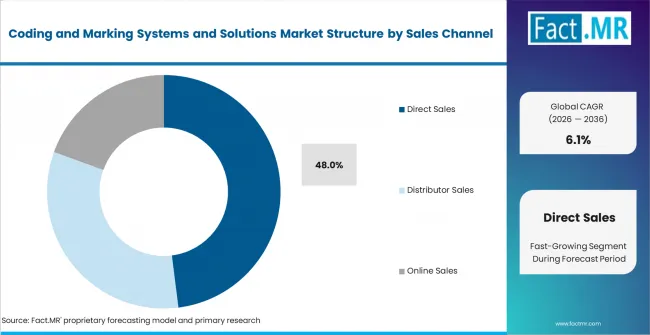
Large manufacturers prefer direct supplier links because coding equipment needs installation support and production-line validation. Distributor remain important for small manufacturers and regional service coverage. Direct sales are expected to hold 48.0% share in 2026 as major food and industrial accounts need service contracts. Online sales support spare parts and selected consumables. Domino launched new life sciences laser and inkjet solutions in 2025, including a high-resolution inkjet printer for variable data and 2D code applications. [4] Channel choice is based on technical support and response time.
- Direct Support: Large plants use direct sales because installation help and service support are important during setup and production.
- Distributor Reach: Regional distributors help smaller manufacturers access coding equipment with local guidance and faster service.
- Online Parts: Digital channels support repeat orders for consumables and spare parts during quick replacement needs.
Coding and Marking Systems and Solutions Market Drivers, Restraints, and Opportunities
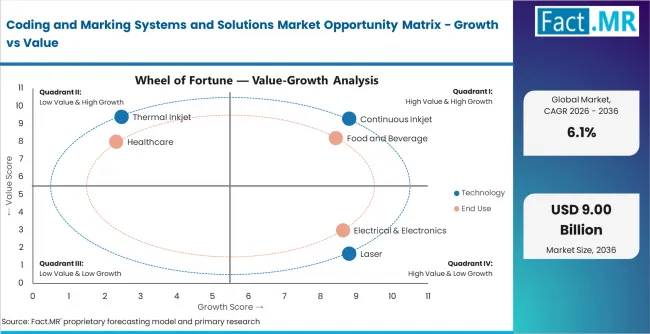
Traceability and recall readiness are the main drivers for coding and marking systems demand. Manufacturers need readable variable data on packs and shipping units for audits and recall checks. Regulated food and pharmaceutical plants need clear batch codes and serialization because code errors can delay product release.
High system cost can slow adoption among smaller manufacturers. Coding equipment needs proper installation and operator training. Plants must keep consumables and service support available. Smaller plants may keep manual methods if line speed is low.
Opportunities in the Coding and Marking Systems and Solutions Market
- 2D Code Printing: Suppliers can help manufacturers prepare for wider QR and GS1 Digital Link use on packaging lines and traceability program requirements.
- Laser Coding: Equipment makers can target applications that need permanent marks and lower consumable use on rigid packs and industrial parts.
- Code Management Software: Vendors can connect printers with batch records and line controls to reduce coding errors during changeovers and audits.
Regional Analysis
Based on regional analysis, the coding and marking systems and solutions market is segmented into North America, Latin America, Europe, East Asia, South Asia and Pacific, and Middle East and Africa.
.webp)
| Country | CAGR 2026 to 2036 |
|---|---|
| China | 7.0% |
| India | 6.8% |
| United States | 6.2% |
| Germany | 5.8% |
| Japan | 5.6% |
Source: Fact.MR analysis, based on forecast approach and primary research.
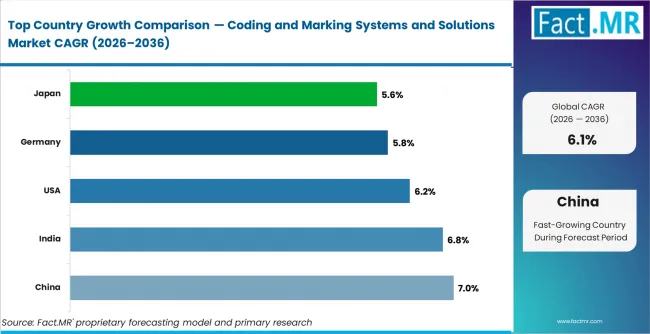
East Asia Coding and Marking Systems and Solutions Market Analysis
East Asia demand comes from packaged goods and export manufacturing. China and Japan support regional sales through food packaging lines and advanced manufacturing systems. Printers must handle fast lines and different pack substrates.
- China: China is projected to record 7.0% CAGR through 2036 as packaged food and electronics production support coding demand. Large factories need systems that print batch data and traceability marks at high speed. Flexible packaging and bottle coding be major demand areas. Domestic manufacturers will prefer cost-controlled equipment with local service.
- Japan: Japan coding demand is supported by high-quality manufacturing and replacement cycles. Food and healthcare plants need precise coding equipment for low-error production. Japan is forecast to advance at 5.6% CAGR over the study period as manufacturers upgrade line-integrated systems. Laser and thermal transfer systems can gain from applications that need clean codes and lower rework. Packaging plants will prefer systems with stable uptime and compact design. Service quality will matter because production disruption is costly.
South Asia and Pacific Coding and Marking Systems and Solutions Market Analysis
South Asia and Pacific demand is supported by India. Food processing and consumer goods packaging support coding equipment adoption. Manufacturers need readable codes for traceability and retail compliance.
- India: India is likely to post 6.8% CAGR through 2036 as food processing and pharmaceutical packaging expand. Packaged food firms need batch and expiry coding across pouches and bottles. Pharmaceutical manufacturers need serialization-ready systems for domestic and export packs. Local distributors will stay important for installation and maintenance. Demand will favor CIJ printers and laser coders. Suppliers with fast field service can gain more repeat accounts.
North America Coding and Marking Systems and Solutions Market Analysis
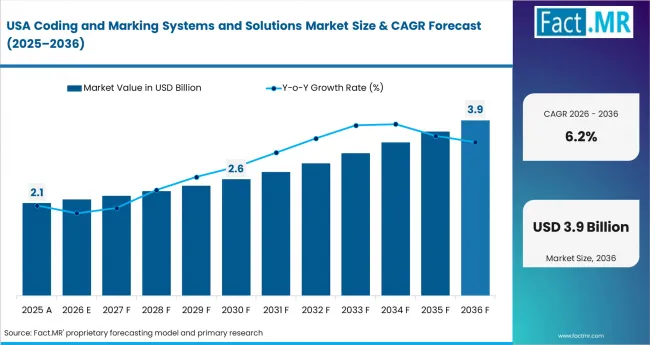
North America demand is led by the United States. Food safety and industrial part marking support printer replacement. Manufacturers need coding systems that connect with packaging line control.
- United States: The United States is expected to register 6.2% CAGR through 2036 as traceability needs support printer upgrades. Food processors need clear lot codes and production records. Pharmaceutical and healthcare packaging needs reliable serialization and barcode printing. Automotive and electronics firms use marking systems for part identity and anti-counterfeit control. Demand will favor suppliers with software support and wide service coverage.
Western Europe Coding and Marking Systems and Solutions Market Analysis
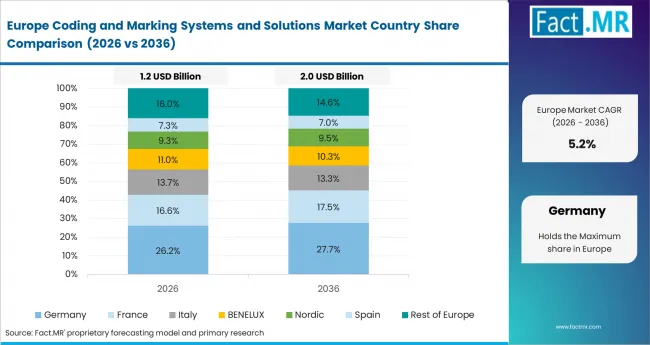
Western Europe demand is supported by manufacturing automation and product safety rules. Germany need durable coding for packaged goods and regulated products. Laser systems and code management tools are gaining attention.
- Germany: Germany is anticipated to record 5.8% CAGR by 2036 as automotive and industrial goods producers use durable marking. The country’s manufacturing base needs reliable part identification on components and packaging. EU product safety rules strengthen traceability duties for economic operators. German manufacturers will prefer coding systems that connect code quality with line control. Laser marking can gain in metal and plastic part applications.
Competitive Aligners for Market Suppliers
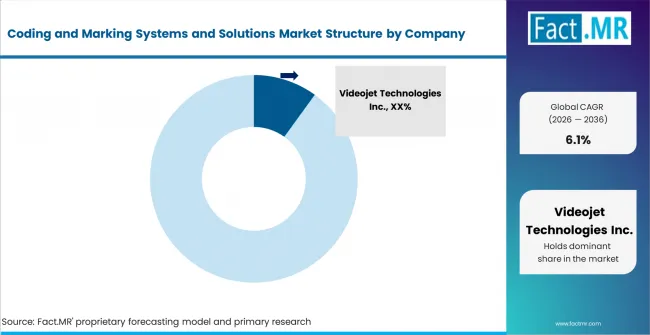
The coding and marking systems and solutions market includes industrial printer manufacturers and coding equipment suppliers. Videojet Technologies Inc. and Domino Printing Sciences plc serve the market through industrial coding systems. Markem-Imaje SAS and Linx Printing Technologies Ltd support marking needs across packaging lines. Hitachi Industrial Equipment Systems Co. Ltd. and Matthews Marking Systems are tied to coding equipment and related support services.
By 2036, suppliers with connected printers and code management software will gain better access to large manufacturing accounts. Food and pharmaceutical plants will prefer systems that reduce coding errors and support code quality checks. Smaller manufacturers will continue to use distributors for equipment support and consumables.
Key Companies in Coding and Marking Systems and Solutions Market
- Videojet Technologies Inc.
- Domino Printing Sciences plc
- Markem-Imaje SAS
- Linx Printing Technologies Ltd
- Hitachi Industrial Equipment Systems Co., Ltd.
- Matthews Marking Systems
Bibliography
- [1] GS1. (2026, January). GS1 General Specifications. GS1.
- [2] U.S. Food and Drug Administration. (2026, May). FSMA Final Rule on Requirements for Additional Traceability Records for Certain Foods.
- [3] Videojet Technologies Inc. (2024, April 24). Videojet introduces a new MEK-free ink for continuous inkjet printers.
- [4] Domino Printing Sciences. (2025, June 2). New Solutions for the Life Sciences Industry: Domino Expands Portfolio with New Innovative Products.
- [5] Statistics Bureau, Ministry of Internal Affairs and Communications. (2025, September). Statistical handbook of Japan 2025.
This Report Addresses
- Strategic intelligence on coding and marking systems and solutions demand across industrial production lines.
- Growth opportunity mapping across China, India, the United States, Germany and Japan.
- Segment analysis by technology, end use, offering, substrate and sales channel.
- Regional outlook covering packaging traceability, food and beverage coding, pharmaceutical serialization and electronics marking.
- Competitive analysis of Videojet Technologies Inc., Domino Printing Sciences plc, Markem-Imaje SAS, Linx Printing Technologies Ltd and Hitachi Industrial Equipment Systems Co., Ltd.
- Product assessment covering continuous inkjet printers, laser marking systems, thermal transfer printers, consumables and code management software.
- Primary interviews, supplier checks and official source review support validation.
Coding and Marking Systems and Solutions Market Definition
The coding and marking systems and solutions market covers industrial printers and related software used to place variable information on products or packaging. The market includes batch numbers and traceability marks used across manufacturing and packaging lines.
Coding and Marking Systems and Solutions Market Inclusions
The scope includes continuous inkjet printers and code management software. Coding and marking used on healthcare products and electronics are included.
Coding and Marking Systems and Solutions Market Exclusions
The scope excludes general office printers and office printing papers. It excludes decorative printing used only for branding artwork. Label stock sold without coding hardware or software is outside scope. General packaging machinery is excluded unless it includes coding or serialization functions.
Coding and Marking Systems and Solutions Market Research Methodology
- Primary Research
- Primary research includes interviews with packaging line managers and plant quality heads. Coding equipment distributors were reviewed separately.
- Desk Research
- Desk research reviews traceability standards and official product safety rules. Supplier product pages support technology validation.
- Market-Sizing and Forecasting
- Forecasting uses technology demand and end-use adoption. Offering mix, substrate use, and sales channel patterns support the forecast approach.
- Data Validation and Update Cycle
- Forecasts are validated through supplier checks and packaging line interviews. Regional assumptions are reviewed against packaged goods production and regulated labeling requirements.
Scope of the Report

| Attribute | Details |
|---|---|
| Quantitative Units | USD 5.0 billion in 2026 to USD 9.0 billion by 2036 at 6.1% CAGR |
| Market Definition | Industrial systems and solutions used to print variable product information on packaging and manufactured goods |
| Technology | Continuous Inkjet, Laser, Thermal Inkjet, Thermal Transfer Overprinting, Other Technologies |
| End Use | Food & Beverages, Electrical & Electronics, Automotive & Aerospace, Healthcare, Other End Uses |
| Offering | Printers & Coders, Consumables, Software & Services |
| Substrate | Flexible Packaging, Rigid Plastic, Glass, Metal, Paper & Board |
| Sales Channel | Direct Sales, Distributor Sales, Online Sales |
| Regions Covered | North America, Latin America, Europe, East Asia, South Asia and Pacific, Middle East and Africa |
| Countries Covered | China, India, United States, Germany, Japan |
| Key Companies Profiled | Videojet Technologies Inc., Domino Printing Sciences plc, Markem-Imaje SAS, Linx Printing Technologies Ltd, Hitachi Industrial Equipment Systems Co., Ltd., Matthews Marking Systems |
| Forecast Period | 2026 to 2036 |
| Approach | Hybrid top-down and bottom-up approach using technology demand, end-use uptake, offering mix, substrate use, and regional validation |
Coding and Marking Systems and Solutions Market Analysis by Segments
-
By Technology:
- Continuous Inkjet
- Laser
- Thermal Inkjet
- Thermal Transfer Overprinting
- Other Technologies
-
By End Use:
- Food & Beverages
- Electrical & Electronics
- Automotive & Aerospace
- Healthcare
- Other End Uses
-
By Offering:
- Printers & Coders
- Consumables
- Software & Services
-
By Substrate:
- Flexible Packaging
- Rigid Plastic
- Glass
- Metal
- Paper & Board
-
By Sales Channel:
- Direct Sales
- Distributor Sales
- Online Sales
-
Region:
- North America
- United States
- Canada
- Europe
- Germany
- France
- Italy
- Spain
- East Asia
- China
- Japan
- South Korea
- South Asia and Pacific
- India
- ASEAN
- Australia and New Zealand
- Latin America
- Brazil
- Mexico
- Argentina
- Middle East and Africa
- GCC Countries
- South Africa
- Turkey
- North America
- Frequently Asked Questions -
What is the Coding and Marking Systems and Solutions Market size in 2026?
The coding and marking systems and solutions market is estimated to reach USD 5.0 billion in 2026.
What will the Coding and Marking Systems and Solutions Market be worth by 2036?
The coding and marking systems and solutions market is projected to reach USD 9.0 billion by 2036.
What CAGR is projected for the Coding and Marking Systems and Solutions Market?
The coding and marking systems and solutions market is forecast to record 6.1% CAGR from 2026 to 2036.
Which technology leads the Coding and Marking Systems and Solutions Market?
Continuous inkjet leads with 42.0% share in 2026 as high-speed lines need non-contact printing across varied substrates.
Which country expands fastest in the Coding and Marking Systems and Solutions Market?
China is projected to record 7.0% CAGR through 2036 as packaged food and electronics production support coding demand.
How does India perform in the Coding and Marking Systems and Solutions Market?
India is likely to post 6.8% CAGR through 2036 as food processing and pharmaceutical packaging expand.
How does the United States perform in the Coding and Marking Systems and Solutions Market?
The United States is expected to register 6.2% CAGR by 2036 as traceability requirements support printer upgrades.
How does Germany perform in the Coding and Marking Systems and Solutions Market?
Germany is poised to record 5.8% CAGR from 2026 to 2036 as automotive and industrial producers use durable marking.
How does Japan perform in the Coding and Marking Systems and Solutions Market?
Japan is forecast to advance at 5.6% CAGR through 2036 as manufacturers upgrade line-integrated coding systems.
What is the main driver in the Coding and Marking Systems and Solutions Market?
The main driver is traceability because manufacturers need readable variable data on products and packs.
What is the main restraint in the Coding and Marking Systems and Solutions Market?
The main restraint is high system cost because equipment and service add to line investment.
Why is continuous inkjet important in this market?
Continuous inkjet is important because it supports fast non-contact printing on many package surfaces.
Why are food and beverages important for coding systems?
Food and beverage products need batch and shelf-life codes for recall control and retail handling.
Table of Content
- Executive Summary
- Global Market Outlook
- Demand to side Trends
- Supply to side Trends
- Technology Roadmap Analysis
- Analysis and Recommendations
- Market Overview
- Market Coverage / Taxonomy
- Market Definition / Scope / Limitations
- Research Methodology
- Chapter Orientation
- Analytical Lens and Working Hypotheses
- Market Structure, Signals, and Trend Drivers
- Benchmarking and Cross-market Comparability
- Market Sizing, Forecasting, and Opportunity Mapping
- Research Design and Evidence Framework
- Desk Research Programme (Secondary Evidence)
- Company Annual and Sustainability Reports
- Peer-reviewed Journals and Academic Literature
- Corporate Websites, Product Literature, and Technical Notes
- Earnings Decks and Investor Briefings
- Statutory Filings and Regulatory Disclosures
- Technical White Papers and Standards Notes
- Trade Journals, Industry Magazines, and Analyst Briefs
- Conference Proceedings, Webinars, and Seminar Materials
- Government Statistics Portals and Public Data Releases
- Press Releases and Reputable Media Coverage
- Specialist Newsletters and Curated Briefings
- Sector Databases and Reference Repositories
- Fact.MR Internal Proprietary Databases and Historical Market Datasets
- Subscription Datasets and Paid Sources
- Social Channels, Communities, and Digital Listening Inputs
- Additional Desk Sources
- Expert Input and Fieldwork (Primary Evidence)
- Primary Modes
- Qualitative Interviews and Expert Elicitation
- Quantitative Surveys and Structured Data Capture
- Blended Approach
- Why Primary Evidence is Used
- Field Techniques
- Interviews
- Surveys
- Focus Groups
- Observational and In-context Research
- Social and Community Interactions
- Stakeholder Universe Engaged
- C-suite Leaders
- Board Members
- Presidents and Vice Presidents
- R&D and Innovation Heads
- Technical Specialists
- Domain Subject-matter Experts
- Scientists
- Physicians and Other Healthcare Professionals
- Governance, Ethics, and Data Stewardship
- Drivers
- Restraints
- Opportunity
- Trends
- Scenario Forecast
- Demand in Optimistic Scenario
- Demand in Likely Scenario
- Demand in Conservative Scenario
- Opportunity Map Analysis
- Product Life Cycle Analysis
- Supply Chain Analysis
- Investment Feasibility Matrix
- Value Chain Analysis
- PESTLE and Porter’s Analysis
- Regulatory Landscape
- Regional Parent Market Outlook
- Production and Consumption Statistics
- Import and Export Statistics
- Primary Modes
- Global Market Analysis 2021 to 2025 and Forecast, 2026 to 2036
- Historical Market Size Value (USD Million) Analysis, 2021 to 2025
- Current and Future Market Size Value (USD Million) Projections, 2026 to 2036
- Y to o to Y Growth Trend Analysis
- Absolute $ Opportunity Analysis
- Global Market Pricing Analysis 2021 to 2025 and Forecast 2026 to 2036
- Global Market Analysis 2021 to 2025 and Forecast 2026 to 2036, By Technology
- Introduction / Key Findings
- Historical Market Size Value (USD Million) Analysis By Technology , 2021 to 2025
- Current and Future Market Size Value (USD Million) Analysis and Forecast By Technology , 2026 to 2036
- Continuous Inkjet
- Laser
- Thermal Inkjet
- Continuous Inkjet
- Y to o to Y Growth Trend Analysis By Technology , 2021 to 2025
- Absolute $ Opportunity Analysis By Technology , 2026 to 2036
- Global Market Analysis 2021 to 2025 and Forecast 2026 to 2036, By End Use
- Introduction / Key Findings
- Historical Market Size Value (USD Million) Analysis By End Use, 2021 to 2025
- Current and Future Market Size Value (USD Million) Analysis and Forecast By End Use, 2026 to 2036
- Food and Beverage
- Electrical & Electronics
- Healthcare
- Food and Beverage
- Y to o to Y Growth Trend Analysis By End Use, 2021 to 2025
- Absolute $ Opportunity Analysis By End Use, 2026 to 2036
- Global Market Analysis 2021 to 2025 and Forecast 2026 to 2036, By Offering
- Introduction / Key Findings
- Historical Market Size Value (USD Million) Analysis By Offering, 2021 to 2025
- Current and Future Market Size Value (USD Million) Analysis and Forecast By Offering, 2026 to 2036
- Printers & Coders
- Consumables
- Software & Services
- Printers & Coders
- Y to o to Y Growth Trend Analysis By Offering, 2021 to 2025
- Absolute $ Opportunity Analysis By Offering, 2026 to 2036
- Global Market Analysis 2021 to 2025 and Forecast 2026 to 2036, By Substrate
- Introduction / Key Findings
- Historical Market Size Value (USD Million) Analysis By Substrate, 2021 to 2025
- Current and Future Market Size Value (USD Million) Analysis and Forecast By Substrate, 2026 to 2036
- Flexible Packaging
- Rigid Plastic
- Glass
- Flexible Packaging
- Y to o to Y Growth Trend Analysis By Substrate, 2021 to 2025
- Absolute $ Opportunity Analysis By Substrate, 2026 to 2036
- Global Market Analysis 2021 to 2025 and Forecast 2026 to 2036, By Sales Channel
- Introduction / Key Findings
- Historical Market Size Value (USD Million) Analysis By Sales Channel, 2021 to 2025
- Current and Future Market Size Value (USD Million) Analysis and Forecast By Sales Channel, 2026 to 2036
- Direct Sales
- Distributor Sales
- Online Sales
- Direct Sales
- Y to o to Y Growth Trend Analysis By Sales Channel, 2021 to 2025
- Absolute $ Opportunity Analysis By Sales Channel, 2026 to 2036
- Global Market Analysis 2021 to 2025 and Forecast 2026 to 2036, By Region
- Introduction
- Historical Market Size Value (USD Million) Analysis By Region, 2021 to 2025
- Current Market Size Value (USD Million) Analysis and Forecast By Region, 2026 to 2036
- North America
- Latin America
- Western Europe
- Eastern Europe
- East Asia
- South Asia and Pacific
- Middle East & Africa
- Market Attractiveness Analysis By Region
- North America Market Analysis 2021 to 2025 and Forecast 2026 to 2036, By Country
- Historical Market Size Value (USD Million) Trend Analysis By Market Taxonomy, 2021 to 2025
- Market Size Value (USD Million) Forecast By Market Taxonomy, 2026 to 2036
- By Country
- USA
- Canada
- Mexico
- By Technology
- By End Use
- By Offering
- By Substrate
- By Sales Channel
- By Country
- Market Attractiveness Analysis
- By Country
- By Technology
- By End Use
- By Offering
- By Substrate
- By Sales Channel
- Key Takeaways
- Latin America Market Analysis 2021 to 2025 and Forecast 2026 to 2036, By Country
- Historical Market Size Value (USD Million) Trend Analysis By Market Taxonomy, 2021 to 2025
- Market Size Value (USD Million) Forecast By Market Taxonomy, 2026 to 2036
- By Country
- Brazil
- Chile
- Rest of Latin America
- By Technology
- By End Use
- By Offering
- By Substrate
- By Sales Channel
- By Country
- Market Attractiveness Analysis
- By Country
- By Technology
- By End Use
- By Offering
- By Substrate
- By Sales Channel
- Key Takeaways
- Western Europe Market Analysis 2021 to 2025 and Forecast 2026 to 2036, By Country
- Historical Market Size Value (USD Million) Trend Analysis By Market Taxonomy, 2021 to 2025
- Market Size Value (USD Million) Forecast By Market Taxonomy, 2026 to 2036
- By Country
- Germany
- UK
- Italy
- Spain
- France
- Nordic
- BENELUX
- Rest of Western Europe
- By Technology
- By End Use
- By Offering
- By Substrate
- By Sales Channel
- By Country
- Market Attractiveness Analysis
- By Country
- By Technology
- By End Use
- By Offering
- By Substrate
- By Sales Channel
- Key Takeaways
- Eastern Europe Market Analysis 2021 to 2025 and Forecast 2026 to 2036, By Country
- Historical Market Size Value (USD Million) Trend Analysis By Market Taxonomy, 2021 to 2025
- Market Size Value (USD Million) Forecast By Market Taxonomy, 2026 to 2036
- By Country
- Russia
- Poland
- Hungary
- Balkan & Baltic
- Rest of Eastern Europe
- By Technology
- By End Use
- By Offering
- By Substrate
- By Sales Channel
- By Country
- Market Attractiveness Analysis
- By Country
- By Technology
- By End Use
- By Offering
- By Substrate
- By Sales Channel
- Key Takeaways
- East Asia Market Analysis 2021 to 2025 and Forecast 2026 to 2036, By Country
- Historical Market Size Value (USD Million) Trend Analysis By Market Taxonomy, 2021 to 2025
- Market Size Value (USD Million) Forecast By Market Taxonomy, 2026 to 2036
- By Country
- China
- Japan
- South Korea
- By Technology
- By End Use
- By Offering
- By Substrate
- By Sales Channel
- By Country
- Market Attractiveness Analysis
- By Country
- By Technology
- By End Use
- By Offering
- By Substrate
- By Sales Channel
- Key Takeaways
- South Asia and Pacific Market Analysis 2021 to 2025 and Forecast 2026 to 2036, By Country
- Historical Market Size Value (USD Million) Trend Analysis By Market Taxonomy, 2021 to 2025
- Market Size Value (USD Million) Forecast By Market Taxonomy, 2026 to 2036
- By Country
- India
- ASEAN
- Australia & New Zealand
- Rest of South Asia and Pacific
- By Technology
- By End Use
- By Offering
- By Substrate
- By Sales Channel
- By Country
- Market Attractiveness Analysis
- By Country
- By Technology
- By End Use
- By Offering
- By Substrate
- By Sales Channel
- Key Takeaways
- Middle East & Africa Market Analysis 2021 to 2025 and Forecast 2026 to 2036, By Country
- Historical Market Size Value (USD Million) Trend Analysis By Market Taxonomy, 2021 to 2025
- Market Size Value (USD Million) Forecast By Market Taxonomy, 2026 to 2036
- By Country
- Kingdom of Saudi Arabia
- Other GCC Countries
- Turkiye
- South Africa
- Other African Union
- Rest of Middle East & Africa
- By Technology
- By End Use
- By Offering
- By Substrate
- By Sales Channel
- By Country
- Market Attractiveness Analysis
- By Country
- By Technology
- By End Use
- By Offering
- By Substrate
- By Sales Channel
- Key Takeaways
- Key Countries Market Analysis
- USA
- Pricing Analysis
- Market Share Analysis, 2025
- By Technology
- By End Use
- By Offering
- By Substrate
- By Sales Channel
- Canada
- Pricing Analysis
- Market Share Analysis, 2025
- By Technology
- By End Use
- By Offering
- By Substrate
- By Sales Channel
- Mexico
- Pricing Analysis
- Market Share Analysis, 2025
- By Technology
- By End Use
- By Offering
- By Substrate
- By Sales Channel
- Brazil
- Pricing Analysis
- Market Share Analysis, 2025
- By Technology
- By End Use
- By Offering
- By Substrate
- By Sales Channel
- Chile
- Pricing Analysis
- Market Share Analysis, 2025
- By Technology
- By End Use
- By Offering
- By Substrate
- By Sales Channel
- Germany
- Pricing Analysis
- Market Share Analysis, 2025
- By Technology
- By End Use
- By Offering
- By Substrate
- By Sales Channel
- UK
- Pricing Analysis
- Market Share Analysis, 2025
- By Technology
- By End Use
- By Offering
- By Substrate
- By Sales Channel
- Italy
- Pricing Analysis
- Market Share Analysis, 2025
- By Technology
- By End Use
- By Offering
- By Substrate
- By Sales Channel
- Spain
- Pricing Analysis
- Market Share Analysis, 2025
- By Technology
- By End Use
- By Offering
- By Substrate
- By Sales Channel
- France
- Pricing Analysis
- Market Share Analysis, 2025
- By Technology
- By End Use
- By Offering
- By Substrate
- By Sales Channel
- India
- Pricing Analysis
- Market Share Analysis, 2025
- By Technology
- By End Use
- By Offering
- By Substrate
- By Sales Channel
- ASEAN
- Pricing Analysis
- Market Share Analysis, 2025
- By Technology
- By End Use
- By Offering
- By Substrate
- By Sales Channel
- Australia & New Zealand
- Pricing Analysis
- Market Share Analysis, 2025
- By Technology
- By End Use
- By Offering
- By Substrate
- By Sales Channel
- China
- Pricing Analysis
- Market Share Analysis, 2025
- By Technology
- By End Use
- By Offering
- By Substrate
- By Sales Channel
- Japan
- Pricing Analysis
- Market Share Analysis, 2025
- By Technology
- By End Use
- By Offering
- By Substrate
- By Sales Channel
- South Korea
- Pricing Analysis
- Market Share Analysis, 2025
- By Technology
- By End Use
- By Offering
- By Substrate
- By Sales Channel
- Russia
- Pricing Analysis
- Market Share Analysis, 2025
- By Technology
- By End Use
- By Offering
- By Substrate
- By Sales Channel
- Poland
- Pricing Analysis
- Market Share Analysis, 2025
- By Technology
- By End Use
- By Offering
- By Substrate
- By Sales Channel
- Hungary
- Pricing Analysis
- Market Share Analysis, 2025
- By Technology
- By End Use
- By Offering
- By Substrate
- By Sales Channel
- Kingdom of Saudi Arabia
- Pricing Analysis
- Market Share Analysis, 2025
- By Technology
- By End Use
- By Offering
- By Substrate
- By Sales Channel
- Turkiye
- Pricing Analysis
- Market Share Analysis, 2025
- By Technology
- By End Use
- By Offering
- By Substrate
- By Sales Channel
- South Africa
- Pricing Analysis
- Market Share Analysis, 2025
- By Technology
- By End Use
- By Offering
- By Substrate
- By Sales Channel
- USA
- Market Structure Analysis
- Competition Dashboard
- Competition Benchmarking
- Market Share Analysis of Top Players
- By Regional
- By Technology
- By End Use
- By Offering
- By Substrate
- By Sales Channel
- Competition Analysis
- Competition Deep Dive
- Videojet Technologies Inc.
- Overview
- Product Portfolio
- Profitability by Market Segments (Product/Age /Sales Channel/Region)
- Sales Footprint
- Strategy Overview
- Marketing Strategy
- Product Strategy
- Channel Strategy
- Domino Printing Sciences plc
- Markem-Imaje SAS
- Linx Printing Technologies Ltd
- Hitachi Industrial Equipment Systems Co., Ltd.
- Matthews Marking Systems
- Videojet Technologies Inc.
- Competition Deep Dive
- Desk Research Programme (Secondary Evidence)
- Assumptions & Acronyms Used
List Of Table
- Table 1: Global Market Value (USD Million) Forecast by Region, 2021 to 2036
- Table 2: Global Market Value (USD Million) Forecast by Technology, 2021 to 2036
- Table 3: Global Market Value (USD Million) Forecast by End Use, 2021 to 2036
- Table 4: Global Market Value (USD Million) Forecast by Offering, 2021 to 2036
- Table 5: Global Market Value (USD Million) Forecast by Substrate, 2021 to 2036
- Table 6: Global Market Value (USD Million) Forecast by Sales Channel, 2021 to 2036
- Table 7: North America Market Value (USD Million) Forecast by Country, 2021 to 2036
- Table 8: North America Market Value (USD Million) Forecast by Technology, 2021 to 2036
- Table 9: North America Market Value (USD Million) Forecast by End Use, 2021 to 2036
- Table 10: North America Market Value (USD Million) Forecast by Offering, 2021 to 2036
- Table 11: North America Market Value (USD Million) Forecast by Substrate, 2021 to 2036
- Table 12: North America Market Value (USD Million) Forecast by Sales Channel, 2021 to 2036
- Table 13: Latin America Market Value (USD Million) Forecast by Country, 2021 to 2036
- Table 14: Latin America Market Value (USD Million) Forecast by Technology, 2021 to 2036
- Table 15: Latin America Market Value (USD Million) Forecast by End Use, 2021 to 2036
- Table 16: Latin America Market Value (USD Million) Forecast by Offering, 2021 to 2036
- Table 17: Latin America Market Value (USD Million) Forecast by Substrate, 2021 to 2036
- Table 18: Latin America Market Value (USD Million) Forecast by Sales Channel, 2021 to 2036
- Table 19: Western Europe Market Value (USD Million) Forecast by Country, 2021 to 2036
- Table 20: Western Europe Market Value (USD Million) Forecast by Technology, 2021 to 2036
- Table 21: Western Europe Market Value (USD Million) Forecast by End Use, 2021 to 2036
- Table 22: Western Europe Market Value (USD Million) Forecast by Offering, 2021 to 2036
- Table 23: Western Europe Market Value (USD Million) Forecast by Substrate, 2021 to 2036
- Table 24: Western Europe Market Value (USD Million) Forecast by Sales Channel, 2021 to 2036
- Table 25: Eastern Europe Market Value (USD Million) Forecast by Country, 2021 to 2036
- Table 26: Eastern Europe Market Value (USD Million) Forecast by Technology, 2021 to 2036
- Table 27: Eastern Europe Market Value (USD Million) Forecast by End Use, 2021 to 2036
- Table 28: Eastern Europe Market Value (USD Million) Forecast by Offering, 2021 to 2036
- Table 29: Eastern Europe Market Value (USD Million) Forecast by Substrate, 2021 to 2036
- Table 30: Eastern Europe Market Value (USD Million) Forecast by Sales Channel, 2021 to 2036
- Table 31: East Asia Market Value (USD Million) Forecast by Country, 2021 to 2036
- Table 32: East Asia Market Value (USD Million) Forecast by Technology, 2021 to 2036
- Table 33: East Asia Market Value (USD Million) Forecast by End Use, 2021 to 2036
- Table 34: East Asia Market Value (USD Million) Forecast by Offering, 2021 to 2036
- Table 35: East Asia Market Value (USD Million) Forecast by Substrate, 2021 to 2036
- Table 36: East Asia Market Value (USD Million) Forecast by Sales Channel, 2021 to 2036
- Table 37: South Asia and Pacific Market Value (USD Million) Forecast by Country, 2021 to 2036
- Table 38: South Asia and Pacific Market Value (USD Million) Forecast by Technology, 2021 to 2036
- Table 39: South Asia and Pacific Market Value (USD Million) Forecast by End Use, 2021 to 2036
- Table 40: South Asia and Pacific Market Value (USD Million) Forecast by Offering, 2021 to 2036
- Table 41: South Asia and Pacific Market Value (USD Million) Forecast by Substrate, 2021 to 2036
- Table 42: South Asia and Pacific Market Value (USD Million) Forecast by Sales Channel, 2021 to 2036
- Table 43: Middle East & Africa Market Value (USD Million) Forecast by Country, 2021 to 2036
- Table 44: Middle East & Africa Market Value (USD Million) Forecast by Technology, 2021 to 2036
- Table 45: Middle East & Africa Market Value (USD Million) Forecast by End Use, 2021 to 2036
- Table 46: Middle East & Africa Market Value (USD Million) Forecast by Offering, 2021 to 2036
- Table 47: Middle East & Africa Market Value (USD Million) Forecast by Substrate, 2021 to 2036
- Table 48: Middle East & Africa Market Value (USD Million) Forecast by Sales Channel, 2021 to 2036
List Of Figures
- Figure 1: Global Market Pricing Analysis
- Figure 2: Global Market Value (USD Million) Forecast 2021-2036
- Figure 3: Global Market Value Share and BPS Analysis by Technology, 2026 and 2036
- Figure 4: Global Market Y-o-Y Growth Comparison by Technology, 2026 to 2036
- Figure 5: Global Market Attractiveness Analysis by Technology
- Figure 6: Global Market Value Share and BPS Analysis by End Use, 2026 and 2036
- Figure 7: Global Market Y-o-Y Growth Comparison by End Use, 2026 to 2036
- Figure 8: Global Market Attractiveness Analysis by End Use
- Figure 9: Global Market Value Share and BPS Analysis by Offering, 2026 and 2036
- Figure 10: Global Market Y-o-Y Growth Comparison by Offering, 2026 to 2036
- Figure 11: Global Market Attractiveness Analysis by Offering
- Figure 12: Global Market Value Share and BPS Analysis by Substrate, 2026 and 2036
- Figure 13: Global Market Y-o-Y Growth Comparison by Substrate, 2026 to 2036
- Figure 14: Global Market Attractiveness Analysis by Substrate
- Figure 15: Global Market Value Share and BPS Analysis by Sales Channel, 2026 and 2036
- Figure 16: Global Market Y-o-Y Growth Comparison by Sales Channel, 2026 to 2036
- Figure 17: Global Market Attractiveness Analysis by Sales Channel
- Figure 18: Global Market Value (USD Million) Share and BPS Analysis by Region, 2026 and 2036
- Figure 19: Global Market Y-o-Y Growth Comparison by Region, 2026 to 2036
- Figure 20: Global Market Attractiveness Analysis by Region
- Figure 21: North America Market Incremental Dollar Opportunity, 2026 to 2036
- Figure 22: Latin America Market Incremental Dollar Opportunity, 2026 to 2036
- Figure 23: Western Europe Market Incremental Dollar Opportunity, 2026 to 2036
- Figure 24: Eastern Europe Market Incremental Dollar Opportunity, 2026 to 2036
- Figure 25: East Asia Market Incremental Dollar Opportunity, 2026 to 2036
- Figure 26: South Asia and Pacific Market Incremental Dollar Opportunity, 2026 to 2036
- Figure 27: Middle East & Africa Market Incremental Dollar Opportunity, 2026 to 2036
- Figure 28: North America Market Value Share and BPS Analysis by Country, 2026 and 2036
- Figure 29: North America Market Value Share and BPS Analysis by Technology, 2026 and 2036
- Figure 30: North America Market Y-o-Y Growth Comparison by Technology, 2026 to 2036
- Figure 31: North America Market Attractiveness Analysis by Technology
- Figure 32: North America Market Value Share and BPS Analysis by End Use, 2026 and 2036
- Figure 33: North America Market Y-o-Y Growth Comparison by End Use, 2026 to 2036
- Figure 34: North America Market Attractiveness Analysis by End Use
- Figure 35: North America Market Value Share and BPS Analysis by Offering, 2026 and 2036
- Figure 36: North America Market Y-o-Y Growth Comparison by Offering, 2026 to 2036
- Figure 37: North America Market Attractiveness Analysis by Offering
- Figure 38: North America Market Value Share and BPS Analysis by Substrate, 2026 and 2036
- Figure 39: North America Market Y-o-Y Growth Comparison by Substrate, 2026 to 2036
- Figure 40: North America Market Attractiveness Analysis by Substrate
- Figure 41: North America Market Value Share and BPS Analysis by Sales Channel, 2026 and 2036
- Figure 42: North America Market Y-o-Y Growth Comparison by Sales Channel, 2026 to 2036
- Figure 43: North America Market Attractiveness Analysis by Sales Channel
- Figure 44: Latin America Market Value Share and BPS Analysis by Country, 2026 and 2036
- Figure 45: Latin America Market Value Share and BPS Analysis by Technology, 2026 and 2036
- Figure 46: Latin America Market Y-o-Y Growth Comparison by Technology, 2026 to 2036
- Figure 47: Latin America Market Attractiveness Analysis by Technology
- Figure 48: Latin America Market Value Share and BPS Analysis by End Use, 2026 and 2036
- Figure 49: Latin America Market Y-o-Y Growth Comparison by End Use, 2026 to 2036
- Figure 50: Latin America Market Attractiveness Analysis by End Use
- Figure 51: Latin America Market Value Share and BPS Analysis by Offering, 2026 and 2036
- Figure 52: Latin America Market Y-o-Y Growth Comparison by Offering, 2026 to 2036
- Figure 53: Latin America Market Attractiveness Analysis by Offering
- Figure 54: Latin America Market Value Share and BPS Analysis by Substrate, 2026 and 2036
- Figure 55: Latin America Market Y-o-Y Growth Comparison by Substrate, 2026 to 2036
- Figure 56: Latin America Market Attractiveness Analysis by Substrate
- Figure 57: Latin America Market Value Share and BPS Analysis by Sales Channel, 2026 and 2036
- Figure 58: Latin America Market Y-o-Y Growth Comparison by Sales Channel, 2026 to 2036
- Figure 59: Latin America Market Attractiveness Analysis by Sales Channel
- Figure 60: Western Europe Market Value Share and BPS Analysis by Country, 2026 and 2036
- Figure 61: Western Europe Market Value Share and BPS Analysis by Technology, 2026 and 2036
- Figure 62: Western Europe Market Y-o-Y Growth Comparison by Technology, 2026 to 2036
- Figure 63: Western Europe Market Attractiveness Analysis by Technology
- Figure 64: Western Europe Market Value Share and BPS Analysis by End Use, 2026 and 2036
- Figure 65: Western Europe Market Y-o-Y Growth Comparison by End Use, 2026 to 2036
- Figure 66: Western Europe Market Attractiveness Analysis by End Use
- Figure 67: Western Europe Market Value Share and BPS Analysis by Offering, 2026 and 2036
- Figure 68: Western Europe Market Y-o-Y Growth Comparison by Offering, 2026 to 2036
- Figure 69: Western Europe Market Attractiveness Analysis by Offering
- Figure 70: Western Europe Market Value Share and BPS Analysis by Substrate, 2026 and 2036
- Figure 71: Western Europe Market Y-o-Y Growth Comparison by Substrate, 2026 to 2036
- Figure 72: Western Europe Market Attractiveness Analysis by Substrate
- Figure 73: Western Europe Market Value Share and BPS Analysis by Sales Channel, 2026 and 2036
- Figure 74: Western Europe Market Y-o-Y Growth Comparison by Sales Channel, 2026 to 2036
- Figure 75: Western Europe Market Attractiveness Analysis by Sales Channel
- Figure 76: Eastern Europe Market Value Share and BPS Analysis by Country, 2026 and 2036
- Figure 77: Eastern Europe Market Value Share and BPS Analysis by Technology, 2026 and 2036
- Figure 78: Eastern Europe Market Y-o-Y Growth Comparison by Technology, 2026 to 2036
- Figure 79: Eastern Europe Market Attractiveness Analysis by Technology
- Figure 80: Eastern Europe Market Value Share and BPS Analysis by End Use, 2026 and 2036
- Figure 81: Eastern Europe Market Y-o-Y Growth Comparison by End Use, 2026 to 2036
- Figure 82: Eastern Europe Market Attractiveness Analysis by End Use
- Figure 83: Eastern Europe Market Value Share and BPS Analysis by Offering, 2026 and 2036
- Figure 84: Eastern Europe Market Y-o-Y Growth Comparison by Offering, 2026 to 2036
- Figure 85: Eastern Europe Market Attractiveness Analysis by Offering
- Figure 86: Eastern Europe Market Value Share and BPS Analysis by Substrate, 2026 and 2036
- Figure 87: Eastern Europe Market Y-o-Y Growth Comparison by Substrate, 2026 to 2036
- Figure 88: Eastern Europe Market Attractiveness Analysis by Substrate
- Figure 89: Eastern Europe Market Value Share and BPS Analysis by Sales Channel, 2026 and 2036
- Figure 90: Eastern Europe Market Y-o-Y Growth Comparison by Sales Channel, 2026 to 2036
- Figure 91: Eastern Europe Market Attractiveness Analysis by Sales Channel
- Figure 92: East Asia Market Value Share and BPS Analysis by Country, 2026 and 2036
- Figure 93: East Asia Market Value Share and BPS Analysis by Technology, 2026 and 2036
- Figure 94: East Asia Market Y-o-Y Growth Comparison by Technology, 2026 to 2036
- Figure 95: East Asia Market Attractiveness Analysis by Technology
- Figure 96: East Asia Market Value Share and BPS Analysis by End Use, 2026 and 2036
- Figure 97: East Asia Market Y-o-Y Growth Comparison by End Use, 2026 to 2036
- Figure 98: East Asia Market Attractiveness Analysis by End Use
- Figure 99: East Asia Market Value Share and BPS Analysis by Offering, 2026 and 2036
- Figure 100: East Asia Market Y-o-Y Growth Comparison by Offering, 2026 to 2036
- Figure 101: East Asia Market Attractiveness Analysis by Offering
- Figure 102: East Asia Market Value Share and BPS Analysis by Substrate, 2026 and 2036
- Figure 103: East Asia Market Y-o-Y Growth Comparison by Substrate, 2026 to 2036
- Figure 104: East Asia Market Attractiveness Analysis by Substrate
- Figure 105: East Asia Market Value Share and BPS Analysis by Sales Channel, 2026 and 2036
- Figure 106: East Asia Market Y-o-Y Growth Comparison by Sales Channel, 2026 to 2036
- Figure 107: East Asia Market Attractiveness Analysis by Sales Channel
- Figure 108: South Asia and Pacific Market Value Share and BPS Analysis by Country, 2026 and 2036
- Figure 109: South Asia and Pacific Market Value Share and BPS Analysis by Technology, 2026 and 2036
- Figure 110: South Asia and Pacific Market Y-o-Y Growth Comparison by Technology, 2026 to 2036
- Figure 111: South Asia and Pacific Market Attractiveness Analysis by Technology
- Figure 112: South Asia and Pacific Market Value Share and BPS Analysis by End Use, 2026 and 2036
- Figure 113: South Asia and Pacific Market Y-o-Y Growth Comparison by End Use, 2026 to 2036
- Figure 114: South Asia and Pacific Market Attractiveness Analysis by End Use
- Figure 115: South Asia and Pacific Market Value Share and BPS Analysis by Offering, 2026 and 2036
- Figure 116: South Asia and Pacific Market Y-o-Y Growth Comparison by Offering, 2026 to 2036
- Figure 117: South Asia and Pacific Market Attractiveness Analysis by Offering
- Figure 118: South Asia and Pacific Market Value Share and BPS Analysis by Substrate, 2026 and 2036
- Figure 119: South Asia and Pacific Market Y-o-Y Growth Comparison by Substrate, 2026 to 2036
- Figure 120: South Asia and Pacific Market Attractiveness Analysis by Substrate
- Figure 121: South Asia and Pacific Market Value Share and BPS Analysis by Sales Channel, 2026 and 2036
- Figure 122: South Asia and Pacific Market Y-o-Y Growth Comparison by Sales Channel, 2026 to 2036
- Figure 123: South Asia and Pacific Market Attractiveness Analysis by Sales Channel
- Figure 124: Middle East & Africa Market Value Share and BPS Analysis by Country, 2026 and 2036
- Figure 125: Middle East & Africa Market Value Share and BPS Analysis by Technology, 2026 and 2036
- Figure 126: Middle East & Africa Market Y-o-Y Growth Comparison by Technology, 2026 to 2036
- Figure 127: Middle East & Africa Market Attractiveness Analysis by Technology
- Figure 128: Middle East & Africa Market Value Share and BPS Analysis by End Use, 2026 and 2036
- Figure 129: Middle East & Africa Market Y-o-Y Growth Comparison by End Use, 2026 to 2036
- Figure 130: Middle East & Africa Market Attractiveness Analysis by End Use
- Figure 131: Middle East & Africa Market Value Share and BPS Analysis by Offering, 2026 and 2036
- Figure 132: Middle East & Africa Market Y-o-Y Growth Comparison by Offering, 2026 to 2036
- Figure 133: Middle East & Africa Market Attractiveness Analysis by Offering
- Figure 134: Middle East & Africa Market Value Share and BPS Analysis by Substrate, 2026 and 2036
- Figure 135: Middle East & Africa Market Y-o-Y Growth Comparison by Substrate, 2026 to 2036
- Figure 136: Middle East & Africa Market Attractiveness Analysis by Substrate
- Figure 137: Middle East & Africa Market Value Share and BPS Analysis by Sales Channel, 2026 and 2036
- Figure 138: Middle East & Africa Market Y-o-Y Growth Comparison by Sales Channel, 2026 to 2036
- Figure 139: Middle East & Africa Market Attractiveness Analysis by Sales Channel
- Figure 140: Global Market - Tier Structure Analysis
- Figure 141: Global Market - Company Share Analysis