- Base Value(2025): 83.0 Bn
- Estimated Value(2026): 85.8 Bn
- Forecast Value (2036): 119.9 Bn
- CAGR (2026 - 2036): 3.4%
Coil Wound Device Market Analysis and Forecast by Fact.MR
- The global coil wound device market comprises electromagnetic components that are manufactured by winding wires such as transformers, inductors, chokes, solenoids, and electromagnetic coils.
- These devices have applications in power distribution, electronics, automotive, telecommunications, and industrial sectors.
- This includes power transformers, distribution transformers, signal inductors, power inductors and specialty coil-wound devices.
- These devices employ electromagnetic core, winding, insulation and termination technologies to achieve voltage conversion, energy storage, signal filtering and electromagnetic actuation.
- Demand is driven by power grid expansion, electronics miniaturization, electric vehicle adoption, renewable energy integration and telecommunications infrastructure investment.
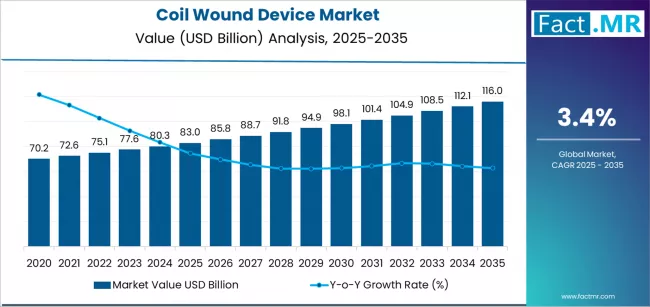
Coil Wound Device Market Market Value Analysis | Source: Fact.MR
Summary of Coil Wound Device Market
- Market Snapshot
- The global market for coil wound devices was valued at approximately USD 83.0 billion in 2025.
- The market is anticipated to reach USD 85.82 billion in 2026 and is expected to reach USD 119.9 billion by 2036.
- The coil wound device market is anticipated to grow at a CAGR of 3.4% during the forecast period.
- The market is anticipated to create an absolute $ opportunity of USD 34.07 billion during the forecast period 2026-2036.
- Power transformers account for 52% of the product share in 2026.
- The key growth markets during the forecast period are India (5%) and China (4%).
- Demand and Growth Drivers
- Distribution and power transformers is the largest value segment in the coil wound device market. Increasing power grid expansion and modernization is driving the sustained demand for distribution and power transformers.
- Demand for small inductors, chokes and transformers for consumer equipment, data center power supplies and telecommunications equipment is being driven by electronics miniaturization.
- With the growth of electric vehicle production, the need for high frequency transformers, inductors and coil wound components in onboard chargers, DC-DC converters and battery management systems is on the rise.
- Specialized transformers and inductors are needed for renewable energy integration such as solar inverters and wind turbine power conversion and grid interconnection equipment.
- Investment in telecommunications infrastructure including 5G base stations, fiber network equipment and data center power systems is driving demand for high performance coil wound components.
- Product and Segment View
- Power Transformers account for 52% of the product segment in 2026, supported by broad applicability and established installed base across core end-use verticals.
- Power Distribution and Grid represents 58% of the application segment in 2026, with demand shaped by institutional procurement, regulatory requirements, and expanding professional adoption.
- Copper Winding Technology accounts for 64% of the technology segment, reflecting its established position as the standard operational approach.
- Key segmentation includes:
- Product: Power Transformers, Distribution Transformers, Signal Inductors, Power Inductors, Specialty Coil Wound Components
- Application: Power Distribution and Grid, Electronics and Telecom, Automotive and EV, Renewable Energy, Industrial Equipment
- Distribution Channel: Direct Sales, Distributors, OEM Supply Chains, Aftermarket Services
- These systems enable:
- Measurement, monitoring, or control functions across distributed operational environments.
- Remote management and data integration through connected platforms.
- Performance optimization in applications where precision and reliability are primary procurement criteria.
- Geography and Competitive Outlook
- Demand in North America remains stable, supported by established end use verticals, replacement cycles and technology upgrade activity.
- Regulatory compliance, modernization of processes, and increasing professional adoption are driving steady growth in Europe.
- Demand in Asia Pacific is outpacing other regions, with India (5%) and China (4%) leading the charge.
- Key companies are ABB, Siemens Energy, Schneider, TDK, Vishay, Murata, Panasonic, Sumida.
- Analyst Opinion
- Shambhu Nath Jha, Principal Consultant at Fact.MR, says 'The coil wound device market is structurally tied to electrification, digitization, and grid infrastructure investment. Transformers dominate because every unit of electrical energy generated, transmitted, or consumed passes through multiple transformer stages. Power distribution and grid modernization account for the largest demand because transformer replacement cycles and grid expansion programs operate on multi-decade timelines with predictable procurement volumes. India and China are growing fastest because both countries are simultaneously expanding grid infrastructure, scaling electronics production, and accelerating electric vehicle adoption. The market is evolving toward higher-frequency, more compact designs driven by power electronics advancement, but traditional copper-wound transformers will remain the volume backbone for decades.'
Key Growth Drivers, Constraints, and Opportunities
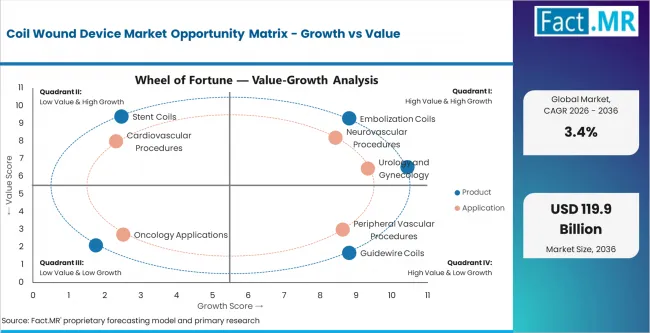
Coil Wound Device Market Opportunity Matrix Growth Vs Value | Source: Fact.MR
Key Factors Driving Growth
- Power grid expansion and transformer replacement programs are generating the largest and most predictable demand volume for coil wound devices globally.
- Electronics production growth is expanding procurement of compact inductors and transformers for consumer, automotive, and industrial power supply applications.
- Electric vehicle production scale-up is driving demand for high-frequency coil wound components in power conversion and battery management systems.
Key Market Constraints
- Copper price volatility directly affects manufacturing costs for coil wound devices and can squeeze margins in high commodity price environments.
- In mature markets, the availability of skilled winding operators is decreasing leading to increased labor costs and constraining the ability to scale production of custom and specialty coils.
- Planar and printed magnetics are gaining traction in high frequency, low power applications where traditional wound components are at a disadvantage in size and weight.
Key Opportunity Areas
- Grid modernization and smart grid investment in developed markets is driving replacement demand for aging transformer fleets with higher-efficiency, lower-loss designs.
- The transition to wide-bandgap semiconductors (SiC, GaN) in power electronics is creating a demand for coil wound components designed for higher switching frequencies and lower losses.
- Expansion of data center power infrastructure is generating sustained demand for high-efficiency transformers, inductors and power conversion components.
Segment-wise Analysis of the Coil Wound Device Market
- Power Transformers are expected to account for 52% of the product segment in 2026, owing to their wide applicability, low complexity, and continued use across the largest end-use verticals.
- Institutional demand, regulatory mandates and professional adoption will be the key demand drivers, with the Power Distribution and Grid segment accounting for 58% of the application segment in 2026.
- Copper Winding Technology makes up 64% of the technology segment, indicating its well-established operational role and large installed base.
The coil wound device market is segmented on the basis of product, application, end use, technology, distribution channel and region. The report includes a market overview of Power Transformers, Distribution Transformers, Signal Inductors, Power Inductors, Specialty Coil Wound Components by product. Application Coverage includes Power Distribution & Grid, Electronics & Telecom, Automotive & EV, Renewable Energy, Industrial Equipment. Power Transformers is the leader in terms of value in the immediate term due to their installed base and wide applicability while emerging segments are expected to drive the next phase of growth as the requirements evolve.
Which Product Segment Dominates the Coil Wound Device Market?
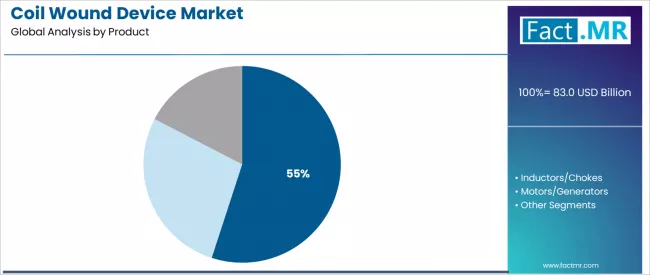
Coil Wound Device Market Analysis By Product | Source: Fact.MR
Power transformers and distribution transformers are expected to account for 52.0% of the product type segment in 2026. Their leadership reflects the fundamental role of transformers in every stage of electrical power generation, transmission, distribution, and end-use conversion. Transformers represent the highest-value and most volume-intensive category in the coil wound device market. Inductors and chokes hold the second-largest share, with demand driven by high-volume electronics production, power supply filtering, and the growing content per unit in electric vehicles, data center equipment, and telecommunications infrastructure.
Which Application Segment Dominates the Coil Wound Device Market?
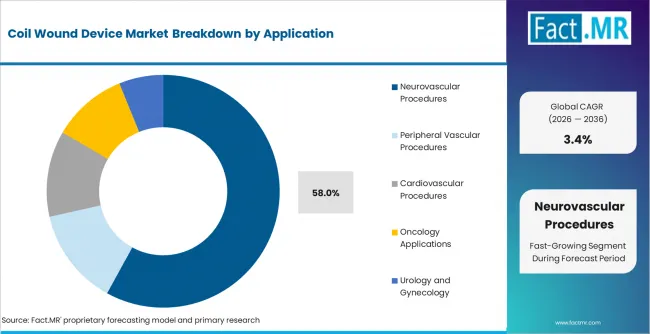
Coil Wound Device Market Analysis By Application | Source: Fact.MR
Power distribution and grid infrastructure is projected to be the largest application segment in 2026. This is indicative of the size of transformers procured across utility scale generation, transmission networks and distribution substations along with industrial and commercial power delivery requirements. Grid infrastructure has the most predictable long-cycle procurement pattern in the marketplace.
Electronics and telecommunications is the second largest application, with demand driven by the proliferation of power supplies, converters, and filtering components in consumer electronics, data center equipment, base stations, and industrial controls.
Which Product Trend is Shaping the Next Phase of Growth in the Coil Wound Device Market?
The fastest growing design trend in the market is for high-frequency coil wound components optimized for wide-bandgap power electronics, but they are not the biggest product category yet. Their share will probably grow as silicon carbide and gallium nitride power semiconductors drive demand for inductors and transformers that efficiently operate at higher switching frequencies.
This move to high frequency designs is a structural change in the power conversion architecture. Smaller, lighter and more efficient power stages demand coil wound components with lower core losses, optimized winding configurations and thermal management adequate for higher operating temperatures. The manufacturers who are investing in advanced core materials, litz wire and automated high-frequency winding capability are best placed to capture the next wave of design wins in EV, data center and renewable energy power electronics.
Regional Outlook Across Key Markets
.webp "Top Country Growth Comparison Coil Wound Device Market Cagr (2026 2036)")
Top Country Growth Comparison Coil Wound Device Market Cagr (2026 2036) | Source: Fact.MR
- India is leading the growth at 5%, driven by expanding domestic demand, infrastructure investment and policy-led adoption.
- North America is mixed, with the U.S. at 3% as a mature market with established replacement cycles and technology upgrade activity.
- Demand in Europe continues to be strong at 3.2%, led by Germany, driven by regulatory compliance, process modernization and quality-driven procurement.
CAGR Table
| Country | CAGR (%) |
|---|---|
| India | 5% |
| China | 4% |
| Mexico | 3.3% |
| Germany | 3.2% |
| USA | 3% |
| South Korea | 2.9% |
| Japan | 2.5% |
Source: Fact.MR analysis. Updated May 21, 2026
Source: Fact MR (FMR) analysis, based on proprietary forecasting model and primary research.
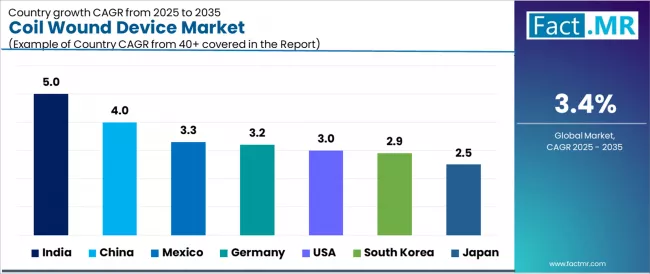
Coil Wound Device Market Cagr Analysis By Country | Source: Fact.MR
Market Outlook for Coil Wound Devices in India
The India coil wound device market is projected to grow at a CAGR of 5.0% through 2036. Demand is shaped by grid expansion, transformer procurement programs, electronics production growth, and electric vehicle adoption.
- Grid expansion programs drive the largest transformer procurement volumes.
- Electronics production growth supports inductor and component demand.
- Electric vehicle adoption generates new demand for power conversion components.
China Coil Wound Device Demand Trends
The China coil wound device market is projected to grow at a CAGR of 4.0% through 2036. Demand is supported by power grid investment, electronics manufacturing scale, EV production, and renewable energy infrastructure.
- Power grid investment generates sustained transformer demand.
- Electronics manufacturing scale drives high-volume inductor procurement.
- EV and renewable energy expansion creates new component requirements.
Mexico Coil Wound Device Growth Assessment
The Mexico coil wound device market is projected to grow at a CAGR of 3.3% through 2036. Demand is supported by nearshoring electronics assembly, grid infrastructure investment, and automotive production expansion.
- Nearshoring electronics assembly drives component procurement.
- Grid infrastructure investment sustains transformer demand.
- Automotive production expansion supports power conversion component needs.
Germany Coil Wound Device Market Demand Analysis
The Germany coil wound device market is projected to grow at a CAGR of 3.2% through 2036. Demand is supported by industrial equipment production, renewable energy integration, and EV power electronics requirements.
- Industrial equipment production sustains transformer and inductor demand.
- Renewable energy integration drives specialized component procurement.
- EV power electronics requirements generate high-frequency component demand.
United States Coil Wound Device Market Outlook
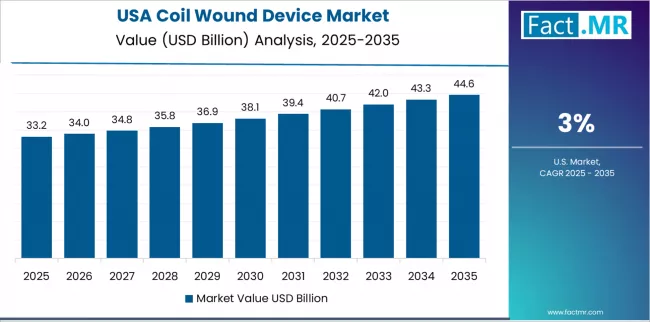
Coil Wound Device Market Country Value Analysis | Source: Fact.MR
The U.S. coil wound device market is projected to grow at a CAGR of 3.0% through 2036. Demand is supported by grid modernization, data center expansion, EV infrastructure, and defense electronics procurement.
- Grid modernization drives transformer replacement procurement.
- Data center expansion generates power conversion component demand.
- Defense electronics procurement supports specialty coil wound device demand.
Japan Coil Wound Device Growth Outlook
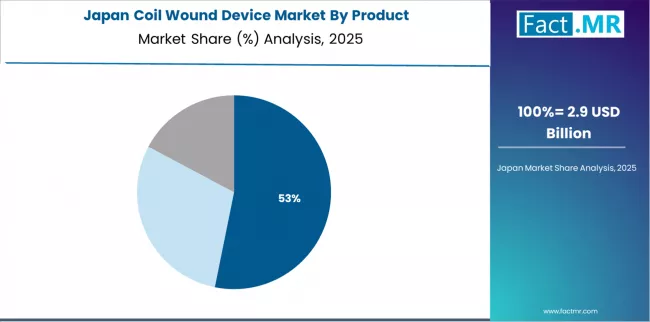
Coil Wound Device Market Japan Market Share Analysis By Product | Source: Fact.MR
The Japan coil wound device market is projected to grow at a CAGR of 2.5% through 2036. Demand is shaped by electronics production, automotive electrification, and precision industrial equipment requirements.
- Electronics production sustains compact inductor and transformer demand.
- Automotive electrification drives power conversion component procurement.
- Precision equipment requirements support high-quality component specification.
Competitive Benchmarking and Company Positioning
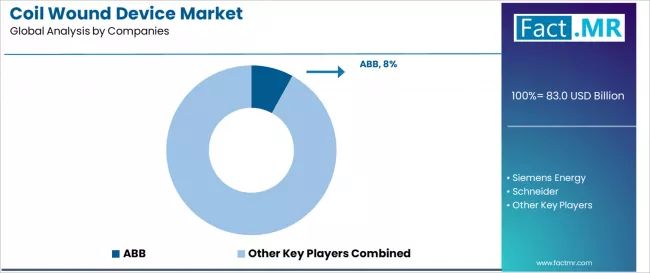
Coil Wound Device Market Analysis By Company | Source: Fact.MR
Coil Wound Device Market Analysis By Company
- ABB, Siemens Energy, Schneider, and TDK hold strong positions in the global coil wound device market through comprehensive product portfolios spanning power transformers, distribution transformers, inductors, and electronic components, supported by global manufacturing and distribution infrastructure.
- Vishay, Murata, Panasonic, and Sumida compete strongly in electronic inductor and transformer segments, with positioning shaped by miniaturization capability, high-volume production capacity, and established positions in consumer electronics and automotive supply chains.
- Competition across the transformer segment is shaped by manufacturing scale, copper procurement efficiency, and project execution capability, while the electronic component segment is defined by automation capacity, design library breadth, and OEM specification relationships.
The competitive landscape spans two distinct tiers: power transformer manufacturers and electronic component producers. ABB, Siemens Energy, Schneider, Hitachi Energy, and Eaton compete in the power and distribution transformer segment through manufacturing scale, grid utility relationships, and project execution capability.
TDK, Vishay, Murata, Panasonic, Sumida, and Wurth dominate the electronic inductor and compact transformer segment through high-volume automated production, miniaturization technology, and deep OEM specification relationships.
Delta, Hammond, Meidensha, and Toshiba add competition across specific voltage classes, application verticals, and geographic markets.
Strategic priorities include developing high-frequency component platforms, expanding wide-bandgap compatible product lines, improving manufacturing automation, and growing capacity in high-demand geographies.
Key Companies in the Coil Wound Device Market
- ABB, Siemens Energy, Schneider, TDK are among the leading players in the coil wound device market globally, supported by strong brand visibility, broad product portfolios, and established positions across core end-use segments.
- Vishay, Murata, Panasonic, Sumida hold established positions across specific application verticals, geographic markets, and technology tiers, supported by product quality, distribution penetration, and category experience.
- Wurth, Delta, Hammond, Hitachi Energy, Eaton, Meidensha, Toshiba continue to compete through focused product offerings, price-point coverage, and niche strength in specific applications or regional markets.
Recent Industry Developments
- ABB – High-Efficiency Distribution Transformer Launch (2025)
- ABB expanded its transformer portfolio with high-efficiency distribution transformers designed to reduce energy losses and support grid modernization and renewable energy integration applications.
- TDK – Automotive Power Inductor Expansion (2025)
- TDK expanded its automotive power inductor portfolio with compact, high-frequency inductors designed for EV power systems, DC-DC converters, and onboard charging applications.
- Siemens Energy – Grid Transformer Portfolio Expansion (2025)
- Siemens Energy expanded its power transformer portfolio to support renewable energy integration, offshore wind projects, and utility-scale grid modernization applications.
Leading Companies Shaping the Coil Wound Device Market
- ABB
- Siemens Energy
- Schneider
- TDK
- Vishay
- Murata
- Panasonic
- Sumida
- Wurth
- Delta
- Hammond
- Hitachi Energy
- Eaton
- Meidensha
- Toshiba
Sources and Research References
- ABB. High-efficiency transformer platform and grid modernization updates.
- TDK. Automotive power inductor and electronic component product launches.
- Siemens Energy. Grid transformer portfolio expansion and renewable energy updates.
- Power grid investment data, electronics production statistics, electric vehicle market reports, and transformer industry publications.
- Primary interviews with transformer manufacturers, electronic component producers, utility procurement teams, and automotive power electronics engineers.
This bibliography is provided for reader reference and is not exhaustive. The full report contains the complete reference list and detailed citations.
Key Questions This Report Addresses
- What is the current and future size of the Coil Wound Device Market?
- How fast is the Coil Wound Device Market expected to grow between 2026 and 2036?
- Which product type is likely to lead the market by 2026?
- Which application segment is expected to account for the highest demand by 2026?
- What factors are driving demand for coil wound devices globally?
- How is the shift toward high-frequency power electronics influencing the market?
- Why are India and China emerging as the fastest-growing markets?
- How are grid modernization and EV production supporting demand?
- Which countries are projected to show the fastest growth through 2036?
- Who are the key companies active in the Coil Wound Device Market?
- How does Fact.MR estimate and validate the market forecast?
Coil Wound Device Market Definition
The coil wound device market covers electromagnetic components manufactured through wire winding processes, including transformers, inductors, chokes, solenoids, and electromagnetic coils for power distribution, electronics, automotive, telecommunications, and industrial applications.
Coil Wound Device Market Inclusions
- The study covers global and regional market size and forecasts by product type, application, end use, technology and distribution channel for the period from 2026 to 2036.
- It analyses regional demand based on grid infrastructure investment, electronics production, electric vehicle adoption and telecommunications expansion.
- The report covers technology trends, market drivers and restraints, and competitive landscape including product portfolios, manufacturing capacity and OEM specification positions.
- It includes pricing and cost analysis in the categories of power transformers, distribution transformers, electronic inductors and specialty coil wound component.
Coil Wound Device Market Exclusions
- The scope does not include solid state transformers, planar magnetics and printed magnetics that do not use wire winding manufacturing processes.
- It does not include loose copper wire, insulation materials and magnetic core materials that are sold as raw inputs without being incorporated into finished coil wound devices.
- The report does not include electric motors, generators and rotating electromagnetic machines, classified separately from static coil wound devices.
- It also excludes semiconductor devices, power modules and electronic assemblies that include coil wound components as embedded sub-components.
Coil Wound Device Market Research Methodology
- The methodology includes secondary research, primary interviews and forecast modelling.
- It uses 100+ secondary sources and benchmarks 50+ company product portfolios.
- Market sizing covers 30+ countries via a demand-side model, validated by top-down.
- Important inputs include application demand trends, regulatory activity, end-use adoption rates, pricing analysis and distribution penetration.
- The model also cross-checks demand against shipments, pricing trends, channel mix, and product launches.
- 25+ interviews with manufacturers, distributors, end users and industry participants for primary validation.
- The final estimates are subject to trade-flow checks, review of sales patterns and sensitivity testing.
Segmentation
Scope of Analysis
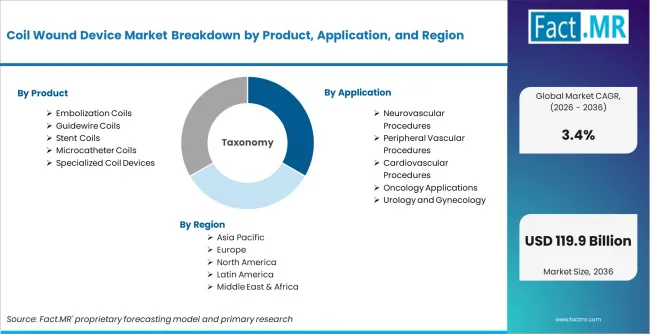
Coil Wound Device Market Breakdown By Product, Application, And Region | Source: Fact.MR
| Parameter | Details |
|---|---|
| Quantitative Units | USD 85.82 billion to USD 119.9 billion, at a CAGR of 3.4% |
| Market Definition | The coil wound device market covers electromagnetic components manufactured through wire winding processes, including transformers, inductors, chokes, solenoids, and electromagnetic coils for power distribution, electronics, automotive, telecommunications, and industrial applications. |
| Regions Covered | North America, Latin America, Europe, East Asia, South Asia and Pacific, Middle East and Africa |
| Countries Covered | India, China, Mexico, Germany, USA, South Korea, Japan, 30 plus countries |
| Key Companies | ABB, Siemens Energy, Schneider, TDK, Vishay, Murata, Panasonic, Sumida, Wurth, Delta, Hammond, Hitachi Energy, Eaton, Meidensha, Toshiba |
| Forecast Period | 2026 to 2036 |
| Approach | Hybrid demand-side and top-down methodology built on country-level application demand, product benchmarking, pricing analysis, shipment validation, and primary interviews across manufacturers, distributors, and end users |
Source: Fact.MR analysis. Updated May 21, 2026
Coil Wound Device Market Segmentation
-
Coil Wound Device Market Segmented by Product:
- Embolization Coils
- Detachable Coils
- Electrolytic Detachable Coils
- Mechanical Detachable Coils
- Pushable Coils
- Fibered Pushable Coils
- Bare Metal Coils
- Detachable Coils
- Guidewire Coils
- Core Guidewires
- Stainless Steel Core Wires
- Nitinol Core Wires
- Coated Guidewires
- Hydrophilic Coated Wires
- Hydrophobic Coated Wires
- Core Guidewires
- Stent Coils
- Self Expanding Coils
- Nitinol Stent Coils
- Shape Memory Coils
- Balloon Expandable Coils
- High Precision Stent Coils
- Thin Strut Coils
- Self Expanding Coils
- Microcatheter Coils
- Delivery Coils
- High Flexibility Coils
- Torque Control Coils
- Support Coils
- Reinforced Coil Systems
- Kink Resistant Coils
- Delivery Coils
- Specialized Coil Devices
- Drug Eluting Coils
- Anti Proliferative Coils
- Targeted Therapy Coils
- Bioactive Coils
- Hydrogel Coated Coils
- Expandable Bio Coils
- Drug Eluting Coils
- Embolization Coils
-
Coil Wound Device Market Segmented by Application:
- Neurovascular Procedures
- Aneurysm Treatment
- Intracranial Aneurysm Coiling
- Wide Neck Aneurysm Treatment
- Arteriovenous Malformations
- AVM Embolization
- Fistula Closure Procedures
- Aneurysm Treatment
- Peripheral Vascular Procedures
- Peripheral Embolization
- Tumor Embolization
- Bleeding Control Procedures
- Vascular Occlusion
- Varicocele Treatment
- Pelvic Congestion Treatment
- Peripheral Embolization
- Cardiovascular Procedures
- Coronary Interventions
- Coronary Occlusion Procedures
- Collateral Vessel Treatment
- Structural Heart Procedures
- Septal Defect Closure
- Valve Related Procedures
- Coronary Interventions
- Oncology Applications
- Tumor Embolization
- Liver Tumor Treatment
- Kidney Tumor Treatment
- Targeted Therapy Delivery
- Localized Drug Delivery
- Chemoembolization
- Tumor Embolization
- Urology and Gynecology
- Uterine Fibroid Treatment
- Uterine Artery Embolization
- Fibroid Shrinkage Therapy
- Urological Embolization
- Prostate Artery Embolization
- Renal Bleeding Control
- Uterine Fibroid Treatment
- Neurovascular Procedures
-
Coil Wound Device Market Segmented by End Use:
- Hospitals
- Public Hospitals
- Government Medical Centers
- Teaching Hospitals
- Private Hospitals
- Multi Specialty Hospitals
- Cardiac Care Hospitals
- Public Hospitals
- Specialty Clinics
- Cardiology Clinics
- Interventional Cardiology
- Cath Lab Centers
- Neurology Clinics
- Neurovascular Centers
- Stroke Treatment Centers
- Cardiology Clinics
- Ambulatory Surgical Centers
- Day Care Centers
- Minimally Invasive Centers
- Outpatient Surgical Units
- Specialty Surgery Centers
- Endovascular Surgery Centers
- Vascular Treatment Centers
- Day Care Centers
- Research and Academic Institutes
- Medical Research Centers
- Clinical Research Institutes
- Device Testing Labs
- Universities
- Medical Colleges
- Training Institutes
- Medical Research Centers
- Hospitals
-
Coil Wound Device Market Segmented by Technology:
- Detachable Coil Technology
- Electrolytic Detachment
- Battery Controlled Systems
- Precision Detachment Systems
- Mechanical Detachment
- Pull Wire Systems
- Release Mechanism Systems
- Electrolytic Detachment
- Material Technology
- Nitinol Based Coils
- Shape Memory Alloys
- Super Elastic Coils
- Platinum Based Coils
- Soft Platinum Coils
- Dense Packing Coils
- Nitinol Based Coils
- Coating Technology
- Hydrogel Coatings
- Expandable Coatings
- Volume Expansion Systems
- Polymer Coatings
- Drug Loaded Coatings
- Biocompatible Coatings
- Hydrogel Coatings
- Delivery Technology
- Microcatheter Delivery
- Flexible Catheter Systems
- Trackable Delivery Systems
- Imaging Guided Systems
- Fluoroscopy Guided Systems
- 3D Navigation Systems
- Microcatheter Delivery
- Detachable Coil Technology
-
Coil Wound Device Market Segmented by Technology:
- Detachable Coil Technology
- Electrolytic Detachment
- Battery Controlled Systems
- Precision Detachment Systems
- Mechanical Detachment
- Pull Wire Systems
- Release Mechanism Systems
- Electrolytic Detachment
- Material Technology
- Nitinol Based Coils
- Shape Memory Alloys
- Super Elastic Coils
- Platinum Based Coils
- Soft Platinum Coils
- Dense Packing Coils
- Nitinol Based Coils
- Coating Technology
- Hydrogel Coatings
- Expandable Coatings
- Volume Expansion Systems
- Polymer Coatings
- Drug Loaded Coatings
- Biocompatible Coatings
- Hydrogel Coatings
- Delivery Technology
- Microcatheter Delivery
- Flexible Catheter Systems
- Trackable Delivery Systems
- Imaging Guided Systems
- Fluoroscopy Guided Systems
- 3D Navigation Systems
- Microcatheter Delivery
- Detachable Coil Technology
-
Coil Wound Device Market Segmented by Distribution Channel:
- Direct Sales
- Hospital Supply Contracts
- Bulk Procurement Contracts
- Long Term Supply Agreements
- OEM Partnerships
- Medical Device OEMs
- Healthcare System Suppliers
- Hospital Supply Contracts
- Distributors
- Medical Device Distributors
- Regional Distributors
- Specialty Device Suppliers
- Authorized Dealers
- Hospital Equipment Dealers
- Clinical Supply Providers
- Medical Device Distributors
- Group Purchasing Organizations
- Healthcare Networks
- Hospital Networks
- Clinic Networks
- Bulk Procurement Groups
- Public Procurement Bodies
- Private Purchasing Groups
- Healthcare Networks
- Aftermarket Services
- Supply Services
- Consumable Supply Providers
- Replacement Supply Chains
- Support Services
- Technical Support Providers
- Training Providers
- Supply Services
- Direct Sales
-
Coil Wound Device Market by Region:
- North America
- USA
- Canada
- Mexico
- Latin America
- Brazil
- Chile
- Rest of Latin America
- Western Europe
- Germany
- UK
- Italy
- Spain
- France
- Nordic
- BENELUX
- Rest of Western Europe
- Eastern Europe
- Russia
- Poland
- Hungary
- Balkan & Baltic
- Rest of Eastern Europe
- East Asia
- China
- Japan
- South Korea
- South Asia and Pacific
- India
- ASEAN
- Australia & New Zealand
- Rest of South Asia and Pacific
- Middle East & Africa
- Kingdom of Saudi Arabia
- Other GCC Countries
- Turkiye
- South Africa
- Other African Union
- Rest of Middle East & Africa
- North America
Frequently Asked Questions
Which application segment will contribute significant share in the Coil Wound Device Market in 2026?
What will be the size of the coil wound device market in 2036?
How much will the market grow between 2026 and 2036?
How much will the Welding Equipment Market grow between 2026 and 2036?
What are the key product types in the Welding Equipment Market?
Who worked on this report


Preview the report firsthand - request a free sample
Free SampleGet the brochure for pricing and purchase details
Download PDF