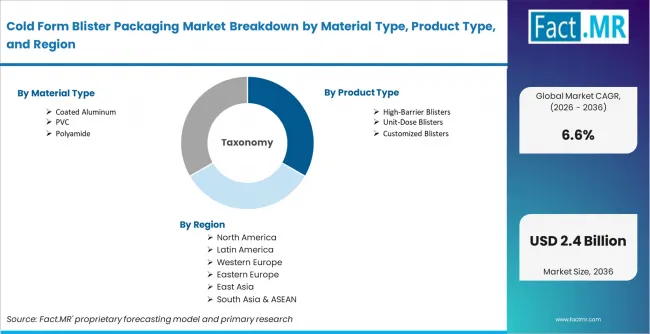
Cold Form Blister Packaging Market Size, Share, Growth and Forecast (2026 - 2036)
The Cold Form Blister Packaging Market is segmented by Material Type (Coated Aluminum, PVC, Polyamide, Polypropylene, and Others), Product Type (Standard Cold Form Blisters, Child-Resistant Blisters, High-Barrier Blisters, Unit-Dose Blisters, and Customized Blisters), Application (Pharmaceuticals, Consumer Products, Electronics and Semiconductors, Food and Confectionery, and Other Applications), End Use (Pharmaceutical Companies, Contract Packaging Organizations, Nutraceutical Companies, Medical Device Companies, and Consumer Goods Companies), Sales Channel (Direct Institutional Sales, Distributor Sales, Contract Packaging Supply, Online Industrial Supply, and Export Channels), and Region. Forecast for 2026 to 2036.
Fact.MR analysis indicates that the cold form blister packaging market is moving through a high-barrier pharmaceutical protection phase. Drug manufacturers, contract packagers, and medical device companies are evaluating packaging through moisture protection, light resistance, tamper evidence, and line compatibility. Demand is gaining depth where sensitive tablets, capsules, and specialty medicines require stronger protection than standard thermoformed blister packs.
Cold Form Blister Packaging Market Forecast and Outlook By Fact.MR
- The cold form blister packaging market was valued at USD 1,197.8 million in 2025.
- According to Fact.MR, demand is projected to reach USD 1,276.8 million in 2026 and expand to USD 2,419.3 million by 2036, reflecting a CAGR of 6.6% during the forecast period.
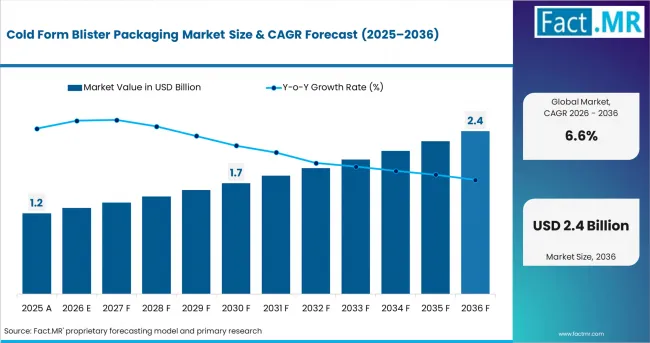
| Metric | Value |
|---|---|
| Estimated Value in 2026 | USD 1,276.8 million |
| Forecast Value in 2036 | USD 2,419.3 million |
| Forecast CAGR (2026 to 2036) | 6.6% |
Summary of Cold Form Blister Packaging Market
- Market Definition
- The market includes high-barrier cold form blister packs used to protect medicines, nutraceuticals, medical devices, and sensitive products from moisture, oxygen, and light.
- Demand Drivers
- Pharmaceutical companies are using cold form blisters where tablets and capsules need stronger barrier protection than standard plastic blisters.
- Contract packaging organizations are expanding blister formats because export-focused drug packs require stable shelf-life performance.
- Medical product suppliers use cold form packs where unit-dose safety, tamper evidence, and product protection are critical.
- Key Segments Analyzed
- By Material Type: Coated aluminum is expected to hold approximately 48.0% share in 2026, supported by high barrier strength and formability.
- By Product Type: High-barrier blisters lead in 2026 with about 36.0% share, due to rising use in moisture-sensitive medicines.
- By Application: Pharmaceuticals account for around 72.0% share in 2026, driven by tablets, capsules, and specialty drug packaging.
- By End Use: Pharmaceutical companies hold nearly 54.0% share in 2026, since regulated drug packaging remains the largest demand base.
- By Sales Channel: Direct institutional sales are projected to lead with 43.0% share in 2026, as large buyers prefer specification-based supply.
- By Geography: Japan leads growth through 2036 at 7.1% CAGR, supported by precision packaging and high-quality pharmaceutical production.
- Analyst Opinion at Fact.MR
- Shambhu Nath Jha, Senior Analyst at Fact.MR, opines, “Cold form blister packaging demand is no longer defined only by drug pack volume. The stronger shift is toward barrier assurance, material consistency, and packaging formats that protect sensitive formulations through long supply chains. Suppliers that can support regulatory documentation, cavity design, and line performance will hold a better position than companies competing only on laminate price.”
- Strategic Implications
- Material suppliers should improve aluminum laminate consistency because pharma buyers evaluate packs through barrier performance and forming reliability.
- Contract packagers need stronger cold form line capability to serve specialty drugs and export-ready medicine packs.
- Converters should support cavity design and validation because cold form packaging can affect material use, pack size, and machine speed.
- Methodology
- Market sizing uses pharmaceutical blister demand, coated aluminum usage, contract packaging activity, drug export volume, and average laminate prices.
- Analysis includes FDA container closure guidance, USP packaging standards, ISO packaging references, company product catalogues, and packaging supplier inputs.
- Forecasts account for high-barrier drug packaging, generic medicine exports, unit-dose demand, aluminum price movement, and regional pharmaceutical output.
The market is expected to generate an absolute opportunity of USD 1,142.5 million between 2026 and 2036, supported by increasing pharmaceutical packaging needs. Growth is being driven by demand for moisture-resistant packaging for sensitive drugs, expansion of unit-dose compliance packs, and rising export-oriented pharmaceutical supply. Regulatory guidance from the U.S. Food and Drug Administration emphasizes the importance of container closure systems in maintaining drug product quality, while United States Pharmacopeia packaging standards reinforce the need for protective systems that preserve product integrity during storage and distribution. These factors keep cold form blister packaging relevant in high-protection pharmaceutical applications. [1]
Japan leads with a projected CAGR of 7.1% through 2036, supported by high packaging quality standards and export-oriented pharmaceutical supply. The United States records 7.0%, with demand anchored in prescription drug packaging and compliance packs. Germany advances at 6.8%, backed by pharmaceutical manufacturing and strict quality expectations. India grows at 6.7%, supported by generic drug exports and contract packaging growth. China posts 6.6%, helped by pharmaceutical scale and high-barrier packaging adoption. Italy grows at 6.1%, supported by medicine packaging and regional pharma production.
Segmental Analysis
Cold Form Blister Packaging Market Analysis by Material Type
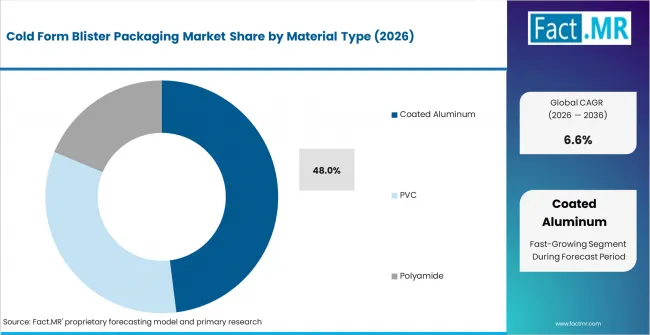
Coated aluminum is expected to hold 48.0% share in 2026 as it provides strong protection against moisture, oxygen, and light. Pharmaceutical companies use coated aluminum laminates where tablets and capsules are sensitive to humidity or long storage cycles. Fact.MR identifies coated aluminum as the prime material in cold form blister packaging because of its barrier characteristics and shaping options. FDA container closure guidance supports the need to evaluate packaging protection for drug stability and quality. PVC and polyamide layers remain important in laminate structures, but coated aluminum keeps leadership because cold form packs depend on metal-based barrier performance. Poor aluminum quality can affect forming behavior and cavity integrity.
- Barrier Protection: Coated aluminum helps protect medicines from moisture and oxygen exposure.
- Forming Strength: Treated foil supports cavity formation without cracking during cold forming.
- Drug Stability: High-barrier laminates help preserve product quality during storage and export.
Cold Form Blister Packaging Market Analysis by Product Type
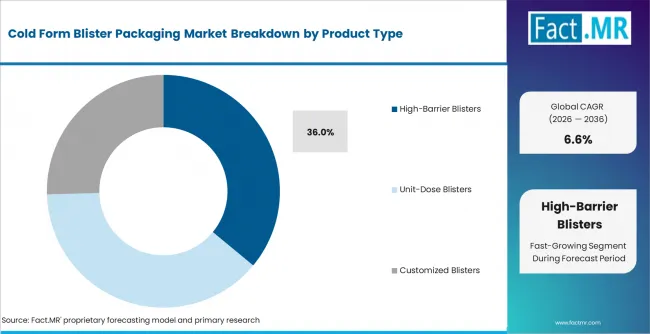
High-barrier blisters are projected to account for 36.0% share in 2026 because more drugs require stronger protection through distribution and storage. These packs are used for moisture-sensitive tablets, capsules, and specialty products where shelf-life control is central to product quality. USP packaging standards reinforce the importance of packaging systems that protect pharmaceutical articles from environmental exposure [3]. Standard blisters remain relevant for routine products, but high-barrier formats gain share where humidity, oxidation, or light exposure can affect stability. Child-resistant and unit-dose formats also grow in regulated markets. Weak barrier selection can increase product rejection risk and shorten shelf life.
- Moisture Control: High-barrier blisters reduce exposure for humidity-sensitive formulations.
- Export Readiness: Stronger packs support products moving through long and varied supply chains.
- Specialty Drug Use: Sensitive medicines often need stronger protection than standard thermoformed packs.
Cold Form Blister Packaging Market Analysis by Application
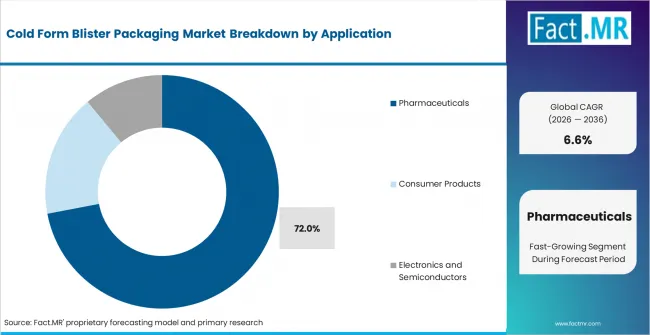
Pharmaceuticals form the largest application base because cold form blister packs are widely used for tablets, capsules, and specialty oral solids. This application is estimated to account for 72.0% share in 2026. Drug manufacturers prefer cold form blisters where shelf life, patient compliance, and unit-dose protection need to be managed together. FDA packaging guidance links container closure systems with drug quality and stability, which supports demand for validated pharmaceutical packs. [2] Consumer products and electronics use cold form packs in selected cases, yet pharmaceuticals retain the largest demand because regulatory and stability needs are stronger. Packaging failure can affect product safety, recall risk, and brand trust.
- Tablet Protection: Cold form blisters provide each dose with a dedicated protective cavity.
- Compliance Use: Unit packs help patients track dose timing and reduce handling errors.
- Regulatory Fit: Pharmaceutical packaging must support stability, labeling, and distribution requirements.
Cold Form Blister Packaging Market Analysis by End Use
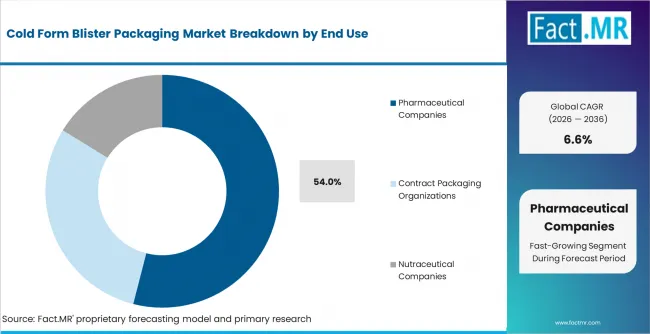
Pharmaceutical companies lead demand because they require validated blister systems for prescription drugs, generics, and specialty medicines. Pharmaceutical companies are expected to hold 54.0% share over the forecast period. These buyers evaluate cold form packs through barrier strength, line performance, print compatibility, and regulatory documentation. WHO good manufacturing practice guidance supports controlled packaging operations within pharmaceutical production [4]. Contract packagers and nutraceutical firms are growing buyers, but pharma companies retain the largest value because their stability standards and volumes are higher. Weak supplier documentation can delay product registration and batch release.
- Regulated Demand: Pharma companies need packaging aligned with stability and quality requirements.
- High Volume: Oral solid dose medicines create recurring blister material consumption.
- Validation Need: Packaging suppliers must support documentation, testing, and change control.
Cold Form Blister Packaging Market Analysis by Sales Channel
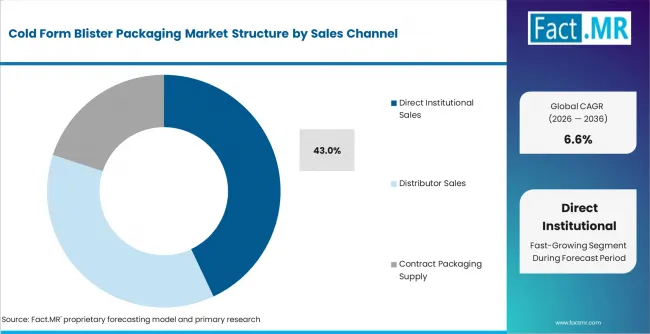
Direct institutional sales are expected to account for 43.0% share in 2026 as large pharmaceutical and contract packaging buyers need specification-based supply. Direct engagement helps buyers secure laminate grades, forming support, print alignment, and quality documentation. Company product catalogues from major packaging suppliers show that cold form blister materials are often sold with technical specifications and application support. Distributor sales remain relevant for smaller buyers, while export channels matter for regional converters. Direct sales lead because quality control and supply continuity matter more than spot availability. Weak channel support can create production delays and validation risk.
- Specification Control: Direct supply helps buyers secure laminate thickness and barrier requirements.
- Technical Support: Packaging suppliers assist with forming trials and line compatibility.
- Supply Continuity: Long-term agreements reduce risk during aluminum price movement or demand spikes.
Drivers, Restraints, and Opportunities
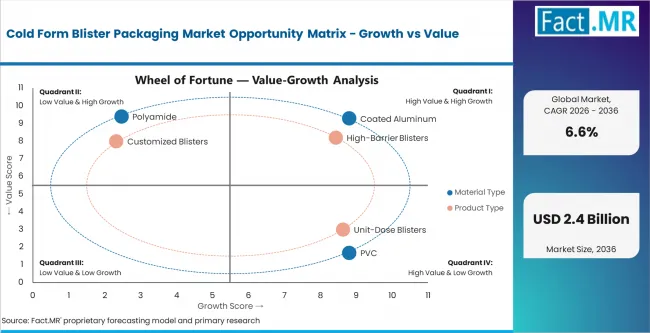
Pharmaceutical packaging demand is increasing as drug makers seek stronger protection for moisture-sensitive medicines. Cold form blister packs offer higher barrier performance than many thermoformed plastic alternatives. Fact.MR notes that coated aluminum remains central because no other material can match its barrier characteristics and forming range in cold form blister packaging. Growth improves where manufacturers connect packaging selection with shelf-life control, export stability, and unit-dose compliance. Contract packaging organizations benefit as more pharma companies outsource blister packaging operations.
Aluminum cost volatility remains the key restraint. Fact.MR identifies rising aluminum prices and raw material instability as threats to cold form blister packaging manufacturers. Cold form packs also use more material than standard thermoformed blister packs because aluminum does not stretch as efficiently. This can increase pack size and reduce line speed in some cases. Sustainability concerns may affect adoption where buyers look for lower-material packaging. Suppliers must prove lifecycle value through product protection, lower rejection risk, and better shelf-life security.
- Specialty Drug Packaging: High-value and moisture-sensitive medicines create demand for stronger blister barriers.
- Contract Packaging Growth: Outsourcing creates opportunities for cold form blister lines and validation support.
- Child-Resistant Packs: Regulated markets create demand for formats that combine protection with patient safety.
Regional Analysis
The cold form blister packaging market is assessed across North America, Europe, Asia Pacific, Latin America, and Middle East and Africa, covering 40+ countries with demand profiles shaped by pharmaceutical output, contract packaging, drug exports, material supply, quality standards, and healthcare packaging regulation.
.webp)
| Country | CAGR (2026 to 2036) |
|---|---|
| Japan | 7.1% |
| USA | 7.0% |
| Germany | 6.8% |
| India | 6.7% |
| China | 6.6% |
| Italy | 6.1% |
Source: Fact.MR analysis, based on proprietary forecasting model and primary research
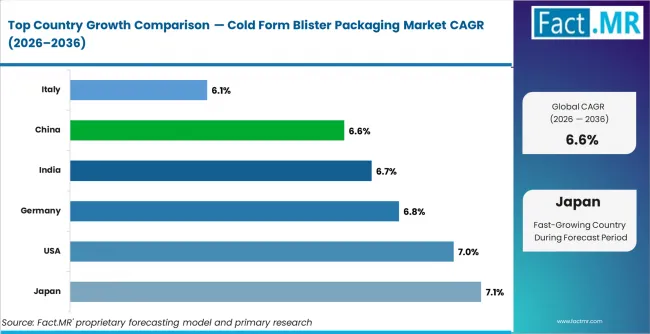
Asia Pacific Cold Form Blister Packaging Market Analysis
Asia Pacific records strong growth because pharmaceutical manufacturing, generic drug exports, and packaging conversion capacity are expanding together. Japan benefits from precision manufacturing and high-quality pharma packaging standards. India gains from generic drug exports and contract packaging demand. China adds scale through domestic pharmaceutical output and growing high-barrier packaging adoption.
- Japan: Japan leads the country outlook as high-quality manufacturing and pharmaceutical export needs strengthen cold form blister demand. The country is projected to grow at 7.1% CAGR by 2036. Drug makers value precision-formed packs, strong barrier protection, and consistent laminate quality. Packaging suppliers support export-oriented manufacturers serving Southeast Asia, South Korea, and Taiwan. Buyers weigh reliability, forming performance, and regulatory documentation before supplier approval.
- India: Generic drug exports and contract packaging growth support cold form blister packaging demand in India. Pharmaceutical companies use cold form packs for moisture-sensitive tablets and export-ready oral solids. India is forecast to grow at 6.7% CAGR from 2026 to 2036. Cost sensitivity remains important, but quality documentation is critical for regulated markets. Suppliers that combine competitive pricing with reliable barrier performance can strengthen adoption.
- China: Pharmaceutical manufacturing scale and high-barrier packaging adoption support demand in China. Domestic drug producers are improving packaging formats as quality standards tighten. China is projected to post 6.6% CAGR over the assessment period. Coated aluminum demand grows where tablets and capsules need strong protection during storage and distribution. Suppliers with stable material supply and technical forming support can improve market access.
North America Cold Form Blister Packaging Market Analysis
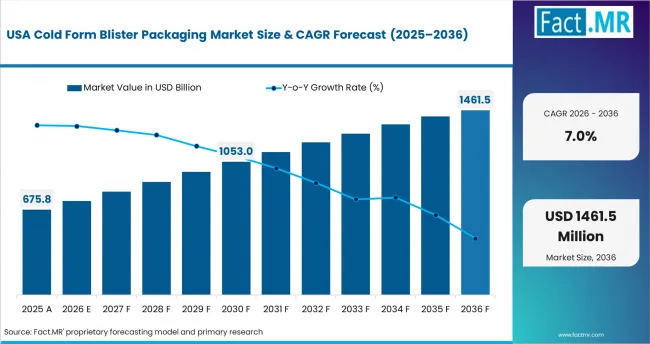
North America remains a high-value region because prescription drug packaging, specialty medicines, and compliance packs support cold form blister use. The United States anchors regional demand through pharmaceutical manufacturing, contract packaging, and high-quality packaging validation.
- USA: The United States has a strong pharmaceutical and contract packaging base that supports cold form blister demand. Prescription drugs, specialty medicines, and compliance packs are key demand areas. The country is projected to record 7.0% CAGR through 2036. Drug manufacturers focus on moisture protection, dose security, and packaging validation. Suppliers with strong technical service and regulatory documentation can defend long-term contracts.
Europe Cold Form Blister Packaging Market Analysis
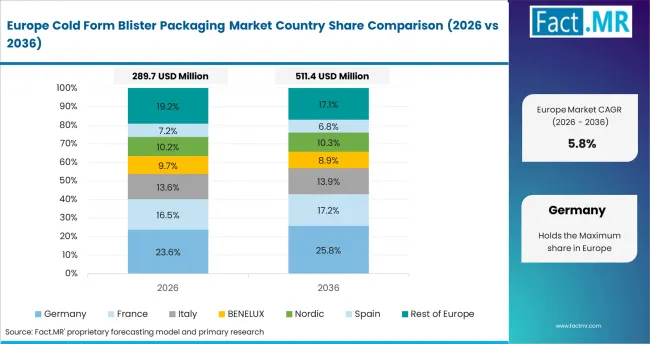
Europe shows steady demand because pharmaceutical manufacturing, quality systems, and export-oriented drug supply support high-barrier packs. Germany leads regional growth through pharmaceutical scale and advanced packaging standards. Fact.MR notes that Germany is attractive for cold form blister packaging due to its developed pharmaceutical industry, high-tech packaging demand, and strong quality standards. EU pharmaceutical rules and packaging quality requirements influence material approval and pack validation [5]. Suppliers compete through barrier performance, documentation, and sustainability improvements.
- Germany: Germany benefits from pharmaceutical manufacturing, research activity, and strict quality expectations. Demand is linked to tablets, capsules, and specialty medicines requiring strong moisture protection. Germany is forecast to grow at 6.8% CAGR over the study period. Buyers tend to favor suppliers with validated materials and reliable forming support. Packaging consistency and regulatory documentation influence purchasing more than price alone.
- Italy: Medicine packaging and regional pharma production support cold form blister demand in Italy. Contract packagers and pharmaceutical companies use high-barrier laminates for sensitive oral solids. Italy is projected to grow at 6.1% CAGR by 2036. Growth remains steady because the country has an established pharmaceutical manufacturing base. Suppliers that support smaller batch runs and export documentation can improve adoption.
Fact.MR analysis of regional demand covers Asia Pacific, North America, Europe, Latin America, and Middle East and Africa. The study assesses pharmaceutical manufacturing, contract packaging capacity, aluminum laminate supply, drug export demand, packaging regulation, and supplier support across major markets.
Competitive Aligners for Market Players
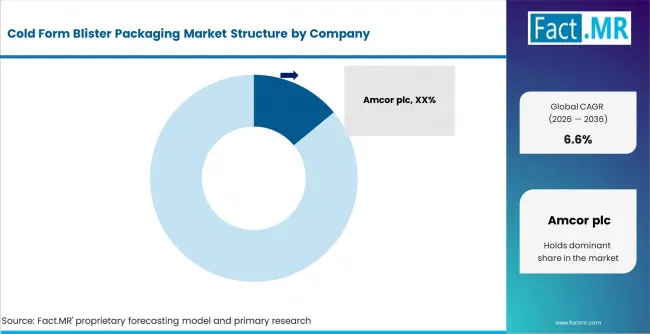
The cold form blister packaging market is moderately concentrated because high-barrier pharmaceutical packaging requires laminate expertise, material consistency, and regulatory documentation. Large packaging companies hold advantages through global pharma relationships, converter scale, and validated material systems. Regional converters compete through local supply, flexible batch sizes, and cost-focused packaging support.
Competitive advantage depends on barrier quality, forming performance, laminate consistency, print compatibility, and technical service. Amcor, Constantia Flexibles, Bilcare, UFlex, Tekni-Plex, ACG Pharmapack, Essentra, Svam Packaging, Ningbo Dragon Packaging, and Rollprint Packaging represent supplier groups where material reliability and pharma packaging experience matter. Pharmaceutical buyers are less likely to switch suppliers when packaging materials are validated within drug stability files.
The market is divided between standard pharmaceutical cold form blisters and high-barrier specialty formats. Suppliers that combine laminate performance with documentation and line support can protect institutional demand. Regional companies can gain ground where cost control, fast delivery, and technical trials matter most.
Key Players
- Amcor plc
- Constantia Flexibles Group GmbH
- Bilcare Limited
- UFlex Limited
- Tekni-Plex, Inc.
- ACG Pharmapack Pvt. Ltd.
- Essentra plc
- Svam Packaging Industries Pvt. Ltd.
- Ningbo Dragon Packaging Technology Co., Ltd.
- Rollprint Packaging Products, Inc.
- R-Pharm Germany GmbH
- Shanghai Haishun New Pharmaceutical Packaging Co., Ltd.
Bibliography
- [1] United States Food and Drug Administration. (2024). Container closure systems for packaging human drugs and biologics. FDA.
- [2] United States Food and Drug Administration. (2024). Pharmaceutical quality resources. FDA.
- [3] United States Pharmacopeia. (2024). Packaging and distribution standards. USP.
- [4] World Health Organization. (2024). Good manufacturing practices. WHO.
- [5] European Medicines Agency. (2024). Quality guidelines. EMA.
This Report Addresses
- Strategic intelligence on cold form blister packaging demand across pharmaceuticals, nutraceuticals, medical devices, consumer products, and sensitive goods globally.
- Market forecast from USD 1,276.8 million in 2026 to USD 2,419.3 million by 2036 at a CAGR of 6.60%.
- Growth opportunity mapping across Japan precision packaging, U.S. prescription drug packs, Germany pharma manufacturing, India generic exports, and China high-barrier packaging adoption.
- Segment analysis by material type, product type, application, end use, sales channel, and region.
- Regional outlook covering Asia Pacific pharma manufacturing growth, North America compliance packaging, and Europe quality-controlled drug packaging.
- Competitive analysis of Amcor, Constantia Flexibles, Bilcare, UFlex, Tekni-Plex, ACG Pharmapack, Essentra, Svam Packaging, Ningbo Dragon Packaging, and Rollprint Packaging.
- Product adoption analysis covering barrier performance, aluminum laminate quality, cavity forming, moisture protection, regulatory documentation, and line compatibility.
- Report delivered with market sizing, segment outlook, regional analysis, company profiling, and forecast assumptions.
Cold Form Blister Packaging Market Definition
The market covers cold form blister packaging made through cold-forming processes that shape aluminum-based laminate structures without heat. These packs provide strong barrier protection against moisture, oxygen, and light. The scope includes cold form blister materials and formats used for tablets, capsules, nutraceuticals, medical devices, consumer goods, and selected specialty products.
Cold Form Blister Packaging Market Inclusions
The study includes global and regional forecasts from 2026 to 2036. It covers coated aluminum, PVC, polyamide, polypropylene, and other laminate structures used in cold form blister packs. It includes standard blisters, child-resistant blisters, high-barrier formats, unit-dose packs, and customized cavity designs supplied to pharmaceutical, nutraceutical, medical device, and consumer product manufacturers.
Cold Form Blister Packaging Market Exclusions
The scope excludes thermoformed blister packs, bottles, sachets, strip packs, cartons, pouches, vials, and flexible packaging not produced through cold forming. It also excludes aluminum foil sold for non-packaging industrial use. The focus stays on cold-formed blister structures designed for high-barrier product protection.
Cold Form Blister Packaging Market Research Methodology
- Primary Research
- Interviews with pharmaceutical packaging heads, contract packaging managers, aluminum laminate suppliers, blister line engineers, quality assurance heads, packaging converters, and medical packaging distributors across major regions.
- Desk Research
- Uses FDA packaging guidance, USP packaging standards, pharma packaging references, company product information, medical packaging safety resources, and aluminum industry documentation.
- Market-Sizing and Forecasting
- Hybrid model using pharmaceutical blister demand, laminate consumption, contract packaging volume, drug export requirements, product-level barrier needs, and average selling prices by material type.
- Data Validation and Update Cycle
- Forecasts were validated through converter inputs, pharmaceutical packaging purchase patterns, material availability reviews, supplier catalogues, and regional drug manufacturing indicators.
Scope of Report

| Attribute | Details |
|---|---|
| Quantitative Units | USD 1,276.8 million (2026) to USD 2,419.3 million (2036), at a CAGR of 6.6% |
| Market Definition | High-barrier cold-formed blister packaging used for pharmaceutical, nutraceutical, medical device, and sensitive product protection |
| Forecast Period | 2026 to 2036 |
| Historical Reference | 2025 |
| Material Type Covered | Coated aluminum, PVC, polyamide, polypropylene, others |
| Product Type Covered | Standard cold form blisters, child-resistant blisters, high-barrier blisters, unit-dose blisters, customized blisters |
| Application Covered | Pharmaceuticals, consumer products, electronics and semiconductors, food and confectionery, other applications |
| End Use Covered | Pharmaceutical companies, contract packaging organizations, nutraceutical companies, medical device companies, consumer goods companies |
| Sales Channel Covered | Direct institutional sales, distributor sales, contract packaging supply, online industrial supply, export channels |
| Regions Covered | North America, Europe, Asia Pacific, Latin America, Middle East and Africa |
| Countries Covered | USA, Canada, Mexico, Germany, UK, France, Italy, Spain, Nordic, BENELUX, China, Japan, India, ASEAN, Australia and New Zealand, Brazil, Argentina, Chile, Saudi Arabia, GCC, Turkey, South Africa, and Rest of MEA |
| Key Companies Profiled | Amcor, Constantia Flexibles, Bilcare, UFlex, Tekni-Plex, ACG Pharmapack, Essentra, Svam Packaging, Ningbo Dragon Packaging, Rollprint Packaging, R-Pharm Germany, Shanghai Haishun |
| Approach | Hybrid top-down and bottom-up model using pharmaceutical blister demand, aluminum laminate consumption, contract packaging output, drug export activity, average selling prices, and primary interviews with packaging buyers and converters |
Cold Form Blister Packaging Market by Segments
-
By Material Type:
- Coated Aluminum
- PVC
- Polyamide
- Polypropylene
- Others
-
By Product Type:
- Standard Cold Form Blisters
- Child-Resistant Blisters
- High-Barrier Blisters
- Unit-Dose Blisters
- Customized Blisters
-
By Application:
- Pharmaceuticals
- Consumer Products
- Electronics and Semiconductors
- Food and Confectionery
- Other Applications
-
By End Use:
- Pharmaceutical Companies
- Contract Packaging Organizations
- Nutraceutical Companies
- Medical Device Companies
- Consumer Goods Companies
-
By Sales Channel:
- Direct Institutional Sales
- Distributor Sales
- Contract Packaging Supply
- Online Industrial Supply
- Export Channels
-
By Region:
- North America
- United States
- Canada
- Mexico
- Latin America
- Brazil
- Argentina
- Chile
- Rest of Latin America
- Western Europe
- Germany
- France
- United Kingdom
- Italy
- Spain
- Nordic Countries
- BENELUX
- Rest of Western Europe
- Eastern Europe
- Russia
- Poland
- Hungary
- Balkan and Baltic
- Rest of Eastern Europe
- East Asia
- China
- Japan
- South Koreaa
- South Asia and Pacific
- India
- ASEAN
- Australia and New Zealand
- Rest of South Asia and Pacific
- Middle East and Africa
- Kingdom of Saudi Arabia
- Other GCC Countries
- Turkey
- South Africa
- Rest of Middle East and Africa
- North America
- Frequently Asked Questions -
How large is the global cold form blister packaging market in 2025?
The global cold form blister packaging market was valued at USD 1,197.8 million in 2025.
What will the market size be in 2026?
Based on revised Fact.MR analysis, demand for cold form blister packaging is estimated to grow to USD 1,276.8 million in 2026.
What is the projected market size by 2036?
The market is projected to reach USD 2,419.3 million by 2036, generating USD 1,142.5 million in absolute dollar opportunity.
What is the expected CAGR from 2026 to 2036?
Fact.MR projects a CAGR of 6.60% for the global cold form blister packaging market during the forecast period.
Which material type is poised to lead the market?
Coated aluminum leads with approximately 48.0% share in 2026 due to high barrier strength and cold-forming performance.
Which product type accounts for the largest demand?
High-barrier blisters account for about 36.0% share in 2026 because moisture-sensitive medicines need stronger protection.
Which application holds the highest share?
Pharmaceuticals hold around 72.0% share in 2026 due to tablet, capsule, and specialty drug packaging demand.
Which end use leads the market?
Pharmaceutical companies hold nearly 54.0% share in 2026 because regulated medicine packaging remains the largest demand base.
Which sales channel leads demand?
Direct institutional sales hold around 43.0% share in 2026 because large buyers prefer specification-based supply and technical support.
Which country shows the fastest growth?
Japan leads at 7.1% CAGR through 2036, supported by precision packaging and high-quality pharmaceutical production.
What is driving demand for cold form blister packaging?
Demand is driven by moisture-sensitive drugs, specialty medicines, export-ready packaging, unit-dose formats, and high-barrier protection needs.
What is the key challenge in this market?
Aluminum price volatility, higher material use, sustainability pressure, and slower line speed limit faster adoption across some applications.
Table of Content
- Executive Summary
- Global Market Outlook
- Demand to side Trends
- Supply to side Trends
- Technology Roadmap Analysis
- Analysis and Recommendations
- Market Overview
- Market Coverage / Taxonomy
- Market Definition / Scope / Limitations
- Research Methodology
- Chapter Orientation
- Analytical Lens and Working Hypotheses
- Market Structure, Signals, and Trend Drivers
- Benchmarking and Cross-market Comparability
- Market Sizing, Forecasting, and Opportunity Mapping
- Research Design and Evidence Framework
- Desk Research Programme (Secondary Evidence)
- Company Annual and Sustainability Reports
- Peer-reviewed Journals and Academic Literature
- Corporate Websites, Product Literature, and Technical Notes
- Earnings Decks and Investor Briefings
- Statutory Filings and Regulatory Disclosures
- Technical White Papers and Standards Notes
- Trade Journals, Industry Magazines, and Analyst Briefs
- Conference Proceedings, Webinars, and Seminar Materials
- Government Statistics Portals and Public Data Releases
- Press Releases and Reputable Media Coverage
- Specialist Newsletters and Curated Briefings
- Sector Databases and Reference Repositories
- Fact.MR Internal Proprietary Databases and Historical Market Datasets
- Subscription Datasets and Paid Sources
- Social Channels, Communities, and Digital Listening Inputs
- Additional Desk Sources
- Expert Input and Fieldwork (Primary Evidence)
- Primary Modes
- Qualitative Interviews and Expert Elicitation
- Quantitative Surveys and Structured Data Capture
- Blended Approach
- Why Primary Evidence is Used
- Field Techniques
- Interviews
- Surveys
- Focus Groups
- Observational and In-context Research
- Social and Community Interactions
- Stakeholder Universe Engaged
- C-suite Leaders
- Board Members
- Presidents and Vice Presidents
- R&D and Innovation Heads
- Technical Specialists
- Domain Subject-matter Experts
- Scientists
- Physicians and Other Healthcare Professionals
- Governance, Ethics, and Data Stewardship
- Research Ethics
- Data Integrity and Handling
- Primary Modes
- Tooling, Models, and Reference Databases
- Desk Research Programme (Secondary Evidence)
- Data Engineering and Model Build
- Data Acquisition and Ingestion
- Cleaning, Normalisation, and Verification
- Synthesis, Triangulation, and Analysis
- Quality Assurance and Audit Trail
- Market Background
- Market Dynamics
- Drivers
- Restraints
- Opportunity
- Trends
- Scenario Forecast
- Demand in Optimistic Scenario
- Demand in Likely Scenario
- Demand in Conservative Scenario
- Opportunity Map Analysis
- Product Life Cycle Analysis
- Supply Chain Analysis
- Investment Feasibility Matrix
- Value Chain Analysis
- PESTLE and Porter’s Analysis
- Regulatory Landscape
- Regional Parent Market Outlook
- Production and Consumption Statistics
- Import and Export Statistics
- Market Dynamics
- Global Market Analysis 2021 to 2025 and Forecast, 2026 to 2036
- Historical Market Size Value (USD Million) Analysis, 2021 to 2025
- Current and Future Market Size Value (USD Million) Projections, 2026 to 2036
- Y to o to Y Growth Trend Analysis
- Absolute $ Opportunity Analysis
- Global Market Pricing Analysis 2021 to 2025 and Forecast 2026 to 2036
- Global Market Analysis 2021 to 2025 and Forecast 2026 to 2036, By Pump Type
- Introduction / Key Findings
- Historical Market Size Value (USD Million) Analysis By Pump Type , 2021 to 2025
- Current and Future Market Size Value (USD Million) Analysis and Forecast By Pump Type , 2026 to 2036
- Patch Pumps
- Smart Pumps
- Disposable Pumps
- Patch Pumps
- Y to o to Y Growth Trend Analysis By Pump Type , 2021 to 2025
- Absolute $ Opportunity Analysis By Pump Type , 2026 to 2036
- Global Market Analysis 2021 to 2025 and Forecast 2026 to 2036, By Accessory
- Introduction / Key Findings
- Historical Market Size Value (USD Million) Analysis By Accessory, 2021 to 2025
- Current and Future Market Size Value (USD Million) Analysis and Forecast By Accessory, 2026 to 2036
- Insulin Reservoirs/Cartridges
- Batteries
- Tubing Sets
- Insulin Reservoirs/Cartridges
- Y to o to Y Growth Trend Analysis By Accessory, 2021 to 2025
- Absolute $ Opportunity Analysis By Accessory, 2026 to 2036
- Global Market Analysis 2021 to 2025 and Forecast 2026 to 2036, By Patient Type
- Introduction / Key Findings
- Historical Market Size Value (USD Million) Analysis By Patient Type, 2021 to 2025
- Current and Future Market Size Value (USD Million) Analysis and Forecast By Patient Type, 2026 to 2036
- Type 1 Diabetes
- Insulin-Dependent Type 2 Diabetes
- Pediatric Patients
- Type 1 Diabetes
- Y to o to Y Growth Trend Analysis By Patient Type, 2021 to 2025
- Absolute $ Opportunity Analysis By Patient Type, 2026 to 2036
- Global Market Analysis 2021 to 2025 and Forecast 2026 to 2036, By End User
- Introduction / Key Findings
- Historical Market Size Value (USD Million) Analysis By End User, 2021 to 2025
- Current and Future Market Size Value (USD Million) Analysis and Forecast By End User, 2026 to 2036
- Homecare Settings
- Hospitals and Clinics
- Long-Term Care Facilities
- Homecare Settings
- Y to o to Y Growth Trend Analysis By End User, 2021 to 2025
- Absolute $ Opportunity Analysis By End User, 2026 to 2036
- Global Market Analysis 2021 to 2025 and Forecast 2026 to 2036, By Sales Channel
- Introduction / Key Findings
- Historical Market Size Value (USD Million) Analysis By Sales Channel, 2021 to 2025
- Current and Future Market Size Value (USD Million) Analysis and Forecast By Sales Channel, 2026 to 2036
- Specialty Diabetes Supply
- Distributor Sales
- Direct Institutional Sales
- Specialty Diabetes Supply
- Y to o to Y Growth Trend Analysis By Sales Channel, 2021 to 2025
- Absolute $ Opportunity Analysis By Sales Channel, 2026 to 2036
- Global Market Analysis 2021 to 2025 and Forecast 2026 to 2036, By Region
- Introduction
- Historical Market Size Value (USD Million) Analysis By Region, 2021 to 2025
- Current Market Size Value (USD Million) Analysis and Forecast By Region, 2026 to 2036
- North America
- Latin America
- Western Europe
- Eastern Europe
- East Asia
- South Asia and Pacific
- Middle East & Africa
- Market Attractiveness Analysis By Region
- North America Market Analysis 2021 to 2025 and Forecast 2026 to 2036, By Country
- Historical Market Size Value (USD Million) Trend Analysis By Market Taxonomy, 2021 to 2025
- Market Size Value (USD Million) Forecast By Market Taxonomy, 2026 to 2036
- By Country
- USA
- Canada
- Mexico
- By Pump Type
- By Accessory
- By Patient Type
- By End User
- By Sales Channel
- By Country
- Market Attractiveness Analysis
- By Country
- By Pump Type
- By Accessory
- By Patient Type
- By End User
- By Sales Channel
- Key Takeaways
- Latin America Market Analysis 2021 to 2025 and Forecast 2026 to 2036, By Country
- Historical Market Size Value (USD Million) Trend Analysis By Market Taxonomy, 2021 to 2025
- Market Size Value (USD Million) Forecast By Market Taxonomy, 2026 to 2036
- By Country
- Brazil
- Chile
- Rest of Latin America
- By Pump Type
- By Accessory
- By Patient Type
- By End User
- By Sales Channel
- By Country
- Market Attractiveness Analysis
- By Country
- By Pump Type
- By Accessory
- By Patient Type
- By End User
- By Sales Channel
- Key Takeaways
- Western Europe Market Analysis 2021 to 2025 and Forecast 2026 to 2036, By Country
- Historical Market Size Value (USD Million) Trend Analysis By Market Taxonomy, 2021 to 2025
- Market Size Value (USD Million) Forecast By Market Taxonomy, 2026 to 2036
- By Country
- Germany
- UK
- Italy
- Spain
- France
- Nordic
- BENELUX
- Rest of Western Europe
- By Pump Type
- By Accessory
- By Patient Type
- By End User
- By Sales Channel
- By Country
- Market Attractiveness Analysis
- By Country
- By Pump Type
- By Accessory
- By Patient Type
- By End User
- By Sales Channel
- Key Takeaways
- Eastern Europe Market Analysis 2021 to 2025 and Forecast 2026 to 2036, By Country
- Historical Market Size Value (USD Million) Trend Analysis By Market Taxonomy, 2021 to 2025
- Market Size Value (USD Million) Forecast By Market Taxonomy, 2026 to 2036
- By Country
- Russia
- Poland
- Hungary
- Balkan & Baltic
- Rest of Eastern Europe
- By Pump Type
- By Accessory
- By Patient Type
- By End User
- By Sales Channel
- By Country
- Market Attractiveness Analysis
- By Country
- By Pump Type
- By Accessory
- By Patient Type
- By End User
- By Sales Channel
- Key Takeaways
- East Asia Market Analysis 2021 to 2025 and Forecast 2026 to 2036, By Country
- Historical Market Size Value (USD Million) Trend Analysis By Market Taxonomy, 2021 to 2025
- Market Size Value (USD Million) Forecast By Market Taxonomy, 2026 to 2036
- By Country
- China
- Japan
- South Korea
- By Pump Type
- By Accessory
- By Patient Type
- By End User
- By Sales Channel
- By Country
- Market Attractiveness Analysis
- By Country
- By Pump Type
- By Accessory
- By Patient Type
- By End User
- By Sales Channel
- Key Takeaways
- South Asia and Pacific Market Analysis 2021 to 2025 and Forecast 2026 to 2036, By Country
- Historical Market Size Value (USD Million) Trend Analysis By Market Taxonomy, 2021 to 2025
- Market Size Value (USD Million) Forecast By Market Taxonomy, 2026 to 2036
- By Country
- India
- ASEAN
- Australia & New Zealand
- Rest of South Asia and Pacific
- By Pump Type
- By Accessory
- By Patient Type
- By End User
- By Sales Channel
- By Country
- Market Attractiveness Analysis
- By Country
- By Pump Type
- By Accessory
- By Patient Type
- By End User
- By Sales Channel
- Key Takeaways
- Middle East & Africa Market Analysis 2021 to 2025 and Forecast 2026 to 2036, By Country
- Historical Market Size Value (USD Million) Trend Analysis By Market Taxonomy, 2021 to 2025
- Market Size Value (USD Million) Forecast By Market Taxonomy, 2026 to 2036
- By Country
- Kingdom of Saudi Arabia
- Other GCC Countries
- Turkiye
- South Africa
- Other African Union
- Rest of Middle East & Africa
- By Pump Type
- By Accessory
- By Patient Type
- By End User
- By Sales Channel
- By Country
- Market Attractiveness Analysis
- By Country
- By Pump Type
- By Accessory
- By Patient Type
- By End User
- By Sales Channel
- Key Takeaways
- Key Countries Market Analysis
- USA
- Pricing Analysis
- Market Share Analysis, 2025
- By Pump Type
- By Accessory
- By Patient Type
- By End User
- By Sales Channel
- Canada
- Pricing Analysis
- Market Share Analysis, 2025
- By Pump Type
- By Accessory
- By Patient Type
- By End User
- By Sales Channel
- Mexico
- Pricing Analysis
- Market Share Analysis, 2025
- By Pump Type
- By Accessory
- By Patient Type
- By End User
- By Sales Channel
- Brazil
- Pricing Analysis
- Market Share Analysis, 2025
- By Pump Type
- By Accessory
- By Patient Type
- By End User
- By Sales Channel
- Chile
- Pricing Analysis
- Market Share Analysis, 2025
- By Pump Type
- By Accessory
- By Patient Type
- By End User
- By Sales Channel
- Germany
- Pricing Analysis
- Market Share Analysis, 2025
- By Pump Type
- By Accessory
- By Patient Type
- By End User
- By Sales Channel
- UK
- Pricing Analysis
- Market Share Analysis, 2025
- By Pump Type
- By Accessory
- By Patient Type
- By End User
- By Sales Channel
- Italy
- Pricing Analysis
- Market Share Analysis, 2025
- By Pump Type
- By Accessory
- By Patient Type
- By End User
- By Sales Channel
- Spain
- Pricing Analysis
- Market Share Analysis, 2025
- By Pump Type
- By Accessory
- By Patient Type
- By End User
- By Sales Channel
- France
- Pricing Analysis
- Market Share Analysis, 2025
- By Pump Type
- By Accessory
- By Patient Type
- By End User
- By Sales Channel
- India
- Pricing Analysis
- Market Share Analysis, 2025
- By Pump Type
- By Accessory
- By Patient Type
- By End User
- By Sales Channel
- ASEAN
- Pricing Analysis
- Market Share Analysis, 2025
- By Pump Type
- By Accessory
- By Patient Type
- By End User
- By Sales Channel
- Australia & New Zealand
- Pricing Analysis
- Market Share Analysis, 2025
- By Pump Type
- By Accessory
- By Patient Type
- By End User
- By Sales Channel
- China
- Pricing Analysis
- Market Share Analysis, 2025
- By Pump Type
- By Accessory
- By Patient Type
- By End User
- By Sales Channel
- Japan
- Pricing Analysis
- Market Share Analysis, 2025
- By Pump Type
- By Accessory
- By Patient Type
- By End User
- By Sales Channel
- South Korea
- Pricing Analysis
- Market Share Analysis, 2025
- By Pump Type
- By Accessory
- By Patient Type
- By End User
- By Sales Channel
- Russia
- Pricing Analysis
- Market Share Analysis, 2025
- By Pump Type
- By Accessory
- By Patient Type
- By End User
- By Sales Channel
- Poland
- Pricing Analysis
- Market Share Analysis, 2025
- By Pump Type
- By Accessory
- By Patient Type
- By End User
- By Sales Channel
- Hungary
- Pricing Analysis
- Market Share Analysis, 2025
- By Pump Type
- By Accessory
- By Patient Type
- By End User
- By Sales Channel
- Kingdom of Saudi Arabia
- Pricing Analysis
- Market Share Analysis, 2025
- By Pump Type
- By Accessory
- By Patient Type
- By End User
- By Sales Channel
- Turkiye
- Pricing Analysis
- Market Share Analysis, 2025
- By Pump Type
- By Accessory
- By Patient Type
- By End User
- By Sales Channel
- South Africa
- Pricing Analysis
- Market Share Analysis, 2025
- By Pump Type
- By Accessory
- By Patient Type
- By End User
- By Sales Channel
- USA
- Market Structure Analysis
- Competition Dashboard
- Competition Benchmarking
- Market Share Analysis of Top Players
- By Regional
- By Pump Type
- By Accessory
- By Patient Type
- By End User
- By Sales Channel
- Competition Analysis
- Competition Deep Dive
- Medtronic plc
- Overview
- Product Portfolio
- Profitability by Market Segments (Product/Age /Sales Channel/Region)
- Sales Footprint
- Strategy Overview
- Marketing Strategy
- Product Strategy
- Channel Strategy
- Insulet Corporation
- Tandem Diabetes Care, Inc.
- F. Hoffmann-La Roche Ltd.
- Ypsomed Holding AG
- Debiotech S.A.
- SOOIL Development Co., Ltd.
- Medtronic plc
- Competition Deep Dive
- Assumptions & Acronyms Used
List Of Table
- Executive Summary
- Global Market Outlook
- Demand to side Trends
- Supply to side Trends
- Technology Roadmap Analysis
- Analysis and Recommendations
- Market Overview
- Market Coverage / Taxonomy
- Market Definition / Scope / Limitations
- Research Methodology
- Chapter Orientation
- Analytical Lens and Working Hypotheses
- Market Structure, Signals, and Trend Drivers
- Benchmarking and Cross-market Comparability
- Market Sizing, Forecasting, and Opportunity Mapping
- Research Design and Evidence Framework
- Desk Research Programme (Secondary Evidence)
- Company Annual and Sustainability Reports
- Peer-reviewed Journals and Academic Literature
- Corporate Websites, Product Literature, and Technical Notes
- Earnings Decks and Investor Briefings
- Statutory Filings and Regulatory Disclosures
- Technical White Papers and Standards Notes
- Trade Journals, Industry Magazines, and Analyst Briefs
- Conference Proceedings, Webinars, and Seminar Materials
- Government Statistics Portals and Public Data Releases
- Press Releases and Reputable Media Coverage
- Specialist Newsletters and Curated Briefings
- Sector Databases and Reference Repositories
- Fact.MR Internal Proprietary Databases and Historical Market Datasets
- Subscription Datasets and Paid Sources
- Social Channels, Communities, and Digital Listening Inputs
- Additional Desk Sources
- Expert Input and Fieldwork (Primary Evidence)
- Primary Modes
- Qualitative Interviews and Expert Elicitation
- Quantitative Surveys and Structured Data Capture
- Blended Approach
- Why Primary Evidence is Used
- Field Techniques
- Interviews
- Surveys
- Focus Groups
- Observational and In-context Research
- Social and Community Interactions
- Stakeholder Universe Engaged
- C-suite Leaders
- Board Members
- Presidents and Vice Presidents
- R&D and Innovation Heads
- Technical Specialists
- Domain Subject-matter Experts
- Scientists
- Physicians and Other Healthcare Professionals
- Governance, Ethics, and Data Stewardship
- Research Ethics
- Data Integrity and Handling
- Primary Modes
- Tooling, Models, and Reference Databases
- Desk Research Programme (Secondary Evidence)
- Data Engineering and Model Build
- Data Acquisition and Ingestion
- Cleaning, Normalisation, and Verification
- Synthesis, Triangulation, and Analysis
- Quality Assurance and Audit Trail
- Market Background
- Market Dynamics
- Drivers
- Restraints
- Opportunity
- Trends
- Scenario Forecast
- Demand in Optimistic Scenario
- Demand in Likely Scenario
- Demand in Conservative Scenario
- Opportunity Map Analysis
- Product Life Cycle Analysis
- Supply Chain Analysis
- Investment Feasibility Matrix
- Value Chain Analysis
- PESTLE and Porter’s Analysis
- Regulatory Landscape
- Regional Parent Market Outlook
- Production and Consumption Statistics
- Import and Export Statistics
- Market Dynamics
- Global Market Analysis 2021 to 2025 and Forecast, 2026 to 2036
- Historical Market Size Value (USD Million) Analysis, 2021 to 2025
- Current and Future Market Size Value (USD Million) Projections, 2026 to 2036
- Y to o to Y Growth Trend Analysis
- Absolute $ Opportunity Analysis
- Global Market Pricing Analysis 2021 to 2025 and Forecast 2026 to 2036
- Global Market Analysis 2021 to 2025 and Forecast 2026 to 2036, By Pump Type
- Introduction / Key Findings
- Historical Market Size Value (USD Million) Analysis By Pump Type , 2021 to 2025
- Current and Future Market Size Value (USD Million) Analysis and Forecast By Pump Type , 2026 to 2036
- Patch Pumps
- Smart Pumps
- Disposable Pumps
- Patch Pumps
- Y to o to Y Growth Trend Analysis By Pump Type , 2021 to 2025
- Absolute $ Opportunity Analysis By Pump Type , 2026 to 2036
- Global Market Analysis 2021 to 2025 and Forecast 2026 to 2036, By Accessory
- Introduction / Key Findings
- Historical Market Size Value (USD Million) Analysis By Accessory, 2021 to 2025
- Current and Future Market Size Value (USD Million) Analysis and Forecast By Accessory, 2026 to 2036
- Insulin Reservoirs/Cartridges
- Batteries
- Tubing Sets
- Insulin Reservoirs/Cartridges
- Y to o to Y Growth Trend Analysis By Accessory, 2021 to 2025
- Absolute $ Opportunity Analysis By Accessory, 2026 to 2036
- Global Market Analysis 2021 to 2025 and Forecast 2026 to 2036, By Patient Type
- Introduction / Key Findings
- Historical Market Size Value (USD Million) Analysis By Patient Type, 2021 to 2025
- Current and Future Market Size Value (USD Million) Analysis and Forecast By Patient Type, 2026 to 2036
- Type 1 Diabetes
- Insulin-Dependent Type 2 Diabetes
- Pediatric Patients
- Type 1 Diabetes
- Y to o to Y Growth Trend Analysis By Patient Type, 2021 to 2025
- Absolute $ Opportunity Analysis By Patient Type, 2026 to 2036
- Global Market Analysis 2021 to 2025 and Forecast 2026 to 2036, By End User
- Introduction / Key Findings
- Historical Market Size Value (USD Million) Analysis By End User, 2021 to 2025
- Current and Future Market Size Value (USD Million) Analysis and Forecast By End User, 2026 to 2036
- Homecare Settings
- Hospitals and Clinics
- Long-Term Care Facilities
- Homecare Settings
- Y to o to Y Growth Trend Analysis By End User, 2021 to 2025
- Absolute $ Opportunity Analysis By End User, 2026 to 2036
- Global Market Analysis 2021 to 2025 and Forecast 2026 to 2036, By Sales Channel
- Introduction / Key Findings
- Historical Market Size Value (USD Million) Analysis By Sales Channel, 2021 to 2025
- Current and Future Market Size Value (USD Million) Analysis and Forecast By Sales Channel, 2026 to 2036
- Specialty Diabetes Supply
- Distributor Sales
- Direct Institutional Sales
- Specialty Diabetes Supply
- Y to o to Y Growth Trend Analysis By Sales Channel, 2021 to 2025
- Absolute $ Opportunity Analysis By Sales Channel, 2026 to 2036
- Global Market Analysis 2021 to 2025 and Forecast 2026 to 2036, By Region
- Introduction
- Historical Market Size Value (USD Million) Analysis By Region, 2021 to 2025
- Current Market Size Value (USD Million) Analysis and Forecast By Region, 2026 to 2036
- North America
- Latin America
- Western Europe
- Eastern Europe
- East Asia
- South Asia and Pacific
- Middle East & Africa
- Market Attractiveness Analysis By Region
- North America Market Analysis 2021 to 2025 and Forecast 2026 to 2036, By Country
- Historical Market Size Value (USD Million) Trend Analysis By Market Taxonomy, 2021 to 2025
- Market Size Value (USD Million) Forecast By Market Taxonomy, 2026 to 2036
- By Country
- USA
- Canada
- Mexico
- By Pump Type
- By Accessory
- By Patient Type
- By End User
- By Sales Channel
- By Country
- Market Attractiveness Analysis
- By Country
- By Pump Type
- By Accessory
- By Patient Type
- By End User
- By Sales Channel
- Key Takeaways
- Latin America Market Analysis 2021 to 2025 and Forecast 2026 to 2036, By Country
- Historical Market Size Value (USD Million) Trend Analysis By Market Taxonomy, 2021 to 2025
- Market Size Value (USD Million) Forecast By Market Taxonomy, 2026 to 2036
- By Country
- Brazil
- Chile
- Rest of Latin America
- By Pump Type
- By Accessory
- By Patient Type
- By End User
- By Sales Channel
- By Country
- Market Attractiveness Analysis
- By Country
- By Pump Type
- By Accessory
- By Patient Type
- By End User
- By Sales Channel
- Key Takeaways
- Western Europe Market Analysis 2021 to 2025 and Forecast 2026 to 2036, By Country
- Historical Market Size Value (USD Million) Trend Analysis By Market Taxonomy, 2021 to 2025
- Market Size Value (USD Million) Forecast By Market Taxonomy, 2026 to 2036
- By Country
- Germany
- UK
- Italy
- Spain
- France
- Nordic
- BENELUX
- Rest of Western Europe
- By Pump Type
- By Accessory
- By Patient Type
- By End User
- By Sales Channel
- By Country
- Market Attractiveness Analysis
- By Country
- By Pump Type
- By Accessory
- By Patient Type
- By End User
- By Sales Channel
- Key Takeaways
- Eastern Europe Market Analysis 2021 to 2025 and Forecast 2026 to 2036, By Country
- Historical Market Size Value (USD Million) Trend Analysis By Market Taxonomy, 2021 to 2025
- Market Size Value (USD Million) Forecast By Market Taxonomy, 2026 to 2036
- By Country
- Russia
- Poland
- Hungary
- Balkan & Baltic
- Rest of Eastern Europe
- By Pump Type
- By Accessory
- By Patient Type
- By End User
- By Sales Channel
- By Country
- Market Attractiveness Analysis
- By Country
- By Pump Type
- By Accessory
- By Patient Type
- By End User
- By Sales Channel
- Key Takeaways
- East Asia Market Analysis 2021 to 2025 and Forecast 2026 to 2036, By Country
- Historical Market Size Value (USD Million) Trend Analysis By Market Taxonomy, 2021 to 2025
- Market Size Value (USD Million) Forecast By Market Taxonomy, 2026 to 2036
- By Country
- China
- Japan
- South Korea
- By Pump Type
- By Accessory
- By Patient Type
- By End User
- By Sales Channel
- By Country
- Market Attractiveness Analysis
- By Country
- By Pump Type
- By Accessory
- By Patient Type
- By End User
- By Sales Channel
- Key Takeaways
- South Asia and Pacific Market Analysis 2021 to 2025 and Forecast 2026 to 2036, By Country
- Historical Market Size Value (USD Million) Trend Analysis By Market Taxonomy, 2021 to 2025
- Market Size Value (USD Million) Forecast By Market Taxonomy, 2026 to 2036
- By Country
- India
- ASEAN
- Australia & New Zealand
- Rest of South Asia and Pacific
- By Pump Type
- By Accessory
- By Patient Type
- By End User
- By Sales Channel
- By Country
- Market Attractiveness Analysis
- By Country
- By Pump Type
- By Accessory
- By Patient Type
- By End User
- By Sales Channel
- Key Takeaways
- Middle East & Africa Market Analysis 2021 to 2025 and Forecast 2026 to 2036, By Country
- Historical Market Size Value (USD Million) Trend Analysis By Market Taxonomy, 2021 to 2025
- Market Size Value (USD Million) Forecast By Market Taxonomy, 2026 to 2036
- By Country
- Kingdom of Saudi Arabia
- Other GCC Countries
- Turkiye
- South Africa
- Other African Union
- Rest of Middle East & Africa
- By Pump Type
- By Accessory
- By Patient Type
- By End User
- By Sales Channel
- By Country
- Market Attractiveness Analysis
- By Country
- By Pump Type
- By Accessory
- By Patient Type
- By End User
- By Sales Channel
- Key Takeaways
- Key Countries Market Analysis
- USA
- Pricing Analysis
- Market Share Analysis, 2025
- By Pump Type
- By Accessory
- By Patient Type
- By End User
- By Sales Channel
- Canada
- Pricing Analysis
- Market Share Analysis, 2025
- By Pump Type
- By Accessory
- By Patient Type
- By End User
- By Sales Channel
- Mexico
- Pricing Analysis
- Market Share Analysis, 2025
- By Pump Type
- By Accessory
- By Patient Type
- By End User
- By Sales Channel
- Brazil
- Pricing Analysis
- Market Share Analysis, 2025
- By Pump Type
- By Accessory
- By Patient Type
- By End User
- By Sales Channel
- Chile
- Pricing Analysis
- Market Share Analysis, 2025
- By Pump Type
- By Accessory
- By Patient Type
- By End User
- By Sales Channel
- Germany
- Pricing Analysis
- Market Share Analysis, 2025
- By Pump Type
- By Accessory
- By Patient Type
- By End User
- By Sales Channel
- UK
- Pricing Analysis
- Market Share Analysis, 2025
- By Pump Type
- By Accessory
- By Patient Type
- By End User
- By Sales Channel
- Italy
- Pricing Analysis
- Market Share Analysis, 2025
- By Pump Type
- By Accessory
- By Patient Type
- By End User
- By Sales Channel
- Spain
- Pricing Analysis
- Market Share Analysis, 2025
- By Pump Type
- By Accessory
- By Patient Type
- By End User
- By Sales Channel
- France
- Pricing Analysis
- Market Share Analysis, 2025
- By Pump Type
- By Accessory
- By Patient Type
- By End User
- By Sales Channel
- India
- Pricing Analysis
- Market Share Analysis, 2025
- By Pump Type
- By Accessory
- By Patient Type
- By End User
- By Sales Channel
- ASEAN
- Pricing Analysis
- Market Share Analysis, 2025
- By Pump Type
- By Accessory
- By Patient Type
- By End User
- By Sales Channel
- Australia & New Zealand
- Pricing Analysis
- Market Share Analysis, 2025
- By Pump Type
- By Accessory
- By Patient Type
- By End User
- By Sales Channel
- China
- Pricing Analysis
- Market Share Analysis, 2025
- By Pump Type
- By Accessory
- By Patient Type
- By End User
- By Sales Channel
- Japan
- Pricing Analysis
- Market Share Analysis, 2025
- By Pump Type
- By Accessory
- By Patient Type
- By End User
- By Sales Channel
- South Korea
- Pricing Analysis
- Market Share Analysis, 2025
- By Pump Type
- By Accessory
- By Patient Type
- By End User
- By Sales Channel
- Russia
- Pricing Analysis
- Market Share Analysis, 2025
- By Pump Type
- By Accessory
- By Patient Type
- By End User
- By Sales Channel
- Poland
- Pricing Analysis
- Market Share Analysis, 2025
- By Pump Type
- By Accessory
- By Patient Type
- By End User
- By Sales Channel
- Hungary
- Pricing Analysis
- Market Share Analysis, 2025
- By Pump Type
- By Accessory
- By Patient Type
- By End User
- By Sales Channel
- Kingdom of Saudi Arabia
- Pricing Analysis
- Market Share Analysis, 2025
- By Pump Type
- By Accessory
- By Patient Type
- By End User
- By Sales Channel
- Turkiye
- Pricing Analysis
- Market Share Analysis, 2025
- By Pump Type
- By Accessory
- By Patient Type
- By End User
- By Sales Channel
- South Africa
- Pricing Analysis
- Market Share Analysis, 2025
- By Pump Type
- By Accessory
- By Patient Type
- By End User
- By Sales Channel
- USA
- Market Structure Analysis
- Competition Dashboard
- Competition Benchmarking
- Market Share Analysis of Top Players
- By Regional
- By Pump Type
- By Accessory
- By Patient Type
- By End User
- By Sales Channel
- Competition Analysis
- Competition Deep Dive
- Medtronic plc
- Overview
- Product Portfolio
- Profitability by Market Segments (Product/Age /Sales Channel/Region)
- Sales Footprint
- Strategy Overview
- Marketing Strategy
- Product Strategy
- Channel Strategy
- Insulet Corporation
- Tandem Diabetes Care, Inc.
- F. Hoffmann-La Roche Ltd.
- Ypsomed Holding AG
- Debiotech S.A.
- SOOIL Development Co., Ltd.
- Medtronic plc
- Competition Deep Dive
- Assumptions & Acronyms Used
List Of Figures
- Figure 1: Global Market Pricing Analysis
- Figure 2: Global Market Value (USD Million) Forecast 2021-2036
- Figure 3: Global Market Value Share and BPS Analysis by Pump Type, 2026 and 2036
- Figure 4: Global Market Y-o-Y Growth Comparison by Pump Type, 2026 to 2036
- Figure 5: Global Market Attractiveness Analysis by Pump Type
- Figure 6: Global Market Value Share and BPS Analysis by Accessory, 2026 and 2036
- Figure 7: Global Market Y-o-Y Growth Comparison by Accessory, 2026 to 2036
- Figure 8: Global Market Attractiveness Analysis by Accessory
- Figure 9: Global Market Value Share and BPS Analysis by Patient Type, 2026 and 2036
- Figure 10: Global Market Y-o-Y Growth Comparison by Patient Type, 2026 to 2036
- Figure 11: Global Market Attractiveness Analysis by Patient Type
- Figure 12: Global Market Value Share and BPS Analysis by End User, 2026 and 2036
- Figure 13: Global Market Y-o-Y Growth Comparison by End User, 2026 to 2036
- Figure 14: Global Market Attractiveness Analysis by End User
- Figure 15: Global Market Value Share and BPS Analysis by Sales Channel, 2026 and 2036
- Figure 16: Global Market Y-o-Y Growth Comparison by Sales Channel, 2026 to 2036
- Figure 17: Global Market Attractiveness Analysis by Sales Channel
- Figure 18: Global Market Value (USD Million) Share and BPS Analysis by Region, 2026 and 2036
- Figure 19: Global Market Y-o-Y Growth Comparison by Region, 2026 to 2036
- Figure 20: Global Market Attractiveness Analysis by Region
- Figure 21: North America Market Incremental Dollar Opportunity, 2026 to 2036
- Figure 22: Latin America Market Incremental Dollar Opportunity, 2026 to 2036
- Figure 23: Western Europe Market Incremental Dollar Opportunity, 2026 to 2036
- Figure 24: Eastern Europe Market Incremental Dollar Opportunity, 2026 to 2036
- Figure 25: East Asia Market Incremental Dollar Opportunity, 2026 to 2036
- Figure 26: South Asia and Pacific Market Incremental Dollar Opportunity, 2026 to 2036
- Figure 27: Middle East & Africa Market Incremental Dollar Opportunity, 2026 to 2036
- Figure 28: North America Market Value Share and BPS Analysis by Country, 2026 and 2036
- Figure 29: North America Market Value Share and BPS Analysis by Pump Type, 2026 and 2036
- Figure 30: North America Market Y-o-Y Growth Comparison by Pump Type, 2026 to 2036
- Figure 31: North America Market Attractiveness Analysis by Pump Type
- Figure 32: North America Market Value Share and BPS Analysis by Accessory, 2026 and 2036
- Figure 33: North America Market Y-o-Y Growth Comparison by Accessory, 2026 to 2036
- Figure 34: North America Market Attractiveness Analysis by Accessory
- Figure 35: North America Market Value Share and BPS Analysis by Patient Type, 2026 and 2036
- Figure 36: North America Market Y-o-Y Growth Comparison by Patient Type, 2026 to 2036
- Figure 37: North America Market Attractiveness Analysis by Patient Type
- Figure 38: North America Market Value Share and BPS Analysis by End User, 2026 and 2036
- Figure 39: North America Market Y-o-Y Growth Comparison by End User, 2026 to 2036
- Figure 40: North America Market Attractiveness Analysis by End User
- Figure 41: North America Market Value Share and BPS Analysis by Sales Channel, 2026 and 2036
- Figure 42: North America Market Y-o-Y Growth Comparison by Sales Channel, 2026 to 2036
- Figure 43: North America Market Attractiveness Analysis by Sales Channel
- Figure 44: Latin America Market Value Share and BPS Analysis by Country, 2026 and 2036
- Figure 45: Latin America Market Value Share and BPS Analysis by Pump Type, 2026 and 2036
- Figure 46: Latin America Market Y-o-Y Growth Comparison by Pump Type, 2026 to 2036
- Figure 47: Latin America Market Attractiveness Analysis by Pump Type
- Figure 48: Latin America Market Value Share and BPS Analysis by Accessory, 2026 and 2036
- Figure 49: Latin America Market Y-o-Y Growth Comparison by Accessory, 2026 to 2036
- Figure 50: Latin America Market Attractiveness Analysis by Accessory
- Figure 51: Latin America Market Value Share and BPS Analysis by Patient Type, 2026 and 2036
- Figure 52: Latin America Market Y-o-Y Growth Comparison by Patient Type, 2026 to 2036
- Figure 53: Latin America Market Attractiveness Analysis by Patient Type
- Figure 54: Latin America Market Value Share and BPS Analysis by End User, 2026 and 2036
- Figure 55: Latin America Market Y-o-Y Growth Comparison by End User, 2026 to 2036
- Figure 56: Latin America Market Attractiveness Analysis by End User
- Figure 57: Latin America Market Value Share and BPS Analysis by Sales Channel, 2026 and 2036
- Figure 58: Latin America Market Y-o-Y Growth Comparison by Sales Channel, 2026 to 2036
- Figure 59: Latin America Market Attractiveness Analysis by Sales Channel
- Figure 60: Western Europe Market Value Share and BPS Analysis by Country, 2026 and 2036
- Figure 61: Western Europe Market Value Share and BPS Analysis by Pump Type, 2026 and 2036
- Figure 62: Western Europe Market Y-o-Y Growth Comparison by Pump Type, 2026 to 2036
- Figure 63: Western Europe Market Attractiveness Analysis by Pump Type
- Figure 64: Western Europe Market Value Share and BPS Analysis by Accessory, 2026 and 2036
- Figure 65: Western Europe Market Y-o-Y Growth Comparison by Accessory, 2026 to 2036
- Figure 66: Western Europe Market Attractiveness Analysis by Accessory
- Figure 67: Western Europe Market Value Share and BPS Analysis by Patient Type, 2026 and 2036
- Figure 68: Western Europe Market Y-o-Y Growth Comparison by Patient Type, 2026 to 2036
- Figure 69: Western Europe Market Attractiveness Analysis by Patient Type
- Figure 70: Western Europe Market Value Share and BPS Analysis by End User, 2026 and 2036
- Figure 71: Western Europe Market Y-o-Y Growth Comparison by End User, 2026 to 2036
- Figure 72: Western Europe Market Attractiveness Analysis by End User
- Figure 73: Western Europe Market Value Share and BPS Analysis by Sales Channel, 2026 and 2036
- Figure 74: Western Europe Market Y-o-Y Growth Comparison by Sales Channel, 2026 to 2036
- Figure 75: Western Europe Market Attractiveness Analysis by Sales Channel
- Figure 76: Eastern Europe Market Value Share and BPS Analysis by Country, 2026 and 2036
- Figure 77: Eastern Europe Market Value Share and BPS Analysis by Pump Type, 2026 and 2036
- Figure 78: Eastern Europe Market Y-o-Y Growth Comparison by Pump Type, 2026 to 2036
- Figure 79: Eastern Europe Market Attractiveness Analysis by Pump Type
- Figure 80: Eastern Europe Market Value Share and BPS Analysis by Accessory, 2026 and 2036
- Figure 81: Eastern Europe Market Y-o-Y Growth Comparison by Accessory, 2026 to 2036
- Figure 82: Eastern Europe Market Attractiveness Analysis by Accessory
- Figure 83: Eastern Europe Market Value Share and BPS Analysis by Patient Type, 2026 and 2036
- Figure 84: Eastern Europe Market Y-o-Y Growth Comparison by Patient Type, 2026 to 2036
- Figure 85: Eastern Europe Market Attractiveness Analysis by Patient Type
- Figure 86: Eastern Europe Market Value Share and BPS Analysis by End User, 2026 and 2036
- Figure 87: Eastern Europe Market Y-o-Y Growth Comparison by End User, 2026 to 2036
- Figure 88: Eastern Europe Market Attractiveness Analysis by End User
- Figure 89: Eastern Europe Market Value Share and BPS Analysis by Sales Channel, 2026 and 2036
- Figure 90: Eastern Europe Market Y-o-Y Growth Comparison by Sales Channel, 2026 to 2036
- Figure 91: Eastern Europe Market Attractiveness Analysis by Sales Channel
- Figure 92: East Asia Market Value Share and BPS Analysis by Country, 2026 and 2036
- Figure 93: East Asia Market Value Share and BPS Analysis by Pump Type, 2026 and 2036
- Figure 94: East Asia Market Y-o-Y Growth Comparison by Pump Type, 2026 to 2036
- Figure 95: East Asia Market Attractiveness Analysis by Pump Type
- Figure 96: East Asia Market Value Share and BPS Analysis by Accessory, 2026 and 2036
- Figure 97: East Asia Market Y-o-Y Growth Comparison by Accessory, 2026 to 2036
- Figure 98: East Asia Market Attractiveness Analysis by Accessory
- Figure 99: East Asia Market Value Share and BPS Analysis by Patient Type, 2026 and 2036
- Figure 100: East Asia Market Y-o-Y Growth Comparison by Patient Type, 2026 to 2036
- Figure 101: East Asia Market Attractiveness Analysis by Patient Type
- Figure 102: East Asia Market Value Share and BPS Analysis by End User, 2026 and 2036
- Figure 103: East Asia Market Y-o-Y Growth Comparison by End User, 2026 to 2036
- Figure 104: East Asia Market Attractiveness Analysis by End User
- Figure 105: East Asia Market Value Share and BPS Analysis by Sales Channel, 2026 and 2036
- Figure 106: East Asia Market Y-o-Y Growth Comparison by Sales Channel, 2026 to 2036
- Figure 107: East Asia Market Attractiveness Analysis by Sales Channel
- Figure 108: South Asia and Pacific Market Value Share and BPS Analysis by Country, 2026 and 2036
- Figure 109: South Asia and Pacific Market Value Share and BPS Analysis by Pump Type, 2026 and 2036
- Figure 110: South Asia and Pacific Market Y-o-Y Growth Comparison by Pump Type, 2026 to 2036
- Figure 111: South Asia and Pacific Market Attractiveness Analysis by Pump Type
- Figure 112: South Asia and Pacific Market Value Share and BPS Analysis by Accessory, 2026 and 2036
- Figure 113: South Asia and Pacific Market Y-o-Y Growth Comparison by Accessory, 2026 to 2036
- Figure 114: South Asia and Pacific Market Attractiveness Analysis by Accessory
- Figure 115: South Asia and Pacific Market Value Share and BPS Analysis by Patient Type, 2026 and 2036
- Figure 116: South Asia and Pacific Market Y-o-Y Growth Comparison by Patient Type, 2026 to 2036
- Figure 117: South Asia and Pacific Market Attractiveness Analysis by Patient Type
- Figure 118: South Asia and Pacific Market Value Share and BPS Analysis by End User, 2026 and 2036
- Figure 119: South Asia and Pacific Market Y-o-Y Growth Comparison by End User, 2026 to 2036
- Figure 120: South Asia and Pacific Market Attractiveness Analysis by End User
- Figure 121: South Asia and Pacific Market Value Share and BPS Analysis by Sales Channel, 2026 and 2036
- Figure 122: South Asia and Pacific Market Y-o-Y Growth Comparison by Sales Channel, 2026 to 2036
- Figure 123: South Asia and Pacific Market Attractiveness Analysis by Sales Channel
- Figure 124: Middle East & Africa Market Value Share and BPS Analysis by Country, 2026 and 2036
- Figure 125: Middle East & Africa Market Value Share and BPS Analysis by Pump Type, 2026 and 2036
- Figure 126: Middle East & Africa Market Y-o-Y Growth Comparison by Pump Type, 2026 to 2036
- Figure 127: Middle East & Africa Market Attractiveness Analysis by Pump Type
- Figure 128: Middle East & Africa Market Value Share and BPS Analysis by Accessory, 2026 and 2036
- Figure 129: Middle East & Africa Market Y-o-Y Growth Comparison by Accessory, 2026 to 2036
- Figure 130: Middle East & Africa Market Attractiveness Analysis by Accessory
- Figure 131: Middle East & Africa Market Value Share and BPS Analysis by Patient Type, 2026 and 2036
- Figure 132: Middle East & Africa Market Y-o-Y Growth Comparison by Patient Type, 2026 to 2036
- Figure 133: Middle East & Africa Market Attractiveness Analysis by Patient Type
- Figure 134: Middle East & Africa Market Value Share and BPS Analysis by End User, 2026 and 2036
- Figure 135: Middle East & Africa Market Y-o-Y Growth Comparison by End User, 2026 to 2036
- Figure 136: Middle East & Africa Market Attractiveness Analysis by End User
- Figure 137: Middle East & Africa Market Value Share and BPS Analysis by Sales Channel, 2026 and 2036
- Figure 138: Middle East & Africa Market Y-o-Y Growth Comparison by Sales Channel, 2026 to 2036
- Figure 139: Middle East & Africa Market Attractiveness Analysis by Sales Channel
- Figure 140: Global Market - Tier Structure Analysis
- Figure 141: Global Market - Company Share Analysis