- Base Value(2026): 330 Mn
- Estimated Value(2026): 330 Mn
- Forecast Value (2036): 1175 Mn
- CAGR (2026 - 2036): 13.5%
Cold Plasma Food Processing Market Size, Market Forecast and Outlook By Fact.MR
Valuation of the cold plasma food processing market stood at USD 290 million in 2025. According to Fact MR, demand for cold plasma food processing solutions is expected to reach USD 330 million in 2026 and USD 1,175 million by 2036. A CAGR of 13.5% is projected for the forecast timeline.
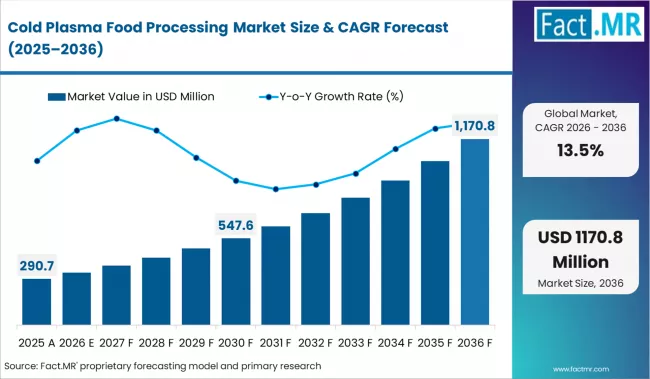
Cold Plasma Food Processing Market Market Value Analysis | Source: Fact.MR
Summary of the Cold Plasma Food Processing Market
- Market Definition
- The market includes non-thermal food processing technologies that use ionized gas generated under controlled electrical conditions to reduce microbial contamination on food surfaces. Cold plasma systems operate at low temperature, enabling microbial inactivation, pesticide residue reduction, and packaging sterilization without significantly affecting product texture, taste, or nutritional composition. These technologies are applied across fruits, vegetables, meat, seafood, dairy products, ready to eat foods, and bakery products.
- Demand Drivers
- Increasing regulatory focus on food safety and reduction of microbial contamination across processing environments
- Rising demand for non thermal preservation technologies that maintain texture and nutritional properties of food products
- Expansion of advanced food processing infrastructure requiring efficient surface decontamination methods
- Growing requirement for chemical free sterilization methods supporting residue reduction across fresh produce and packaged foods
- Key Segments Analyzed
- Technology Type: Dielectric barrier discharge accounts for approximately 36% share due to compatibility with continuous processing environments
- Application: Food surface decontamination leads with nearly 28% share supported by microbial reduction requirements
- Food Category: Fruits and vegetables and ready to eat foods demonstrate strong adoption of non thermal processing technologies
- Geography: Asia Pacific shows relatively higher growth supported by modernization of food processing infrastructure
- Analyst Opinion at Fact MR
- Shambhu Nath Jha, Principal Consultant, Fact MR, opines, "In this updated edition of the Cold Plasma Food Processing Market report, industry participants will observe increased adoption of non thermal food safety technologies designed to improve microbial control efficiency. Cold plasma systems enable surface sterilization and shelf life extension without significant thermal exposure. Companies that strengthen plasma system engineering capabilities and integration compatibility with industrial processing lines are expected to maintain competitive positioning through 2036."
- Strategic Implications/Executive Takeaways
- Expand engineering capabilities supporting integration of plasma treatment systems into existing food processing lines
- Strengthen validation processes demonstrating microbial reduction efficiency across different food categories
- Improve system scalability supporting industrial throughput requirements across packaged food manufacturing environments
- Monitor regulatory compliance frameworks influencing adoption of non thermal food safety technologies
- Methodology
- Primary interviews conducted with food processing equipment manufacturers, plasma technology providers, and food safety specialists
- Desk research based on food engineering publications, company reports, regulatory guidelines, and technical datasets
- Market sizing derived using a hybrid approach combining bottom up equipment revenue analysis with top down technology adoption assessment
- Data validation performed through cross verification with food technology datasets and internal peer review aligned with Fact MR standards
Cold Plasma Food Processing Market
| Metric | Details |
|---|---|
| Industry Size (2026E) | USD 330 million |
| Industry Value (2036F) | USD 1,175 million |
| CAGR (2026 to 2036) | 13.5% |
Source: Fact.MR analysis. Updated Mar 27, 2026
A CAGR of 13.5% indicates transformational expansion, reflecting transition from pilot-scale validation to broader commercial deployment in food safety and surface decontamination applications. Growth momentum is supported by regulatory pressure to reduce chemical residues and improve pathogen control efficiency, while scaling constraints persist due to capital intensity of plasma systems, validation requirements across food categories, and integration complexity within existing processing lines.
China leads with a projected CAGR of 15.1%, supported by expansion of advanced food processing infrastructure and increasing focus on non-thermal microbial reduction technologies. India follows with a CAGR of 14.6%, driven by growing adoption of surface decontamination systems across fruit, vegetable, and ready-to-eat food processing units. The United States records a CAGR of 13.2%, reflecting steady integration of plasma-based sterilization technologies within packaged food safety operations. Germany shows a CAGR of 12.4%, supported by continuous investment in precision food processing equipment and contamination control systems. Japan records the slowest growth at 11.8%, reflecting a mature market where demand is largely tied to replacement cycles of existing non-thermal processing equipment. Mature markets generate a significant share of replacement demand as technology upgrades remain focused on processing efficiency, shelf life extension, and regulatory compliance across industrial food safety systems.
Segmental Analysis
Cold Plasma Food Processing Market Analysis by Technology Type
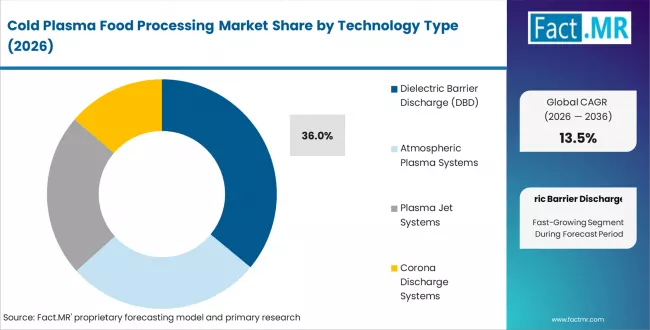
Cold Plasma Food Processing Market Analysis By Technology Type | Source: Fact.MR
- Market Overview: Based on Fact MR assessment, dielectric barrier discharge (DBD) technology is projected to account for 36% share of the cold plasma food processing market in 2026. DBD plasma systems are incorporated across non-thermal food treatment processes requiring controlled microbial reduction without structural degradation of heat-sensitive food matrices. Electrical discharge generated between insulated electrodes produces reactive species capable of reducing microbial load across fresh produce, meat surfaces, and packaging materials. Processing compatibility with atmospheric pressure operation supports integration into existing food production lines requiring minimal modification to mechanical handling systems.
- Demand Drivers:
- Non Thermal Processing Requirements: DBD plasma treatment supports microbial inactivation without exposure to high temperature conditions affecting texture integrity of fresh food products.
- Surface Treatment Precision: Controlled plasma discharge supports targeted decontamination across irregular food surfaces including fruits, vegetables, and protein-based products.
- Equipment Integration Compatibility: Atmospheric pressure plasma systems are incorporated into conveyor based processing environments requiring continuous treatment cycles across high throughput food manufacturing operations.
Cold Plasma Food Processing Market Analysis by Application
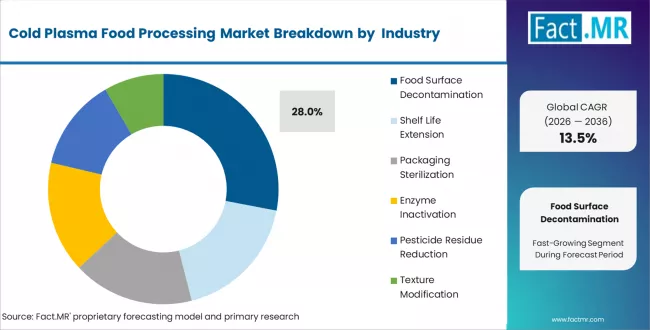
Cold Plasma Food Processing Market Analysis By Application | Source: Fact.MR
- Market Overview: Food surface decontamination is estimated to hold 28% share of the cold plasma food processing market in 2026, supported by increasing requirement for microbial reduction across fresh and minimally processed food categories. Plasma generated reactive oxygen and nitrogen species interact with bacterial cell membranes enabling reduction of pathogen presence across exposed food surfaces. Application deployment is observed across fresh produce washing lines, meat processing environments, and packaging sterilization stages requiring controlled reduction of contamination risk prior to distribution.
- Demand Drivers:
- Microbial Load Reduction Requirements: Food processors apply plasma treatment to reduce presence of pathogens associated with surface contamination across perishable food products.
- Shelf Stability Support: Surface level microbial control contributes to maintenance of product quality parameters across refrigerated distribution environments.
- Process Line Compatibility: Plasma treatment units are configured for integration into existing production workflows supporting continuous food handling and packaging preparation stages.
Key Dynamics
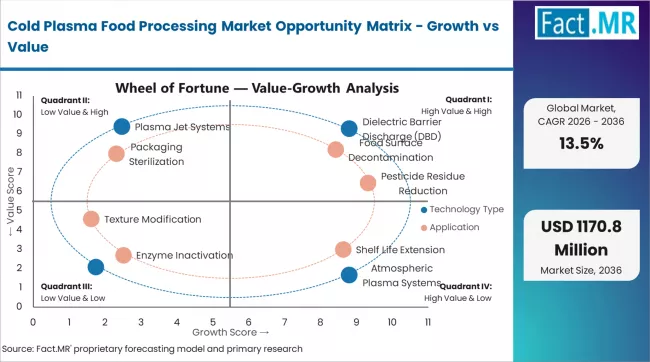
Cold Plasma Food Processing Market Opportunity Matrix Growth Vs Value | Source: Fact.MR
Cold Plasma Food Processing Market Drivers, Restraints, and Opportunities
Fact MR analysis indicates that the cold plasma food processing market developed from non-thermal food preservation technologies designed to reduce microbial contamination without high heat exposure. Early adoption was concentrated in laboratory-scale sterilization systems where plasma-generated reactive species enabled surface decontamination of food materials. The current market valuation reflects gradual industrial integration across fruits, vegetables, meat, and packaged food processing where cold plasma systems extend shelf life and reduce pathogen load. Demand persists because non-thermal processing maintains product texture and nutritional composition while supporting microbial safety requirements.
A structural shift is occurring as conventional thermal pasteurization and chemical decontamination methods face limitations in preserving fresh-like product characteristics. Heat-based sterilization remains widely used in high-volume processing where established infrastructure supports cost efficiency. Cold plasma systems require specialized equipment capable of generating dielectric barrier discharge, plasma jets, or corona discharge under controlled atmospheric conditions. These systems involve higher capital investment due to equipment integration and validation requirements. Even with moderate adoption across industrial food processing facilities, higher equipment pricing and specialized installation support gradual market value expansion.
- Non Thermal Preservation: Food processors deploy cold plasma systems to reduce microbial contamination while maintaining texture and nutritional properties in fresh and minimally processed foods.
- Food Safety Validation: Regulatory frameworks such as U.S. Food and Drug Administration food processing safety guidelines and European Food Safety Authority novel food evaluation procedures influence approval pathways.
- Asia Processing Adoption: China, Japan, and South Korea maintain active research and pilot-scale deployment of plasma-based food processing technologies.
Regional Analysis
The cold plasma food processing market is assessed across North America, Europe, Asia Pacific, Latin America, and Middle East & Africa, segmented by country-level adoption of non-thermal processing technologies, food safety compliance requirements, and industrial sterilization applications. Regional demand reflects microbial decontamination needs, shelf-life enhancement techniques, and processing efficiency improvements. The full report offers market attractiveness analysis.
.webp "Top Country Growth Comparison Cold Plasma Food Processing Market Cagr (2026 2036)")
Top Country Growth Comparison Cold Plasma Food Processing Market Cagr (2026 2036) | Source: Fact.MR
| Country | CAGR (2026-2036) |
|---|---|
| China | 15.1% |
| India | 14.6% |
| United States | 13.2% |
| Germany | 12.4% |
| Japan | 11.8% |
Source: Fact.MR analysis. Updated Mar 27, 2026
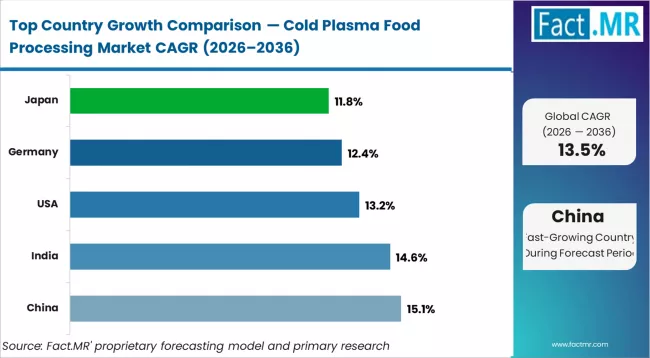
Cold Plasma Food Processing Market Cagr Analysis By Country | Source: Fact.MR
Source: Fact MR analysis, based on proprietary forecasting model and primary research
North America
North America functions as the advanced food safety technology and non-thermal processing innovation hub, supported by strong regulatory compliance and food sterilization research. Nordson Corporation maintains a strong position in plasma processing systems. Apyx Medical Corporation expands plasma-based treatment solutions. Advanced Plasma Solutions, Inc. supports industrial plasma applications.
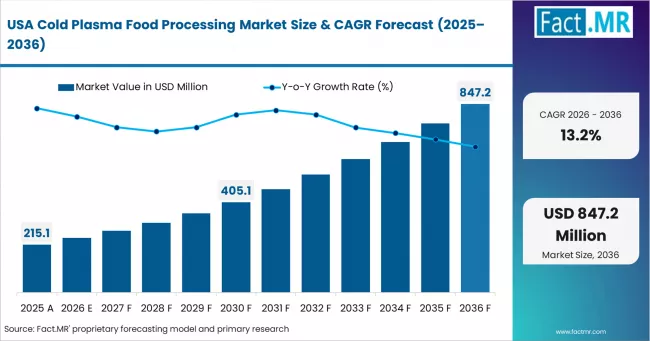
Cold Plasma Food Processing Market Country Value Analysis | Source: Fact.MR
- United States: Demand for cold plasma food processing in United States is projected to rise at 13.2% CAGR through 2036. Growth is supported by Food Safety Modernization Act guidelines (U.S. FDA, ongoing), governing microbial control technologies. Advanced Plasma Solutions, Inc. expanded cold plasma treatment capabilities (March 2023), supporting food safety applications.
Europe
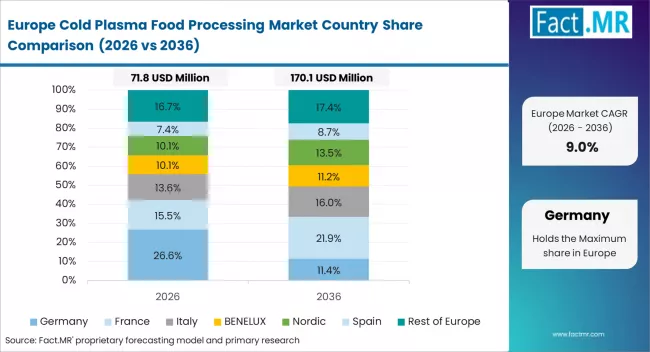
Cold Plasma Food Processing Market Europe Country Market Share Analysis, 2026 & 2036 | Source: Fact.MR
Europe operates as the regulatory and food processing innovation base, shaped by strict hygiene compliance standards and advanced food technology adoption. PVA TePla AG supports plasma-based treatment systems. PlasmaTreat GmbH expands atmospheric plasma processing technologies. Neoplas Med GmbH strengthens cold plasma application development.
- Germany: Demand for cold plasma food processing in Germany is projected to rise at 12.4% CAGR through 2036. EU food hygiene regulations (European Commission, updated 2022) support advanced sterilization methods. PlasmaTreat GmbH expanded plasma-based food processing solutions (February 2023), supporting adoption.
Asia Pacific
Asia Pacific serves as the high-growth food processing technology and contamination control market, supported by expanding packaged food production and regulatory modernization. Henniker Plasma strengthens plasma system manufacturing capabilities. CINOGY System GmbH supports atmospheric plasma technology development. Europlasma NV expands industrial plasma applications.
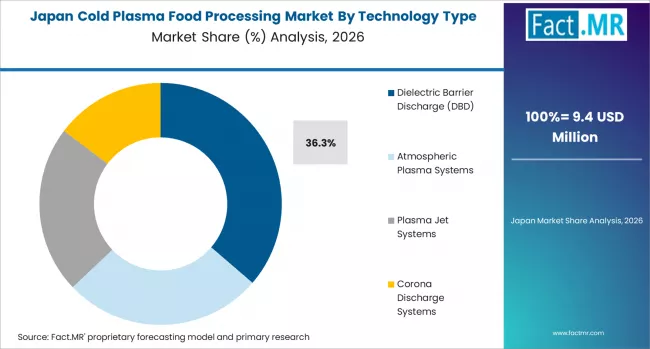
Cold Plasma Food Processing Market Japan Market Share Analysis By Technology Type | Source: Fact.MR
- China: Demand for cold plasma food processing in China is projected to rise at 15.1% CAGR through 2036. The National Food Safety Standard modernization initiatives (NHC, updated 2022) support advanced microbial control technologies. Henniker Plasma expanded plasma treatment systems for food applications (April 2023), supporting market growth.
- India: Demand for cold plasma food processing in India is projected to rise at 14.6% CAGR through 2036. The Food Safety and Standards Authority of India hygiene standards (updated 2022) support adoption of advanced food processing technologies. CINOGY System GmbH expanded plasma-based processing solutions (May 2023), supporting domestic adoption.
- Japan: Demand for cold plasma food processing in Japan is projected to rise at 11.8% CAGR through 2036. The Food Sanitation Act updates (Ministry of Health, Labour and Welfare, revised 2021) support advanced food safety processing systems. Europlasma NV expanded plasma-based sterilization technologies (January 2023), supporting market demand.
Fact MR's analysis of cold plasma food processing market in global regions consists of country-wise assessment that includes China, India, United States, Germany, and Japan. Readers can find non-thermal processing trends, food safety technology adoption patterns, regulatory developments, and competitive positioning across key markets.
Competitive Landscape
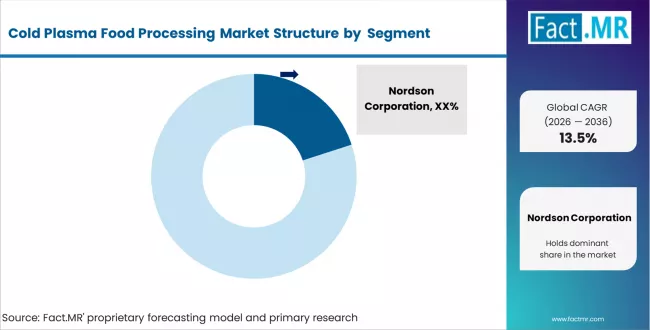
Cold Plasma Food Processing Market Analysis By Company | Source: Fact.MR
Competitive Structure and Buyer Dynamics in the Cold Plasma Food Processing Market
The competitive structure of the Cold Plasma Food Processing Market is moderately fragmented, with specialized plasma technology companies and industrial equipment providers participating in system development and commercialization. Companies such as Nordson Corporation, PVA TePla AG, PlasmaTreat GmbH, Enercon Industries, and Henniker Plasma maintain strong positions through established expertise in surface treatment and plasma generation technologies. These firms supply atmospheric plasma systems and dielectric barrier discharge equipment used for food surface decontamination and shelf life improvement. Additional participants including Neoplas Med GmbH, CINOGY System GmbH, Apyx Medical, Advanced Plasma Solutions, and Europlasma NV contribute through specialized plasma processing technologies and application focused system designs. Competition is primarily influenced by treatment efficiency, system scalability, operational reliability, and compatibility with food processing lines.
Several companies maintain structural advantages through proprietary plasma generation technologies and established industrial engineering capabilities. Firms such as Nordson Corporation and PVA TePla AG benefit from experience in plasma system manufacturing and integration with industrial processing equipment. PlasmaTreat GmbH and Enercon Industries maintain advantages through application specific engineering expertise in atmospheric plasma treatment systems. Food processors typically evaluate multiple equipment providers before adopting plasma processing technologies to ensure compatibility with existing production lines. Procurement decisions assess equipment performance, regulatory compliance, and long term operational reliability. This purchasing behavior moderates supplier pricing leverage across the market. Providers with specialized plasma engineering capabilities and established industrial installation experience retain moderate negotiating influence within emerging food processing technology deployments.
Key Players of the Cold Plasma Food Processing Market
- Nordson Corporation
- PVA TePla AG
- Henniker Plasma
- Enercon Industries
- Neoplas Med GmbH
- CINOGY System GmbH
- Apyx Medical
- Advanced Plasma Solutions
- Europlasma NV
- PlasmaTreat GmbH
Bibliographies
- [1] World Health Organization / Joint Expert Group on Food Processing Technologies. (2023). Cold plasma technology in food safety: Regulatory review and safety assessment framework. WHO-FAO. Retrieved March 24, 2026.
- [2] U.S. Food and Drug Administration. (2024). Food Contact Notification authorizations: Cold plasma systems for food contact surfaces and packaging treatment. U.S. FDA. Retrieved March 24, 2026.
- [3] Food and Chemical Toxicology / Review Series. (2024, December 31). Versatile dielectric barrier discharge (DBD) cold plasma for food safety: Microbial decontamination, pesticide residue removal, and quality preservation. ScienceDirect, 123(C), 109876. Retrieved March 24, 2026.
- [4] Critical Reviews in Food Science and Nutrition. (2023, February 15). Cold plasma treatment advancements in food processing and safety: Non-thermal preservation of fruits, vegetables, and low-moisture foods. PMC, 63(11), 1-21. Retrieved March 24, 2026.
- [5] Postharvest Biology and Technology. (2022, December 31). Application of cold plasma for fresh produce quality and shelf-life extension: Surface decontamination and ripening delay in climacteric fruits. Elsevier, 195, 1-10. Retrieved March 24, 2026.
This Report Addresses
- Market size estimation and revenue forecasts for the Cold Plasma Food Processing Market from 2026 to 2036, supported by non-thermal food safety technology adoption trends and industrial sterilization equipment deployment benchmarks.
- Growth opportunity mapping across dielectric barrier discharge systems, atmospheric plasma systems, plasma jet systems, and corona discharge technologies applied in food surface decontamination, shelf-life extension, and packaging sterilization processes.
- Segment and regional revenue forecasts covering food categories, technology types, application areas, and major processing markets including China, India, United States, Germany, and Japan.
- Competition strategy assessment of leading companies such as Nordson Corporation, PVA TePla AG, PlasmaTreat GmbH, Henniker Plasma, and Enercon Industries, including plasma engineering capability benchmarking and industrial processing integration analysis.
- Regulatory impact analysis covering U.S. Food and Drug Administration food safety frameworks, European Food Safety Authority processing guidelines, and global hygiene compliance standards influencing non-thermal processing technology adoption.
- Market report delivery in PDF, Excel, PPT, and interactive dashboard formats designed for food technology investment evaluation, equipment procurement planning, and processing efficiency benchmarking.
- Supply chain vulnerability assessments examining equipment capital intensity, validation requirements across food categories, integration complexity within processing lines, and competition from thermal and chemical sterilization technologies influencing commercialization pace.
Cold Plasma Food Processing Market Definition
The Cold Plasma Food Processing Market includes technologies that use ionized gas at low temperature to treat food products for microbial reduction and surface decontamination. Cold plasma is generated by applying electrical energy to gases, creating reactive species that interact with microorganisms without exposing food to high heat. This process helps maintain product quality while reducing contamination risks. Cold plasma systems are used in treatment of fruits, vegetables, meat, seafood, and packaged foods. The primary function of cold plasma processing is to improve food safety and extend shelf stability without significant thermal impact on product characteristics.
Cold Plasma Food Processing Market Inclusions
This report covers global and regional market sizes for cold plasma food processing technologies with forecast analysis for the study period. The market is segmented by technology type including dielectric barrier discharge systems, atmospheric plasma systems, plasma jet systems, and corona discharge systems. Application segments include food surface decontamination, shelf life extension, packaging sterilization, enzyme inactivation, pesticide residue reduction, and texture modification. End users include food processing companies, packaging manufacturers, and food technology providers. The report also evaluates pricing trends, technology adoption patterns, and selected trade flow analysis across major food processing equipment markets.
Cold Plasma Food Processing Market Exclusions
The report excludes traditional thermal food processing technologies such as pasteurization, sterilization, and irradiation methods. Chemical based food preservation techniques are not included. The scope also excludes laboratory research equipment used for experimental plasma studies without commercial food processing applications. Packaging materials not treated with plasma technology are outside the defined market scope, as the analysis focuses strictly on cold plasma technologies applied to food processing and safety enhancement.
Cold Plasma Food Processing Market Research Methodology
- Primary Research: Interviews were conducted with food processing equipment manufacturers, food technology specialists, research scientists, and processing facility operators.
- Desk Research: Public information was collected from food technology publications, company reports, research papers, and industry data sources.
- Market-Sizing and Forecasting: A hybrid model combining bottom up equipment revenue analysis with top down demand assessment across food processing sectors was applied.
- Data Validation and Update Cycle: Findings were cross verified using multiple industry data sources and expert inputs, with periodic updates conducted as new market information becomes available.
Segmentation
Report Scope
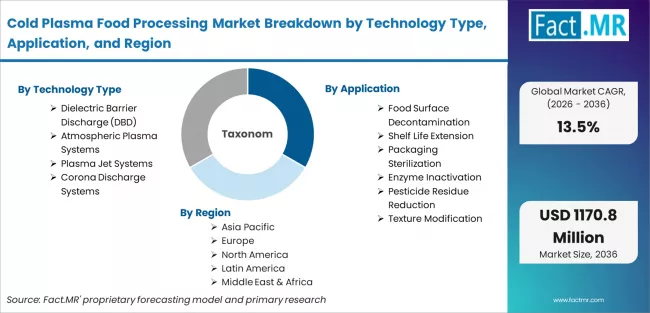
Cold Plasma Food Processing Market Breakdown By Technology Type, Application, And Region | Source: Fact.MR
| Metric | Value |
|---|---|
| Quantitative Units | USD 330 million (2026) to USD 1,175 million (2036), at a CAGR of 13.5% |
| Market Definition | The cold plasma food processing market includes global deployment of non-thermal plasma technologies used to improve microbial safety, extend shelf life, and modify surface properties of food products without significant heat exposure. |
| Food Category Segmentation | Fruits & vegetables, Meat & poultry, Dairy products, Seafood, Ready-to-eat foods, Bakery products |
| Technology Type Segmentation | Dielectric barrier discharge (DBD), Atmospheric plasma systems, Plasma jet systems, Corona discharge systems |
| Application Segmentation | Food surface decontamination, Shelf-life extension, Packaging sterilization, Enzyme inactivation, Pesticide residue reduction, Texture modification |
| Regions Covered | North America, Latin America, Europe, East Asia, South Asia, Oceania, Middle East and Africa |
| Countries Covered | United States, Canada, Mexico, Brazil, Argentina, Germany, France, United Kingdom, Italy, Spain, China, India, Japan, South Korea, Netherlands, Switzerland, Australia, and 40+ countries |
| Key Companies Profiled | Nordson Corporation, PVA TePla AG, Henniker Plasma, Enercon Industries, Neoplas Med GmbH, CINOGY System GmbH, Apyx Medical, Advanced Plasma Solutions, Europlasma NV, PlasmaTreat GmbH |
| Forecast Period | 2026 to 2036 |
| Approach | Hybrid top-down and bottom-up market estimation based on food safety technology adoption trends, equipment installation benchmarking, processing throughput analysis, regulatory compliance requirements, and validation through primary interviews with food processing technology providers and industrial equipment manufacturers. |
Source: Fact.MR analysis. Updated Mar 27, 2026
Cold Plasma Food Processing Market Key Segments
-
Food Category :
- Fruits and Vegetables
- Meat and Poultry
- Dairy Products
- Seafood
- Ready to Eat Foods
- Bakery Products
-
Technology Type :
- Dielectric Barrier Discharge (DBD)
- Atmospheric Plasma Systems
- Plasma Jet Systems
- Corona Discharge Systems
-
Application :
- Food Surface Decontamination
- Shelf Life Extension
- Packaging Sterilization
- Enzyme Inactivation
- Pesticide Residue Reduction
- Texture Modification
-
Region :
- North America
- USA
- Canada
- Mexico
- Europe
- Germany
- UK
- France
- Italy
- Spain
- Nordic Countries
- BENELUX
- Rest of Europe
- Asia Pacific
- China
- Japan
- South Korea
- India
- Australia
- Rest of Asia Pacific
- Latin America
- Brazil
- Argentina
- Rest of Latin America
- Middle East and Africa
- Kingdom of Saudi Arabia
- United Arab Emirates
- South Africa
- Rest of Middle East and Africa
- Other Regions
- Oceania
- Central Asia
- Other Markets
- North America
Frequently Asked Questions
How large is the demand for Cold Plasma Food Processing in the global market in 2026?
What will be the market size of Cold Plasma Food Processing in the global market by 2036?
What is the expected demand growth for Cold Plasma Food Processing in the global market between 2026 and 2036?
Which company is identified as a leading technology provider in the Cold Plasma Food Processing market?
Which technology type is projected to dominate Cold Plasma Food Processing adoption by 2026?
Why is dielectric barrier discharge technology widely used in cold plasma food processing?
What is driving demand for Cold Plasma Food Processing technology in China?
What is the growth outlook for the Cold Plasma Food Processing market in China?
Why is India an emerging market for cold plasma food processing systems?
What is the growth outlook for the Cold Plasma Food Processing market in India?
How is demand for Cold Plasma Food Processing evolving in the United States?
What is the growth outlook for the Cold Plasma Food Processing market in the United States?
What is the growth outlook for the Cold Plasma Food Processing market in Germany?
How is Japan positioned in the Cold Plasma Food Processing market?
What is the growth outlook for the Cold Plasma Food Processing market in Japan?
What is cold plasma food processing and what is it mainly used for?
What does the Cold Plasma Food Processing market include in this report?
What applications are included in the scope of the Cold Plasma Food Processing market?
What is excluded from the scope of the Cold Plasma Food Processing market report?
What does market forecast mean in the Cold Plasma Food Processing market report?
How is the Cold Plasma Food Processing market forecast developed in this report?
What does primary validation indicate in the Cold Plasma Food Processing market analysis?
Who worked on this report


Preview the report firsthand - request a free sample
Free SampleGet the brochure for pricing and purchase details
Download PDF